A Crisis Of Identity: When Global Elites Forget How To Be Patriotic

global-elite

The global, liberal elite are increasingly transcending any lingering commitment to patriotism and national identity, setting them on a collision course with the small-c conservative majority

Michael Lind has an unmissable essay in the National Review this week, entitled “The Open-Borders ‘Liberaltarianism’ of the New Urban Elite“, which manages to explain so much about the rise of Donald Trump and the growing inability of political elites in America and Britain to speak to whole swathes of the country they supposedly control.

The crux of Lind’s argument seems to be that the educated, liberal (to use American parlance) inhabitants of the large cities have increasingly taken on what were always fringe libertarian ideas about open borders and the irrelevance or undesirability of the nation state, leading them to pursue policies and espouse values which alienate the more suburban and rural population.

Key quote:

To date, the public conversation on both sides of the Atlantic has been dominated almost entirely by the elite inhabitants of Densitaria, interrupted only by occasional populist revolts such as the Trump phenomenon or the Brexit vote. In a relatively short period of time, a new elite ideology has emerged that contrasts the dynamic, multicultural, libertarian city-state with the allegedly anachronistic and immoral nation-state. This ascendant worldview unites the open-borders economics and cosmopolitan, utilitarian morality of old-fashioned libertarianism with an idealization of the largest cities and their denizens.

In the 1970s and 1980s, libertarians made all of the major arguments heard from globalists since the 1990s: Favoring citizens over foreign nationals is the equivalent of racism; national borders impeding the free flow of labor and goods are both immoral and inefficient; the goal of trade and immigration policy should not be the relative security or relative wealth of particular countries, but the absolute economic well-being of all human beings.

Until the 1990s, this was an eccentric minority perspective in the U.S. and other democracies, encountered only in small-circulation libertarian journals or in the work of the occasional unworldly academic theorist of cosmopolitan ethics. But in the 2000s, as affluent whites from the professional class and their Latino, immigrant, and black allies displaced working-class whites as the base of the Democratic party, the traditional labor-liberal opposition to low-wage immigration and offshoring of industry was replaced by a new open-borders progressivism distinguishable from traditional libertarianism only by its unworkable combination of support for unrestricted immigration with a generous national welfare state.

This certainly accounts for one of the main reasons behind the Labour Party’s civil war in Britain – from the Blair era onward, Labour has been entirely captured by the open-borders progressives and increasingly turned its back on its former working class voter base. Even under the current Labour leadership election, both candidates hold open borders convictions to their core, even if only Owen Smith is stupid enough to rant about overturning the EU referendum result in public.

It also accounts for the increasing public rage (among non-progressives) about immigration in America, where the Democrats are proud and unrepentant in their support for illegal immigration while the Republicans have talked a tough talk for decades yet done nothing, precisely because the Republican political elites benefit from the current immigration status quo as much as anyone. Enter Donald Trump to an arena where nobody else is even seriously talking about the impact of mass immigration on wages and cultural cohesion, and one cannot be surprised when his crude, simplistic solutions gain political traction.

More:

The combination of open-borders “liberaltarianism” and trendy urbanist hype might lead one to wonder whether leagues of dynamic city-states should replace moribund modern nation-states. Benjamin Barber has published a book titled If Mayors Ruled the World: Dysfunctional Nations, Rising Cities. Barber is one of the founders of the Global Parliament of Mayors, which, according to his website, can help “fill the void left by nation states who [sic] are increasingly dysfunctional.” The economist Paul Romer has proposed boosting Third World development by means of semi-autonomous “charter cities,” which to his critics look remarkably like Western colonial enclaves.

Not even Barber and Romer propose actual urban independence. While cities may teach one another best practices, there is not the slightest chance that leading American cities will secede from the United States, link up with other city-states around the world, and form a new, global version of the Hanseatic League or the Delian League.

We saw the same loose talk after the EU referendum vote, with many Londoners (most of whom have no conception of what the EU really is or how it works) furious at having part of their cosmopolitan identity ripped away from them (as they see it) suggesting that London should somehow secede from the rest of the “backward” United Kingdom and become its own independent city state.

Of course this would never actually happen, but it shows just how disconnected the metropolitan elites are becoming from the country as a whole, and the sheer contempt with which they regard other regions which dared to express their patriotism and belief in self-determination by voting for Brexit. It is also misplaced arrogance of the worst sort – the lights would go out and people would begin to starve in London within days were it not for the arterial links of people and goods from the supposedly terrible and backward rural and suburban regions.

And it is this continual feeling of disrespect, I think, which does so much to drive populist insurgencies like the rise of Donald Trump, and (if I am honest) even those populist causes that I actually agree with, like Brexit. People in the industrial and commuter heartlands, as well as rural folk, are getting increasingly sick of being told that they are too backward, too intolerant, too racist, that their own priorities and concerns do not matter and that they should be led in all regards by an urban elite who don’t even seem terribly attached to the country that gives them life and liberty, and who find the slightest display of national pride or patriotism almost painfully embarrassing.

I’m fortunate. I got into a good university and managed to embark on a career which has seen me work in numerous countries across three continents. But if this had not been the case – if, like many of my peers, an international business career was either never on the cards or simply not what I wanted to do – then I would probably be quite put out by people whose interest and commitment to any one country seems transitory at best telling me what I should think about immigration, global governance and democracy.

Now living in remain-voting West Hampstead, I am surrounded by the kind of people who are aghast at the Brexit vote and who consider it a calamity brought down upon the heads by the kind of ignorant, unwashed oiks whom they would never normally speak to unless they were fixing their car or serving them a burger. I can see how it must grate with Middle England, because it grates with me.

Lind goes on to touch on this point:

What appears to be a debate among globalists and nationalists, then, is really a debate about the structure of the 21st-century nation-state. There are real dangers associated with the coalescing elite ideology of post-national globalism or, to be precise, national-elite pseudo-globalism.

One danger is groupthink resulting from the attempt by the new globalists to equate even enlightened and civic nationalism with racism. When the economist Larry Summers, nobody’s idea of a pitchfork-waving populist, tentatively called for “responsible nationalism,” he was criticized by The Economist, whose open-borders libertarianism, once eccentric, has become near-orthodoxy among the trans-Atlantic elite.

And closes with this stark warning:

The most significant threat is the possibility that the abandonment of national patriotism by many elite citizens of the nation-state for make-believe cosmopolitanism will weaken national unity, to the benefit of sub-national racism, ethnocentrism, and regionalism. The loyalties that succeed national solidarity are likely to be narrower, not broader. If history is any guide, the victims of tribalism and illiberal populism are likely to include would-be citizens of the world who despise the nation-states that make possible not only their wealth but also their security.

Absolutely. This blog has been banging on for years about the continued importance of the nation state as the final guarantor of most of our most precious rights and freedoms. But the nation state is also, in the democratic age, a relatively harmless way of allowing people to feel and express a sense of belonging and community pride without tipping over into other, much darker expressions of identity.

Those weepy europhiles mourning Britain’s imminent departure from the EU because they consider themselves “European citizens” might want to pause and think through the consequences of further undermining the nation state, which is the primary aim of their beloved project. Because enlightened, one-world government is a few centuries away yet, and whatever crops up to replace the nation state that they so eagerly undermine will likely be unpleasant, even violent.

And while it may not be purely libertarian, this blog would much rather live in a world of moderate, familiar nationalist rivalry than descend into the known horrors of ethnic or religious sectarianism. We already see the early fruits of this blinkered commitment to “multiculturalism” in self-segregated and un-policed communities here in Britain among certain immigrant populations. We don’t need to extend those delights to the entire population.

What is the solution? Michael Lind does not offer one, and this blog does not see an easy fix either. But when global elites (Davos Man and the like) and the next tier down (those with international lives and careers) have more in common with each other than with those of other socio-economic groups and communities in their own countries, it is a recipe for political alienation and the eventual fracturing of our civic life.

To avoid disaster and a true crisis of democracy, our ruling elites in the political and commercial sphere must somehow learn to be patriotic again – for if the nation state has no champions it will go on being relentlessly undermined on all fronts. But right now there is little evidence that they are remotely interested in bridging the growing chasm between their own interests and those of the people they supposedly “serve”.

This leaves the field wide open for the likes of Donald Trump and UKIP 3.0 to make inroads with voters left cold by the other options available to them. And the time may soon come when the political elites sorely regret ceding this territory.

 

globalism-versus-culture

Bottom Image: Stefan Molyneux, Globalism versus Culture

Support Semi-Partisan Politics with a one-time or recurring donation:

Agree with this article? Violently disagree? Scroll down to leave a comment.

Follow Semi-Partisan Politics on TwitterFacebook and Medium.

A Strong, Christian Case For The Nation State (And Against The European Union)

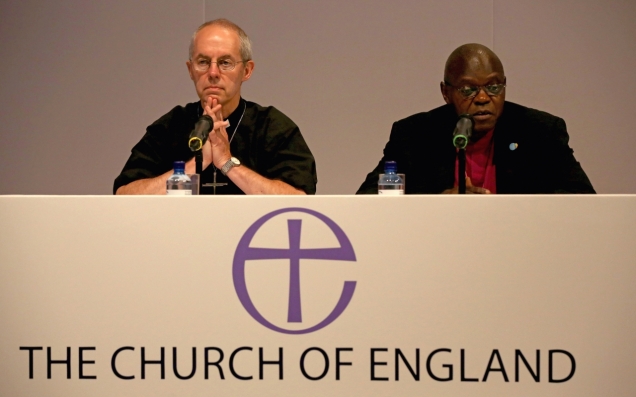
Justin Welby - John Sentamu - Archbishops - Church of England - EU Referendum - European Union - Brexit - Remain

Here is an intellectually robust, theologically rooted argument in support of the nation state and against the European Union. Why are Christian EU apologists unable to produce a similarly heavyweight case of their own, instead of relying on woolly platitudes about ‘togetherness’ and ‘co-operation’?

The Reimagining Europe blog has just published a serious intellectual (and even theological) but highly readable case for the continuance of the nation state, and criticism of those who suggest that the age of supranational government is either logical, inevitable or a goal to which Christians should aspire.

While I do not agree with every single nuance of the argument put forward by Nigel Biggar (Regius Professor of Moral and Pastoral Theology at Christ Church college, Oxford) the overall thrust of his argument is quite unimpeachable. It certainly is rooted in a far deeper reading of scripture and theological analysis than the glib statements of support for the European Union and Remain campaign from Archbishops John Sentamu and Justin Welby.

Biggar begins:

Thirty years ago I was told by a senior Anglican clergyman that the nation-state was passé. I can’t remember why he thought as he did, but I do remember that his conviction was a fashionable one. Quite why it was fashionable isn’t clear to me now. The mid-1980s were too early for globalisation’s transfer of power from national governments to free global markets and transnational corporations to have become evident. Perhaps it was the recent entry of an economically ailing and politically strife-torn Britain into the arms of the European Economic Community that made the nation-state’s days look so numbered. And, of course, the Cold War, which would not thaw until 1989, made international blocs look like a monolithic fact of global political life.

Finally, someone raises the historical context of Britain’s entry into the EEC in their Christian argument about the EU referendum. Good. Nothing can be understood without understanding the history and purpose of the European Union, but also the circumstances which led Britain to join in the first place. For if those circumstances (global obsolescence and lack of a “role”, economic decline, industrial strife, the very real risk of being ejected from what Michael Moore might call the “Premier League” of nations) are no longer present, why on earth would we now wish to stay, given all of the EU’s manifold flaws and failings?

Biggar goes on to discuss differing national attitudes toward being a quasi-autonomous member of a larger supranational grouping:

But there’s another, historically deeper reason. This was graphically impressed upon me during a visit to last year’s exhibition at the British Museum, “Germany: Memories of a Nation”. (I’d strongly recommend the book, by the way.) One of the exhibits was a map of north-western Europe in the mid-18th century, on which were superimposed the coinages current in Germany and Britain at the time. In Britain, there was one coin; in Germany, about sixty. Britain was a unitary state; Germany a territory with a common language, but comprising dozens of different kingdoms and principalities.

And here’s where being both German and Roman Catholic comes into play. For the dozens of mini-states in mid-18th century Germany were the vestiges of the multinational, Catholic, Holy Roman Empire, which the Protestant Reformation had helped to destroy. For Roman Catholics, especially on the European continent, and especially in Germany, the notion of a federation of states, sharing a broadly common culture and subject to a transcendent, quasi-imperial authority seems a perfectly natural condition.

Not so for the English, who have inhabited a nation-state whose basic structures span a thousand years, and whose history has taught them to fear the concentration of continental power. It’s no accident, therefore, that one can find in Anglican thought a marked tendency, from F. D Maurice in the mid-19th century to Oliver O’Donovan now, to affirm the existence of a plurality of independent nations, whose external relations are governed by international law rather than a supranational state.

Quite so. The lived experience of Britons, and our national history, is simply too different to reconcile with that of continental Europe under the umbrella of an overarching set of political institutions. In some areas of Europe, particularly the disputed regions which have changed back forth between countries over centuries (think Alsace-Lorraine), people have a history of maintaining a cohesive identity almost separate to whichever nation happened to claim their territory at the time. There is no similar history in Britain (though one could argue that the experience of the non-England home nations within the UK comes closest).

The upshot is that there is precious little in our folklore, literature, art or indeed politics which well equips us to carry on functioning happily no matter which foreign king makes the key decisions, or from which city they may do so. We are not built for supranational rule – despite ourselves having presided over an empire which did exactly that, we have not been on the receiving end in a thousand years.

Biggar then gets biblical, something which too few of the most prominent Christian apologists for the European Union have been willing to do:

Christians tend to view the nation-state and so the prospect of a European federation differently, according to whether they are Roman Catholic or Protestant, and according to their historical experience. All Christians, however, are accountable to the Bible. What does it have to say about these matters?

On the one hand, the New Testament makes quite clear that a Christian’s affection and loyalty have to go beyond the nation. They have to transcend it. Primarily, they have to attach themselves to God and to His coming Kingdom or rule. This we read in the third chapter of the Epistle to the Philippians, where St Paul, having identified himself strongly with the Jewish nation—“a Hebrew of the Hebrews”—then firmly subordinates his Jewish identity to his loyalty to God in Christ:

“But whatever were gains to me I now consider loss for the sake of Christ. What is more, I consider everything a loss because of the surpassing worth of knowing Christ Jesus my Lord, for whose sake I have lost all things. I consider them rubbish, that I may gain Christ…. [O]ur citizenship”, he tells the Christians at Philippi, “is in heaven” (vv. 7-9, 20).

Taken at face value, it would seem that Paul is saying that Christian identity must obliterate and completely replace national identity. But Paul, I think, is speaking hyperbolically here; he’s exaggerating. In fact, he never entirely repudiated his Jewish identity, but rather sought to understand how his new-found loyalty to God in Christ could actually fulfil his original national loyalty.

Biggar is right to suggest that St Paul’s injunction to completely erase national identity is a rhetorical exaggeration. And it is certainly the case that if British Christians were indeed called to renounce their Britishness, there is absolutely no reason why they should then take up a European identity – if any passing allegiance to country is wrong, then allegiance to a supranational body which is actively trying to become a country in its own right is just as wrong.

As Jesus Himself said, “My kingdom is not of this world” (John 18:36). While we are indeed all brothers and sisters in Christ, it is made very clear to us that our common citizenship is at an embryonic stage in this temporal world, represented by the global Church, and that the nation to which we shall all one day belong is not one of Earth.

Biggar goes on to concede the transitory nature of nation states:

Against such idolatrous nationalism, Christians must refuse the claim that nations have an eternal destiny, and that their survival is an absolute imperative. Nations are in fact contingent, evolving, and transitory phenomena. They come and they go. The United Kingdom did not exist before 1707 (and could have ceased to exist this year, had the Yes campaign won the Scottish independence referendum.) The United States could have ceased to exist in the early 1860s. Czechoslovakia did cease to exist in 1993.

So a Christian cannot be a Romantic nationalist, idolatrously attributing an absolute value to any nation. That’s one part of the truth.

With this important counterpoint:

But there is another part. This is alluded to by St Paul’s continuing identification with the Jewish people. And it’s made explicit in the Old Testament, where the prophet Jeremiah addresses the Jews, who had been carried off into exile in Babylonia, after the sacking of Jerusalem in the year 586BC. This is what he says:

“This is what the Lord Almighty, the God of Israel, says to all those I carried into exile from Jerusalem to Babylon: “Build houses and settle down; plant gardens and eat what they produce. Marry and have sons and daughters; find wives for your sons and give your daughters in marriage, so that they too may have sons and daughters. Increase in number there; do not decrease. Also, seek the welfare of the city to which I have carried you into exile. Pray to the Lord for it, because if it prospers, you too will prosper (vv. 4-7).”

Though they are citizens of another country, though they are currently exiles in Babylon, the people of God should nevertheless “seek the welfare of the city”.

Why is this? The answer lies in our created nature as human beings. We are finite, not infinite; creatures, not gods. We come into being and grow up in a particular time, and if not in one particular place and community, then in a finite number of them. We are normally inducted into particular forms of social life by our family and by other institutions—schools, churches, clubs, workplaces, political parties, public assemblies, laws. These institutions and their customs mediate and embody a certain grasp of the several universal forms of human prosperity or flourishing—that is to say, the several basic human goods—that are given in and with the created nature of human being. It is natural, therefore, that we should feel special affection for, loyalty toward, and gratitude to those communities, customs, and institutions that have benefited us by inducting us into human goods; and, since beneficiaries ought to be grateful to benefactors, it is right that we should.

This is true – we do indeed feel special affection and loyalty toward communities, customs and institutions which give us utility. But we should be wary of where this particular strand of thought may lead us. For as we know, the European Union is particularly adept at “purchasing loyalty” by using funds raised from nation state taxpayers and sent to Brussels as EU membership fees to then bribe national citizens with their own money in the form of development spending or sponsorship of various arts and community projects.

Pete North warns about this very phenomenon with this brilliant observation:

The founding fathers were savvy in their design of le grande project. They always knew it could never be done all at once because the central vision would never secure a mandate. Integration by deception has always been the modus operandi. It salami slices powers little by little, so gradually that few ever notice. And you’d never see it unless you know what the game plan is. They were long term thinkers. They knew it would take a generation or so to advance their agenda and they had a roadmap to do it.

It has always used funding of local projects to manufacture consent. It’s why you’ll find EU logos emblazoned on any nature reserve or community hall or obscure museum out in the shires, to convince the plebs that their benevolent EU guardians cared more for them than the London government. It is why it funds universities too. Every strata of civil society has an injection of EU cash. Education, NGOs, you name it. And it works.

[..] The founding fathers always knew a day would come where the legitimacy of the EU would be questioned. And now you see how well their pernicious scheme worked, with the entirely of the civic establishment coming out in favour of remain. They have made idle supplicants of our institutions, robbing them of their vitality, curiosity and dynamism.

While Biggar is absolutely correct to make his point, defenders of the nation state must be careful that this is not then used as justification by EU apologists for the behaviour and existence of the EU – a kind of retroactive justification for unwanted supranational political union based on the wheedling claim that people like it when Brussels gives them back their own money.

Biggar’s conclusion is a resounding rejection of pessimism about the nation state and the ignorant embrace of the EU by many in leadership positions in the church, based only on the woolliest of Christian thinking (my emphasis in bold):

Of course, institutions at a national level are not the only ones that enable us to flourish as human beings, but they do remain among them; and they are still the most important. This is true, notwithstanding the easy illusion of global identity that today’s social media create. While international institutions such as the United Nations have developed since the Second World War, they haven’t replaced nation-states and don’t seem likely to do so any time soon. Indeed, the UN only has as much power as nation-states choose to give it. So the nation-state is here to stay for the foreseeable future, and it continues to have great power to shape the lives of individual human beings. Insofar as it has shaped our lives for the better, helping us to prosper, we owe it our gratitude and loyalty; insofar as it has mis-shaped our lives (or other people’s) for the worse, we owe it our commitment to reform. Either way, we owe it our attention and our care.

So, in sum, as I see it, the Bible teaches on the one hand that no nation-state deserves absolute loyalty. Every state is subject to the universal laws of God, of which it may fall foul and deserve criticism. On the other hand, Scripture implies that nation-states can, and should, and often do furnish the structures necessary for human flourishing. They cause us to prosper. Therefore, they deserve our loyal, if sometimes critical, care.

[..] In the age of global capitalism, they are less powerful than they used to be. And they have always been bound, more or less, to each other by need, by treaty, and by law. Nevertheless, nation-states remain the fundamental units in the international order, and the day when they will be superseded by a global state is nowhere in sight.

Nation-states are not in fact passé, and the Bible doesn’t tell us that they should be. What’s more, my German Catholic friend really shouldn’t argue for Britain’s remaining in the European Union on the ground that the age of the nation-state is over. Because, of course, a federal EU would be nothing other than a larger state, serving the newly self-conscious nation of Europeans, and able to hold its own against the United States on the one hand, and Russia and China on the other.

There may well be good reasons for Britain to remain in the E.U. But if that is so, the unchristian nature, or the obsolescence, of the nation-state is not one of them.

An intellectually rousing piece with a resoundingly clear conclusion – that the nation state, for all its flaws, has been the underwriter of our most fundamental freedoms and liberties for too long to carelessly cast it aside in the blinkered rush toward supranationalism.

Those with senior leadership positions within the church – I’m thinking here particularly of Archbishops John Sentamu and Justin Welby of the Church of England – are too intelligent not to know the history, purpose and inevitable future trajectory of the EU. Unlike the average man on the street, we need not extend to them the charitable assumption that they are simply ignorant on the matter – after all, our state church is about as deeply embedded in the British establishment as it is possible to be.

Therefore, when the likes of Justin Welby or John Sentamu argue that Britain should vote to remain in the EU in the coming referendum, they do so from a clear base of knowledge that this would mean our continued participation in a project whose ultimate direction has never wavered – the creation of a common European state. This means that they either want Britain to be part of this reckless European endeavour (though they are too dishonest to admit as much, perhaps believing it is their duty to mislead their congregations, who they consider too stupid to appreciate the necessity of political union), or they think that Britain can somehow flourish as a kind of “associate member” on the margins of an ever-tightening political union of the eurozone countries, in which our existing influence would be greatly diminished.

If it is the former, and the Archbishops are closet euro federalists who dare not declare their ultimate goal in public, then this is a truly reprehensible way for them to behave, advocating as they do a wishy-washy, hand-wringing argument for Remain based on economic fears rather than making their true political intentions clear. And if it is the latter, and they have convinced themselves that remaining on the margins of a steadily integrating European Union can do anything but marginalise us and diminish our presence on the world stage then their political judgement is bordering on the catastrophic – and only reinforces the case that the Church of England should be fully disestablished and severed from its anachronistic, unjustifiable constitutional role in the United Kingdom.

But here we have it – a muscular Christian case in support of the nation state, and implicitly against the European Union. Will we ever hear the equivalent pro-EU Christian case articulated so eloquently, or at such length? We have certainly seen nothing to date. In fact, the further up the church hierarchy the Christian EU apologists are found, the weaker and more insubstantial their arguments generally become.

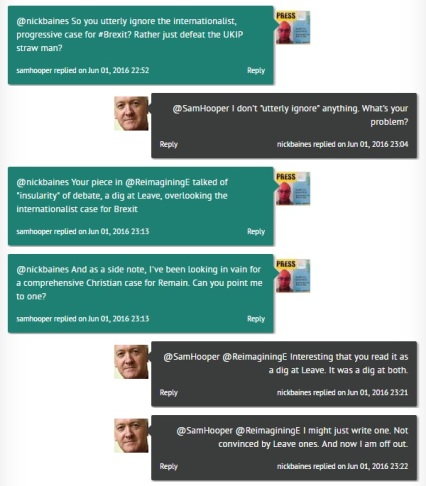
I recently had an exchange on Twitter with Nick Baines, the Anglican Bishop of Leeds, in which I questioned his description of the Leave campaign as “insular” and asked when we might expect a substantive Christian case in favour of the EU:

Bishop Nick Baines - Sam Hooper - EU Referendum - Brexit - Christian case for EU

Bishop Baines promised just such an article, but none has yet been forthcoming. Indeed, a clear, unambiguous and unapologetic Christian case in favour of the European Union and a Remain vote in the EU referendum can scarcely be heard, despite the weight of establishment Christianity coming down on the side of remaining in the EU.

This is untenable. If the bishops are to retain any kind of temporal authority – at least in my eyes – it is not enough to make wishy-washy statements vaguely supportive of the Remain campaign without any intellectual or theological legwork to back them up. This reeks of confirmation bias – of bishops, comfortably ensconced in the establishment, making up their minds that the EU is a good thing in advance, and then cherry picking facts to support their existing viewpoint.

A common Christian complaint is that our religion is being increasingly forced from the public square in this new secular age. And it is partly true – freedom of speech and religious expression are sometimes outrageously curtailed in this country. But participation in the public square comes with a price: if one wants to be heard and taken seriously, one must say sensible things and be prepared to back them up with a solid argument.

At present, too many bishops of the church are willing to sell out the public square and everything else in this country to Brussels, and do so without offering a sound argument for remaining in the European Union based on our knowledge of the nature, purpose and direction of the EU. The bishops believe that a sprinkling of glib words about “togetherness” and “co-operation”, mixed with some hand-wringing concerns about the short term economic impact of Brexit taken straight from the Remain camp’s playbook, amount to a sufficient case. But they do not.

Ideally, the bishops should come down unanimously on the right side of this issue. But since that is not going to happen, they should at least participate in the debate with a shred of honour. And if they arrogantly proceed with their current approach, preaching the Remain argument on the flimsiest of pretexts, then they should not be surprised if they cause the gates to the public square to be permanently locked to Christians.

And what a dismal legacy that will be.


Postscript: More on the Christian case for Brexit hereherehere and here.


European Union - United Kingdom - Britain - Flags

Top Image: New Statesman

Support Semi-Partisan Politics with a one-time or recurring donation:

Agree with this article? Violently disagree? Scroll down to leave a comment.

Follow Semi-Partisan Politics on TwitterFacebook and Medium.

The EU’s Undermining Of National Identity Creates A Space Where Islamist Extremism Freely Grows

Jean Claude Juncker - Manuel Vals - Brussels Attacks - European Union

Eroding national identities while forging an unwanted and unloved new European identity creates a dangerous gap, which Islamist extremists are now exploiting

There is a welcome glimmer of realisation in today’s New York Times that repeated attempts to artificially force political union on the disparate peoples of Europe (alternately by threat and by stealth) is leading to increasingly suboptimal outcomes.

Jochen Bittner writes:

Official Europe has worked hard to move past nationalism, so that there is no German or French Dream. But there’s no European Dream, either, not yet. So new migrants have no spirit to tap into, as they do in the United States. Instead, some Muslims find it more attractive to give their loyalty to Allah, their fellow believers or the Islamic State.

Intelligence services estimate that up to 6,000 jihadists from Western Europe have traveled to join the Islamic State. This enormous figure does not illustrate merely the failures of integration policy. It also shows the failure of mainstream European Muslims to keep their youth immune from extremism.

A result of this mutual apathy is too many Islamists, and too few police and intelligence officers — particularly in Belgium, but not just there. We may have a common European currency, but we still do not have a common European terrorism database. Islamists in Western Europe seem better coordinated than the European authorities hunting them.

There is a creeping awareness too that the head-in-the-sand insistence by many Western leaders that Islamist terror has “nothing to do with Islam” has been a textbook case of wishful thinking overriding political judgement, even common sense:

For the sake of social peace, after the Sept. 11 attacks, and later after the Madrid and London bombings, we told ourselves that Islam and Islamism had nothing to do with each other. But sadly, they do. The peaceful religion can sometimes serve as a slope into a militant anti-Western ideology, especially when this ideology offers a strong sense of belonging amid the mental discomfort of our postmodern societies.

That’s not to say that the article is right about everything. At one point it lapses back into the lazy, unthinking assertion that the European Union is solely responsible for keeping the peace since the Second World War:

So are Germany’s critics right? Is it reasonable to pull up the drawbridge?

In a way, the very question shows the disproportionality of the thought — unless you think it’s worth sacrificing 60 years of peace and international cooperation to the depredations of terrorists. It’s what they want; European disunity, confusion and extremism put them a step closer to the all-out war between Muslims and non-Muslims they so desperately seek.

The notion that the leaders of Islamic State – or radical jihadists in general – could give a hoot whether the Western European countries they so fervently loathe are grouped together under a single political umbrella or under their own auspices is ludicrous beyond words.

The home-grown radical Islamist terrorists from Belgium, Britain and France do not feel any allegiance to Europe or to their own particular country. Their only allegiance is to their warped strain of Islam, which teaches them to loathe anything and everything which does not conform to a very fundamentalist, conservative and specific worldview.

If anything, the European Union’s insistence on subordinating the national identities of individual member states in a thousand ways large and small, and attempting to shoehorn in an artificial new European identity which consistently fails to take root is primarily responsible for allowing a radical Islamist identity to creep in between the cracks.

If the European Union is the vehicle for international collaboration that its cheerleaders consistently claim, then it would focus on intergovernmental co-operation – for that is what will do the most good thwarting future terror attacks. But the EU doesn’t particularly care about co-operation between security services. Such matters are exquisitely boring to the architects and drivers of European political integration, who care only about creating a single European state.

Consider: if the European Union is a benign and non-threatening group of countries coming together to trade and solve common problems (like the threat of Islamist terrorism), why is such a tiny fraction of its budget – and an even smaller percentage of officials’ time – spent on enhancing intergovernmental co-operation so that agencies and forces work seamlessly together when they most need to?

No, the European Union has a flag, anthem and parliament for a reason – because those are the things that matter to them, the building blocks of political union. Sure, the EU’s leaders are happy to take advantage of the Brussels terror attacks – as they do with every other crisis – to declare that the only solution is “more Europe”. But the more Europe they have in mind won’t do a damn thing to thwart future terror attacks. It will only make them more likely.

Building a politically unified European state involves first dissolving existing national identities, and then replacing them with a new European identity commanding the loyalty and affection of the people. The EU has been moderately successful at the former, but absolutely hopeless at the latter. Staggeringly few people see themselves as European first and foremost – nearly all retain primary loyalty to their country, or in some cases to a region – like Scotland or the Basque region.

And as the nation state is undermined on one side while the vaunted new European identity consistently fails to materialise, this creates an ever widening gap which can be filled by Islamist extremist recruiters and terrorists. When there is no healthy sense of national identity, first and second generation immigrants may struggle to assimilate, and sometimes they will find meaning and belonging in undesirable places.

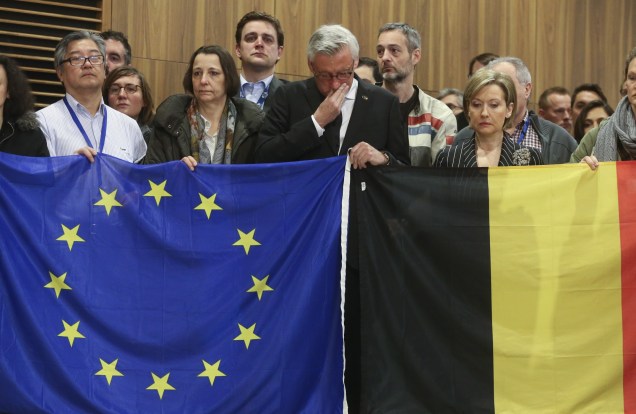
None of this should be shocking. Much of it was entirely predictable. But the European Union – who are now sickeningly claiming that they were the true victims of the attack, as though a self-important bureaucratic talking shop even registers on the Islamic State’s radar – refused to take the threat seriously, because it was too busy building up the appearance and trappings of a state.

Proper co-operation and coordination between national intelligence services does not require a European Parliament, a European Council, a flag, an anthem or pretensions on the world stage. If the EU really cared about keeping its citizens safe first and foremost, it could immediately deprioritise all further steps toward political integration, roll back its outsized role in supranational governance and focus on facilitating the kind of basic inter-governmental cooperation that might have feasibly prevented the Paris and Belgium attacks.

But of course the European Union will never do this in a million years. Because the EU has some other objective, far more important than trifling concerns over national security, on its agenda.

Now what could those other priorities possibly be?


Brussels Attacks - Je Suis Bruxelles

Agree with this article? Violently disagree? Scroll down to leave a comment.

Follow Semi-Partisan Politics on TwitterFacebook and Medium.