Labour And The Left Simply Do Not ‘Get’ Patriotism, And Their Patron Saints Holiday Proposal Proves It

UK Britain Patron Saints

The Labour Party’s genius plan to “unite the nation” by further Balkanising the United Kingdom

The Labour Party and the British Left in general just don’t get it. With the honourable exception of a few Cassandra-like voices warning that the Left must learn to re-embrace patriotism in order to reconnect with millions of lost voters, most on the Left seem intent on screeching “multiculturalism” at the top of their lungs until the United Kingdom (and even its constituent parts) are nothing more than historic entries in an encyclopaedia.

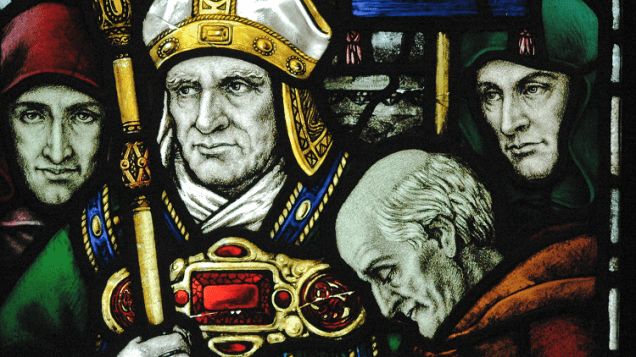
Labour’s latest great initiative is to create four new public holidays celebrating the individual patron saints of the four home nations. From the HuffPost:

A Labour government will seek to create four new UK-wide bank holidays on the patron saint’s day of each of the home nations, Jeremy Corbyn has announced.

The Labour leader said the move would bring together England, Scotland, Wales and Northern Ireland, while giving workers a well-deserved break.

Under the plan, it would mean there would be public holidays on St David’s Day (March 1), St Patrick’s Day (March 17), St George’s Day (April 23) and St Andrew’s Day (November 30).

“The four nations that make up our great country have rarely been more divided due to the damaging and divisive policies of this Conservative Government,” Corbyn said.

“But where Theresa May divides, Labour will unite our four nations. A Labour government will make St George’s Day – England’s national day and Shakespeare’s birthday – a public holiday, along with St David’s Day, St Andrew’s Day and St Patrick’s Day.”

This is the kind of idiotic idea that could only come from a leader, a party and a political movement which have so lost touch with the idea of what patriotism and national identity mean that they can communicate only in meaningless grunts and gestures, like a parrot mimicking speech without understanding the language. Or perhaps an elephant painting with its trunk.

Right now there is a problem with British national identity, inasmuch as it is increasingly missing from the people who are supposed to possess it. Why is this the case? Well, try the fact that our schools fail to teach students a balanced, cohesive and chronological history of their own country, while any attempts to teach citizenship or civics tend to degrade into leftist agitprop pushed by an almost universally left-wing corps of teachers.

Try the fact that national pride and British exceptionalism had become so embarrassing, gauche and ultimately rare among the left-wing establishment that whole explanatory articles were written explaining to people the peculiar warm, fuzzy and hitherto-unknown feeling they felt in their chests when London hosted the 2012 Olympics.

Try the fact that we just went through a bruising EU referendum in which the Remain campaign spent nearly all their time talking – against all available evidence – about what a small, puny and ineffective country we are compared to the swaggering might of, say, Malaysia or Norway.

Try the fact that Scotland has taken the decision to transform itself into a one-party SNP state despite that party’s jackboot authoritarianism and mind-boggling incompetence at governing, while agitating for independence every three years in the hope that certain childlike adults dwelling there might be better protected from the Evil Tor-ees in England, thus further fraying the bonds of our union.

Or the fact that for decades now, leftists have been insisting that we must observe, celebrate and even exaggerate the smallest of our cultural differences rather than celebrate and strengthen the bonds which unite us. Because multiculturalism.

And now that Brexit has given them a scare, Scottish secessionism refuses to die back down to the angry grumblings of the 1990s and 2000s, English nationalism is increasingly demanding acknowledgement and policemen are being killed at the gates of Parliament by homegrown terrorists, these wise mavens of the Left have decided that just maybe it might be worth throwing patriotism a bone after all. Not because of a sincere rethink of their worldview but because someone at Labour HQ thought it would make a good campaign gimmick and a way to garner positive headlines on St George’s Day.

Unfortunately, Labour’s inexplicable response to the challenges we face is to propose the creation of four new public holidays, saints days, which would further emphasise the separateness and uniqueness of the home nations rather than drawing us together in a common celebration of what we have achieved and will achieve together as a single United Kingdom.

One might think that the Left would instinctively realise that in our increasingly secular age, putting the focus of our national identity and patriotism on historical religious figures otherwise unacknowledged by non-Christians is not the smartest pull factor among subpopulations which have until now been encouraged to do their own thing in terms of integrating or not integrating with wider British society. As a Catholic, the saints and their lives have meaning to me. For millions of others, they do not.

Martin Luther King Jr. DayPresident’s Day and Independence Day have meaning for all Americans because they are rooted in shared history, not in waning faith. I know that the Left often like to talk down Britain and our substantial contributions in world commerce, arts, sciences, culture and diplomacy, but I’m sure that if they scratched their heads they might find something in the last few centuries of our national story worth elevating as a day in which all Britons can be proud (but please, not the Fifth of July).

Now, there’s nothing wrong with celebrating the unique histories, culture and achievements of our four home nations, and indeed we should do so more often. But too often this comes at the expense of celebrating British or UK-wide identity. As this blog has long argued, what we need more than anything is a single day to celebrate our entire United Kingdom, along the lines of France’s Bastille Day or America’s Independence Day.

And this should be backed by a myriad of other policies and gestures, large and small, which together might serve to nurture a positive sense of British identity around which we can all gather – regardless of ethnicity, colour, national origin, gender or any other grouping.

Some ideas that come to mind: a daily or weekly pledge recited by pupils at public schools; a return to playing the national anthem before top flight (and even lower level) sporting events, rather than reserving such gestures for the FA Cup final; continuing the investment in Team GB at the Olympic games and then celebrating their achievements back home after the fact; doing more to honour the armed forces and others who serve in uniform, both in public life and by encouraging businesses to acknowledge, reward and employ veterans; expanding on the National Citizen Service scheme, one of the few positive legacies from the Cameron government. I’m sure there are a thousand other, better ideas to be added to this list.

Instituting four new public holidays where the British people take the day off from work at significant cost to the economy, just to dwell on the fact that we are four rather than one people, is not the answer. One can’t even call it stupid – it is more the product of politicians who have so lost touch with the idea and importance of patriotism and national identity that they are no longer able to engage in sensible policy discussion on the matter. Rather than criticise Jeremy Corbyn and the Labour Party for this cack-handed policy suggestion, one pities the limitations to their thinking.

You don’t unite and strengthen a fraying union by chopping it even more firmly into four parts and then frantically celebrating the differences. And though the word “diversity” is almost branded into the minds of many leftists as an unquestionably good thing, Jeremy Corbyn, the Labour Party and the British Left in general would do much better to reflect instead on the far more inspiring words “E Pluribus Unum”.
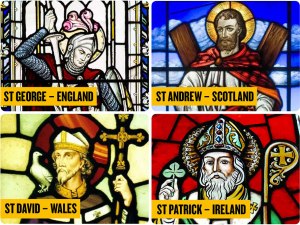
 

Patron Saints UK Britain - St George England - St Andrew Scotland - St David Wales - St Patrick Ireland

Support Semi-Partisan Politics with a one-time or recurring donation:

Agree with this article? Violently disagree? Scroll down to leave a comment.

Follow Semi-Partisan Politics on TwitterFacebook and Medium.

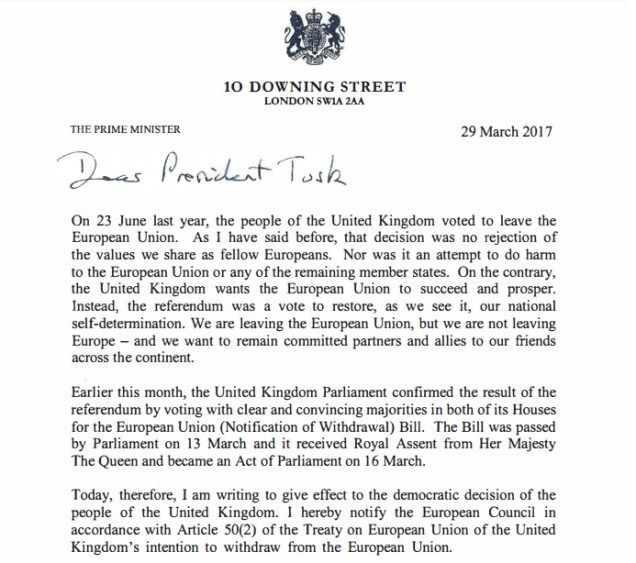
On Article 50 Day

United Kingdom Britain EU Secession - Article 50 Letter - Downing Street - Theresa May - Donald Tusk - European Union

A genuine opportunity for democratic renewal – if we can keep it

Many believed – either through arrogance or hopelessness – that this day would never come.

Article 50 Day: the day that the British government triggered Article 50 of the Lisbon Treaty and formally signalled to the European Union our decision to secede from that dysfunctional, anachronistic and profoundly anti-democratic political union, conceived more than a century ago and constructed in a post-war age now almost completely alien to us.

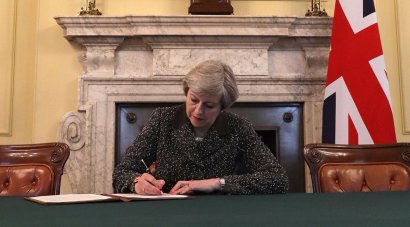
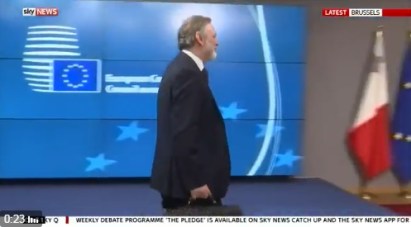
Of the many pictures which may come to represent “Brexit Day” in historical memory, the two images which struck me are the photograph of Theresa May signing the Article 50 notification letter in Downing Street last night, and the television footage of the British official (Ambassador Sir Tim Barrow) in Brussels, striding into the European Council building to deliver the note to president Donald Tusk.

Why? Because these images more than any other represent the astonishing triumph of democracy over the near-unanimous will of the political establishment.

Theresa May signing Article 50 Letter - Downing Street - Brexit - EU

Sir Tim Barrow - Article 50 letter - Brexit- European Union - Britain

Theresa May did not want to sign the Article 50 letter. During the referendum she campaigned, albeit half-heartedly and often nearly invisibly, for Britain to remain in the European Union before accepting the inevitable and promising to implement Brexit as she manoeuvred for the Tory leadership.

And the British civil service, foreign office and diplomatic corps, represented here by Tim Barrow, our Permanent Representative to the EU, certainly did not want to deliver the letter, so accustomed are they to thinking and operating only within the narrow tramlines of those competencies not surrendered to Brussels..

The generations of politicians, diplomats and bureaucrats who currently run Britain were raised on a narrative of national decline and inevitable dependence on the Brussels political union as the only means of amplifying our fading voice in world affairs. Their formative years were spent during the Winter of Discontent and marked by one post-war national humiliation after another. The tremendous post-1970s (Thatcherite) revival has failed to disabuse them of the utterly false, poisonous notion that Britain is a small and insignificant country, no longer capable of governing herself in the manner of other independent countries such as Canada or Australia, let alone as the fifth largest economy and major cultural, commercial, diplomatic and military power that we truly are.

By huge margins, these people were deeply wedded to Britain’s inevitable future as a European Union member state, and consider Brexit a huge mistake bordering on a tragic act of national self-harm. And yet Theresa May signed the letter, Tim Barrow delivered it, Article 50 was duly triggered and the process of Britain’s secession from the European Union was put into motion.

Why is this something to be celebrated? Because at a time when there is every reason for cynicism and doubt, it shows that at a fundamental level, the British people are indeed still in charge of their own destiny.

Theresa May did not want to sign the letter and Tim Barrow did not want to deliver it, but they did so because they retain a sufficient fear of (if not respect for) the public that they dared not abuse their power by overriding the results of a public referendum. Note that there is no such reticence about subverting democracy in the diminished union we are now leaving – unfavourable referendum results in member states (relating to EU treaties or the ill-fated constitution) have consistently been treated as unfortunate but minor setbacks and then sidestepped by the Brussels machinery, its leaders safe in the knowledge that they are so insulated from democratic accountability that they will suffer no consequences for their actions.

In Britain, however, there remained just enough fear of the people for our leaders to be forced to do the right thing, against their will. That’s not to say that they will get Brexit right, not by a long stretch – right up until Referendum Day, many Brexiteers were too busy hating the EU to identify the future relationship they wanted to have with it, while bitter Remainers did much to poison public and media opinion against the kind of transitional EEA deal which would have caused the least economic disruption. But given a mandate to take Britain out of the European Union our leaders are now doing so, however clumsily and against their will. This is as it should be.

Brendan O’Neill also gets it:

What we’re witnessing in Britain today, with Theresa May triggering Article 50, is something radical: the political class is going against its own judgement under the duress of the demos. The polite, peaceful duress of the demos, it should be pointed out.

We know that 73 per cent of MPs want to stay in the EU. We know many in the House of Lords are horrified by Brexit and were keen to hold it up. We know 70 per cent of business leaders wanted Britain to remain, and that some of them launched costly legal battles to try to stymie the Brexit momentum. And yet in the end, all of them, every one, has had to roll over and give in to the masses: to the builders, nurses, teachers, mums, old blokes, unemployed people and others who effectively said to the political class: ‘You’re wrong. We should leave’. To the people surprised that such a state of affairs can exist, that the political set can be made to do something it doesn’t want to by the mass of society, including even uneducated people: what did you think democracy meant? This is what it means.

Yes, this is what democracy means. To do anything else – to override or subvert the referendum decision for Brexit – would mean the triumph of technocracy  and well-meaning dictatorship over democracy.

We tend to forget, because it has not been this way within living memory for many citizens, but in a democracy the leaders are supposed to fear and respect the people and their judgment, not the other way around. As government relentlessly expanded and the bureaucratic state encroached ever more on our lives, we have unfortunately come to fear the government far more than government leaders fear the public – but not so with Brexit. Government ministers know that to defy the Brexit vote and seek to remain in the EU against the wishes of the people would visit such anarchy and destruction upon the country that they daren’t seriously even consider it (save inconsequential politicians such as Tim Farron). And so no matter how much they dislike it, today they implement our instructions.

Of course, Brexit is just one issue. In many other arenas of public life, officials have absolutely no qualms about defying public opinion and treating voters as polling units to be managed or placated rather than autonomous, thinking and engaged citizens to be feared and respected. We must take care not to merely repatriate powers from Brussels back into the arms of a power-hungry, over-centralised Westminster government that will fail to act in the interest of the UK’s diverse home nations and regions, and which carelessly surrendered its own powers to Brussels without democratic consent in the first place. Now, more than ever, we must hold our politicians and civil servants to account.

Brexit is the start of an opportunity for real democratic and constitutional reform, not an outcome in itself. Secession from the European Union makes the rejuvenation of our democracy possible, but by no means inevitable.

When queried by a stranger as to the outcome of the constitutional convention he was leaving, American founding father Benjamin Franklin famously replied: “A Republic, if you can keep it”.

Today, as Theresa May’s government (for all its many flaws) triggers Article 50 and serves notice on the European Union, we seek to reclaim our national self-determination and renew our democracy – if we can keep it. If we can rise to the occasion and collectively seize the great opportunity which now stands before us.


Theresa May signing Article 50 Letter - Downing Street - Brexit - EU

Support Semi-Partisan Politics with a one-time or recurring donation:

Agree with this article? Violently disagree? Scroll down to leave a comment.

Follow Semi-Partisan Politics on TwitterFacebook and Medium.

What European Identity?

Remainer paints EU flag on her face - European Union - Brexit

No, watching an arthouse movie twice a year doesn’t count

Pete North puts into rather forceful words a sentiment which inchoately bubbles up within me every time I see a tearful Remainer painting the EU flag on their face and weeping into an eagerly waiting television camera about how the cruel, racist vote for Brexit has somehow ripped their “European identity” away from them.

North scoffs:

For all that cretinous bilge from remainers about us Brexiteers “stealing my European identity”, I say bollocks. You have no European identity. It is a figment of your imagination. You weren’t watching [a] French cop show on Netflix last night were you? You didn’t go and see a Spanish superhero film at the cinema last week. You know more about US politics than you do about the EU. Culturally, militarily and politically we are Anglospheric. That is a fact.

For all that we have seen remainers amphibious with grief, I say go and look at the traffic jams and the behaviour of drivers in Rome or go and watch the Spanish torture a bull to death and tell me that your culture is in any way reflected in Europeans. That’s when I tell you to fuck right off.

If I have to pick an empire to be allied with, I choose the USA every single time. The land of The Wire, South Park, Rick and Morty, the First Amendment. The country that never needed any persuading that Communism is the manifestation of evil on earth.

Say what you like about Donald Trump, but Donald Trump is not America. Trump is for four years or so. Moreover, Trump is a good sign. Yes, he’s a brash, oafish wrecker but he was elected on the back of a total rejection of American leftism. That which has aggressively moved to bury all moral norms and free speech along with it.

This is why Trump is weakening relations with the EU. Ultimately the diseased politically correct establishment in the USA is the consequence of a detached and corrupt liberal elite. In that respect the USA is in a more advanced state of decay than the EU – but we should view it as a warning. The soft left political consensus of the EU, with its deeply ingrained NGOcracy is that same disease. Brexit is not Trump. Brexit means we avert having one of our own.

I concur wholeheartedly.

Ask a Remainer what their favourite television show is, and they are far more likely to cite an American show than a European one.

Ask a Remainer what their favourite movie is, and they are far more likely to cite something from Hollywood than a worthy-but-subtitled movie from France, Spain or Italy.

Ask a Remainer who their favourite pop music artist is, and they are far more likely to cite an American artist than a European one.

Ask a Remainer to name a political hero or inspiration and I would wager that they are far more likely to reach for Abraham Lincoln, Franklin Delano Roosevelt, John F Kennedy or Barack Obama than Jacques Chirac, Gerhard Schröder, Silvio Berlusconi or Angela Merkel.

Ask a Remainer to cite a famous legal case or decision from a jurisdiction other than their own, and they are far more likely to name a famous case from the US Supreme Court – Brown v Board of Education, Roe v Wade – than a case from the European courts, or those of any member state.

For that matter, look at our legal system of Common Law, which influenced the formation of the American legal system (in the original colonies through to the federal system) and which is markedly different to the civil law traditions prevalent on the continent.

There are exceptions, of course. There are some areas where Europe does exert a stronger gravitational pull over us than North America or the wider Anglosphere. But besides geographic proximity, they are few and far between. Those who claim that we are somehow predominantly “European” in culture tend to either do so from a position of wishful thinking, wanting to position us closer to European social democratic tradition because they wish that our politics would move further in that direction, or from the blinkered perspective of their own narrow social circles.

None of this is to claim that British people lack an affinity for Europe, have nothing in common with other European countries or are in any way hostile to European culture. Many Brits do have deep and abiding links with the continent, myself included – I have a deep and abiding affinity with France and the French culture and people dating back to my teenage years, but I am clear in my mind that this is a relationship nurtured with a culture distinct from and different to my own, not a mere extension of my own culture.

And anybody who seriously surveys the full sweep of cultural connections – legal, governmental, artistic, musical, touristic, commercial – and tries to tell you that the British people have more in common with mainland Europe than with our friends in the Anglosphere (particularly the United States and Canada) is deliberately trying to deceive you, and deluding themselves in the process.


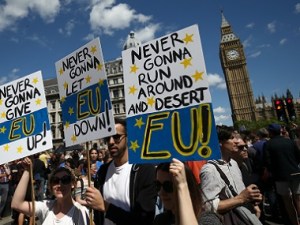
People hold banners during a demonstration against Britain's decision to leave the European Union, in central London

Support Semi-Partisan Politics with a one-time or recurring donation:

Agree with this article? Violently disagree? Scroll down to leave a comment.

Follow Semi-Partisan Politics on TwitterFacebook and Medium.

Scottish Brexit Hysteria: Nicola Sturgeon’s Flawed IndyRef2 Argument

Scotland - European Union - Brexit - UK - Independence - IndyRef2

I begged once, back in 2014. I will not beg again.

Thus far I have refrained from commenting on Nicola Sturgeon’s tunnel-visioned decision to agitate for a re-run of the 2014 Scottish independence referendum following last year’s vote for Brexit.

Back then, I poured my heart into the pro-Union campaign because I strongly believe in our United Kingdom, and do not want to see what I believe to be one of the two greatest and most consequential countries on Earth torn apart unnecessarily to the diminution of all. My beliefs have not changed since then.

However, I do not intend to make another argument or write even one more article seeking to convince the Scottish people to realise the self-evident, inherent wisdom of remaining in our United Kingdom. As the 2014 campaign drew to a close, I quoted the peroration of President Abraham Lincoln’s famous first inaugural address, which sums up my feelings far better than I can put into my own words:

In your hands, my dissatisfied fellow-countrymen, and not in mine, is the momentous issue of civil war. The Government will not assail you. You can have no conflict without being yourselves the aggressors. You have no oath registered in heaven to destroy the Government, while I shall have the most solemn one to “preserve, protect, and defend it

I am loath to close. We are not enemies, but friends. We must not be enemies. Though passion may have strained it must not break our bonds of affection. The mystic chords of memory, stretching from every battlefield and patriot grave to every living heart and hearthstone all over this broad land, will yet swell the chorus of the Union, when again touched, as surely they will be, by the better angels of our nature.

Substitute “separation” for “civil war” and you have my distilled viewpoint on the matter of Scottish independence. But Scottish nationalism is a blind and unreasoning beast, appeals to logic and sentiment will get us nowhere, and we should recognise this fact. If one seriously believes that the Scottish people are being oppressed and having their democratic rights trampled by the Evil English, or that they somehow lack their due influence in our nation’s government despite enjoying political devolution and autonomy far greater than that enjoyed by the UK’s most populous home nation, then a sensible discussion cannot be had.

Neither am I willing to involve myself in another referendum campaign which will consist of those on the side of Scottish independence prancing around pretending that they are the sole custodians of compassion and progressivism (not that I claim the latter label for myself), and that the only thing preventing Scotland from becoming a modern-day socialist Utopia is the cold, dead hand of English conservatism. I will not buy into the pernicious myth that people’s hearts get a little bigger and their spirits more generous the moment they move north of Berwick-upon-Tweed. Scottish nationalists: try building that compassionate welfare state with a 15% annual government budget deficit and the economy-suffocating tax rises which would be required to close it, and then talk to me about compassion.

Nor am I willing to debate on the skewed terms of the Scottish National Party, which is an authoritarian, centralising machine (one fire and police service for an entire country, really?!) which would happily turn Scotland into an undemocratic one-party state under the cult of personality of Nicola Sturgeon or Alex Salmond given the opportunity. I will not debate further concessions or autonomy for Scotland when the SNP government refuses to avail itself of the fiscal autonomy which has already been granted, and when similarly populous English regions (like, say, Yorkshire) are equal in population but have a fraction of the voice, and yet bear this injustice with more stoicism than that of every last Scottish nationalist combined. The SNP does not debate or negotiate in good faith, as should be evident by the mere fact that we are even discussing a re-run of the independence referendum after the matter was supposedly settled for a generation.

All of that being said, and despite the known disingenuousness and bloody-mindedness of the SNP, I was rather surprised by Nicola Sturgeon’s widely reported public statements and recent series of tweets, which amount to nothing more than another hysterical hissy fit about Brexit coupled with an Olympian denial of reality – Trumpian “alternative facts”, if you will:

Sturgeon wants to hold another referendum when “the terms of Brexit [are] clear and before it is too late to choose an alternative path”. But it is clear to everyone with a functioning brain that there will be no alternative path. No matter how much the UK government screws up the negotiation and process of Brexit, there is no alternative for Scotland to remain an EU member. It has been stated and restated by one EU leader after another that there is no mechanism either for a region to remain part of the European Union when its parent member state secedes, or for a seceding region to claim automatic, continuous or even expedited EU membership on the basis of the former parent country’s membership.

One can argue about whether this is right or wrong – the political motivations behind it are quite clear, with certain other EU member states none too keen to give succour to restive independence movements in their own regions – but one thing a government should and cannot do is base its policy and public pronouncements on a denial of basic reality which can best be described as howl-at-the-moon stupid. If Scotland wants to be an “independent country” and an EU member (to the limited extent that the two overlap) then it must apply to rejoin the EU as a new entity from the outside, whereby its application will almost certainly be vetoed by Spain. Those are facts.

So what does Sturgeon mean when she says that the Scottish people must be free to pull the eject lever on the United Kingdom “before it is too late to choose an alternative path”? She is basically lying to her own citizens, pretending that the ejector-seat she is selling them is connected to a functioning parachute when in fact it is weighed down by the iron anvil of reality. And what is that awkward reality? The fact that voting to secede from the United Kingdom necessarily and automatically means that Scotland would find itself out of the UK and the EU, certainly for a long time and almost certainly forever.

Of course, many Scottish nationalists and their finger-wagging apologists in the rest of the UK love to argue that it is somehow ironic for pro-Brexit Unionists to warn Scotland of the dangers of finding itself locked outside of a larger political entity. These people think that they have hit on a clever, winning argument when in fact all they have done is reveal the paucity of their own understanding of patriotism and national identity, let alone why people voted for Brexit.

There never was (and likely never will be) a culture and common feeling of “European-ness” that outweighs British identity, and so it never made sense for such a powerful and dominant level of supranational government – one with determinedly expansionist, federal aspirations, no less – to sit over us in Brussels. There is, however, a strong sense of Britishness and shared British history, no matter what contemporary pundits say about the decline of Britishness and the rise of English nationalism.

If you doubt it, answer this one question: what was the name of the decisive Second World War air battle fought between July and October 1940? (Hint: even a post-patriotic millennial can tell you that it wasn’t the Battle of England, just as Pearl Harbor and 9/11 were attacks on the United States of America and not on Hawaii and New York respectively). Our sense of identity is overwhelmingly forged as a unified British entity (albeit one with proud constituent home nations), no matter what narratives of fracture that the pro-EU media class try to feed us. And so there is all the difference in the world between wanting to preserve the United Kingdom, to which most of us have at least some sentimental attachment, and wanting to free the United Kingdom from antidemocratic supranational European government which didn’t exist half a century ago and which most people barely comprehend.

Brexit, at its core, sought to return the highest and most consequential level of government to a polis with a commensurate sense of shared identity. If Scottish nationalists try to suggest that it is somehow hypocritical for Brexiteers to support the United Kingdom and warn of the cultural costs of separation then they either think that you are stupid or else are being catastrophically stupid themselves. Both options are equally plausible.

So by all means let Scotland hold another referendum, at the appropriate time. If they choose to defy the current polls and vote for true isolation on the world stage as a tiny country in poor fiscal health, determined to antagonise its larger neighbour, then that is their right. But they must do so only when the temper tantrum of their attempted divorce from the United Kingdom does not further imperil what is already a fraught and difficult Brexit negotiation for the rest of us.

Since Scotland is coming out of the European Union anyway (as even Nicola Sturgeon realises in her more lucid moments), it makes absolutely no sense for Scotland to pull the eject lever and jettison from the United Kingdom before the Brexit negotiations and process are complete. Sturgeon pretends that the referendum must be held virtually overnight, before it is “too late to choose an alternative”, but she is deliberately deceiving the people she represents. There will be no alternative other than the binary of life inside Brexit Britain or life as an independent country, whether the vote is held tomorrow or in 2025. All that holding IndyRef2 before Brexit is complete will accomplish is prioritising the vainglorious fantasy of Scottish nationalists over the UK government’s solemn responsibility (shoddily discharged thus far, admittedly) to secure the best deal and optimal future relations for our entire United Kingdom.

So go ahead, Scotland. Have your second referendum – at the appropriate time, once the United Kingdom you so despise has successfully finished negotiating its way through our present great national trial. I will not say a single further word to convince you to stay – the decision is yours, and if Project Fear worked back in 2014 then I can only hope that Project ‘Mystic Chords of Memory’ will ultimately do the job next time around.

So do what you will. But in 2014 you voted to remain part of the United Kingdom, and as a full and equal part of the UK you don’t now get to sabotage the Brexit process in pursuit of the SNP’s unachievable fantasy of leaping smoothly from our Union to that of Brussels.


Scotland UK Unity Rally Trafalgar Square London semipartisansam

Support Semi-Partisan Politics with a one-time or recurring donation:

Agree with this article? Violently disagree? Scroll down to leave a comment.

Follow Semi-Partisan Politics on TwitterFacebook and Medium.

Brexit Catastrophisation Watch, Part 3 – The Cultural Elite’s Ongoing Anti-Brexit Tantrum Is Pointless And Childish

girl-tantrum-eu-brexit-catastrophisation

Hell hath no fury like a self-involved, virtue-signalling, pig ignorant artist forcibly separated from his beloved European identity

Anyone who has ever had the misfortune to be in close proximity to a young child having a screaming meltdown in a supermarket, church or (worst of all) on a long aeroplane journey will immediately recognise the tenor and tone of the Guardian’s latest offering in their ongoing “But The Evil Tor-ees Took My European Identity From Me” series.

And this week’s whinnying public tantrum comes courtesy of writer Tom McCarthy, who can’t wait to tell us how he spurned the opportunity to attend a festival of British arts because daring to celebrate British artistic creativity post-Brexit is clearly akin to having attended the Nuremberg Rallies in 1930s Germany.

McCarthy pompously declares:

In our society, the artist may have no executive power whatsoever, but their ace-card lies in the fact that they command a means – perhaps the primal one – of putting value in the world: a means of making meaning. They can use this status to subvert, or to shore up, power – sometimes both at the same time – and they can do this well, badly or indifferently; but one thing they can never do is be politically neutral.

A few weeks ago I received an invitation to a special reception to be held at the Royal Academy for “British artists” to celebrate “British creativity”. In normal times such a gesture might have seemed a little jingoistic, but essentially innocuous. But these are not normal times. Given the extraordinary far-right takeover the country seems to be undergoing, current talk of “British” X or Y or Z (“values” or “decency” or “culture”) usually marks one end of a chain, at the other end of which someone is being shunned in a playground, spat at in a supermarket, or worse. The invitation mentioned designers and businesses who “shape our culture”, and outlined the security procedures that would surround the event. It wasn’t hard to read between the lines: while Martin Roth at the V&A had made it clear his institution would have no truck with such nonsense, the RA was helping to assemble a roll-call of figures from the arts to pose arm-in-arm with ministers, royalty and innovators of the James Dyson variety, for a soft-power, post-Brexit rebrand of “British” culture.

How terribly brave of McCarthy to make such a principled stand, which will have cost him absolutely nothing and cemented his status as a hero among other pig-ignorant europhiles in the cultural scene. No, really. How terribly subversive, taking a public action which panders to the existing groupthink and prejudices of the political and cultural elite, nearly all of whom remain horrified by Brexit. The idea that Tom McCarthy is in any way being countercultural or subversive is as hilarious as it is pitiful.

McCarthy continues:

The fact is, I’m not an example of “British creativity”. Like all English-language writers, I’m thoroughly European. To read Shakespeare is to read a rich remix of Ovid, Petrarch and Lucretius; to read Joyce (a British passport-holder) is to read Mallarmé, Laforgue, Goethe. The wellspring of our shared archive is Greek – and since the Hellenic world was in fact spread all around the Mediterranean basin, this means that to be European is already to be African and Asian.

Millennia of trade and empire, of diaspora and endlessly crisscrossing migration, have produced a culture that is and always will be cross-pollinated. If London and other British cities have become cultural hubs, this is because they stand at intersections within larger, international flows and networks. To credit an intersection with creating (“innovating”) the currents from which it merely feeds, though, is like calling a lightbulb a generator.

The number of idiotic sentences about Brexit and democracy uttered by self-proclaimed artists probably now registers in the tens of millions, but still McCarthy’s claim that all English-speaking writers are “thoroughly European” is particularly fatuous.

If “all English-language writers” are European, why do we not hail F. Scott Fitzgerald as a great European author? And even if we did consider Fitzgerald to be European, using McCarthy’s tortured logic, isn’t this yet more damning evidence that one does not need to be part of a supranational political union to derive a sense of regional or continental identity? Fitzgerald’s European-ness is innate and inalienable, according to McCarthy, and utterly uncontingent on belonging to a power-hungry, relentlessly integrating Cold War-era club like the EU. So what exactly in the problem with Brexit?

Is Switzerland, outside the European Union, not “European”? Is Norway somehow severed from the continent, its artists unable to “cross-pollinate” ideas with their French or Spanish peers? And if the likes of John Steinbeck and F. Scott Fitzgerald are great European writers despite both of whom having perished before the sainted European Union came into being, isn’t this proof that sharing an undemocratic set of supranational institutions is entirely unnecessary in forging a common heritage and identity?

Weepy British artists still in floods of tears at the thought of Britain leaving the EU should in fact take heart from Tom McCarthy’s rant. Since “all English-language writers” are “thoroughly European”, even those who lived their entire lives on a different continent decades before the institutions of the European Union even came into existence, why get so upset simply because Britain will shortly cease to send MEPs to Brussels and Strasbourg?

The culmination of McCarthy’s virtue-signalling extravaganza:

About the same time, I received another invitation, this time to read from my work at an anti-Brexit art festival in Hackney’s gallery-filled Vyner Street. Beneath bunting designed by Fiona Banner, Bob and Roberta Smith and Jessica Voorsanger played a gig, Katrin Plavcak and Ulrika Segerberg did an electronic sewing machine-enhanced performance, Lucy Reynolds conducted a “choir” who chanted in 20 languages at once, and a large crowd who could trace their heritage to every corner of the Earth ate, drank and generally had fun celebrating internationalism and renouncing tribalist bigotry, while children darted round their legs.

It’s quite possible that several of the Vyner Street participants, being high-profile culture-shaping innovators, were invited to the RA too. I doubt they’ll go, though, any more than I will.

And there it is. That’s what this is really all about. Tom McCarthy hasn’t had his European identity ripped away from him, as by his own admission his sense of European-ness transcends any one political institution and seemingly includes African and Asian culture, too (perhaps someone needs to have a quiet word with him about his imperialist, oppressive cultural appropriation).

No, this is members of the British artistic and cultural scene, left-wing almost to the last man, doing what they do best: spurning patriotism at every turn (embracing “all centuries but this and every country but their own”, as W.S. Gilbert might have put it), revealing their exquisite discomfort with anything British and promoting a rootless form of virtue-signalling internationalism instead. It is self-evident that Tom McCarthy would have no qualms about attending a celebration of French or Italian culture, were he invited to one. No, it is only his own culture which he detests and sees fit to associate with the “far right”.

“Look at me, look at me! I’m a citizen of the world! I’m not beholden to your base, quasi-fascistic preoccupations with national identity and community”, screams Tom McCarthy’s insufferable hissy fit in the Guardian. Well, good for him. Thankfully, a majority of Britons (even those cowed by Project Fear into voting Remain) disagree with this toxic notion.

Castigating the inventor James Dyson for having “[thrown] his lot in with Nigel Farage” in supporting Brexit, McCarthy declares “I don’t even dry my hands in public toilets” any more following the EU referendum, a riveting declaration that this brave, Super Virtuous Man will have absolutely nothing to do with those who dared to defy the pro-EU orthodoxy.

If Tom McCarthy chooses to forego washing his hands after using the lavatory as part of some pinch-faced middle class anti-Brexit rebellion, that is his own business. This blog would be quite content if he simply took pity on the rest of us and ceased to sculpt prissy, virtue-signalling little articles in the Guardian out of his own faeces.


Thousands Of People Take Part In The March For Europe

Top Image: Pixabay

Support Semi-Partisan Politics with a one-time or recurring donation:

Agree with this article? Violently disagree? Scroll down to leave a comment.

Follow Semi-Partisan Politics on TwitterFacebook and Medium.