Labour’s Cynical, Disingenuous National Debt Hysteria

Labour Party attack ad Tories national debt

Pot, meet kettle

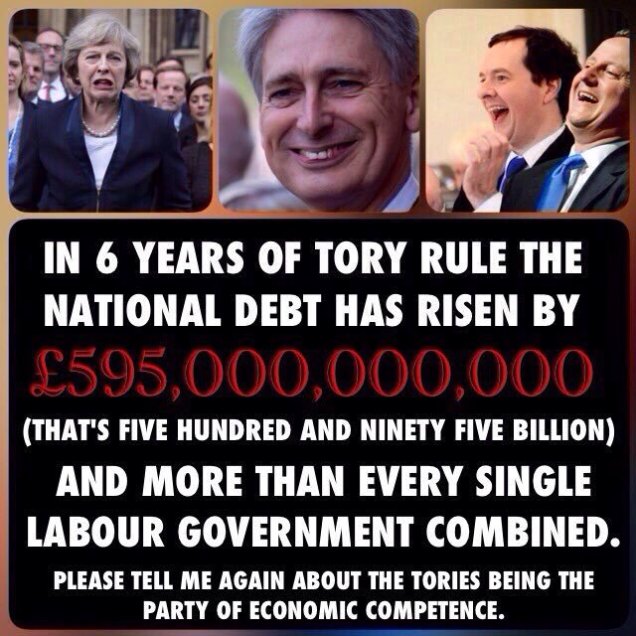
You’ve probably already seen them countless times over the course of this general election campaign – the smug, sanctimonious internet memes bandied about by Labour supporters and other left-wing activists excoriating the Conservatives for having presided over a massive increase in the national debt since taking office in coalition back in 2010.

And of course this is factually correct. The only thing missing from these outraged little infographics is an admission of what would have happened to the budget deficit and national debt under fiscally incontinent left-wing economic policies – and the answer, of course, is that the situation would be even worse.

Yet even “serious” publications have been pushing the same disingenuous message, with Alison McGovern recently writing a piece for the New Statesman, demanding “The Tories used the budget deficit to attack Labour – so why haven’t they fixed it yet?”:

Spot the pattern? Tory Chancellors who loudly proclaim the virtues of having a budget surplus, have, in the end, presided only ever over deficits.

But it gets worse. The deficit, as the gap between money coming into the Treasury and money spent, has to be paid for by borrowing. And quite rightly, the Tories’ deficit target was matched by a debt goal. Borrowing to invest in structural improvements to our economy is clearly the right thing to do. But that is very different from permanent borrowing to prop up day-to-day spending.

Yet the Tories have delayed their target on debt three times since 2010

Their original target was to have debt falling by 2015-16. Then in 2014 that was delayed until 2016-17. Then in 2015 the target was to keep it falling every year until 2020-1. Then in 2016 that was changed to be “falling by 2020-1”.

This “goal” looks like one that will always be swerved as the Tory mismanagement rolls on.

Author’s emphasis in bold. McGovern concludes:

The budget deficit was used repeatedly by Osborne as an attack on Labour’s record in office.

This has now been demonstrated to be ludicrous chutzpah. Laughable, if it were not so serious. Ironic, if it were not to have such lasting consequences for all of us.

It’s time we moved on from a debate about the Labour past, and looked at what the Tories are doing today. We should show the leadership the country badly needs, and take this fight on.

Yes, how rude of the homeowner not to instantly repair all of the damage caused by the arsonist.

The bare-faced gall of these people is astonishing. Heading into the Great Recession, the Labour Party under Tony Blair and Gordon Brown consistently ran budget deficits, despite the fact that the economy was growing and boom and bust had apparently been “abolished”. And so when the downturn hit, there was almost zero room for fiscal manoeuvre by the government. Sure, we printed lots of money and nationalised failing banks – didn’t the Left used to angrily call that “privatising the profits and nationalising the losses?” – but we were in no position to undertake the kind of stimulus spending that America unleashed and which Keynesian economics dictates is the correct way to deal with a recession.

The budget deficit naturally exploded and reached a peak just as the Conservative / Liberal Democrat coalition government came into office, reaching a peak of around £160 billion when Labour left office. This means that the national debt was being added to every year at the fastest rate in modern history. To their partial credit, the Conservatives have succeeded in at least reducing the budget deficit every year (thereby slowing the rate of increase in the national debt) though they have consistently relaxed and missed their own targets for doing so, with the budget deficit now not due to be eliminated until the year 2026. And so we now have the spectacle of  smarmy left-wing internet meme-sharers lambasting the Tories for having failed to eliminate the deficit and significantly lower the national debt.

Well, what would they have had the Evil Tories do? The Left squealed like self-entitled pigs when George Osborne made even modest efforts to trim the deficit, repeatedly relaxing the timetable by which he planned to return Britain to a budget surplus. Are the Left now saying that they would rather have had deeper budget cuts? Abolishing the Army, perhaps? Surely not reducing funding for Our Blessed NHS (genuflect)? Or perhaps they secretly intended to eliminate the budget deficit by dramatically hiking income tax and national insurance on all tax bands, in angry defiance of the Laffer Curve? But what when this only suppressed economic activity even further?

Let’s be clear – the Conservative Party, under chancellors George Osborne and Philip Hammond, has been depressingly unambitious when it comes to eliminating the budget deficit. The party of David Cameron and Theresa May has not been the party of fiscal responsibility, and their constant lying about “fixing the roof while the sun is shining” and “paying down Britain’s debts” when in fact they have done no such thing only makes matters worse.

But the only thing more ludicrous than a Conservative Party which struts around pretending to be the guardians of fiscal responsibility is a Labour Party which ran budget deficits in the good years, leaving Britain particularly vulnerable to the loss of tax revenue accompanying a recession, attacking the Tories for having failed to enact measures which they would never have enacted themselves, and which in fact they repeatedly criticised the Tories for even attempting to do. It is simply mind-boggling that the Labour Party dares to attack the Tories on the question of deficit reduction and the national debt when their “anti-austerity” policies would have increased the deficit even further and made the national debt even larger.

Blogger Paul Goldsmith has had enough:

I actually can’t take it anymore. It is economically illiterate and it is self-defeating and it has to stop. It is like someone lighting a fire, which is an inferno when the fire brigade arrives, and then the person who starts it runs around replacing the brigade’s water with oil, and fanning the flames, whilst screaming at the fire bridgade that they can’t believe the fire isn’t out. Yes, Labour’s repeated taunts about the national debt really are that preposterous. Self-defeating too, as it brings attention back onto how the fire got started in the first place.

And then launches into this glorious tirade:

So, having left a deficit of £160bn, and a national debt (cumulative deficits added together), of just under a trillion, Labour have noted that the debt is bigger. Well, duh! Were the Tories supposed to have eliminated the deficit in their first year in Government? Impossible. In fact, what the Tories chose to do is to cut spending, added to a few tax rises, and slowly eliminated that deficit. Very slowly, slower than they originally hoped. But at every turn, every cut, Labour opposed them. Every single one. So yes, every year a lot of deficit (decreasing every time) got added to the national debt, but that is because Labour left such a massive deficit.

Now, yes, they left that deficit mostly because of the action they took to save the banking system and to try and stimulate the economy to stave off depression during the financial crisis. A financial crisis that wasn’t caused by Labour.

But look at the seven years between 2001 and the start of the crisis in 2008. Those were times of economic growth. During times of economic growth that deficit should have been a surplus (tax revenue greater than government spending). But it wasn’t, as Tony Blair and Gordon Brown chose to spend and maintained a deficit of around £40 billion a year. This means there was no financial room to manoeuvre when the inevitable recession came. Of course, Brown had boasted that he might have abolished boom and bust, so may not have been ready for that recession. But when it came, a huge amount of public money was thrown at it, which meant the Conservatives inherited a massive deficit.

Here’s my point, every time Labour mention the addition to the debt under the Conservatives, the Conservatives can just point to what they were left with. Best summed up by the note left by the last Labour Chief Secretary to the Treasury, Liam Byrne, to the first Coalition replacement, David Laws: “I’m afraid there is no money.”

It’s funny. Transport these same leftists to the United States, where beloved Barack Obama ruled from 2009 to 2017 in the aftermath of the same global recession, and they would doubtless shriek with outrage at similarly cynical efforts recently made by the Republican Party to pin the blame for American budget deficits and increasing national debt squarely on the Democrats. They would rightly point out that President Obama inherited a mess, an economy in freefall and public spending jacked up artificially high by his fiscally incontinent predecessor George W. Bush. They would correctly point out that nobody can work economic miracles like making a large structural budget deficit and cumulative national debt disappear in an instant.

But the sanctimonious meme-sharers do not live in America where an admired left-wing president ruled for the past eight years. They live in Britain, where the callous, heartless Evil Tor-ees (they’re lower than vermin, don’t you know!) have been in charge since 2010, and so all of the leeway and understanding that they would demand for themselves is stubbornly withheld from the other side under identical conditions.

As is so often the case, Labour Party propaganda relies on voter ignorance and lack of medium or even short-term memory in order to make an impact. With these lowbrow memes and the highbrow articles which underpin them, Labour Party activists and sympathetic commentators are counting on the British people being too stupid to ask what Labour would have done differently to have achieved a budget surplus and reduced national debt given the same circumstances faced by the Tories.

That’s certainly one way to go about trying to win an election, but there is nothing to be proud of in this tawdry, disingenuous approach.
 

Labour Conservatives National Debt - General Election 2017

Support Semi-Partisan Politics with a one-time or recurring donation:

Agree with this article? Violently disagree? Scroll down to leave a comment.

Follow Semi-Partisan Politics on TwitterFacebook and Medium.

Left Wing Self-Awareness Award, Part 2

Samuel Hooper - Left Wing Self-Awareness Award - British Politics - Socialists

Jon Ashworth sees the light

More credit where credit is due to Jonathan Ashworth, Labour’s Shadow Health Secretary, who took a break from leading public worship of Our Blessed NHS (genuflect) to encourage Labour activists to see Conservative voters as potential hearts and minds to be changed rather than unconsionable, amoral degenerates.

From the Guardian:

The shadow health secretary has urged Labour to see Conservative voters as the party’s “friends and neighbours and relatives” rather than portraying those who are attracted to Theresa May’s offer as the enemy.

[..] He claimed that while there was no intention by Labour figures to portray Conservative voters in a negative light, the “febrile world of Twitter and social media can sometimes inadvertently convey that”.

Ashworth said his message was to stress: “Those who vote Conservative aren’t our enemies. They are our friends and neighbours and relatives. We need to be convincing them to switch to Labour where we can.

“They are people who live in our communities – we need to be persuading them as well as ensuring that those who voted Labour in past elections are sticking with us again.”

It’s a little bit cheeky of Jon Ashworth to suggest that there has never been any intention by Labour figures to portray Conservative voters in a negative light. The mere fact that prominent Labour politicians and activists choose to argue in such stridently moral terms about left-wing policies being altruistic and right-wing policies being motivated by base self-interest makes a clear implication that Tory voters are morally deficient – there simply is no other inference to be drawn from the rhetoric.

One might also consider the official Labour party leaflets distributed in the recent Copeland by-election, warning that a Conservative victory would literally “cost mums their children”.

The Guardian reported at the time:

A graphic Labour pamphlet warns voters in Copeland that a Tory victory in the by-election will “cost mums their children” in an open letter aimed at highlighting the risks of NHS cuts in the constituency.

The handwritten letter in support of Labour candidate Gillian Troughton, a St John ambulance driver and former hospital doctor, is from local mother Paula Townsley. The leaflet is the second posted through letterboxes by Labour activists to contain dire warnings about the closures of maternity services at West Cumberland hospital.

Accusing conservative voters of aiding and abetting in the death of babies doesn’t seem particularly inadvertent. On the contrary, it sounds like a deliberate attempt to make conservative policies seem not simply misguided and erroneous (as conservatives believe left-wing policies to be) but deeply, profoundly wicked. And presumably this election pamphlet was signed off by somebody with at least some authority within the Labour Party.

That being said, Jon Ashworth’s clear and explicit exhortation to Labour activists encouraging them to see the humanity in conservative voters (rather than Evil Tory vermin to be avoided or exterminated) can only be a good thing.

Not everybody agrees, though. A below-the-line commenter over at LabourList retorts:

What troubles me is the sacrifices in our values we have to make in order to appeal to Tory voters. What aspects of our manifesto would we have to dump? And how would that go down with our core vote?

None! At this point, you don’t have to make any sacrifices to your values. Just stop treating the other side as though they are pantomime villains, and you will be at least 30 percent of the way there. Dare to imagine that your opponent’s conservatism is borne of a legitimate moral framework and a sincere belief in what is best for society and the country, just as you believe that left-wing policies are the panacea. That’s all you have to do at this stage!

When it comes to toxic left-wing activism, it is the grassroots that do 80 percent the damage – on social media and through their coarse and vulgar protests. Jon Ashworth is correct to say that it is not usually Labour MPs themselves who are most responsible for whipping up anti-conservative hatred – or at least they tend not to do so while the cameras are rolling. Therefore Labour politicians have a responsibility to warn their more hot-blooded activists that treating Theresa May’s really very moderate centrist government as some kind of evil Nazi-like regime to be “resisted” is counterproductive and highly offputting to those who vote Conservative in good conscience.

Jon Ashworth’s conversion to the cause is therefore most welcome.

More, please.


Jonathan Ashworth - Labour Party - shadow health secretary

Support Semi-Partisan Politics with a one-time or recurring donation:

Agree with this article? Violently disagree? Scroll down to leave a comment.

Follow Semi-Partisan Politics on TwitterFacebook and Medium.

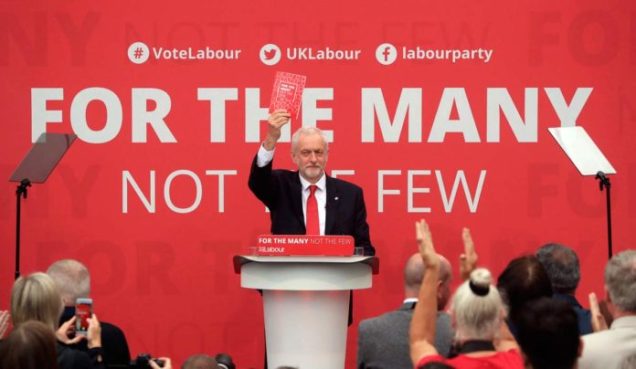
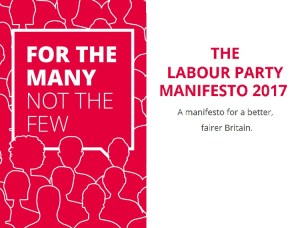
Labour Manifesto: Voters Know Left Wing Policies Are Individually Alluring But Collectively Foolish

Labour Party General Election 2017 Manifesto - Jeremy Corbyn - For The Many Not The Few

Left-wing party manifestos fail to deliver electoral wins despite the popularity of their individual components because voters are smart enough to realise that promising the moon on a stick is not realistic

One self-deceiving mantra that we hear time and again from the Labour and the British Left is that people supposedly love individual left-wing policies but fail to vote Labour in the same numbers, and that if only they change X, Y or Z then the public will fall in love with the great package deal of free stuff + no responsibility and usher in a perpetual era of socialist government.

Currently, the excuse for failure is Jeremy Corbyn, and a number of leftist activists are busy consoling themselves that the Labour leader’s reputation is the only problem. Swap him out and keep the same policies, the self-deception goes, and everyone will suddenly start clamouring to vote Labour at all times.

How many times have we heard the likes of Polly Toynbee sanctimoniously declaring in a TV news debate that people “overwhelmingly” support left-wing policies like the renationalisation of the railways and the utilities sectors, hiking taxes on “the rich” or funnelling ever-increasing sums of money toward “Our NHS”? Too many to count.

And yes, certain individual policies can be very popular, particularly left-wing ones. If you prance around promising more stuff for less money – better public services, faster healthcare, higher welfare payments, all conveniently paid for by somebody else – you are bound to pick up a number of gullible admirers. But more importantly, when pollsters test the appeal of individual policies, people are likely to be very warm to left-wing, redistributive ideas when they are named individually.

It is only when you look at the systemic effect of implementing a basket of left-wing policies all at once that the appeal begins to wear off, as people engage more deeply with the question and the shine starts to come off the socialist Utopia. You might be able to convince voters that a punitive tax raid on the most productive people in society will cobble together enough money for one shiny new government programme, but when you start spending the revenues from that same tax hike multiple times and promising to do fifteen wonderful things with the same small pot of cash, that’s when voters’ natural scepticism kicks in.

Here’s the Guardian, falling into the same trap:

Renationalising the railways was backed by 52% of voters, with 22% opposed and 26% saying they did not know. Nationalising the energy market was supported by 49% with 24% against and 28% saying they did not know.

Labour’s most popular policy among those surveyed was banning zero-hours contracts, with 71% in favour and 16% against.

Despite the strong support for the party’s policies, only 30% agreed with the sentiment that Corbyn should be given a fair chance at leading the country, while 56% said he would be a “disaster” as prime minister.

And the Mirror, doubling down:

There is also widespread support for increasing income tax on those earning more than £80,000 a year.

This is backed by 65% of voters, with just 24% opposed.

A small majority (51%) of Tories also support the policy as do 80% of Labour voters, 72% of Lib Dems and 69% of UKIP voters.

Labour’s pledge to limit the state pension age to 66 is supported 74% of voters, with 15% against and 11% don’t know.

Again this policy goes down well with Tory voters, with 67% of them supporting it and just 22% against.

Here’s Manuel Cortes banging the drum at LabourList:

Make no mistake, Labour’s programme is transformative in a way not seen since 1945 or, Thatcher’s counter-revolution. We know our policies are overwhelmingly popular. Our challenge between now and June 8, is to turn the debate in our country away from Brexit onto the bread and butter issues which our policies tackle.

The polls tell us this will be a Herculean task but they are also saying that our manifesto commitments, on a raft of issues, have huge majorities in favour.

Meanwhile, Josiah Mortimer at Left Foot Forward at least recognises that voter preference is more complex than approval for a basket of individual policies, but still manages to miss the point:

It begs the question: if voters agree with most of Labour’s headline policies – what’s going wrong?

The latest poll of polls has Labour on around 30% – 16 percentage points behind the Conservatives. It’s a divide that makes sense only if you understand politics as being about much more than policies – but leadership, and above that: presentation of those policies and that leadership.

There are of course the usual misgivings over Jeremy Corbyn’s qualities as a statesman (56% say they think he would be ‘a disaster’ as Prime Minister while 30% think he should be given a ‘fair chance at leading the country’).

But beyond that, there is the issue of presentation. It’s been said time and again that Labour’s current policies aren’t significantly to the left of his predecessor (‘warmed up Millibandism’). From renationalising the railways and ending private involvement in the NHS, to prioritising council housing and clamping down on the energy companies: all this has been done and said before.

But it often feels that the left do ourselves few favours – in presenting policies as more radical than they really are – and voters do perceive Corbyn as much more left-wing than he is: with 0 being effectively a communist, and 10 being the most right-wing, voters put Corbyn at 2.2, and Labour at 3.

But the discrepancy between individual policy popularity and overall opinion poll performance is due to more than the “Corbyn effect”, and it is disingenuous of the Guardian and other left-wing media to pretend otherwise.

We see similar enthusiasm gaps between individual left-wing policies and overall voting intention throughout recent British political history – support for rail renationalisation has been high since the railways were privatised – and also in the United States, where Democrats love to crow that many voters actually support their high-taxing, pro-union, pro-redistribution policies only to be disappointed on election day when conservative Republicans keep being elected to various levels of public office.

But many leftists genuinely seem to struggle with this notion. To their minds, if one promises one wonderful free thing after another, the cumulative effect will be enormous and should result in nothing but a Labour landslide in the general election. They make no allowance for the diminishing returns of left-wing fiscal incontinence, or realise that each further promise makes the complete package less believable rather than more.

Owen Jones actually gets closer to the truth, admitting to Varsity:

However, Jones is quick to point out that popular policies aren’t enough saying “individual policies don’t win elections, you need a clear vision to inspire people in terms of what you’re going to do.”

And developing his point in the Guardian:

As has been noted, Labour’s recent policies are indeed electorally very popular. You don’t win elections, though, with policies that – taken individually – have high levels of support, as Ed Miliband discovered. There has to be a vision to bring them together. If you don’t define what you are for, you will be defined by your opponents, already the critical problem afflicting Labour’s leadership. You need a sunny, optimistic vision, not a miserable shaking of the stick at everything that’s wrong.

Jones is right and wrong here. A vision certainly helps. However, the Tories have just launched their 2017 general election manifesto which contains no discernible vision or philosophy of government at all, beyond a final repudiation of Thatcherism, a spiteful kick at libertarianism and a pledge to make random gestures to the Just About Managing (JAMs) by pinching from the Labour playbook.

This blog certainly wishes that it were otherwise; that Theresa May had decided to fight the 2017 general election on an unapologetically small-government, conservative platform – particularly since electoral victory is all but guaranteed, together with the opportunity to reshape the country if only the political will was there. But the Conservatives’ imminent victory is proof that one does not need a logical set of policies or a coherent philosophy of government in order to win support.

If anything, the problem is that many voters know the left-wing vision only too well, and simply want nothing to do with it. Jeremy Corbyn may be bad at communicating an appealing left-wing worldview, sometimes couching even relatively pedestrian policies in the off-putting language of revolutionary struggle, but his predecessor Ed Miliband was as bland as bland can be, and still nobody took the bait. Likewise, since leaving office the heavy fisted Gordon Brown has developed a talent for giving angry TED-style intervention speeches at crucial political junctures, but he too was unable to sell an attractive, convincing left-wing vision to voters tired of centre-left New Labour rule.

The problem is not that the left-wing vision does not exist, or lacks decent salespeople to pitch it. The problem is that people who know it tend to dislike it. Envy of the rich, a desire to tear the successful down rather than build the underprivileged up, a seething antipathy to business and entrepreneurship, the stubborn insistence on inviting the government deep into the private lives of every citizen, treating half the country as perpetually helpless and “vulnerable” people in need of constant nurturing by the state, endless moralising about being the sole keepers of compassion, and now the embrace of toxic and divisive identity politics – there is no confusion about what Labour stands for, only dislike ranging from mild indifference to complete revulsion.

Unfortunately, though, these beliefs and attitudes run deep through the political Left. Even when voters like a particular individual Labour policy they are too often unconvinced to give Labour their vote because they rightly perceive that the policy is borne from the wrong motives.

Labour could promise to cut income tax to zero for everybody earning below £50,000 and throw in a £10k rebate on top, funded by punitive taxes on millionaires and confiscatory wealth taxes on assets, which would be a hugely popular policy, but they will not persuade an election-winning coalition of voters to back them based on it because in the back of their minds, voters know that even if they are to personally benefit from one of Labour’s pie-in-the-sky ideas, everybody will suffer – themselves included – when they quickly succeed in driving the country into the ground.

Hard as it is for some on the Left to believe, voters sometimes actually appreciate it when political parties level with them rather than endlessly trying to flatter and bribe them with “free” stuff. It was a Democratic president, John F. Kennedy, who exhorted his fellow citizens to ask what they could do for their country rather than what their country could do for them. Somewhere along the way, on both sides of the Atlantic, the Left seems to have lost this spirit, and replaced it with the gnawing certainty that voters want a shopping list of bribes, a promise to be perpetually looked after by the state and alleviated of all responsibility for their lives.

Fortunately this is not the view of most voters, which is why the Labour Party and the British people look set to continue talking past one another, on June 8 and into the future.


Labour Party Manifesto 2017 - For the many not the few

Support Semi-Partisan Politics with a one-time or recurring donation:

Agree with this article? Violently disagree? Scroll down to leave a comment.

Follow Semi-Partisan Politics on TwitterFacebook and Medium.

The British Left’s Cunning Plan To Reach Working Class Voters: Insult Them

Dont be a Nob - Dont vote Tory - Working Class - Leftist sanctimony arrogance

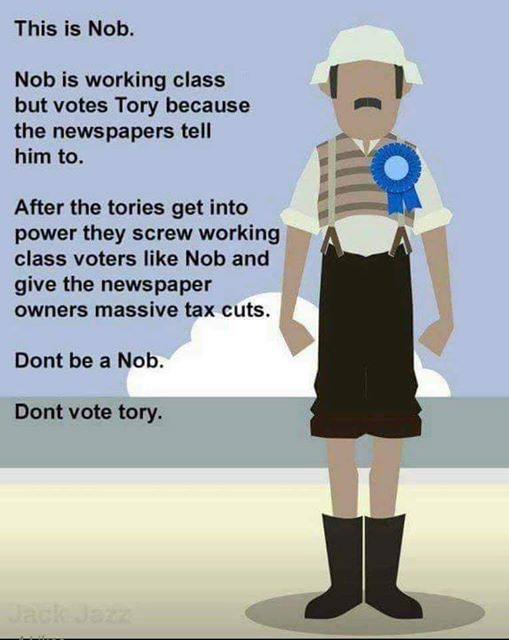
How can the British Left appeal to working class voters turned off by socialist paternalism and attracted by conservative messages of patriotism, freedom and self-sufficiency? Maybe a really sanctimonious internet meme will do the trick.

This internet meme – currently being widely circulated on Facebook and other social media by self-satisfied young lefties who think that twenty minutes spent reading HuffPost on the tube every day makes them a political guru – really does have it all.

First it has the crude pictorial stereotype of a “typical working class person” (but actually something far more akin to a Monty Python character), standing there in his workman’s garb all ready for an honest day’s labour ploughing the fields, making widgets in a factory or going down the mines – you know, the kind of jobs that people who work for creative agencies in Shoreditch think that people in Harlow or Stoke perform when they are not claiming their much-deserved benefits.

Then we have the arrogant, sanctimonious assertion that the poor fellow votes Tory only because the “newspapers tell him to”. This, of course, is in direct contrast to the enlightened sharers of the meme, who are naturally very highly intelligent, quizzical yet cynical souls who patiently weigh up every data source and review every policy position, judging every argument based on its merits before miraculously finding themselves in total agreement with whatever the Guardian, the Huffington Post or so-called comedian Marcus Brigstock happens to be telling them.

Next, we get the assertion that the Evil Tor-ees “screw working class voters” once they get into government, simply because they dare to treat the British public like autonomous human beings who might prefer it if the government got out of their way and treated them like capable adults rather than perpetual lifelong victims to be coddled and cared for by the state from cradle to grave.

And finally, of course, we get the culmination of the hilarious “word play” by which such working class voters who dare to shun their rightful masters and defenders (the parties of the Left) are labelled “Nobs”.

Honestly, it is hard to believe how a meme like this could possibly fail to deliver 100 percent of the working class vote to Jeremy Corbyn’s harmonious and very in-touch Labour Party, Tim Farron’s pinch-faced “Citizen of the World” LibDems, Caroline Lucas’s human progress-hating Greens and Nicola Sturgeon’s authoritarian, incompetent SNP.

But just for some fun, below is a more honest version of the meme, describing the kind of person who proudly shares it on their Facebook timeline – presumably in the hope of persuading the kind of working class person whose intellect they scorn, whose political viewpoints they despise and whose company they would never keep in a million years:


Jeremy Corbyn - Hipster - Middle Class Left Wing

This is Pretentious, Virtue-Signalling Douchewad. Douchewad shares glib and overwrought anti-conservative memes on social media because their unquestioning discipleship of the Guardian and HuffPost has convinced them that anybody from the “working class” who doesn’t buy into the Left’s collectivist, non-contributory welfare supporting, NHS-worshipping, success-punishing agenda must have been brainwashed by the Evil Murdoch Press into voting against their own interests for the Evil Tor-ees.

It never occurs to Douchewad that said working classes might value self-sufficiency, personal resilience and individual opportunity (with a welfare state that acts as a safety net rather than a comfort blanket) over the chance to be the lifelong, helpless and perpetually dependent sympathy project for some Social Studies or PPE-educated leftist who prances around acting like the champion of the striving classes right up until until such people dare to offer political opinions of their own (cough, Brexit).

Don’t be a Douchewad.

Actually, go for it. Be a Douchewad. Vote Labour, Green, SNP or LibDem while broadcasting to the world about what an enlightened, compassionate, woke person you are, unlike those monstrous Tories. At this point you are literally doing Theresa May’s job for her.

Knows nothing about politics - posts anti conservative memes

Support Semi-Partisan Politics with a one-time or recurring donation:

Agree with this article? Violently disagree? Scroll down to leave a comment.

Follow Semi-Partisan Politics on TwitterFacebook and Medium.

General Election 2017: An Unpredictable Race In Hampstead & Kilburn

General Election 2017 - Hampstead and Kilburn Conservatives attack leaflet - Tulip Siddiq Labour Party Jeremy Corbyn - 1

Game On in Hampstead & Kilburn

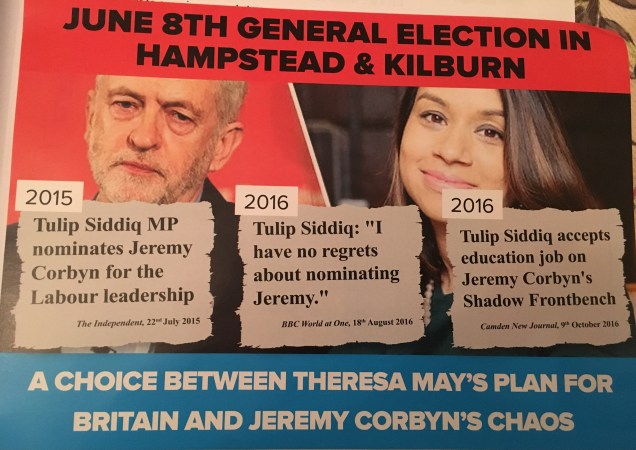
Today I received the above piece of campaign literature from the Hampstead and Kilburn Conservatives. It isn’t exactly subtle, and it perfectly encapsulates the problem facing incumbent Labour MP Tulip Siddiq, defending her slim majority of 1,138.

When Glenda Jackson was defending the seat in 2010, Labour squeaked home with a majority of just 42, making the seat the most marginal in England. And crucially, back then the seat was a tight three-way marginal, with the Liberal Democrats less than a thousand votes off the pace. In 2015, the LibDems suffered in Hampstead & Kilburn as they did nationwide, despite fielding an excellent candidate in Maajid Nawaz, and slumped to just 3,039 votes.

By way of further context, Hampstead & Kilburn voted strongly in favour of remaining in the European Union during the referendum, 75% Remain to 25% Leave,  with nearly 23,000 constituents signing an angry petition demanding a second referendum when things didn’t go their way with the first one.

So what will happen in the snap general election on 8 June 2017?

Given Labour’s current polling, and the personal polling of leader Jeremy Corbyn, by all rights Tulip Siddiq should be packing her office in Portcullis House and looking for something new to occupy her time. A majority of 1,138 puts Hampstead & Kilburn high on the Tories’ target list, and a few ministerial campaign visits and perhaps a drive-by from the PM herself ought to flip the seat, all other things being equal.

However, all other things are not equal.


The Brexit Factor

Brexit is a real factor here. Following the EU referendum I sat on the 139 bus from West Hampstead alongside numerous “March for Europe” protesters bearing placards weepily declaring themselves to be not British but European. Anger at Brexit runs deep here, as I discovered when I inadvertently carried a Brexit-themed shopping bag into the local Waitrose supermarket on Finchley Road during the campaign. The strength of pro-Remain feeling and the depths of the anger (and let’s face it – the arrogant refusal to even attempt to empathise with the opposing side) on display in this constituency throws everything up in the air when it comes to predicting general election results.


The LibDem Factor

To my mind, the key question is what happens to the Liberal Democrat vote. Nationally, the LibDems have come back from the dead, more in spite of Tim Farron’s leadership than because of it, and driven almost entirely by that party’s near-unambiguous anti-Brexit position. One knows that a successful vote for a LibDem candidate would result in an MP determined to delay or even scupper Brexit altogether were it remotely possible to do so, and this will be very attractive to a lot of voters here – the kind of people who abandoned the party in a hissy fit back in 2015 because of their coalition with the Evil Tor-ees, but who suddenly realise that they have common cause with Farron & Co. once again.


The Tory Factor

This is likely to see a number of voters – the “wetter”, less ideological and pro-EU Tories – switching their support from the Conservatives back to the Liberal Democrats. If your imagined “European identity” is the most important factor in your vote, then going LibDem is the only smart decision here.

In 2015, the Tories pandered to the constituency by running an extremely wet, centrist candidate – Simon Marcus was against the “bedroom tax” and welfare reform, and even against Trident renewal – and still came up short. I have yet to get a good sense of where 2017 candidate Claire-Louise Leyland stands on core ideological identifiers like tax policy, welfare reform, education, defence spending and civil liberties, but it seems likely that as an embryonic career politico (she stood for the Northern Irish constituency of West Tyrone back in 2015) she would generally toe the party line, perhaps diverging to the left on occasions.

Voters basing their decision on economic competence and basic credibility will probably therefore feel safe in voting Tory with Leyland on the ballot. Even though the Hampstead & Kilburn Conservatives probably don’t have any wiggle room to move further to the left, what else can centrist voters do – plump for Jeremy Corbyn? Hardly likely. That leaves the threat posed by the LibDems to the Tory europhile wing as the only real danger to be addressed.

However, just as Brexit is pushing some soft conservatives out of the Tory Party toward the LibDems, Jeremy Corbyn’s leadership of the Labour Party is likely to push a number of Hampstead & Kilburn voters away from Labour, also to the LibDems. Quite how much this will occur is hard to predict.


The Labour Factor

The more Hampstead side of the constituency has its share of trustafarian Corbynista types who think that reheated 1970s socialism is the best thing since sliced bread, but I suspect that there are far more young lefty creative professionals here who recoil from Corbyn’s haphazard management of the party and the very real chance that he will significantly hike their taxes given half a chance. There are a lot of people here for whom being seen as a “lefty” is important for social and professional acceptance and/or advancement, but who also quite like having disposable income and a functioning economy in which to spend it. Thus Jeremy Corbyn isn’t really their guy.

Meanwhile, the more Kilburn side of the constituency contains an awful lot of Corbyn true believers – as I saw when I attended a Corbyn rally at the Kilburn State Cinema during the post-Brexit leadership coup. However, there are also a number of working and lower-middle class constituents who might recoil from the kind of metropolitan identity politics that the Labour Party currently peddles, as Channel 4 news discovered when they trawled Kilburn High Road for vox pops.

In short, the Labour vote here is even more unpredictable than the Tory vote. The Guardian suggests that Hampstead & Kilburn may be part of a “metropolitan firewall” for Labour. Hmm, now where have I heard vastly over-optimistic talk of an electoral firewall before?


Too Many Moving Parts

While it is safe to say that the Liberal Democrats will exceed their 2015 vote total (despite fielding a candidate without Maajid Nawaz’s household name factor), it is hard to predict just how strongly the party will rebound, or at whose expense. Theresa May’s Brexit position (and revulsion at Brexit in general) will drive some Tory voters over to the LibDems, while lack of confidence in Jeremy Corbyn will drive some Labour voters the same way.

Will the combined effect be sufficient that the LibDems manage a miraculous come-from-behind victory, sneaking past the two big parties to snatch the seat? Unlikely. It would take an awful lot of defectors to bump up the LibDem total by such a large amount. But it is not impossible. The LibDem vote here fell by 13,452 between 2010 and 2015 just because their voters were in a strop with Nick Clegg for his decision to pragmatically enter a coalition with the Evil Tor-ees in the national interest rather than propping up the rotting carcass of Gordon Brown’s Labour government. Stung by Brexit, how much more reason have they now to return to the fold, more motivated than ever before?

However, I think it is more likely that the Hampstead & Kilburn constituency will be won by the party which manages to do the best job preventing their peripheral supporters from defecting to the LibDems. And it seems to me that the Conservatives have an advantage here.

While 2017 candidate Claire-Louise Leyland remains something of an unknown quantity (former Stronger In campaigner turned Theresa May supporter, passionate about mental health and otherwise fill in the blanks), she at least represents a party viewed rightly or wrongly as basically competent. This article is not the place to relitigate the many ways that Theresa May’s government is endangering our national interests through their glib and superficial approach to Brexit negotiations, but in a head-to-head between Tory ideologues and fratricidal Labourites you pick the swivel-eyed Tory every time.

Labour, on the other hand, risk losing their most pro-European supporters – the kind of tedious people who paint the EU flag on their face at public demonstrations and call themselves “citizens of the world” – to the LibDems, together with portions of their young professional vote and working class anti-Corbyn vote.

In other words, while even an ardently pro-European Conservative voter has many reasons to think long and hard before abandoning the party, pro-European Labour voters with little real expectation of a general election victory have every incentive to shrug and vote for LibDem candidate Kirsty Allan (while furiously humming “Ode to Joy”, naturally).

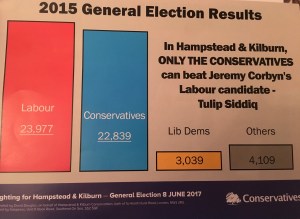
And that is why the piece of campaign literature which came through my door today should be extremely worrying for Labour’s Tulip Siddiq. The helpful chart on one side makes it look as though this is a straight-up fight between Jeremy Corbyn’s loopy, crackpot Labour Party and the Tories (thus underplaying the possibility of a LibDem fightback), while the reverse side trumpets three “damaging” headlines in which Siddiq proudly takes credit for nominating Jeremy Corbyn to the Labour leadership, refuses to concede that it was an error and then actually joins his Shadow Cabinet (while conveniently omitting the fact that Siddiq later resigned from the shadow frontbench in order to clutch the EU flag and vote against Article 50).


Where Things Stand

If this is indeed a scenario in which the two leading parties – Labour and the Conservatives – are attempting to win by losing the least number of votes to the Liberal Democrats, then the Tories presently have the advantage, and if they are smart they will do everything they can to tie Tulip Siddiq to Jeremy Corbyn in the public imagination. This will certainly be the advice/orders filtering down from Lynton Crosby and CCHQ in any case.

The more that Hampstead & Kilburn constituents are seeing and talking about how Tulip Siddiq helped inflict Jeremy Corbyn on the country and repeatedly enabled his chaotic leadership of the party (fair characterisation or not) rather than how the Tories have a childlike understanding of Brexit and an increasingly tarnished reputation for economic competence, the more likely it is that the Conservatives will prevail on 8 June and Claire-Louise Leyland will be returned as our new MP.

To survive and retain the seat for Labour, Tulip Siddiq must find a way of beating the Labour Party’s unbeatable Brexit conundrum while also distancing herself from Jeremy Corbyn – but not to the extent that it keeps the Corbynista vote at home or threatens any support she might need from the party leadership. In other words, Siddiq really has to thread the needle to prevail here.

Meanwhile, the Liberal Democrats need to make the local race all about Brexit, and nothing else. Kirsty Allan needs to paint herself as the only candidate with the courage to stand up for all of Hampstead & Kilburn’s heartbroken “citizens of the world” by acting with other LibDems as a drogue parachute on Britain’s departure from the European Union. Then she must hope that she can tempt enough such people away from their 2015-era partisan loyalties in order to pull the LibDems back to their 2010 levels of support, plus a little bit extra. It is a tall order, but not quite an impossible one.

So, all to play for at the moment. Bring on the hustings!


Update – 30 April

This interesting analysis from the Guardian and Electoral Calculus uses ICM polling to suggest that the Liberal Democrat resurgence may be a paper tiger – an attractive theme (and one eagerly picked up by the Remain-sympathising Westminster press) but with little basis in actual reality.

In particular, it shows that while a number of previously Labour-voting Remainers are indeed likely to jump ship to the LibDems, the Conservative vote looks far stickier, with 2015 conservative voters far less likely to jump ship even if they disagree with Brexit. This would seem to pour cold water on any hopes of a LibDem resurgence here.

The upshot of their analysis:

Our model sees the Tories on 422 seats, with Labour reduced to just 150, and the Lib Dems declining from 9 to 6. The Conservative majority would be north of 190. Labour would be wiped out beyond what most people are currently predicting. Leadership candidates like Clive Lewis would no longer be leadership candidates, because they would no longer be MPs.

The Lib Dems could lose a third of their MPs even after gains in places like Cambridge, with seats like Carshalton & Wallington, Richmond Park and Southport especially vulnerable. The danger in these seats is pretty clear. In Carshalton, Tom Brake won a majority of 1,510 in 2015. If a fraction of the town’s 7,000 UKIP voters return to the Tories, that majority will be wiped out. Southport is almost identically poised. Unless a major influx of Remain voters arrives from somewhere – and there’s no indication in any of this data that it will – then these seats will be lost. The Lib Dems don’t face the same problem in Richmond Park, which only turned back to the Lib Dems in December; but with a majority of less than 2,000 and a recent history of flipping, you wouldn’t bet the mortgage on a hold.

Devastating if correct.

On the plus side for Labour, there is hardly any UKIP vote in Hampstead & Kilburn to drift back to the Tories, unlike some other constituencies where the potential backwash of ex-UKIP voters to the Conservative Party threatens to sink LibDem and Labour candidates alike. This means that Tulip Siddiq’s fate as the constituency MP is firmly in Labour’s own hands, and their ability to hold on to their vote in the face of Jeremy Corbyn’s broad unpopularity.


General Election 2017 - Hampstead and Kilburn Conservatives attack leaflet - Tulip Siddiq Labour Party Jeremy Corbyn - 2

Support Semi-Partisan Politics with a one-time or recurring donation:

Agree with this article? Violently disagree? Scroll down to leave a comment.

Follow Semi-Partisan Politics on TwitterFacebook and Medium.