The Daily Toast: Tony Blair On Labour’s Future In The Age of Corbyn

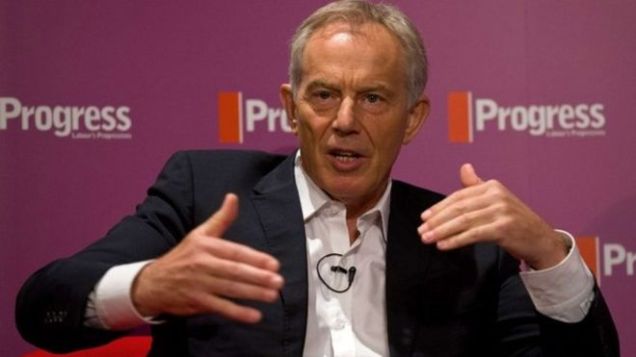
Tony Blair - Labour Leadership - Jeremy Corbyn - Annihilation

The Labour Left may dismiss him as a Red Tory war criminal, but Tony Blair raises some awkward questions about what Labour stands for in the Age of Corbyn

In the Christmas special edition of The Spectator, Tony Blair offers a typically self-aggrandising but (to the Corbynite Left) infuriatingly perceptive take on the challenges facing Labour, and why the emboldened hard Left are not equal to the task before them.

Defending New Labour’s record in government between 1997-2010, Tony Blair writes:

In a society in which fewer and fewer people thought of themselves as traditional working class, we needed to build a new coalition between the aspirant up and coming and the poorest and most disadvantaged. For the task of winning power, the emphasis on the values of community, society, family, compassion and social justice was highly effective.

But for the task of governing, we had to do more than proclaim our values, we had to have the courage and creativity to apply them anew to a changing world and make what counted what worked rather than defending interests or tradition.

That’s the rub: what does Labour stand for in a society where fewer and fewer people  think of themselves as being working class, or attach any real meaning or identity to that label? And specifically, what does the Corbynite Left of the party stand for in this new reality?

Blair points to an uncomfortable truth for Labour. Because few people, other than the Owen Jones romantic Left, still obsess about class. And though economic inequality is very much a real thing, many of us share common tastes in popular culture to an extent which was simply not the case in the 1920s or even the 1950s.

What does social class even mean when thousands of one-percenters listen to the same pop music and partake of traditionally working class interests such as football, and the technological revolution has given the masses the same access to entertainment, culture and travel destinations as the very wealthy? Does class mean anything at all in 2015, besides being a shorthand way to describe a person’s accent? Arguably not.

So what has replaced the issue of class in our public discourse? The answer, of course, is the new obsession with equality. Nebulous and never clearly defined, the Left harp on about equality without ever explaining whether they are referring to equality of opportunity or equality of outcome. But as a crude generalisation, one could say that centrist Labour strives (however badly) for equality of opportunity, while the Corbynite Left dream of a word of total, enforced equality of outcome.

What unites these two warring factions within Labour is the fact that neither side have the first clue about how to use public policy to translate their vision into reality. Centrist Labour is intellectually dead and hasn’t had an original idea since Tony Blair left office, but the rot became particularly bad during the Ed Miliband era. Miliband’s speeches were full of meaningless platitudes and waffle about creating a “fair” Britain, but shockingly free of specific policies or strategies to reshape the country accordingly.

And the emboldened Left are full of spittle-flecked condemnation of the Evil Tories, not to mention the endless, preening virtue-signalling which has become their hallmark. But they offer no solutions either, just a 24/7 Twitter stream of criticism of Tory policy. Want to know what the Corbynites want to do with taxes or welfare? Good luck finding out. Most of them don’t have a clue, and the few that do know won’t say because they know that their real vision for Britain would be hugely unpalatable to the general electorate.

The danger for Labour in failing to stand for an election-winning coalition of voters – as they did when they represented a cohesive working class in the twentieth century – is that others will define Labour to the electorate, and not in a flattering way.

Already, the Conservatives are pushing the message that Labour are the party of welfare, entitlement and anybody who is a net “taker” from society. And what can Labour possibly say to counter this claim, when they can always be found popping up on television to denounce spending cuts without announcing anything amounting to a cohesive plan of their own?

Blair closes his Spectator piece by warning:

Right now we’re in danger of not asking the right questions never mind failing to get the right answers. All of it is about applying values with an open mind; not boasting of our values as a way of avoiding the hard thinking the changing world insists upon.

Unfortunately, even the anti-Corbyn elements of the Labour Party seem utterly unable to grasp this fundamental truth. And too often, it seems that all Labour know how to do is hate the Tories and boast about their own values, rather than identifying solid policies to put them into practice.

Consider how the recent vote on military action in Syria descended into a mudslinging sideshow, with the Corbynite left accusing anyone who disagreed with their pacifist stance of being an Evil Tory warmonger. Or the way that the Labour Party rode to battle against the tax credit changes, the welfare cap and the NHS junior doctors pay dispute, enthusiastically taking up arms against the Conservatives without uttering a word about how they would address very real problems of concern to many British voters.

On these issues and more, Labour currently propose no solutions. While military intervention in Syria may well fail or lead to a worse outcome, no alternative has been clearly outlined – assuming that airy talk about negotiating with ISIS is not to be taken seriously. Ask ten Labour MPs (including the shadow cabinet) what the party proposes to do about welfare or the NHS and you are likely to get fifteen different answers.

In his article, Tony Blair repeatedly argues against focusing on ideology:

Infrastructure, housing, social exclusion – all these challenges require more modernising and less ideological thinking.

But this is misleading. Strong viable governments only come about when there is a coherency and consistency of ideology which informs the policies offered to the electorate. It’s no good just coming up with a basket of pragmatic policies – people rightly see this for what it is: electoral opportunism.

Labour need to pick an ideology, whether it is that of their leader, that of Tony Blair or that of the incoherent band of uncharismatic centrists who currently pass for party heavyweights. And then they need to show the public that real, tangible policies for government can flow through the party, shaped and informed by those ideals. Labour’s credibility is currently so low that opportunistic opposition to individual Conservative policies will deliver them nothing at the ballot box. An alternative platform for government is what’s needed.

And that takes us back to the opening question: who does Labour actually represent in the Age of Corbyn and his sulky centrist antagonists, when nearly everybody with an aspirational bone in their body is abandoning the party?
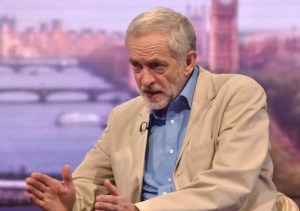
Jeremy Corbyn - Labour Party - Andrew Marr Show - BBC

Agree with this article? Violently disagree? Scroll down to leave a comment.

Follow Semi-Partisan Politics on TwitterFacebook and Medium.

Oldham, UKIP And The Soft Bigotry Of The Guardian

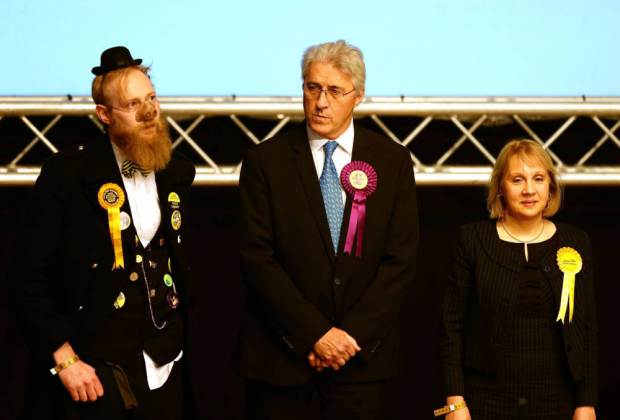
Jim McMahon - John Bickley - Labour Party - UKIP - Oldham by election

In their smugness at the Oldham by-election result, the Left are in danger of learning the wrong lessons from UKIP’s failure to gain traction

It goes without saying that the by-election result in Oldham is of great reassurance to Jeremy Corbyn and a bad, bad outcome for UKIP.

Much is already being written about how the result provides breathing space for Corbyn after a difficult week marked by the Syria vote. But one piece of commentary caught my attention, specifically this throwaway line at the bottom of the Guardian’s analysis:


Ukip can take no joy from failing to win in a racially charged area.


In this short, throwaway sentence lies all of the sneering anti-UKIP bigotry which has come to typify the new middle-class left-wing clerisy and their house journal, The Guardian.

Why would UKIP “take joy” from winning in a racially charged area? The Guardian clearly accepts this idea as gospel, but why would any decent human being be actively thrilled to profit from racial unrest and community tension?

That’s not to say that UKIP do not benefit from these conditions when they occur. But as newspapers like the Guardian usually love to point out, UKIP actually tend to do best in areas where there are fewest immigrants but where local deprivation is high. If anything, the ideal target constituency for UKIP is not somewhere awash with hardworking Polish immigrants, but a run-down, faded and economically dying coastal or northern town with few job prospects and even fewer immigrants.

No decent person would arrive in a constituency marred by racial tension, rub their hands in glee and look forward to collecting the electoral dividend. But this is precisely what the Guardian accuse UKIP of doing. Because they don’t believe it is possible to be decent and a Ukipper. First they continually equate UKIP’s opposition to unlimited EU immigration with racism, which it categorically is not, whatever the other rights and wrongs of their position. And then they write about UKIP taking joy from exploiting racial tension as though they were the BNP in tweed.

Last week while campaigning in Oldham, Labour’s shadow chancellor John McDonnell stood in front of a crowd of supporters and called UKIP (and, by extension, the party’s supporters and sympathisers) “evil”. That was an incredibly insulting, ignorant and offensive thing to say, as well as being factually inaccurate. But at least we all know where John McDonnell stands and exactly what he thinks of people who believe in democracy, quiet patriotism and the nation state.

The Guardian would never be so gauche as to explicitly say that UKIP are evil. But they don’t need to. Their typical reader assumes it to be true, and so will nod along unthinkingly at a line about UKIP being supposedly disappointed not to have successfully exploited racial division.

Unfortunately, this is just further evidence of the Left assuming a very two-dimensional, cartoon caricature image of people who disagree with them. Conservatives can never disagree with socialism due to honest differences in outlook, they must be selfish Tory Scum. And Ukippers cannot have legitimate concerns over democracy and immigration, they must simply be racist.

We saw this same inability to empathise, to think from the perspective of the other person, when Channel 4 aired their ridiculous mockumentary “UKIP: The First 100 Days”, where Ukippers were portrayed by London-dwelling middle class film makers as two-dimensional, foul-mouthed, racist simpletons with working class accents.

There’s no doubt that the Oldham by-election was a very bad result for UKIP. Either UKIP have reached a natural ceiling in their support, their current electoral strategy is wildly misfiring, or the party’s reported financial troubles are so severe that they prevented the deployment of any serious ground game and voter mobilisation effort. The reality is likely to be some combination of all three.

But sneering that UKIP lost because they failed to exploit racial tensions – as though that goal is what motivates the party, and as though Nigel Farage were just another Nick Griffin – is wrong and ultimately counterproductive to the Left’s attempt to defeat the UKIP challenge.

Lasting victory can only ever come via a thorough understanding of one’s opponent. And the Guardian’s response to Labour’s by-election victory in Oldham proves that the Left are still a long, long way from understanding UKIP.

Labour Launch their Oldham West and Royton By-election Campaign

Agree with this article? Violently disagree? Scroll down to leave a comment.

Follow Semi-Partisan Politics on TwitterFacebook and Medium.

Syria Vote: Hilary Benn, Saviour Of The Labour Party?


Despite deep division within Labour, Hilary Benn’s excellent speech in the Syria debate made David Cameron look very small indeed. But it changes nothing in terms of Jeremy Corbyn’s leadership

Is Hilary Benn the saviour of the Labour Party, the chosen one sent to lead the party out of the Corbynite darkness?

People are starting to say so – first as a result of Benn’s determined stance in the crunch shadow cabinet meeting yesterday, and especially now, after that electrifying speech in the Syria debate.

The speech was undoubtedly a good one. Here’s a key excerpt:

So the question for each of us – and for our national security – is this: given that we know what they are doing, can we really stand aside and refuse to act fully in our self-defence against those who are planning these attacks? Can we really leave to others the responsibility for defending our national security when it is our responsibility? And if we do not act, what message would that send about our solidarity with those countries that have suffered so much – including Iraq and our ally, France.

And the stirring peroration:

Now Mr Speaker, I hope the house will bear with me if I direct my closing remarks to my Labour friends and colleagues on this side of the House. As a party we have always been defined by our internationalism. We believe we have a responsibility one to another. We never have – and we never should – walk by on the other side of the road.

And we are here faced by fascists. Not just their calculated brutality, but their belief that they are superior to every single one of us in this chamber tonight, and all of the people that we represent. They hold us in contempt. They hold our values in contempt. They hold our belief in tolerance and decency in contempt. They hold our democracy, the means by which we will make our decision tonight, in contempt.

And what we know about fascists is that they need to be defeated. And it is why, as we have heard tonight, socialists and trade unionists and others joined the International Brigade in the 1930s to fight against Franco. It’s why this entire House stood up against Hitler and Mussolini. It is why our party has always stood up against the denial of human rights and for justice. And my view, Mr Speaker, is that we must now confront this evil. It is now time for us to do our bit in Syria. And that is why I ask my colleagues to vote for the motion tonight.

The House erupted into rare and sustained applause (which is apparently okay these days, so long as it is not SNP Members of Parliament doing the clapping), while social media and the blogosphere lit up with praise for Benn and hopeful talk that this speech might represent the reassertion of the centrist Left and the high water mark for the Corbynite flood.

Here’s Dan Hodges, waxing lyrical:

Hilary Benn’s speech. It is about to become the House of Commons “where were you when Kennedy was shot” moment. Where were you sitting. Who were you with. What were you thinking.

It was a truly incredible moment. He did not just captivate the House, he inverted the House. Hilary Benn did not look like the Shadow Foreign Secretary. He did not look like the leader of the opposition. He looked like the prime minister. And by extension, his party, which for the past few days has appeared broken and beaten, looked like the government.

Most amazing of all was the effect on the real Leader of the Opposition. Though we may as well now refer to him as the former leader of the opposition. Jeremy Corbyn started by looking agitated. Then he appeared uncomfortable. Then he began to shrink. It was like watching the witch from the Wizard of Oz who has just had a bucket of water thrown over her. All the talk of his “mandate”. All the talk of his legions of new activists. They were destroyed in an instant. Crushed by Hilary Benn and 100 years of the Labour party’s accumulated moral authority.

If only that were so.

Of course Hodges would talk up Hilary Benn, or anyone else from the Labour front bench who managed to sound eloquent while undermining Jeremy Corbyn – and fair enough. The praise is deserved, if somewhat excessive. People will not long remember this speech, and only people within the Westminster bubble and the highly politically engaged will have paid it any note at all. We should not allow ourselves to get carried away by the adrenaline of the moment.

While Hilary Benn’s speech may have been extraordinarily cathartic for centrist Labour types who have had little cause for hope since Jeremy Corbyn (or even Ed Miliband) won the leadership of their party, there is little reason to believe that one speech will dramatically change the fortunes of the Labour Party.

Most people do not watch parliamentary debates, even moderately iconic ones (and this one has certainly been hyped out of all proportion, with politicians and the media talking up the extension of existing airstrikes as some kind of paradigm-shifting declaration of war). Few people will have actually seen Hilary Benn grow in stature, or Jeremy Corbyn shrink a little next to him on the green benches last night.

Martin Kettle acknowledged as much in his own piece praising Benn’s speech:

Wednesday was certainly a reminder that speeches can still make a difference in politics. It was, though, a Victorian political event in a digital age. Benn’s speech was electrifying in the chamber. It triggered an instant Twitter storm among what may have been several hundred BBC Parliament watchers. But most people watch other things. Most people still don’t know who Hilary Benn is, let alone that he made a well regarded speech. And the sleepless digital news caravan has already moved on.

While it’s great that the dignified, sober part of the Labour Party briefly asserted itself – by thwarting Corbyn’s desire to whip the Syria vote, and in Hilary Benn’s speech – it does little to change the cold, hard calculus facing the Labour Party.

Jeremy Corbyn is still not going anywhere – he smilingly said as much on the Andrew Marr show last weekend. His supporters are still growing in influence within the Labour Party, and their memories are long – the current talk of deselections will not have been forgotten by the time the 2020 general election rolls around. And while Benn’s speech was excellent, it only further highlighted the division within the shadow cabinet. That’s the message that most people will take away – that on an important decision about committing British armed forces to action, the Labour Party is no longer able to come to a common position.

Hilary Benn may have displayed his leadership credentials last night, but there is no escaping the fact that Jeremy Corbyn retains firm control of the party, and that any effort to remove Corbyn will produce a nuclear backlash from the activist party base.

The Labour Party needs more than one man with a good speech in his pocket and centrism in his heart. If the goal is to recapture the centre ground of British politics, Labour needs a new wave of members to dilute and counteract the thousands of left-wing activists attracted by Corbyn. And while Hilary Benn gave a good speech on foreign policy, there is no evidence that he is beloved by the public or capable of attracting legions of centre-left supporters back to the party.

Labour Party centrists are desperate for a saviour, and that is understandable. But Hilary Benn is not the answer – not even if ten of his clones sat in Jeremy Corbyn’s shadow cabinet.

To change course, the centrists don’t need one Hilary Benn. They need one hundred thousand new people to be inspired enough by Benn’s words to pick up the phone and join the Labour Party. And that’s simply not going to happen.

The Labour Party needs a new membership before it can even begin to think about choosing a new leader.

Hilary Benn - Syria Speech

Agree with this article? Violently disagree? Scroll down to leave a comment.

Follow Semi-Partisan Politics on TwitterFacebook and Medium.

What Does The Conservative Party Stand For In The Era Of Jeremy Corbyn?

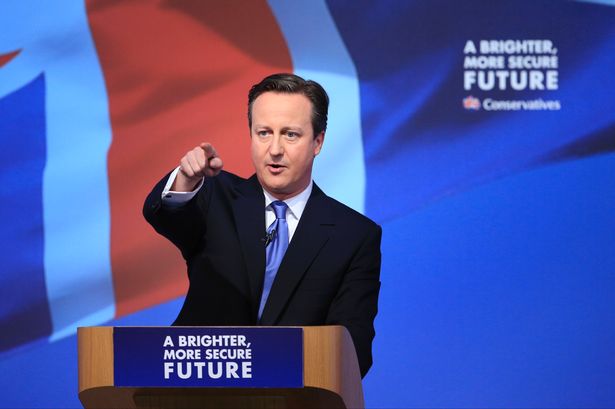
David Cameron - What Do The Conservatives Tories Stand For In The Age Of Jeremy Corbyn

With Jeremy Corbyn’s Labour Party consumed by infighting and discredited with the public, David Cameron’s Conservative government could do almost anything it desires. So why is it treading water?

What does the Conservative Party stand for in the era of Jeremy Corbyn?

What do the Tories stand for when they are barely opposed in Parliament, and consequently have virtual carte blanche to do anything they please?

The answer, apparently, is not much of anything. And it’s good to see that more people on the Right are finally starting to get impatient with the lack of conservative conviction flowing from Number 10 Downing Street.

Janet Daley gets straight to the point in her latest Telegraph column, asking what is the point of the Tories if they refuse to radically shrink the size of the state:

It is fairly clear what use the Tories have decided to make of the current lack of opposition. They will become not just the accepted party of government but the only political party that anybody would ever need. Instead of putting forward a specific, identifiable view of what government should be and how it should relate to the people, which they can offer up for debate, they will occupy all the ground, cover all the bases, be everywhere on the political spectrum at once. They will incorporate centre-Left and centre-Right, and make economic intervention live alongside the free market. They will even, as Mr Osborne did in his Autumn Statement, filch the language of enforced equality (“social justice”).

In short, if Labour is not fit to carry on a debate, then the Tories will scrap the idea of debate altogether. They will be all things to all men: the all-purpose, all-embracing, totally inclusive permanent party of government. This new single-party monopoly will incorporate every popular measure, however inconsistent or contradictory, into its amorphous programme. By the time Labour is ready to engage in election-winning argument, there will be nothing to argue about.

Instead of being emboldened by the lack of serious opposition and seeing it as a once-in-a-generation opportunity to do necessary radical things, the Tories have decided to play it for short-term political advantage. The real problems will not be addressed. They will just be fudged – and bought off with fistfuls of money.

The depressing truth is that the Tories in government have made a decision to solidify their grip on power by effectively ceasing to be a small-C conservative party at all, instead rebranding themselves as the only sane choice when the alternative is the Corbyn/McDonnell socialist double act.

This worrying lack of ideological commitment has been reinforced over and over, whether it’s the Autumn Statement that sounded more like a Gordon Brown-style moneybomb than a fiscally conservative blueprint for government, or David Cameron’s triumphal party conference speech – which even the Independent thought was shockingly centrist.

But not everybody sees it like this. Iain Martin, writing in CapX, sees opportunity in the fact that the Conservatives now essentially govern unopposed:

Corbyn’s leadership does gift the British Conservatives an historic opportunity. Not one of those “they might they win the next general election” opportunities, but the chance to capitalise on Labour’s existential crisis and create a broad-based coalition of interests that dominates the coming decades and turns the UK into an even more dynamic, market-based, technologically advanced, prosperous society.

No. The government can either lead Britain kicking and screaming towards a more dynamic, free and market-based future, or it can create a broad-based coalition of special interests, each with their own collection of whiny, selfish demands and veto rights over national policy. But it cannot do both.

Radical policies of the kind needed to cure Britain’s productivity gap and vastly improve our competitiveness are not borne out of consensual, hand-holding workshops where all of the public service unions and taxpayer funded charities lounge around together brainstorming new ways to extort taxpayer money. Nor are bold policies borne out of the ingratiating desire to please everybody all the time, and never come face to face with a critical newspaper headline.

The radical conservative/libertarian policies that this country needs in order to roll back the state – and empower the people to shape their own destiny rather than remaining vassals of the state or passive consumers of public services – will not be divined by drawing a line half way between the David Cameron and Ed Miliband election manifestos of 2015 and splitting the difference.

When Margaret Thatcher came to power in 1979 she knew that there could be no appeasement with the dismal establishment belief that the best Britain could then hope for was a smoother, more orderly century of national decline than we witnessed during the Winter of Discontent. She knew that Britain needed harsh medicine if things were to be turned around and the patient saved. That didn’t mean that Thatcher rode to battle against every pillar of the post-war consensus simultaneously – nationalised companies and the NHS remained even after her premiership – but it did mean that she was not terrified of being seen as an ideological, even polarising figure. She stood for something.

What do David Cameron and George Osborne stand for, besides keeping the Conservative Party in power and (hopefully) executing a smooth transition from Dave to George by 2020? What kind of Britain do they want to preserve, protect or change? It is almost impossible to tell, because the key decisions – as with the Autumn Statement – are always so depressingly tactical and reactive, not strategic. I was not yet born when Margaret Thatcher became prime minister, but I could describe in some detail her evolving political philosophy and accomplishments in government. By contrast, David Cameron came to power when my political engagement was very high indeed, and yet I would struggle to fill two paragraphs outlining Cameron’s ideology or aims for this country.

Even the few hints of a long-term strategy from the Conservatives – making us more secure, or paying down the national debt – only serve to highlight how far the government is falling short of these goals. The surveillance state continues to expand while the root causes of the extremist Islamist threat are barely discussed, much less tackled; the Chancellor burbles on about fixing the roof while the sun is shining, and yet the deficit is far from eliminated and the national debt continues to increase every single day.

David Cameron - Centrist

But it does not have to be this way. The Conservative Party leadership may be depressingly void of ambition and tainted with the first blush of scandal, but there are green shoots of a future conservative renaissance visible within the party.

Last week I attended a Westminster lobby event held by Conservatives for Liberty, the right-libertarian campaign group for whom I am proud to write. During the course of the evening, we were addressed by five Conservative MPs, each of whom was able to make a far more convincing case for individual liberty in ten minutes than David Cameron has made for the entirety of his premiership.

Chris Philp described himself as a “proud Thatcherite” and dared to make reference to both “The Road To Serfdom” by Hayek and “On Liberty” by John Stuart Mill.

Lucy Allan, the antithesis of a career politician, said “my view is that a real conservative is definitely a libertarian”, and proceeded to speak out against mass surveillance and the rise of authoritarianism in the name of national security.

The irrepressible James Cleverly warned against paternalistic government and the excesses of the public health lobby, saying “I don’t want to live in a world where personal choice is codified. We have a word for that, and that word is fascism”.

John Redwood made a point that the Treasury sorely needs to hear, lamenting that too many MPs “forget they are there to represent taxpayers as well as beneficiaries of state largesse” and describing the state’s overbearing presence in all aspects of life as “a wooden public monopoly that guarantees maximum inconvenience and maximum cost”.

And David Nuttal vowed that he would continue to work tirelessly “to stop the relentless march of the nanny state” and the “massive industry” which supports it.

Of these excellent speakers, Chris Philp, James Cleverly and Lucy Allan (if she stays in politics beyond 2020) are all potential leadership material for the future, particularly in a world where the official opposition is virtually non-existent and the country is crying out for a new, clear sense of direction. Any one of these rising stars have the inspiration and charisma to one day lead the party in a new, more transformational direction.

With the Parliamentary Labour Party seemingly intent on self-administering a near mortal wound with their relentless sniping and bitter briefing against Jeremy Corbyn, a bold new Conservative leader committed to the principles of liberty and a small state (the antithesis of George Osborne, who doesn’t even pay lip service to these ideals) could re-shape the Right and promote a better, more inspiring form of conservatism than the current “Blairism when there’s no money left” status quo.

The fact that David Cameron and George Osborne are watching the slow implosion of the Labour Party and conjuring up plans to woo Ed Miliband voters – rather than capitalise on this once-in-a-century opportunity to execute a real conservative agenda unopposed – reveals their worrying lack of confidence in core conservative principles and values. If the Prime Minister and Chancellor really believed in reducing the tax burden, reforming welfare, building up our armed forces, shrinking the state, promoting localism and devolving decision-making to the lowest level possible (with the individual as the default option), they could do so. They could be building a new, conservative Britain right here, right now. Virtually unopposed.

But Cameron and Osborne are doing no such thing. They simper and equivocate, and talk about fixing the roof and paying down the debt while doing no such thing, and still they attract endless negative headlines for inflicting an austerity which exists primarily in the minds of permanently outraged Guardian readers.

If Britain is not a transformed country in 2020 – with a smaller state, more dynamic private sector and greater presence on the world stage – there will be absolutely nobody to blame other than the party holding the keys to government. The party with the word “conservative” in their name. The Tories will have been in power for ten years and have nearly nothing to show for it, save some weak protestations about having fixed Labour’s prior mismanagement of the economy.

That’s not the kind of party I want to be associated with. That’s not the party I campaigned to elect in 2010, back when it seemed possible that a new Conservative administration might aspire to being something more than a moderate improvement on Gordon Brown.

The Conservatives have a choice. Presented with the golden opportunity of Jeremy Corbyn’s leadership of the Labour Party, the Tories can seize the chance to transform themselves into the party of Allan, Philp or Cleverly. Or they can continue to be the equivocating, triangulating party of Cameron and Osborne.

Yes, of course there’s no point having bold new conservative ideas unless you can stay in power to make those ideas a reality, as the Cameron/Osborne apologists would no doubt respond. But neither is there any point winning and holding power unless you actually have ideas worth implementing.

The Conservatives have the power. And thanks to the Labour Party, they are under no immediate threat of losing that power, no matter what they do in office. So where are the big ideas?

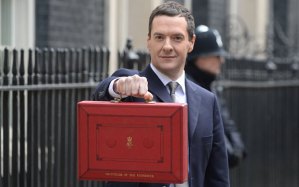
George Osborne - Chancellor of the Exchequer - Budget

Agree with this article? Violently disagree? Scroll down to leave a comment.

Follow Semi-Partisan Politics on TwitterFacebook and Medium.

Mao-Quoting IRA Apologist Calls UKIP An ‘Evil Force In Society’

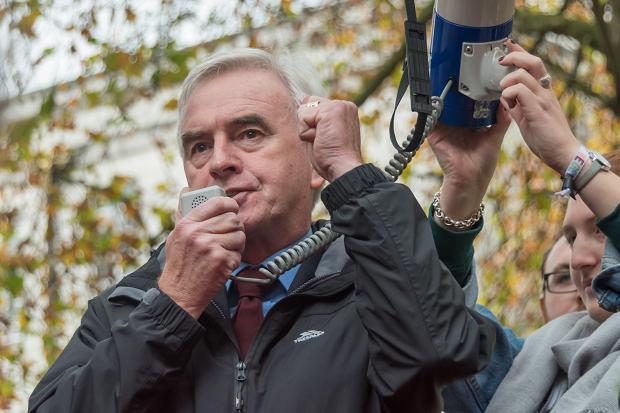
John McDonnell - UKIP - An evil force in our society.jpg

Labour’s shadow chancellor has all the time in the world for IRA terrorists, and only praise for their murderous actions. But John McDonnell thinks that UKIP voters and people who believe in national sovereignty are “evil”

While speaking at a Momentum campaign dinner this weekend, John McDonnell took a break from quoting Mao Tse-Tung and spoke instead about his view of UKIP:

But actually, winning for Labour is important but beating Ukip is just as important as well.

We can not allow what I think is an evil force within our society – that divides society often on the basis of race, often on the basis on some of the crudest policies that you can imagine any political party advocating. We cannot allow them to get any form  of toehold within our political system and that’s why it’s about defeating them but more importantly, defeating them — a clear contrast in terms of a sincere, local committed socialist candidate.

This, of course, is in the context of Labour’s loosening hold on the constituency of Oldham, where UKIP may overturn the 14,000+ majority won by the late Michael Meacher back in May.

And it’s good to know exactly what the Labour leadership thinks of those British people who believe in democracy, national sovereignty and self-determination – people who dare to be quietly patriotic instead of angrily insisting that there is any moral equivalence between Britain and the forces of terrorism, religious fundamentalism and communist dictatorship.

But of course we already knew what the Labour leadership thinks of those people. Since the beginning of Ed Miliband’s vacillating, sanctimonious leadership of the Labour Party back in 2010, the Labour Party has strutted around as though they are the sole custodians of the nation’s conscience and morals, the only ones with a soul – while the rest of us are evil Tory Scum who delight in persecuting the poor and the sick.

Even an unprecedented rejection at the ballot box in May and a leadership election did nothing to shake the confidence of the party base that they were enlightened and virtuous souls voting for society, while the rest of us were greedy, avaricious racists, voting for our wallets and a return to the 1920s. This may be the marching song of the Corbynites, but it is a self-flattering myth believed by other more moderate factions of the Labour Party, too.

As it goes with domestic policy, so it is with international affairs and Britain’s place in the world. The slavishly pro-EU stance of the Labour and the British Left are portrayed as the only “enlightened” or “moral” opinion to hold, while anyone who questions whether Britain should continue to participate in a tightening supra-national political union that nobody wanted or voted for is somehow reactionary or old-fashioned.

And that’s before we even mention immigration. The Labour Party are at their thuggish worst when they seek to smear anyone who questions the wisdom of unlimited intra-EU immigration as a bigot or racist. And John McDonnell proves that he is more than willing to do this, when he speaks about the danger of a political party which “divides society often on the basis of race”.

The irony, of course, is that whatever the other rights or wrongs of UKIP’s immigration policy, theirs is inarguably the least racist policy of all the main political parties, including Labour. The Labour Party, together with all others, are fully wedded to Britain’s continued membership of the European Union and the continued free movement of people within that union. Which is lovely for hard-working southern and eastern Europeans with no qualifications, who out-compete unqualified Brits in the labour market, but less so for highly skilled Indian, Pakistani, Chinese or Brazilian workers who may have a huge amount to contribute to our economy but face significant obstacles to working and settling here.

The Labour Party has no response to this fundamental truth. They know that their fixation on continued British membership of the European Union promotes racial discrimination against non-Europeans when it comes to immigration policy, as well as dooming underqualified Brits to a life of minimum wage drudgery. But the socialist, internationalist pipe dream of European government trumps real concern for working people every single day. So they assuage their guilty consciences by ostentatiously pretending to be great anti-racism campaigners, and accusing everybody who sees through their cheap, tawdry tricks of being tantamount to a white supremacist.

It’s cheap and it’s pathetic, and it’s being pimped out by a despicable Labour shadow chancellor who praised the use of terrorism – the bomb and the bullet – against innocent British citizens.

Six months after a general election at a time of Conservative government missteps and scandals, and Labour are struggling to defend a 14,000 seat majority in the safest of safe seats. Those votes are bleeding away in no small part to UKIP, who are convincing many wavering Labour voters that Nigel Farage’s party is now better placed to defend their interests than a Labour Party which has been captured first by substance-free Milibandism and then by Islingtonian, Jeremy Corbyn-style moral hectors.

And Labour’s response? The same response they always give when they are backed into a tight spot – shroud themselves in the white robes of virtue and scream “racism!” at anyone who points out just how morally and intellectually bankrupt they really are.

A humiliating UKIP victory in Oldham – and the banishment of John McDonnell back to the swamps of vile far-left obscurity where he belongs – cannot come soon enough.

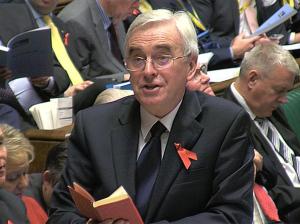
John McDonnell - Little Red Book - Mao Tse Tung

Agree with this article? Violently disagree? Scroll down to leave a comment.

Follow Semi-Partisan Politics on TwitterFacebook and Medium.