In a blast from the past, former prime minister John Major, continuing his recent trend of interventions in the British political debate, has made headlines for supposedly contradicting David Cameron’s stance on immigration.
In an apparent snub to David Cameron, the former Conservative Prime Minister said it was admirable that people coming to the UK had the “guts and the drive” to travel thousands of miles to Britain in order to improve their lives, not just to “benefit from our social system”.
Speaking to the BBC Radio 4 programme Reflections with Peter Hennessy, he continued: “I saw immigrants at very close quarters in the 1950s and I didn’t see people who had come here just to benefit from our social system.
“I saw people with the guts and the drive to travel halfway across the world in many cases to better themselves and their families. And I think that’s a very Conservative instinct.”
Of course, John Major is absolutely right. People who make the long journey to Britain in order to build a better life for themselves and their families are highly likely to have drive, ambition and work ethic in greater degrees than the average sedentary Brit. But in seeking to create a story in the middle of political slow news season, many media outlets (including the BBC) have been somewhat disingenuous in the way that they presented Major’s remarks.
The former prime minister was quite specific that he was talking about the kind of immigration that he saw first-hand, growing up and living with his family in Brixton, London. The immigration profile at that time was light years away from the current breakdown of immigration in the 21st century, and crucially did not include large numbers of European immigrants coming to Britain availing themselves of their rights under the EU’s common market. In John Major’s youth, the EU and the dream of ever-closer union was but a twinkle in the eye of the era’s political leaders.
The 1950s did see a period of mass immigration, but it was not of the same scale in absolute numbers and was mostly immigration from the Commonwealth as British passport holders born overseas took advantage of their right to settle in the mother country. To speak in praise of immigration from this era is not necessarily to contradict the government’s efforts to reduce net immigration in the year 2014. Thus it is disingenuous for the British media to take John Major’s praise of a 1950s phenomenon and translate it into criticism of 21st century policy.
The one area where John Major is absolutely right, and was not misrepresented by the media, is his claim that many immigrants do indeed have quite conservative instincts at heart. This instinct can be broken down into two types – social conservatism (particularly the case for immigrants from heavily Catholic countries) and fiscal conservatism. The worry for the Tories is that they are completely failing to tap into either of these sentiments or to build meaningful levels of support among recent immigrants.
But how can the government go about doing this while honouring its pledge to reduce overall net immigration? There is a narrow tightrope to walk between responding to public concern about the current immigration rate and making it clear to existing immigrants that they are welcome, encouraging them to assimilate as quickly as possible and then reaching out to them to turn them into Conservative voters. The margin for error is small, but it should still be possible.
Many recent immigrants come from countries that only a few decades ago struggled to escape from under the heavy yoke of Soviet communism – think Poland or Slovakia as prime examples. There is a love and appreciation for capitalism and the free market among many Poles and Slovaks that is often absent from indigenous British people, who tend to take our system for granted or focus only on its faults. And at a time when Ed Miliband’s Labour party seem to offer heavy regulation and re-nationalisation as their only policy prescriptions, the Conservatives have a ripe opportunity to show that their vision of lower taxes and greater freedom will deliver for everyone in the UK, immigrants firmly included.
There is also political capital to be made in toughening up the rules around access to benefits for newly arrived immigrants. The notion that newly arrived immigrants should be allowed to claim support from a system which they have never contributed towards is just as galling to a Polish family settled in Britain for five years and paying taxes as it would be to any UK citizen. But successfully arguing this point would require deft and precise use of language so that the media has no opportunity to run with the false trope that the evil Tories believe that all immigrants are benefit-scrounging parasites.
In short, the areas where the Conservative party (and indeed UKIP) currently alienate immigrants tend to be around the semantics and tone of the debate, whereas their actual policy prescriptions (maximum freedom, low taxes) make an ideal fit for many prospective immigrant voters.
But the Conservatives should have absolutely no expectations that the media, or the Labour Party, will lift a finger to guide immigrants toward this truth. In fact, if the twisting of John Major’s words today is anything to go by, the opposite will take place – the Conservatives will be painted as heartless and cruel in wanting to enforce stricter entrance criteria, while the many negative ways that Labour policies have the potential to hurt economic migrants will be glossed over and excused.
The irony is that British immigration policy tends to only affect new immigrants once – at the point they enter the UK to settle and work. From that point onward, once they are safely settled and working in Britain, the issue becomes largely irrelevant. Ed Miliband and the Labour Party have thus far managed to coast along on the assumption that they will win the lion’s share of the recent immigrant vote because they tend to advocate for a more laissez-faire border policy. But there is absolutely no reason why this should be the case.
The Conservatives have a compelling message to offer those recent immigrants who will go to the ballot box for the first time in 2015. It is a message of liberty and personal responsibility which should resonate strongly with just the type of people who took a huge risk in packing up their lives and moving to Britain. But for all his well-intentioned words, John Major failed to deliver that message in a way that cut through the skewed agenda of the news editors.
David Cameron and the Conservative Party urgently needs charismatic MPs and councillors to step up, refine and then start sharing this new message, this Conservative pact with recent immigrants. If they do not rise to the challenge, Labour will win the immigrant vote by default once again.
Most British people will go through life not knowing what it takes for a foreigner to become a citizen of the UK. Why would we? By accident of birth most of us had the immense good fortune to grow up in one of the greatest, most wealthy, powerful and free countries on Earth, never giving our 0.89% against-the-odds luck a second thought. We have no experience of uprooting our lives and moving to these isles from somewhere else, or of the financial and bureaucratic hurdles that must be overcome in order to settle here and acquire a British passport.
Our lack of empathy – together with widespread ignorance of the various types of immigration and the differing rules and laws governing them – makes it very hard to have a rigorous, fact-based discussion of past and present British immigration policy. Throw in the careerist short-term focus of our politicians and a sane debate becomes next to impossible, as we have seen over and over again, most recently in the 2014 European elections.
Witnessing the British immigration system close-up when you are already a UK citizen, safe and secure in your legal status, offers a dispassionate but revealing glimpse of what it is actually like to go through the arduous and often stressful process of settling permanently in Britain. If only our political leaders and opinion-setters in the media would disengage from the battle of the 24 hour news cycle for one day and take the time to see for themselves, they might have a small epiphany and (for those with genuinely open minds) become willing to think and talk about immigration in a different way, giving us the debate we need rather than the one we have.
You don’t have to travel far for this reality check because the heart of Britain’s current immigration problem is best expressed not at passport control at Heathrow airport, the migrant camps in Calais or the Polish grocery store on the high street, but in the accredited test centres up and down the country that administer the “Life In The UK” test to people seeking permanent residency or citizenship of the UK.
To be clear, the problem is not the “Life In The UK” test itself – though one could certainly quibble with the curious selection of factoids and trivialities that the Home Office proclaims to represent a sound working knowledge of modern Britain, or speculate endlessly about the percentage of immigrants who exercise their right to take the test in Welsh or Scottish Gaelic (at unknown cost to the taxpayer).
The problem is that the “Life In The UK” test takers are in the midst of a long, demanding and expensive process to settle permanently in Britain, one which an equal number of immigrants – by virtue of being EU citizens – are free to bypass altogether. This disparity of treatment, a function of Britain’s membership of the European Union, inadvertently reveals almost everything that is wrong with the current British immigration debate.
Observing the waiting room in of one of these anonymous-looking test centres as an existing, documented British citizen is a revelatory and slightly humbling experience, because here you are surrounded by people who fiercely covet something that you already have. As you enter, you are quite likely to pass by people leaving in tears because they have failed the test and have to take it (and pay the fee) again.
The prevailing mood is one of fear – the candidates sit in tense silence, often with heads bowed over test prep books, going over a few final practice questions before showtime. Did the Roman occupation of Britain last for 150 years or 400 years? Who fought in two wars against Napoleon – Horatio Nelson or Winston Churchill? And is driving your car as much as possible one of the two things you can do to look after the environment?
Softball questions aside, the bar to settle here when you come from outside the EU is set very high. To seek permanent residency or citizenship is to make a significant investment of time, energy and money towards an application which may not even be successful (and for which there is no refund in the event of rejection).
It involves divulging every conceivable detail about your life and proving to immigration officials beyond reasonable doubt that you are capable of sustaining yourself economically without becoming a burden on the state. And to top it off, your biometric information is taken and added to a database for identity verification whenever you enter or leave the country, and for any other purpose that the government may concoct in future.
A and B might be more fun.
The process by which someone from the European Union settles in the United Kingdom is rather simpler. The single market ensures that citizens of any EU member state can move to the UK to work and live indefinitely as they please, bypassing all of the steps and hurdles facing a Sri Lankan, American, Turkish or Chinese immigrant. The minimum logistical requirements consist of packing a bag and turning up.
This is great for those of us who want (and are able) to live an itinerant life or pursue a multinational European career – the benefits of the single market cannot then be overstated. But for every British person who sees only opportunity in the EU’s free movement of people, there is another working for the minimum wage who will never be offered a secondment to the Brussels office by their company, and who must console themselves with the second-order benefits of free movement – such as “delighting in the capital’s kaleidoscopic culture” or being served their “early morning coffee” by someone from Spain.
The single market in its current and unamended form may yet be in Britain’s best interest, and the free movement of people may be a net positive thing – but the British people have not had a say in the matter since the 1975 European Community referendum, and it’s quite clear that they want to have a debate about it now.
Sometimes that desire is expressed forcefully and unpleasantly – any talk from politicians and their supporters about “hordes of Romanians” or slurs about eastern European workers is rude, disrespectful and unbecoming – but it is categorically not racist. Those who disagree need to check their dictionary and contemporary history books to reacquaint themselves with the true meaning of the word.
(It should – but does not – go without saying that just because the immigration sceptics have their fair share of racists within the ranks, this does not imply or prove that all anti-immigrant positions are necessarily racist. All racists are against immigration by definition, but not all people – or even most people – with concerns about immigration are racist).
Our British democracy is neither perfect or universal. That’s how it comes to pass that people have voted in every general and European election since the 1975 referendum but still ended up in 2014 with an immigration policy widely considered unsatisfactory. We have been guided to this bad place by generations of politicians who were too cowardly to start a difficult conversation on the subject during their own tenures, happy to leave the issue on the back-burner until it is now finally starting to boil over in the age of Cameron, Clegg, Miliband and Farage.
A real leader would seize the opportunity to give the British people the debate that they want, and which has been wrongly suppressed for too long by a political consensus that cried “racism!” at the first mention of immigration. A real leader would step up and proclaim the many benefits that immigration confers on Britain, while acknowledging its wildly varying impact on different sections of society, and discussing ways to mitigate the negative aspects. A real leader – and for all he has done to start the debate, Nigel Farage has failed here – would do all of this without resorting to scapegoating or undue exploitation of people’s fears.
In short, none of Britain’s party chiefs can at present be described as a responsible leader on one of the most important political issues of the day for many people. As it stands, our country loses no matter who wins in 2015.
If Labour (who have been almost entirely captured by their metropolitan professional class at the expense of their former party base) win the general election, nothing will change and the increasingly poisonous status quo will continue. A majority within this rootless Labour Party still see any questioning of immigration as morally equivalent to owning a signed first edition of Mein Kampf, and Ed Miliband has apparently decided that refusing to acknowledge UKIP’s victories and the public sentiment behind them will somehow be interpreted as a sign of his strength and resoluteness.
If the Conservatives win, they will likely fail in their attempts to extract meaningful concessions for Britain on inter-union movement of people from the EU or changing the eligibility for immigrant access to public services and the welfare state (getting unanimous support from the other 27 member states being a dim prospect). The only way the Tories will then be able to save face is to increase the already onerous barriers and impediments to those seeking to come to the UK from outside the European Union, many of whose talents and skills we urgently need – and the last thing we should be doing is further discouraging them from coming here.
If the Liberal Democrats avoid complete electoral annihilation in 2015, their best hope is to join another coalition government, in which case their natural instincts could only lead them to solidify Ed Miliband’s “full steam ahead” policy on Europe in the event of a Labour-led government or act as a minor brake on any destructive moves to crack down further on non-EU immigration in the event of another Conservative-led coalition.
And if UKIP were to perform well and capture a significant number of seats at Westminster without toning down their overly strident rhetoric or adding any kind of nuance or acknowledgement of geopolitical reality to their own policies, the other parties would likely be so unwilling to deal with them that their MPs would simply be frozen out of the process altogether.
For all this ambivalence, Britain is a diverse and mostly tolerant land, and immigrants have played a huge part in our history and heritage. In today’s modern economy we need to be able to compete for the brightest and best of all the world’s talent, making it attractive for people to study at British universities, work for British firms and settle here with their families.
Somewhere between the onerous and expensive application process for non-EU immigrants combined with quotas and limited access to public services on one hand, and the EU single market’s wide open borders on the other, lies the best answer to Britain’s immigration conundrum. Unfortunately, Britain is not able to choose the perfect point along this spectrum because the EU mandates an all-or-nothing approach. You are either part of the European Union and a full member of the single market, or you are on the outside.
The free-movement aspect of the single market makes perfect sense in the context of the ‘ever-closer union’ that the EU’s founders envisaged would one day become a single political European superstate – indeed, such a goal cannot be realised without total, unimpeded free movement of people. But if the goal is anything less than total political union (and a vanishingly small proportion of Brits or other Europeans want to be subsumed into such an entity) then there is no real reason for the absolutist status quo, in which any controls on people coming from the EU to live and work in Britain are prohibited.
Unlike the United States of America – a real political, cultural and economic union – in Europe there are naturally occurring impediments to the free movement of people anyway, due to differences in language, culture, currency (not all of the EU is within the Eurozone) and other factors. Imposing modest, light-touch limitations in response to the wishes of the people need not bring the European Union crashing down or mean the imposition of ‘fortress Britain’.
The free movement of people within the EU may or may not remain the correct policy for Britain once all is said and done. But those who trumpet only the benefits and view any discussion of the cost as tantamount to xenophobia are guilty of shutting down an important debate whose time has come.
In this age of austerity, the main political fault line is over how much the rich should contribute versus the poor at a time of cuts to government services. Some of those who speak out most eloquently and forcefully on behalf of the poor are the same relatively wealthy middle class people who also unquestioningly support unlimited immigration.
These left-wing champions of the downtrodden would be aghast at the suggestion that their noble and high-minded political beliefs are in any way hurting the working classes for whom they presume to speak, but in supporting unlimited EU immigration and seeking to shut down any debate on the matter with accusations of racism and ignorance, they are doing just that – preserving benefits for themselves at the expense of the less privileged.
And if you personally benefit from immigration because it keeps your gentrified city neighbourhood more interesting and makes it affordable to get your house cleaned twice a week, but you don’t care about the effect – real or perceived – on those who are never likely to enjoy these benefits, how are you any better than the hated ‘bankers’ who protest higher taxes because (according to the received wisdom) they are good for society but bad for them?
The current immigration debate sees the British metropolitan left doing what it does best – high mindedly pontificating on what’s best for the country and for the less well-off in particular, and then being horrified when those same people actually express ideas and opinions of their own rather than following the script carefully prepared for them.
Immigrants studying for the “Life in the United Kingdom” exam often use the official Home Office approved test preparation book, which contains 408 practice questions to rehearse before subjecting themselves to the real thing. As a result, some newly-arrived immigrants find themselves better versed in fundamental aspects of British life than those of us who have lived here our whole lives.
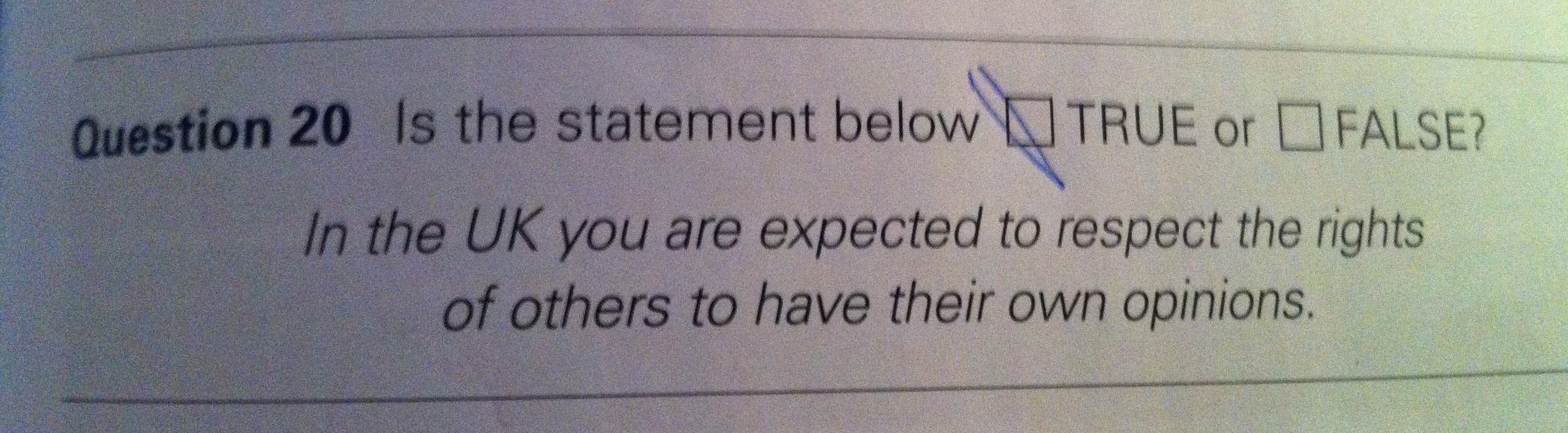
Those politicians, journalists and activists who still seek to police the immigration debate and preordain its outcome could do worse than studying up on this one, known to every new British citizen:
Is the statement below TRUE or FALSE?
In the UK you are expected to respect the rights of others to have their own opinions.
If you enjoyed reading this article, please take a second to LIKE or SHARE it on social media using the buttons below. Help to spread the word and continue the debate.
The media has rightly devoted a lot of time and attention today to the fact that David Cameron’s authority was challenged by over 90 Conservative backbenchers who supported an amendment to the Immigration bill to make it harder for foreign criminals to avoid deportation by appealing to the European Court of Human Rights on the grounds that their right to a family life would be infringed.
Foreign criminals can stay; British citizens merely suspected of terror offences to lose their citizenship.
The BBC’s Nick Robinson does a good job of unpacking the ludicrous exercise in Game Theory that led the various Conservative, Labour and Liberal Democrat factions to adopt their particular stances:
The home secretary believes that a proposal to give her stronger powers to deport foreign criminals is illegal, unworkable and may, in fact, lead to fewer deportations.
So, Conservative ministers have been ordered by the prime minister not to oppose it.
Yes, you read that right.
Despite all of the above David Cameron has told his troops to abstain rather than face headlines about a massive Tory revolt. He is said to be sympathetic to the aims of the backbench rebels who have refused to back down.
I personally fail to see why the Home Secretary or any elected politician should be personally involved in deciding deportation cases, in much the same way that I find it bizarre that they can determine whether or not to release prisoners serving life sentences. These matters should be non-political and sit with the judiciary, and while I am in favour of deporting foreign criminals I would much rather achieve this end by empowering judges and allowing them to apply clear legislation stating that criminal conviction of a non-citizen would result in the rescinding of the right to reside in the UK than by conferring even more powers on the Home Secretary to make life-and-death decisions over individual cases. But this is by the by.
The chicanery and slapstick attempts by the Home Secretary Theresa May and the party leadership to first outmanoeuver and then placate the rebellious backbenchers, some of which I personally witnessed from the public gallery of the House of Commons, are certainly newsworthy. But there is a real danger that the story will be framed as being primarily about Cameron’s leadership, or the potential impact of intraparty fighting on the Conservatives’ prospects at the next election, when something much more fundamental is also taken place. Namely, the fact that the bill, as it stands, would give government the power to strip a naturalised British citizen of their citizenship on the mere suspicion of being engaged in terrorist conspiracy.
[Deputy Prime Minister Nick] Clegg said he supported the home secretary’s proposal to strip naturalised British citizens of their citizenship if they are judged to present a threat to national security. It would even apply to those who have no other citizenship, rendering them stateless.
He said the current laws had become a “passport for endless games in the courts to prevent people being deported that should be.
“We are tightening up the way the courts can interpret article 8, the right to a family life, so it cannot became an excuse for unjustified legal procrastination.”
Speaking on LBC’s Call Clegg, he added he knew the plan to make some naturalised British citizens stateless was controversial, but justifiable in a very small number of cases. He said the revocation of British citizenship “would apply in cases where individuals pose a real threat to the security of this country”.
“Judged” to present a threat to national security, but not convicted of any crime by a jury to back up the allegation. Perhaps this is just the inevitable next step given the fact that the British government for a long time also advocated control orders to keep terrorism suspects in a state of legal and personal limbo without giving them full legal due process.
Of course, Nick Clegg is eager to assure us that any cases of citizenship revocation will be extremely rare and only conducted in the gravest of circumstances – but since those circumstances would always be opaque to the general public, any words that he utters in support of this draconian and inhumane measure can be distilled into the much shorter phrase “just trust me”. He has given the British public no good reason to do so. And if the number of cases is really so small, what exactly is the compelling reason that they cannot have their day in court to determine their guilt or innocence of conspiring to commit terrorist acts? By Clegg’s own admission it certainly can’t be concern for the workload of the courts.
Fortunately the ever-watchful eye of Liberty, the National Council for Civil Liberties, picked up on what is happening and issued a stern public rebuke to the government, for what little good it will do:
Shami Chakrabarti, director of Liberty, said: “Liberty always said that terror suspects should be charged and tried. First politicians avoided trials for foreign nationals; now they seek the same for their own citizens.
“This move is as irresponsible as it is unjust. It would allow British governments to dump dangerous people on the international community, but equally to punish potential innocent political dissenters without charge or trial. There is the edge of populist madness and then the abyss.”
It is tragically ironic that, if the bill passes in its current form, the law will grant a convicted foreign criminal the right to remain in the UK and avoid deportation because of a fictitious invented “human right” to remain with their family in a country not their own, while a legal, naturalised British citizen merely suspected of a terrorism offence stands to have their British citizenship revoked, potentially rendering them stateless.
Surely this is one civil liberty infringement and constitutional idiosyncrasy too far, even for our increasingly draconian, secretive national security State?
Note – The BBC’s Mark D’Arcy has an excellent explanation of the parliamentary rules and procedures which influenced the outcome of today’s parliamentary antics. The bill is currently at Report stage, the only opportunity for the entire House of Commons to debate the bill in detail and propose amendments, and at this stage it is essentially left to the whim of the Speaker, John Bercow, to determine which amendments are debated and vote on in the limited time available. If this doesn’t seem to you like quite the best way to scrutinise and amend new legislation, you are not alone in your thinking.
Four years of painstaking research have finally revealed the gaping black hole in Britain’s finances, the reason why the British state has grown so large and expensive yet manages to achieve such mediocre outcomes in so many areas.
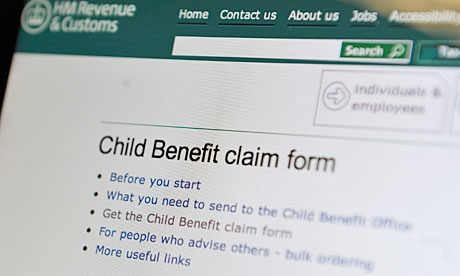
No, it wasn’t throwing ever larger sums of money at the same inefficient education and healthcare delivery models. Nothing to do with a rigid retirement age at a time of ever increasing life expectancy. It turns out that the problem was providing multilingual access to benefit claim forms, and translating services to immigrants who lack fluent English. Armed with this knowledge, Iain Duncan Smith, the Work and Pensions secretary, has drafted a clever scheme to fix everything.
The Daily Mail, for whose readers this policy was so transparently and cravenly crafted, summarises it thus:
In a radical bid to slash Britain’s benefits bill, the Prime Minister intends to stop printing welfare paperwork in foreign languages and prevent claimants using taxpayer-funded translators at benefits offices.
The move – which would also hit British residents who cannot speak English – was due to be announced tomorrow, but has been delayed following a row with Nick Clegg.
Tories hope that axeing foreign-language versions of documents explaining how to claim benefits would make it harder for immigrants such as newly arrived Romanians and Bulgarians to cash in on the UK’s benefits system, encourage others already here to learn English – and save money spent on translators.
Anyone who thinks that taking this action will slash Britain’s annual welfare bill needs to go away, look at the figures and then maintain a long period of dignified silence. Social security spending (pensions and benefits) will cost Britain £256 billion in 2014. How much of that vast sum do people really think goes toward printing forms in multiple language and hiring translators? Who, exactly, is the Work and Pensions secretary trying to fool?
Just use Google Translator, that will save some cash.
If you want to do the things that IDS proposes to save some money around the edges then that’s one thing, but to enact them and claim that it will “slash the welfare bill” is misleading and disingenuous. Iain Duncan Smith is a talented minister with otherwise good ideas, and it is discouraging to see him wasting his efforts proposing ideas such as this when he knows full well that they will go nowhere towards solving our fiscal problems.
Of course, there are doubtless some lazy immigrants who are perfectly capable of learning English sufficiently well to be able to function independently, and yet who choose not to do so for one reason or another. Where this refusal is rooted in a stubborn unwillingness to integrate into British society and desire to remain part of an insular and closed community, this is a particular cause for concern, because integrating new immigrants effectively into our country is vital for social, law and order and national security reasons. But threatening to cut benefits from immigrant claimants is highly unlikely to either solve the problem of people persistently failing to learn English or dramatically cut the welfare bill.
If the Tories’ concern about new immigrants struggling to integrate into British society is genuine, then they should propose some positive ideas to help promote inclusion and cohesion, and suggest ways to make it easier for new arrivals to learn their new native language. There should be some carrot (even if the incentive is of the cheapest kind, such as pointing people in the direction of existing English courses at local colleges and institutions) as well as the stick of cutting off access to benefits. If they are not seen to tackle the problem from both ends, many people (myself included) will suspect them of cynical motives.
And cynical they are. This is a proposal designed entirely to grab headlines, but more worryingly than that, it is a proposal designed to win the approval of the Daily Mail. If the Conservative party is really gearing up for 2015 general election mode by pandering to the prejudices of their base rather than reaching out to those whose instincts are to vote Labour or Liberal Democrat (who are likely to roll their eyes at policy announcements such as this) then there is grave cause for concern at their electoral prospects.
All is not yet lost – the Conservative Party has recently shown some signs of attempting to reach out beyond their core supporters. But, as so often, we see these small steps forward immediately neutralised by the two steps back of the let’s-bash-the-immigrants rhetoric. Shedding the label of the “nasty party” is not helped by policy proposals such as this.
The sardonic response from the Liberal Democrats puts it best:
“These are proposals from the Tories which haven’t been agreed in Government,” [the LibDem source] said.
“We’ve already taken significant steps to make sure we all enjoy the right to move and to work, but not a freedom to claim.
“We will look at these proposals, but would prefer the Tories to agree policies in Government rather than chase Ukip’s tail via the Sunday papers.”
The Conservatives would do well to heed this particular pearl of wisdom from their inexperienced junior coalition partners.
James Kirkup, writing in The Telegraph, asks “How much would you pay to reduce immigration?”, in an article praising UKIP’s Nigel Farage for making the supposedly bold proclamation that he would rather be slightly less well-off in return for lower levels of immigration into the United Kingdom – in other words, that he is willing to pay out of his own pocket to reduce immigration.
[Farage] added: “If you said to me, would I like to see over the next ten years a further five million people come in to Britain and if that happened we’d all be slightly richer, I’d say, I’d rather we weren’t slightly richer, and I’d rather we had communities that were united and where young unemployed British people had a realistic chance of getting a job.
“I think the social side of this matters more than pure market economics.”
Kirkup, who considers this to be a “genuinely interesting” way for Farage to reframe the debate, phrases the quandry this way:
How much economic growth should we give up? How much of your fellow citizens’ prosperity, are you willing to sacrifice in order to cut the number of people entering Britain from abroad?
To be precise, how much — to the nearest £1, please — would you pay to reduce immigration?
Unfortunately, by accepting Farage’s premise that immigration is harmful in all spheres other than the economic – and the idea that immigration must automatically be a negative thing, a cause for concern or something to be ameliorated.
This is yet another argument where the two opposing sides seem to argue back and forth over an irrelevant distraction rather than the main issue. Why is it that immigration has, at times, led to divided communities and fractured society? Why must it be that immigration puts the young British unemployed at even more of a disadvantage? If only we could begin to address and turn around these key issues, surely the matter of net immigration into the UK would cease to be of almost any importance at all.
For example, we should re-examine how Britain can better to integrate and assimilate new immigrants into our society, avoiding the mistakes of countries such as France and learning from those such as the United States. How can we ensure the right balance between providing support and assistance to help new arrivals find their feet and integrate into society, and using “tough love” where necessary to ensure that the state is not enabling immigrant communities to isolate and refuse to become part of British society?
We should take a long, hard look at our education system and parenting culture and ask why it is that a young adult born and raised behind the iron curtain in an economic, political and social environment far less prosperous and nurturing than that of the UK is so often preferable, in the eyes of so many reputable and rational employers, to a British-born young jobseeker who has enjoyed all of these advantages.
And yes, we should look at the topics of welfare and the terms of our relationship with the European Union, and decide whether allowing brand new economic migrants to our shores to benefit from the welfare system that the rest of us have paid into over a longer period is really a cost that we are willing to continue to pay in order to maintain our EU membership in its current form.
None of this debate will happen as long as we accept the premise that economics aside, immigration is an inherently bad thing – to shrug our shoulders and go along with Nigel Farage’s line of reasoning, as James Kirkup and others do so willingly.
How much would people pay to have an informed debate about the real social, educational and economic issues around immigration? More than our politicians and media seem to realise.






 Semi-Partisan Politics