The Junior Doctors’ Strike Is A Tawdry Pay Dispute, Not A Principled Defence Of The NHS

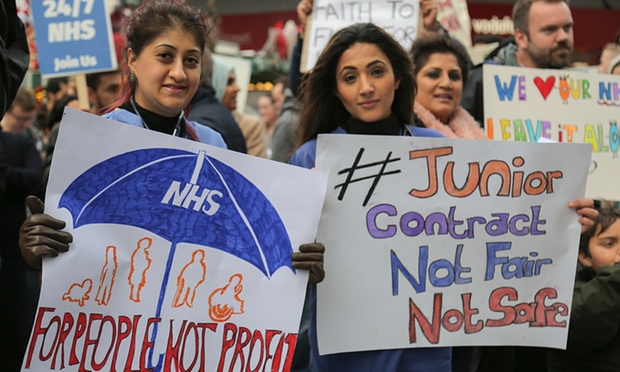
NHS Junior Doctors Contract Strike

This strike is about money, not patient safety or the future of the NHS

James Forsyth speaks sense on the naivety and arrogance behind the ongoing junior doctors’ strike:

This walk out, the first all-out strike since the NHS’s creation, isn’t over some issue of high principle. It’s about money. The main sticking point in their negotiations with the government is that Saturday shouldn’t be treated as a normal working day.

The BMA’s suggestion at the weekend that it was prepared to call off the walk out if the government didn’t impose the new contract, but instead pilot it for a while, suggests that even the doctors themselves fear they’ll lose public sympathy by going ahead with this strike.

Yes. The fact that the final sticking point in negotiations is around money reveals all of the previous lofty, high-minded concerns about public safety and “tired doctors making mistakes” to be the cynical campaign rhetoric that it is.

Forsyth hammers home the point on pay:

Under the government’s offer, those junior doctors who are on duty one Saturday in four will receive a premium pay rate of 30 per cent. This means they are, on average, getting paid more for working on Saturdays than nurses, midwives and paramedics. The proposed deal is also more generous than what firefighters and police officers get for doing their job on a Saturday. This is hardly grounds for a walkout that will inevitably put lives at risk.

Junior doctors are right that they are paid less than doctors in some other countries. But this is, in large part, because the state has heavily subsidised their education. By the time a doctor has finished their foundation training, the state has already spent a quarter of a million pounds on them.

Until doctors are prepared to pick up more of this tab themselves, they shouldn’t complain that some of those working in other health systems are paid more than them. Indeed, it would be sensible of the state to actually require medical students to commit to working in the NHS for a certain number of years before funding their training—something that it doesn’t currently do. Junior doctors should also remember that if they stay in medicine and become consultants, they will find themselves in the top two percent of earners in this country.

This blog is no fan of the current Conservative government and no great proponent of the latest NHS reforms. But for the sake of decency, this strike needs to be broken. And then we need to have a long, hard national conversation about why an advanced democracy like Britain is facing a national strike of any kind in the year 2016.

Hint: if we did not still have a monolithic nationalised health service – the fifth largest employer on the planet serving the 22nd largest country by population – we could never be in the ludicrous position of suffering a strike of all the junior doctors in the land. Doctors would not all share the same employer, patients would not all rely on the same medical service and we would all be spared this drama.

Something to mull over as the accusations and counter-accusations fly.


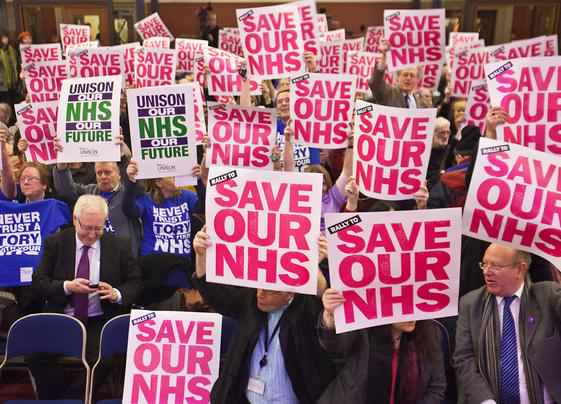
Save Our NHS

Agree with this article? Violently disagree? Scroll down to leave a comment.

Follow Semi-Partisan Politics on TwitterFacebook and Medium.

Responding To The Junior Doctors’ Strike

An inspiring (if unattainable) example from across the Atlantic

How to respond to a national walkout by government employees who perform a critical job for a large organisation, and who cynically advance their demands for more money under the false banner of concern for public safety?

Ronald Reagan offers us one blueprint, from back in that dim and distant time when both Britain and America were blessed with leaders who (for their various faults and blind spots) were not afraid to lead, and to take bold and decisive action when necessary.

This is the speech Reagan gave in August 1981 when PATCO, the American air traffic controllers union, called an illegal strike (federal workers being prohibited from striking under the Taft-Hartley Act) demanding, among other things, a 32-hour work week:

This morning at 7 AM the union representing those who man America’s air traffic control facilities called a strike. This was the culmination of 7 months of negotiations between the Federal Aviation Administration and the union. At one point in these negotiations agreement was reached and signed by both sides, granting a $40 million increase in salaries and benefits. This is twice what other government employees can expect. It was granted in recognition of the difficulties inherent in the work these people perform. Now, however, the union demands are 17 times what had been agreed to – $681 million. This would impose a tax burden on their fellow citizens which is unacceptable.

I would like to thank the supervisors and controllers who are on the job today, helping to get the nation’s air system operating safely. In the New York area, for example, four supervisors were scheduled to report for work, and 17 additionally volunteered. At National Airport a traffic controller told a newsperson he had resigned from the union and reported to work because, “How can I ask my kids to obey the law if I don’t?” This is a great tribute to America.

Let me make one thing plain. I respect the right of workers in the private sector to strike. Indeed, as president of my own union, I led the first strike ever called by that union. I guess I’m maybe the first one to ever hold this office who is a lifetime member of an AFL – CIO union. But we cannot compare labor-management relations in the private sector with government. Government cannot close down the assembly line. It has to provide without interruption the protective services which are government’s reason for being.

It was in recognition of this that the Congress passed a law forbidding strikes by government employees against the public safety. Let me read the solemn oath taken by each of these employees, a sworn affidavit, when they accepted their jobs: “I am not participating in any strike against the Government of the United States or any agency thereof, and I will not so participate while an employee of the Government of the United States or any agency thereof.”

It is for this reason that I must tell those who fail to report for duty this morning they are in violation of the law, and if they do not report for work within 48 hours, they have forfeited their jobs and will be terminated.

Obviously such a feat could not be repeated by the British government in its dealings with striking NHS staff – though the case for banning strikes by national public sector workers becomes more compelling by the day.

But if repeating Reagan’s actions are not possible for political and logistical reasons (firing 11,000 air traffic controllers is much easier than firing 55,000 junior doctors, not to mention the fact that the junior doctors are operating within the current law), at least we might hope that the government will act in the spirit of Reagan. And in the spirit of Reagan, the government should refuse to give any further ground to striking public sector workers who are willing to cynically jeopardise public health in a dispute which now rests primarily on the question of Saturday payand is certainly nothing to do with patient safety or the continued existence of the NHS.

This blog firmly believes that the NHS model is broken and than a system conceived in the 1940s is barely adequate to the demands of the 2010s, and will be hopelessly inadequate to the demands of the 2040s. If we are to persist with a public option, then there is no reason why healthcare should continue to be provided by a monolithic government organisation, the fifth largest employer in the entire world (with all the baggage, internal politics and resistance to change which that stunning fact implies).

There is no good reason why we cannot look closely at the healthcare systems of countries such as France, Germany, Japan or Canada and redesign our system accordingly – if only we could rediscover our sense of national ambition and shed our increasingly unwarranted pride in the NHS. We could even still call the new healthcare system “the NHS” if our cult-like attachment to the brand really runs so deep.

The time is long overdue for Britain to have that national conversation, endlessly kicked down the road by politicians terrified of upsetting nervous voters and governments which have proved constitutionally incapable of daring mighty things. But first we need to overcome this peculiar, anachronistic industrial dispute – one which belongs more comfortably in 1976 than 2016 – and end the junior doctors’ strike, by imposing the current contract offered if necessary.

And in that effort, let the spirit of Ronald Reagan guide Jeremy Hunt.


NHS Worship - London Olympic Games 1

Agree with this article? Violently disagree? Scroll down to leave a comment.

Follow Semi-Partisan Politics on TwitterFacebook and Medium.

Is This The Beginning Of The End Of Britain’s NHS Idolatry?

NHS Logo - Cross - National Religion - Worship - Idolatry

Are we witnessing the high water mark of mindless NHS-worship?

Regular readers will know that this blog is a constant critic of the British cult of NHS-worship. Not of the NHS specifically, but of the fawning, servile and uncritical way in which the National Health Service is viewed and debated in the public discourse.

Whether one prefers state-provided everything and harbours intense suspicion of privatisation, or yearns for the innovation and competition that the private sector (at its best) can bring, any reasonable person should be sickened by the stultifying atmosphere which has surrounded the NHS debate for decades. And yet we tolerate it, even demand it from our leaders.

It is not healthy that in this one specific area of our national life, politicians cannot make important criticisms without feeling obligated to counterbalance the truth with obsequious words of praise. And our stubborn refusal to look around the world for guiding examples of best practice in healthcare delivery has all the arrogance of American exceptionalism, in blinkered defence of something which is very far from exceptional.

At times, this blog has felt like a very lonely voice in the wilderness on the subject of our true national religion. The NHS being the supercharged third rail of British politics that it is, few mainstream commentators (and almost no serious politicians) have traditionally shown any willingness to touch the issue.

But there may now be a few encouraging signs that we have reached the high-water mark of our NHS adulation; that even the NHS’s most ardent supporters are coming to realise that making every arcane debate about healthcare policy or junior doctors’ pay a screeching matter of “Saving Our NHS” is not in their interests or those of British healthcare in general.

Simon Jenkins has a piece in the Guardian in which – shockingly, for that publication – he admits that “our adoration is killing the NHS”:

People may dislike other public services. They see the police as dodgy, train drivers as bolshy, utilities as run by crooks. But the NHS “saved my mum’s life”. So leave the doctors and nurses alone. Just give them money. Give everyone money.

Nothing dents this love. Day after day, the headlines scream of NHS woe. Last month half of all doctors said they offered a worsening service. Eleven thousand heart patients “die because of poor care”. The NHS wastes £12bn on a computer system that “does not work”. One in four hospital staff feels “harassed and bullied”. Three-quarters of them tell care quality commissioners that “patient safety is now at risk”. If the NHS is to the British, as former chancellor Lord Lawson said, “not a service but a religion”, the religion must be juju.

These are the words of someone who is frustrated (as well he should be) by the fact that our blind, unthinking adulation of the NHS – the healthcare equivalent of an ingratiating politician naming Nelson Mandela as his hero – prevents us from recognising the real and intractable flaws in the system.

Jenkins continues:

The NHS’s carapace of love has to be its biggest danger. On Wednesday it was revealed that, despite last year’s Francis report on whistleblowing, not a single sacked NHS whistleblower has been re-employed or manager reprimanded. Instead doctors are eulogised for the “daily miracle of saving lives”. This is despite the OECD reporting that they save fewer lives per head than insurance-based health services in Germany, Switzerland and the Netherlands. Britain’s record on tracing cancer is dreadful.

Doctors are in the business of saving lives. It is their job. Firefighters are not “miracle workers” for putting out fires, or teachers for getting pupils through exams. Healthcare may benefit from fear of death and disease, and we are rightly appreciative of those who relieve it. But when other professionals such as social workers or carers of the elderly fail, they are publicly excoriated. Why is the NHS immune?

Jenkins goes on to talk about the strange sense of security which comes from the “familiar NHS surgery”, with its “wartime air” and feeling of national solidarity. This is something that even I, a heathen free marketeer, have experienced and can relate to. Walk into a large NHS hospital in any of Britain’s big cities and you feel as though you have entered the belly of the beast – a vast, thrumming, living organisation of buildings, computers, machines and human beings, which functions according to its own time zone and alien protocols.

When you are sick, being enveloped in the warm embrace of this organisation – knowing that you will experience the same colour schemes, uniforms, routines and brisk bedside manner anywhere in the country – can feel quite reassuring. And because we tend to be at our most vulnerable when we encounter the NHS – when something is wrong with us, or with a loved one – we crave that reassurance.

But with the power dynamic thus skewed in favour of the state (providing healthcare) and against us (unwell, and receiving it), we have a natural tendency to be uncritically grateful for whatever service we are given, rather than subjecting it to the proper scrutiny of a consumer. Something usually has to go very, very wrong in order for us to complain.

If the NHS delivered your baby, set your broken arm, diagnosed and effectively treated your cancer or gave you a heart and lung transplant, you are likely to be well-disposed toward the NHS. You may even find yourself cheering along when populist politicians shoot for cheap applause by lavishly praising and vowing to defend it from mysterious external threats (usually in the form of the Evil Tories).

Never mind the fact that healthcare systems in developed countries around the world deliver babies, set broken limbs, treat cancer and transplant organs every day, to rich and poor people alike. The NHS Industrial Complex has been very effective in conflating “healthcare” and “the NHS” in the public mind, so that many people genuinely seem to believe that if they experienced the same medical condition as a citizen of another country, they would now be either bankrupt or dead. It is masterful propaganda, but it is most certainly not conducive to measured public debate about healthcare policy.

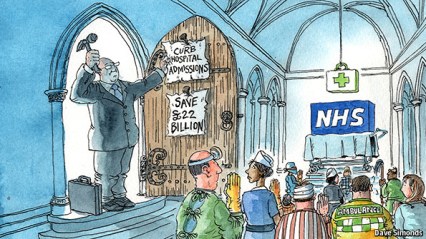
NHS - National Religion - Cartoon

This is why it is good to see the first cracks starting to appear in the massive metaphorical golden idol of St. Aneurin Bevan of Tredegar, which the British people now worship like those before us worshipped Baʿal. Most encouraging of all comes this recognition from Simon Jenkins that “free at the point of delivery” has become more of a quasi-religious chant than unquestionably wise healthcare policy:

I have never understood why so many self-inflicted “health needs”, such as sports injuries, drunkenness and overeating, should be charged to the state. Some fire brigades are charging for careless callouts. Mountain and lifeboat rescues often request “contributions”. Free at the point of delivery has long been a proud boast of the NHS. But that is policy, not papal doctrine.

The drug companies always made sure “free” did not apply to NHS prescriptions. With demand rising exponentially, supply of care must be rationed by something: if not by some form of payment and insurance, it will be by queueing and quality.Last year it emerged that more than 300,000 patients waited in ambulances for more than half an hour just to get into A&E.

It is ironic that Jenkins’ questioning article is published in the Guardian, the newspaper which has arguably done the most harm in terms of inculcating a blindly and aggressively worshipful attitude toward the health service, to the total exclusion of any of the radical thinking for which that paper claims to stand. Only last week, the Guardian concluded a month-long “celebration” of the NHS in which journalistic scepticism and intellectual curiosity were suspended and replaced with a barrage of articles telling the NHS-supporting Left everything that they want to hear. I critiqued their “This Is The NHS” series here and here.

But here we have – from an NHS supporter, and one who says “there is nothing wrong with loving the NHS” – an admission that rationing by price in some certain situations can actually be preferable to our current settlement of rationing by time and quality. This is a breakthrough indeed. If only we could also break the Left’s demand for uniformity at all costs (mediocrity for all rather than excellence for any) then we would really be getting somewhere.

I must admit that I thought things would have to get a lot worse before we finally turned a corner in our misplaced reverence for the NHS – more scandals, more falling metrics, much longer waiting times. But the current level of bipartisan NHS fervour (partly whipped up by the BMA and junior NHS doctors, who are cynically pretending that their current dispute with the government over pay and conditions is actually about patient safety or, laughably, the very survival of the NHS) is clearly proving to be too schmaltzy and blindly uncritical even for some stalwart NHS defenders.

Perhaps the shrieking of the NHS priests and priestesses is most like the closed-minded rhetoric of the Biblical creationists, who shout ever louder and demand ever more concessions to their peculiar sensibilities the more their fundamentalist beliefs are debunked and discredited, eventually pushing the embarrassed moderates away.

Perhaps we are witnessing all of this sound and fury – the constant and strictly enforced praising of the NHS model, on pain of political death – because the NHS Clerisy know that theirs is ultimately a losing fight; that the British people will not long persevere in their belief that the only possible choice is between the NHS and dying in the street of untreated TB.

Perhaps, then, there is real (if still very limited) hope for genuine healthcare reform in Britain, after all.

Save Our NHS

Middle image: Cartoon by Dave Simonds, published in The Economist

Agree with this article? Violently disagree? Scroll down to leave a comment.

Follow Semi-Partisan Politics on TwitterFacebook and Medium.

NHS-Worship, Non-Contributory Welfare And Britain’s Idea Of Fairness

Save Our NHS

Blind devotion to our indifferent, non-contributory welfare state plus a warped definition of “fairness” are holding Britain back

The Guardian’s ongoing “This Is The NHS” series is really pushing my buttons at the moment. The newspaper is clearly particularly proud of their feature project, which makes the series’ blatant NHS hagiography and stunning lack of intellectual curiosity especially infuriating to read.

As a journalistic exercise it has been utterly contemptible, constantly telling people what they want to hear – that the NHS saves lives (as though that were not a feature of every healthcare system), that it employs many hardworking people – rather than what they need to hear in order to make an informed, dispassionate judgement about whether the UK’s unique approach to healthcare delivery is sustainable in the future.

Any and every inconvenient fact which suggests that the NHS is not in fact the “envy of the world” is immediately shot down in the series of articles – like when the Guardian quotes a professor of European public health‘s dismissal of reports criticising the NHS as being “market oriented”, as though the accusation automatically ends the argument, and as though we could not have foreseen that opinion by simply reading his job title.

For the better part of a month now we have been treated to statements such as this, comparing the NHS to other healthcare systems and – unsurprisingly – finding it to be the best in the world:

A mission statement set in 1948 for a universal service free at the point of use is under strain like never before. People are still able to see a GP free of charge – though booking an appointment is becoming harder. It will cost nothing to call out an ambulance and go through A&E, to undergo chemotherapy or major surgery. And yet about 11% of the population prefer to pay for private health insurance.

“And yet”! And yet despite having this state-provided, socialist wonder on our doorstep, an astonishing 11% of the population elect to pay for supplementary coverage. Could it possibly be because cancer outcomes in the UK are about the worst in the developed world, or because getting to see the specialist who can actually treat your condition requires going through the gatekeeping step of booking a GP appointment, often with a month-long wait before each step? No. The people who pay to go private are clearly just ungrateful, verging on insane, to want to circumvent such a benevolent system.

Yesterday, this saccharine coverage – and the Guardian’s publication of a parsimonious little online calculator enabling readers to calculate how much they “cost” the NHS – prompted me to write:

But of course we all know exactly why the Guardian is so eager to talk about how much we cost the state (and chide us for doing so) yet desperate to avoid talking about how much we contribute. Because to look at both sides of the equation simultaneously would be to encourage the public to ask whether they getting value for money. And it would reveal – as we now know – that the majority of us are net takers, or beneficiaries, from the system.

The Guardian’s whole anti-Tory, anti-austerity schtick is built entirely on the notion that we all contributed to our public services, and that the dastardly Evil Tories are cutting services to which we have all made substantial financial contributions. They seek to perpetuate the vague notion that we have a contributory welfare system, when in reality Britain’s welfare system is defiantly, depressingly non-contributory.

And that, right there, is the real problem.

Not the NHS itself – a flawed but well-meaning organisation filled to the brim with mostly hard working and well intentioned people – but rather, the warped view we have of the concept of “fairness” in this country, and the desperate lengths the Left will go to to stop us from thinking rationally about important issues.

In Britain, the word “fair” has been taken by the Left and forcibly redefined to mean “redistributive”. You’ll see it in public discussions of any issue from tax policy to healthcare – no policy can ever be described or promoted as being “fair” unless it takes from the privileged few and given to the “disadvantaged” many. Everything now has to be redistributive – or at least, nothing can ever move in a less redistributive direction, resulting in a one-way ratchet to ever bigger government.

Thus Gordon Brown’s decision to hike the top rate of income tax from 40% to 50% was bold, progressive and generous, while George Osborne’s decision to undo just some of that punitive and unproductive tax increase (cutting the top rate from 50% to 45%) was a corrupt, almost immoral “giveaway to millionaires”.

And thus a healthcare system based on insurance – which might see people who make unhealthy lifestyle choices pay more, rather than being subsidised by their peers – is considered unthinkably bad, while the NHS model, funded through our progressive tax system, is lauded as being inherently good and virtuous. Indeed, the only way that the NHS could be improved in the eyes of its most ardent admirers would be if wealthy people could be targeted and forced to pay arbitrary additional “NHS tributes” every time they experienced success or felt any kind of joy in their unfairly privileged lives.

And this is why it is almost impossible to imagine real reform of the NHS, the welfare state or any other major modern edifice of British public life. Because “fairness” has been corrupted from its more authentic meaning, the meaning which we might apply in any other context in life – the principle of reward being commensurate with effort, or “getting out what you put in”. And while we may still be taught The Little Red Hen as children, as adults we much prefer to virtue-signal by nodding along to the mantra that fairness means the state blindly treating everyone exactly the same.

But there is nothing “fair” about the status quo. As this blog noted last year while discussing Britain’s homicidal welfare system:

Usually it’s good when government does not discriminate. Justice, for example, should certainly be blind, as the old saying goes. But when it comes to social security, we choose to regard our welfare system as a “safety net”. Yet any fisherman knows that different nets are needed for different environments, and likewise a one-size-fits-all safety net for citizens experiencing unemployment or hard times simply won’t catch everybody. Some will slip through entirely and crash to the ground, while others will become ensnared and trapped forever. In other words, when it comes to welfare we should actually want the government to actively discriminate.

[..] The problem – and the great moral rot at the heart of the British welfare system – is that the state makes absolutely no distinction between the perfectly-fit, perfectly-able eighteen year-old who can’t quite be bothered to look for a job, and people of more nuanced and complex circumstances. Worse still, the system treats people who have worked hard for many years, often contributing enormous tax payments to the Treasury throughout their lifetimes, in exactly the same perfunctory way that it treats a person spat out of compulsory education at eighteen without the curiosity or drive to find a career.

[..] People talk about the welfare system as being a “safety net” without thinking, and for some people it may function as such tolerably well, if they ever use it at all. But for many thousands and millions of others, our universal and non-contributory system – which remarkably, despite being the product of classic Big Government, takes absolutely no account of our individual lives and circumstances – is no such thing.

If a person is born into deprived circumstances, our social safety net is far more likely to resemble deadly quicksand, seeming benign at first but quickly trapping the victim without hope, dragging them ever deeper with each desperate exertion to break free. And if they are even moderately well-off but suddenly fall on hard times, Britain’s universal welfare system certainly isn’t like landing in a soft safety net – it’s more like smacking into a concrete floor from a fifty-foot drop.

Contributory vs non-contributory. Kristian Niemietz of the IEA perfectly encapsulated the difference between these two principles in an IEA article from 2013:

The difference between a contributory and a means-tested welfare system is not just an administrative one. The two reflect completely different conceptions of fairness, and different understandings of what a welfare system should be there for.

A contributory system is based on an understanding of ‘fairness’ in the sense of ‘proportionality’, or reciprocity: the more you have paid into the common pool, the more you should be entitled to take out of it. Quid pro quo, something for something. In a means-tested system, meanwhile, fairness is understood as supporting the needy, with support being proportional to need. The more you need, the more you get, and if you don’t need support, you won’t get any.

And goes on to explain that despite originating from an utterly perverse interpretation of “fairness”, re-establishing the contributory principle is politically toxic in Britain because it would mean breaking the association – forged in the many decades since the Beveridge Report was first published – between the word “fairness” and the idea of the state treating everybody exactly alike, regardless of merit:

Due to their emphasis on proportionality, contributory systems are not, in themselves, redistributive. They are only redistributive to the extent to which they deviate from the contributory principle, which no system adheres to in an entirely pure form. But a welfare state that honours contribution cannot, at the same time, be strongly redistributive, and a welfare state that is strongly redistributive cannot, at the same time, honour contribution. In this sense, those who have recently discovered their love for the contributory principle are not telling the full story. They are right to point out that the British welfare state offers those who have worked and contributed for a long time a rough deal. But they fail to mention that this is precisely what redistribution is all about. If the welfare state has little left for those who have a paid a lot into the system, it is because all the money has already been spent on non-contributory transfers.

So unless our new contribution enthusiasts are also planning to substantially expand the welfare state – and I take it that that is not their intention – then they can only restore the contributory principle by reducing the extent of redistribution. Since nobody appears to be prepared to do that either, ‘something for something’ is hollow rhetoric. There will be no return to contributory welfare.

It seems to me that there are two potential ways to go. On one hand, we could move toward a more genuinely contributory welfare system. Under such a system, the amount of (say) unemployment benefit received would vary according to prior salary and past taxes paid, making it closer to unemployment insurance – a disbursement intended to provide a time-limited “soft landing” in the event of unforeseen job loss. Means testing would cease under such a system. And while a basic payment would be available to all citizens, those who contributed most would receive more help should they fall on hard times.

And on the other hand, we could accept that this more discerning form of “fairness” is politically toxic and unachievable, cut our losses, and focus instead on making the current bloated and inefficient system of applying for a complex array of potential benefits much more streamlined. And our best hope in this case might be to follow the lead of Finland and implement a form of Basic Income (otherwise known as negative income tax).

Basic Income offers something to both the political Left and Right. For those on the Left, the principle of universality is maintained. Everyone receives a guaranteed, flat-rate disbursement from the state every month, regardless of their wealth or income level, to be spent on essentials like food and housing or frittered away on foreign holidays as the recipient needs – or prefers. And for those on the Right, the expensive bureaucracy involved in means testing is eliminated, nobody is ever disincentivised from working, and the existence of “flat benefits” may eventually help to normalise the mirror concept of flatter taxation.

Is Basic Income “fair”? Strictly speaking, not by either of the two definitions discussed here. It is neither actively redistributive, and nor does it deliver more benefit to those who contribute the most. But despite the many criticisms of Basic Income, it is eminently pragmatic. And this itself is a huge advantage. Rather than having the Left and Right continue to shout at each other and fight each other to the awkward draw which has bequeathed us our current system, Basic Income – once bedded in – could help to depoliticise welfare and guarantee a minimum living standard for all citizens at the same time.

These are debates that we could be having in this country, if only we were able to stop patting ourselves on the back for the enlightened “compassion” of our current welfare state. These are some of the radical policy ideas that we could be debating – not as fringe intellectual arguments but as serious policy discussions.

But the debate never happens. And unless something changes, it never will. Politicians – and newspapers like the Guardian – keep us nodding along to the same tired old soundtrack about how lucky we are to have institutions like Our Blessed NHS and welfare state, and we keep on agreeing, even as they kill people.
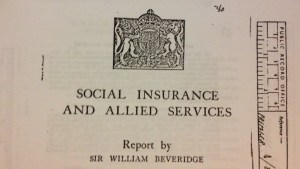
Beveridge Report - Welfare State

Agree with this article? Violently disagree? Scroll down to leave a comment.

Follow Semi-Partisan Politics on TwitterFacebook and Medium.

National Religion Daily Penance: How Much Do YOU Cost Our NHS?

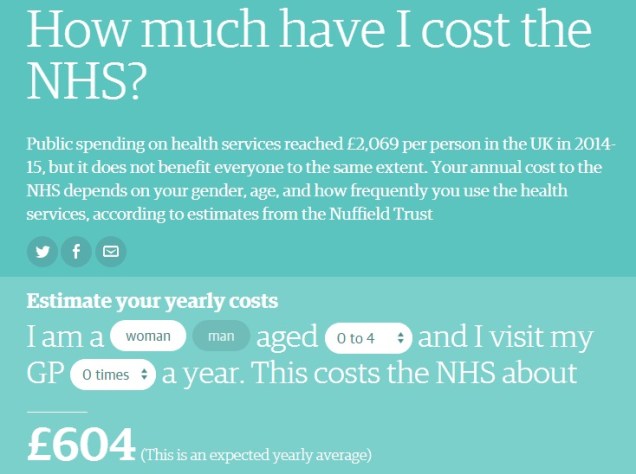
NHS - National Religion - How Much Have I Cost The NHS - Worship - Self Flagellation - Socialism

Don’t join in the Guardian’s fawning worship of the state – you don’t owe the NHS anything

If any further proof were needed that conservatives and socialists think differently and see the world in a completely different way, you need only look at the latest feature in the Guardian’s nauseating, saccharine “This Is The NHS” series, a self-flagellating little feature asking “How much have I cost the NHS?”

In this post, the Guardian takes a break from exploiting real-life stories from doctors and patients to emotionally manipulate people into blindly supporting Britain’s unique but unexceptional healthcare system, and instead invites you to plug your personal details into their online calculator so that you can find out exactly how much money Our Blessed NHS lavishes on you every year. You ungrateful wretch.

The Guardian intones:

Public spending on health services reached £2,069 per person in the UK in 2014-15, but it does not benefit everyone to the same extent. Your annual cost to the NHS depends on your gender, age, and how frequently you use the health services, according to estimates from the Nuffield Trust.

So the total cost of your healthcare increases as you consume more healthcare services. Riveting stuff. Great investigative journalism.

The calculator does throw up some interesting numbers. Interestingly, if you sit stubbornly at home and never use a single NHS service or treatment of any kind, you somehow still manage to cost the health service hundreds of pounds a year.

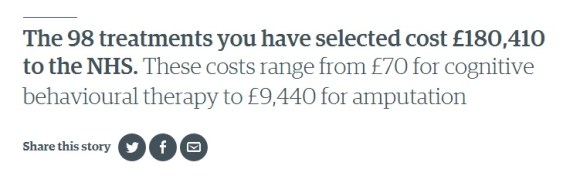
Meanwhile, at the other end of the spectrum, if you were really unfortunate and had every possible thing go wrong with you (once) in a given year, the NHS could be on the hook for as much as £180,410 – though I suspect that the calculator is holding back here, and that some patients may comfortably exceed this total without having to check every single box:

How Much Do You Cost The NHS - 3

How Much Do You Cost The NHS - 2

Also interesting is the fact that the only mention of mental health and associated problems from addiction to depression is buried deep in the “Other” section, and not given the prominence that a right-on publication like the Guardian might be expected to lavish. One can only speculate as to the reason for this sudden downplaying of mental health issues.

But the really interesting and revealing fact is that the Guardian published the article at all – and the conspicuous lack of a counterpoint piece asking how much we each contribute to the NHS (or indeed any of our other public services) every year through our taxes. Why the obsession with how much we are individually costing the state (or harming the environment with our carbon dioxide emissions, or doing any other Bad Thing) when there is no equal curiosity about how much we contribute? Looking at one side of the equation is meaningless until you also have visibility of the other.

This deliberate omission is especially galling at a time when some citizen-focused governments are now providing individual taxpayers with an itemised receipt every year, showing how much of their taxes have been spent on different areas of the budget like education, healthcare and defence. George Osborne even brought the practice to Britain, to the inevitable howls of protest (and accusations of disseminating propaganda) from the Left.

It may seem trivial, but this is a fundamental difference in mindset. Issuing a receipt showing how and where government is spending your money is an act of transparency and an acknowledgement that the government derives its legitimacy from – and can only function with the consent of – the citizenry.

Publishing a sanctimonious little online calculator so that your left-wing readership can calculate how much they cost society with every breath, on the other hand, elevates the state above all. It presupposes that we exist only at the pleasure of the government, that the state has a rightful claim on all of our possessions as well as the product of our labour, and that we should be grateful for any trivial sum that we are allowed to keep for ourselves after we have funded the Public Services behemoth.

Doing things the Guardian’s way – focusing on how much taxpayers “cost” their own government – inverts the proper power relationship between citizen and government, which should rightly be one of the state existing to serve and protect the people, not the other way around.

But of course we all know exactly why the Guardian is so eager to talk about how much we cost the state (and chide us for doing so) yet desperate to avoid talking about how much we contribute. Because to look at both sides of the equation simultaneously would be to encourage the public to ask whether they getting value for money. And it would reveal – as we now know – that the majority of us are net takers, or beneficiaries, from the system.

The Guardian’s whole anti-Tory, anti-austerity schtick is built entirely on the notion that we all contributed to our public services, and that the dastardly Evil Tories are cutting services to which we have all made substantial financial contributions. They seek to perpetuate the vague notion that we have a contributory welfare system, when in reality Britain’s welfare system is defiantly, depressingly non-contributory.

Some of us contribute vastly more to the exchequer than we will ever receive back in public services. Some of us struggle to break even. And others are on “take” mode for pretty much their entire lives – often for very justifiable reasons, but other times much less so. Most of us will fall into different categories at different stages of our lives.

But the Guardian doesn’t want people to know or think about any of this, or have access to this information. The prosperous middle-class couple on a joint six-figure income, blessed with good health and the lifestyle habits to maintain it, may well balk when they realise how much they are contributing to the NHS compared to what they receive back in a given year, or the equivalent projected lifetime figures. And they may balk again when they realise that their chain-smoking neighbour who trundles off to the doctor at the first sign of a cold contributes far less.

In short, real transparency about contributions made and benefits received would encourage a more consumer-like mindset among the people, forcing them to take responsibility and make the decisions which are best for them and for their families. And this goes against everything that the Guardian believes, because they want us to be a nation of state-dependent drones, flopping around helplessly, utterly reliant on services and/or alms disbursed by the government.

So, to recap: Itemised bills from the government for services provided to you by the state? Wonderful, brilliant idea, and a great way to remind us of everything that the beneficent nanny state does on our behalf.

Itemised receipts from the government showing the breakdown of how your tax payments are being spent? Evil propaganda designed to mislead the people and whip the lemmings up into a hysterical rage.

Glad we cleared that up.

A scene from the Olympic opening ceremony celebrating the NHS

NHS Worship - London Olympic Games 1

Agree with this article? Violently disagree? Scroll down to leave a comment.

Follow Semi-Partisan Politics on TwitterFacebook and Medium.