2014: The Year Of UKIP

Year of UKIP defections mayor Gloucester


“…the core question of our time is how we meet the challenge of globalisation, and how we retool or retire the idea of the nation state in response. You can agree with UKIP’s stance or despise it with every fibre of your being, but right now they are the only British political party to have identified the core problem and gone before the electorate with a proposed solution.”

‘Tis the season for Year In Review blog posts and breathless predictions about what more to expect in 2015. And while these can be good fun to write, and even read, it is safe to say that none of the political predictions, at least, are worth the paper they are printed on, or the real estate they occupy on your smartphone screen.

The truth is, nobody knows what will happen as Britain enters the seismic election year of 2015. The outcome of this general election is almost impossible to predict, and certainly cannot be divined by examining national-level polling that fails to take into account the furious dynamics that will come into play in individual constituencies. Those who confidently predict the total electoral obliteration of the Liberal Democrats forget the huge effort expended by many LibDem MPs to effectively ingratiate themselves with their local electorates, for example, while those predicting that Nigel Farage’s People’s Army will occupy multiple benches in the House of Commons after May 7 overlook just how punishing Britain’s electoral system always is to new and insurgent parties.

But if it is not possible to look forward with much certainty – though a hung parliament and some form of ‘confidence and supply’ minority administration led by either the Tories or Labour seems increasingly likely – we can at least look back at the year that was 2014, in order to see who has been right and who has been calamitously wide of the mark.

Continue reading

Ed Miliband’s Failure To Relaunch


This dated, early-colour TV footage of President Lyndon B. Johnson addressing the University of Michigan’s graduating class of 1964 stands as a simple, self-evident example of a great political speech.

It’s necessary to point this out because those of us who came of age under the New Labour governments of Tony Blair and Gordon Brown, or even more recently in the Lib-Con Coalition years, may well never have heard one in our lifetimes – at least not in contemporary British politics.

2014 marks fifty years since the unveiling of LBJ’s Great Society initiative, in which Johnson unveiled a sweepingly bold and progressive agenda of domestic programmes intended to combat poverty, inequality and racial injustice in America. Only two years previously, the slain president John F. Kennedy had also called upon his country to dedicate itself to a bold new purpose: landing a man on the surface of the moon and returning him safely to Earth, within the decade. Kennedy’s goal – America’s goal – was achieved on 16th July, 1969.

That’s what leaders do. As citizens of modern Western democracies we are more or less capable of handling the day-to-day business of living life – working, raising families, finding meaningful recreation – ourselves, only looking to government to provide or assist with that which ordinary human beings and families cannot do by or for themselves alone. Great, even competent political leaders understand this truth, and devote their energies to setting the big picture, steering the ship of state, even daring and accomplishing mighty things when the occasion arises.

Or at least, that’s what leaders and prospective leaders are supposed to do.

Continue reading

British Politics Has Become A Centrist, Ayn Rand-Style Dystopia

Westminster train 02


Readers of Atlas Shrugged will recall the Taggart Tunnel disaster, a seminal moment in Ayn Rand’s novel. The deadly train accident, an avoidable, man-made calamity, highlights the devastating but inevitable consequence of having too few people of moral fibre, wisdom and intelligence left in positions of power and authority.

For those unfamiliar: in the build-up to the disaster, the Taggart Railroad’s flagship transcontinental service breaks down while passing through Colorado, stranding a trainload of passengers in the mountains. Taggart Transcontinental’s best engineers and executives have long since deserted the company, resigning out of frustration with the endless bureaucratic meddling and the glorification of consensual mediocrity which has taken hold of corporate and political culture in the dying days of the United States. With no replacement diesel locomotives available and with nobody willing to take responsibility or speak truth to power, a self-important politician travelling on the train is able to bully reluctant and inexperienced railroad employees to use a coal-burning engine to pull the train through the long, airless mountain tunnel, resulting in the death by asphyxiation of everyone on board.

The grey characters of modern British politics are far less compelling than those in Ayn Rand’s dystopia, but alarming parallels are starting to appear between the groupthink and instinct for self-preservation shown by  the elite in Atlas Shrugged and the recent behaviour of the Westminster village as it faces the intertwined problems of unfinished constitutional reform, voter apathy, the relentless march of UKIP and an economic recovery that may as well not exist for the low-paid.

Continue reading

The Tipping Point

UKIP Opinium Poll 31 Percent


“To win new recruits, motivate their activists and sustain the interest of politicians and the media, UKIP need to overcome the wasted vote syndrome and appear as a credible choice at general elections” – Robert Ford and Matthew Goodwin, Revolt on the Right: Explaining Support for the Radical Right in Britain


UKIP’s victory in the Clacton by-election, giving the party their first MP, was bad for the political establishment.

The ComRes poll giving UKIP’s Mark Reckless a 13-point lead ahead of the Rochester by-election was awful.

But these local by-elections, history-making as they are, can only do so much damage – they give the main political parties, particularly the Tories, a black eye, and not much more. Even if UKIP go on to win the by-election in Rochester and Strood as now seems likely, Mark Reckless and Douglas Carswell will still only form a caucus of two at Westminster, hardly enough to start flexing their parliamentary muscles or influencing legislation.

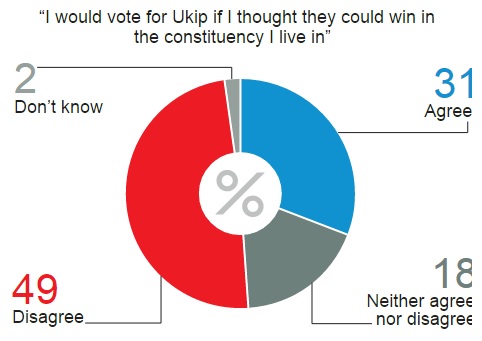
However, a poll just released by Opinium and The Observer reveals something that could shake the establishment to its foundations: 31% of voters would now support Nigel Farage’s party if they believed UKIP had a credible chance of winning in their local constituency. Nearly a third of the electorate are ready to wash their hands of big three political parties entirely, and vote for a new, untested alternative. Not just in the local or European elections, where UKIP are already establishing a track record of success, but in the United Kingdom’s general election next year.

Continue reading

Panic

Mark Reckless UKIP Rochester


Of course UKIP were going to do well in Clacton, the establishment consoled themselves after Douglas Carswell eviscerated the Tories in his thumping by-election victory.

After all, they said, Carswell’s seaside constituency is chock full of exactly the type of unlettered, economically left-behind losers who would be hoodwinked by Nigel Farage’s politics of grievance and fear. But just wait until Rochester and Strood, when the less personable Mark Reckless has to face his more enlightened constituents at the ballot box after jumping ship to UKIP. The Tories’ formidable campaigning operation will kick into gear, the UKIP advance will be halted and normal political order will be restored.

So went conventional wisdom, and the general thrust of most mainstream analysis in the aftermath of the Clacton result. But no longer. A poll by ComRes, released last night, gave UKIP a commanding 13 point lead in the Rochester and Strood constituency, with UKIP on 43%, Conservatives on 30%, Labour on 21% with the Greens and Liberal Democrats fighting for scraps with 3% each.

It’s now officially time to panic. And each faction of the British political establishment is quietly losing the plot in their own uniquely predictable way.

Continue reading