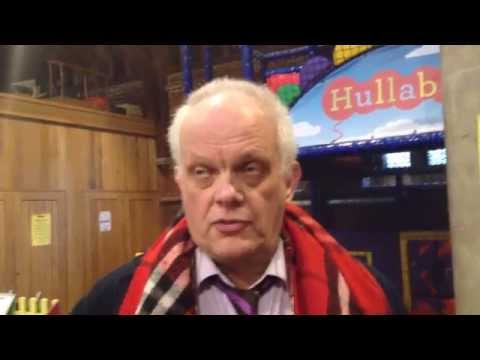
UKIP candidate Magnus Nielsen is perhaps best known for his eyebrow-raising comments on Islam, proposing that mosques should only be able to hire imams from a government-approved register of non-extremist preachers. When interviewed prior to the candidate hustings on Thursday, Nielsen stated that he is in favour of peoples’ right to practice religion freely, so long as it does not “intervene on the human rights of other people”.
Nielsen also defended UKIP from what the party sees as media obsession with the misdeeds and wacky opinions of some of their “loose cannon” candidates, pointing out that “UKIP is the only party which will not allow you to become a member if you have been a member of the BNP. That is not true of the Labour Party”.
Interestingly, Magnus Nielsen did not have a ready position to take on TTIP, declining to say whether he was for or against the trade deal currently being negotiated between the European Union and the United States until he researched the issue further.
Click here for interviews with each of the 2015 candidates standing for election in Hampstead and Kilburn, and a summary of the recent hustings organised by West Hampstead Life.
When interviewing Rebecca Johnson, I asked how the Green Party would mitigate what would inevitably be huge transitional costs involved in moving the British economy from its current state to a radically different, more “sustainable” footing, particularly if the rest of the world did not follow suit. Johnson spoke about “growing different kinds of jobs, community based jobs, community based shops, localised, community based industry to supply the sustainable, renewable energy” and vowed to “change the architecture of how energy is produced”.
When asked about this upheaval, Johnson said: “there will be transitional changes. I see those as opportunities. With every opportunity there will be different ways in which jobs and industry and community responsibilities will change and will grow … I believe that very very quickly, people will find that they are happier, healthier, they have better communities and better living standards, they have better education and health which means better security”.
Rebecca Johnson continued: “I believe that the transition can be done in the lifetime of one parliament”.
Click here for interviews with each of the 2015 candidates standing for election in Hampstead and Kilburn, and a summary of the recent hustings organised by West Hampstead Life.
When the votes of the 2010 general election were counted in the northwest London constituency of Hampstead and Kilburn, veteran Labour MP Glenda Jackson clung on to her seat in the face of a strong Conservative challenge by the narrowest of margins – a mere 44 votes. The fact that the Liberal Democrats were a only 800 votes further behind makes this blogger’s home constituency the tightest three-way marginal in the country.
Based on the 2010 results, with Labour 44 votes ahead of the Tories and the Conservative-LibDem coalition none too popular among many voters, the Labour Party could reasonably expect to hold this seat in May 2015. But these are not normal times, and the various national dynamics at play will keep this constituency an interesting one to watch.
The excellent local West Hampstead blog, West Hampstead Life, is organising candidate hustings to take place in the constituency at the Sheriff Centre on West End Lane tonight at 7.30pm. Your blogger will be present, and hopes to sneak a couple of minutes with each candidate to question them on national issues and their personal philosophies.
The parliamentary candidates for the constituency of Hampstead & Kilburn are as follows:
Today saw the launch of the Conservative Party’s latest election broadcast, emailed to their supporters and promoted on YouTube. And from a strictly artistic and technical perspective, it’s not bad.
The video was distributed along with this blurb:
Samuel, <– thanks, mail merge personalisation
Have you seen our new Election Broadcast?
It shows how our plan is securing the things we all want for our children and grandchildren: a good education, a decent job, great public services and the chance to make the most out of their lives.
It’s really important that everyone knows the choice at this election: a better, more secure future with the Conservatives or putting all the progress we’ve made at risk with Ed Miliband propped up by the SNP.
Cue lots of video footage of babies and small children, and voiceovers in which the parents express their hopes that little Johnny will emerge from the British educational system reasonably literate and numerate, never have to “worry about paying the bills each month” as an adult, and to come of age in “a Britain with opportunities” (duh). All of this is accompanied by the gentle strumming of guitars familiar to any fan of the TV show Gilmore Girls, and the same amiable whistling that TSB currently uses in advertisements to trick people into thinking that they are a friendly local bank.
But despite the focus on youth, in reality the Tories (and Labour too) are much more concerned with “securing the things we all want” not for our children and grandchildren, but for our parents and grandparents. The welfare state certainly needed reforming in 2010, and Iain Duncan Smith’s rollout of Universal Credit could yet go a long way toward eliminating the benefit trap, but it cannot escape anyone’s attention that the younger generations have borne the brunt of the necessary corrections to excessive government spending.
Meanwhile, Britain’s pensioners – who are much more likely to be homeowners and free of the cost of young raising families – have not been asked to contribute a penny, even as we were told that we are “all in it together”. Instead, the older generation are showered with non-means tested benefits such as free television licences and bus passes, while their pensions are protected with a “triple lock” which ensures that they will always get richer in real terms.
As the official 2015 general election campaign gets underway, all of the polls and indicators point not just to a hung parliament, but to a precariously balanced and dangerously weak government ultimately stumbling from the wreckage.
If there is no majority government, then the opposition parties could vote against the government in a no-confidence motion. However the new Fixed-Term Parliaments Act would then trigger a fresh general election if no government can be formed within two weeks. It’s hard to predict how the fresh result would be different. The Conservatives might benefit if people felt that Labour and the SNP had been obstructive, but it would be an uncertain and speculative venture for all parties.
The last option is for a minority government. A party grouping with fewer than 326 seats could win a no-confidence motion helped by some opposition abstentions. This avoids the compulsory new election. But the minority government would have to build a fresh coalition for every Commons vote. And without a “confidence and supply” agreement, there is no guarantee that even the budget would be passed. In short, life would be much more difficult for a minority government.
This meltdown scenario is unlikely, but it has a real chance of happening. Perhaps it would be the natural end for a campaign without a clear winner.
This could truly be the nightmare scenario for Britain: the election results may leave both Labour and the Tories feeling bruised, the LibDems nearly wiped out and not in a position to give either party a majority in coalition, UKIP and the Greens furious that their substantial national support failed to translate into many Westminster seats, and the SNP strutting around in triumph as Scotland effectively becomes a one-party nation.


 Semi-Partisan Politics