Taxes, The Answer To Everything

HMRC taxes


When your default position holds that Government should always be bigger and seek to do more, and play an ever larger role in the life of the citizenry, it generally follows that you will also be obsessed with tax policy, and ingenious ways to come up with new revenues. After all, the all-seeing, all-knowing behemoth has to be funded somehow.

Polly Toynbee, in her latest Guardian column, lambasts the Conservative-led government for “giving up” on trying to find new revenues, and imagines a world where tax avoidance (perfectly legal) and tax evasion (not so much) can be eliminated at the click of her fingers. She writes:

Cutting the 50% top rate suggests no great enthusiasm for rigorous taxing. Last week’s ONS figures revealed gigantic avoidance of the 50% top rate. It could have been collected but George Osborne needed to prove it didn’t work. The Treasury estimated raising the rate to 50% should bring in £6.2bn, but the actual return was a puny £100m.

In year one, before its official start date, high earners gamed the tax by rushing to take dividends and bonuses early. They paid more into pensions, gaining undeserved higher tax relief. Or they used trusts, or took income as capital gains. (That can be stopped, by fixing capital gains, as Nigel Lawson did, at the same rate as income tax, as the Institute for Fiscal Studies advocates.) Once Osborne announced the top rate would fall to 45%, high earners gamed it again. Incomes Data Services reports a massive delay in bonuses until after 6 April, when they leapt up by 107% in the finance sector to catch the new 45% rate. That could have been forestalled.

In Polly Toynbee world, a 50% top rate of tax is absolutely worthy and to be encouraged, and she sees nothing wrong with this, but we already know that. What is more striking, however, is the glib way in which she assumes that the population, outraged by such high taxes, can simply be stopped from taking perfectly legal measures to limit their tax bill. Phrases such as “that can be stopped” or “that could have been forestalled” are boldly laid down, but are not followed up with the how to do it when it comes to implementation.

When she does offer specific prescriptions for raising more tax revenues, she picks and chooses from the worst and most counter-productive tax policies from around the world, including this gem:

Britain can do plenty alone: we could adopt US tax laws that make every UK passport holder, wherever they are in the world, pay UK tax.

Ah yes, double taxation. The United States is the only major western country to enforce this policy of taxing their citizens on money earned overseas, and the policy is universally despised and acts as a significant disincentive for many Americans to work abroad for any length of time. But by all means Polly, let’s adopt that hated policy.

This is not to say that there is not a very real problem of tax avoidance, but it is far more on the business side than the individual side. People are rightly outraged when companies such as Starbucks use crafty mechanisms (“oh, we have to pay all the money we make in our UK stores as a royalty to our European headquarters in Amsterdam, so we don’t have any UK profits to be taxed this year, sorry”) to avoid paying tax on profits earned in Britain. And somehow it seems even worse when those same corporations, under the harsh glare of the media spotlight, deign to cut the government a cheque, to throw the exchequer a small bone to help solve their PR crisis.

Of course, the whole quagmire could be cleaned up very easily if only there was a political party (hi, UKIP) willing to take a scythe to the existing British tax code and rebuild it from the ground up, based on the tenets of real fairness, which of course means a flat tax. A flat rate of tax on income, corporate profits, capital gains and (if we must keep it) on value added, i.e. sales. Wherever possible, double taxation should be avoided – if you have paid tax on income or a purchase already, HMRC should not be allowed to come back for a second bite of that asset later on. And if we have learned nothing else from our friends across the sea in the United States, deductions should be avoided at all costs, as should Gordon Brown’s labyrinthine system of tax credits that you can claim for everything under the sun. Eliminate deductions and tax credits so that you can lower rates for everyone.

Toynbee concludes:

Tax cheating should be Labour’s chance to tell honest political truths: you get what you pay for, you can’t have Swedish services on US tax ideology. Tax is the price we pay for civilisation. At elections, all parties promise the impossible, more with less and cuts in “bureaucracy” to pay for everything. Treating the public like children on tax does nothing for trust in politics. The door has opened for that conversation.

In her mind, big government is synonymous with “civilisation”. The more responsibilities that the government takes on, and the more that citizens are subservient to the government, the more “civilised” that society becomes. Polly Toynbee probably knows more history than me, but I can think of at least a couple of great civilisations from the past that survived and prospered just fine without 50% top rates of income tax, married couples allowances, earned income tax credits or personal allowances.

And if Polly Toynbee really thinks that the door has opened for a conversation about the government going back to talking half of every pound that you earn above a certain threshold, and preventing citizens from making private financial decisions and transactions at a time of their own choosing so as to limit their tax liability, I am reasonably confident that she will find that door slammed very hard in her face by the British people.

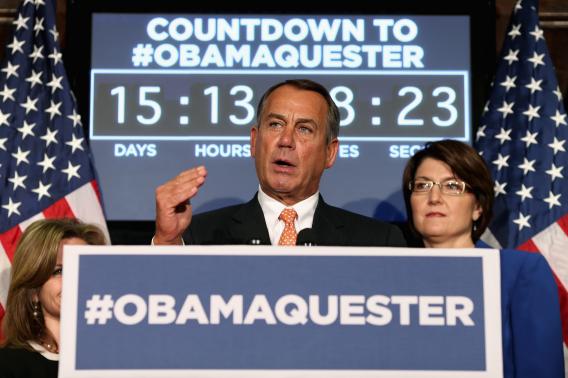
Republicans For Big Government

Barack Obama - Sequester - Obamaquester

Run for your lives! The Obama Jobs Sequester is coming!

The evil President Obama sneakily – and somehow avoiding the notice of Congress – inserted into a congressionally approved bill a provision that would make large, across-the-board cuts in domestic spending if Republicans and Democrats failed to work together to reach a grand bargain on spending, tackling tax revenues and federal spending in a unified and bipartisan way.

And now that congressional leaders have failed to agree on these items, the undiscriminatingly large cuts are about to fall on the federal budget, which will result in many lost jobs, particularly in the area of national defence, which is just terrible. And all because of Obama. Right?

At least that’s how Kimberley Strassel, writing in The Wall Street Journal, sees it:

A year ago, the president demanded a $500 billion “sequester” of defense dollars as a penalty should Congress fail to cut a grand debt deal. Congress of course failed, and Mr. Obama’s sequester is now imminent. The sequester slash comes on top of the $487 billion in defense cuts Mr. Obama had already ordered in January of this year, threatening the likes of Mansfield.

Defense Secretary Leon Panetta has warned of the damage the sequester will do to national security. Yet the far more immediate political problem for Mr. Obama is that the cuts are compounding his domestic jobs liability—in the final stretch of the campaign.

More than one million lost private-sector jobs, to get down to it, as estimated by groups ranging from the National Association of Manufacturers to the Aerospace Industries Association. Military jobs are on the block, but the bulk of the pink slips will come from private businesses—from giant defense companies on down to smaller businesses that are the economic mainstays of their communities. They’ll come from states crucial for President Obama’s re-election: Virginia, Florida, North Carolina, and more.

So apparently, according to the Kimberley Strassel school of thought, what we should be doing in this recession is cutting government spending, because government doesn’t create jobs, entrepreneurs do. Unless that government spending is supporting jobs in the defence sector, of course, in which case we should be increasing it, dramatically!

Some more “moderate” Republicans argue that while they support cuts in principle, they are appalled by these looming defence cuts in particular because they are across-the-board and arbitrary, and pay little heed to particular defence programs or areas that could be more reasonably targetted for cutting. That’s the point of the sequester that they and their Democratic colleagues agreed to. It inflicts blind, undisciminating pain on areas of government spending precious to both sides of the political aisle, with the intention of presenting such an unthinkably draconian package of cuts that leaders would get together to forge a compromise.

If you don’t like the idea of a scythe being taken to defence spending or to welfare programmes without regard to their individual merit, get together, in the name of patriotism and bipartisanship, and for the sake of the people who elected you, and hammer out a compromise that cuts the welfare state while raising tax revenues to help close the massive hole in America’s federal budget.

Interestingly, you never hear Republicans making the same arguments against across-the-board cuts to welfare programmes, or social security, or food stamps. In those cases, apparently, it is fine to slash away at the budget with little regard for the people who were led to believe by their government (Republicans as much as Democrats) that certain benefits would be available to them, and who planned their lives accordingly, often with little left in reserve.

We can argue the rights and wrongs of this – personally I find the welfare state too generous, and politicians of all sides too cowardly in failing to tell voters the truth about the unsustainability of current levels of provision over the past recent decades – but surely we can all agree that just as you cannot rip a bandage from an open wound and expect the patient to be unharmed, so you cannot remove anticipated benefits or support from citizens overnight, at a time of economic hardship, and expect their lives, or the social fabric, to remain stable.

In fact, there is only one other area of government spending besides national defence that I can think of where Republicans have come out in outraged horror at the mere talk of blanket cutbacks – I’m speaking, of course, about Medicare. Those lofty words about scaling back federal spending and shrinking the size of government sure do fly out of the window awfully fast when one of their core constituencies (in this case, the grey vote) is in the firing line.

But Kimberley A. Strassel is not troubled by any of these arguments or contradictions, content instead to bob gently in the vast ocean of her own ignorance, wilful self-deception and cynically fiscally irresponsible propaganda.

No, for her it is the Obama Jobs Sequester, the Machiavellian outcome that he desired all along in order to gut his own nation’s capacity to defend itself. It’s the only plausible explanation for how we find ourselves in this situation. Unless it isn’t.

How Not To Do Tax Policy

Priti Patel, writing in The Spectator’s Coffee House blog, warns that:

… we should all fear Ed Miliband’s praise for a new socialist French President who plans to raise the top rate of tax to 75 per cent. It is a chilling reminder of Miliband’s own commitment to a permanent 50 per cent income tax rate in this country.

But as he visited the Elysée Palace this week, one of France’s leading newspapers warned that the 75 per cent tax rate threat is already leading to French businesses evacuating senior executives to London. Since François Hollande’s victory on 6 May, this exodus of enterprise has caused the waiting list of the prestigious Charles de Gaulle school in our capital to rocket by over 700 places. We haven’t even rolled out the red carpet yet.

Very true. Let this be a warning to all those who think either that there is a binary choice between “austerity” and “growth”, or that Britain’s (or France’s) finances can be rectified, and the current excessive levels of government spending maintained, simply by turning the screws on the rich a little more.

Unfortunately, Patel’s article also misses out the most crucial actions required to get the British economy moving again – introducing much needed supply side reforms. Note:

Yesterday’s economic news reminds us of the need for the Government to continue to focus relentlessly on getting our economy moving – dealing with the debt crisis, boosting bank lending to the real economy, and ensuring sustainable long-term prosperity through radical economic reform.

Nothing about reducing regulation, either independently or through the European Union. Nothing about tackling the restive trades union that are always a day or so away from striking for spurious reasons.

By all means warn about Labour’s policies on tax, but given the fact that Osborne messed up the Budget and left us with a 45% top rate of tax for the foreseeable future, let’s focus on where the coalition government has the political strength to do the most good to restore economic growth.

SEMI-PARTISAN SUMMARY

CULTURE

Amanda Marcotte, writing at Slate magazine, makes a compelling case for movie scriptwriters and directors to show more condom use in their movies. She makes a fair point: “In the world of movies and TV, people seem to be having sex all the time, but they almost never talk about or are shown using contraception. Since so much of movie sex serves the plot, you get encounters that are much more spontaneous than they would be in real life, without any pause in the action to wrap it up. Young viewers could easily get the sense that the norm is to hop right in bed with someone without ever worrying about unintended pregnancy.” And it’s true – if realism is your aim (and admittedly this is not always the case), pretending that people hop into bed with each other without going through that awkward “fumbling in the bedside cabinet drawer” moment is a misrepresentation, and one that can be easily (and, if done well, humorously) corrected.

Jim Henson Studios, creator of The Muppets, is boycotting Chick-fil-A over that company’s president’s condemnation of gay marriage. In a stern rebuke, their statement reads: “The Jim Henson Company has celebrated and embraced diversity and inclusiveness for over fifty years and we have notified Chick-Fil-A that we do not wish to partner with them on any future endeavors”.

Proco Moreno, Alderman of Chicago’s 1st Ward, joined in the anti Chick-fil-A backlash, stating that he would block the restaurant chain’s attempts to open their second Chicago outlet in his district because of the aforementioned statement issued by their CEO. His statement is somewhat over-the top – “If you are discriminating against a segment of the community, I don’t want you in the 1st Ward” – it is hard to see how any discrimination is taking place, as the restaurant does not check the sexual orientation of its customers upon entry, or have any policies in place that discriminate against one or another. But the fact remains that needlessly coming out in favour of a regressive social policy position that has no direct impact on your business or bottom line, can cost you money.

Getting in on the act, The Onion reports on Chick-fil-A’s new homophobic sandwich. Reports The Onion: “In a press conference to reporters, company representatives said the homophobic new sandwich will include the national fast food chain’s trademark fried chicken filet wrapped in a piece of specially-smoked No Homo ham that would be topped with a slice of Swiss cheese and lathered in a creamy new Thousand Island-based Fag Punching sauce”.


BRITISH POLITICS

The UK economy shrank by another 0.7% according to the latest figures released today. Iain Martin, writing in The Telegraph, thinks that George Osborne has six months to turn things around. I would guess that this estimate sounds about right, but I am not optimistic that Osborne will do anything differently, given his obstinate refusal to implement the needed supply-side reforms, and his obsession with trying to score cheap political points from Ed Balls, a diversion which should be beneath him.

The Guardian’s foremost education journalist twists herself in knots trying to explain why she is against private schools, and yet is sending her daughter to a private school. She takes a whole article, and many unnecessary words to explain what I can say in just three – she’s a hypocrite. She says: “I remember reading about Diane Abbott’s decision to send her son to the £10,000-a-year City of London school. She said she was a mother first and a politician second, a point that resonated strongly with me.” Precisely. She’s happy to inflict her left-wing social engineering on other people to make them conform to her ideal worldview (uniform standards, uniform people, uniform outcomes), but as soon as her own interests come in to play, she takes the conservative position.


AMERICAN POLITICS

Oh noes. The house of cards built by Grover Norquist has started to come crashing down as more and more elected officials repudiate his “tax pledge”. Whether you think the current tax burden in America is sustainable or not, I think most reasonable people can agree that Norquist’s pledge is overly restrictive on lawmakers, preventing them from closing unwarranted and discriminatory tax loopholes on the grounds that doing so would constitute a “tax increase”. Norquist, and his advocacy group Americans for Tax Reform, are one of several significant hurdles standing in the way of a fundamental simplification of the existing byzantine tax code. We should all cheer its demise, and hope that similar obstacles from the American left fall by the wayside too, in the name of meaningful, lasting reform.

It is hard to disagree with this piece from Marbury, discussing the old-fashioned political art of persuasion, and the relative aptitudes of Obama and Clinton at using it. Through the lense of the Northern Irish “Good Friday” peace accord, Marbury looks at the way that President Clinton was able to flatter, cajole and reassure the key parties so that they reached a point where a deal could be signed, and how this skill is currently lacking in the Obama administration. Money quote: “Obama likes the big set-piece speech. But every policy he has backed, from the stimulus to healthcare, has declined in popularity the more speeches he made about it. His speeches explain things very well, very precisely. But they don’t change minds. This, it turns out, was the big hole in Obama’s campaign rhetoric of unification, of bringing red and blue together. He spoke about it eloquently, but he was never going to be the president who put it into action. Obama is a preacher, not a persuader. He’s terrific if you already agree with him, but doesn’t have much impact on those who don’t.”

Jacob Weisberg, writing in Slate magazine, effectively deconstructs the Romney campaign’s attempts to smear President Obama with the “Chicago machine politician” label. Says Weisberg: “Of course, Romney isn’t interested in this kind of nuance. ‘Chicago-style politics’ is mainly just a way for him to call Obama corrupt without coming out and saying so”.

Diagnosing The Coalition

It is hard to disagree with this uncompromising assessment of the UK Coalition Government’s performance over recent months, by Trevor Kavanagh at The Sun.

In particular:

Unless the PM and his deputy reach a truce soon this partnership will be lucky to survive the year.

A split would force an early election and, incredibly, put Labour back in power after one richly deserved term in Opposition.

The Lib Dems, with only nine per cent of the vote according to a new poll, would be wiped out as a political force.

Labour’s recovery is as astonishing as the slide in Coalition support. Ed Miliband can claim some credit. But this collapse is due entirely to Government bungling on just about every major issue.

Somehow it has allowed the impression that the Coalition, not Labour, is to blame for our economic woes.

Yes, yes, a thousand times yes. It is ridiculous almost to the point of complete disbelief that this government, and the senior Tory ministers within it, have allowed a situation where Labour’s economic policies and statements are given serious consideration only two years after they were so utterly and thoroughly debunked. That really takes a sustained level of incompetence to achieve, and the more you look at it, the more inescapable becomes the conclusion that the majority of the blame lies with George Osborne:

The PM has to decide whether the Chancellor is a statesman devoted full-time to keeping Britain’s precious Triple-A credit rating. Or a political bruiser who risks his credibility in unseemly brawls with Ed Balls.

It is Mr Osborne, not Nick Clegg’s Lib Dem rabble, who is to blame for the Government’s collapse in public esteem.

People don’t mind Westminster thuggery if it works. But torpedoing his own Budget with a catalogue of unforced errors and crass incompetence is unforgivable.

In a few short weeks, Mr Osborne has shredded his reputation and turned the Coalition into a lame duck administration.

It takes a special talent to cast Mr Balls on the right side of an economic argument but Mr Osborne somehow managed to do so.

If the Prime Minister cannot grasp this nettle, he is finished. A job swap with William Hague is the solution.

This is a genuinely interesting idea, though I very much doubt that David Cameron is about to replace his Chancellor in the upcoming reshuffle. But people expressed doubts at the time of his appointment about Osborne’s youth and inexperience, and while he is certainly a political bruiser, it must also be remembered that it was under his political stewardship that the Conservatives failed to gain an outright majority in the 2010 general election, tarnishing his credentials as a political operative as well as a Chancellor of the Exchequer.

It is also amusing that Hague’s name is now being floated as a potential replacement, given the sniping and complaining about his own performance that was taking place a year ago – “Hague Has Lost His Mojo”, etc. etc. In terms of cabinet minister performance, it would appear that slow and steady is winning the race at the moment.