Declaring an idea or opinion to be “problematic” has become the activist Left’s tool of choice for shutting down debate and attacking free speech
I have a real issue with the recent hijacking and misappropriation of the word “problematic” by new generation feminists, trigger warning-toting student activists and the right-on Left in general. You could say that I find it…well, problematic.
Until recently, expressing a right-wing opinion or questioning the inexorable rise of identity culture might have seen you branded by the activist Left as being offensive, racist, sexist or oppressive in some other way. The criticism may well have been a shrill overreaction to a perfectly reasonable and valid point, but at least you knew where you stood and of what you were accused. Today, you are far more likely to be noted and quietly logged by the New Age Censors as being “problematic” – someone possessing opinions which do not properly conform to the current orthodoxy.
Take the insult that is university-sponsored sexual consent classes for fully grown adults, in which lecture theatres full of browbeaten good guys (the few potential future rapists never attend, of course) are made to feel like they are a potential threat to society, and that sexual relations between autonomous individuals should be stripped of their intimacy through the adoption of affirmative consent checkpoints at every stage of the relationship.
Andy Burnham’s Labour leadership campaign has its flaws, but these grasping allegations of sexism are cynical, shameful and unfounded
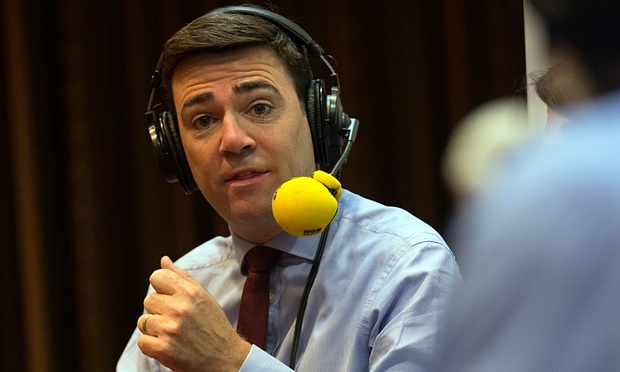
I dearly hope that one Andy Burnham rally was not all it took for me to become “part of the change” or whatever desperately lame slogan his supporters are now using, but today I actually find myself defending the man.
I have to take exception to the storm of manufactured outrage swirling around social media simply because Andy Burnham failed to agree – when asked on the radio – that he should effectively step aside from the leadership contest so that a woman can win.
During BBC Radio 5 Live’s Labour leadership hustings today, Andy Burnham was asked whether it would be “great” if Labour chose a female leader. And Burnham, realising that to say yes would be to effectively denigrate his own campaign, replied “When the time is right, when the right leader comes along”, clearly meaning when the future woman leader did not have to win at his own expense.
But in today’s charged and cynical atmosphere – fed at all times by the virtue signalling Twitterverse – you would think that Burnham had ordered his two female leadership opponents out of the leadership contest and back to the kitchen.
Yvette Cooper’s cynical attempt to weaponise the feminist cause to rescue her flagging leadership campaign is too little, too late
Now that some bookmakers are already paying out on bets that Jeremy Corbyn will win the Labour leadership, it is time to look at the also-rans, the bland non-entities currently sparring with each other for the dubious honour of a second place finish. And as a general rule, they have not covered themselves in glory.
Yvette Cooper’s campaign has been notable not so much for her ideas (thoroughly unexciting, as befits her Guardian endorsement) but for her decision to weaponise the feminist angle in the desperate search for votes.
Bringing back clause IV: spending billions of pounds we haven’t got switching control of some power stations from a group of white middle aged men in an energy company to a group of white middle aged men in Whitehall.
Let’s be clear: Yvette Cooper doesn’t think that nationalisation is bad because it would lead to inefficiency, higher prices or less reliable service, or for any other ideological reason. Her only objection to Corbyn’s proposal is that “white, middle aged men” would continue to run the show.
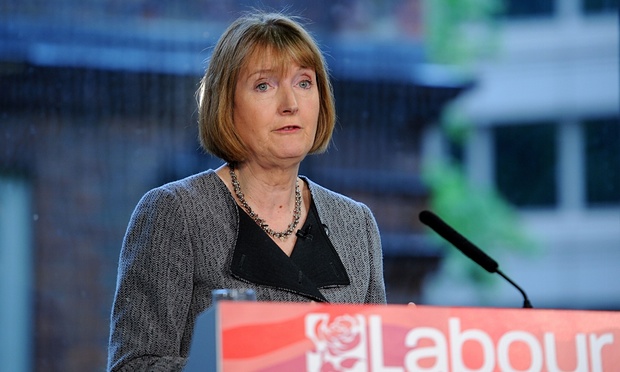
Acting Labour Leader Harriet Harman gave a very revealing interview to the Guardian this weekend, looking back on her career as she prepares to return to the backbenches after serving in the party leadership since 2007.
Whilst one can – and should – strenuously disagree with Harman’s politics, no one can deny her role in the feminist movement or the trail she blazed by standing up to the horrifically sexist club that Parliament was when she was first elected in 1982. Given these accomplishments, it is a shame that she now ends her frontbench career presiding over a farcical leadership contest and the potential splitting of her party.
But the most memorable part was when Harman spoke about how terrified she was of then Prime Minister Margaret Thatcher that she actually hid round a corner in the Houses of Parliament in order to prevent the approaching prime minister meeting her newborn baby:
Couldn’t the then prime minister Margaret Thatcher have taken her [to the Strangers’ Bar in Parliament]? Harman recoils. She wouldn’t have dreamed of socialising with her, she says.
“Very early on, I brought in one of the babies to the Commons and I saw her at the other end of the corridor. She was bearing down on me with two adoring parliamentary private secretaries trotting at her side, and she looked as if she was going to come and admire the baby. I had this terrible feeling of thinking, ‘I don’t want her to look at the baby’, almost like one of those cartoons where the witch looks at the baby and the baby shrivels. I didn’t want my perfect baby to have Thatcher’s eyes upon him.” Did she hide her baby from Thatcher? “No, I just shot off down a side corridor. It was very visceral, very heartfelt.”
I’m not sure quite what Harriet Harman intended this little vignette to reveal about herself, but it speaks volumes about the way many in the Labour Party see themselves and view their conservative opponents.
The conventional wisdom holds that Ed Miliband managed to land a serious blow on David Cameron at this week’s Prime Minister’s Questions, exposing the Tory leader and his party for their chronic shortage of women in leadership positions and the key offices of state. Miliband makes a good point – an abysmal 4 out of 22 cabinet ministers in the coalition government are women, and only one of those, Theresa May at the Home Office, occupies a position that really matters (Culture, Northern Ireland and International Development, the other ministries headed by women, are either irrelevant or decidedly junior-league). That simply is not good enough, and David Cameron has just cause to feel ashamed.
[David Cameron] was taunted about the Conservatives’ “women problem” by Ed Miliband in the same week it emerged several prominent women have recently been sacked from government jobs and Anne McIntosh, a high-profile female Tory MP, was deselected by her local association.
The Labour leader also claimed a prominent businesswoman, who is the wife of a Tory donor, had been greeted by Cameron with the remark: “Where’s your husband?”
He then accused the coalition of failing women across the UK by allowing the pay gap between men and women to widen for the first time in five years.
“You promised to modernise your party, but you are going backwards. You run your government like the old boys’ network – that’s why you are failing women across your party and across the country,” Miliband said.
And the initial exchange between the two leaders at Prime Minister’s Question Time can be seen here:
Less reported is the fact that the Labour Party has a record on promoting women every bit as appalling as do the Conservatives, as Dan Hodges correctly observes in his Telegraph column:
Women still aren’t allowed to hold senior positions in the Labour party. The three major political briefs are Prime Minister/Leader, Chancellor and Foreign Secretary. Apart from a short period during the fag end of Tony Blair’s administration when Margaret Beckett was placed in charge of the Foreign Office, and 14 weeks when Yvette Cooper oversaw the shadow post under Ed Miliband, none of those offices have been held by women. The Labour party has been in existence for 114 years. And during that time – under Labour – a woman has held or shadowed one of three major offices of state for a period of 14 months.
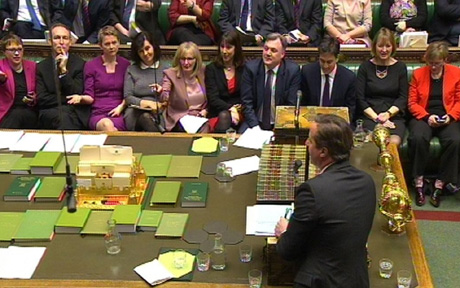
Fourteen months. And yet you would not think that Labour was sitting on such a poor record when Ed Miliband stood preening at the dispatch box in the Commons on Wednesday. One could have been forgiven for thinking that women made up a statistically and politically perfect 51% of Labour seats in Parliament and in the shadow cabinet, particularly given the rather unusual concentration of the Labour Party’s female talent on the front bench alongside their leader:
When PMQs started, several people commented on the fact that a number of Labour’s women shadow cabinet members were artificially concertinaed together close to Miliband. The reason they did that was because if they hadn’t done that they wouldn’t have been in camera shot. And that’s because there’s a convention that people sit alongside their leader based on seniority.
If something about the picture below strikes you as odd – don’t worry. There is indeed something different about the Labour front bench at PMQs this week – namely, a lot more women clustered on either side of Eds Miliband and Balls than is usually the case. It is hard to determine which is worse – Ed Miliband’s disingenuous photo opportunity, or the willingness of a number of female Labour MPs to go along with it by essentially allowing themselves to be used as props by their leadership.
Not your standard distribution.
A less-reported fact amid the furore is that all four women cabinet ministers in the coalition government are Conservative MPs, which rather begs the question of how the Liberal Democrats have managed to fly under the radar and avoid being called out for their own shameful inability to recognise and promote female talent within their own ranks. But somehow the party of Lord Rennard seems to be scoring a free pass on their own institutional sexism for the time being – at least as far as Ed Miliband’s focus is concerned.
The lack of women in senior positions in all political parties is a real problem, one which Miliband does little to debate or address by trading barbs with the Prime Minister. Some advocate all-woman shortlists as a solution to the problem, and of course the Labour Party has adopted this particular approach. This blog disagrees with it – firstly on the grounds that it robs local constituencies of the opportunity to select from the widest possible pool of talent when choosing who they want to represent them in Parliament, and secondly because if we must tolerate reverse discrimination as a necessary evil to help put right historic wrongs (and I’m far from convinced that we should), it should be done at the earliest stage possible and certainly not at the point of parliamentary candidate selection.
But while we may condemn Miliband’s posturing on the subject and question his methods, we must also acknowledge that at least the Labour Party under Ed Miliband is engaged in a bona fide effort to increase the number of women in their parliamentary party. There is a lot of rueful head-shaking from the Conservatives at the conspicuous lack of women in theirs, but not much action of any kind at all.
The Conservatives, the party of Margaret Thatcher, should be leading the charge on anything to do with meritocracy. The fact that they are not currently doing so is alarming.





 Semi-Partisan Politics