The Narrowing Path To Victory For Brexit Supporters

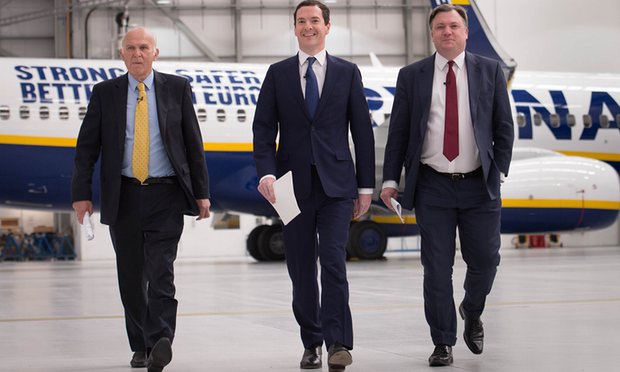
George Osborne - Ed Balls - Vince Cable - RyanAir - Brexit - EU Referendum - Establishment - Coke Zero Conservatism

A big external shock or a rising tide of anti-establishment rage are now the only remaining paths to victory for the poorly-led Brexit campaign

Getting a majority of Britons to vote to leave the European Union – particularly in so compressed a time frame, with the entire establishment chorus raised in unison against us – was always going to be very much a long shot. That much is obvious; asking people to vote against the established status quo is always very difficult, and despite having spent years flaunting their euroscepticism in public, it quickly became clear that many of the “big hitters” had given almost no thought as to what Britain’s future outside the EU should look like.

How different things could be if only the official Leave campaign had…oh, I don’t know, some kind of Brexit plan – not just familiar recitations of everything that is wrong with the EU, but an actual positive alternative vision for Britain, rooted in fact and probability rather than idle conjecture. But the shining ones in charge of Vote Leave and Leave.EU saw no need for a stinkin’ plan, preferring to paint with childishly broad brushstrokes their half-baked vision of buccaneering Britain negotiating and signing tens of trade deals a year, while the EU falls over itself to give us all the benefits of single market access at no cost (because the Germans like selling us their cars, don’t you know?)

Or as Pete North puts it:

From the outset you need to stress test your message. It has to be the words of winners. Eurosceptics bleat on about going global but it’s empty when you contrast it with the rest of their message which is outright hostile to global engagement. Again, it fails the credibility test.

I’ve said it time and again, but simply whingeing about the EU doesn’t work. Very few people like the EU, but they need a seriously good reason to take a risk – and that means you have to have a safe and desirable alternative. Oh, and a plan to get there. Vote Leave’s approach is to pretend there are magic wands to instant prosperity. Rather than seeking experts they sought people who will tell them what they like to hear. The Westminster bubble all over. They are going to lose and they will deserve it.

And so, with an uphill battle on their hands, the official Leave campaign has done almost nothing to improve their chances of victory, preferring to fire up the base and exalt in their lack of a Brexit plan rather than make a concerted effort to win over the undecided. And we are now rapidly approaching the point where all straightforward paths to victory are closed to the eurosceptics. Privately, David Cameron’s team expect to win with as much as 58% of the vote, and it increasingly appears that the only thing which might decisively change the Leave campaign’s fortunes is a big external shock – a flareup of the migrant crisis, a badly timed EU power play or a domestic political scandal, for example.

But why, besides the obvious ineptitude of the official Leave campaign, is it proving so hard to win over the undecided? It certainly doesn’t help that the arguments for remaining in the EU tend to be simplistic and fear-based*, while those in favour of Brexit (at least the thinking person’s version of Brexit) are more nuanced and complex. Among those who are not already die-hard eurosceptics, the push factor away from the EU can only take root when one has a basic grasp of the EU’s history and workings, while the pull factor toward an outward-looking, globally engaged Britain requires an understanding of the changing global trade and regulatory environment which the mainstream media utterly fails to provide (because they themselves do not understand it either).

(* Here I discount the genuine euro-federalist argument, which is perfectly legitimate but almost never heard in Britain because it is so distasteful to the majority.)

When Remainers crow that most major organisations from the IMF to large corporations want Britain to remain in the EU it superficially sounds like a slam-dunk case for staying, until one realises that most of the organisations held up by the Remain campaign are duty bound to minimise the risk (however small) of economic disruption, but have absolutely no mandate whatsoever when it comes to protecting and preserving democracy.

The CEO of a large corporation is accountable to the board and shareholders for the financial performance of their firm – often, it should be pointed out, with an unhealthy emphasis on the short term. CEOs have no legal responsibility to make public pronouncements about what is best for Britain’s democracy – the ability of British citizens to exercise meaningful control over the decisions and policies affecting their lives. And they certainly do not forfeit their bonuses when political engagement and voter turnout falls as people increasingly realise that it doesn’t much matter which party holds the majority in Westminster.

Were it not so depressing, it would be amusing watching Remain campaigners, particularly those on the Left, eagerly lap up every word uttered by the voices of big business – people whom they otherwise utterly distrust and openly despise, but whose statements that Britain should remain in the EU are accepted gratefully and unquestioningly because they confirm all of the existing biases of the EU apologists. Enjoy it while it lasts, because you are never again likely to hear Ryanair and the Labour Party press office singing so lustily from the same hymn sheet.
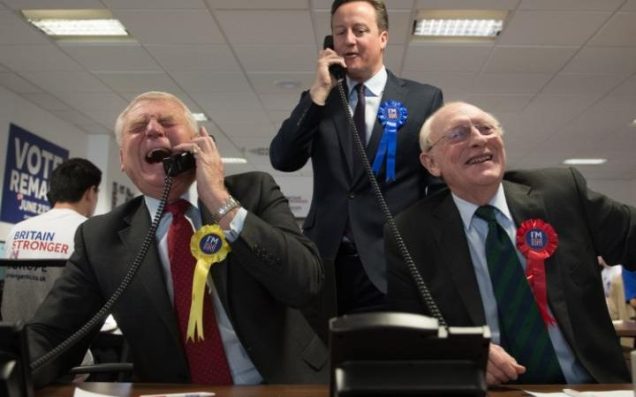
David Cameron - Neil Kinnock - Paddy Ashdown - Stronger In - EU Referendum - Brexit

But if, as expected, we go on to lose the referendum by a sizeable margin, our only remaining hope will be that the victorious David Cameron acts in as smug and condescending a way as he did in the aftermath of the Scottish independence referendum. Counterintuitively, this is when we need the prime minister to be at his arrogant best – to claim that the issue is settled for a lifetime and then swan around taking his gruesome victory lap and talking overexcitedly about how Britain will play a leading role in his mythically reformed European Union.

In other words, we need the prime minister to do everything in his considerable power to mock and belittle us if Remain carry the day, because this will add much needed fuel to the eurosceptic movement, light a fire under the the referendum post-mortem (Pete North is already talking about Nuremberg trials for those Brexit big beasts who did the most to let the side down) and hopefully result in a post-defeat surge in support like the one enjoyed by the SNP last year.

And there is every chance that this will happen – David Cameron has a big ego and a thin skin, and his political radar often deserts him when he gets emotional. Sadly, this may now be our best hope – to keep the margin of defeat as small as possible, and then hope for (or indeed provoke) as many gaffes and missteps as possible from the victorious Remainers.

It bring no joy to report this state of affairs – clearly it would be far better if Leave were consistently ahead by 10 points in all the polls and on course for victory, even if it means winning on the back of a “Brexit plan” drawn in children’s crayon. The only consolation is that this blog increasingly believes that the EU is doomed one way or another, that within ten years or twenty it will disintegrate under the weight of its own paralysing indecision, internal contradictions and interminable one-way ratchet towards closer integration.

We would all like to spend the remainder of 2016 preparing for secession negotiations and pressing the government to adopt sensible stances – and we should continue to fight to win, right up to the end. This is the last negative word this blog will write about the Leave campaign until the referendum is over – at which point you will find me, gavel in hand, on the bench at Brexiteer Nuremberg.

But increasingly it seems that our immediate job on 24 June will be to keep the flame of liberty alive, ready for the next opportunity – if and when it comes. And if we are truly dedicated to the cause, we must now begin preparing for that eventuality, too.

 

European Union - United Kingdom - Britain - Flags

Top Image: Guardian

Agree with this article? Violently disagree? Scroll down to leave a comment.

Follow Semi-Partisan Politics on TwitterFacebook and Medium.

The Official Leave Campaign’s Dismal Half Term Report Card

Report Card - Brexit Campaign - EU Referendum - Vote Leave

While many Brexiteers may be in line for a gold star for trying hard, the official Vote Leave campaign and its major spokespeople are coasting for a big fat F when it comes to execution

With little more than a month to go until voting in the EU referendum, it is worthwhile for Leavers and Brexiteers to pause, take stock of where we are and conduct a candid review of our strengths and weaknesses – what is working, and what is actively setting back the cause of independence from the European Union.

This blog post is not such a detailed report – though some other intrepid Brexiteer may well wish to create one, as a matter of historical record if nothing else. For in truth one does not need to dive deep into the poll numbers or aggregated political analysis to see that the Leave campaign is not only on course to lose the EU referendum, but is actively doubling down on those behaviours and activities which make defeat more likely.

For evidence, one has only to regard this crowing article in the New Statesman, in which Glenis Willmott gloats about the overly-emotional, rank amateurism of the country’s most prominent voices for Brexit.

One can almost hear the glee in her heart as Willmott writes:

They needed a new argument, a positive, forward-looking vision for what they see as the future of Britain… but they realised they didn’t have one so reverted to WWII and Hitler. Having lost all arguments on the economy, Vote Leave’s Boris Johnson raised the spectre of Hitler, talking about superstates and “historical parallels” between the EU and Nazi Germany. And they’re accusing the Remain campaign of being fearmongers?

They’ve complained about the terms of the debate. They’ve accused broadcasters of conspiring with the government. They’ve said journalists would be punished, and called for civil servants to be sacked. They’ve said they’ll disrupt pro-EU meetings and target pro-EU businesses. At every stage they’ve attacked individuals or organisations and not their arguments. And now they’ve invoked Godwin’s Law by comparing their opponents to Hitler.

Their tactics are the textbook definition of the increasingly desperate behaviour of the losing side in a debate.

Willmott concludes:

It’s what happens when you’ve given up on convincing the undecideds and care only about firing up die-hard Eurosceptics, praying for a low-turnout poll, which Vote Leave privately admits is their strategy. Having lost the argument on the economy, they’re now following step-by-step the UKIP guide to politics: attack foreigners, bash immigrants and peddle conspiracy theories of continental plots to take over Britain, likening Brussels of today to Berlin of yesteryear. It would be laughable if it wasn’t so serious.

And who can disagree with her? People expect some kind of positive message if they are to vote for a campaign – it can’t all be doom and gloom. And while the Remain campaign are certainly no strangers to scaremongering, they do at least take time to waffle on about their vague, fictionally pleasant European Union, a naive vision of a loose association of countries coming together on a super voluntary basis to fight crime, trade with one another and enshrine rights for working people.

Never mind that this idealised vision of the European Union is complete nonsense (and it is). People believe it because Vote Leave are too busy shouting about building a new hospital on every street corner with the money we supposedly save from leaving the EU that they almost totally neglect to pick apart Stronger In’s incredibly superficial and deceptive sales pitch.

It does, therefore, strongly appear as though Vote Leave have given up on winning the new support of anybody without a long-held antipathy toward the EU, choosing to focus instead on firing up the base and praying for a low turnout. Sadly, this almost never works. Brexiteers fired up on lashings of anti-immigration, “they need us more than we need them” rhetoric can still only vote once, just like everyone else. A fervent minority is still a referendum-losing minority.

Worse still, when they aren’t ranting about building hospitals on top of hospitals on top of hospitals in their utopian post-Brexit Britain, Vote Leave and other eurosceptic big beasts love nothing more than to prance around playing the role of the aggrieved victim. Despite having known for a long time that the prime minister is an unrepentant europhile and that the Cameron/Osborne “renegotiation” was nothing more than a deceptive piece of theatre, the brightest stars in the eurosceptic firmament somehow neglected to come up with a countervailing strategy besides running weeping to the media, sobbing about how unfair it all is.

Mary Ellen Synon puts it very well over at her excellent new Brexit blog:

This kind of complaint is worse than useless, it is embarrassing.

Anyone over the age of six who squeals, ‘He’s not playing fair!’ is absurd.

Of course Cameron is not playing fair. Of course he has been involved in secret dealings with big business. He is a politician who intends to win, and he has form for exactly this kind of behaviour.

I therefore have no time for Tories such as the MP Jacob Rees-Mogg who is reported today to be ‘furious’ over Cameron’s secret FTSE dealings.

Rees-Mogg told the Bruges Group in London that Cameron’s secret Remain dealings with the big corporations while he still worked to make people believe he might support Britain leaving the EU was ‘a scandal of the highest order.’ He said it appeared Parliament had been misled by Cameron.

Yet Rees-Mogg is a member of a party that was happy to go on backing Cameron even after he betrayed his ‘cast-iron guarantee’ to give the British people a referendum on the Lisbon Treaty.

That betrayal was in 2009. Cameron was a weasel then; he is a weasel now. It is no good for Leave campaigners such as Rees-Mogg to act as if they have only just realised it.

Quite. While it is not unreasonable to remark on the levels of deceit and lack of principle emanating from the Conservative Party leadership – pity the day when we come to accept it as unremarkable, or even virtuous – there is no point building a national referendum campaign around the fact. Besides the fact that momentum matters in elections and moping around weeping that you got a raw deal is like a big neon sign declaring that the momentum is with the other side, we are back to the fact that the Leave campaign does not have a compelling vision of an alternative Britain outside the EU.

And Vote Leave failed to come up with an alternative vision for Britain because that would mean having some kind of plan for Brexit. And they long ago decided that their unrepentant lack of a Brexit plan was somehow going to be their greatest selling point.

As Synon concludes:

The Leave campaign needs to stop whining that the campaign is ‘unfair,’ because of course it is.

However, Cameron is winning this referendum not because he is slippery, he is winning it because the official Leave campaign has described no clear, safe path out of the EU for the voters.

In other words, Cameron is not winning this campaign. The Leave campaign is losing it by being unthinking, uninformed, and unorganised.

This much is true: Cameron is not winning, but rather the Leave campaign is losing. And while the pro-EU side may have the advantage, at least this is not based on the great skill of the Remain campaign. David Cameron and his motley crew are coasting by using the advantage of their bully pulpit and the public’s natural hesitancy to depart from the status quo as their chief weapons. Even most Remainers would likely concede, under pressure, that Cameron achieved no meaningful concessions in his renegotiation, and that they cannot say with certainty what the EU will look like in five, ten or twenty years’ time, for example.

Right now this is enough, because Vote Leave have decided to fritter away their time and resources making ridiculous promises, playing the victim and invoking Godwin’s Law. Thus the Remain campaign is winning by default. But their numbers are potentially soft – people are sticking with Remain only because Boris Johnson doesn’t look like the type of man who can tie his shoes unaided, and because the avalanche of establishment opinion (organisations with no mandate to care about democracy but with strong interests in maintaining short term economic stability) coming down on the side of staying in the EU.

Realistically, there is no chance now that Vote Leave will significantly change their tactics, or suddenly embrace Flexcit and the EFTA/EEA model as a stepping stone out of political union. That ship has sailed. The only hope is that the Remain campaign’s principle strength – the overwhelming support of the establishment – may yet become its biggest weakness. And this could well happen.

Right now, Stronger In can point to a cast of thousands of the great and the good who have all lined up to tell the British people that the EU is wonderful, that Cameron negotiated a brilliant new deal and that exiting political union would lead to economic (and even military) armageddon. But what if this stops acting in their favour? These are febrile, uncertain times where little is certain except for the fact that those in positions of authority are distrusted and despised as almost never before. So what if the British political establishment, Barack ObamaChristine Lagarde, David Cameron and his CEO buddies all singing from the same hymn sheet begins to seem more like a stitch-up than wise counsel? What if their unanimity becomes more like a criticality accident of sanctimonious, self-interested elites clubbing together for their own gain rather than the sober, high-minded intervention they like to imagine?

Returning to the half term report card analogy, right now it is fair to say that the official Leave campaign has failed every single piece of coursework they have been set so far. This is not good. But fortunately, fifty percent of the total class grade is based on the end of term exam, and here we have an opportunity to make up some distance. We are never going to get an A and win by a landslide, but a concerted effort in the right direction and a hefty dose of luck* could yet bring us to 50% +1, which is all we need.

So do not despair, fellow Brexiteers. A pathway to victory still exists, albeit one which is heavily dependent on luck, or “events, my dear boy, events“. Fighting the EU referendum with Vote Leave in the driving seat is like being partnered with the class idiot for an important assignment – we are going to have to do all the leg work while they thrash around attention-seeking and disrupting everyone else. It will be difficult, but it can be done. Just buckle down, hope that the shining ones at Vote Leave towers manage to keep a lid on their worst excesses, and then pray for some kind of game-changing event to shake up the board.

This thing isn’t over until it’s over.


*mostly involving Vote Leave sitting out a few rounds and letting the adults take a turn.


European Union - United Kingdom - Britain - Flags

Agree with this article? Violently disagree? Scroll down to leave a comment.

Follow Semi-Partisan Politics on TwitterFacebook and Medium.

Brexit For Grown Ups

Eurosceptic but tempted to vote Remain because of the Boris Johnson / Faragist circus that is the official Leave campaign? There is a better Brexit campaign out there, and they have a comprehensive plan for safely leaving the European Union which does not rely on trumped up statistics or school playground insults

Are you a eurosceptic or undecided voter who is instinctively sceptical of the European Union, but put off by the bombast and rank amateurism of the official Leave campaign?

Perhaps you sense that there must be a better campaign out there somewhere, that the well worn record of Nigel Farage and the ranting of Boris Johnson – a man who had not even decided which side he was on until a couple of months ago – cannot possibly make then the best ambassadors for Brexit.

Perhaps you appreciate that most of us already know and understand the reasons why the EU is bad, and that what matters now is convincing a majority of our fellow citizens that there is a safe and non-disruptive way to leave the political construct of the EU while maintaining, even enhancing, our status as a global trading nation.

If this describes you, then you may get value out of this excellent TED-style talk by Dr. Richard North of the eureferendum.com blog. The video comes from a recent meeting of The Leave Alliance at the Royal Overseas League in London, and is a great visual exposition of the comprehensive plan for leaving the European Union known as Flexcit or the Market Solution.

Read The Market Solution pamphlet here.

Read Flexcit (the full-length plan) here.

It is vital for people to understand that the coming EU referendum is not like a general election, or even a by-election. We are not voting to elect the Vote Leave Party – thank heavens. That means that although Vote Leave often say some fantastical and frustrating things, and continue to spout statistics which don’t withstand the slightest scrutiny and end up helping the other side, fortunately it doesn’t matter because Vote Leave will not be in charge of the secession negotiations with the EU.

The idiots in Vote Leave do not speak for the whole Brexit movement, and their half baked plans for leaving (such as they exist) do not represent the political realities. In reality – when you take into account the inherent caution of the civil service and the composition of the Westminster parliament which would have to deal with a Brexit vote (more than 50% Remainers) – Britain would inevitably take the path of least resistance and exit to an off-the-shelf EFTA/EEA model (or a shadow version of the same) as a stepping stone, maintaining single market access but giving Britain the right of reservation, an emergency brake on immigration (like the one David Cameron failed to win) and a full seat on all world bodies once again.

This is why Remainers are desperate to falsely discount the EFTA/EEA model as something that Brexiteers either do not want or which would mysteriously be denied us – for it annihilates at a stroke every last one of their doom-laden warnings about economic apocalypse in the event of Brexit, while freeing us from the explicitly political union which they seem to love but dare not publicly say so. Adopting Flexcit (the Market Solution) leaves the Remain campaign with literally nothing besides their fear of change and love of having a supranational government increasingly do the hard work of governing.

For in truth, there is no cooperation between European countries which cannot flourish just as well – and often much better – outside the EU’s explicitly political, integrationist structure. Be it defence, international aid or the environment, inter-governmental cooperation can be far more effective than running everything through a set of institutions in Brussels which were designed not to foster effective governance, but to gradually sideline and undermine the various member states, creating immense resistance and resentment along the way.

If one reads the history of the EU, one quickly realises that the founding fathers never troubled to hide their intent, or the fact that two world wars made them see the nation state as the root of all evil, and the EU’s supranational government as the “cure”. This is not a conspiracy theory – you can read it in their own words. To think that Britain can stay in the club and not be swept along to the final destination is denialist fantasy.

As for staying “globally relevant”, this blog and my fellow writers in arms ceaselessly point out that most EU trade rules are actually set by global bodies like UNECE, Codex Alimentarius, the IMO and other organisations. The EU often does not come up with these rules and regulations, but merely passes them along to the member states, sometimes with unwelcome EU gold plating and tweaks which actually act as an impediment to global trade. The EU is certainly no longer the “top table,” as Remainers love to claim.

That is the future of trade and globalisation – global regulation. Being in the EU means that Britain surrenders our seat or vote on these bodies, must fight to be just one of 28 countries contributing to a common EU position, and has no right of reservation to say no to those regulations which could harm key industries or our national interest. Perversely, sometimes the EU, claiming competency and controlling the British vote, wields that vote against us in these global bodies. Brexit means we can rejoin the global regulatory environment as a full and active player, while remaining in the EU is quite literally giving up and conceding that Britain no longer has the ability or the will to govern ourselves.

But worst of all, voting to Remain because of understandable disillusionment with the mainstream Vote Leave campaign will doom us – quite unnecessarily – to a dismal future lived cowering behind the EU’s skirts while the opportunity to build a genuinely global trading and regulatory framework passes us by.

And for what? Nothing more than the pointless pursuit of a dusty, mid 20th century blueprint for a united Europe, dreamed up by old men scarred by the memory of two world wars and already out of date, long before it is fully realised.

Europe has moved on since VE day. And euroscepticism has moved on since the 1990s. Wanting Britain to leave the EU does not mean throwing your lot in with Nigel Farage, UKIP, Boris Johnson or anyone else, if you do not wish to do so. There is another way. There is a better Brexit campaign out there.

Take 30 minutes of your time to be an engaged citizen, and watch the video.

Then come join us.


The Leave Alliance - Flexcit

Support Semi-Partisan Politics with a one-time or recurring donation:

Agree with this article? Violently disagree? Scroll down to leave a comment.

Follow Semi-Partisan Politics on TwitterFacebook and Medium.

Brexit: The (Animated) Movie

A clear, concise and grown-up case for Brexit, in under three minutes

If you do nothing else today, watch and share this video.

Once again, the hard work and inspiration of independent citizen campaigners puts the official Leave campaign to shame in this EU referendum. This video, created by Piffle (real name Matt, a British animator) does a better job summing up the pro-democracy, pro-trade, pro-globalisation case for Brexit in three short minutes than most of the main Leave campaign figureheads put together.

The transcript:

Hello, Britain.

This EU referendum has been made to look really rather confusing, but it’s actually all quite simple. Britain, as a part of the EU, is in a free trade area that spreads from Iceland to Turkey. Free trade is great as it makes trade easier. However, not all countries in this free trade area are EU members, and no one is proposing we would ever leave the trade bloc if we exit the EU – least of all Germany, who earns billions selling us their cars.

Britain voted to join the EEC back in 1973 [Note: Britain joined in 1973 but the referendum was actually in 1975] when it looked like regional trade blocs were the future. This was long before the internet or mass container shipping, and the Soviet empire was in full swing. Technologies have since made the idea of local trading unions completely obsolete, as it is now as cheap and easy to do business anywhere in the world.

Britain’s future is way beyond the EU. Remaining an EU member means we can’t negotiate favourable trade or business deals – we’re stuck with whatever the unelected EU commissioners think is best. In the past decade, our trade with the EU has fallen from 55 percent to 45, and this idea that we must merge our political institutions for the sake of this shrinking minority of our commerce is just frankly stupid.

But is Britain too small to compete? Britain is the fifth largest economy in the world, has the fourth largest military budget, is a founding member of NATO, a permanent seat holder on the United Nations Security Council, the G8 and the G20, has the world’s most widely spoken language, the world’s best universities, and has a cracking history of maritime trade and independence. If Britain isn’t big enough to compete on the world stage, who the bloody hell is?

Those wanting Britain to remain in the EU are using uncertainty and doubt to spread fear. They claim that each British household could lose as much as £3000 every year by leaving. But even if we pretend this idiotic claim were true, would £750 really be all it takes to purchase your democratic rights? Is the ability to hire and fire our lawmakers, democratic freedoms fought for over hundreds of years, now only worth two month’s rent for a studio apartment in Glasgow and a packet of Wotsits? If 28 unelected British plutocrats tried to pull this crap, I’m sure we’d tell them to bugger off, too.

However you vote, everything is going to change. The EU Commission has made it quite clear that they are on the path to closer financial, legal and border integration. Staying on that bus will lead to us having to ditch the pound sterling, our entire common law judicial system and our borders for the euro, bench trials and Schengen in due course.

The Union is of course desperate to maintain its control, but I don’t think that a few measly threats mean we need to commit our future to this authoritarian regime. Besides, we have been getting on wonderfully well trading, emigrating to and allying with other countries without needing to give their government control over our laws.

So let’s use this one chance to wish the EU the very best, be their trading partners, business colleagues, military allies and friends, but let them know we’ll govern ourselves from here on out – thanks all the same.

My emphasis in bold, minor corrections in brackets.

It is almost as though the creative mind behind Piffle is a reader and admirer of eureferendum.com or The Leave Alliance …


European Union - United Kingdom - Britain - Flags

Video:  “Brexit: The (animated) Movie” created by Piffle

Agree with this article? Violently disagree? Scroll down to leave a comment.

Follow Semi-Partisan Politics on TwitterFacebook and Medium.

The Seven Deadly Sins Of Pro-European Union ‘Remain’ Campaigners

David Cameron - Neil Kinnock - Paddy Ashdown - Stronger In - EU Referendum - Brexit

Zealotry, pessimism, denialism, idiocy, treachery, materialism and sloth – the Seven Deadly Sins of those campaigning for Britain to remain in the European Union

The Financial Times reports on German moves to bring long-simmering plans for an eventual European army back to the boil with the submission of a significant new white paper – the release of which has been conveniently deferred until Britain’s EU referendum is concluded:

Germany is to push for progress towards a European army by advocating a joint headquarters and shared military assets, according to defence plans that could ricochet into Britain’s EU referendum campaign.

Although Berlin has long paid lip-service to forming a “European defence union”, the white paper is one of the most significant for Germany in recent years and may be seized by anti-integration Brexit campaigners as a sign where the bloc is heading.

Initially scheduled to emerge shortly before the June 23 referendum vote but now probably delayed to July, the draft paper seen by the Financial Times outlines steps to gradually co-ordinate Europe’s patchwork of national militaries and embark on permanent co-operation under common structures.

[..] At the European level, the paper calls for “the use of all possibilities” available under EU treaties to establish deep co-operation between willing member states, create a joint civil-military headquarters for EU operations, a council of defence ministers, and better co-ordinate the production and sharing of military equipment.

“The more we Europeans are ready to take on a greater share of the common burden and the more our American partner is prepared to go along the road of common decision-making, the further the transatlantic security partnership will develop greater intensity and richer results,” the paper states.

This is not shocking. This is not surprising. This is what the gradual creep toward European political union looks like. Proposals like this are raised before being quietly deprioritised, seemingly dropped in the face of political backlash, only to be resurrected and advanced once more, each time gaining a little more ground until the end result is achieved – not necessarily by its original name (as with the Constitution) but always in practical effect. No never means no with the European Union. It simply means brief retrenchment before pressing ahead the same thing with a slightly different label.

At this point I do not know what more can be said, what further evidence can be presented, to convince people that the European Union is not the benign, happy-go-lucky club of friendly countries occasionally coming together on a super voluntary basis to fight crime, Save the Earth and braid each other’s hair that they are so desperate to believe it to be.

The EU is not shy about its intended direction of travel. None of the EU’s “founding fathers” were remotely shy about what they wanted their creation to become. For all of its bureaucracy, the Brussels machinery is usually quite transparent in its workings, for those with the patience to look and discover what they do in our name. And yet there persists a massive disconnect between the European Union’s own self-declared purpose and the way in which it is perceived and portrayed in Britain.

I once ran for the train at London Euston station, intending to go to the city of Wolverhampton (don’t ask why). But I didn’t look closely enough at the departure screen, and accidentally boarded the service to Manchester, engrossed on a phone call, only realising my error when the train first stopped at Stoke-on-Trent. But crucially, once I realised my mistake I did not stay on the train in the forlorn hope that by staying in my seat I might still somehow end up in the West Midlands. No – I got off the train and rectified the error. I did so because like most people, on matters of travel I am capable of perceiving and understanding objective reality – in this case, the reality that I was sitting on a train taking me at great speed to somewhere I had no wish to go. My destination and that of the other passengers were irreconcilably different.

As it was with my ill-fated train adventure, so it is with Britain, currently being borne along on the semi-fast service to European political integration. It should now be abundantly clear to everyone that the destination is not “friendly trade and cooperation” as the EU’s desperate apologists claim, and yet many wavering voters still believe that if they close their eyes, ignore the mounting signs and stay fearfully on the train, it will take them somewhere acceptable.

And I don’t get it. I just do not understand those of my fellow countrymen who are educated people and not hardcore European federalists – people who do not want Britain to become subsumed into a European political union or cast aside as the rejected half-member with no influence on the periphery – but who nonetheless intend to vote Remain in this EU referendum. I’m not being dramatic. I have tried very hard to put myself in the position of a soft Remain supporter, and I can no longer do it. Clearly I have passed the Brexiteer event horizon and can no longer turn back, not that I wish to. And I speak as a former hardcore euro-federalist (back in my student days).

Basically, to vote Remain in this EU referendum, one quite simply has to either:

1. Be a committed euro-federalist, eager for a United States of Europe

2. Understand that this is the end goal, abhor it, but think so little of Britain’s prospects as an independent, globally-engaged nation that being part of such a European state seems like the “least worst” option

3. Summon enormous powers of denial in order to ignore the EU’s trajectory and accept at face value David Cameron’s fraudulent assertion that he has secured meaningful concessions from Brussels

4. Be incredibly ignorant of recent history and basic, easy to research facts

5. Actively wish harm to one’s own country and democracy

But perhaps that is not entirely fair. As I wrote recently, I can see how some voters – particularly those from my own Millennial generation – might choose to prioritise short term financial stability over long-term democratic health, though I think that such people seriously underestimate the risks inherent in surrendering the last vestiges of our democracy to an unaccountable supra-national government. And of course some people are just incredibly apathetic.

So there are also the further two possibilities:

6. Self-centred materialism

7. Laziness and apathy concerning an issue of fundamental importance

That’s it. Those are the choices. Zealot, pessimist, denialist, idiot, traitor, materialist or sloth.

If you are planning to vote Remain in the EU referendum, which one are you?


European Union - United Kingdom - Britain - Flags

Agree with this article? Violently disagree? Scroll down to leave a comment.

Follow Semi-Partisan Politics on TwitterFacebook and Medium.