Tony Benn And The Left Wing Case For Brexit

What is the left wing case for Brexit? The same as everyone else’s case: democracy and self-determination

In this response to a student’s question at the Oxford Union, the late Tony Benn makes a calm but passionate argument for Brexit which anybody of any political leaning should be able to embrace:

When I saw how the European Union was developing, it was very obvious that what they had in mind was not democratic. I mean, in Britain you vote for the government and therefore the government has to listen to you, and if you don’t like it you can change it. But in Europe all the key positions are appointed, not elected – the Commission, for example. All appointed, not one of them elected.

[..] And my view about the European Union has always been not that I am hostile to foreigners, but that I am in favour of democracy. And I think out of this story we have to find an answer, because I certainly don’t want to live in hostility to the European Union but I think they are building an empire there and they want us to be a part of that empire, and I don’t want that.

Typically, the left-wing argument against the EU and for Brexit consists of lamentations that EU rules prevent the government from renationalising industries, erecting protectionist barriers to trade and entry, or otherwise meddling in the free market. Jeremy Corbyn would be busy making such arguments right now, were it not for his colossal failure of political courage in rolling over to the demands of the die-hard pro-Europeans the moment he became Labour Leader.

Such arguments are all well and good, if you are one of the small minority of the population for whom the British government’s current inability to renationalise the energy sector keeps you awake at night in a cold fury. But such people are few and far between.

When asked his own thoughts about the European Union, Tony Benn did not do what most contemporary Labour Party personalities do, and talk about the virtues of undemocratically imposing more stringent social and employment laws on Britain (an irritatingly less social-democratic country than our continental friends). Because Tony Benn understood that the left-wing case against the European Union was about democracy, democracy and more democracy.

Tony Benn understood that some things are more important than whether Britain might happen to move in a slightly more left or right wing direction as a short and medium term consequence of Brexit. He understood that self-determination and democracy – particularly the ability for the citizenry to remove people from office – is the first and most important consideration in determining the democratic health of a country.

And Benn understood that living in a democracy where his own side would sometimes win and sometimes lose was far preferable to living in a dictatorship where his own preferred policies were implemented through coercion with no public redress.

Jeremy Corbyn also seemed to understand these things, until he most unexpectedly ascended to the leadership of the Labour Party, which loves the European Union with a blinkered fierceness with which there can be no reasoning.

Indeed, there are now so few high profile left-wing eurosceptics that the bulk of the heavy lifting in this EU referendum will inevitably be done by those on the centre-right. Their challenge – our challenge – will be to make a positive case for Brexit as a desirable thing in and of itself, and not as part of a partisan political agenda.


Jeremy Corbyn - European Union - EU Referendum - Capitulation

Agree with this article? Violently disagree? Scroll down to leave a comment.

Follow Semi-Partisan Politics on TwitterFacebook and Medium.

Brexit: How Much Democracy Would You Sacrifice To Reduce Uncertainty?

Brexit - European Union - Democracy - Uncertainty - 3

How much democracy would you give away in the hope of greater short term stability?

Our glorious leader has taken to the pages of the Sunday Telegraph today to offer his standard stump speech, talking down Britain’s prospects as an independent country.

Focusing exclusively on the (mostly) short term costs of Brexit whilst determinedly overlooking the costs of remaining in a relentlessly integrating political union, David Cameron warns:

A year ago, the Conservative election manifesto contained a clear commitment: security at every stage of your life. Britain is doing well. Our economy is growing; unemployment is falling to record lows.

We need to be absolutely sure, if we are to put all that at risk, that the future would be better for our country outside the EU than it is today.

There is no doubt in my mind that the only certainty of exit is uncertainty; that leaving Europe is fraught with risk. Risk to our economy, because the dislocation could put pressure on the pound, on interest rates and on growth. Risk to our cooperation on crime and security matters. And risk to our reputation as a strong country at the heart of the world’s most important institutions.

And in other utterly astounding and headline-worthy news, a group of finance ministers from the world’s leading economies released a statement yesterday, sombrely declaring that Britain leaving the European Union would represent an economic shock.

Or as the Telegraph tells it:

The global economy will suffer “a shock” if Britain votes to leave the European Union, the world’s 20 leading nations have warned.

In a joint statement, finance ministers from the G20 group of major economies unanimously agreed that the risk of “Brexit” posed dangers for international stability.

George Osborne, who is attending the meeting of central bankers and ministers in China, said the danger of a Leave vote on June 23 would represent one of the gravest threats of 2016.

In what will be seen as a coded attack on Boris Johnson, who is campaigning to leave, he added that the leaving the EU would not be “some amusing adventure” but a serious threat to Britain and the world.

Well, that’s it then. Quest for democracy and self-governance cancelled. Call off the referendum and put away all those naive thoughts of Brexit, because the world financial markets don’t like the idea very much, and what’s best for an American hedge fund manager automatically trumps your right to self determination.

Why, oh why do those awful eurosceptics and Brexiteers persist with their alarming and selfish calls for an end to undemocratic, unaccountable, supra-national government? Can’t they see that they are creating economic uncertainty? Won’t somebody please think of the children?

This, by the way, is the same George Osborne who insisted that “we rule nothing out” when it came to possibly campaigning for Britain to leave the EU, until the conclusion of the so-called renegotiation. This opens up the hilarious thesis that while the Chancellor of the Exchequer believes that Brexit would be unspeakably traumatic for Britain and for the world economy, he was nonetheless prepared to recommend that we quit the EU and flirt with so-called disaster, had Britain not secured that precious reminder that we are already under no obligation to adopt the euro (one of our renegotiation “victories”).

If George Osborne is so desperate to warn us that Brexit would not be an amusing adventure, why was he willing to publicly countenance Britain leaving the EU in the event that he and David Cameron failed to win their puny basket of concessions from Brussels? If Britain leaving the EU would inevitably be such a disruptive and traumatic event, why did they insist that nothing was off the table if they didn’t get what they wanted?

But put all of that to one side. The more fundamental question we have to ask ourselves is whether we are happy for every key decision about our civic life to be determined purely by economic forecasts. And not necessarily detailed or well researched forecasts at that, but rather by unverifiable assertions about fickle market sentiment – which inevitably prioritises the short term over the long term, and which can put a price on risk but not on democracy.
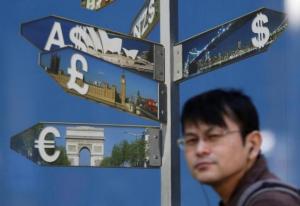
A man walks past various currency signs outside a brokerage in Tokyo
The EU apologists in the Remain camp will throw their hands up in mock horror at this statement, but it is true: some things – like democracy – are more important than money.

In fact, you can tell a lot by observing the times when EU apologists and left-wingers earnestly listen to the voice of big business and the far more frequent occasions when they demonise the “greedy” corporate world. To point out the naked confirmation bias at play here is hardly necessary.

As this blog commented some time ago, when HSBC was making dark murmurings about potentially upping sticks and leaving Britain in the event of Brexit:

Isn’t it funny how the voice of big business – usually the object of scorn and hatred from the left – suddenly becomes wise and sagacious when the short term interests of the large corporations happen to coincide with those of the Labour Party?

Labour have been hammering “the corporations” relentlessly since losing power in 2010, accusing them of immoral (if not illegal) behaviour for such transgressions such as not paying enough tax, not paying employees enough money, paying employees too much money and a host of other sins. In Labour’s eyes, the words of a bank executive were valued beneath junk bond status – until now, when suddenly they have become far-sighted and wise AAA-rated pronouncements, just because they have come out in support of Britain remaining in the EU.

The ability of the British people to determine their own future does not appear as a line item on any company’s balance sheet or P&L account, so of course large corporations – as represented by the minority of FTSE 100 chief executives who recently signed a letter arguing against Brexit – do not care whether the people in their home country live in a functional democracy.

Most businesses are just as happy to make money from operating in oppressive autocracies as it is in free democratic countries; nobody is investing in China out of admiration for that dictatorship’s record on human rights. And indeed it is not the job of corporations to make such value judgements, or to safeguard the constitutional frameworks that hold this or any other country together.

That job falls to our politicians, people who should be able to distinguish corporate self interest from the national interest. And who should be able to distinguish between serious macroeconomic upheavals based on a fundamentally worsening economic outlook and short-term macroeconomic shocks based on spooked markets and jittery investors.

Of course Brexit might cause shock waves and be disruptive in the short term. One of the largest and most influential countries in the world would be leaving the most prominent supra-national political union in the world, and it would be concerning if such an event took place without causing a ripple of attention. But potential economic uncertainty is not the point, and neither is it a sufficient reason to fearfully remain in the EU in perpetuity while overlooking the profound and irredeemably anti-democratic nature of the club.

In fact, one can go further and argue that it is the tremulous fear of uncertainty – and our apparent preference for technocratic risk-minimisation at every turn and in every aspect of our lives – which has sucked the ideological contrast out of our contemporary politics and done so much to encourage voter apathy.

Pete North picks up on this point in an excellent blog post, in which he argues that a little uncertainty might actually be a very welcome development:

This is why the EU sucks. We can have any government of any stripe so long as it performs within a set of predefined parameters and does as it is told. How very dull. In dispensing with democracy we have dispensed with politics and in place of politics we have civic administration where everything is merely about the allocation of resources. Where’s the big idea?

We have heard from every politician the same vague promises about returning power to the people and restoring localism, but we’ve heard it from ardent europhiles who do not see the inherent contradiction in their empty words.

By excluding the people from decision making we have killed off social innovation and enterprise, we have beaten the life out of our education system and where our health system works it is more through luck and the application of cash than actual managerial skill. It is little wonder that business looks overseas for skilled individuals in that our schools are micromanaged to the point of insanity, beating the vitality out of teachers so that children are neither engaged nor educated.

Put simply, there is no longer any uncertainty in politics. The corporates have got their own way. They keep saying if we leave the EU, it will cause uncertainty but that’s actually exactly what we need. We do need some uncertainty that causes to re-engage in politics and to learn more about civic participation and steer decision making. We need some political risk taking so that we can innovate. It might mean a lot improves and it might mean some things break down. But wouldn’t that be more tolerable than the interminable beigeness of modern, post-democracy Britain?

And ultimately, it comes down to that one question: what price does the Remain camp put on democracy?

If the EU is frustrating and imperfect (as all but the most starry-eyed europhiles concede) but leaving would simply be too great a risk, where then is the tipping point? At what point do the negative consequences of gradually but relentlessly losing control over the decisions which affect our lives outweigh a brief wobble in the FTSE 100 or a few sleepless nights for central bankers? And if we have not already reached this tipping point, those who argue for us to stay in the EU have a moral responsibility to tell us where they do draw the line.

Europhiles, particularly those on the political Left, love to portray themselves as progressive and enlightened warriors, fighting for freedom and security for the little guy. Well, here is a blazing example of them doing exactly the opposite in real life.

Given the choice in this referendum to stand up for the right of the poorest and most disadvantaged citizen to exert some limited measure of control over their government by campaigning for Brexit and repatriating sovereignty from Brussels, instead the EU apologists would condemn us to yet more political union with Europe. And all because to do otherwise would go against the wishes of finance ministers, central bankers and certain chief executives. Way to fight for the average citizen!

Risk and uncertainty are not dirty words. And while our prime minister seems to believe that we are a nation of frightened children who are terrified of making important decisions and who instinctively run away from the slightest risk, I choose to hope that there are still enough of us who realise that the EU’s anti-democratic status quo is not the best option for Britain’s future, that David Cameron’s sham renegotiation has done nothing to change that basic calculus, and that a brighter and more democratic future could await us if we dare to ignore the many vested interests and take bold action.

David Cameron went to the country at the general election last year offering a Big Government, nanny state “plan for every stage of your life”. He now asks us to trust that the future he has carefully planned out for us – one of sheltered irrelevance, tucked away in an anachronistic 1950s regional political union – is the best that modern Britain can hope for.

This referendum provides the opportunity for British citizens to show that we hold our country in much higher regard than does our own prime minister – and to help consign David Cameron, together with our EU membership, to the dustbin of political history.
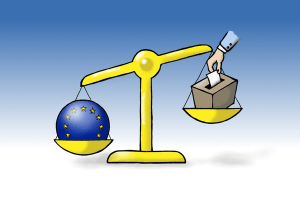
 

EU Democracy - Brexit

Agree with this article? Violently disagree? Scroll down to leave a comment.

Follow Semi-Partisan Politics on TwitterFacebook and Medium.

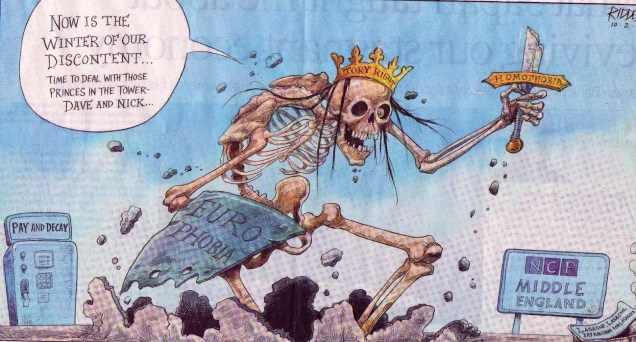
Can I Get A Prescription For My Chronic Europhobia On The NHS?

Europhobia - Euroscepticism - EU Referendum - European Union - Leave Campaign - Stereotypes

When will they invent a cure for euroscepticism?

Well, it’s official. Caring about democracy, taking an interest in how we choose to govern ourselves and thinking like an engaged citizen rather than a terrified consumer are symptoms of madness, or a highly contagious disease of some kind.

Dan Hodges laments:

Boris Johnson is mayor of the world’s greatest capital city. He is currently the bookies favourite to be next prime minister of the United Kingdom. And yet the madness has claimed him too.

As it must claim anyone who signs up to the Out campaign’s cause. Because insanity is not a by-product of the Out campaign. It is at the core of its offer.

For Out to win they know they must first destroy reason. They must convince a majority of mature, rational British adults that we should withdraw from our largest, most profitable trading block just at the very moment the world is teetering on the brink of another global recession. They know they must convince them of the wisdom of turning our back on our most important diplomatic partnerships just as Vladimir Putin is casting his malign eye westwards. They know they must convince them the Britain should attempt to face – in isolation – the most significant refugee crisis and terror threat since the war.

And so to do that, they are trying to spread the contagion. Not though rational argument. No[t], actually, through fear. But simply by trying to drag an entire nation through the looking glass. To convince us all to see the same upside down world they see whenever the hear the name “Europe”.

And concludes, hopefully:

This is what this debate is doing to otherwise sane, intelligent people. It is literally making them incapable of confronting the realities of the world we face in 2016. They are being forced to flee through time, back to the windswept beaches of France, or the dusty hilltop forts of the Raj.

And there, huddled round their camp fires, belting out another lusty rendition the Eton Boating song, they will lose. The voters are hardly enamoured of Europe. They are concerned by immigration, and creeping ECHR restrictions. They have a healthy lack of respect for Euro officialdom. A few still hanker for a prawn cocktail crisp.

But they look at the Out campaign, and they know. They look at those advocating withdrawal, and they can sense it. An inflection in the voice. A glint in the eye. They can see they are afflicted with The Fever.

Soon it will be over. Britain will vote. Britain will vote to remain In the European Union. And then, hopefully, our friends will be returned to us.

I’m going to do something I almost never do, and let this one pass without comment. Because although I profoundly disagree with Dan’s view of Brexit, when it comes to the way the major Leave campaigns jostling for official designation are conducting themselves, there is absolutely nothing I can say in their defence.

It is hard to fight back against the trope that dissenting from European political union by stealth is equivalent to the pathology of “Europhobia” when some people – either losing sight of the grand prize or never having understood it in the first place – are determined to live up to their own worst stereotypes.

One quick suggestion, though. If we are indeed to remain “friends” once this bitterly contested referendum is over, it might be wise for those on the Remain side to stop pathologising their opponents.

Europhobic - Europhobia - Brexit - European Union - EU Referendum

Euro - European Union Flag

Agree with this article? Violently disagree? Scroll down to leave a comment.

Follow Semi-Partisan Politics on TwitterFacebook and Medium.

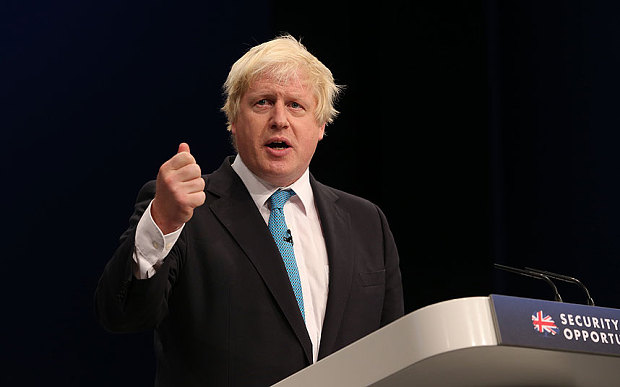
Boris Johnson, Follower-In-Chief

Boris Johnson - Follower in Chief - Brexit - EU Referendum - European Union

Boris Johnson, Profile in Cowardice

While many of us rolled our eyes and lost what last remaining scraps of respect we may have had for Boris Johnson after his last-minute, nakedly self-serving decision to spurn David Cameron and back the Leave campaign, others seem to be swooning with delight.

The Telegraph conducted a delightfully unscientific poll of local Conservative Party Constituency Association heads, and found that a handful more local chairs now back Boris Johnson over George Osborne.

Boris Johnson has pulled ahead of George Osborne in the Conservative leadership race after coming out in favour of Britain leaving the European Union, a survey of grassroots Conservatives has found.

The Telegraph contacted the heads of 50 Conservative constituency associations and found that 12 back Mr Johnson, the Mayor of London, while eight support Mr Osborne, the Chancellor.

Theresa May, the Home Secretary, and Sajid Javid, the Business Secretary, have the support of just five of the Conservative Association heads between them after choosing to back the campaign to remain in the European Union.

Priti Patel, the employment minister, had the support of one association head while 24 said that they are undecided.

If leading the Conservative Party in your local geographic area still entitles you to call yourself a “grassroots” member, then one wonders what term should be used for the humble folk who stuff envelopes, knock on doors and distribute leaflets without the benefit of a title. Root vegetable conservatives? Tuber Tories? Surely something deeply subterranean, at any rate.

And leave aside for the moment the depressing fact that the only one of these potential future leaders who might reasonably be described as an ideologically uncompromised conservative – Priti Patel – has the support of only one constituency chairperson.

It is what comes next – the words of one Conservative constituency chairman, praising Boris – which is truly puzzling:

John Doddy, chairman of the Broxtowe Conservative Association, said: “Boris Johnson was needed to make a positive impact on Vote Leave. We needed a big hitter. The only potential leader that has shown considerable courage is Boris.”

The Telegraph picks up and runs with this Heroic Boris theme in the sub-headline to their article:

Exclusive: Grassroots Tories hail Boris Johnson’s ‘courageous’ decision to come out in favour of a Brexit in potentially ‘game-changing’ moment for party leadership race.

Considerable courage? Hardly.

Boris Johnson, Follower-In-Chief, dithered, vacillated and prevaricated for as long as he possibly could, until the Tory Leadership Acquisition calculus shifted around him (as other, more principled colleagues nailed their colours to the mast one by one) to such an extent that eventually there was only one option left open to the London mayor if he wanted to present himself as a viable alternative to George Osborne.

With all of his main rivals for the Conservative Party leadership swinging behind David Cameron’s fatuous and empty “renegotiation” and supporting the Remain campaign, the only possible way for Boris Johnson to find himself in the top two candidates selected by MPs for consideration by the wider party was for him to declare for the other side and then hope that his choice is validated with a “Leave” vote in the referendum, casting Boris as the only heavyweight to have been on the right side of the plebiscite.

But even then, one could tell that Boris Johnson was reluctant – that this Hail Mary political pass was the last thing that he actually wanted to do, and that it went against his own far more pro-EU instincts. That much was revealed by the fact that when outlining the reasons for his decision, Johnson initially floated the “can’t we all just get along” suggestion that we vote Leave only to wring a few more minor concessions from Brussels rather than actually leaving the EU, before eventually having to walk back this suggestion in the face of justified criticism and ridicule.

And yet there are some in the Conservative Party – generally those who would smile and forgive Boris if they came home from work to find him in bed with their spouse – whose determinedly superficial thinking leads them to hold Boris Johnson a courageous hero, and others in the media willing to help the narrative along despite its obvious falsehood.

“Considerable courage”? From Boris Johnson? If this is what bold and visionary courage looks like, I would hate to ever behold rank, abject, self-serving cowardice.


Boris Johnson - EU referendum

Agree with this article? Violently disagree? Scroll down to leave a comment.

Follow Semi-Partisan Politics on TwitterFacebook and Medium.

Will The EU Referendum Be Decided By The “Shy Eurosceptic” Vote?

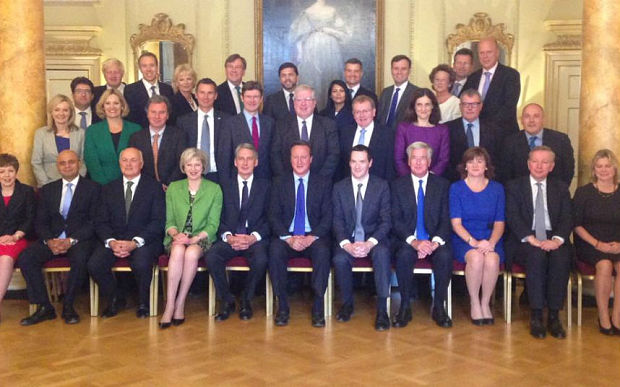
David Cameron - Conservatives - Cabinet

Is there a shy eurosceptic factor at play in the EU referendum?

What happened to all of the supposedly staunchly eurosceptic Conservative cabinet ministers – people like Sajid Javid and Rob Halfon – when it came time to nail their colours to the mast and declare their desire to leave the European Union?

Charles Moore has a theory:

Obviously one factor is that Tory MPs have found it convenient in recent years to adopt Eurosceptic protective colouring in their constituencies. But I think there is something deeper. The fear factor which may well win the referendum for Mr Cameron actually operates even more strongly on the elites than on the mass of the population. People who hold important jobs are much more worried than normal citizens about being considered ‘off the wall’. If they opt for ‘leave’, they will be interrogated fiercely by their peers about their decision. If they declare for ‘remain’, they will be left in peace. The EU is the biggest elite orthodoxy of the western world since we gave up our belief in imperialism. Most people within elites find it too tiring and dangerous to question the orthodoxy under which they have risen to the top.

Now, I have no time at all for those craven Conservative MPs who built their precious reputations and careers on a foundation of what turns out to be utterly fake euroscepticism. But neither can I deny the very real, socially oppressive aura that surrounds euroscepticism in some quarters, whereby it becomes very difficult for people to publicly express their eurosceptic opinions in certain context and company. And if one cannot excuse the shameless U-turning when it is committed by our elected representatives, we should perhaps be more understanding when ordinary members of the public falter.

So what are we dealing with here? It’s the same factor which makes otherwise confident, extroverted people drop their voices to a hushed and conspiratorial whisper when discussing their conservative political leanings in an elite (or creative/artistic) workplace, or makes a school teacher think twice before openly contradicting the biased, anti-Tory ranting of their colleagues.

But it is more than simply avoiding hassle. For many people, not only the elites, it is also a case of seeking to avoid very tangible real-world consequences of being known to hold unfashionable opinions – the threat of public ridicule, professional censure or even job loss, simply for committing thought-crime.

Maybe nobody will care if you fail to join in the joking with your colleagues when they laugh about Nigel Farage or mock those knuckle-dragging Little Englanders who want to pull up the drawbridge on Fortress Britain. But maybe they will notice, and maybe it might lead to an awkward question: “Wait a minute, you can’t seriously support those racists, can you? You’re having a laugh, right?” Far easier to just go along with the crowd. Why risk antagonising the boss, or the people you sit next to every day? Why risk that upcoming promotion? Better just stay silent.

And of course, this is exactly what happened last May. Ed Miliband and the Labour Party convinced themselves that they were heading for victory in the general election. They really, sincerely believed it (read Dan Hodges’ book “One Minute To Ten” to get a sense of just how fervently they believed it). But it was all nonsense, a great exercise in self-deception made possible by the fact that Labour activists had created such a stultifying aura of sanctimonious left-wingery and screeching Tory-hatred that anyone with a remotely conservative political leaning simply dropped out of the conversation and went silent. Silent, that is, until May 7 – at which time they marched to their polling station and delivered David Cameron back to 10 Downing Street.

Is there a chance that history might repeat itself now it comes to the EU referendum? It is certainly a possibility. There are many social settings – mostly where the social, academic or artistic elites live and work – where expressing a eurosceptic opinion or declaring one’s support for Brexit is tantamount to reading aloud from Mein Kampf in the town square. But conversely, there are no equivalent places or scenarios where one might reasonably expect to be actively persecuted for expressing pro-EU sentiments.

That alone speaks volumes. And while it may not excuse the despicable behaviour of some Conservative cabinet ministers who chose career advancement over eurosceptic principle, it would explain the reluctance of many people from certain professions or social groups to openly declare their euroscepticism.

As to how much of a chilling effect the establishment’s instinctive pro-EU instincts have on the polling and the wider referendum debate, we will likely not know until the votes are counted.


Scientists for EU

Universities for Europe - 2

Agree with this article? Violently disagree? Scroll down to leave a comment.

Follow Semi-Partisan Politics on TwitterFacebook and Medium.