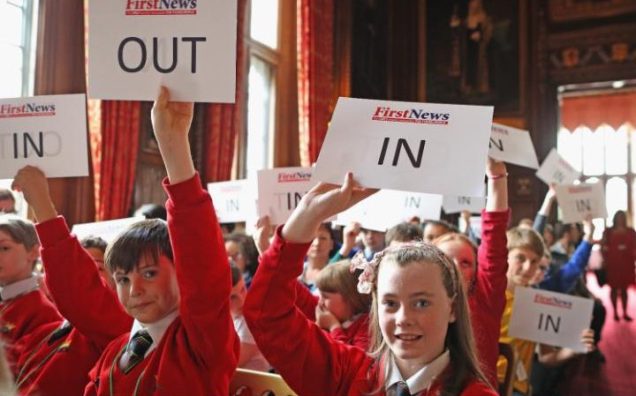
Our Schools Are Hotbeds Of Anti-Democratic, Anti Free Speech Sentiment, Hostile To Conservative Students

EU Referendum - Brexit - Free Speech - Children - School - Education

British schools and universities represent an oppressive and highly unsafe space for young students who believe in free speech or hold pro-Brexit beliefs

If you think that you have been made to feel uncomfortable for holding eurosceptic, pro-Brexit beliefs, spare a thought for those young Brexiteers trapped firmly behind enemy lines in the clutches of Britain’s left-wing educational establishment.

Tanya Kekic, a sixth-form student, writes in Spiked about the post-referendum climate endured by those who supported Brexit:

As they had scarcely met anyone supporting Brexit, they could not understand how this had happened. Their only explanation was that the electorate was misguided, brainwashed, uneducated and motivated only by their hatred of immigrants. They were not at all embarrassed by their disdain for ordinary people. In fact, teachers and pupils openly said that democracy is a sham, that we need ‘experts’ to make the big decisions and that idiot Leavers should not have been able to vote in the first place. I’ve not been around long, but I have never seen anything like it. I knew this kind of loathing of the ‘masses’ existed, but in the past it had been disguised.

The same low opinion of people is shown by my teachers’ and classmates’ rejection of freedom of speech on the grounds that, firstly, the public are too uneducated to hear dangerous views, and, secondly, the public are too weak and vulnerable to hear something that might offend them. Over the past year my freedom-loving friend and I have had ongoing debates at school about whether there should be a limit to freedom of expression. We have not yet found a teacher who believes in unfettered freedom of speech.

The most shocking encounters have been with our philosophy teacher. First of all, she declared that she completely disagrees with freedom of speech and the very idea of a free press. (I am not kidding.) Secondly, she became hysterical when we said that no religion, including Islam, should be above mockery or criticism (this was after we were shown a video ridiculing Christianity). She told us to ‘get out’ of the classroom, while whining that we can’t criticise the prophet Muhammad because it says not to in the Koran. We heard from another teacher that apparently we have ‘extreme’ views. (As far as I know, we haven’t yet been reported to Prevent.)

If believing in freedom and democracy makes you an extremist, we are really in trouble. Schools are encouraged to teach students about British values, such as tolerance and pluralism. But when they don’t know what these principles are, little wonder they fail to uphold them in practice. In particular, the idea of tolerance is very confused. We are not told to allow unpleasant views to be shared and then to challenge and criticise them; rather, we are told either to shut up and respect all beliefs, or to censor and shut them down. To understand why hypersensitive university students are cowering in Safe Spaces and banning ideas they disagree with, you only need to sit in on a Year Eight citizenship lesson.

This is concerning indeed, though not surprising. This blog has previously reported on the plaintive cries for help and/or of frustration from young conservatives, eurosceptics and civil libertarians who found themselves being ruthlessly persecuted at school, often with the full knowledge and participation of their own teachers. And clearly the EU referendum has taken that pre-existing hostile climate for free speech and injected it with steroids.

One marvels in particular at the philosophy teacher who “became hysterical” at the mere idea (not even the act) of criticising Islam, and who pre-emptively ejected Kekic and her friend from class as punishment for daring to suggest that all ideas should be open to debate and criticism. On might have thought that adherence to this view would be a prerequisite for anybody seeking to teach philosophy of all subjects, but apparently there are now schools employing philosophy teachers who actively oppose the idea of critiquing certain ideas and belief systems.

Where teachers lead, impressionable students will often follow. And the clear message being sent by the academic establishment – not only at the university level but at the school level too – is that the Cult of Social Justice and Identity Politics is firmly in charge now. Free speech is even less of an absolute right than it was before, woolly metro-leftism is firmly established as the only acceptable political worldview and ideas should no longer be judged on their own merit, but rather on the identity of their proponent and the position which they occupy in the Hierarchy of Privilege.

When I appeared on the BBC Daily Politics earlier this year to discuss the phenomenon of oversensitive students, I joked that something strange seems to happen in the minds of otherwise sensible young people the moment they first set foot on a university campus, making them suddenly obsessed with their racial and gender identities and utterly incapable of tolerating alternative viewpoints. But of course this facetiousness disguised an important truth, made clear by Kekic: the fact that we are raising our children to be this way from birth, through our therapeutic culture, worshipping of the self, encouraging of a state of constant personal fragility and a starkly authoritarian attitude toward any speech which even remotely contradicts certain established orthodoxies (Islam is above reproach, the EU is fundamentally good, etc.)

There are already whole industries – certainly in academia but elsewhere too – where holding conservative or eurosceptic beliefs amounts to social or professional suicide. The other day I attended a meeting of good people involved in various social enterprises and charities in the third sector. After I brought up the topic of the EU referendum in passing, the speaker proceeded to wax lyrical about just how awful Brexit is, never thinking for a moment that anybody in the room might possibly disagree with her. Though it was amusing, I also felt a pang of awkwardness and discomfort, knowing that I was surrounded by people who would be utterly repelled if I revealed my own true feelings about Brexit (I did anyway).

The point is that as a grown man and a political blogger well used to debate and disagreement, I still paused momentarily before airing a perfectly mainstream and acceptable opinion in front of people who strongly disagreed and who thought that those who supported Britain leaving the EU were stupid at best and malicious at worst. How, then, must those young people with conservative or eurosceptic beliefs feel, who have not yet developed so thick a skin? How are they to feel comfortable expressing their sincerely and legitimately held political views when finger-wagging teachers casually accuse them of “extremism” and conspire to silence them altogether?

There is a cancer in our schools and universities, metastasising throughout the entire educational establishment. It is a tumour which sucks the life out of free speech and academic freedom, and encourages dull, lumpen conformity invigilated by a watchful, censorious, politically correct Taliban.

We need to excise that tumour before it kills off independent thinking, freedom of speech and academic enquiry for good.


European Union - United Kingdom - Britain - Flags

Top Image: Telegraph

Support Semi-Partisan Politics with a one-time or recurring donation:

Agree with this article? Violently disagree? Scroll down to leave a comment.

Follow Semi-Partisan Politics on TwitterFacebook and Medium.

The Church Of England’s Tantrum Over The EU Referendum Result Is Insulting To Brexit-Supporting Christians

Bishop Robert Innes - EU Referendum - Remain - Brexit - European Union - Christianity

Nearly a month after Britain’s historic vote to leave the European Union, swathes of the Church’s leadership are stuck in furious denial

This blog had very little time for the Revd. Dr. Robert Innes, the Church of England’s Bishop of Europe, before the EU referendum and Britain’s shocking, wonderful decision to leave the EU. But it has even less time for his incessant, self-pitying (and democracy-loathing) moaning in the weeks since that historic vote.

The Archbishop Cranmer blog reports:

“Let me be clear,” said the Rt Rev’d Dr Robert Innes, Bishop of Europe, as he addressed the General Synod of the Church of England. “From my European perspective, this Referendum and its result represent a sad loss of national vocation; an abject failure of political leadership; and a squandering of the birthright of our young people.” And Synod applauded their Euro-prophet for a full 10 seconds, seemingly oblivious to the fact that lay Anglicans voted for Brexit in their droves (and by a majority). “Britain seems to be a country anxious to build fences,” he added, before reminding the people of God that his task as a bishop is to build bridges. Not to the wider world, it seems. Or even to the 22 nations of Europe which aren’t in the European Union, which includes the supremest bridge Pontifex himself, all neatly fenced off in Vatican City State. But Dr Innes’ task as a bishop is to build bridges to the other nations of the European Union, and without political union he is seemingly bereft and hindered from doing so.

Cranmer goes on to highlight Bishop Innes’ complete and utter disregard and disdain for the pro-Brexit opinions of many lay Christians:

The Bishop of Europe acknowledges that some in his Diocese were pleased with the Referendum result, but he doesn’t tell their stories. They are sidelined, disdained and ignored: they don’t quite fit the Bishop’s narrative of shame, anger and deep sadness. “One older man in Paris said to me: ‘I have never been so ashamed of my country.’ A lady in Geneva said to me: ‘I have found it hard to stop being angry.’” There’s no apprehension of joy, liberty, hope or optimism: no awareness of the abundance of bridges we can now build into the whole world. For the Bishop of Europe, British identity and national vocation were wrapped up in ever closer political union: there is no refuge or strength to be found in Brexit.

Christians who voted to leave the EU did so for a variety of reasons, and none of them is worthy of less consideration than the shame of the old man in Paris or the anger of the lady in Geneva. Do we not also seek to cooperate and fellowship with other churches in Europe? Do we not pray to avoid harm and relieve suffering? Are we any less concerned with human rights, the common good or injustice? Are we incapable of loyalty to brotherhood and respect for authority? Is our ethic simply one of nationalistic purity, individualism and xenophobia?

[..] Is there not an echo in our historic national vocation of looking out to the seas and saving Europe from herself? Rather than being an abject failure of political leadership, might Brexit not represent a noble and commendable success? Instead of squandering the birthright of our young people, might we not just have preserved their ancient rights and liberties as freeborn Britons?

One wonders exactly how long the British political and cultural establishment – of which the Church of England is a firm member – can go on being openly, seethingly contemptuous and angry at the British people without finding themselves on the receiving end of an eventual backlash which will make Donald Trump seem the epitome of polite restraint.

The way which those people of privilege and wealth (such as bishops, newspaper columnists and politicians) have conducted themselves since the EU referendum, staggering around the political landscape rending their garments and gnashing their teeth in despair at the prospect of being separated even an inch from their beloved European Union, is enough to induce nausea. It is particularly offensive when such arrogant and self-pitying emotions burst forth from people who fatuously claim to care about the whole of society while reserving a particular duty of care to exactly the type of disenfranchised, economically suffering people who voted for Brexit in their droves.

It is almost enough to make one pine for the days when the establishment merely ignored the concerns, priorities, hopes and dreams of ordinary people as the elite ravenously pursued their own interests. To a poor Christian, it was likely enough of an insult and stretching of Christ’s teaching to be ministered to by a disinterested bishop who lives in a mansion and sits in the House of Lords while they have to trudge five miles to the food bank. Now, as punishment for daring to vote for Brexit, now they must endure the same gulf in circumstances while also being harangued and accused of small-minded racism by some pampered upper middle class oik who uses the collection plate offerings of thousands of other economically struggling Christians to ride the Eurostar first class to “build bridges” with Europe while the social fabric of his own country continues to crumble.

How, one wonders, does the Church of England expect to survive when too few of its bishops follow the example set by Mark Rylands, Bishop of Shrewsbury, who approached the EU question fairly and with the interests of the world’s poorest at heart rather than the interests of Britain’s ruling elites, and determined that Brexit was best for British democracy and for the world’s poor?

How does the Church of England expect to survive when the face it presents to the nation (and its own congregations) too often resembles the contemptuous face of Bishop Robert Innes, horrified by the great unwashed in all their uneducated xenophobia, and the democratic decision they made to leave the European Union?

Quo usque tandem abutere, episcopus, fides nostra?


Christianity - Europe - EU - Brexit

Support Semi-Partisan Politics with a one-time or recurring donation:

Agree with this article? Violently disagree? Scroll down to leave a comment.

Follow Semi-Partisan Politics on TwitterFacebook and Medium.

A Failed Military Coup In Turkey Is The Worst Possible Outcome For Democracy

People react near a military vehicle during an attempted coup in Ankara

This failed military coup has achieved the awful outcome of allowing Turkey’s tin pot dictator in gestation, the despicable President Erdogan and his supporters, to pose as champions of the very democracy they are busy subverting

Nobody in their right mind usually yearns for a military coup – the violence, confusion, civilian casualties, suspension of justice, martial law and human rights abuses which occur in the best of times are nothing to welcome, no matter how odious the status quo.

But once it became clear that a military coup was underway in Turkey, involving at least a subset of the military, it were better for that coup to succeed with as little bloodshed as possible than to have it fail.

Why? Because if you thought President Recep Tayyip Erdoğan was bad before, just wait until paranoid, vengeful President Erdogan 2.0 is unleashed once he has finished putting down the coup and reasserting control over his divided country.

This is a vain and power-hungry little man who was at one desperate point last night reduced to addressing his nation via FaceTime, through an iPhone screen pointed at a television camera. He will not have taken kindly to this humiliation, and his vengeance will be swift and merciless.

President Erdogan was already well on the way to tin-pot dictator status, jailing critical journalists and political opponents, seizing control of independent critical newspapers and turning them into pro-government propaganda outlets, violently suppressing popular protests, subverting the constitution and building himself a palace fit for a king. All of this will now be accelerated.

As Mark Wallace rightly warns in Conservative Home:

If you thought he was a paranoid tyrant before, you ain’t seen nothing yet.  Erdogan was already throwing his weight around – jailing journalists, seizing control of critical newspapers, sending riot police in to fight protests and so on. But now he has a concrete threat which he can use to justify any and all repressive measures. The odds are that we will now see even tougher clampdowns which sadly will extend will beyond those actually responsible and likely sweep up many targets whom the government finds it convenient to be rid of.

Worse still from a secular standpoint, the military’s bluff has now been called. Turkey’s military has historically served as a firewall, a last line of defence against creeping Islamism and theocratic control. While details of this coup attempt have yet to fully emerge – it may be the case that these events were plotted only by one specific subset of the military – it now appears that the military has gambled and lost. It is hard to see them serving their pro-secular role in future, especially once Erdogan has made further personnel changes, replacing the current general staff with his stooges.

This failed coup attempt is also bad news for everyone else who relies on Turkey being a moderately stable presence in the region, and a trustworthy negotiating partner. Erdogan already had the European Union over a barrel with its pants down, extorting huge sums of money from European taxpayers in exchange for taking the smallest of actions to stem the flow of migrants and refugees entering the EU via Turkey. Expect that price to go up (while Turkey’s commitment to abiding by its agreement goes down) now that Erdogan feels the need to shore up his own position.

But the truly depressing thing about this failed military coup is the fact that it allows an utterly despicable and contemptible man and his hardcore supporters to parade around like the champions of democracy when in fact they are its sworn enemies. Erdogan himself once remarked that he views democracy as akin to getting on a bus, and that once the bus reaches its destination he will get off – in other words, he will submit himself to taking part in elections until he has built up a sufficient power base, and then kill Turkish democracy in the crib so that he can never be removed.

Already in the early hours of the morning, when it appeared that the coup attempt was failing, we saw Erdogan’s supporters wrap themselves in the flag of democracy:

Sadly, some in Britain who should know better – including the normally reliable Brendan O’Neill – joined in the same chorus:

The events cited by O’Neill – the establishment’s horror at Brexit, the Islamist terrorist slaughter of innocent people in Nice on Bastille Day and this failed coup in Turkey – are hardly comparable. While the first two do indeed represent the hatred held by some people for popular liberal democracy, President Erdogan is no great believer in liberal democracy, using it as a vehicle when it helps him but quick to suppress it when it represents a threat to his interests.

The danger is that by ennobling Erdogan’s survival by lumping it together with legitimate democratic movements (like Brexit) we help to shore up the power of somebody who is no friend of democracy, and who fully intends to snuff out democracy altogether once he has used it to drag Turkey back to some primitive, theocratic dark age.

This really is the worst of all possible outcomes. Military coups are never something to be celebrated, even when aimed at deposing someone as unpleasant as Erdogan – his defeat should come at the ballot box, not at the barrel of a tank gun. But a failed coup is doubly bad since it weakens the military, hardens Erdogan’s supporters and makes the man himself even more paranoid and authoritarian – there are already talks of Turkey reinstating the death penalty to deal with the plotters.

Whichever side had prevailed in this coup attempt, democracy would have been the nominal loser. But democracy’s defeat will be particularly bitter now that Recep Tayyip Erdoğan stands strengthened and victorious.


Postscript: The failed coup in Turkey also seems to have brought out the worst in several British politicians, notably Labour MP Chris Bryant who thought that turmoil in Turkey provided a perfect opportunity to smear Brexiteers:

In other words, Chris Bryant is literally blaming Brexit and the quest for British independence from ever-closer European political union for causing civil unrest in a country thousands of miles away.

“Sore loser” doesn’t even come close to describing this hysterical, childish behaviour from an elected Labour MP. So out of touch are Labour MPs with the mood of the country (and their own constituents – Chris Bryant’s constituency voted for Brexit, 54-46 per cent) that even now they are sulking and taking part in a tantrum, lashing out at the British people for having the temerity to ignore their doom-laden advice and drag them away from their beloved EU.

The next time you hear it said that the Corbynites are rendering the Labour Party unelectable, remember that it was the centrist Chris Bryant acting like a moronic child on social media while civilians were being killed in Turkey.


Turkish President Erdogan addresses during an attempted coup in Istanbul

Top & Bottom Image: Indian Express

Support Semi-Partisan Politics with a one-time or recurring donation:

Agree with this article? Violently disagree? Scroll down to leave a comment.

Follow Semi-Partisan Politics on TwitterFacebook and Medium.

There Is Nothing Noble Or Virtuous About Defending The EU

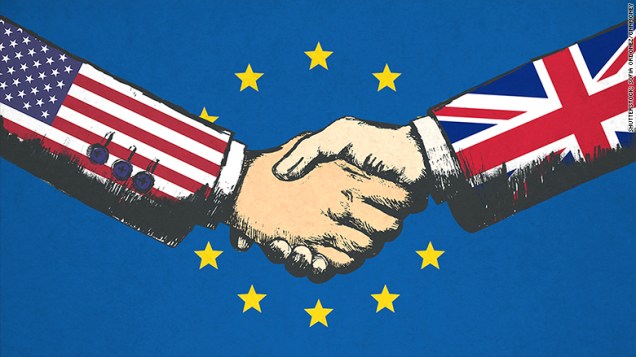
European Union - USA - UK British flags

The EU’s defenders in the middle class and political/cultural elite love to believe that they are supporting a grand and noble project, but close their eyes to the economic and democratic damage wrought by this failing supranational union

An opinion piece in the New York Times provides a welcome antidote to that newspaper’s fatuous, instinctive pro-Europeanism.

Tim Parks writes:

Had I had the right to vote, which I have lost after 30 years living in Italy, I would have voted to remain in the European Union. But I do not think it a scandal that others think differently. If it was a scandal that people voted to leave, then surely it was a scandal to have held a referendum at all. And if it is a scandal to hold a referendum on an issue central to the destiny of a nation and about which its people feel deeply, then I have misunderstood the meaning of freedom and democracy in the West.

So why the extraordinary incredulity and indignation? Why the sense of betrayal? Why do so many people find this result unacceptable? It seems that over the last 30 or 40 years the idea has taken hold that there can be no peaceful or productive future for Europe without the European Union. As a result, anyone who voted to be outside it must be discredited as pernicious or ignorant, perpetrator or victim of some sinister populism. In the United States, this unhelpful reaction has taken the form of likening the leaders of the Leave campaign to Donald J. Trump. But Britain is not America and this was not a presidential election. Immigration played a role, but no one in the Leave campaign was suggesting Muslims be banned from Britain. On the contrary, some Muslims supported the Brexit vote. To see the debates of other countries in terms of one’s own internal politics is always a failure of imagination.

All this shock, horror and kneejerk denigration might be understandable if the European Union were notching up important successes and resolving its member states’ many problems, or if, at the very least, it had a figurehead with whom European citizens could identify, someone of whom one might say, “However badly things are going, I have faith in so and so, I believe he or she really does have the interests of my nation at heart, really is concerned about unemployment in my town,” be it Newcastle or Naples.

Obviously the EU has no such figureheads. Its vaunted “founding fathers” are unknown and unloved by all but the most starry-eyed euro federalists, its parliament a fraud, its stolen anthem a joke and its leaders held in widespread contempt. It cannot appeal to any sense of collective destiny because the loyalty of the vast majority of EU citizens lies first and foremost with their own nation state.

And Parks is quite right to note that the EU is failing across most of the metrics by which one might reasonably judge success. Economic growth, employment and social cohesion have all been thrown under the bus in the name of European political union, while the countries most let down by the EU project remain within the union only because they suffer from a national form of Stockholm Syndrome.

Parks points out:

But the Union’s greatest failing is that after decades of regulations of every possible kind it has not brought the nations of the Continent closer together. Day by day Italians are told whether their government’s economic policy has been accepted or rejected by Berlin, but about the Germans they know little or nothing. In each country, we follow our own national news media and are locked into the agendas of our own political systems. We are separate nations but not sovereign nations. We obey the dictates of Brussels and read Jonathan Franzen and “Harry Potter.” We watch American films and follow the American elections far more closely than those of any other country in the European Union. Is this a community?

But best of all is when Parks turns his gaze on the middle class and political elites who remain the EU’s strongest defenders:

The middle classes, the cultured elite, love the idea that they are taking part in a historic project that will bring peace and prosperity to the Continent, put an end to war, take steps to defend the environment, protect Europeans from superpower ambitions and multinational depredations, etc., etc. I love this idea, too. Like so many others, I take comfort in this noble enterprise.

But when the project does not bring prosperity, when it does not do enough to protect the environment, when its protectionist trading policies systematically damage the economies of the third world, I, like everyone else, don’t want to think about it; we prefer to close our eyes. This is not the narrative we like to believe we live in.

[..] With Brexit this decades-old spell is set to break. And how does the liberal elite on both sides of the Atlantic react to this deafening alarm? They scream foul and blame the dumb British working classes for spoiling the party. It might be wiser to examine our own attachment to a narrative that is going nowhere.

But the defiant liberal elite will not let go of their false narrative, preferring to nurture a sense of grievance and display to the world a shameful contempt for democracy.

Just this weekend, grieving metropolitan Remainers held a “Picnic against Brexit” in Green Park, in what was billed as an opportunity for people to “heal” and “comfort” one another. Disappointed Remainers are literally treating their defeat in the EU referendum as a kind of emotional trauma, an unendurable shock to the system for a group of people who have had their way since 1973, came to rely on the EU’s comfort blanket and who simply cannot conceive of life as a citizen of an independent country.

An emotional reaction of this strength is only possible when one genuinely believes that one is fighting on the side of righteousness and possesses a monopoly on the virtues of wisdom, compassion and truth. It is much like the arrogance of tearful Labour supporters who simply could not understand why the country rejected Ed Miliband and re-elected the Evil Tories in the 2015 general election. The strong overlap between these two groups of people is no coincidence.

For people who make up a supposed intellectual and moral elite, the Remainers-in-denial are extraordinarily unperceptive. Even now, they can not accept that the 52% of their fellow citizens – including many working class voters – who voted to leave the EU might have a point, that their beloved European Union might not be the wonderful and benevolent force for good that they insist it is. On the contrary, they stubbornly continue to insist that those who voted for Brexit did so  either out of ignorance or malice, and work to prevent Brexit from happening.

This will not end well. Sneering contempt for the political opinions and values of ordinary people has not done the elites any good this electoral cycle, in Britain or America. If the elites are at all interested in bridging the divide and repairing their relationship with the rest of the country then they must start displaying the kind of introspection and empathy demonstrated by Tim Parks in his NYT article – and far fewer disdainful middle class picnics against democracy.


Brexit - EU - European Union Flag - Missing Star - Britain - UK

Top Image: CNN

Agree with this article? Violently disagree? Scroll down to leave a comment.

Follow Semi-Partisan Politics on TwitterFacebook and Medium.

A Tory-Labour Centrist Alliance? The Self-Serving Establishment Will Stop At Nothing To Stay In Power

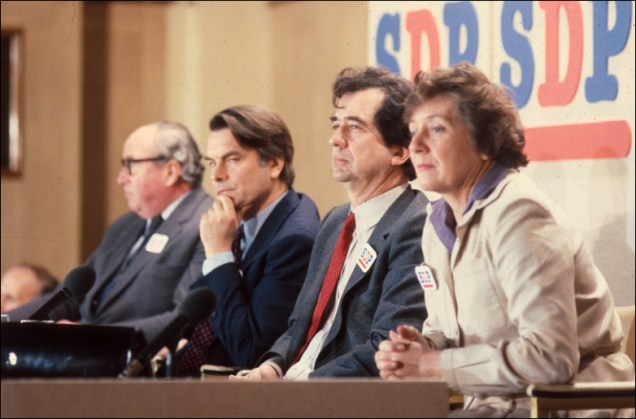
SDP Launch

The British people have made clear that they want their two main political parties to once again stand for recognisably different policies, values and objectives. But the response of calculating, stale and ideology-free centrist MPs seems to be to reorganise themselves in order to avoid dealing with a reality they would rather ignore

Politics is finally getting interesting again. After more than two decades of stale, centrist managerialism following the resignation of Margaret Thatcher, we are finally starting to see real ideological and intellectual dividing lines re-emerging in our political discourse.

After a long and dismal period where it barely mattered whether you voted for Team Red or Team Blue, so similar were their policies, we face the delicious prospect of which way people vote actually mattering once again. This is a good thing. Dry, stultifying conformity might just about be acceptable when things are in a good state, everyone is prosperous and happy, and a safe pair of hands is all that is required to keep the good times rolling.

But while many prosperous, metropolitan professional types (including nearly the entire British political class) may have been coasting through life thinking that everything was fine and dandy, in fact things were not fine for millions of their fellow citizens. And when the status quo is failing so many people, a consensual, moderate and determinedly un-radical form of politics is the very last thing which will bring about the required change.

This is why we should celebrate the short-term chaos which is roiling British politics. For too long we have been cursed by a Labour Party which cares more about making its middle class, urban supporters feel good about themselves than actually delivering tangible improvements in the lives of the working poor and the dispossessed or responding to their concerns about our democracy and our country. And since Thatcher’s departure, the ideologically rootless Tory Party – this blog describes the Cameron cohort as Coke Zero Conservatives, the same conservative taste you recognise but with none of the caffeinated, calorific oomph which makes it worth drinking – has adopted one socialist, redistributionist policy after another in a desperate, failed bid to shake off their so-called “Nasty Party” image.

In other words, within the space of twenty years the two major political parties have converged to such an extent that they were almost indistinguishable from one another – Ed Miliband’s Labour Party went into the 2015 general election flogging coffee mugs on their campaign website which promised to “control immigration”, while David Cameron’s Conservative Party manifesto was creepily subtitled “A plan for every stage of your life” – statist control freakery if ever there was.

The result of this, we all know, was the rise of the fringe parties – the incredible success of the Scottish National Party despite their utterly woeful record actually wielding power in Scotland, and the rise and rise of UKIP which set the wheels in motion for David Cameron’s bitterly regretted decision to offer the country a referendum on our continued EU membership.

Since the shock victory for Brexit in the EU referendum, things have only gotten worse for the forces of dull, greyscale centrism. David Cameron resigned in justified humiliation having waged a deceitful and bullying campaign in favour of remaining in the EU, in which he threatened his own citizens with punishment if they voted the “wrong” way, and yet still managed to lose. Meanwhile, the Labour Party, whose parliamentary caucus never accepted Jeremy Corbyn’s leadership and sought to undermine it from Day One, decided to make their last stand. Unfortunately, that last stand appears to be the utterly bland and uninspiring figure of Angela Eagle, whose coming leadership challenge will be utterly obliterated by Jeremy Corbyn, who remains very popular with the expanded Labour Party membership.

In other words, this has been a bad time for the establishment. Our poor superiors have endured setback after setback, with their preferred centrist candidates being routed as the public justifiably yearn for the return of authenticity and ideological coherence to their politics. And now they face a setback which cannot be endured – the prospect of seeing their country taken out of the European Union (that great escape from accountability for Europe’s governing elites) against their will.

But they are not going to take this lying down.

The Guardian reports on an utterly despicable new development – the fact that centrist Tory and Labour MPs, terrified at the prospect of the bland, consensual form of politics in which they thrive being brought to an end, are now proposing to unite in order to form a new centrist political party.

From the Guardian:

Tory and Labour MPs have held informal discussions about establishing a new political party in the event of Andrea Leadsom becoming prime minister and Jeremy Corbyn staying as Labour leader, a cabinet minister has disclosed.

Senior players in the parties have discussed founding a new centrist grouping in the mould of the Social Democratic party (SDP) should the two main parties polarise, according to the minister. Talks should be taken seriously, though they are still at an early stage, according to the source.

“There have been talks between Labour and Tory MPs about a new party,” the minister said. “A number of my colleagues would not feel comfortable in a party led by Andrea Leadsom.”

It is understood that MPs in both parties who campaigned to remain in the European Union believe there is an opportunity to build on the newly founded relationships between centrist MPs in both parties made before the EU referendum.

A Tory party source said Labour and Conservative MPs who campaigned in favour had become closer during the campaign and increasingly come to regard themselves as “a tribe”.

In other words, if the centrists do not get their way (as they have done uninterrupted since at least 1991) then they will take their toys and leave, founding an entirely new political party for their own glorification rather than doing the hard work of convincing existing party members that they are wrong.

This seems to be prompted largely by the fact that certain prima donna centrist MPs, used to enjoying the trappings of power and influence which come from senior positions in government or opposition, are unable to tolerate even a brief period in the wilderness while more unabashedly ideological leaders have their turn running the show, and so must orchestrate a way for their own failed and reviled centrist clan to continue pushing their self-serving, wishy-washy agenda.

In Labour’s case, this is just about understandable. Jeremy Corbyn is indeed vastly different to what we have been trained to think a Labour leader should be since the days of Michael Foot. The post-Clause IV, post-Blair accommodations with capitalism mean nothing to Jeremy Corbyn, and he is proud to admit as much. Under Corbyn’s watch, the Labour Party has indeed become markedly more left wing. Therefore, a convincing case could indeed be made that moderate, centrist Labour MPs have no place in the party of Jeremy Corbyn. But since Corbyn is supported by a thumping majority of Labour Party members, it would rightly be for the centrist MPs to toddle off and find a new home (and new supporters). Labour is Corbyn’s party now, not theirs.

The Conservatives, though, have far less of an excuse. It would be interesting to know whether the Tory SDP plotters come predominantly from the older guard or from the 2010 and 2015 intakes. Logic would suggest that many of the more recent Tory MPs, who entered parliament in the dismal Age of Cameron, are most ill at ease at the prospect of being led by a superficially more Thatcherite leadership candidate like Andrea Leadsom. But then Theresa May hardly fits the profile of progressive conservatism, with her flinty-eyed authoritarianism, disdain for civil liberties and championing of a large, overbearing nanny state to watch over us and regulate our speech and behaviour. None of these are endearing qualities in a future Tory leader and prime minister, so any Conservative MP happy to wear the blue rosette for Theresa May but happy to shack up with Labour in case of Andrea Leadsom clearly has a very broken and opportunistic political compass.

The Guardian article continues:

A senior Labour party source confirmed that at least one Conservative minister and one of the shadow cabinet ministers who resigned last week had been involved in discussions about such a reshaping of British politics.

“There is a feeling that there might have to be a new party at the centre of British politics,” he said. “It’s early days, but the conversations are at a pretty high level.”

The suggestion comes as the Liberal Democrat peer Shirley Williams demands a central role for all pro-EU parties at Westminster in shaping the UK’s relationship with the EU. She warns that, without a cross-party consensus on the final deal, the country could fall apart in bitter post-Brexit division and acrimony.

Trust Shirley Williams to be at the centre of this subversive attempt by the political class to reorganise themselves so as to thwart the will of the people. She may play the part of the kindly faced elderly lady very well, but is there any more noxious emblem of our centrist malaise than Baroness Williams? I can think of none.

We now witness the depressing fact that a group of Conservative and Labour MPs – we do not yet know how large this potential grouping may be – have a shared love for keeping Britain chained to the antidemocratic EU which transcends whatever minor differences they may have on policy. And those policy differences between Tory an Labour are undoubtedly very few in this centrist age. Therefore, in a last-ditch effort to avoid being dragged out of the EU kicking and screaming, these MPs are now willing to betray the constituents who elected them to parliament by defecting to join a “worst of all worlds” Party of the Damned, a cesspit of wishy-washy MPs who startle like shy fauns at the first sign of passionate ideological debate.

Even before the official result of the EU referendum was declared, there were noises being made by pro-EU Remainers in denial that some means should be found to overturn the public’s vote to leave the European Union on one spurious pretext or another. Most popular now is the idea that the referendum should be ignored or re-run because the public are gullible fools who were tricked by the slick lies and distortions of the official Vote Leave campaign (as though the Remain camp was not engaged in lies, threats and downright cheating of its own). And it now seems that this is to be used as cover, an excuse to legitimise the subversion of British democracy by a group of spoiled sore losers accustomed to always getting their way.

We must not allow these machinations to succeed. While Labour MPs – so diametrically at odds with a leader who commands overwhelming support among the party membership – should arguably do the decent thing and walk off into obscurity and irrelevance by attempting to form a new party of the centre-left, there is absolutely no excuse for Tory and Labour MPs joining together to create a hybrid centrist party – particularly when neither of the two remaining Conservative leadership candidates can be described as right-wing ideologues in the mould of Thatcher.

That such a dramatic step is even being considered shows the rot in our national and political life wrought by the EU. We are now lumbered with a largely useless political class, wobbly-lipped MPs who are terrified at the prospect of Britain governing herself and not having our government’s every decision vetted by the omniscient supranational European government in Brussels. These plotting MPs are behaving like children suddenly separated from their parents in a busy crowd – screaming, weeping, arms outstretched in anguish at having been ripped away from that which gives them comfort and succour, their alpha and omega. It is an unseemly, pathetic exhibition which they are putting on in their desperation to stop Brexit, stop the realignment of British politics along more ideological lines and return to the happy days when fast-track ministerial careers were their for the taking so long as they managed to be sufficiently bland, predictable and uncontroversial.

Hopefully before long we will learn the names of these Labour and Tory MPs who care so much about their future career prospects but so little for their own constituents that they would abandon the parties under which they were elected in order to create a new centrist holding party to achieve through political skulduggery what they were not able to achieve at the general election or the EU referendum.

And hopefully those MPs concerned will then quickly face the full wrath of their constituency parties and associations for having entertained such self-serving thoughts.

God willing, none of them will be in parliament by the time of the next general election, having been deselected and replaced by new MPs for whom socialism, conservatism, ideology and principle are not such dirty words.
 

SDP - Charles Kennedy

Brexit - EU - European Union Flag - Missing Star - Britain - UK

Agree with this article? Violently disagree? Scroll down to leave a comment.

Follow Semi-Partisan Politics on TwitterFacebook and Medium.