The Daily Toast: Iain Martin’s Brexit Ultimatum To Tory Ministers

Conservative Eurosceptics - Brexit - David Cameron

Politicians with the integrity to openly declare their stance on the biggest political issue of our generation should be the rule, not the exception

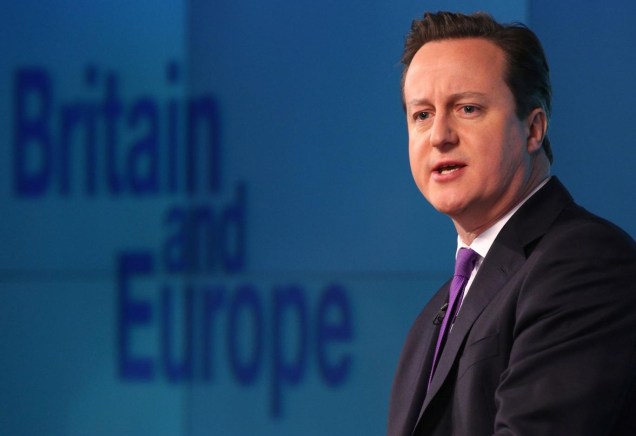
Like most people in Britain, Iain Martin has had enough of equivocating politicians – specifically Conservative cabinet ministers – refusing to take a public position on Britain’s EU membership, and maintaining the fiction that David Cameron’s cosmetic “renegotiation” can have any possible impact on their decision.

Martin goes so far as to call Conservative ministers “a bunch of careerist scaredy cats”, writing in CapX:

Britain’s looming vote on the EU is not – or should not be – politics as normal. It is a historic moment, in which the UK will decide to take one of two quite different paths. Party management and careers matter, of course, but sometimes there are choices that should be about something more than the mere game of politics. The EU referendum is one such event.

This is absolutely correct. Whatever one’s views on the European Union and Brexit, surely all of us can agree that this debate is infinitely more important than the minor tweaks to education, healthcare and fiscal policy which separate the various political parties.

Having established the importance of the coming referendum, Iain Martin issues the following challenge:

Ministers, it is make your mind up time. Although David Cameron’s renegotiation with the EU for new membership terms could have been the real deal, it is clear that it will deliver very little. It is In or Out, probably as soon as this summer. For that reason, ministers need to do something that is highly unfashionable and considered downright deranged in the British Establishment: decide what you believe – enthusiastically for In, reluctantly for In, or Out because you think it is best for your country – and get ready to fight for it at public meetings across the land. Don’t be scared. You are grown men and women. You might even be surprised how much voters like politicians saying what they believe rather than what is convenient for their careers.

This argument is – I know – a stretch, considering how careerist politics has become. But for anyone playing a leading role in the affairs of a nation to base such a vital decision purely on career progression or fear of friends is not only wrong, it’s pathetic. And in ten years time, none of it, all the hedging and game-playing, will matter a jot. By then David Cameron will be having a snooze after lunch in rural Oxfordshire. Osborne will be running the World Bank or a hedge fund. The decision on the EU, on the other hand, now that will have mattered a lot.

The current failure of Conservative ministers and other senior politicians to break cover and nail their colours to the mast only contributes to the (depressingly accurate) perception of contemporary politicians as principle-free careerists squabbling over the right to sit in technocratic management of our public services, rather than principled statesmen grappling with weighty political issues.

In our current political climate, where the Conservative Party runs away from small government principles in pursuit of the centre ground and Jeremy Corbyn’s Labour Party is criticised for actually being left-wing, it is clear that the vast majority of politicians prefer the former to the latter.

Power is pursued for its own sake, even if it means the centrist coalition of supporters cobbled together to deliver victory make it impossible to do anything remotely radical, transformational or different once in office. Thus, despite the overwrought rhetoric from both sides, neither Labour nor the Conservatives  propose a single policy which would move Britain away from its current centrist landscape.

Politicians who came of age in this age of the Tyranny of Centrism find it inordinately difficult to express a strong, sincerely held political opinion because all of their training and professional experience teaches them that pragmatic caution and a reflexive fear of fixed beliefs are the surest route to success.

Whether it’s the NHS, tax reform, constitutional reform or Britain’s relationship with Europe, MPs are strongly predisposed to fiddling around the edges themselves, while accusing others of partisan recklessness. Thus change is only ever incremental, and nearly always in the direction of More Government – the path of least resistance for any elected official.

Unfortunately, too many within the public and the media are willing to excuse this state of affairs, urging us to put ourselves in the politicians’ shoes rather than demanding sincerity and principle from our elected officials. It is therefore particularly pleasing to see Iain Martin losing patience with the status quo and demanding that those who seek to run the country actually declare the direction in which they would lead us.

The Tyranny of Centrism can only continue so long as we tolerate and enable it by rewarding glib superficiality and punishing strong displays of principle from our politicians. And on an issue as important as Britain’s future relationship with the EU, this is no time for fence-sitters, careerists or cowards.

EU Renegotiation - Brexit - European Union

Agree with this article? Violently disagree? Scroll down to leave a comment.

Follow Semi-Partisan Politics on TwitterFacebook and Medium.

Pro-EU Campaigners Can’t Decide Whether Brussels Is Friend Or Frenemy

Britain - UK - European Union - Referendum - Brexit - Punishment Beating

The Good Cop/Bad Cop routine of the EU’s British cheerleaders betrays the fundamental weakness of the europhile argument

I have always struggled to wrap my head around that strain of pro-Europeanism which declares “the EU is a benevolent and harmless group of countries working together for mutual gain” on the one hand, and “the EU will ruthlessly punish us and seek to make an example out of us if we ever try to leave” on the other.

Call me stupid, but the two visions of Brussels don’t seem to be compatible. Either the European Union is a harmless coming together of independent European nations seeking to work together to meet challenges that no single country can face alone (ha!), or the EU is a process whose ultimate destination is a single sovereign entity possessing most of the executive, legislative and judicial powers which it gradually usurped from the member states.

If it is the former, nobody would much care whether Britain stayed or departed. Why would they, when the EU is just a harmless club of countries coming together voluntarily to deal with mutual challenges?

But if it is the latter – if the EU is in fact a deadly serious political project with clear federal aspirations, which dare not make themselves known for fear of alarming the electorate – then its portrayal as a snarling, vindictive beast when scorned suddenly starts to make a lot of sense. Any member state attempting to leave such an organisation would represent a stunning repudiation of over forty years of incremental, relentless political integration, and therefore it is a very helpful piece of deterrence if people believe that any country trying to leave would be dealt with ruthlessly and punitively.

Of course, the cynical pro-EU “Remain” campaign tries to have it both ways. When it suits them in their campaigning, the EU is a happy-go-lucky club of like-minded countries who frolic and trade with one another. But when that hopelessly naive, childlike view of Brussels is questioned by eurosceptics and Brexiteers, out comes the other portrait of a snarling, vicious EU which will ruthlessly destroy Britain if we continue to drag our feet or think about leaving.

Good cop, bad cop. Europhiles will normally try the “good cop” routine first when engaging with undecided voters. But this tends to come unstuck as soon as eurosceptics and Brexiteers counter with their own positive vision of Britain restored as a sovereign democracy playing a full and engaged role in global trade and world affairs.

Since the pro-EU crowd are unable to share their own repugnant vision of a politically integrated Europe for fear of scaring people away, they are instead forced to go negative, hence the rapid and disconcerting pivot from “See how nice the European Union is, and all the wonderful things it does for us” to “If we try to leave the EU, they’ll rough us up”. Truly, their position is less a serious argument about governance and diplomacy, and more the tortured thought process of a battered spouse trying to rationalise staying in an abusive relationship.

Latest to play the part of the battered spouse is Labour MP Stephen Kinnock, who spuriously claimed in Parliament:

Article 50 of the Lisbon treaty states that, on announcing its intention to withdraw from the European Union, the withdrawing state will automatically be excluded from all meetings of the European Council and, if agreement is not reached within two years, the withdrawing state will be automatically excluded from the negotiated terms. Does the right hon. and learned Gentleman agree that a withdrawing state is therefore liable to suffer what would amount to a punishment beating to dissuade others from withdrawing, and that therefore there is no such thing as a soft Brexit?

Of course, this is alarmist, hyperbolic nonsense emanating from the mouth of somebody who is either catastrophically stupid and truly believes his own fiction, or who hails from that school of thought which believes that pro-EU evangelists are allowed to tell blatant lies in service of the Greater Good.

The truth is that remaining EU member states could not be overtly vengeful toward a departing Britain even if they wanted to. The European Union is required by law to negotiate constructively and in good faith with any member exercising its Article 50 right to secede, besides which there are powerful business interests on both sides who have a lot riding on continued trade and good relations between Britain and the EU, and who would assert overwhelming pressure on politicians to overcome whatever petty personal gripes they may have in order to reach a pragmatic deal with the EU’s biggest trading partner.

As Ben Kelly points out over at Conservatives for Liberty:

The notion that the EU would refuse to cooperate, or even seek to “punish” the UK in the event of secession – thereby clearly violating EU law as well as failing to comply with international law – is beyond the realm of realistic politics. As Sir David Edward, the first British Judge of the European Court, has said – EU law requires all parties to negotiate in good faith and in a spirit of cooperation.

Article 50 requires the EU to conclude an agreement with the seceding state, “taking account of the framework for its future relationship with the Union“. Notably, Articles 3, 4 8 and 21 of the Treaty on European Union require the EU to “contribute to … free and fair trade” and to “work for a high degree of cooperation in all fields of international relations, in order to … encourage the integration of all countries into the world economy, including through the progressive abolition of restrictions on international trade” and to adhere to the “principle of sincere cooperation […] in full mutual respect” and “assist each other in carrying out tasks which flow from the Treaties.”

Add to that the sheer illogicality of effectively launching a trade war against the only vaguely dynamic economy and trading partner in the entire region, and the idea of the EU “punishing” Britain starts to look like the absurd scaremongering hyberbole which it so clearly is.

But being demonstrably wrong does nothing to deter the European Union’s cheerleaders within the British political establishment. Only back in October, this blog had to take Conservative MP Mark Field to task for tremulously suggesting that a vote for Brexit would somehow give France just cause to cease all co-operation with reciprocal border controls by way of retaliation:

On the border question, Mark Field seems to accept that it would be right and proper for France to retaliate against Brexit by ceasing all border co-operation and actively helping to funnel more illegal immigrants to Britain. If this is really what he thinks France would do – if he really believes that the French hold this attitude to the British – he should be railing against the French for their supposed immaturity and recklessness in the face of a European migration crisis, not holding it up as a warning to Britons not to provoke the French into doing something so patently unreasonable.

At every turn, Mark Field seems to not only imagine the worst, most apocalyptic response possible from our EU partners, but also then assumes that they would be somehow justified in being so intransigent and punitive in their dealings with Britain, and that it would somehow be our fault for having provoked them.

Where does this dismal, pessimistic attitude come from? Why does Mark Field think so little of his own country, our status and our potential that he sincerely believes that other (mostly smaller) countries would bully us if we vote to leave the European Union, and that not only would Britain be totally unable to withstand this bullying, but that they would be right to bully us in the first place?

Displaying Olympian feats of cognitive dissonance, the EU’s cheerleaders within the Remain campaign are somehow able to hold a number of poisonous and utterly contradictory ideas within their heads at all times, including the following rigid beliefs:

  1. The EU is our benevolent protector, always looking out for us
  2. The EU is a jealous lover, demanding our absolute fidelity
  3. The EU will attack us mercilessly if we ever decide to leave it
  4. Britain will deserve any attack by the EU if we choose to leave
  5. Britain is incapable of standing up to any act of bullying by the EU

Like a battered spouse, many pro-EU campaigners and commentators have convinced themselves that Brussels is always in the right, and Britain – with our pesky, awkward hangups about sovereignty and democracy – is perpetually in the wrong.

Like a battered spouse, many of the EU’s British cheerleaders have internalised the corrosive, national self-doubt and occasional sabre-rattling from the continent to such an extent that they sincerely believe that any punishment or retaliation coming our way would somehow be deserved.

And like a battered spouse, the Remain campaign are under the spell of an autocratic (and in this case imaginary) bully whose power to coerce is completely illusory – once we make the brave decision to leave.

But here’s the really good news: Britain does not have to remain in this abusive relationship any longer. There will be no retaliation for leaving, because there can be no retaliation – even if intemperate heads within Brussels wanted to make an example out of Britain, they would be constrained both by law and commercial imperative.

Better still, a rational and thorough plan of escape already exists, laying out a detailed strategy to separate Britain from the EU’s political tentacles in a phased, low-risk approach. That plan is called Flexcit (or The Market Solution), and any serious Brexit campaigner – or engaged citizen – should give it their serious attention.

By contrast, the pro-EU side – as well as being unable to decide whether Brussels is a trusted partner or an abusive spouse – have no plan for how Britain should react when the EU takes the next inevitable step toward fiscal and political union, leaving Britain with the choice of limited influence within the core (at the price of adopting the Euro) or complete irrelevance on the periphery. The status quo is not an option in this referendum.

And given the choice between the timid, euro-parochialism of the Remain campaign and the Leave campaign’s positive vision of a prosperous and democratic United Kingdom outside the EU, there is simply no contest.

EU Democracy - Brexit

Agree with this article? Violently disagree? Scroll down to leave a comment.

Follow Semi-Partisan Politics on TwitterFacebook and Medium.

Cameron’s Fear That EU Partners Will Reveal Truth About His “New Deal”

British People - EU Renegotiation - Referendum - Brexit

David Cameron is negotiating with the British people on behalf of the European Union, not the other way around

David Cameron’s entire “renegotiation” (in fact in has been no such thing, for there were never any demands made) has all been completely backwards, with the prime minister far more interested in huddling with fellow European ministers to work out what kind of a deal might be successfully snuck past the British people than conducting any kind of listening exercise with the British public to determine what key concerns and demands need to be taken to Brussels.

And we see yet more evidence of this in the Times’ Red Box briefing today, which reports on the understandable concern from the government that the meaningless superficiality of David Cameron’s “reform” will be inadvertently exposed by a fellow European leader or minister who makes the mistake of telling the truth:

British ministers are urging their European counterparts to talk up David Cameron’s renegotiation deal to persuade British voters that it is significant.

There are fears in the UK government that some foreign leaders, who have been irritated by Cameron’s demands, will be publicly dismissive of any deal agreed at next month’s European Council summit.

Senior British figures point to polling that shows that opinion on the EU is evenly split, but if voters think the prime minister has secured “major change” they will vote overwhelmingly to stay.

[..] The nightmare scenario is if a minister from Germany, France or Poland goes on the record to say Cameron’s changes are meaningless window dressing.

The piece goes on to quote polling which suggests that successfully presenting the output from the renegotiation as “major change” dramatically increases the probability of a “Remain” vote:

Asked to “imagine David Cameron has secured a small change in Britain’s relationship with the European Union, securing guarantees over some key issues that he said protected British interests, but without any major change in which policy areas the European Union has powers in”, 38 per cent wanted to leave and 37 would want to stay.

If Cameron “could not secure any change” and the referendum was held with the EU “as it is now”, 46 per cent would leave and only 32 per cent remain.

But if Cameron gets “major change” including “substantial changes to the rules Britain has to follow and British opt-outs from European Union rules in several different policy areas” the result is dramatically shifted

Some 50 per cent of people would then vote to remain, with only 23 per cent determined to leave.

None of this is in any way surprising, and as such it is not really “news” at all. Anybody with their head properly screwed on knows that the government is not conducting a serious renegotiation with the EU in good faith with their mandate from the British people, and that everything we are now witnessing is part of a co-ordinated public perceptions and expectations management effort from a prime minister and a government who made their minds up long ago.

But while this is hardly breaking news, it is still worth taking the time to pause, step back from the daily commotion of the Brexit debate, and marvel at the bigger picture.

The first duties of any elected government – of any prime minister – are to advance the national interest of the United Kingdom, and to fulfil the mandate on which they were elected in the first place. Feeling the pressure from UKIP midway through the last parliament, David Cameron chose to offer a referendum on Britain’s continued membership of the EU – against his better judgement, his personal pro-Europeanism and his (wrong but sincerely held) belief that Brexit would be against our national interest.

But since having been returned to power in May, the prime minister has not acted in good faith based on that mandate. In fact, he has been deliberately deceptive and manipulative, seeking to create and propagate the illusion that he is pounding tables in Brussels and fighting for our priorities in Europe, when he never even bothered to check what those priorities are, let alone insist on any specific concessions.

David Cameron and his loyalist cheerleaders prance around as though they have bravely confronted the EU with a specific list of demands designed to win back sovereignty and secure it forever, when all they did was write a wheedling, begging letter to Donald Tusk hesitantly suggesting a few topics of discussion – half of which were slapped down the same day.

This is how you end up with the risible scenario of George Osborne appearing on Newsnight yesterday to give an update on “renegotiations” which are not taking place, and declaring himself a eurosceptic despite the fact that he is currently engaged in nothing more than a joint marketing effort with our EU partners to hoodwink British voters into thinking that we have won some meaningful concessions:

If David Cameron, George Osborne and the more vacuous half of the Conservative Party can all describe themselves as “eurosceptic” and do so with a straight face, then we are all eurosceptics now. Everyone, from Martin Schulz, Jean-Claude Juncker, Kenneth Clarke and the entire sorry cast of Britain Stronger in Europe would qualify as a eurosceptic by this metric, because everybody concedes that the EU needs reform of one kind or another (even if that reform involves “more Europe”).

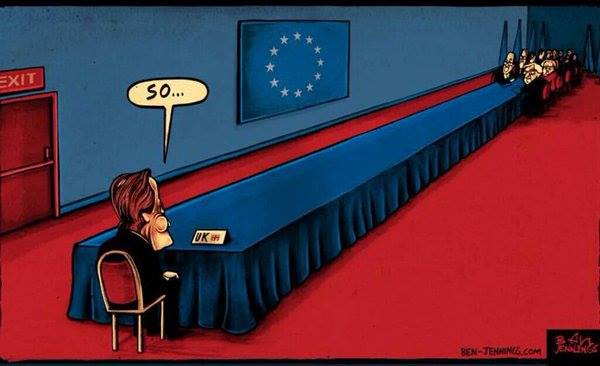
In fact, it is not an exaggeration to say that when it comes to this non-renegotiation, the British public are effectively sitting at one end of the long conference table while the British government schemes and confers with the rest of the European Union at the other end.

I know it is hopelessly idealistic of me, but I expect more from my elected government. And it is getting tremendously tiring waking up every day wondering what new schemes,devices and cunning plans the prime minister of this country intends on using to hoodwink and misdirect the people he supposedly serves into believing that he is in any way working on their behalf.

A greater man than David Cameron – if his devotion to the EU and fear of Brexit were similarly genuine – might have stood up and declared that because he believes EU membership to be strongly in our national interest, he couldn’t in good conscience put it to a popular vote or negotiate in an unbiased way on behalf of the United Kingdom. Yes, such a stance would have further fuelled the rise of UKIP, but at least I could respect the intellectual honesty and consistency.

But David Cameron did not do this. Rather than behaving with honour or principle, Cameron swanned around, pretending to share the public’s concerns about the European Union, and then – as soon as his re-election was secure and the UKIP threat neutralised – zipped across to Brussels to begin plotting with fellow EU heads of government and state as to how Britain’s pesky electorate could best be mollified, placated and distracted while the Brussels juggernaut rolls on unopposed.

And they wonder why there is a strong public perception of a self-serving European political elite who doggedly pursue their own interests in direct opposition to the will and interests of their national electorates!

There is only so much that one can take of duplicitous politicians who pretend to be eurosceptic and favour Brexit when stumping for votes or positive headlines, but whose every action contradicts this stance once in power. And I may have finally reached my limit.

If the EU’s form of parochial pseudo-internationalism really does represent the best future of human governance – and it really, really, really doesn’t – then politicians should come out and say so. They should own their love and admiration of the EU and their lack of faith in Britain, instead of hiding from these things and pretending to be eurosceptics.

I respect any politician of any stripe who has the courage of their convictions – who is able to articulate a sincerely held viewpoint without first running it by a focus group, and whose commitment to their causes runs deeper than exploiting them for electoral gain. That’s why I maintain a degree of respect for Jeremy Corbyn, despite sharing none of his socialist beliefs.

Jeremy Corbyn’s sincere-but-loopy socialism I can respect. The unabashed European federalists in Brussels I can respect, too. Though hardly any of them are democratically elected officials, at least they have the courage to hail their creation for what it is – an embryonic state in gestation.

But David Cameron and George Osborne – europhiles in stolen eurosceptic clothing, actively engaged in perpetrating a moral fraud on the British public – people like that I cannot respect, do not respect and will never respect.

Brexit - Flexcit - European Union

Top image: cartoon by Ben Jennings

Agree with this article? Violently disagree? Scroll down to leave a comment.

Follow Semi-Partisan Politics on TwitterFacebook and Medium.

An Open Letter To UKIP Voters

Open Letter to UKIP Supporters - Brexit - Immigration

Dear UKIP Supporter,

There’s no easy way to put this, so I’ll just come right out and say it. If you truly want Britain to vote for Brexit and independence from the European Union in the coming referendum – if that is your top priority right now, as it is mine – then we need to drop our demand to scrap the free movement of people between Britain and Europe and stop calling for stricter immigration controls on people wanting to live and work here.

Before you dismiss me as some pro-European mole from the Remain campaign sent to deceive you, hear me out. I voted for UKIP in the 2015 general election after much soul-searching, because I share your disillusionment and disgust with the political establishment and three main legacy parties – all of which are pro-EU to their core, and all of which have lied to us for decades about the European project and ever-closer political union. I also have admiration and respect for Nigel Farage, without whom we would not be having this referendum at all.

But this is our last chance to save Britain from being absorbed into a European state, and I am terrified of waking up on the morning after the referendum only to find that by insisting on every single one of our demands – particularly on immigration, which is a controversial topic with strong feelings on both sides – we scare the public, lose the vote and squander our only chance of escaping from ever-closer political union.

By asking people to vote to leave the EU, we are already asking them to place a lot of trust in our shared vision for a stronger, more prosperous independent Britain. Unfortunately, many people are swayed by the Remain campaign’s pro-EU propaganda, which relentlessly tells them that Britain is too small and weak a country to succeed on its own. You and I know that to be nonsense, but we already have an uphill battle on our hands to overcome the establishment’s formidable misinformation machine. And demanding an end to the free movement of people within the European Economic Area on top of everything else is just a step too far. People are naturally risk-averse, and keeping this issue on our list of demands is one thing too many.

I know that having secured the referendum from a reluctant David Cameron, it seems like total victory is within your grasp – that you are on the verge of getting everything that you have wanted for so long. And I know that despite the difficult general election result, there are enough indicators to convince you that the tide is turning in your direction, that the entirety of UKIP’s agenda can one day be achieved.

But I implore you to remember what happened to overconfident Labour supporters at the general election. They imprisoned themselves in an ideological bubble of their own making, used social media to talk to each other rather than convincing undecided voters, were hypnotised by their partisan Twitter feeds and drew the false conclusion that the country was about to make Ed Miliband the next prime minister. Their hearts were broken on May 8. Don’t make the same mistake.

I’ve seen some of the UKIP discussion groups on Facebook and the online newspaper comments sections, and I know you have, too. Yes, there are good points made here and there, and some very honest and decent people. But there is also an obsession with immigration that borders on the fanatical. To win the Brexit referendum, we need 51% of the country to vote with us, and like it or not, too many people simply don’t consider immigration a burning issue. They do, however, think that harping on the subject too much strays very close to xenophobia, and if our movement is portrayed as racist or xenophobic in any way, then it’s game over.

Besides, is immigration itself really the problem, or is it the negative side effects of immigration which need to be tackled – the impact on schools, housing, public services and community cohesion? Because there are ways that we can address these issues other than campaigning on a platform of ending free movement and enforcing strict limits on immigration, thus scuppering any chance we have of winning the referendum.

We can look at making our welfare system work on a much more contributory basis, and we can do more to ensure that local areas feeling the greatest strain of inward migration are given significantly more money and resources to help them cope. We can invest properly in adult education, reskilling our workforce for the jobs of the future so that hardworking British people are never left behind at the mercy of cheap overseas labour. And yes, we can also have that important conversation about British values, so that everyone who lives on these islands respects the unique culture and heritage which make Britain so special. Many of the levers to help mitigate the impact of immigration are not possible under EU law, but they would be if Britain were an independent country again.

But by insisting on ending the free movement of people within the European Economic Area as part of our demands for Brexit, we are letting perfection be the enemy of the good. At the risk of using too many clichés, ending free movement is the straw which will break the camel’s back and end our dream of leaving the European Union. Why? Because there are not enough votes in an anti-immigration stance to win, and because opposing free movement loses us nearly as many votes as it gains.

By insisting on ending the free movement of people as part of Brexit, 25% of the electorate will shun us because no matter how misguided they are, they hear “immigration controls” and think “racism”. And another 25% will be very wary of us because they are young, pro-European professionals or students who like the idea of easily being able to live and work in Rome or Paris if they want to, and understandably don’t want to jeopardise their own life chances. That leaves us with no margin for error – we would have to win every single other vote out there, which is just impossible.

But if we campaign for Brexit while promising to respect the free movement of people for the time being, we take away our opponent’s greatest weapon – the false and ludicrous accusation that we are Little Englanders who want to pull up the drawbridge because we are somehow scared of Johnny Foreigner.

Truth be told, you didn’t begin supporting UKIP just so that you could talk about immigration all the time, important though it is. Like me, you recognised that something fundamental is at stake when it comes to our relationship with the EU. Are we to continue sliding down the greasy slope toward European political union, where so many key decisions are taken in Brussels that the idea of Britain as a sovereign state with unique national interests becomes a laughable absurdity? Or are we finally ready to do what every major non-European country does, and face the world as a fully engaged, globally connected and influential world power? Will we continue to be governed by laws and policies set in Brussels where we have just 1/28th of a voice, or are we mature enough to govern ourselves?

At the end of the day, it comes down to one small word – democracy.

Like me, you supported UKIP because you saw Nigel Farage standing up for democracy when it seemed like nobody else cared. And the country owes you a debt of gratitude for what you did. I know many of you have received insults, abuse and worse for daring to vote differently than your friends and family, but your courage has brought us to a place where the dream of independence from the European Union and the return of democracy to Britain are within our reach.

Having got this far, it is all too tempting to assume that the same strategy which forced David Cameron to offer the referendum in the first place will also help us win it. But this is just not so. Nigel Farage did an amazing job turning UKIP’s 3% at the 2010 general election into 13% in 2015, but that still leaves us a massive 38 percent away from winning the referendum. And you just can’t make up that kind of gap by shouting the same message with a louder voice.

Bearing this in mind, I ask you to consider that no great endeavour is won without great sacrifice, and that something major has to change if we are to win the referendum and secure freedom and democracy for our country. And at this critical juncture, like it or not, the sticking point for the electorate is immigration and the free movement of people. Accept the status quo on the free movement of people for the time being and we have a fighting chance of extricating ourselves from the tentacles of Brussels. But stubbornly insist on getting everything we want, and we will be left with absolutely nothing.

This is a difficult and unwelcome message to hear, I know. But making this one sacrifice, and taking this one leap of faith – on the understanding that as an independent country we will seek to deal robustly with the negative consequences of immigration – will put victory within our grasp.

And just think of what we gain by being more flexible on immigration:

The young first-time voter who has only ever been taught good things about the EU and immigration will no longer be scared away by our campaign, and can then be engaged with our arguments about democracy and persuaded to vote for Brexit.

The young professional couple living in Manchester or London will be forced to pick between one side which wants remote and unaccountable government in Brussels and another side which wants laws made by the people they affect. And when they no longer have to worry that their freedom to live and work in Europe is in jeopardy, they will be much more likely to side with us.

Small and large business owners who are naturally eurosceptic but fear the potential uncertainty of labour supply or harm to the economy will be free to follow their hearts and vote for Brexit, knowing that there is no risk to their livelihoods.

Meanwhile, the sneering europhiles of the Remain camp will be dumbfounded, and their campaign left in utter chaos. Their whole argument is built on lying to voters and insisting that people like us only oppose the European Union because deep down we hate foreigners and want to see a complete halt to immigration. This is a golden opportunity to show them – and the country – that they are wrong, that while we have legitimate concerns about unrestricted immigration, we support Brexit because we are on the side of democracy first and foremost.

And ultimately, it is our faith in democracy – not our policies on immigration or anything else – which is our greatest strength, and the greatest weakness of our opponents. Unlike the europhiles, we can look voters in the eye and tell them that Brexit is about trusting them to make the right decisions for themselves and for our country. The Remain campaign has nothing to say about democracy, because they distrust the British people so much that they simply don’t believe we can run our own affairs.

So there it is.

We can win this referendum and secure Britain’s future for our children and grandchildren. But nobody said that it would be easy, or that this victory would be possible without sacrifice. Therefore we must be adaptable and willing to look at plans which have a chance of winning over undecided voters while simultaneously de-risking Brexit, even if it means that we don’t get everything that we might want.

And remember: democracy is key. If we win the referendum and keep Britain from being irreversibly absorbed into a political union, we preserve our freedom to revisit any and all other agreements with the EU in future, and to stand up for our national interest. But if we allow our greed to lose us the referendum, then Britain will soon be unable leave or change the terms of our membership, even if we want to. Dropping our demands on immigration is the safest thing to do, and it is also the right thing to do.

I hope that you will consider what I have to say, and bear it in mind as we respond to demands to show our plan for Brexit. Thank you for hearing me out.

With best wishes,

Sam Hooper

British citizen, former UKIP voter, Brexit campaigner
Open Letter

Agree with this article? Violently disagree? Scroll down to leave a comment.

Follow Semi-Partisan Politics on TwitterFacebook and Medium.

Don’t Believe The Europhiles: There Is No Status Quo If We Vote To Remain

European Parliament

Anyone thinking of voting to Remain in the European Union through fear of the unknown must remember that the EU is on a journey of its own, and will look very different in ten, twenty and thirty years’ time


… The undiscovered Country, from whose bourn
No Traveller returns, Puzzles the will,
And makes us rather bear those ills we have,
Than fly to others that we know not of.

– Hamlet, Act III, Scene I


In a must-read piece, UK Unleashed invites us to imagine a near future in which Britain has made the mistake of voting to remain in the European Union in the coming referendum:

It’s 2030. Thirteen years previously, after a torrent of negative campaigning by the Remain side and having been mind-crippled by unparalleled EU funded FUD, the UK population voted to remain in a ‘reformed EU’. The fight was down to the wire and, yet again, pollsters were shown to be wide of the mark, yet surprisingly on message. But when the count came in, Remain won by a mere 2%.

This ‘significant majority’ was accepted as a mandate by the then Prime Minister David Cameron to take the the UK in to a new relationship with the EU. ‘The British Option’ as it was called, brought us to the outer ring in 2022 after it was ratified by the people of the UK in a second referendum. Although originally seen as a triumph against ‘ever closer union’, in 2030 there are now well established concerns. Whilst the likes of Norway (which continues to top the world ranking for prosperity) sit at the top tables of global bodies where the rules are hammered out, the UK are now further retracted and marginalised, neither taking a global position or one of prominence within the EU.

To compound matters, Montenegro, Serbia and Turkey have now all joined the ever growing federation, with Boznia Herzegovina and Kosovo also on the cusp of membership. Our margin of vote in the European Parliament and European Council are lower than ever and about to shrink yet again. In spite of complaints about the inability of any one member to stand up to the EU in any meaningful way, the committed europhiles, in thrall to their pay masters, repeat the mantra that we should be grateful to have the opportunity to ‘collaborate’. Our hands bound behind our backs, we’re unable to harness the power of the now maturing international markets, instead we remain chained to an ageing customs and political union in spite of the fact that EU exports have continued to decline year on year.

Unrealistic scaremongering? Hardly. Think of the organisation we joined back in 1973, and what a different beast it is today, both in size and competence. Then think of the current geopolitical crises and changes, and how they are already being used by the integrationists as a catalyst and excuse for further “essential reform”.

Only a fool could believe that the driving forces behind the EU think that their creation has reached a benign state of perfection, and that no further change is desirable. And only a fool could believe that the European Union’s response to the latest global challenges – from terrorism to climate change – will be anything other than “more Europe”.

This is a key point, because the chief argument of those who would keep Britain in the EU is the hysterical claim that leaving would be some terrible and unprecedented leap into the dark. Unable to wax lyrical about their beloved EU for fear of alienating vital swing voters – and because there is nothing remotely inspirational about the European Union – instead the europhiles hammer on relentlessly with the scaremongering notion that Brexit is scary while Britain’s future in the EU will be predictable, prosperous and permanently sunny.

Or as UK Unleashed memorably puts it:

I guess when you’re ensconced in the arms of the EU octopus and you’ve divested yourself of any sense of national identity, you’ll say what ever it takes to avoid being prised away. In their heads, these people probably don’t see themselves primarily as British, instead they’re EU nationals just waiting for the country to be hatched in the next treaty.

The europhiles are in absolutely no position to make such promises of security within the EU and destitution without. What little they know of the EU’s immediate future they cannot campaign on, because it would be repugnant to many British voters, and the rest is just as much a mystery to them as it is to everyone else. We simply do not know what future geopolitical challenges we will face, or precisely how they will be used by the arch-integrationists to continue the journey they began back in 1950.

All we can say with any degree of confidence is that the EU will look very different in 2050 than it looks today, and that the self-declared aspirations of many European national leaders and EU officials to pool even more sovereignty and undermine the nation state yet further will be in full fruition.

Dr. Richard North gives us a glimpse of what lies ahead:

Hidden in plain sight, as in various documents published in Europe including last September’s “State of the Union Address” by Commission President Jean-Claude Juncker, is the plan for a radical restructuring of the EU into two classes of member.

The 19 eurozone countries will move on to much closer political and economic union; while Britain and the rest become mere “associate members” (possibly also including countries outside the EU, such as Norway and Switzerland).

As Juncker explained, none of this is to be formally revealed until 2017, when the Commission issues a White Paper to trigger the laborious procedures now required for any new treaty. And these might not be concluded until 2025.

All of which completely transforms the game play. Mr Cameron can keep his original promise to hold a referendum in 2017, but only to ask the British people for permission to remain in the EU until the terms of the new treaty are clear. We will then have to hold a second referendum on whether we accept these terms.

Britain will then have the choice of belonging to the new inner core, the vanguard for the dissolution of the nation state, or membership of the outer rim of states, burdened with many of the same costs but with even less influence and fewer dubious benefits. That is what we can reasonably expect by voting to Remain – and if any EU supporter would care to argue otherwise, let them step forward and do so, presenting their own less dystopian vision of the future.

In reality, once the deceptive posturing of the Remain camp is stripped away, it is only the Leave campaign which gives the impression that they have given any thought at all to what life outside or inside the European Union might realistically look like for Britain beyond the next decade, or how such an exit from unwanted political union can be managed under a variety of scenarios.

And on this note it is extremely encouraging to see that Dr. Richard North, pre-eminent authority on the European Union and author of Flexcit (the best adaptive Brexit plan in existence), is partnering with Arron Banks and Leave.EU in a consultancy role to make Flexcit that group’s official exit plan.

This is great news, and means that one of the two largest Leave campaign groups (really the only one, since Vote Leave is teeming with people who don’t actually want to leave the European Union) actually has a robust, solid plan for Brexit. If Brexiteers learn about and support this excellent plan, we will be able to go into the referendum battle with the Remain camp’s best weapon – the false claim that Leave supporters have “no plan” for Brexit – broken in their hands.

The Remain camp’s whole fearmongering argument to persuade us to vote to stay in the European Union is that we are safer and more prosperous under our current arrangements, while Brexit would throw everything into flux, potentially create chaos and leave us worse off. Basically, their uninspiring campaign message is “better the devil you know than the devil you don’t.”

But that is not the choice before us in this referendum. The EU is changing, moving down a swift and pre-determined path to further integration for most member states with powerless irrelevance awaiting those other countries not wishing to join the core. There will be no “devil we know” to side with, but only devils we don’t. And of those, staying part of an ever-tightening political union for which most of us have no love or affinity is far more threatening a devil than having the faith and confidence that Britain can succeed as an independent country playing a full and unfiltered role on the world stage once again.

That’s the choice before us now. And since the Leave camp now has Flexcit on their side while the Remain camp has nothing but smears, scaremongering and a vision of the future they are too ashamed to articulate, the only devil to be avoided is the one which pledges fealty to Brussels.

Brexit - Flexcit - European Union

Agree with this article? Violently disagree? Scroll down to leave a comment.

Follow Semi-Partisan Politics on TwitterFacebook and Medium.