The European Union Does Not Promote The Neighbourliness Preached By Jesus

Bishop Robert Innes - EU Referendum - Remain - Brexit - European Union - Christianity

As yet another bishop declares his support for keeping Britain in the EU, the last gasp strategy of the intellectually and morally defeated Remain campaign starts to become clear

More hand-wringing, wheedling declarations that Britain should sacrifice our own democracy and national interests in order to “save Europe from itself”, over at the Reimagining Europe blog.

Robert Innes, bishop of the Diocese in Europe writes:

At the heart of Jesus’ teaching is an ethic of neighbourliness. ‘Love your neighbour as yourself’, he says. And in the parable of the Good Samaritan he stretches the idea of the neighbour to include even those in close by regions with whom we have traditional rivalries.

Ah, so we are going to be treated to another rendition of that glib assertion that because “friendship” and “co-operation” sound like nice Christian things, it automatically follows that Britain should sacrifice our democracy and dissolve ourselves into the embryonic common European state.

This is based on the blinkered view that co-operation between friendly democracies is only possible when coordinated by a powerful supranational regional government, something which would come as a great surprise to Christians in Africa, Asia and the Americas, whose countries seem to be able to co-operate with one another on environmental, energy, economic, defence and intelligence matters without becoming vassals of a large regional organisation with slobbering aspirations of statehood.

Bishop Innes continues:

Being a good neighbour has costs. We may be expected to come to our neighbour’s aid. Frankly, at the moment Europe needs British help. The whole continent is struggling with migration. Debt and unemployment afflict the southern states. And these are generating populist sentiments which threaten us all. The European Institutions in Brussels have benefited from a good deal of British administrative and political expertise in the past. In order for them to work well and to promote the good of the whole continent, they need that expertise now. We have contributed democratic principles, a sense of humanity, tolerance and practical common sense over many decades. These are loved and valued by our European neighbours.

From where I sit, there is an awful lot riding on the Referendum Vote. It feels, from Brussels, like a vote that could determine not just the future of Britain but the future of the European continent, for decades to come. I have already posted my vote. There’s no secret that it was for ‘Remain’. Not everyone in my diocese will agree with me, and I respect that. But I hope that the remaining days of the campaign will be marked by high quality information and truly informed debate. I hope there will be a massive voting turnout. And, yes, I hope that Britain will stay in the European Union and help our whole continent find its way through difficult times and into a new future.

Having been comprehensively routed in the argument about democracy (though to be fair, the EU apologists, knowing their weak position, barely put up a fight) and seen the polls gradually turn towards Brexit as people tire of the scaremongering and pessimism of the Remain campaign, we seem to be moving into a new phase of the referendum.

It now seems to be the contention of some Remainers that the EU may well do us little or no good whatsoever, but that it is our duty to remain lashed to the mast nonetheless out of blind solidarity with our European allies. We saw Jonathan Freedland advancing just such a case in the Guardian this week, essentially arguing that British democracy is a small and trivial thing, a worthless trinket and a small price to pay to stop the squabbling countries of Europe from going at each others’ throats.

Of course, this is insidious nonsense. The European Union undermines democracy in all of its member states, not just Britain. That’s what it was designed to do – become an increasingly powerful supranational government of Europe by slowly and steadily accumulating more powers and hollowing out the democracy and decision-making competencies of the member states. And we see a growing antipathy toward the EU project across Europe, not just in Britain and not just in the traditionally eurosceptic countries, with France now holding a more unfavourable view of the EU than we do.

In this modern context, stubbornly voting to remain in the European Union in defiance of the damage it is doing to our democracies as well as the social and economic harm being wrought by the EU’s single currency and migration policy is the height of irresponsibility. If you see four friends stumbling drunk out of a bar and walking toward their parked car, you don’t hop in the back seat and go along for the ride, you beg them not to drive and call them a taxi instead. And so it is with the EU – there is no good reason why we should march in lockstep with the rest of the EU in a direction which can only lead to more voter apathy, civil unrest and socio-economic misery – least of all because a very superficial interpretation of Christian teaching suggests that it is the right-on, progressive thing to do.

Interestingly, Robert Innes’ article is currently unavailable at Reimagining Europe – perhaps he encountered hostility to his blinkered europhilia from members of his diocese, or perhaps even he realised the fatuous over-simplicity of his article.

But this is an argument which is coming up again and again, the Hail Mary pass of the Remain campaign – that the EU may well be terrible, but that somehow we owe it to the other member states to stick around until the bitter end. It is a weak argument from a campaign based entirely on weak arguments, and if the Remain camp continue to push this defeatist narrative it suggests that they really are in trouble.


Postscript: More on the Christian case for Brexit herehereherehere and here.


European Union - United Kingdom - Britain - Flags

Top Image: Archbishop of Canterbury

Agree with this article? Violently disagree? Scroll down to leave a comment.

Follow Semi-Partisan Politics on TwitterFacebook and Medium.


Britain Should Not Have To Sacrifice Our Democracy In The Name Of Franco-German Reconciliation

Francois Hollande - Angela Merkel - France - Germany - Reconciliation - EU Referendum

No, the EU did not “keep the peace” in Europe. And Britain should not be expected to sacrifice our own democracy in the name of Franco-German reconciliation

Continuing the apocalyptic hysteria now emanating from the intellectually bankrupt pro-EU Remainers, Jonathan Freedland has a particularly offensive piece in the Guardian, comparing Brexit to the election of Donald Trump as potential calamities on a similar scale before declaring that he would sooner see a President Trump than a newly independent Britain.

Freedland phrases his question:

What if the devil came to visit you in the dead of night? What if, dressed in a fine suit, his tail and pitchfork artfully concealed, Lucifer himself offered you a deal? Knowing the anxiety that was keeping you – a good, progressive type – up at night, he promised that he would grant you one, but only one, of your two deepest current wishes: you could either be sure that Donald Trump would lose the US presidential election or you could be guaranteed that Britain would vote to stay in the European Union. You could have one or the other, but not both. Which would you choose?

Because, of course, Guardian readers are saintly and virtuous while anybody with conservative instincts is intrinsically disordered in some way.

Freedland goes on to explain why he chooses President Trump over Brexit:

But the future viability of the UK is not the reason I’d be tempted to use up my one devilish wish to prevent Brexit. Nor is it the near-certain economic gloom that will befall this country, an outcome so obvious when you take a step back and consider any country voluntarily giving up its right to trade on advantageous terms with a market of 500 million customers.

No, the spectre that would haunt me as Satan drummed his fingers, waiting for my decision, would be much more elemental. It is the fear that the European Union, already battered by the eurozone crisis, simply could not withstand the departure of one of its “big three” members. We would not be tugging at a mere thread but yanking out a guy rope: the EU would collapse – maybe not straightaway, but eventually.

[..] Why should that bother us? We’d be well out of it by then. But remember the history of this continent. The story of Europe is the story of near-constant war and bloodshed. The 100 years war, the 30 years war, the Spanish wars, the Franco-Prussian wars, the two world wars of the last century: this is what the nations of Europe do to one another – unless they are held together in an arrangement that obliges them to settle their differences around a Brussels conference table, where the most mortal danger is tedium and late-night halitosis.

This is what the European project is about. Not just goods and services and trade and jobs, important as all those things are, and crazy as we would be to jeopardise them. But about life and limb. And make no mistake: if the EU’s 27 member states become Europe’s 27 warring nations, we will not be safely detached, serenely distant across the Channel. We will be drawn in, as we always have been.

In other words, Jonathan Freedland seriously believes – or at least is willingly to publicly say – that peace in Europe has nothing to do with economic growth, nothing to do with the atomic age and Mutual Assured Destruction, nothing to do with NATO or the Marshall Plan and nothing to do with the fact that economically advanced, liberal democracies just don’t tend to declare war on one another. No, in Freedland World, the only thing preventing Europe from instantly reverting back to 1914 is the grand projet by which our troublesome nation states are slowly being dissolved once and for all.

Freedland concludes:

It takes an extraordinary confidence to look at the last millennium of European history and gamble that the 70 years of peace that have held since 1945 – an exceptional, aberrational interlude – have had nothing to do with the existence of the European project. Do we really think it’s a coincidence that no two EU member states have ever fought each other? Do we want to roll the dice to find out? Do we feel that lucky?

What piffle. Don’t seek the restoration of nation state democracy and the repatriation of powers gradually frittered away to a largely unaccountable supranational government of Europe, because to do so might unleash a time warp taking us all back to 1914. Is this really what the pro-EU die-hards are now reduced to?

Pete North is having none of it:

Oh really? You don’t think that the peace came from the desire of the peoples to create the peace? Instead it had to be enforced by a sovereignty-confiscating artificial entity? Or could it be that the second world war era was not really concluded until the fall of the Berlin Wall?

Up to that point the peace was held in place by fear of mutually assured destruction. Nobody wanted to break the uneasy stalemate because of the lethal consequences it would unleash. I think it safe to say the EEC had precisely zero influence in maintaining or building the peace.

He says “let Britain remain, to prevent the 21st century being as drenched in blood and sorrow” but this really rather ignores the reality that peaceful democracies as a rule do not go to war with each other, and it is unlikely we will be fighting over those resources which the EU pooled. I don’t see a war over coal and steel, do you?

Moreover, if the peoples of Europe are prevented from influencing the laws they must live by without the possibility of reform or repeal, what do you suppose is going to happen? Are you saying that a strong supranational authority will maintain the peace by enforcing it? How is it going to do that exactly? And what sort of peace is that when it is an authority stifling a democratic correction? Tyranny that’s what it is. Peace at the barrel of a gun.

Everywhere we look in Europe we see stresses and strains with ever more resentment as the EU is caught up in its own institutional paralysis, failing to adequately respond to the many emergencies it has a hand in creating. This leads to increasingly unilateral action and the rise of the far right everywhere. That doesn’t end well in Europe does it? And there are of course two other supranational projects in Europe in the last century. Yugoslavia and the USSR. Remind me how well that worked out.

I agree wholeheartedly.

Jonathan Freedland seems to be suggesting that regardless of the economic question, Britain should willingly sacrifice her own democracy and right to self-determination in order to help preserve an apparently fractious peace in Europe. He is arguing that the inability of the British people to exercise meaningful control over those who lead us is a small price worth paying in this effort. He is, effectively, saying that democracy has little value.

In Freedland World, Britain should sacrifice her democracy happily and willingly to reduce even by a minuscule fraction the future possibility of France and Germany going at each other again. It’s self evident, apparently.

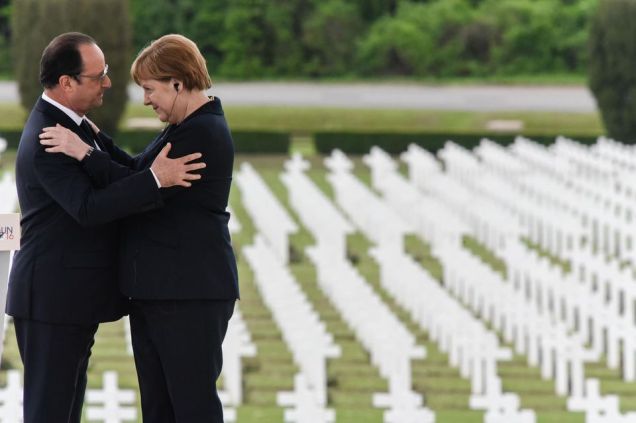
I’m sorry, but no. Any petty grudges or historic rivalries remaining in Europe are not a sufficiently good reason for me to throw away my right to live in a democracy. I’m glad that Francois Hollande and Angela Merkel shared that special moment together at the Verdun centenary memorial where they held hands, gazed into each other’s eyes and “forgave” each other for past national sins. Good for them. Still doesn’t trump our right to help elect the people who make the key domestic, trade and foreign policy decisions impacting our lives, and to kick them out of office if we disapprove of the job they are doing.

Every day that passes reveals in a new light the sheer disdain in which the pro-EU British Left hold the very idea of democracy. If they are not warning us portentously that returning power to Westminster might result in an elected British government doing things that it was elected to do (pass the smelling salts!) they are now suggesting that democracy is a mere trifle, something with which we should be happy to part in order to prevent other third parties from behaving in a self-destructive way.

I’m not having it. And the turning opinion polls suggest that the British people as a whole aren’t having it either – that in actual fact we like the idea of democracy, value it rather more highly than our “moral superiors” in the Guardian and resent the establishment’s coordinated attempt at scaring us into dropping our demands for self-determination.

And at some point after the EU referendum, whichever way it goes, the Jonathan Freedlands of this world (and the pro-EU British Left in general) will need to explain, account and hopefully atone for coming down so unapologetically on the wrong side of democracy.


European Union - United Kingdom - Britain - Flags

Top Image: Liberation

Agree with this article? Violently disagree? Scroll down to leave a comment.

Follow Semi-Partisan Politics on TwitterFacebook and Medium.

Ambrose Evans-Pritchard Makes A Most Honourable Argument For Brexit

Ambrose Evans Pritchard - Brexit - EU Referendum

All the most eloquent cases for Brexit set aside the bleating of Vote Leave and appeal to the people’s understanding of the democratic case for leaving the European Union

Ambrose Evans-Pritchard’s measured and eloquent justification for his decision to vote Leave on 23 June, published today in the Telegraph, is a must-read example of the noble democratic case for Brexit.

He rightly eschews all of the nonsense spewed out by the official Vote Leave campaign, recognising that this has nothing to do with saving pennies here or there, and that the real basis for any decision on how to vote must be whether one is happy with the current direction of the European Union, and whether one believes there is any realistic chance of altering that trajectory.

And Evans-Pritchard, like this blog, firmly believes that the direction is indeed one we cannot follow, and that there is no such chance of changing the EU’s course:

Stripped of distractions, it comes down to an elemental choice: whether to restore the full self-government of this nation, or to continue living under a higher supranational regime, ruled by a European Council that we do not elect in any meaningful sense, and that the British people can never remove, even when it persists in error.

For some of us – and we do not take our cue from the Leave campaign – it has nothing to do with payments into the EU budget. Whatever the sum, it is economically trivial, worth unfettered access to a giant market.

We are deciding whether to be guided by a Commission with quasi-executive powers that operates more like the priesthood of the 13th Century papacy than a modern civil service; and whether to submit to a European Court (ECJ) that claims sweeping supremacy, with no right of appeal.

It is whether you think the nation states of Europe are the only authentic fora of democracy, be it in this country, or Sweden, or the Netherlands, or France – where Nicholas Sarkozy has launched his presidential bid with an invocation of King Clovis and 1,500 years of Frankish unity.

The following critique of the EU’s effect on national democracy is particularly damning:

The Project bleeds the lifeblood of the national institutions, but fails to replace them with anything lovable or legitimate at a European level. It draws away charisma, and destroys it. This is how democracies die.

“They are slowly drained of what makes them democratic, by a gradual process of internal decay and mounting indifference, until one suddenly notices that they have become something different, like the republican constitutions of Athens or Rome or the Italian city-states of the Renaissance,” says Lord Sumption of our Supreme Court.

And then:

It is a quarter century since I co-wrote the leader for this newspaper on the Maastricht summit. We warned that Europe’s elites were embarking on a reckless experiment, piling Mount Pelion upon Mount Ossa with a vandal’s disregard for the cohesion of their ancient polities. We reluctantly supported John Major’s strategy of compromise, hoping that later events would “check the extremists and put the EC on a sane and realistic path.”

This did not happen, as Europe’s Donald Tusk confessed two weeks ago, rebuking the elites for seeking a “utopia without nation states” and over-reaching on every front. “Obsessed with the idea of instant and total integration, we failed to notice that the citizens of Europe do not share our Euro-enthusiasm,” he said.

If there were more Tusks at the helm, one might still give the EU Project the benefit of the doubt. Hard experience – and five years at the coal face in Brussels – tells me others would seize triumphantly on a British decision to remain, deeming it submission from fear. They would pocket the vote. Besides, too much has happened that cannot be forgiven.

The EU crossed a fatal line when it smuggled through Lisbon Treaty, by executive cabal, after the text had already been rejected by French and Dutch voters in its earlier guise. It is one thing to advance the Project by stealth and the Monnet method, it is another to call a plebiscite and then to override the outcome.

The only vaguely objectionable part is when Evans-Pritchard fails to exhort others to follow his decision:

I urge nobody to follow my example. It ill behoves anyone over 50 to exhort an outcome too vehemently. Let the youth decide. It is they who must live with consequences.

On the contrary, people should be encouraged to follow the decision making process of somebody who actually recognises that the question before us is not a matter of penny-pinching, curtailing immigration, workers’ rights or any other particular outcome, but rather of determining whether the British people should make these decisions for ourselves or have them imposed upon us from a higher authority.

And “letting the youth decide” may sound magnanimous, but in fact it is only through the wisdom of age that we stand a chance of defending our liberties, as Pete North emphasises:

No. You see, the democracy we were born to was fought for and won with blood. It is not ours to give away. We are the custodians of it. And this is too important to be left to the youth, barely out of the state system, barely aware of what the EU is, how it functions or the devious tricks pulled on us to bring it about.

And when I think how dumb I was when I was twenty – and not much smarter five years later, I am inclined to trust in the wisdom of the elders. While they may not be the ones living with the consequences, we all have an obligation to ensure that which we pass on is something that will endure and sustain the peace.

Now look across the Channel and seriously ask yourselves if that political entity has the look of longevity about it. Look closely. Is that really the mess you want to hand to the next generation?

This point resonates strongly with me. As a teenager and into my first years at university I was an ardent euro-federalist, to the extent that the EU flag used to adorn the wall of my digs in Cambridge. I was not ignorant about how the EU worked, but I was ignorant about democracy – the arrogance of youth caused me to conveniently skip over the fact that the project I so admired was not the result of bottom-up desire among the European peoples for an overarching supranational government, but rather the manifestation of a very specific dream shared by a small number of European elites.

My attitude at the time: the EU is self-evidently wonderful, and too bad for those who disagree – they will come around when the project comes to full fruition and they are part of a powerful, prosperous United States of Europe. My attitude now, with fifteen more years of self-study, commercial awareness and general life experience, together with a greater respect and appreciation for democracy: quite the opposite.

The views of the young are important (at 33 I hesitate to include myself in their number), and in many cases their idealism is noble. But the fact that a seventy-year-old will not be around in thirty years to reap the benefits or negative consequences of this year’s EU referendum vote in no way means that their opinions should hold lesser weight. Wisdom, a greater sense of historical context and the desire to be a good steward to the best of our traditions and liberties are priceless attributes of older voters, and yes- sometimes parents and grandparents do know best, as those cheering eighteen-year-old europhiles will discover when they grow up and have families of their own.

Regardless – this minor point aside, this quietly eloquent case for Brexit from Ambrose Evans-Pritchard is very good, and should encourage all thinking Brexiteers that they are right to focus on democracy and the supremacy of Parliament over and above all of the noise from the official Leave and Remain campaigns.

Now, if only Ambrose Evans-Pritchard could be persuaded to go on the stump with this argument…


European Union - United Kingdom - Britain - Flags

Agree with this article? Violently disagree? Scroll down to leave a comment.

Follow Semi-Partisan Politics on TwitterFacebook and Medium.

History Will Judge Left-Wingers Who Betray Their Principles To Support The Anti-democratic European Union

Jeremy Corbyn - Labour In for Britain - 2

Shining an unforgiving light on the wishful thinking and self-deception powering the naive left-wing campaign for Britain to remain in the EU

Your best read of the day comes from Elliot Murphy at Counterpunch, a writer from the Left who systematically deconstructs the fatuous assertion by the likes of Owen Jones, Jeremy Corbyn and Yanis Varoufakis that the EU can be reformed and turned into some kind of Utopian socialist paradise.

Certainly the EU as it is presently constituted is hardly friendly to traditional leftist interests and obsessions, as Murphy points out:

This groundswell of support for Remain across substantial parts of the Left is hard to square with the facts. State aid to declining industries, along with renationalisation, are not permitted by current EU laws (under directive 2012/34/EU), and any mildly progressive government which managed to get elected in 2020 would be hindered from the outset by the EU. Considerable reforms of the energy market would also be illegal under EU directives 2009/72EU and 2009/73/EU. Collective bargaining is becoming much weaker across the EU, most vividly in France and Germany.

McDonnell’s plans for People’s Quantitative Easing? Outlawed by Article 123 of the Treaty on the Functioning of the European Union. The series of anti-trade union laws introduced in Britain over the past few decades? The EU has no qualms with these whatsoever, showing no interest in providing even modest forms of protection for workers.

As the Labour Leave campaign points out, the EU would also outlaw an end to NHS outsourcing, tougher measures on tax avoidance, and general improvements to workers’ rights. The soft Left’s talk of international solidarity and the brotherhood of man in relation to the EU is absurd, especially as it continues to drive forward deeply militaristic and undemocratic (or rather, anti-democratic) policies. The EU is, after all, one the world’s major post-war imperialist projects, boasting an inherently and aggressively exploitative relation with the global South. The entirety of the EU parliament could be filled with McDonnells and Iglesias’s and no substantial reform would be forthcoming: The parliament is an institution purely of amendment and all power lies with the civil servants and the unelectable Commission.

Brilliant. How marvellous it is to hear the fatuous, paper-thin leftist defence of the European Union being properly shredded by somebody who isn’t willing to furiously ignore their own political convictions, suppress the cognitive dissonance and blindly cheerlead for the Remain campaign.

And of course Murphy is quite right – you could pack the European Parliament full of Owen Joneses and Jeremy Corbyns and still it would make no difference to the work and impact of a body which cannot propose or strike down EU laws and policies. There is a reason why the EU’s architects made sure that the one “democratic” component of the entire project was utterly toothless, and this is it.

But what of these nascent leftist “change” movements like Democracy in Europe 25 (DiEM25) or Another Europe is Possible (AEiP)? Murphy has surveyed the work of these and other fantasist left-wing Remainers, and is unimpressed:

When Michael Chessum, a major organiser of the pro-Remain ‘Another Europe is Possible’ (AEiP) movement, is questioned about what concrete ‘changes’ he would like to see in EU, he simply dodges the question. Chessum’s behaviour generalises. To my knowledge, not a single supporter of Remain has presented a satisfying answer to the question of how we are supposed to go about reforming the EU. Even Yanis Varoufakis during his recent ‘Lunch with the Financial Times’ interview confessed that in reality the EU isn’t going to be reformed to anywhere near the extent the Remainers are hoping for (attempts to reform ‘will probably end in failure like all the best intentions’, he claimed). Even Remain supporter Ed Rooksby can write on his blog about how he is ‘not particularly convinced by arguments emanating from [AEiP] in relation to the possibility of transforming EU institutions in a leftist direction’. How is a new, reformed EU possible? How can we change it to break from the Washington Consensus? The answers are, worryingly, not forthcoming.

Quite rightly, Murphy has no time for those who waffle on about reform – “Of course the EU needs reform” being perhaps the most overused phrase of this entire referendum campaign – while failing to outline any concrete or probable steps to achieving that elusive change:

Airy-fairy proposals for ‘another Europe’ to ‘protect our rights’ and so forth simply fill a void lacking any concrete solutions to achieve this and any proposals for how to achieve a new EU constitution. In theory, another anything is possible: Another New Zealand, Another Skelmersdale, Another Isla Nublar, Another Tamriel. It is not as if another EU is inherently unreachable, but rather that without any posited, realistic steps to achieve it, the hopes of the Remain camp will quickly dissolve after June 23rd, no matter which side wins.

Concrete solutions are lacking, then, as it is no good for the Left camp of Remain to simply point voters in the direction of Owen Jones columns and Caroline Lucas YouTube videos instead. The powers of the European Commission, European Central Bank and European Court of Justice are guaranteed by EU treaties and can only be reformed as a result of a unanimous agreement within the Council of Ministers. AEiP may exert some moderate degree of influence over the UK’s soft Left, but it will have to become substantially more commanding if it hopes to influence the Council of Ministers. Likewise, the foundational pro-austerity, market liberalisation principles of the EU are established by the same treaties, which can be modified only by a unanimous agreement by all 28 member states.

Quite so. All of this, one must recall, is taking place in the context of David Cameron having singularly failed to extract even one substantive concession from his fellow EU heads of government during his damp squib “renegotiation” effort.

Now, this blog will be the first to concede that the entire exercise was a sham – the government didn’t even bother to properly consult the people as to the nature of reform which we wanted, arrogantly assuming that they already knew. But in any case, even when faced with the potential departure of the European Union’s restive second-largest contributor, the EU offered nothing by way of sweeteners. Would it have been different had Angela Merkel et al been dealing with a genuinely eurosceptic British prime minister? Perhaps. But if David Cameron couldn’t get any kind of deal from the EU, what chance do a fuzzy coalition of leftists have of achieving reform in another direction?

Neither does Murphy have time for the weak reasoning of foreign leftists who have sought to parachute themselves into the debate with a minimal understanding of the facts:

The Left Remain camp have also recently been galvanised by Noam Chomsky’s tenuous support for their cause, with Owen Jones and AEiP posting quotations of the professor’s brief statements on the matter. Chomsky’s reasons for supporting Remain are extremely weak and don’t stand up to much scrutiny. His reasoning is as follows: The racist Right is in favour of Leave, therefore we should Remain. But the racist Right is also in favour of Remain. Chomsky’s logic seems to be as follows: If P, therefore Q, so why not Z? Indeed, if an Out vote would simply ‘leave Britain more subordinate to US power’, as Chomsky claims, then why did Obama urgently, even desperately call for Britain to Remain? Owen Jones has in the past ridiculed what he calls ‘Chomsky fans’ on Twitter (while also labeling those who politely disagree with him ‘Stalinist’, ‘sectarian’, ‘ultra-left’ and ‘Gallowayite’), but deems it appropriate to sign up to his views when they align with his own. Chomsky’s opinions about the UK are naturally not going to be thoroughly well-formed and articulated, unlike his criticisms of US domestic and foreign policy: For instance, during a visit to the University of St Andrews in 2012 he expressed pro-monarchy feels for the rudimentary reason that if people enjoy it and find it fun, then who’s to object to it?

Many on the left simply cannot begin to address the limitations of the Remain camp: For instance, Media Lens, UK leftists sympathetic to Chomsky, have been oddly silent about the entire EU referendum. A certain level of unease and awkwardness pervades a lot of discussion about the EU, with many preferring simply to abstain or delay decision making until later. At Chomsky’s university, Matt Damon recently addressed MIT’s class of 2016 with ideas that Will Hunting would be far from impressed with, calling for a Remain vote with his typical mixture of casual arrogance and self-assurance, but devoid of any argument or apparent understanding. Damon ultimately retreated into the safe territory of banker-bashing, forgetting to justify his reasoning for supporting Remain.

So Matt Damon thinks that Brexit is a bad idea. Who the hell cares? Damon clearly has no understanding of the history or political issues at stake, and is merely parroting what he believes to be the “correct”, right-on opinions in order to signal his own virtue. More worrying is the fact that when it comes to the specific question of the EU, many thinking leftists are doing the same thing – temporarily switching off their brains and switching themselves over to “mindless repetition of approved talking points” mode.

As this blog conjectured when Owen Jones abandoned his nascent euroscepticism and went back to loyally cheerleading for the EU:

It is a shame to see Owen Jones – at his best an intelligent and articulate voice on the Left – frittering away his time on the EU referendum campaign by pointing out the foibles and tactical hypocrisies of the Leave campaign. But what other choice does he have? Despite knowing full well that the EU is unreformable, Jones has committed to supporting Britain’s continued membership.

I think that this is a betrayal of the democratic accountability and local control that Jones spends much of his time promoting. And I suspect that he does, too. Which is why we can all expect to see lots more “gotcha” videos on YouTube criticising individual members of the Leave campaign, but not a damn thing praising the European Union or explaining how this magical socialist “reform” of the EU is to be achieved.

After all, nothing distracts from a guilty conscience like pointing out the flaws, failings and inconsistencies of other people.

The behaviour of the British Left during the EU referendum campaign would probably make quite an interesting psychological study as an exercise in mass delusion. Thousand of not millions of people with solid left-wing beliefs and a rightful distrust of the establishment are now simultaneously trying to convince themselves that voting for the establishment and the status quo is somehow the brave, left wing thing to do.

European Union - EU Referendum - Tony Benn - Brexit

This coping mechanism takes its toll, which is why left-wing Remainers are so much happier when they are criticising the behaviour of the Leave campaign (making their slanderous allegations of racism and so on) – the more they talk about the wretchedness of the Evil Tories, the less time they have to consider their own betrayal of left-wing principles.

And just look at what it is the supposedly compassionate, generous and open hearted Left are endorsing by campaigning for a Remain vote:

One of the major disasters of the Remain endorsement by substantial parts of the Left is that many seem incapable of acknowledging that the EU has by now become masterful at generating racism and promoting finance capitalism. Acknowledging this dynamic is frankly essential in understanding the rise of Far-Right forces across Europe. The EU was more than willing to impose sanctions on Greece when it became tempted to disobey orders to kowtow to European banks, but it seems far less willing to do anything about the rise of the Far-Right in Germany, France, Croatia, the Czech Republic, Austria and Hungary. As Kevin Ovenden recently put it in Counterfire: ‘Far from countering the far right and authoritarian tendencies, the EU – with its austerity, Fortress Europe, anti-democratic diktats and endemic national antagonisms – is generating those reactionary features: and not only on the far right. The EU is fully behind the French government of Francois Hollande. It has suspended basic freedoms under an eight-month old state of emergency and is using the militarised police to batter through new austerity measures passed not by parliament, but by executive decree’.

[..] The ‘choice’ of austerity in Britain is no such thing in the EU, being part of its treaty. Anyone who claims that the EU is beneficial to workers’ right clearly hasn’t read the text of its treaty, which makes it very clear what the EU’s intentions are, and always have been. The ‘freedom’ for big firms to move capital, labour and commodities without any restrictions in order to maximise profits, regardless of social or environmental cost, is something no genuine socialist, communist or anarchist could ever support. Moreover, the EU is infamously driven towards privatisation, ‘free markets’ and the Transatlantic Trade and Investment Partnership (largely the work of the Troika) – which signifies game over for much of Britain’s indigenous industries if adopted, as the EU’s 28 states engage in a race to the bottom in order to diminish living standards and workers’ rights.

Hardly the kind of behaviour that a good comrade should be defending, surely?

Oh wait, this explains it:

In the face of this apparently austere ideology, the EU is nevertheless careful to generously fund British quangos, charities, arts groups, museums and universities to ensure the recycling of a healthy pro-EU sentiment amongst the influential middle class intelligentsia, academia and commentariat, ensuring that most of its major limitations are sidelined or forgotten about. It manages to do all this after having intentionally destroyed Britain’s fishing industry. This system amounts to one of the clearest definitions of a racket.

But it is more than a racket, isn’t it? It is almost what you might call class warfare – the privileged and well connected upper middle classes aggressively asserting their interests (continued funding for their quangos and charities) over the interests of the working classes. Again, Murphy is absolutely right to call out the hypocrisy.

Murphy is also right to ask how the Left will be viewed if Britain does vote to Leave, in a future where smoothly exiting from political union while maintaining access to the single market ensured that none of the Remainers’ apocalyptic warnings of economic ruin come true:

A serious Left argument against the EU needs to be presented both in the event of a Leave or Remain vote, since without the presence of any serious Lexit arguments being presented, in the event of a Leave vote left-wing Remainers will be thoroughly cornered and will be forced to rapidly re-orient their tactics to accommodate for the likely UKIP gains (among many other things). When Remainers focus purely on the positives of the (often dubious) positives of EU, we should ask how this dishonest and skewed set of priorities will be interpreted post-referendum.

Absolutely so.

When the dust settles, and when Britain continues its slide away from democracy in the event of a Remain vote, all that people will remember is the likes of Jeremy Corbyn and Owen Jones – people who pride themselves on their right-on credentials – standing shoulder to shoulder with the establishment in defence of the status quo. And when they tremulously offer their “battered spouse” excuse (but I thought we could change the EU!) they will rightly be scorned, and mocked and then ignored.

Already UKIP is starting to encroach on Labour’s heartland vote. Labour MPs and former ministers are lashing out in confusion and outrage at the unwillingness of local councillors and ordinary party activists to help them in their great establishment effort to keep Britain in the EU. On this issue, the parliamentary party and the grassroots are starting to come apart at the seams. And in the event of a Remain vote, you can be sure that UKIP will be there, ready to pick up swathes more disaffected Labour votes.

The question of Britain’s independence is not a partisan issue. It is equally as shameful when conservatives are willing to sell out their own democracy as when socialists do the same. But given the nature of the EU, and how this corrupt supranational political union benefits the wealthy and well connected elites far more than the people, it is Labour’s dogged support for Remain that stinks to high heaven.

Tony Benn would be ashamed of what his party has become. Labour are supposed to be the party of ordinary people. We know because they never shut up about it. And yet nearly the entire Labour Party is uncritically cheering the status quo and our ongoing membership of a dysfunctional political union which nobody would invent if it didn’t exist, and nobody would join if it did.

But of course, there were always two sides to the Labour Party – the cerebral middle class ideologues and internationalists, and the working class movement borne out of the trades union movement. Well, we know what happened to that particular branch of Labour in the age of the SpAdocracy. Now all that’s left is the middle class clerisy.

Now, the middle class left-wing clerisy want desperately to stay in the European Union – it funds their research, universities, development schemes, artistic projects and businesses, funnelling them British taxpayer money without the unseemly need to beg the taxpayers directly in elections.

They love the EU because it enables them to virtue-signal their enlightened progressivism, while also delivering a whole host of lucrative in-house side benefits. And if it means betraying democracy, betraying the poor and betraying the interests of Labour’s core voters, that’s just fine. So long as that grant money keeps flowing, of course.

Sadly for these parasitic folks and their defenders on the pro-EU left, some of us are watching, observing and taking note. And when the time for blame and judgement comes around, there will be no escaping accountability for having sided against democracy in their arrogance, fear, ignorance and greed.

We will make sure of it.

 

European Union - United Kingdom - Britain - Flags

Top Image: Economist

Support Semi-Partisan Politics with a one-time or recurring donation:

Agree with this article? Violently disagree? Scroll down to leave a comment.

Follow Semi-Partisan Politics on TwitterFacebook and Medium.

Okay, Let’s Talk About Patriotism

David Cameron - David Miliband - British Museum - EU Referendum - Brexit - European Union - Patriotism

David Cameron thinks that Britain owes its limited greatness to the coiffured prancing of One Direction. This is a man who doesn’t know how to begin thinking like a patriot because he doesn’t appreciate the first thing about what makes Britain truly great

David Cameron spent much of his 20-minute grilling in last night’s damp squib of a television “debate” with Nigel Farage waffling on in the vaguest possible terms about patriotism.

Specifically, the prime minister wheeled out almost the identical meaningless phrases that he always uses when he finds himself scrambling to recover his footing – like when he failed to win an outright parliamentary majority in 2010, and when faced with worrying poll numbers in the 2014 Scottish independence referendum.

He then advanced the rather surprising argument that the way in which we might best show our patriotism and love of country is to vote for its continued subsummation into that giant self-help group for countries who have lost their mojo known as the European Union.

The Daily Mail summarises Cameron’s basic pitch:

The Prime Minister acknowledged that sometimes the EU “can drive me mad, it is a bureaucracy, it is frustrating” but “walking away, quitting, would reduce our national influence, would reduce our economy, would reduce our say in the world and as a result would damage our country”.

He told the audience: “You hear a lot of talk about patriotism in this referendum. As far as I’m concerned I love this country with a passion, I think we are an amazing country and I say if you love your country then you don’t damage its economy, you don’t restrict opportunities for young people, you don’t actually isolate your country and reduce its influence in the world.”

Warning that Brexit could lead to Scotland separating from the UK he said: “You don’t strengthen your country by leading to its break-up. So I’m deeply patriotic, but I think this is a case for a bigger, greater Britain inside a European Union.”

Urging voters to think of the next generation he said: “I hope that when people go to vote on June 23 they think about their children and grandchildren, they think about the jobs and the opportunities they want for them, the sort of country we want to build together and they vote to say ‘we don’t want the little England of Nigel Farage’, we want to be Great Britain and we are great if we stay in these organisations and fight for the values we believe in.”

He added: “Leaving is quitting and I don’t think Britain, I don’t think we are quitters, I think we are fighters. We fight in these organisations for what we think is right.”

This blog’s response to being labelled a “quitter” for wanting to leave the European Union is here.

Meanwhile, Tony Edwards of The Brexit Door blog picks up on the cognitive dissonance which must necessarily be involved in thinking that fearfully remaining in a stultifying regional political union rather than engaging with the world in the same way as every other advanced country on the planet outside of Europe is somehow the “patriotic” thing to do.

Edwards writes:

The Prime Minister is losing the debate on the EU – and so yesterday (7th June) he missed the funeral of Cecil Parkinson to attend a hurriedly arranged press conference in the run up to his appearance with Nigel Farage on ITV.

It’s not the first time we have heard this rather fatuous appeal to patriotism, this form of words first appeared late last week, but it is the polling that has driven this level of rather empty rhetoric. If you leave the EU, he says, you are a “Quitter” who doesn’t “love the UK”.

This was always the inevitable end for this campaign, this descent into pure nonsense. The trigger for the press conference was no doubt a mixture of things – the polling across the weekend, the Newsnight programme on Monday, and the recent articles in the Telegraph by both Allister Heath and Ambrose Evans Pritchard which have been very optimistic on the EEA/EFTA route out of the EU. This has been allied with the reporting of the BBC that civil servants are already planning for Brexit via this route, something that the Prime Minister has often denied, but we have heard talk of since the beginning of the year.

While there is an honourable and intellectually coherent case made for staying in the European Union and deepening our commitment to join the EU in its ultimate journey toward common statehood, this is not a debate which is ever heard in Britain. Most of our politicians, recognising that publicly suggesting that Britain join France and Germany on their long-established path to common statehood would go down like a bucket of cold sick, are unsurprisingly reticent to talk about the EU in these terms.

And so in Britain those who wish us to Remain in the EU argue from a purely fear-based economic perspective, which makes the sudden attempt to portray this as the “patriotic” choice sound especially contrived false, as Tony points out:

On the pro EU side, there is an honourable argument to be made for travel towards a single European state. On the mainland, this is a debate that actually breaks into the open. Many on the continent wish for an EU that is totally federal, and challenges the USA as the world’s leading business superpower. Some wish it to have a similar military strength, and others wish to see the elevation of large block political entities as a step towards a ‘Star Trek’ ideal of a single world government. All of these are laudable aims, but they have never been expressed in the UK debate by those who wish to remain in the EU. The argument here is always about trade, economics and migration – the short term issues.

And Tony’s brilliant conclusion:

Democracy has hardly had a word uttered about it in this debate. The EU is the beginning of the end of the rather short democratic experiment in Western Europe. For most of us, full suffrage is just less than a century old – the first truly democratic election general election in the UK was in 1929, an election which returned Ramsey MacDonald to power as the first Labour PM of a functioning Labour government. By 1961, our politicians were already looking to remove the power of the people by exporting it to the newly formed EEC, fully aware that its design was for a technocratic Europe rather than a democratic one.

So the experiment in the UK lasted no more than 32 years before politicians tried to unravel it. That is something that bears serious thought. Do we prise democracy above all else, or do we simply want a life in which the big questions are not asked of us as a people, so we are left untroubled by them?

That is the real issue at stake in this referendum, and judging by many of the responses I have seen, especially from younger people, there is a lack of willingness to engage with the deeper issues, something mirrored by the political class which plays only to the gallery.

Precisely so. The deeper question facing us is do we even want to be informed and engaged citizens any more? Are we willing to educate ourselves as to the issues, participate in our democracy and bear our share of responsibility for the resulting triumphs, disasters and (more usually) bland stalemates? Or are we happier being passive consumers of goods and public services, occasionally bleating our outrage when we don’t get what we want but otherwise content for others to do the dull work of running the country (or continent) while we devote ourselves to watching re-runs of Britain’s Animals Got Strictly Come Bake-Off On Ice?

Citizens or consumers? That is the deeper choice facing us in this EU referendum debate. Are we willing to put in the work which comes with being the former in exchange for the reward of greater control over our lives, or are we willing to wave away the responsibility in the hope that doing so keeps mortgage rates and the price of Chinese flat-screen TVs that little bit lower?

So how would a patriot act? I think it is now clear which side represents the strivers and which side the quitters. In any case, one can normally take a good cue from the words and deeds of those currently in power, and David Cameron sets a shining example for us all.

The lesson for would-be patriots, therefore, is this: speak and behave in the polar opposite manner to David “don’t be a quitter” Cameron and you won’t go far wrong.


David Cameron – a prime minister whose esteem and ambition for his own country is so pathetically small that when given an open-goal to sell Britain’s evident greatness to the world he fell back on delivering a weak impression of Hugh Grant in the film “Love Actually”:


David Cameron Patriotism

European Union - United Kingdom - Britain - Flags

Top Image: Telegraph

Bottom Image: Guardian

Agree with this article? Violently disagree? Scroll down to leave a comment.

Follow Semi-Partisan Politics on TwitterFacebook and Medium.