What Conservative Government? – Part 7, 2016 Party Conference Edition

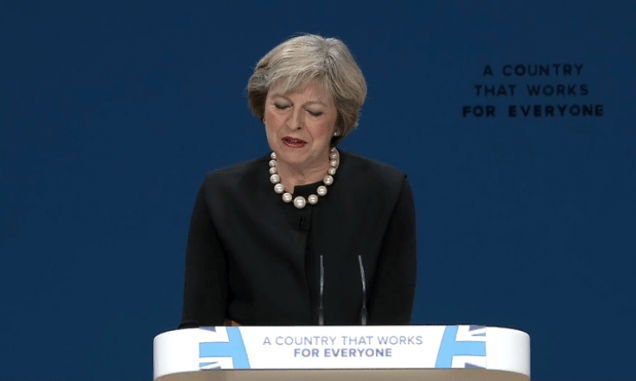
theresa-may-conservative-party-conference-2016-birmingham

Fiscal incontinence, a bizarre grammar school obsession and a new crackdown on civil liberties – forgive me for not cheering along as Theresa May’s Conservative In Name Only Party assembles, victorious, in Birmingham

Theresa May would never have been this blog’s choice to be Britain’s new prime minister, but I have tried to maintain a spirit of cautious optimism in the months since the EU referendum toppled David Cameron and upended our national politics.

And there have been some genuinely positive signs along the way. For one, healthy national pride and patriotism – dead and buried for so long, with New Labour the principal executioner – is starting to make a comeback, no longer automatically scorned by all of Britain’s leading politicians.

Indeed, the Telegraph reports that Theresa May made patriotism one of the lynchpins of her keynote speech to Conservative Party Conference in Birmingham today:

The establishment must stop sneering at the patriotism of ordinary Britons, Theresa May will say today.

During her keynote speech to the Conservative conference, the Prime Minister will proclaim that the Tories are now the party of working class people.

In a bid to attract millions of disaffected Labour voters across the country, she will add that concerns about immigration have for too long been dismissed as “distasteful” and “parochial”.

She will attack the condescending views of politicians and establishment figures who are “bewildered” by the fact that more than 17 million people voted for Britain to leave the European Union.

[..] “Just listen to the way a lot of politicians and commentators talk about the public,” Mrs May will say. “They find their patriotism distasteful, their concerns about immigration parochial, their views about crime illiberal, their attachment to their job security inconvenient. They find the fact that more than seventeen million people voted to leave the European Union simply bewildering.”

This is good. While sneering, elitist anti-democrats like Matthew Parris may suffer convulsions any time somebody outside Zone 2 or with an income of less than £100,000 dares to utter a political opinion, great (and deserved) political rewards potentially await a major political party which stops treating working and middle class patriotism like an infectious disease.

And there was more to admire in today’s keynote speech, not least the fact that Theresa May delivered it from behind a lectern while reading from a printed transcript rather than adopting the tiresome Gordon Brown / David Cameron habit of prancing around the stage while reciting from memory, like an over-eager Shakespearean actor or a Silicon Valley executive delivering a TED talk.

But unfortunately, in that same speech Theresa May also declared “I want to set our party and our country on the path towards the new centre ground of British politics”. In other words, gifted a blank canvas and meaningful opposition only from the ranks of Conservative backbenchers, Britain’s new prime minister is going to play it safe and stubbornly occupy the same tedious middle ground marked out by David Cameron and George Osborne, only a couple of steps further to the left.

But the worst part of Theresa May’s keynote conference speech came when she declared:

“A change has got to come. It’s time to remember the good that government can do. Time for a new approach that says while government does not have all the answers, government can and should be a force for good; that the state exists to provide what individual people, communities and markets cannot; and that we should employ the power of government for the good of the people.”

Excuse me, but no. What is this Miliband-esque, woolly Fabian nonsense?

Opinions differ as to what ails modern Britain, but almost nobody remotely serious would suggest with a straight face that we currently suffer because the state is not yet involved enough in our daily lives, or that it is not performing activities which the market could reasonably undertake. Nobody apart from our new prime minister, that is.

With a new Conservative prime minister singing hymns of praise to an activist state constantly meddling in the lives of its dependent citizenry, we may as well be back in the 1970s. At least David Cameron used to talk about the Big Society (even if he never made it a reality), and suggested that there might be a whole world out there beyond the suffocating reach of the public sector. If we take Theresa May at her word, she seems to believe the opposite – that we should expect to rely on the state in all matters of life, and that markets are terminally “dysfunctional”, requiring constant state intervention.

I’m sorry, but this is unforgivably leftist fluff coming from a supposedly Conservative prime minister. One appreciates that Theresa May has come to office at an exceedingly difficult time, with Britain’s EU secession by far the most ambitious enterprise which this country has attempted in decades. But that is absolutely no excuse for kicking ideology and founding principle to the kerb and engaging in what can only be described as flagrant socialist cross-dressing.

Furthermore, Theresa May’s sloppy wet kiss to Big Government presupposes that until now we have somehow been living in a Hayekian, libertarian nirvana, where the government stayed out of our lives, the successful didn’t have to fork over half of their income in taxes and everybody was left to sink or swim according to their merits. This was hardly the case. The terrible “austerity” inflicted by David Cameron and George Osborne was in reality nothing more than the meekest, politest attempt to stem the constant increases in public spending. Six years on and the deficit remains, the national debt is larger and interest on Britain’s sovereign debt rivals our annual Defence budget.

In other words, Theresa May’s speech made it seem as though working British people had up to now been left to starve in some awful libertarian dystopia, when in fact we remain prisoners of the welfare state/public sector prison created decades ago and put on steroids by Tony Blair and Gordon Brown.

And yet the parties of the Left uniformly fail to realise just how lucky they have it with Theresa May in charge of the country. A Britain led by David Davis, Liam Fox or Jacob Rees-Mogg would quite possibly offer a taste of real austerity for those parts of the country which have grown fat suckling on the taxpayer teat, but with Theresa May they don’t have to worry about any of that. For the prime minister is every bit as much of a champion of the state as Tony Blair, Gordon Brown or Ed Miliband ever were.

Not that you would know it, to read hysterical, weepy editorials like this one in Left Foot Forward:

Theresa May’s speech to Conservative Party conference was supposed to showcase her philosophy. And it did.

It showcased a nightmarish new Conservative ideology that cloaks drastic social illiberalism in the language of inclusive economics, panders to one section of the working class in order to marginalise another, and brands anyone who dares to disagree as unpatriotic and sneering.

And it takes the vote to leave the European Union as a justification for extreme, inward-looking and divisive policies, completely disregarding the 16 million people who voted to remain, not to mention all the decent leave voters, who voted for change, not for for xenophobia.

The delicious irony of a weepy leftist complaining about being disregarded and demonised when such flagrant hostility is the default left-wing attitude towards anybody with remotely conservative opinions is almost too much to bear, but it gets better:

However, the truly frightening aspect of this speech was its divisiveness, its aggression towards anyone who doesn’t fit into the prime minister’s definition of ‘ordinary’.

This includes anyone not born in Britain, despite May’s claim to want ‘a country where it doesn’t matter where you were born.’

It comprises most of the 48 per cent of people who voted to remain in Europe — May seems to have forgotten she was one of them — and all those who envision a more progressive approach to crime, immigration, human rights, healthcare or education.

Here is a prime minister who did everything but daub herself in red paint and sing the Internationale right on the stage of the Conservative Party Conference in Birmingham, and still it isn’t enough for the leftists because the Big Mean Scary Lady apparently used “non-inclusive” language. Truly there is no winning with these people.

In fact, the hysterical reaction from the Left only shows how far Labour’s metro-left ruling class have diverged from their party base and from traditional left-wing thought. Theresa May promises German style corporate governance, more wealth redistribution and the state as an overbearing, omnipresent parent – all of which which would have delighted 1980s socialists – yet the modern metro-left pitches a hissy fit because Theresa May didn’t sing paeans of praise to unlimited immigration or bow down before the altar of corrosive identity politics.

The goalposts keep moving and the ratchet keeps tightening and dragging us leftward. But ordinarily one might at least reasonably expect a Conservative prime minister to act as an anchor and a drag on that influence. Theresa May, though, seems eager to beat the centrist, metro-left in a full-on sprint to the left.

Look: I get that Theresa May is not a socialist herself. But the mere fact that she is comfortable using the same woolly, often meaningless language of Ed Miliband should be a real cause for concern among libertarian-leaning conservatives because it shows that she is far more interested in hoovering up centrist Labour voters than making a bold, compelling case for small government, conservative policies. It is undoubtedly the correct approach if one wants to pursue the path of least resistance, but to tack to the authoritarian centre at a time when the Labour opposition has all but disintegrated is an almost criminal waste of an opportunity to radically reshape Britain – not just through Brexit, but in terms of the relationship between government and citizen.

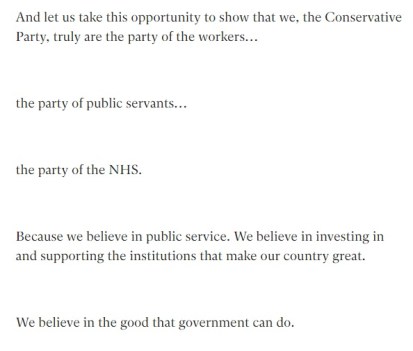
I know I can be a bit of a bore when it comes to analysing political speeches, but it is also depressing to see Theresa May adopt the short sentence / no complex paragraph style also favoured by Ed Miliband.

An excerpt:

theresa-may-conservative-party-conference-2016-speech-transcript


And another:

theresa-may-conservative-party-conference-2016-speech-transcript-2

Put aside for a the obscenity of a Conservative prime minister neglecting to talk about the importance of a flexible labour market to a dynamic economy in favour of trying to outdo Labour in promising counterproductive employment rights, and focus instead on the speechwriting style.

This is the same choppy, disjointed, machine-assembled soundbite speech favoured by Gordon Brown and honed to dismal perfection by Ed Miliband, as this blog explained some time ago:

Behold the short, stunted phrases, written with the news editor’s cropping software in mind while the poor listener’s brain isn’t given a second thought. This is nothing more than a word cloud, a jumble of phrases and platitudes deemed by a focus group to be pleasing or reassuring and then awkwardly bolted together by a computer and beamed onto a teleprompter.

Britain is about to embark on the most complex national endeavour that we have attempted in decades. In seceding from the European Union and deciding to forge our way once more as an independent country, the people of Britain are serving as a case study to the world in how best to maintain and strengthen democracy and accountability in the age of globalisation. Is it really so much to ask that we have a prime minister capable and willing to speak in complete paragraphs rather than ten-word soundbites?

Is it honestly unreasonable to expect that the first major set-piece speech of Theresa May’s premiership should make reference to history, to human endeavour, to our national destiny, rather than simply be a laundry list of bribes to the British people, promising them newer, better public services and an easier life?

This is Milibandism all over again. And while Theresa May is more traditionalist authoritarian than Fabian socialist, alarm bells should be sounding that she intends to govern using the same tired New Labour playbook. May’s conference speech reveals a depressingly small conception of what it means to be the prime minister of the United Kingdom, casting Theresa May as a mere Comptroller of Public Services or a puffed-up cruise ship director rather than a consequential world leader.

Nonetheless, Conservatives seem to be streaming away from Birmingham in a very cheerful mood – some almost outrageously so:

Et tu, Montie?

Yes, libertarian individualism is indeed “THE Tory weakness” if one is trying to appeal to people who love socialism and a big, activist state. Which is why a healthy, virile Conservative Party should either seek to make such people see the error of their ways or else quit pandering to them entirely.

But this is clearly not Theresa May’s approach. She has a different strategy. And what has it wrought thus far?

After three months of reflection over the summer, the Tories are absolutely nowhere when it comes to tackling Brexit, but every indication we have seen suggests that they are toying with the unnecessary self-harm option which would see Britain forsake the single market in a couple of years at the time of EU secession, well before any comprehensive replacement could possibly be negotiated.

We were supposed to be wowed by a so-called “Great Repeal Bill” to undo the 1972 European Communities Act, until five seconds of reflection revealed this grand piece of posturing to be nothing more than a statement of the bleeding obvious – if Brexit is to happen at all, the primacy of EU law and courts must be brought to an end at the moment of departure.

Flagship proposals to build new grammar schools only scratch the surface of problems with British education, but jubilant Tories seem to be treating this policy as the alpha and omega of their plans to create a more educated and skilled workforce when in fact so much more needs to be done to make the British education system the best in the world.

The last Chancellor of the Exchequer was bad enough, with his limp deficit reduction targets, obsession with white elephant infrastructure projects and shameful Brexit scaremongering. But his replacement, Philip Hammond, has taken what little authority the Tories retained on fiscal responsibility and thrown it out the window. Now Conservatives are mocked by John McDonnell of all people – John McDonnell! – for failing to grapple with the public finances, and the national debt will have increased every year after a decade of Tory rule.

And to add insult to serious libertarian injury, Theresa May’s steely-eyed authoritarian side is revving up, with planned new laws to criminalise insulting the army or advocating shariah law for Britain veering from the unworkable to the stupid all the way to the totalitarian.

So I’m sorry, but I can’t get excited about this revamped Conservative In Name Only government. While Theresa May is off to a bright start in terms of tone and temperament, what we have seen so far in terms of policy suggests a shift even further to the economic left than Cameron/Osborne, balanced out by a rise in authoritarianism and government meddling in every aspect of private life.

And for what? To beat Jeremy Corbyn’s Labour Party by a slightly greater landslide in 2020 than is already expected?

Maybe I’m alone in this, but I would rather Theresa May’s government struggle to a 30 seat majority in 2020 based on a really radical, small government manifesto in the model of Thatcher – and then actually go about reshaping the country based on that clear vision – rather than win a 100 seat majority by dressing up in the abandoned clothing of Ed Miliband.

As Margaret Thatcher said in 1968:

There are dangers in consensus; it could be an attempt to satisfy people holding no particular views about anything. It seems more important to have a philosophy and policy which because they are good appeal to sufficient people to secure a majority.

Theresa May clearly disagrees, and there is a very low limit to the respect that this blog can give to a leader who thinks in such unambitious, tactical terms.


David Cameron - Coke Zero Conservative - I Cant Believe Its Not Miliband

Top Image: International Business Times

Support Semi-Partisan Politics with a one-time or recurring donation:

Agree with this article? Violently disagree? Scroll down to leave a comment.

Follow Semi-Partisan Politics on TwitterFacebook and Medium.

Jonah Goldberg On Conservatism In The Age of Donald Trump

Jonah Goldberg says it best when describing the existential danger facing American conservatism in the Age of Trump.

On Trump’s unearned reputation as a happy warrior against political correctness:

This is just flatly not true. I also don’t believe it is true that Trump is appealing to minorities based upon their status as citizens, it’s not in his rhetoric, it’s not what he says; nor do I think he gives a rat’s patoot about the Constitution, which he thinks has twelve articles. He is just making it up as he goes along, riding a populist wave.

[..] This idea that Donald Trump is against political correctness is just a fiction. He’s against being held accountable to people to political correctness for himself but he is delighted to use the exact same bullying tropes of political correctness against other people. He’s done it against me when he tried to get me fired from National Review, saying I was insulting to women and that I have to apologise or resign or be fired because I was so insulting to women. What did I do that was so insulting to women? I said that Donald Trump is staying up late into the night like a teenage girl, tweeting. Which was A, accurate, and B, accurate.

During the primaries when Jeb Bush had a completely understandable and forgivable gaffe about women’s health issues, for weeks Donald Trump was talking about how horrible Jeb Bush was on women’s issues, playing these politically correct cards. He’s a nearest weapon to hand arguer in all things because he does have no philosophy, he has no intellectual grounding whatsoever, and I understand saying “well, we don’t need any more intellectuals, what did intellectuals get us, look at Woodrow Wilson, look at Barack Obama”, I get all that.

But Donald Trump is not a practitioner or a believer in American exceptionalism. He’s rejected the term outright, explicitly, more than once, nor does he represent what we mean by American exceptionalism. His core values, as he says over and over again, are strength and winning. Getting him to talk about the Constitution is like getting my daughter to eat brussel sprouts. I mean, she’ll do it, but it’s not a pretty picture and she tries to get it over with as quickly as possible.

Interestingly, Jonah Goldberg seems to broadly agree with my assessment of the first presidential debate, awarding Hillary Clinton the win, but not by a massive degree:

I thought Trump lost the debate, but not overwhelmingly. He was clearly the winner of the first 30 minutes or so, and if he’d stayed that guy for the full 90 it would have been a hugely consequential rout. But then, Hillary implemented “Bait Trump Protocol Alpha-1,” when she brought up how he got his start with a $14 million loan from his father. (She got the details wrong, but it doesn’t matter. When you’re baiting fish or Trumpzilla, the lure doesn’t have to be real, it just has to be shiny. In fact, getting the bait just slightly wrong makes it even more irresistible, because we all have a natural instinct to correct falsehoods aimed at us, and Trump more than most.)

So Trump bit the shiny thing, and for the rest of the night, plodding, dull Hillary Clinton led Trump around the stage like a matador with a red cape. And, four days later, Trump is still charging around like an enraged bull. At first I thought Clinton’s use of Alicia Machado was odd. There are so many Trump victims out there, why use one with such a weird past? But that’s what was so brilliant about it. If Machado were a nun, it’d be harder for Trump to attack. But Trump thinks he can win this one on the merits and so he won’t let go of it. He didn’t learn the lesson of his feud with the Khan family: The only way to win such fights is to not engage in them at all. The debate wasn’t a disaster but how he handled the post-debate spin was, and continues to be.

If Trump could stay on message, if he could be a disciplined candidate, I think he’d be ten points ahead by now. But realistically, this is no different from saying if he could control anything metal with his mind, he would be Magneto.

In the immediate aftermath of the debate (at 4AM UK Time, with no opportunity for reflection or benchmarking against the reaction of others) I wrote:

Clinton did become more effective during the final 30 minutes, which her campaign will be very relieved about. And did she manage to rile Donald Trump? Yes – but no more than the country is used to seeing after his tussles with Jeb Bush, Marco Rubio or Ted Cruz.

[..] My gut says that this was a victory for Hillary Clinton on points, but a score draw in terms of public reception. Time will soon tell.

All but the most extreme Trump partisans have indeed admitted a Clinton victory on points, substance and tone. And once again, Donald Trump is crowdsourcing advice for how he should tackle the upcoming second debate at Washington University in St. Louis – advice which he will surely reject again, whether it comes from his army of supporters or his despairing, demoralised campaign team.

American conservatives who have chosen to collaborate with Donald Trump have hitched their wagon to the wrong train – in victory or defeat, he will lead them nowhere good.


Donald Trump - RNC - Republican National Convention - Cleveland - Nomination - 2

Support Semi-Partisan Politics with a one-time or recurring donation:

Agree with this article? Violently disagree? Scroll down to leave a comment.

Follow Semi-Partisan Politics on TwitterFacebook and Medium.

Politicising The Supreme Court: A More Liberal SCOTUS Is Nothing To Celebrate

Jeffrey Toobin in The New Yorker salivates at the prospect of a President Hillary Clinton loading the Supreme Court with a bunch of zealous, ideological progressives:

For the first time in decades, there is now a realistic chance that the Supreme Court will become an engine of progressive change rather than an obstacle to it. “Liberals in the academy are now devising constitutional theories with an eye on the composition of the Court,” Justin Driver said. The hopes for a liberal Court will begin—or, just as certainly, end—with the results on Election Day.

Of course there have been times when conservative Republicans have bent the spirit or the letter of the law in pursuit of their own obsessions – cracking down too restrictively on voting rights stands as an obvious, shameful example. But liberal excitement about getting to stamp their mark on the makeup of the Supreme Court seems to extend far beyond merely righting these examples of conservative overreach:

The liberal wish list expands rapidly from there—limited only by the imaginations of law professors, advocates, and the Justices themselves. One possibility is that the Court might recognize a constitutional right to counsel in civil cases. (Currently, only criminal defendants are guaranteed legal representation.) In criminal law, the Court might adopt the idea, which Sotomayor has suggested, that the Constitution forbids incarcerating individuals who are too poor to pay fines. Several scholars have proposed a constitutional right to education, which might force increased funding for poor districts, or, even more speculatively, a right to a living wage.

These goals range from the worthy (no longer imprisoning people who are so poor that they have no prospect of paying large court fines) through the interesting-but-unworkable, all the way to the downright authoritarian and unconstitutional (a federal “living wage”).

But while the Supreme Court is the third and equal branch of government, activists on all sides of the political spectrum are playing with fire when they seek to co-opt the court to be an “engine of progressive change” (or resistance to that change) where they cannot muster popular support to achieve their goals through Congress or, if necessary, amend the Constitution.

The Supreme Court has long been politicised, and American democracy has suffered as a result. And while it may be wishful thinking that the tit-for-tat partisan drama will come to an end any time soon, liberals in particular should be careful. For their side is already ascendant or even victorious on many fronts in the culture war. Social changes which would have been unthinkable three decades ago are now a tangible reality – often a positive thing, sometimes less so. Seeking to gain the last 10% of their social objectives by turning the screws on American conservatives through the Supreme Court will only foster resentment and sow division.

Perhaps liberals genuinely don’t care. Perhaps they are fine with the idea of achieving their goals by circumventing the political process and pushing their “living constitution” interpretations to the limit of coherency. But there will be a backlash, just as there are always consequences when political elites of any stripe push stubbornly ahead with their agendas while forgetting to bring the country with them.


US Supreme Court

Support Semi-Partisan Politics with a one-time or recurring donation:

Agree with this article? Violently disagree? Scroll down to leave a comment.

Follow Semi-Partisan Politics on TwitterFacebook and Medium.

How The Corbynites Would Behave In Government – A Lesson From The 1980s

Conservatives should not feel smug about the hard left takeover of the Labour Party. History shows us that these people are tenacious and capable of inflicting real damage on people and communities in pursuit of their warped ideology, from the lowest seats of power

What would Jeremy Corbyn and the hard left of the Labour Party do if they actually gained political power? It is a question we tend not to ask ourselves or discuss, the possibility seeming so laughably remote that we naturally fixate more on what the Conservative Party is likely to do, given a small majority in government but no real organised opposition.

But it is a question that we should ask ourselves. This blog has been unashamedly supportive of Jeremy Corbyn’s leadership of the Labour Party, not because I agree with his ideology or any Corbynite political positions but because Corbyn represents (together now with Brexit) one of the only agents for breaking British politics out of its current stale, centrist consensus.

The managerial, technocratic politics of the last twenty years has alienated people and drives them away from political discussion, essentially boring them to death while the two main parties squabble over relatively trivial differences in attitude toward taxation, regulation, culture and foreign policy. The 2010 general election, taking place at the height of the Great Recession at a time when bold and original thinking was most needed, hinged on a puny £6bn difference in big spending commitments between Labour and the Conservatives. And though the EU referendum and the subject of Brexit divided the country in half, every political party but one came down hard on the side of remaining in that sclerotic and anti-democratic union.

There is not nearly enough choice in British politics. Being a centrist Labour MP today means broadly accepting the status quo on nearly all fronts while droning on continuously and sanctimoniously about “equality” and “fairness” to anyone who will listen, while being a typical Tory means waxing lyrical about personal freedom and responsibility while doing nothing to shrink the state or bring an end to government paternalism. Even the third parties, so long a pressure release valve, tend to fall in line with the consensus. The SNP is nothing but a slightly more authoritarian and social democrat-leaning Labour Party with a sprinkle of anti-English resentment, while UKIP seems to have betrayed its roots as a radical right-wing party in favour of appealing to disaffected left-wing Labour voters.

In this bland, homogenised context, anything which offers people real choice – a real varied palette of political colours to choose from – can only be a good thing, if for no other reason than that bad ideas will fester and grow out of sight of the country at large unless they are regularly expressed, challenged and defeated. So for all of these reasons, having a genuinely left-wing leader of the Labour Party again is not only jaw-droppingly obvious, it is also essential for the renewal of our democracy.

And yet…

One must also consider what ideologues actually do when they are in power. The Left in particular love to use the Thatcher government as a bogeyman and an emblem of everything evil about conservatism as an ideology, while conveniently glossing over the fact that Britain was a terminal patient receiving half-hearted palliative care before Margaret Thatcher gave the economy and the country some painful, revolutionary but absolutely necessary shock treatment.

But what do the ideological Left do when they are in power? Well, thankfully they have never grasped the reins of national government – the suffocating bipartisan post-war consensus was bad enough. But the hard left do have a track record in local government, and it is not a pretty one.

And that’s where this video comes in – kindly shared with me on Twitter by @eddiecoke. It is about fifteen minutes long, and well worth your time. The video is an excerpt from a 1980s American documentary about the behaviour of the hard, ideological (or “loony”) left in British local government. And some of what you see is quite shocking.

Of course, I knew about all of this in theory. Writing daily about politics, one hears about Red Ken and the GLC, or Derek Hatton and Liverpool City Council. But for early millennials like me, born when Thatcher was already in power and coming of age during late Blairism, the antics of the loony left are often now understood only in theory, while it takes seeing them in practice for the mind to recoil.

Watch the whole video.

What do we see?

Council censorship committees literally going through library books and purging those which do not convey a Social Justice message (in one case a picture book is banned because a white girl character has the temerity to tame a black horse with the aid of sugar cubes).

Snow White and Dr. Doolittle similarly banned.

Beauty and the Beast, Rupert Bear and Thomas the Tank Engine, too.

Replaced by books which go far beyond encouraging tolerance and equal rights, with one book for five-year-olds featuring a section entitled “Masturbation (Touching Yourself to Feel Good”.

The phasing out of competitive sports at school, replaced with open-ended games in which there are no rules, no score is kept and everybody “wins”.

Emboldened Marxist history teachers indoctrinating children with unashamedly pro-communist, anti-American diatribes.

The Brent African Women’s Council being invited to suggest changes to the school lunch menus, and then filibustering a meeting when okra soup and plantain were found not on the menu every single day.

A school governor bragging that he has effectively banned the police from setting foot on his school campus by threatening the headteacher’s job.

Social Justice pantomimes, with the traditional stories modified to shoehorn in messages of liberation and equality (because leftists can’t leave a good story unmolested).

Efforts to get schoolchildren to draw comparisons between the introduction of legislation to crack down on militant trade unionism and the Holocaust.

Viewing this litany of crazy, authoritarian leftist social engineering programmes run amok is quite sobering. And it does make one reconsider whether supporting Jeremy Corbyn and the ascendancy of the Labour Left is the right thing to do. After all, they have unleashed horrors like this on ordinary citizens while controlling only local authorities – how much more harm could they do if unleashed again, or (heaven forfend) on national government?

The answer: a lot. They could do a lot of harm. But that is no reason to recoil in horror at a democratic decision made by ideologically fervent members of the Labour Party. The correct reaction is to ensure that conservative thinking is similarly renewed and emboldened so that it presents an attractive alternative to voters.

Conventional wisdom says that this is already the case – that the UK electorate would pick Theresa May to stay on as prime minister over Jeremy Corbyn in a heartbeat, and that all the Tories need to do is remain as blandly inoffensive / desperately boring and unambitious as possible, so as not to spook voters into reconsidering.

I think this is dangerous complacency. After the past year in politics (on both sides of the Atlantic), nobody has any business making confident predictions about what will or will not happen, or to declare the status quo to be a cast iron certainty forever. Politics at its inclusive and inspiring best is about convincing people to consider new or different ideas, including ones which they had previously rejected. The Leave campaign would never have prevailed in the EU referendum had many people who were ambivalent or even warmly disposed towards the EU persuaded that Britain’s future would be brighter outside. Jeremy Corbyn is asking the British people to consider a radically different political settlement too, and while it is highly likely that the people will tell him to take a hike, it cannot be guaranteed.

Smug right-wing columnists may chortle that Jeremy Corbyn will never see electoral success, but they don’t know what economic or geopolitical shocks lie in await around the corner, or how those will impact British politics. Neither can they guarantee that the British political Right will not undergo a similar schism as is now taking place on the Left, instantly making everything competitive again.

It is not enough for small and large-C conservatives to sit back complacently and laugh at the Labour Party’s turmoil, while doing absolutely nothing to revitalise our own thinking and policymaking. It is not enough to assume that the country knows that conservative solutions are inherently better and more in tune with human nature than socialist dogmas.

If we really are about to enter a new political age where ideology actually starts to matter again, then conservatives should be worried, because we have been caught by surprise. The left’s answer was clearly to re-awaken the socialism of the 1980s and the GLC. What is our answer to be?

Hopefully Theresa May will spell out some broad strokes during the upcoming Conservative Party Conference. But I wouldn’t hold out much hope – the government has its hands full trying to deal with Brexit, and Theresa May’s reputation is that of an authoritarian traditionalist, not a small government, pro-market radical.

And until we conservatives can come up with a coherent and appealing vision for what small government conservatism should look like in 2016 (rather than the post-Cameron fudge we are currently presenting to the public) then our best defence – our only defence, really – against the Corbynites will be their own appalling record in government, going back some thirty years.


ken-livingstone-john-mcdonnell-labour-party-loony-left-socialism

Support Semi-Partisan Politics with a one-time or recurring donation:

Agree with this article? Violently disagree? Scroll down to leave a comment.

Follow Semi-Partisan Politics on TwitterFacebook and Medium.

Conservatism, Behind Enemy Lines

Rod Dreher reports on a fascinating (and depressing) exchange posted on the wall of Princeton professor Robert P. George, between Professor George and a closeted conservative colleague.

The recounted exchange is worth posting in full:

Closeted conservative colleague: “I don’t feel I can say what I think, at least not at this stage. I have a family to care for and other responsibilities, you know.”

Me: “Sure. I’m not criticizing you.”

CCC: “I’ve seen people’s careers ruined for saying what they think.”

Me: “I have, too. I’m really not criticizing you. I assume you’re following your conscience.”

CCC: “You say what you think and you’ve survived. But your the exception.”

Me: “I’ve been very fortunate. That’s true. But there are plenty of others. I’m not unique. There’s Harvey Mansfield, Hadley Arkes, Mary Ann Glendon, Jim Ceaser, and others. Even some people they’ve tried hard to destroy have survived. Mark Regnerus at the University of Texas, Austin,” for example. They threw everything they could find at him, every calumny imaginable. They tried to get him formally investigated and fired. But he has beaten them. I predict he’ll be promoted to full professor this year.”

CCC: “Yes, but there have been lots of victims, too.”

Me: “Yes. Alas. Lots of victims.”

CCC: “You think I should say what I think.”

Me: “I think you should follow your conscience.”

CCC: “That’s just your way of saying I should say what I think.”

Me:; “Look, as I said, I’m not criticizing you. Only you can discern the demands of your own conscience. I didn’t even bring this whole subject up, you did.”

CCC: “I know what you tell your graduate students to do. You tell them not to hide their politically incorrect views.”

Me: “Well, yes, I hardly hide my advice to them. They initially find it counterintuitive. Their natural instinct is to hide their dissenting beliefs or downplay them. I think that’s risky from a character point of view and also not the best strategy for success.”

CCC: “You ARE judging those of us who keep our opinions to ourselves, then.”

Me: “For heaven’s sake, I’m just saying that there is a certain moral hazard in not speaking your mind. As scholars, we’ve got a special obligation to truth and a vocation to truth-telling. Of course, everybody has a basic obligation to honor the truth, as best they grasp it, but our obligation is even more central to who we are. So, speaking for myself, I don’t see what the point of being a scholar is if we’re not willing to speak the truth as best we understand it. I mean, there are lots of other fields we could go into. We could be lawyers, or doctors, operate hedge funds. There’s the insurance business. Wendy’s franchises. Anyway, again speaking for myself, if I felt I couldn’t speak the truth out loud, I would abandon academic life and go do something else.”

CCC: “You’re not afraid to say what you think because you’ve been able to get away with it without your academic career being ruined.”

Me: “That’s exactly backwards. I’ve been able to get away with it because I’m not afraid to say what I think. Fear empowers the bullies. They’re far less bold and aggressive when they know you’re not afraid of them.”

CCC: “Well, I am afraid of them.”

What emotion do you suppose is primarily motivating CCC? I think that the answer is quite clear: terror. Sheer, unbridled terror at the thought of being purged not only from one’s current job but from one’s profession field altogether if one so much as questions the progressive, social justice/identity politics dogma which has descended on academia like a suffocating blanket.

Where else in history have we seen such terror, such fear of having one’s heretical personal beliefs exposed and punished by the state or the mob? It’s hard not to give way to hyperbole, but this is literally the stuff of Orwell’s 1984, or (back in the real world) Soviet Russia during the purges.

And for what? To bring about forced adherence to the new orthodoxy on gender identity, racial politics, climate change, immigration and any other left wing cause du jour. Left-wing academics and students have abandoned any glancing interest in persuasion as a tool, and have jumped straight to brutal enforcement. Some academic fields will take longer than others to fall under the jackboots of this new authoritarianism – the STEM subjects are still relatively free, the humanities dangle over the precipice while the social sciences have long since fallen – but all are heading in the same direction.

And this is why Robert P. George’s own stance matters, and is correct. Just as there can be no equitable accommodation with people who want to establish a fundamentalist Islamist caliphate across the West, neither can conservative academics and other defenders of free speech split the difference with the authoritarian, petty tyrants who are busy consolidating their control over the university campus. One either has academic freedom and the right to free speech, or one does not. There is either censorship and an ideological test for working in certain professions, or there is not.

The time for keeping one’s head down and trying to avoid trouble is over. Those of us who believe in free speech and unrestricted academic enquiry have an obligation to speak out in defence of those being persecuted or intimidated for their beliefs, today and in the future, whether we agree with the particular speech in question or not.

They can’t arrest us all and they can’t fire everyone simultaneously. Conservatism needs to make a stand, to boldly assert that it will not be intimidated and purged from academia without a fight, or without exposing the progressive, social justice cultists as the modern day tyrants that they are.


academia-learning-conservatism

Support Semi-Partisan Politics with a one-time or recurring donation:

Agree with this article? Violently disagree? Scroll down to leave a comment.

Follow Semi-Partisan Politics on TwitterFacebook and Medium.