Nicola Sturgeon’s Failure Of Courage

nicola-sturgeon-scotland-in-europe-snp-second-independence-referendum

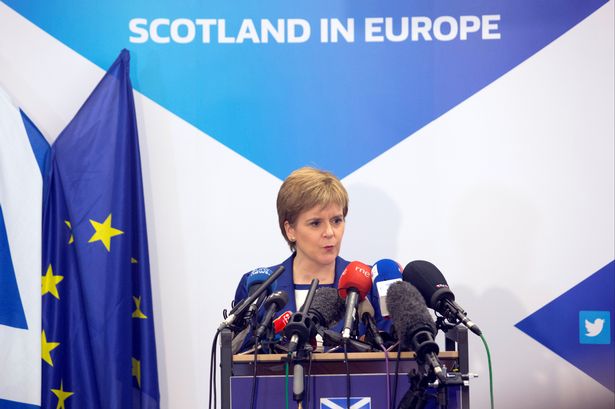
75 days after her massive tantrum about the EU referendum result, a meek and humiliating climbdown from Nicola Sturgeon

From the Guardian:

Nicola Sturgeon has shelved plans for a quick second referendum on Scottish independence after dire spending figures and a fall in public support for leaving the UK.

The first minister told Holyrood on Tuesday that her government only planned to issue a consultation on a draft referendum bill – a measure which falls short of tabling new legislation in this year’s programme for government.

Two months after telling reporters a referendum was “highly likely” within the next two years, she told MSPs that that bill would now only be introduced if she believed it was the best option for Scotland.

Her officials later said that consultation process could start at some time in the next year, with no target date in mind for its launch or its conclusion. Sturgeon’s official legislative timetable, the programme for government, described the referendum as an option and not as a goal.

Well, well, well.

Looks like a tacit admission that running a creaking, statist, big government petro-state north of the border – all based on a fiercely irrational cult of personality – doesn’t produce the kind of dynamic, resilient country which could frolic its way to independence without an economic care in the world after all.

Who could have possibly known?


Postscript: But let us not be too smug. The same report also tells us that the SNP plans to use the Scottish government’s discretionary fiscal powers cut the outrageously high Air Passenger Duty tax by 50% – a good first step in reducing it even further, back to the kind of levels which no longer put passengers off flying to or connecting through the UK:

She confirmed that the SNP would cut air passenger duty at Scottish airports by 50% from April 2018 to stimulate spending, a plan lambasted by Labour and the Scottish Greens as it would damage efforts to tackle climate change.

The day that the Conservative Party can lecture Nicola Sturgeon and the Scottish National Party on pro-consumer, supply-side economic reform with a straight face will be the day when Philip Hammond stands at the despatch box and promises an even greater cut in APD for the rest of the UK in his first Budget.

Until then, the Conservatives continue to disappoint expectations, preferring to virtue-signal their environmentalist credentials and rob leisure and business travellers of their money than usher in the aviation revolution that this country sorely needs.


nicola-sturgeon-snp-scottish-national-party-stronger-for-scotland

Top Image: Daily Record

Support Semi-Partisan Politics with a one-time or recurring donation:

Agree with this article? Violently disagree? Scroll down to leave a comment.

Follow Semi-Partisan Politics on TwitterFacebook and Medium.

This Weak Conservative Government Refuses To Get Tough With The Unions

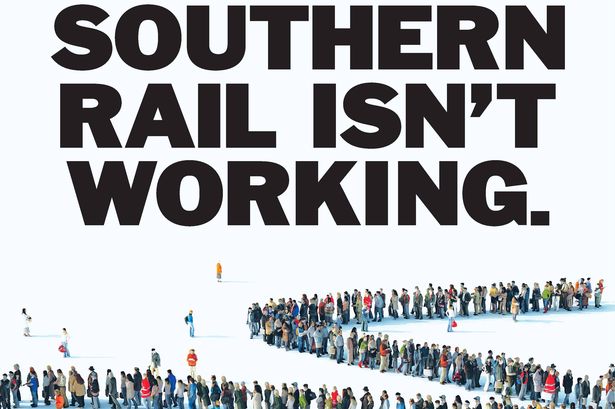
Southern Rail Isnt Working

When even staunch New Labour grandee and columnist John McTernan thinks the Tories are behaving like a weaker version of the Labour Party, British conservatism is in real trouble

As the RMT union’s strike on Southern Rail enters its third consecutive day, inconveniencing hundreds of thousands of commuters while a dithering Tory-lite government watches on, wringing its hands, former New Labour political adviser John McTernan uses his Telegraph column to tear into the Conservative Party.

McTernan writes:

We are in the middle of a five-day rail strike on Southern Rail. Commuters are being massively disrupted. And this is just the latest stage in a dispute in which the Luddite RMT union has made it clear that it is fully committed to fighting against the future.

What about the Government? Where are they in this dispute. It is a crystallisation if all their key themes: investment, modernisation, innovation and productivity. But they are silent.

Well not quite. What we have actually seen is the resignation of the then rail minister Claire Perry, who said:  “I am often ashamed to be the Rail Minister.” And so she should have been – just for her pathetic capitulation to the RMT. This, of course, is just what you would have expected from a Miliband government; but this is a Tory government, with a majority.

There is a famous scene in The West Wing episode about President Bartlet appointing a member of the Supreme Court. He meets Justice Joseph Crouch, whose retirement creates the vacancy, and is angrily addressed by Crouch: “I wanted to retire five years ago. Five years. But I waited for a Democrat. Instead I got you.” The Southern Rail dispute is just like that. Commuters in the Home Counties could be forgiven for thinking: “I waited 23 years for a majority Tory government. Instead I got you.” Where are the core Tory values? Where is the support for management’s right to manage?

This is utterly stunning criticism – shocking not only because it is self-evidently true (the Conservatives in government are a shadow of their glorious best under Margaret Thatcher) but because they are now so bad at governing in a conservative fashion that it has fallen to a former New Labour apparatchik to set them straight.

Why on earth has it fallen to a Labour Party grandee to inveigh against the more militant trades union? Where is the useless europhile Greg Clark, supposedly Secretary of State for Business, Energy and Industrial Strategy during this whole dispute? Where is Chris Grayling, Transport Secretary? Have they all taken lessons from their new boss in the art of disappearing and avoiding the media during scandals affecting their ministerial briefs?

This criticism is particularly damning:

Where are the core Tory values? Where is the support for management’s right to manage?

Where indeed. This blog has wondered the same thing, as the Tories in government behaved like centralising statists, presided over an unprecedented weakening of our national defence, dithered over the housing crisisfailed to get to grips with the nation’s finances, alienated principled conservatives, and as the leader of a supposedly eurosceptic party did all he could to cheat his way to victory for the Remain camp in the EU referendum. Where are the core Tory values?

A Thatcherite government would have stood boldly on the side of consumers over producers, and thus would have been unafraid to plant its flag squarely in the same corner as Southern Rail’s unfortunate commuters. And unlike the Cameron approach to industrial disputes (seemingly applying maximum pressure on businesses to capitulate to union demands, as seen with the London Tube strikes) a Thatcherite government would have recognised the offensive absurdity of the union demands and unashamedly sided against them.

Needless to say, we do not have a Thatcherite government – despite all of the ingredients being in place for another properly ideological right wing government to flourish. The left-wing opposition is hopelessly divided. The Conservatives are under new leadership for the first time in a decade. Boundary review looks set to help the Tories by correcting decades-old biases in favour of Labour, potentially gifting the Tories tens of additional seats. All of these factors stand ready and waiting to be exploited by a radical Conservative government which understands that it has a duty to do more than hold power for the sake of it.

And yet at every turn, the Tories triangulate and tack to the centre. They did so under coalition government (when they had a modicum of an excuse) and they continue to do so now, when they have none. Right now, there is effectively no opposition. A conservative government right now could make a fair stab at privatising pensions and the NHS, and still not be forced out of office so long as the Corbynite and centrist wings of the Labour Party continue their childish tussle for power. The political landscape is ripe for a radical conservative reduction and reshaping of the state, yet there is almost zero evidence that Theresa May’s government intends to attempt any such bold enterprise.

And for what? Will being a centrist clone of New Labour win the Tories any new fans? Of course not. The swivel-eyed Left have long ago convinced themselves that all Tories are “evil” and “vermin”, no matter what they actually do in government.

https://twitter.com/MomentumRugby/status/763072811627872256

We shall win no new fans by trying to adopt the cuddly persona of a young Tony Blair. We will never be liked. Therefore we should focus on being effective, without giving a second thought to winning over the admiration and votes of people who have been raised since birth to despise us. That’s what Margaret Thatcher taught us. And that is the lesson which we seem determined to cast aside in our feverish pursuit of the focus group’s favour.

John McTernan’s quote from The West Wing is very apt. Many conservatives have indeed been waiting for years – since Margaret Thatcher was forced from office, in fact – for another strong Tory leader; somebody committed to conservative, small government principles and willing to fight for them.

Conservatives waited thirteen long years of New Labour government only to get David Cameron. We then endured six years of Cameronism before being presented with the authoritarian Theresa May, foisted on the party in the confused wake of the EU referendum. And whatever electoral success Theresa May enjoys, she may well end up being every bit as much of an ideological disappointment as her predecessor.

But maybe this criticism is premature. Maybe the autumn Conservative Party conference will give birth to a conservative policy platform actually worth voting for. And to be fair to the new prime minister, even Margaret Thatcher bottled her first confrontation with the National Union of Mineworkers, staging a tactical retreat before coming back to finish the job in 1984-85.

But right now, British conservatives are in the ludicrous and humiliating position of being upbraided by a Labour Party grandee – someone from the party of Jeremy Corbyn and Owen Smith, for heaven’s sake – for being insufficiently dedicated to conservative principles.

And when it falls to Tony Blair’s right hand man to tell the Tories how to get tough with the unions, something is clearly rotten with the state of British conservatism.


David Cameron - Coke Zero Conservative - I Cant Believe Its Not Miliband

Support Semi-Partisan Politics with a one-time or recurring donation:

Agree with this article? Violently disagree? Scroll down to leave a comment.

Follow Semi-Partisan Politics on TwitterFacebook and Medium.

A Tory-Labour Centrist Alliance? The Self-Serving Establishment Will Stop At Nothing To Stay In Power

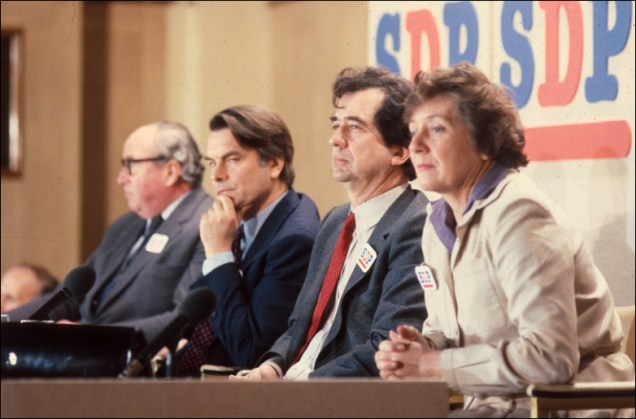
SDP Launch

The British people have made clear that they want their two main political parties to once again stand for recognisably different policies, values and objectives. But the response of calculating, stale and ideology-free centrist MPs seems to be to reorganise themselves in order to avoid dealing with a reality they would rather ignore

Politics is finally getting interesting again. After more than two decades of stale, centrist managerialism following the resignation of Margaret Thatcher, we are finally starting to see real ideological and intellectual dividing lines re-emerging in our political discourse.

After a long and dismal period where it barely mattered whether you voted for Team Red or Team Blue, so similar were their policies, we face the delicious prospect of which way people vote actually mattering once again. This is a good thing. Dry, stultifying conformity might just about be acceptable when things are in a good state, everyone is prosperous and happy, and a safe pair of hands is all that is required to keep the good times rolling.

But while many prosperous, metropolitan professional types (including nearly the entire British political class) may have been coasting through life thinking that everything was fine and dandy, in fact things were not fine for millions of their fellow citizens. And when the status quo is failing so many people, a consensual, moderate and determinedly un-radical form of politics is the very last thing which will bring about the required change.

This is why we should celebrate the short-term chaos which is roiling British politics. For too long we have been cursed by a Labour Party which cares more about making its middle class, urban supporters feel good about themselves than actually delivering tangible improvements in the lives of the working poor and the dispossessed or responding to their concerns about our democracy and our country. And since Thatcher’s departure, the ideologically rootless Tory Party – this blog describes the Cameron cohort as Coke Zero Conservatives, the same conservative taste you recognise but with none of the caffeinated, calorific oomph which makes it worth drinking – has adopted one socialist, redistributionist policy after another in a desperate, failed bid to shake off their so-called “Nasty Party” image.

In other words, within the space of twenty years the two major political parties have converged to such an extent that they were almost indistinguishable from one another – Ed Miliband’s Labour Party went into the 2015 general election flogging coffee mugs on their campaign website which promised to “control immigration”, while David Cameron’s Conservative Party manifesto was creepily subtitled “A plan for every stage of your life” – statist control freakery if ever there was.

The result of this, we all know, was the rise of the fringe parties – the incredible success of the Scottish National Party despite their utterly woeful record actually wielding power in Scotland, and the rise and rise of UKIP which set the wheels in motion for David Cameron’s bitterly regretted decision to offer the country a referendum on our continued EU membership.

Since the shock victory for Brexit in the EU referendum, things have only gotten worse for the forces of dull, greyscale centrism. David Cameron resigned in justified humiliation having waged a deceitful and bullying campaign in favour of remaining in the EU, in which he threatened his own citizens with punishment if they voted the “wrong” way, and yet still managed to lose. Meanwhile, the Labour Party, whose parliamentary caucus never accepted Jeremy Corbyn’s leadership and sought to undermine it from Day One, decided to make their last stand. Unfortunately, that last stand appears to be the utterly bland and uninspiring figure of Angela Eagle, whose coming leadership challenge will be utterly obliterated by Jeremy Corbyn, who remains very popular with the expanded Labour Party membership.

In other words, this has been a bad time for the establishment. Our poor superiors have endured setback after setback, with their preferred centrist candidates being routed as the public justifiably yearn for the return of authenticity and ideological coherence to their politics. And now they face a setback which cannot be endured – the prospect of seeing their country taken out of the European Union (that great escape from accountability for Europe’s governing elites) against their will.

But they are not going to take this lying down.

The Guardian reports on an utterly despicable new development – the fact that centrist Tory and Labour MPs, terrified at the prospect of the bland, consensual form of politics in which they thrive being brought to an end, are now proposing to unite in order to form a new centrist political party.

From the Guardian:

Tory and Labour MPs have held informal discussions about establishing a new political party in the event of Andrea Leadsom becoming prime minister and Jeremy Corbyn staying as Labour leader, a cabinet minister has disclosed.

Senior players in the parties have discussed founding a new centrist grouping in the mould of the Social Democratic party (SDP) should the two main parties polarise, according to the minister. Talks should be taken seriously, though they are still at an early stage, according to the source.

“There have been talks between Labour and Tory MPs about a new party,” the minister said. “A number of my colleagues would not feel comfortable in a party led by Andrea Leadsom.”

It is understood that MPs in both parties who campaigned to remain in the European Union believe there is an opportunity to build on the newly founded relationships between centrist MPs in both parties made before the EU referendum.

A Tory party source said Labour and Conservative MPs who campaigned in favour had become closer during the campaign and increasingly come to regard themselves as “a tribe”.

In other words, if the centrists do not get their way (as they have done uninterrupted since at least 1991) then they will take their toys and leave, founding an entirely new political party for their own glorification rather than doing the hard work of convincing existing party members that they are wrong.

This seems to be prompted largely by the fact that certain prima donna centrist MPs, used to enjoying the trappings of power and influence which come from senior positions in government or opposition, are unable to tolerate even a brief period in the wilderness while more unabashedly ideological leaders have their turn running the show, and so must orchestrate a way for their own failed and reviled centrist clan to continue pushing their self-serving, wishy-washy agenda.

In Labour’s case, this is just about understandable. Jeremy Corbyn is indeed vastly different to what we have been trained to think a Labour leader should be since the days of Michael Foot. The post-Clause IV, post-Blair accommodations with capitalism mean nothing to Jeremy Corbyn, and he is proud to admit as much. Under Corbyn’s watch, the Labour Party has indeed become markedly more left wing. Therefore, a convincing case could indeed be made that moderate, centrist Labour MPs have no place in the party of Jeremy Corbyn. But since Corbyn is supported by a thumping majority of Labour Party members, it would rightly be for the centrist MPs to toddle off and find a new home (and new supporters). Labour is Corbyn’s party now, not theirs.

The Conservatives, though, have far less of an excuse. It would be interesting to know whether the Tory SDP plotters come predominantly from the older guard or from the 2010 and 2015 intakes. Logic would suggest that many of the more recent Tory MPs, who entered parliament in the dismal Age of Cameron, are most ill at ease at the prospect of being led by a superficially more Thatcherite leadership candidate like Andrea Leadsom. But then Theresa May hardly fits the profile of progressive conservatism, with her flinty-eyed authoritarianism, disdain for civil liberties and championing of a large, overbearing nanny state to watch over us and regulate our speech and behaviour. None of these are endearing qualities in a future Tory leader and prime minister, so any Conservative MP happy to wear the blue rosette for Theresa May but happy to shack up with Labour in case of Andrea Leadsom clearly has a very broken and opportunistic political compass.

The Guardian article continues:

A senior Labour party source confirmed that at least one Conservative minister and one of the shadow cabinet ministers who resigned last week had been involved in discussions about such a reshaping of British politics.

“There is a feeling that there might have to be a new party at the centre of British politics,” he said. “It’s early days, but the conversations are at a pretty high level.”

The suggestion comes as the Liberal Democrat peer Shirley Williams demands a central role for all pro-EU parties at Westminster in shaping the UK’s relationship with the EU. She warns that, without a cross-party consensus on the final deal, the country could fall apart in bitter post-Brexit division and acrimony.

Trust Shirley Williams to be at the centre of this subversive attempt by the political class to reorganise themselves so as to thwart the will of the people. She may play the part of the kindly faced elderly lady very well, but is there any more noxious emblem of our centrist malaise than Baroness Williams? I can think of none.

We now witness the depressing fact that a group of Conservative and Labour MPs – we do not yet know how large this potential grouping may be – have a shared love for keeping Britain chained to the antidemocratic EU which transcends whatever minor differences they may have on policy. And those policy differences between Tory an Labour are undoubtedly very few in this centrist age. Therefore, in a last-ditch effort to avoid being dragged out of the EU kicking and screaming, these MPs are now willing to betray the constituents who elected them to parliament by defecting to join a “worst of all worlds” Party of the Damned, a cesspit of wishy-washy MPs who startle like shy fauns at the first sign of passionate ideological debate.

Even before the official result of the EU referendum was declared, there were noises being made by pro-EU Remainers in denial that some means should be found to overturn the public’s vote to leave the European Union on one spurious pretext or another. Most popular now is the idea that the referendum should be ignored or re-run because the public are gullible fools who were tricked by the slick lies and distortions of the official Vote Leave campaign (as though the Remain camp was not engaged in lies, threats and downright cheating of its own). And it now seems that this is to be used as cover, an excuse to legitimise the subversion of British democracy by a group of spoiled sore losers accustomed to always getting their way.

We must not allow these machinations to succeed. While Labour MPs – so diametrically at odds with a leader who commands overwhelming support among the party membership – should arguably do the decent thing and walk off into obscurity and irrelevance by attempting to form a new party of the centre-left, there is absolutely no excuse for Tory and Labour MPs joining together to create a hybrid centrist party – particularly when neither of the two remaining Conservative leadership candidates can be described as right-wing ideologues in the mould of Thatcher.

That such a dramatic step is even being considered shows the rot in our national and political life wrought by the EU. We are now lumbered with a largely useless political class, wobbly-lipped MPs who are terrified at the prospect of Britain governing herself and not having our government’s every decision vetted by the omniscient supranational European government in Brussels. These plotting MPs are behaving like children suddenly separated from their parents in a busy crowd – screaming, weeping, arms outstretched in anguish at having been ripped away from that which gives them comfort and succour, their alpha and omega. It is an unseemly, pathetic exhibition which they are putting on in their desperation to stop Brexit, stop the realignment of British politics along more ideological lines and return to the happy days when fast-track ministerial careers were their for the taking so long as they managed to be sufficiently bland, predictable and uncontroversial.

Hopefully before long we will learn the names of these Labour and Tory MPs who care so much about their future career prospects but so little for their own constituents that they would abandon the parties under which they were elected in order to create a new centrist holding party to achieve through political skulduggery what they were not able to achieve at the general election or the EU referendum.

And hopefully those MPs concerned will then quickly face the full wrath of their constituency parties and associations for having entertained such self-serving thoughts.

God willing, none of them will be in parliament by the time of the next general election, having been deselected and replaced by new MPs for whom socialism, conservatism, ideology and principle are not such dirty words.
 

SDP - Charles Kennedy

Brexit - EU - European Union Flag - Missing Star - Britain - UK

Agree with this article? Violently disagree? Scroll down to leave a comment.

Follow Semi-Partisan Politics on TwitterFacebook and Medium.

Andrea Leadsom vs Theresa May – An Impossible Choice, On Which The Fate Of The Conservative Party Rests

Stepping Stones Report - Goals and Risks - Brexit - EU Referendum

At this difficult time we can take inspiration from our recent history and our last successful effort at national renewal

So it’s Theresa May versus Andrea Leadsom – the final two candidates in the Conservative Party leadership race whose names will now go forward to the wider Tory Party membership in September.

I’m delighted that the Conservatives will soon have given Britain her first two female prime ministers, I really am. When it comes to equality of opportunity the Tories deliver, while Labour bang on endlessly and fruitlessly about equality of outcome, peddle in tawdry identity politics and choose one white male after another to lead them onwards.

But does the successor to Ted Heath Mark II David Cameron really have to be one of these two women? When she entered 10 Downing Street, Margaret Thatcher already had the “Stepping Stones” report in her pocket and on her mind. By contrast, Andrea Leadsom brandishes an overhyped yet still rather thin CV, while Theresa May has your entire internet browsing history and the paranoia to use it against you.

And so, when deciding who to support in this battle to be the next British prime minister I find myself faced with an impossible choice – one may as well flip a coin.

This blog will inevitably write more about the Conservative Party leadership race in the coming days and weeks as I try to make a decision – right now I see pitifully few upsides to either candidacy, and great risk behind either option.

But for now I content myself with re-reading the seminal “Stepping Stones Report” authored by the late John Hoskyns, that masterful diagnosis of everything which ailed Britain in the late 1970s when the state socialist cure had almost succeeded in killing the British patient.

This report – and the solutions contained within it – quite literally saved this country when Margaret Thatcher, who had studied it, came to power in 1979. Without Stepping Stones, Britain would quite likely be a colder, more populous but equally poor and dysfunctional version of Greece. I say this to underline the amazing good which the Conservative Party can do when under the right leadership, and the thread by which such hopes often hang (Margaret Thatcher was considered a rank outsider when she first declared her candidacy for the Tory leadership in 1975).

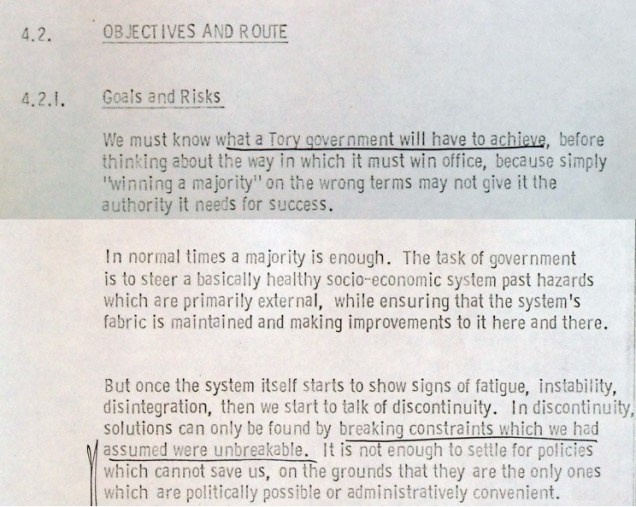
At this time I am drawn to this passage in particular:

We must know what a Tory government will have to achieve, before thinking about the way in which it must win office, because simply “winning a majority” on the wrong terms may not give it the authority it needs for success.

In normal times a majority is enough. The task of government is to steer a basically healthy socio-economic system past hazards which are primarily external, while ensuring that the system’s fabric is maintained and making improvements to it here and there.

But once the system itself starts to show signs of fatigue, instability, disintegration, then we start to talk of discontinuity. In discontinuity, solutions can only be found by breaking constraints which we had assumed were unbreakable. It is not enough to settle for policies which cannot save us, on the grounds that they are the only ones which are politically possible or administratively convenient.

It is safe to say that the Conservative government of David Cameron and George Osborne has been in office but not really in power since being re-elected with a tiny outright majority in 2015. And aside from their creepy manifesto pledge about having “a plan for every stage of your life” it has been almost impossible to discern what the Tories actually stand for, besides staying in power.

Winning a majority has not been enough because the majority was won on the wrong terms – by a prime minister who often pitched himself to the left of Tony Blair in the tawdry hunt for centrist votes. And these are far from ordinary times. As this blog recently pointed out, quoting Lincoln, the dogmas of the quiet past are inadequate to the stormy present.

Theresa May is an accomplished technocrat, but also a fierce and implacable authoritarian. Even her more restrained actions – such as denying the former London mayor Boris Johnson the power to use his expensively purchased second hand German water cannon for crowd control – smack more of political chicanery rather than any shred of liberal principle.

On civil liberties, May is utterly monstrous. But more to the point, Theresa May came down on the wrong side of the most fundamental, existential question to face this country since the end of the Second World War.Worse, she supported the Remain campaign with a calculated half-heartedness, refusing to boldly commit and make the public case for her position. What kind of leadership is this?

Andrea Leadsom is no better. She has publicly and irresponsibly spoken about triggering Article 50 almost immediately, well before any initial scoping discussions have even had the opportunity to commence and well before the British government has had the proper chance to decide how best to implement Brexit, and seems intent on taking us out of the EEA as we secede from the European Union. Her haste is not evidence of super-virtuous commitment to democracy or an uncommon respect for the will of the people, but is the conclusion reached by what seems to be a rather glib and uncurious mind.

But whether you are less repulsed by the flinty-eyed authoritarianism of Theresa May or the oversimplifying, CV-padding antics of Andrea Leadsom, it seems reasonable to say that neither of the two remaining candidates have anything approaching a latter-day Stepping Stones report waiting in their pockets for immediate unveiling as soon as the Queen has invited one of them to become prime minister. And that is what we need most of all right now.

Theresa May’s authoritarian streak, contempt for civil liberties and belief in wielding the coercive power of the state is incredibly objectionable to this blog – yet as by far the more experienced candidate, May is best placed to negotiate good secession terms for Britain with the EU (assuming that she doesn’t double-cross us and effectively condemn Britian to “associate membership” on the margins).

Andrea Leadsom has precious little track record in government or politics in general, and has distinguished herself by saying some downright irresponsible things about Brexit. As a result, she could potentially overshadow the democratic dividend of Brexit through unnecessary self-inflicted economic wounds (e.g. by taking Britain out of the EEA). Yet she is superficially more Thatcher-like (I won’t say Thatcherite), and has the potential, however small, to grow into a far more radical Conservative leader than the soul-sappingly ideology-free Theresa May could ever be.

Choose May and you risk turning Britain into a dystopian police state while rewarding yet another ideology-free, politics-by-numbers technocrat, the kind of person whose unambitious, managerial approach to the great issues of the day turns millions of people off politics altogether.

Choose Leadsom and you risk a tumultuous and highly suboptimal form of Brexit while taking an enormous leap of faith that an untested neophyte will successfully get to grips with one of the steepest learning curves in the world, and that they will be advised well in the process.

Who can choose between these two flawed options with any degree of certainty?


Stepping Stones Report - Wiring Diagram

Brexit - EU - European Union Flag - Missing Star - Britain - UK

Top Image: ‘Stepping Stones’ Report

Agree with this article? Violently disagree? Scroll down to leave a comment.

Follow Semi-Partisan Politics on TwitterFacebook and Medium.

Conservative MPs Must Feel The Political Consequences Of Supporting Remain

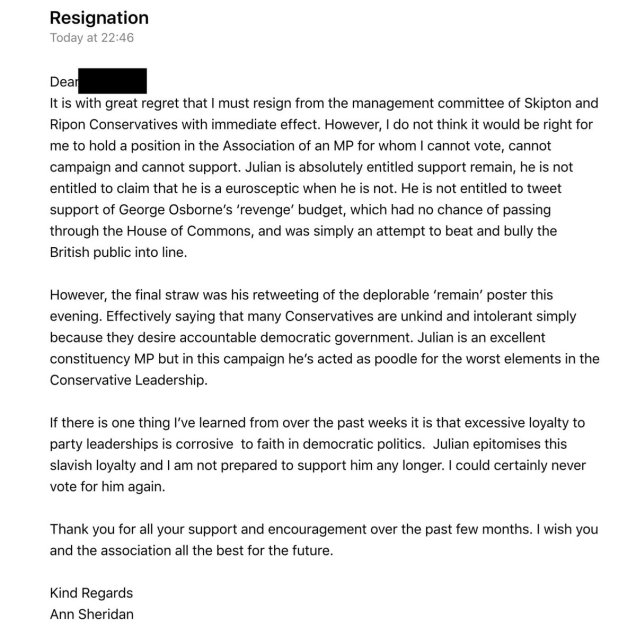
Ann Sheridan Resignation Letter - Julian Smith

Conservative MPs who contravened the will of party members in order to support the prime minister’s tawdry, deceitful Remain campaign should rightly be afraid for their positions

Hopefully this will be the first of many  dominoes to fall – Ann Sheridan, local activist and committee member for Skipton and Ripon Conservatives, is no longer willing to support her turncoat Tory MP, Julian Smith, who ditched his avowed euroscepticism to slavishly support the prime minister’s Remain campaign.

Sheridan writes:

I do not think it would be right for me to hold a position in the Association of an MP for whom I cannot vote, cannot campaign and cannot support. Julian is absolutely entitled [to] support Remain, he is not entitled to claim that he is a eurosceptic when he is not. He is not entitled to tweet support of George Osborne’s ‘revenge’ budget, which had no chance of passing through the House of Commons, and was simply an attempt to beat and bully the British public into line.

However, the final straw was his retweeting of the deplorable ‘remain’ poster this evening. Effectively saying that many Conservatives are unkind and intolerant simply because they desire accountable democratic government. Julian is an excellent constituency MP but in this campaign he’s acted as a poodle for the worst elements in the Conservative Leadership.

If there is one thing I’ve learned from over the past weeks it is that excessive loyalty to party leaderships is corrosive to faith in democratic politics. Julian epitomises this slavish loyalty and I am not prepared to support him any longer. I could certainly never vote for him again.

Ouch.

If this sentiment is widespread among Conservative constituency activists – and personally speaking, I sincerely hope that it it – then the inferno poised to consume the Conservative Party will be even greater than many had previously anticipated. Good. MPs who either ran for selection or cultivated their subsequent reputations as staunch eurosceptics should be made to suffer the consequences for betraying their constituents on such a fundamental matter as Britain’s future governance and democracy. And while it does not presently seem likely, if a wave of de-selections were to take place (as advocated by Momentum within the Labour Party) then this blog would loudly cheer on the process.

Back in 2010, I supported Rob Halfon‘s campaign to unseat the Labour minister Bill Rammell in my hometown of Harlow, Essex. I now sincerely wish that I had not bothered. Halfon’s timid, tremulous and utterly pessimistic argument for staying in the European Union (“I am voting to stay in the European Union because I am frightened by an uncertain world”) is utterly repulsive, the worst of all reasons for Britain to remain in the EU. It betrays a staggering lack of confidence in the country and people which Halfon represents to the degree that his undeniably good work as a constituency MP is utterly negated.

One of the reasons that there is such a “toxic” political atmosphere in the country at the moment directed at our poor old elites is that the main political parties present a stubborn consensus of opinion which is far from settled in the country. Most MPs in nearly all parties are pro-EU, and all parties have been complicit in handing ever more powers and competencies from Westminster to Brussels, hollowing out our own government.

It is bad enough that the Labour Party supports this process of democratic decay – and in fact there are many reasons why principled left-wingers should support Brexit. But it is even worse that so many MPs from the so-called Conservative Party are also cheerleaders for a supranational government of Europe which actively hollows out and undermines the very institutions, traditions and democracy which conservatives are supposed to value.

The decision by so many Conservative MPs to support the Remain campaign has rightly enraged many small-c conservatives, this blog included. It is a show-stopper, a deal-breaker, something which conservatives of principle cannot forgive, forget or move past on 24 June. For whichever way the referendum goes, the fact will remain that over half the Conservative parliamentary caucus – including the prime minister and his despicable chancellor – may as well belong to the Labour Party, for all the good they are doing in power.

Something needs to change – and realistically this can only take the form of real conservatives abandoning the Tory Party en masse, or forcing these ideology-free careerists from their positions and replacing them with people of principle. And since starting a new political party almost never works, most of us choose the latter option. Conservative MPs who betrayed their principles and their constituents to support keeping Britain in the EU should therefore be rightly afraid for their positions. Because hopefully Ann Sheridan’s public denunciation of her own MP will only be the beginning of a grassroots backlash to mirror the turmoil that will soon engulf Westminster.

And those Conservative MPs who served as loyal cheerleaders for the EU from Day 1, or who ditched their previous euroscepticism either through failure of courage or craven desire to curry favour with David Cameron and George Osborne, might then be made to feel the political consequences of their actions by their local constituency associations.

In fact, this blog’s aspiration for the future political and ministerial careers of those Tory MPs like Julian Smith and Rob Halfon is perfectly captured in Job 38:11:

“Hitherto thou shalt come, and shalt go no further.”


European Union - United Kingdom - Britain - Flags

Agree with this article? Violently disagree? Scroll down to leave a comment.

Follow Semi-Partisan Politics on TwitterFacebook and Medium.