General Election 2017: The Unbearable Light-weightedness Of British Politics

rainbow unicorn

We can’t go on like this

I’m just going to come out and say it: given the appallingly weak options available, Jeremy Corbyn probably deserves to be the next prime minister of the United Kingdom.

Don’t get me wrong: if his hard-left socialist policies and aspirations were fully enacted, Corbyn would also likely be the last prime minister of the United Kingdom, but that’s another matter.

After all, is not the point of democracy, of elections, to give the people their right to choose political leadership and representation which they want to see take their communities and their country forward? And if so, who during this miserable general election campaign has done more to convince the British public that they are a person of principle and conviction, willing to tell uncomfortable truths as they see them while standing up to entrenched special interests – Theresa May or Jeremy Corbyn?

Let’s compare.

Who produced an election manifesto which represented some of the best traditions (and sincerely held political views) of their party? That would be Jeremy Corbyn. Who huddled together with two unelected aides to produce in secret a manifesto which declared war on her own voters, repudiated Thatcherism, threw the libertarian wing under the bus and pandered to the worst instincts of everybody who thinks that the state should be like a third parent to them? That would be the “conservative” prime minister, Theresa May.

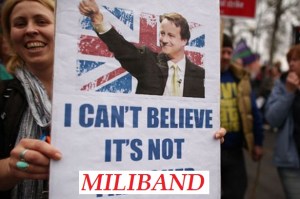
Jeremy Corbyn’s Labour manifesto, in all its leftist, spendthrift glory: costed. Theresa May’s Coke Zero Conservative manifesto – “coke zero” because like the drink, it has the same branding as the real thing but none of the ideological, calorific ooomph which makes it taste good and perk you up – not so much.

Who has made gaffe after gaffe and exacted numerous self-inflicted political wounds, missteps and humiliating U-turns on her party and campaign? That would be Theresa May, whose claim to unruffled, grown-up leadership looks more and more tarnished by the day. Who seems to have finally stopped his penchant for weekly PR disasters and learned not to intervene when his enemy is making a mistake? That would be the old rube, Jeremy Corbyn, despite the fact that he faces a highly antagonistic press.

Who has behaved like an adult and at least accepted the necessity of a Brexit deal with the European Union (however weak a negotiator he would otherwise likely be) as a precursor for economic stability? That would be Corbyn. Meanwhile, who still publicly entertains the confidence-sapping notion of no deal and a disastrous crash out of the EU? That would be strong ‘n stable Theresa.

And who found the courage to go on national television and articulate their party’s values and vision for Britain in tonight’s BBC election debate? Jeremy Corbyn. Who was frightened and cowered away in Downing Street, risibly sending a surrogate minister to fight her battles? That would be the ever-formidable Theresa May.

Whatever one thinks of Jeremy Corbyn, there is mounting evidence that Theresa May simply does not have what it takes to be a successful British prime minister in the 21st century. Perhaps being a diligent, hardworking, non-telegenic, secretive authoritarian with a tiny circle of close-knit advisers helped Theresa May when she was Home Secretary. Lord knows it allowed her to become prime minister despite the party and the country barely having any idea of her core values or guiding philosophy. But as prime minister in the television and internet age, May’s natural reticence doesn’t play well.

You can say that this is a small and petty criticism, and in some ways it is. And perhaps personality should matter less, but we must deal with the world as it is rather than as we would like it to be. When Theresa May skulks in the back row of G7 summit family photos while Donald Trump gladhands with the boy wonder French president Emmanuel Macron and “leader of the free world” Angela Merkel, one gets the strong impression that she similarly fails to win hearts and minds in the all-important closed door sessions.

For all their arrogance and vapidity, the American political elite positively purr over Emmanuel Macron, bulwark against Evil Brexit and saviour of the “liberal world order”. I would wager that far fewer could even name Theresa May. And this advances British interests with our closest and most important ally how, precisely? Donald Trump is one man, quite possibly soon to be an ex-president if the slow-motion coup against him ultimately succeeds. Meanwhile the vast apparatus of American government remains a juggernaut fully committed to the internationalist status quo, and Theresa May is doing nothing to persuade them that any of their preconceptions about the evilness of Brexit and the EU’s self-evident splendour are wrong. A better, more natural communicator would have a fighting chance.

Two provisos: First, Jeremy Corbyn would do no better in this regard, and quite possibly far worse, given that his worldview is based in no small part on anti-Americanism. But Theresa May only looks vaguely acceptable in this regard because Jeremy Corbyn would be so appalling. That’s not a ringing endorsement or a solid qualification for remaining prime minister.

And second, it is hardly as though the Conservative front benches are brimming over with talent one thinks of as solid alternative prime ministers – Boris Johnson is rightly known in America and around the world as a fool who uses a bumbling persona and a smattering of Latin phrases to mask an insatiable vanity and hunger for the spotlight. Who else to choose? Philip Hammond? Well, at least Theresa May makes him look fiscally responsible by comparison, but he’s no media performer. Amber Rudd? She’s a loyal soldier and did a highly commendable job stepping into Theresa May’s shoes for tonight’s debate, particularly so soon after the death of her elderly father earlier this week, but a potential leader? Who else, then? Seriously, I’m asking? Who?

If you had to design the perfect Tory party leader and prime ministerial candidate for this moment in time specifically, what would they look like? Well, everybody probably has their own preferences, but here would be my take on what would work best both politically in Britain and as a person capable of commanding interest and admiration on the world stage:

Ex armed forces (of either gender), mid to senior rank, with an illustrious overseas deployment history. Someone who exudes unapologetic patriotism yet never lapses into cheap jingoism, and whose commitment to defence, national security and veterans affairs is beyond question.

Followed up by a successful later career, possibly in the third sector or the arts but better still in the private sector, having founded a stonking great big corporation that also gives back to the community by employing ex-offenders or partnering with charities to do meaningful work in society.

A solid and consistent record (at least dating to the start of the EU referendum campaign) on Brexit, able to tell a compelling story about how Brexit – properly done – can be good for our democracy and at least neutral on the economic front.

A person who believes that until somebody comes up with a viable alternative to (or augmentation of) the democratic nation state, this institution remains the best method yet devised of ordering human affairs, and that consequently we should not needlessly undermine and vandalise it by vesting power in antidemocratic supranational organisations or pretending that we can sidle our way into a post-patriotic world by stealth rather than with the consent of the people.

Somebody who will not bargain away our civil liberties chasing the chimera of absolute security from terrorists and madmen – particularly while refusing to face down radical Islamism as an ideology to be confronted and defeated – but who will also stand up to expansionist, nonsensical definitions of human rights and an identity politics / political correctness agenda that values hurt feelings more than freedom of expression.

Somebody with the articulateness, gravitas, sincerity and quickness of thought capable of doing the near impossible in 2017: single-handedly turning the tide away from the vapid, broken politics of me, me, me. Somebody willing to ask – as John F. Kennedy once did – not what our country can do for us, but what we can do for our country. Somebody who dares to call us to a higher purpose than merely living in a country with “good public services”, deifying “Our NHS” and having the goddamn trains run on time.

Somebody who chooses for us to go to the moon (or rather its current day equivalent in terms of spectacular human achievement) “and do the other things, not because they are easy, but because they are hard, because that goal will serve to organize and measure the best of our energies and skills”. Kennedy again.

Somebody who realise that unless we as a society nurture and maintain some kind of higher common purpose with one another – and we’ve largely done away with organised religion in Britain, while the Left’s commitment to unlimited multiculturalism has made even the suggestion of unifying around non-negotiable core values prima facie evidence of seething intolerance or racism – we are doomed to fracture into separate warring special interest groups and victimhood lobbies jockeying for position. A country so lacking in confidence in its own values that it refuses to proclaim them, let alone insist upon them. A country in name only, led by a conservative in name only.

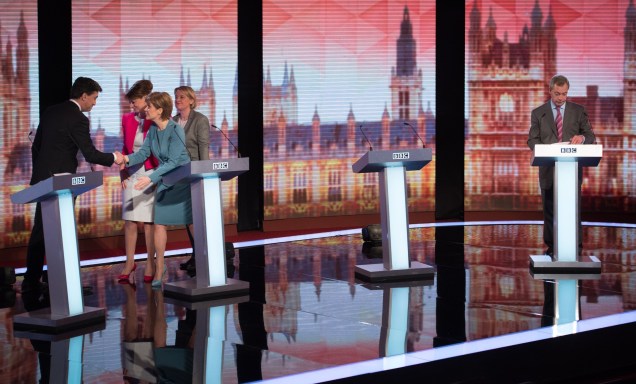
So where is such a potential transformative, neo-Thatcherite Tory leader? Where is such a potential leader of any political party in Britain? Good luck finding them. Look at the typical calibre of people who now become MPs. Sure, you get some who are diligent constituency MPs or single issue campaigners, but this only highlights the flaw of a system of government which draws the executive from the legislature. Look at the new or new-ish MPs of any party with serious ministerial ambitions and you’ll generally find nothing but focus group-approved platitudes and a yawning chasm where ideology or principle ought to reside. Look at the seven characters who lined up behind podiums to debate the issues on primetime TV.

No such party leader (or surrogate) standing on stage at tonight’s BBC televised election debate in Cambridge lived up to even one of these tests. The seven parties of the Left – Labour, Liberal Democrat, Green, Scottish National, Plaid Cymru, UKIP and now Theresa May’s rootless Tories – only know how to campaign by promising people stuff. Lots of stuff, any stuff. More more more. Better, bigger, shinier public services. A welfare state blindly doling out the same universal benefits in disbursements which are laughably small for the wealthy (who don’t need them but are hooked on them because that’s how universal benefits do their dirty work) yet which too often allow the genuinely sick and disabled to barely subsist. Promise after promise. No call to citizenship, to personal responsibility. Just endless promises of safety, security and more stuff, all for free.

Vote for me, I’ll keep you safe from terror. Just gonna need your Facebook password, please. No, vote for me, I’ll keep the economy strong because we all know the only point of a strong economy is to raise more tax to spend on the NHS. Liar! You want to destroy Our Precious NHS! You want people to die in the streets when they get sick, just like they do in America. No, we are now the true party of the NHS! Anything for Our NHS, oh god, anything and everything, my very life for Our Blessed NHS.

Oi! Look over here, free university tuition! Yeah, it’s subsidised by the taxes of other people who never went to university and whose earning power has not been boosted through having a degree, but still. Fairness! Young people are the future! No, no, no, it’s all about the environment. That evil party wants to build an experimental nuclear fusion plant in your grandmother’s basement. But we will bulldoze nasty, Brexit-supporting Stoke-on-Trent and replace it with a massive solar panel field. Much better.

No, look over here! We will bring back British Rail; remember how great British Rail was? Who needs Pret when you’ve got a trusty British Rail egg and cress sandwich? Nice and warm, of course, just like the good old days. Let’s have car-commuting taxpayers in Gainsborough subsidise the travel of London-based city commuters, because fairness. British Rail? Scoff. I’ll see your British Rail and raise you British Leyland! Woohoo – nationalisation, baby! For the Common Good.

All immigrants are a godsend, to the last man. If it weren’t for immigrants, your inflamed appendix would have been dug out by a native-born, chain-smoking school dropout with a can of special brew in his spare hand, and don’t you forget it. No, of course we should have a sensible, measured conversation about immigration. It’s just that I’ll stand here and shriek into the TV cameras that you’re an evil, divisive racist if you disagree with me. But please, go ahead. No no, we should listen patiently to people’s concerns and then carefully explain to them why they are wrong. People love that.

Oh, you? No dear, you don’t have to do anything. We, the politicians, are here to promise you stuff, to pander to your every passing whim. If I’m prime minister, I will make it my overriding personal concern to fix the broken chairs at your GP surgery waiting room – I’ll come round and do it myself, I’ve got some tools in the shed – and make sure that New British Rail adds free wifi to your single-carriage metro train between Stoke and Crewe. Seriously, no worries. I’ll call the boss at 6AM every day until it happens. NATO summit? Geopolitics? Statecraft? Boring! Why be a statesman when I can be a glorified town councillor for 65 million insatiable people? I’m on the case for you, and your every last petty concern. I’ll read foreign policy briefings when I’m on the can, that stuff doesn’t matter.

Heavens no, of course we don’t need to properly empower local politicians to make decisions in the local interest, raising and spending taxes independently of Westminster. For I am running to be Comptroller of British Public Services, and my sole job, my only care in the world is to make your passage through life as easy and painless as possible. You and 65 million of your fellow citizens. The buck stops with me, because public services are everything. After all, Britain didn’t do anything of value or renown on the world stage until we starting implementing the Beveridge Report. Not a damn thing. And now we’ve jacked up the size of the state so much and you have to deal with it so bloody frequently that we’d darn well better make sure you come skipping away happy from every last interaction – too many bad experiences for you are political suicide for us.

All seven of them, yapping away on stage like this as the minutes ticked by and the left-wing Cambridge audience dutifully clapped along to each pledge of More Free Stuff like so many trained seals. But at least Jeremy Corbyn sounded like he meant it, like he was advocating all of these things because they flowed from a sincere and coherent – if utterly misguided – worldview. The rest were just preening, moralising virtue-signalling charlatans. With the exception of Amber Rudd, who did sterling work in the face of her leader’s cowardice, and whom I will not criticise given the circumstances of her appearance.

Now, all of that being said, the prospect (raised by new YouGov polling showing a tightening race) of Jeremy Corbyn overperforming expectations, gaining seats in parliament and entering 10 Downing Street as prime minister backed by a “pwogwessive alliance” of Britain’s childlike left-wing parties, is simply untenable. And so I will vote Conservative on June 8, because my constituency of Hampstead & Kilburn is a tight two-way marginal and the Labour incumbent MP, Tulip Siddiq, was a staunch Corbyn supporter and an unrepentant enemy of Brexit.

So yes, I’ll vote Tory this time. But Lord knows I’ll feel unclean and deeply depressed while doing so, with zero expectation that it will result in anything positive for the country and with considerably more admiration for the man I hope to see defeated than the woman I barely want to win.

Britain, we can do better than this. Probably not much better realistically, at least right now – because as a society we have fallen and been infantilised to such a worrying degree – but still we can do better than these paltry political party leaders. They’re all just so very…small.

Somebody, anybody else, please step up soon. Deep down, as a nation we want more than is being offered to us by Jeremy Corbyn, his provincial Mini Me’s and a confused Tory leader who thinks the path to victory involves dismantling – rather than building upon – the legacy of our greatest post-war prime minister.

Step forward, find the spirit of public service and call us to action, too. Ask us to set our sights beyond our own narrow interests, beyond our bank balances, our bin collections, our next step on the property ladder, the feelings of our intersectional identity groups, the fate of our free mobile roaming calls in Tuscany. Help give us a new purpose, a common purpose, a higher purpose.

Set us a challenge.


People skipping beneath a rainbow

Support Semi-Partisan Politics with a one-time or recurring donation:

Agree with this article? Violently disagree? Scroll down to leave a comment.

Follow Semi-Partisan Politics on TwitterFacebook and Medium.

Is It Time For Conservatives To Get Over Thatcher?

Theresa May - Conservative Party Tories General Election 2017 Manifesto Launch - Halifax

Theresa May is proving to be more Ed Miliband than Margaret Thatcher

Conservative Home’s Paul Goodman thinks that we should all flop around on the ground and praise Theresa May for tearing up tried-and-tested small-government conservative ideology in favour of an interventionist, paternalistic, stubbornly large state. Apparently at this challenging point in our history, when decisive leadership and a clear direction of travel is needed more than ever, we should swallow our reservations and lustily cheer on a pragmatist, paternalistic prime minister who still has not even properly articulated her vision for Britain.

On the day of the Conservative Party’s 2017 general election manifesto launch, Paul Goodman tells us that it is time for us to “get over Thatcher” and “get on with May”, because apparently a New Labour government with a blueish tint is the best that conservatives can now hope for.

Softening the ground in advance of what will surely prove to be a frustratingly unambitious general election manifesto launch – particularly given the paucity of opposition faced by the Tories and the near certainty that they will be returned to government with an increased majority – Goodman simpers:

Theresa May does not support a big state: in her very first major policy speech outside her ministerial responsibilities, she said that it should be “small, strong [and] strategic”.

Oh, well that’s fine then. She said it, so it must be true.

Nor, for that matter, is her so-called Red Toryism as crimson as is sometimes claimed.  Many of the headlines generated during the last few weeks will look less alarming to liberals if they peer at the small print.  May wants more council houses, but it isn’t clear where the land to build them on will be found.  She supports more rights for workers, but it isn’t evident whether taking leave to care for a family member, for example, will be paid – and nor is she planning to scrap the employment tribunal fees that David Cameron introduced.  She has resuscitated a requirement to put employees on boards, but it looks as though companies will choose them.  The red spray is mixed with blue paint.

So now we are to celebrate that Theresa May apparently wants to build more council houses? What about houses for upwardly mobile young people to buy – people who now find it exponentially harder to get on the property ladder than Theresa May’s generation? Where does Theresa May think that the next generation of conservative voters will come from when it is so difficult for so many to take the stake in society that comes from property ownership? And are we to rejoice that an unfunded pledge to allow workers to take family care leave could hurt small businesses and make companies quicker to fire in a downturn and slower to hire in an economic recovery?

She doesn’t want to state to get bigger, but she does want it to intervene more.  The industrial strategy won’t seek to pick winning companies, but it will search for winning sectors.  There will be an energy price cap – not the relative one floated by John Penrose and others, but an absolute one.

I’m sorry, but what is the functional difference between a bigger state and one which simply “intervene[s] more”? Most people judge the size and bearing of the state on the number and nature of interactions they must have with it over the course of their daily lives – everything from speeding tickets to planning permission to small business red tape to the amount of tax taken from their pay cheque every week or month. Even if Theresa May was technically shrinking the percentage of Britain’s GDP accounted for by government spending – and there is no indication that this key indicator is even on her main dashboard of concerns – her record as Home Secretary and subsequently as prime minister suggests that her “intervening” state will only seek to take on an even larger role in our lives.

More:

But while we agitate about the detail, the Prime Minister sees the big picture – and has assimilated its scale and size more clearly than her Thatcherite critics.  The Conservative Party travels through the landscape of its times.  These are not the same as they were in the era of Thatcher’s first landslide, over a quarter of a century ago, any more than they were a quarter of a century or so before that, when Harold Macmillan won his own overwhelming victory in 1959.  The world has globalised.  Family structure has been transformed.  The western world has low birthrates and high immigration.   Britain is a multi-racial country.  The Soviet Union has collapsed and Islamist terror has risen.  The crash happened and recession followed.

Free market absolutists will claim that the former took place because there is too much crony capitalism, and too little of the real thing.  They have a good point.  But the argument only draws one deeper into probing whether the system works as well for the working man and woman as it did in Thatcher’s day.  There are three big reasons why it does not.  First, relations between capitalism and nationalism are strained now in a way that they weren’t then.  Many of those who do well out of it feel they have more in common with their counterparts abroad than their fellow citizens at home.  If you doubt it, ponder the politics of immigration – and look, to pluck just one example out of the air, at how George Osborne at the Evening Standard now beats a pro-migration drum.

Second, the changes in the way we live now have created winners and losers.  The latter are simply out-wrestled by Iain Duncan Smith’s five giants – failing schools, crime, sub-standard healthcare, problem debt, and drug and alcohol dependency.  For those who can’t read or are mired in debt or trapped in substance abuse, the traditional free market nostrums of lower taxes, a smaller state and less red tape are not so much wrong as irrelevant: if a man isn’t working because he can’t count, cutting taxes won’t help him.  Finally, capitalism in the western world is simply not creating well-paid white and blue collar jobs on the same scale as it was in the immediate post-war period.  Welcome to the gig economy.

Nobody seriously disputes any of this, but Theresa May’s prescriptions are all wrong. Globalisation does present real social challenges in terms of ensuring that people are no longer left behind as they have been by many callous elites who otherwise consider themselves enlightened and compassionate. And of course Britain’s industrial makeup and labour market are very different today than in the 1980s, but this doesn’t mean that a heavily interventionist state is the answer.

This blog has often noted that the challenge falls hardest upon conservatives to come up with answers to the problems of globalisation – to find ways to retool and retrain a population so that they can participate in the industries of tomorrow rather than clinging to the dying industries of the past. This was clearly one test that the Thatcher government failed, and the legacy of broken communities left behind as side effects of the Thatcherite medicine is why there are still many people who would shoot themselves before voting Tory, and why the Labour Party’s electoral floor remains so stubbornly high.

But the answer to this challenge is not to steal wholesale from the left-wing playbook and seek to make the government the energetic auxiliary parent to millions of grown adults, people who should be expected to find their own way in life. The answer is to find the least invasive way possible of incentivising people to retrain and gain skills that make them competitive in the labour market – perhaps the kind of vocational adult education common in America’s community colleges, but either tied to the welfare system (so benefits become contingent on learning), made tax-deductible or a requirement for larger companies seeking to make redundancies. As this blog has previously noted, Jeremy Corbyn’s vision for a National Education Service connecting adults with further education is not actually a bad one – it is just the left-wing execution (funnelling everybody off to university, free of charge) which is wrong.

More:

We will have seen more of the Conservative Manifesto by the end of the day.  But what we know already is that May, if she can win her own landslide, wants to correct the liberal excesses of the Thatcher era by making peace with the state – of seeing it, as this site puts it, not as Big Brother, but Little Brother.  This ground has the merit of being where most voters stand: very, very few speak the Westminster Village language of making it bigger or smaller.  And the Prime Minister seems set to use her mandate to do much of what this site has been pressing it to do – such as dropping the tax pledge and ending the pensions triple lock, thereby setting the scene for more flexibility in deficit reduction and more fairness between the generations.

It doesn’t matter whether people speak the Westminster Village language or not. When Margaret Thatcher came to power in 1979, most people had not read the “Stepping Stones” report – that influential document which diagnosed all of Britain’s economic and social ails, and prescribed a comprehensive cure. But the man in the street didn’t need to have read the report, or necessarily have a firm sense of the ideology behind it. What was important was the fact that Margaret Thatcher came to office with a pre-formed ideology already in her mind, while her government’s policies generally flowed from that same consistent approach.

Theresa May is the precise oppose of this – the anti-Thatcher, if you will. Theresa May ascended to 10 Downing Street as the ultimate pragmatist – somebody who kept her head firmly under the parapet while Home Secretary, almost never stirring the waters or causing controversy by ramming through serious reforms in her department and being notable only for her willingness to take advantage of terror attacks in Western countries to vest ever more powers in the security services and clamp down on civil liberties.

There is no Theresa May governing philosophy. While Margaret Thatcher somewhat vaguely quoted St Francis of Assisi as she entered 10 Downing Street for the first time as prime minister, Theresa May spoke quite specifically about helping the JAMs (people who are Just About Managing). But Thatcher’s vagueness concealed a deadly seriousness of intent, while May’s specificity seems only to hint that she will steal shamelessly from the Labour playbook in order to steal their voters.

More:

Thatcherism was right for its times, and has lessons for today.  But the world has moved on, and the Conservatives must move with it.  This is a Party, not a mausoleum.  None the less, the Prime Minister’s plan contains a stinging irony.  May, the former Remainer – as Thatcher also was – has not only embraced Brexit but grasped, perhaps more fully than any other British politician, what it means, what the British people wanted in backing it, and where it is leading.

It is Brexit that is empowering May within her own Party, because the free marketeers are so often Brexiteers too.  Since she has won their trust over the EU, they will forgive her views on the market – for the moment, anyway.

That’s not how it works! Even if one agreed with Theresa May’s ill-considered Brexit approach, merely agreeing to carry out Brexit in accordance with the referendum result does not and should not automatically build up reserves of goodwill ready for the moment that the prime minister chooses to chuck conservative economic policy overboard.

Brexit is incredibly important, but so is the day-to-day government of the country. And rejecting the lighter touch, non-interventionist policies which have benefited this country so much should not be done lightly, as Allister Heath warns in the Telegraph:

This jobs explosion [from 1975 onwards] is an extraordinary achievement, and one which, tragically, the Tories now take for granted. Their policies are no longer geared towards job creation – yesterday’s issue, they clearly think – but towards “improving” the labour market and making it “work” for more people.

[..] The answers from Mayonomics are much more simplistic. There is a demand for lower energy prices, so she will simply deliver them by fiat. The jobs market will be fine regardless of how much more red tape is thrown at it, the new doctrine asserts – after all, the minimum wage keeps going up and the roof hasn’t fallen in. The existence of invisible side-effects, or the fact that we may well be nearing a tipping point, doesn’t enter the calculation. Mayonomics advocates blaming business for “not doing enough for their workers”, but hitting them with yet more non-wage costs will merely put further downwards pressure on wages, in a dangerous vicious circle.

Heath concludes:

To make the most of Brexit, the UK needs to embrace free markets, not retreat to the quiet economic certainties of the Sixties. The Tories will eventually come to realise this, of course, but not before they squander an immense opportunity to retool this country into a 21st century trading superpower.

As I write, Theresa May is on her feet in Halifax, Yorkshire, launching the Conservative Party manifesto. People are standing and cheering. It is an election manifesto which will almost certainly receive the endorsement of the electorate on June 8. But contrary to the hysterical shrieks of the British Left, it will not be a Thatcherite manifesto. In some cases, it will barely be recognisable as a small-C conservative manifesto.

And small government conservatives should not take this lying down.


david-cameron-coke-zero-conservative-i-cant-believe-its-not-miliband

Support Semi-Partisan Politics with a one-time or recurring donation:

Agree with this article? Violently disagree? Scroll down to leave a comment.

Follow Semi-Partisan Politics on TwitterFacebook and Medium.

Brexit Denial Watch, Part 1 – Sarah Olney, The Liberal Democrats’ Special Secret Weapon

Slightly different to the Brexit Catastrophisation Watch series, these Brexit Denial Watch posts will focus on public figures of power and influence who marshal Olympian levels of denial to pretend to themselves and others that the British people did not really vote for Brexit, and that the referendum result can and should be overturned

Let’s all take a moment to savour the defeat of former Conservative MP for Richmond Park, Zac Goldsmith, in the by-election which he foolishly triggered after following through on his word to flounce out of the Conservative Party if the government finally took its boot of the neck of the aviation industry and authorised the expansion of London’s Heathrow airport.

Zac is a wishy-washy watercolour impression of a man, a Conservative In Name Only, Crown Prince of the NIMBYs, a snarling anti-aviation zealot and an utterly useless London mayoral candidate. British politics will miss his early departure like I missed my inflamed appendix after the Royal Free Hospital scooped it out. (How’s that one, Matthew Parris?)

But naturally, the Liberal Democrats’ surprising win in Richmond Park is being spun by a gleeful party as rather more than it is. One can understand the jubilation of a party reduced from being junior coalition partner to a pathetic rump of eight MPs at being able to add another warm body to their number, but they go too far when they claim that 20,000 people in leafy Richmond is such a representative sample of Britain that a by-election result (which often go against the government of the day) can be safely interpreted as the British public “changing their minds” about Brexit.

And this is exactly what the LibDems, in their arrogance, are now claiming. The Spectator reports:

Goldsmith hoped to focus on airport expansion and his decision to fulfil his promise to constituents to stand down if it was given the green light. But the Lib Dems had other ideas and made it about the EU. The Richmond borough voted heavily to remain — at 69/31 — and the Lib Dem campaign — which was also anti-Heathrow — focused on this. They highlighted Goldsmith’s support for Brexit and reached out to Remain voters — with Olney even promising to vote down Article 50 in the Commons, if elected.

In her acceptance speech, Olney said voters had ‘sent a shockwave through this Conservative Brexit government’ while Tim Farron made the bold claim that if this were a general election the ‘Conservatives would lose dozens of seats to the Liberal Democrats – and their majority with it’. Now this is jumping the gun a bit, and as Fraser notes, a lot of the result can be put down to the Lib Dem’s effective ground game where Goldsmith just didn’t seem to have one. But it can’t be denied that the Lib Dem strategy is working. In the Witney by-election, the party increased its votes share from 7pc to 30pc. They have clearly defined themselves as the party of Remain and in constituencies that voted to stay in the EU this message is resonating.

The newly-elected MP herself was even more explicit on Sky News:

Olney told Sky News that ‘it does look now as if we can have a vote in Parliament that might override the referendum – and I will, obviously, be voting to Remain because that is always what I have believed’.

This is hilarious. Furious, tantrum-throwing Remainers have been complaining since the small hours of 24 June that the 52% of people who put their cross in the box voting to leave the European Union were in fact doing anything other than seriously voting for Brexit. It was just a cry of dissatisfaction, we were told. It’s all about immigration, or globalisation, or multiculturalism, and if only politicians say enough platitudinous things to placate public feeling on those issues then there will be no need to go ahead and trigger Article 50 of the Lisbon Treaty, setting in motion the wheels of our departure.

And yet despite 17 million British voters casting their ballots to leave the European Union when the referendum question was both crystal clear and painstakingly discussed in advance (and the consequences clearly printed on the pro-Remain government propaganda sent to every household during the campaign), now we are supposed to believe that this vote was actually not a mandate or instruction to take Britain out of the European Union, while a single solitary by-election in leafy, pro-EU west London in which voters were explicitly choosing who to represent them in Parliament until the next general election, not casting a single-issue decision about Brexit is enough to cancel the whole thing.

Do these people hear just how arrogant they sound, and just how plain their attempts to game the system to their own advantage appear now that the curtain has been pulled back and the desperation of the moment has forced them to dispense with their usual subterfuge?

Besides, who knows whether the voters of Richmond Park really do want Liberal Democrat Sarah Olney as their new MP? As Brendan O’Neill put it on Facebook:

Anti-Brexit Lib Dem wins by-election in Richmond. But how can we be sure the people of Richmond really knew what they were voting for? Maybe they’re “low information”. Maybe they were made poisonously anti-Brexit by Guardian and Economist propaganda. Maybe they’re so hooked on Newsnight and Radio 4 that they can no longer think for themselves. Perhaps they were brainwashed by the demagogues Tony Blair and Richard Branson. Can we really trust such people to make big, important decisions like who should sit in parliament? We need a second vote. Give them another chance to get it right. The country must be saved from their ignorance.

Since the election, alarming new evidence has come to light – in the form of a car crash interview with Julia Hartley-Brewer on LBC radio, in which Sarah Olney jabbered like a madwoman, couldn’t answer a single question about Brexit and eventually panicked and had to be rescued by her spokesman after less than four minutes on air – which suggests that the people of Richmond Park may have unwittingly elected a complete and utter cretin to be their representative in Parliament for the next three and a half years.

Since the people of Richmond Park thought they were electing a competent  human being with a basic grasp of the issues rather than a flailing dilettante who cracks under the immense psychological pressure of a casual interview on morning radio, clearly they did not have all the facts. Clearly they were misled. Clearly they need another opportunity to consider their response in the light of this new information.

Isn’t that what we keep hearing about that idiotic “£350 million for the NHS” Vote Leave NHS bus?


Kumbaya - South Park - Brexit - European Union - EU Referendum

Support Semi-Partisan Politics with a one-time or recurring donation:

Agree with this article? Violently disagree? Scroll down to leave a comment.

Follow Semi-Partisan Politics on TwitterFacebook and Medium.

What Became Of The Great British Progressive Majority? It Never Existed

BBC Challengers Debate - Leaders Debate - General Election 2015 - Nigel Farage Stands Alone

Turns out that pooling their strength and holding hands beneath a big progressive rainbow will not help Britain’s left-wing parties get back into power after all. What a shame.

Remember the Great British Progressive Majority, that overwhelmingly large (yet always infuriatingly hidden) bloc of centre-leftish voters who together wielded the power to lock the Evil Tories out of 10 Downing Street and government forever, if only they could be organised and persuaded to vote tactically?

You know, that vast conclave of redistributionist, environmentalist, identity politics-wielding, Big Government-supporting luvvies who supposedly outweigh the 11.3 million British voters who re-elected the Conservative government last May?

Well, no worries if you don’t recall the fabled progressive majority. Because it turns out that it doesn’t exist after all, and never has.

Guido reports:

This morning the centrist, cross-party Social Market Foundation held a well attended seminar headlined by Chuka Umunna, Nicky Morgan and Nick Clegg. It felt like a wake for the Labour Party. SMF claims – on the back of research from Opinium – that there’s no progressive left-leaning majority in the country – the majority of voters hold “traditionally right-wing views” that will guarantee a “healthy majority” in the future for the right-wing parties.

The wonks categorised voters’ attitudes into eight political tribes/parties that share very distinctive political views. Despite the majority of voters self-describing as “centrist”, most voters actually identified with centre-right and right-wing political attitudes.

But…but…but Nicola Sturgeon promised us! One can hear the wailing from trendy lefty dinner tables from Brighton to Aberdeen. And so she did. So did they all – Sturgeon, Nick Clegg of the forgotten “Lib Dem” tribe, Plaid Cymru’s Leanne Wood, the Green Party’s underwhelming Natalie Bennett. In the tawdry hunt for votes, all of these party leaders told the electorate that between them, they carried the votes to “lock David Cameron out of Number 10 Downing Street“.

The only one to object, as all of this unfolded, was the hapless Ed Miliband, whose votes these other parties were ruthlessly cannibalising. Miliband, still entertaining sweetly pathetic hopes of becoming prime minister, had no great desire to share power in a leftist coalition, to have moralising Scottish and Welsh nationalists perched on either shoulder, scolding him for his insufficient fidelity to socialist principles.

But Miliband need not have worried about sharing power. Between them, the main parties of the Left – Labour, the LibDems, Plaid Cymru, the SNP and the Green Party – managed to accumulate just 13,102,483 votes in the 2015 general election. Meanwhile, the main parties of the Right – Conservative and UKIP – racked up 15,215,675 votes. This gave the parties of the Right an edge of well over 2 million votes, despite the fact that David Cameron’s lacklustre Coke Zero Conservatives hardly put a spring in people’s steps as they went to the polling station. Britain’s fabled progressive majority didn’t show up on polling day. And they didn’t show up because they don’t exist other than in the minds of starry-eyed leftists.

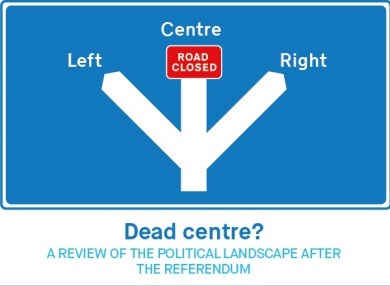
social-market-foundation-britain-progressive-majority

If you have the time, the whole report – entitled “Dead centre? A review of the political landscape after the referendum” – is worth a read. Yes, it contains the obligatory sprinkling of shellshocked establishment wailing about Brexit, and is published by a think tank which claims to represent something (the so-called “radical centre”) which by definition can not exist. But the report nonetheless highlights the key reason why the parties of the Left cannot unite in opposition to the Evil Tor-ees, as many of their activists clearly want to happen.

Money quote:

On the whole, our analysis makes more cheerful reading for those on the right, than on the centre or the left. The two largest tribes, making up around 50% of the population, hold a range of traditionally right wing views, offering a solid foundation on which to aim for the 40-42% of the vote which normally guarantees a healthy majority under our electoral system. These groups share a desire to see immigration reduced to below 100k a year and were both solidly pro-Leave in the EU referendum.

In fact, of the eight different voter tribes identified by the report, “none of the other groups approaches the size or homogeneity of these two”. These two groups alone account for more than half the electorate, and are inherently distrustful of more leftist policies. Throw in a third tribe, the “free liberals” (perhaps including this blog) and you are looking at 57% of the electorate likely to be hostile to collectivist, redistributionist thinking.

If splits within the Conservative Party and between the Tories and UKIP look bad, that is nothing compared to the fissures on the right, according to the report. As Guido notes:

The progressive tribes are fragmented, disagreeing on openness to the world and attitudes towards the welfare state and taxation. This is bad news for the current Labour Party as the think-tank finds massive differences between so-called“Democratic Socialists” and “Community” party voter blocs – traditionally known as Labour supporters – while both tribes agree on socialist policies towards capitalism, they diverge on supporting the EU or having an internationalist approach.

Well, really it is just Labour that is fractured. The LibDems, SNP, Plaid Cymru and Green party have all clearly decided to tread the internationalist, social democrat path, worshipping at the altar of the EU and scorning the nation state as a worthwhile agent for change or guarantor of core liberties. This leaves the Labour Party as the only home for those patriotic left-wingers who might fall into the “Community” tribe. And even there, they find themselves under continual assault by the sneering middle class clerisy which is loathe to give up its stranglehold on policymaking. Jeremy Corbyn answers some of this tribe’s concerns, but not all. In fact, one might consider him equally dissatisfactory to the “Democratic Socialists” as to the “Community” tribe, rubbing each up the wrong way.

Even if the parties of the Left could hammer out an uneasy truce and electoral alliance, why would they? Despite the overblown leftist rhetoric, Theresa May’s Conservative government hardly shows signs of being a radical right-wing government in the manner of Thatcher (more’s the pity), so why attempt a political merger which is almost certainly doomed to failure, just to thwart a very non-threatening centrist Tory government? Leftists’ hatred of the Evil Tor-ees is certainly irrational, but they are not that irrational.

Besides, whatever faultlines currently run through the British Left, the headline numbers don’t lie. And despite the fatuous claims of opportunistic smaller parties that greater Westminster representation would enable them to participate in a progressive majority government, the votes simply are not there. They never were.

Of course, none of this is surprising – except, apparently, to London-dwelling metro-left members of the political class who never actually get out and talk to normal people. Anyone who actually does so knows that Britain remains a vaguely conservative country, shot through with a fairly strong authoritarian streak and a deeply ingrained suspicion of success.

We Brits will happily sign petitions for Things That We Don’t Like to be banned and made illegal (the authoritarian bit), light ourselves on fire outside Downing Street in protest at The Great British Bake Off moving from the BBC to Channel Four (the conservative bit) before going on a long, satisfying rant about how evil it is that the inventors and producers of that television show want to receive market-rate compensation for their creation (the suspicion of success). That’s just who we are as a country. I certainly didn’t need the Social Market Foundation and their “eight tribes” report to know that Britain is a small-c conservative country.

That’s why David Cameron was able to guide his wishy-washy, Coke Zero Conservative government to one and a half general election victories – by appealing to these instincts in us. Lord knows it wasn’t because we were excited about his agenda for government (whatever that may have been).

Anyone who pays the remotest bit of attention to British politics ought to be able to sum up our national character fairly succinctly in a manner such as this. In fact, the only ones unable to do so – who laboured under the hilarious misapprehension that there was some great progressive majority yearning to break free and assert itself, installing a wind turbine on every roof – were the deluded metro-leftists.

Perhaps now they can disenthrall themselves of this sweet but futile notion.


Postscript: This review of the report in Conservative Home is also worth a read.


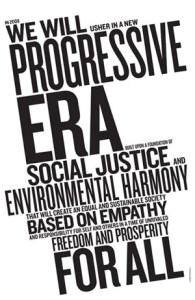
social-justice-progressive-majority-meaningless-waffle

Support Semi-Partisan Politics with a one-time or recurring donation:

Agree with this article? Violently disagree? Scroll down to leave a comment.

Follow Semi-Partisan Politics on TwitterFacebook and Medium.

With David Cameron’s Resignation From Parliament, British Conservatism Can Begin A New, Bolder Chapter

david-cameron-resigns-as-mp-for-witney-parliament-westminster

Finding himself prematurely out of power and seeing no value in life as a mere backbench MP, David Cameron brings the curtain down on a bland, centrist, disappointing and entirely forgettable political career

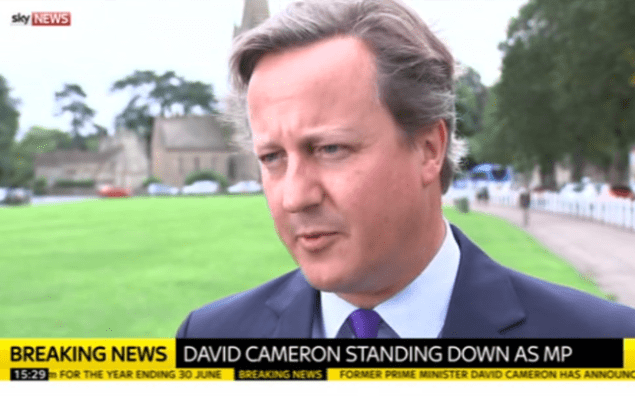
Having successfully completed Tony Blair’s fourth term of office and having a premature end called to his fifth, David Cameron today announced his decision to flounce out of parliament – despite having earlier promised to stay on as an MP after his fall from power.

He took his leave of us with these words:

With modern politics, with the circumstances of my resignation, it isn’t really possible to be a proper backbench MP as a former prime minister. I think everything you do will become a big distraction and a big diversion from what the Government needs to do for our country.

And I support Theresa May, I think she’s got off to a great start, I think she can be a strong prime minister for our country and I don’t want to be that distraction – I want Witney to have a new MP who can play a full part in parliamentary and political life without being a distraction.

[..] I hope I’ll continue to contribute in terms of public service and of course contribute to this country that I love so much.”

[..] I spoke to Theresa May and she was very understanding about this decision. I support her, I support what she’s doing, she’s got off to a cracking start. Obviously I’m going to have my own views about different issues – people would know that. And that’s really the point: as a former prime minister it is very difficult, I think, to sit as a backbencher and not be an enormous distraction and diversion from what the Government is doing. I don’t want to be that distraction; I want Witney to have an MP that can play a full role in parliamentary and political life in a way I think I would find very difficult if not impossible.”

Naturally this has led to speculation that David Cameron somehow disagrees with Theresa May’s loudly-trumpeted plans for new grammar schools and the return of potentially widespread academic selection to the education system.

I find this explanation…unconvincing. If the capsuled history of David Cameron’s premiership and leadership of the Conservative Party has taught us anything about Cameron the man, it is that he has absolutely no core political convictions which he is not more than willing to toss overboard for the sake of political expediency and his relentless desire to engage in centrist triangulation.

Fiscal conservatism? As long as he and George Osborne were able to find some statistical or rhetorical device to falsely claim that they were “paying down Britain’s debts”, Cameron was more than happy to continue spending hand over fist, driving Britain’s national debt ever-upward while exhibiting enormous timidity in reversing many of Gordon Brown’s most draconian tax increases.

Strong national defence? It took his successor, Theresa May, to drive through the parliamentary vote on the renewal of Trident, while under David Cameron’s watch Britain temporarily waived goodbye to our aircraft carrier capability (a true diminution in the eyes of the world) as well as the ability to effectively patrol our own coastline and airspace without the help of allies.

A smaller state? The much-vaunted “Big Society” was dead on arrival in 10 Downing Street back in the spring of 2010, and whatever rearranging of deckchairs the coalition government engaged in, nothing was done to tackle the biggest budget black holes – pensions and the NHS. Under David Cameron, the government preferred to virtue-signal their progressive credentials by spending borrowed money on international aid than get to grips with departmental spending.

So given this singularly unimpressive track record, the idea of David Cameron suddenly discovering an ideological backbone and beliefs strong enough to resign over is frankly ludicrous.

In fact, what really happened is quite obvious. Cast from power unexpectedly and with unexpected speed, Cameron lied when he said that he intended to stay on and complete his term as MP for Witney. To have said otherwise and admitted his intention to resign would have appeared churlish, and more than anything Cameron wanted to cultivate the image of himself as an easy-going happy warrior, ready to relinquish the trappings of office without regret and re-assume a more humble role as a backbencher.

This announcement came as quickly as it possibly could without making Cameron look completely dishonest and reprehensible. At least when Gordon Brown resigned as an MP he had managed four years as a backbencher – albeit four years in which he collected a hefty MP salary while being virtually invisible in Westminster. David Cameron’s brittle ego wouldn’t even permit him to last a year on the backbenches. His top flight political career having been brought to an unexpected end, Cameron saw no reason to stick around as a mere constituency MP.

To politicians like David Cameron, the role of constituency MP is merely a springboard to ministerial power. When the possibility of prize cabinet jobs or the keys to Number 10 Downing Street are no longer an option, wasting time on select committees or dealing with constituents’ issues appears a supreme waste of time – time which could be better spent cashing in on fame and carefully tended relationships while they are still relatively fresh and can bear the most fruit.

James Kirkup is similarly unimpressed with the manner of Cameron’s departure:

On June 27, David Cameron issued this statement: “I will continue with my duties as the MP for Witney. It is an enormous privilege to serve the people of West Oxfordshire.”

So enormous that he could only bear it for a few more weeks, apparently. He’s off, leaving the Commons and triggering a by-election in Witney: some lucky Tory will soon inherit one of the safest and prettiest seats in the country.

What does this tell us about Mr Cameron? Nothing terribly positive, to be honest. Let’s remember, he fought the EU referendum campaign promising not to quit if he lost, then quit when he lost — but only having clung to office as long as possible and having banned the Civil Service from doing any preparatory work for Brexit, thus making it harder for his successor to actually get on with the job.

In between breaking his promise not to resign as PM and breaking his promise not to resign as an MP, the only significant official work he undertook was drawing up an honours list handing an OBE to his wife’s stylist and a knighthood to his press officer.

Not exactly the most dignified departure from office, is it? And certainly not one that’s easy to reconcile with many, many statements from Mr Cameron about the sense of duty he owed to his nation, the selfless service he felt obliged to render.

And Kirkup’s unsparing conclusion:

And this is why flouncing out of Parliament in this way is so telling: it speaks to something fundamental about Mr Cameron’s character and his approach to politics: a lack of seriousness, the absence of real commitment.  Yes, he wanted the job and yes he put the hours in, to the cost of his family.

But he would never die in a ditch for his political beliefs, never shed blood and move mountains to hammer home his arguments. It was always enough to get by, to do just enough to get the top grade and do better than the rest.

Sadly, that describes Cameron perfectly – far more obsessed with optics than reality, and forever in search of the path of least resistance, even when that path ran direct through traditionally left-wing territory.

Ultimately, David Cameron was a weak and instantly forgettable prime minister because he was a centrist triangulator and a technocrat at heart. As prime minister he had no real interest in reforming Britain in his own image, imposing his own worldview or being a statesman. Rather, he was content to campaign and govern as a mere Comptroller of Public Services, the living, breathing symbol of the diminution of our national politics.

With his happy departure from Parliament (en route to a minor footnote in history) one hopes that the ground has shifted under British politics, and that the age of the technocrat might be coming to an end. His successor, Theresa May, while far from being this blog’s preferred choice, at least seems to have some strongly held political views of her own, while Jeremy Corbyn’s imminent re-election as Labour Party leader promises a 2020 general election offering genuine choice to the electorate.

All we need now is for George Osborne to follow his chum David Cameron into political retirement and we may finally be able to turn the page on this most boring and depressing chapter in Conservative history.


David Cameron - Coke Zero Conservative - I Cant Believe Its Not Miliband

Support Semi-Partisan Politics with a one-time or recurring donation:

Agree with this article? Violently disagree? Scroll down to leave a comment.

Follow Semi-Partisan Politics on TwitterFacebook and Medium.