Stop Applauding “Election Fatigued” Brenda From Bristol

If you are emotionally taxed by having to trundle off to your local polling station once a year, maybe you don’t deserve the privileges of citizenship

I know that the cardinal rule of politics is that the people are always right (unless they happened to vote for Brexit) and must be praised, flattered, bribed and otherwise pandered to at all times, but sometimes individual people are wrong and need to be told as much.

Among this category of people: those who have been extravagantly expressing election fatigue, as though having to spend 30 minutes travelling to their local polling station and putting a cross in a box is far too arduous a task to be demanded on anything more than a biannual basis.

On the day that Theresa May announced that she would seek an early general election on 8 June, “Brenda from Bristol” became an overnight celebrity for her comically exaggerated negative response to a BBC reporter’s request for a vox pop asking her opinion on having to choose a government again.

Naturally in this day and age, Brenda from Bristol immediately went viral, as George Osborne’s rag the Evening Standard reports:

A woman from Bristol whose nonplussed response to news of the General Election sparked a wave of support across the country has told reporters she cannot believe her new “celebrity” status.

Brenda from Bristol caused a stir this week when she was asked what she thought of the election and replied: “You’re joking? Not another one!”

“Oh for God’s sake, I can’t honestly… I can’t stand this.

“There’s too much politics going on at the moment. Why does she need to do it?”

She was later tracked down by BBC reporter John Kay who asked her what she thought of her newfound fame.

According to the same report, Brenda from Bristol is now being “inundated with offers” from other media outlets to offer her comically exaggerated world-weary take on the election campaign on an ongoing basis, by news outlets that would rather get their viewers to chuckle along to something inane than attempt the hard work of educating them on matters of policy.

Meanwhile, nobody seems to have stopped to question whether throwing a hissy fit about being summoned back to the polling station is actually praiseworthy behaviour in the first place.

Even the normally aloof and anti-populist New Statesman sycophantically applauds Brenda from Bristol’s anti-election tirade:

What was your reaction when you found out that there would be yet another election?

That your doormat would no longer be a doormat but a hellish rectangle tiled with garish leaflets of smiling white men making hollow promises? That the only thing on the news now will be people saying the word mandate with increasing passion and intensity? That your Facebook wall will no longer be a heartwarming collage of when you first virtually connected with your lifelong friends but one long sincere ill-written political screed with neither paragraph nor point, but asterisks nonetheless? That you will have to wake up, yet again, dead-eyed and clammy-skinned, on the morning after an election, yet again, to your radio telling you your country voted, yet again, to kick itself wholeheartedly in the teeth?

From the highbrow to the lowbrow press, in other words, Brenda from Bristol is being held up as a role model, lavishly rewarded for a fleeting moment of pointless fame in much the same way that Abby Tomlinson was forced into our collective consciousness after creating the “Milifandom” on social media.

‘Twas ever thus. Pitch a memorable hissy fit on Question Time or heckle a senior politician while the cameras are rolling and the nation’s political media will beat a path to your door as though you are some kind of political oracle, uniquely able to capture and channel the zeitgeist of the moment. Spend your time wading through important but impossibly dense documents and breaking them down so that regular people can get to grips with complex policy issues (as Richard North of eureferendum.com and Pete North do so well) and you can look forward to toiling in semi-obscurity, senior journalists well aware of who you are but determined to keep the spotlight away from anybody they consider to be a professional threat.

In a year’s time, Brenda from Bristol will likely have her own talk show, in which fawning politicians will appear to be mockingly berated for trying her patience. Or some enterprising millennial will have set up a YouTube channel for her, in which she records two-minute rants about various policy issues which grind her gears or overly stretch her powers of concentration.

And why? What did Brenda from Bristol do to deserve this fame and this overwhelmingly positive public reaction? She suggested that there is “too much politics”, and that it is unreasonable for ordinary people to march themselves down to a polling station as frequently as once per year to offer their input as to how the country should be run.

Brenda from Bristol is essentially Richard Dawkins’s haughty attitude about non-experts daring to dabble in politics made flesh. Dawkins is famously of the opinion that matters like Britain’s membership of the European Union are so complex and so technocratic that they should be taken permanently out of the hands of ordinary people and left to self-described experts, who of course think dispassionately at all times and are never prone to biases or antipathies which colour their judgments.

This is the real reason why the media is so overwhelmingly supportive of Brenda from Bristol, and why she is receiving so much unearned airtime. Most political journalists are themselves members of the political and cultural elite who have been most upset by Tory rule and further destabilised by Brexit. Nearly to the last person, they support the EU and revile populism because at their core they believe that the people and their base passions should be kept at arm’s length from the levers of political control.

Sure, the political and media class were happy for us to vote once every five years so long as we were picking from a palette of political opinions which are all just varying shades of beige – pro-EU, pro-mass immigration, pro-globalisation, pro-multiculturalism, pro-NHS, pro-welfare state and so on. But when true democratic choice becomes available – as it was with Brexit, and as Jeremy Corbyn currently offers with the Labour Party – they take fright, worried that the British people will select a future for themselves other than the one which the elite have carefully laid out.

No wonder that Brenda from Bristol unwittingly became their idol. Albeit for very different reasons – sheer laziness on the part of Brenda, a desire to regain the initiative and take back control on the part of the elite – both of them want the same thing. Both Brenda and the political elite want ordinary people to outsource the major decisions impacting their lives to an elite class of self-described experts. They essentially support technocracy over democracy.

The rise of Brenda from Bristol therefore damns us all. It puts much of our political and media class to shame for disrespecting democracy and seeking to put down the growing rebellion against self-interested rule of the elites, by the elites and for the elites. But it also puts we the people to shame for being so lacking in political engagement and civic virtue that we genuinely consider it an unwarranted imposition to have to remain educated on political matters throughout the five-year electoral cycle.

Brenda from Bristol represents a shared desire for a return to the stale old status quo, where bipartisan consensus on all the core questions made a mockery of democracy and rendered general elections a mere “rubber stamp” occasionally given by the people to the political elite.

For the sake of all the work we have done to overthrow this failed model of governance, we should stop praising her.


Brenda from Bristol - UK Britain General Election 2017 - Voter Apathy

Support Semi-Partisan Politics with a one-time or recurring donation:

Agree with this article? Violently disagree? Scroll down to leave a comment.

Follow Semi-Partisan Politics on TwitterFacebook and Medium.

There’s Nothing Virtuous About Being a Rootless ‘Citizen Of The World’

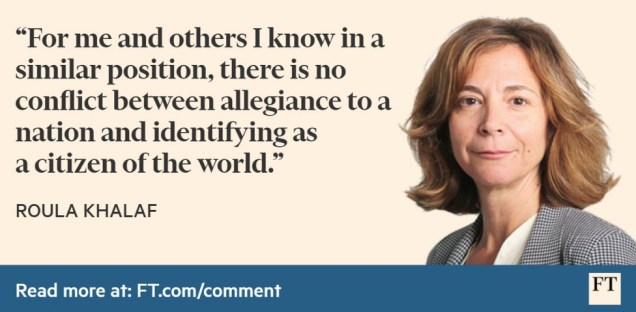
citizen-of-the-world-roula-khalaf
Someone give that woman a medal

Most self-described citizens of the world are actually no such thing. They might enjoy the company of very similar people in increasingly similar global cities, but they probably couldn’t think of a single thing to say to somebody of different socio-economic status from a smaller town twenty miles down the road

Pete North explains perhaps better than anyone exactly why those people who style themselves as liberal “citizens of the world” are often no such thing – neither tremendously liberal, nor engaged citizens of anywhere, in any meaningful respect.

North writes:

In the end there is nothing especially virtuous about people who are well travelled and outward looking. A society needs all stripes to function. We need people to work the routine jobs and then we need a fluid workforce not tied down with responsibilities. Moreover, having dealt with more well pampered HR people than a person ever should, one thing I have noticed is that travel does not necessarily broaden the mind.

If you take an incurious person and lavish travel upon them you are wasting your money. Some of the most shallow, snobby and fatuous people I know would consider themselves liberal citizens of the world. Such people have no concept of what it is to be building or maintaining something with a long term plan. They latch on to the fashionable and socially convenient worldview that the EU is the manifestation of liberal values but it little more than virtue signalling.

And develops his argument:

What I find is that the broader your horizons, the harder it is to fit in wherever you go, and so there remains a polarisation between the settled and the travelled. It is then no surprise that there is an obvious demographic divide and opinion is split between the ages.

In this, the remain side of the Brexit debate seem keen to pour over these demographic studies to pathologise the leave vote, and consequently delegitimise it, as though you need to be of a particular set for your opinion to hold any worth. Democracy is lost on such people. The whole point of democracy is one person; one vote, where we take a sample of opinion and move together on the basis of compromise.

In something as binary as EU membership though there is only winner takes all. There is no third option on the ballot so we move with the majoritarian view which is to leave. For whatever reasons they voted for, they did so in accordance with their own views based on their own choices. Their worldviews are formed by what they see and hear in the media, but also in the street and in the workplace. They are the best judges of what is important to them. To suggest that choosing a more conservative lifestyle means you are not qualified to make such an estimation is to invite the very sentiment behind the leave vote.

What these people know better than anyone is that the frivolous and rootless people telling them how to vote are no better than anybody. I imagine the working classes would like nothing more than to live a more adventurous life but they don’t because they can’t afford it. It’s then a bit rich to tell them that the EU brings them freedom of movement and prosperity.

Earlier this year Theresa May said “If you believe you are a citizen of the world, you’re a citizen of nowhere. You don’t understand what citizenship means”. I smiled when I heard that. Nothing quite so succinctly demolishes the flimsy worldview that believing in the borderless homogenised EU, along with all the pompous garb that goes with it, is somehow enlightenment. May recognises that being a citizen is more than holding outwardly liberal views. It means making a contribution – to be part of something.

It takes no particular talent to drift through life going place to place – and in so doing all you’re likely to meet is others who have made the same choices or enjoy an extraordinary privilege. Far from broadening the mind it merely reinforces a particular mindset which is never exposed to the values of the settled community. It’s why self-styled “citizens of the world” have no self-awareness and do not for a moment appreciate just how naff they sound to everybody else.

In my experience, self-described citizens of the world have tended to describe their outlook in terms of what they get from the bargain rather than what they contribute to the equation. They call themselves citizens if the world because being so affords them opportunities and privileges – the chance to travel, network and do business. Very few people speak of being citizens of the world because of what they give back in terms of charity, cultural richness or human knowledge, yet all of the people that I would consider to be true citizens of the world – people like Leonard Bernstein or Ernest Hemingway – fall into this latter, rarer category.

What does it really mean to be a modern day “citizen of the world”, anyway, besides having a determinedly self-regarding outlook? Most of those who claim the title – either members of the ruling class or young hipsters whining that their futures and European identities have been somehow ripped away from them – are from the big cities, London most prominently. But to a large extent, many world cities are so alike in culture that one can negotiate and skip between them fairly easily,  even with a language barrier.

London has Starbucks, museums, galleries, bars and hipsters. So do Paris, Berlin, Copenhagen, Rome, Warsaw, Manchester, and everywhere else in Europe. In our interconnected world, large global cities are if not interchangeable then at least often share a common culture and vibe.

So you can successfully get smashed in Lisbon, Dublin, Stockholm and Munich? Congratulations, Mr. Citizen of the World. What do you want, a medal? Now go try to strike up a conversation with someone from your own country but from a different social class or region. Try going for a night out in Harlow or Wolverhampton or Preston. Your non-prescription hipster spectacles and quirky denim dungarees might buy you immediate entry to the trendy coffee shops of Amsterdam or the bars of Barcelona, but they’ll get you nowhere in Stoke-on-Trent.

And increasingly this is what it comes down to. We have a broad class of people with access to (and the desire to be part of) this emerging global tribe based in the top cities, and a class of people either cut off from this world or with little desire to participate in it. Now, we should certainly use economic policy to lift those who want to live more global lives into a position where they can do so, and avoid the urge to persecute or condescend to those who do not. But in general, we could all do with a bit less smugness and sanctimony from the Citizen of Starbucks Brigade.

For a start, the vast, vast majority of these people are such poor citizens of their own countries that they would feel adrift and culture-shocked, as though in a foreign land, if you lifted them from their home city and moved them to a smaller town thirty miles down the road. This is not some elite band of super-enlightened, non-judgmental, globally-minded, culturally-aware aesthetes, eager to experience new things. This is a pampered, cosseted tribe of relatively well-off millennials, many of whom are in thrall to the divisive Cult of Social Justice and Identity Politics, who barely understand their own compatriots yet arrogantly believe they are ready to be unleashed upon the world.

There is nothing particularly noble or praiseworthy about overcoming a language barrier to work and make friends with other people just like you who happen to live in other countries – which describes the vast majority of those people now tearfully painting the EU flag on their cheeks at anti-Brexit demonstrations and angrily declaring themselves “citizens of the world”.

Want to do something more challenging and actually worthy of praise? Try earning a reputation as somebody with friendships that span ages, social classes and other demographic indicators. Try living up to the ideal set by Rudyard Kipling:

If you can talk with crowds and keep your virtue,

Or walk with Kings—nor lose the common touch

And if you do so, you might not necessarily become a Man, my son. But at least you won’t be just another insufferable, identikit, cookie-cutter individual who conspicuously supports the European Union – despite barely comprehending what it really is – purely as a means of signalling your virtue to your insufferable, identikit, cookie-cutter fellow citizens of the world.

citizen-of-the-world-alba-white-wolf

Bottom Image: albawhitewolf

Support Semi-Partisan Politics with a one-time or recurring donation:

Agree with this article? Violently disagree? Scroll down to leave a comment.

Follow Semi-Partisan Politics on TwitterFacebook and Medium.

When Will Open Borders Zealots Just Admit That They Want To Abolish America?

new-york-would-never-dream-of-building-a-wall-new-york-magazine-immigration-propaganda

Talking about “undocumented immigrants” in the same breath as refugees, permanent residents and citizens has only one purpose – to imbue illegal immigration with a nobility it does not deserve, deliberately undermining the beleaguered nation state. And the time has come for open borders zealots to be honest about what they are trying to do.

Under the guise of discussing the sanctuary city phenomenon, New York magazine has a propagandistic but otherwise pointless article profiling 44 “New Yorkers” of varying and sometimes dubious immigration status, whose sole purpose seems to be to deliberately blur the lines between various types of immigration, thus giving political cover to the illegal kind.

Why 44 immigrants? Presumably this is an allusion to the fact that Barack Obama is the 44th president of the United States, and because he supported the DREAM Act and implemented the DACA policy (even though only four of 44 people profiled in the piece are themselves beneficiaries). Yes, that is the kind of pseudo-analytical, emotional codswallop that we are going to be dealing with here.

The piece begins with suitable pomposity:

That ours is a sanctuary city — arguably, the sanctuary city — shouldn’t be surprising. After all, for 130 years we’ve displayed, in the New York Harbor, the most iconic symbol of welcome in the world. In the weeks after an election season defined in part by an ugly debate over who should be allowed to live here, New York photographed dozens of immigrants and new citizens, ranging in age from 1 month to 91 years, to suggest the breadth of the New York–immigrant experience.

Of course, capturing the full breadth would be impossible — there are 3 million New Yorkers who were born somewhere else, more than a third of the city’s population. All of which is a good reminder that even the city’s hoariest come-hithers — make it here, make it anywhere, etc. — contain an implicit promise: Our city is open to anyone who’s willing to give it a shot. Give us your poor, your tired, your huddled masses, yes, but also your ambitious, your artsy, your queer, your shunned, your misfits, and anyone else who can’t, for some reason, feel at home where they are. Whatever it is you’re a refugee from, this city can be your refuge. We may have a fabled reputation for crossed-arm toughness, but in reality, New York is the city whose arms have always been open the widest.

We then delve into the profiles, many of whom are of babies who clearly cannot speak for themselves but who are nonetheless selected because of their emotional resonance (using babies to build emotional support for a political argument is fine when it concerns immigration, apparently, but try to do so in connection with a …different subject, and many on the Left will immediately lose their minds).

Some examples:

Prioska Galicia
Age: 19
From: Mexico
Undocumented

“I remember the sound of helicopters, and running, and the cold breeze, and my mom trying to cover me up,” Prioska Galicia says about the night she crossed the border into Arizona in 2004.

She was 6 years old. A recent high-school graduate, Galicia aspires to go to college, but that hope is tempered by the uncertainty of Deferred Action for Childhood Arrivals under Trump. “We want to work. We want to succeed. Other people don’t see it like that. They see it as us wanting to take other people’s jobs.”

Okay, so here we have what might be a seemingly typical case of an illegal immigrant smuggled into the United States by her family – and a very sympathetic case, at that. Galicia is, I am sure, a model petitioner for citizenship in every way.

But then we see Galicia’s case placed alongside examples like this:

Tristan Kelvin Bosc
Age: 1 month
From: United States
Citizen

Bosc was born in November to German and French fathers who met in 2005, two years after moving to the United States.

“For us, it was a choice to move here,” says Benoit Bosc, one of Tristan’s fathers. “You don’t want to over-romanticize it, but you know, the land of dreams where things are possible. We hope that it stays this way because for him, that’s the future.”

Presumably Tristan’s German and French fathers both emigrated to America via one of the legal routes open to them. So why even include such people in an article about sanctuary cities, unless for the deliberate reason of muddying the waters that separate those who follow the process and those who circumvent the process? Maybe there is a word slightly less harsh than “propaganda” to explain what the New Yorker is doing here, but if so, I struggle to think of it.

More:

Pepper Tsue
Age: 2
From: South Korea
Citizen

Tsue and her family moved to New York in 2015. Her mother is Korean and her father is Taiwanese-American.

At home, her mother, Seyun Kim, speaks to her only in Korean. When Pepper started preschool in September, Kim packed a translation sheet for the teacher. It included words and phrases like water, mommy and daddy, and I want a hug. “She’ll learn English,” says Kim. “But it’s important for her to know Korean, too.”

What a marvellous case study in good integration – a mother who deliberately refuses to help her own daughter to assimilate into their new country by conversing with her in the dominant language, and who then has the temerity to pack her daughter off to school with a translation sheet for the teacher, so that those already living here can do all of the hard work. Yes, this is exactly the kind of example that we should be promoting.

One doesn’t like to think ill of people. But what is one supposed to think of the New Yorker when it cherry-picks cases such as this, and celebrates them precisely because they go against the grain of integration and assimilation? Seriously, what is the excusing factor here? I fail to see it.

More:

Indigo Van Eijck
Age: 11
From: The Netherlands
Lawful permanent resident

Indigo Van Eijck is in sixth grade. His family started commuting back and forth from Rotterdam when he was 5 for his father’s work in landscape architecture.

“I had to learn a whole new language,” he recalls. “You do learn English in the Netherlands, but only very little. You say things like, ‘Hi, how are you?’ but in a very Dutch accent.” The family became legal permanent residents in 2011 but still goes back to the Netherlands for a month every summer. “The people are different here,” Indigo says. “Nobody really cares if you go to the store in your pajamas in the morning. At home, most of the strangers you meet on the street are nicer ― probably because the population is so much smaller.” He misses his native cuisine when he’s here, and he made Indonesian dumplings (which are prevalent in Holland) for Thanksgiving. But the sushi in the Netherlands, he says, “is awful.”

So now we have the son of a clearly wealthy landscape architect and a lawful permanent resident. What place do these people have in an article purportedly about sanctuary cities? What do Indigo Van Eijck and his family need to take sanctuary from, precisely?

More:

Fayza Gareb
Age: 22
From: Syria
Refugee

Fayza Gareb’s family fled Syria for Turkey in 2013 when the Assad regime began bombing her family’s village near Aleppo.

“I worked as a waitress in Turkey,” she says. “The first time I heard a plane’s voice over the restaurant, I went under the table because I was scared it would drop bombs like in Syria.” Her father longed to make it to the United States but died of cancer before the family was admitted last August. Gareb and her mother, sister, and brother were among the 15,000 Syrian refugees President Obama pledged to accept in 2016.

And now we have refugees thrown into the mix! Refugees who have been lawfully admitted into the United States and who therefore are at no risk of deportation or particular persecution by federal authorities. Why does New York Magazine see fit to include these cases side-by-side with undocumented child migrants from Mexico, lawful permanent resident children of successful landscape architects and natural born citizens?

Then we have that rarest of cases, a South Korean undocumented SJW, banging on about her relative “privilege”:

Stephanie Ji Won Park
Age: 24
From: South Korea
Undocumented

Stephanie’s family came to New York in 1998 when she was five and overstayed their tourist visas.

She first became aware of being undocumented in middle school, at Horace Mann. “I was thinking about the high-school-senior Bahamas trip, and my mom was like, ‘Hopefully in a couple of years something will happen,’” she says. “Whenever I introduce myself as undocumented I do a whole spiel where I say I think I’m one of the most privileged undocumented people out there. “Like, ‘Oh, I found out because I couldn’t go on a senior trip to the Bahamas.’” As she started applying for colleges, the realities of her status became more clear; still she considers herself lucky. “If I were to be deported, I’d be deported back to South Korea. Yeah, that’ll be tough, but it’s not the same as going back to a country where the chances of being murdered are very high. Maybe it’s a state of denial, but I’m just trying to focus my energy on people that are in a worse position.”

The heart bleeds. Thank goodness there are sanctuary cities like New York which provide a safe space for South Korean tourist visa abusers and their families to skip the queue, spurn the lawful routes of entry into the United States and avoid being sent back to the terrible, dangerous and backward country of South Korea.

More:

Kathleen Bomani
Age: 31
From: Tanzania
Lawful Permanent Resident

Bomani’s Tanzanian parents met while studying at Howard University. Her sister was born here, then her parents moved back home and had her and her brother.

“We spent most of our summers here in the U.S. So then I came for college — at Drexel University in Philadelphia. I studied corporate communications,” she says. She came to New York to live permanently in 2009. “In New York, no one asks you where you’re from because you have an accent. Everyone’s from somewhere. It has a completely different feeling from the rest of the United States. The possibilities of what one can be — there’s just something in the air here.”

Quite why that atmosphere of possibility cannot be maintained while observing federal immigration law is never quite explained, either by Bomani herself or by New York Magazine, who casually use her life story as part of their insidious propaganda.

And finally:

Lourdes
Age: 47
From: Mexico
Undocumented

“I wish for her the same thing I wish for them, the best of life,” Lourdes, 47, says about her granddaughter Kamilla and her children, Ricardo Aca and Montserrat Aca, who are both Dreamers.

Lourdes crossed the border in 2004 and worked as a housekeeper and factory worker before sending for her children. “For me the most important thing is for them to study so that they have a better future, and hopefully stay in this country that we’ve learned to love. Because, in reality, we consider this country now like our country. There was a moment when I felt exasperated, that perhaps I had made a mistake in having brought them over,” says Lourdes. “But looking at it now, I feel like it was worth it. Everything that we went through was worth it.”

It is great that Lourdes and her family have “learned to love” America. Of the various kinds of illegal immigration this is the best kind – people who have or are assimilating, and feel gratitude toward their new host country. Perhaps this kind of illegal immigration is even the most typical, as leftist zealots loudly insist. Perhaps. And certainly we should have sympathy for people like Lourdes and her family – though they retain agency and responsibility for their actions, they were also victims of the strong “pull factor” of illegal immigration, the blind eye turned toward illegal immigration by American business and government.

Many such people are already now American in spirit, and there is nothing to be gained by deporting them. But neither is there anything to be gained from placing them on a pedestal and attempting to endow their actions with some kind of undeserved nobility. Immigration laws exist for a reason. And as with all laws, either support them or argue for their repeal, don’t equivocate while openly celebrating lawbreakers.

As one reads the New York Magazine piece, one is struck by the fact that the vast, vast majority (40 out of 44) of those profiled are either full citizens, lawful permanent residents or approved refugees, none of whom need the shelter of a so-called sanctuary city to live in the United States without fear of deportation. There is absolutely no good reason for these people to be included at all. But there is one very bad reason.

Because the goal here is not really to celebrate sanctuary cities specifically. Despite the title and preamble to the New York Magazine piece, this is nothing more than a convenient hook, a ruse. The real goal is nothing other than the perpetuation of this omnipresent, simplistic, holding-hands-beneath-a-rainbow leftist vision of a borderless world where more than sharing a common humanity (which of course we do), we also share the automatic right to live wherever we want in the world, regardless of whether we choose to move there legally or illegally.

It is part of an insidious attempt to undermine the idea of borders, of nationality, of the nation state itself, and to smear anybody who objects to this radical and untested vision as being a backward-looking reactionary at best and a dangerous racist at worst.

The only reason one might be motivated to publish an article praising sanctuary cities and then profiling the wealthy children of notable Dutch landscape architects is if one is actively pushing this absolutist open borders agenda, a worldview in which there is zero moral or bureaucratic distinction between somebody who obeys immigration law and somebody who proudly flouts those laws.

And if one takes this position, if one tacitly argues that current illegal immigrants living in America should all be praised and lauded and conferred with immediate citizenship, then surely the same goes for anybody around the world who wants to pick up and move to America tomorrow? And then you have no nation states anymore. And no America.

The people at New York Magazine are not stupid. Many of them are blessed with the ability to spin a fine turn of phrase and argue convincingly for the things in which they believe. So when can we stop fighting this tiresome shadow war and get down to the meat of the matter? When will they come out and honestly admit that they want to abolish America?

_

Postscript: If “abolish America” sounds harsh, what else should one call a suite of policies and actions which actively seek to reward lawbreaking and encourage vastly more illegal immigration while demanding absolutely nothing in return by way of bureaucratic compliance, respect for the law or intent to assimilate?

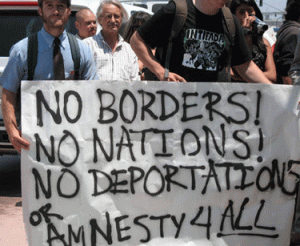
open-borders

Support Semi-Partisan Politics with a one-time or recurring donation:

Agree with this article? Violently disagree? Scroll down to leave a comment.

Follow Semi-Partisan Politics on TwitterFacebook and Medium.

John F Kennedy On The Responsibilities Of Educated Citizens

John F. Kennedy, May 29, 1917 – November 22, 1963

From Kennedy’s address to the 90th anniversary convocation of Vanderbilt University in Nashville, Tennessee, delivered on May 18, 1963:

But this Nation was not founded solely on the principle of citizens’ rights. Equally important, though too often not discussed, is the citizen’s responsibility. For our privileges can be no greater than our obligations. The protection of our rights can endure no longer than the performance of our responsibilities. Each can be neglected only at the peril of the other. I speak to you today, therefore, not of your rights as Americans, but of your responsibilities. They are many in number and different in nature. They do not rest with equal weight upon the shoulders of all. Equality of opportunity does not mean equality of responsibility. All Americans must be responsible citizens, but some must be more responsible than others, by virtue of their public or their private position, their role in the family or community, their prospects for the future, or their legacy from the past.

Increased responsibility goes with increased ability, for “of those to whom much is given, much is required.”

[..] You have responsibilities, in short, to use your talents for the benefit of the society which helped develop those talents. You must decide, as Goethe put it, whether you will be an anvil or a hammer, whether you will give to the world in which you were reared and educated the broadest possible benefits of that education. Of the many special obligations incumbent upon an educated citizen, I would cite three as outstanding: your obligation to the pursuit of learning, your obligation to serve the public, your obligation to uphold the law.

If the pursuit of learning is not defended by the educated citizen, it will not be defended at all. For there will always be those who scoff at intellectuals, who cry out against research, who seek to limit our educational system. Modern cynics and skeptics see no more reason for landing a man on the moon, which we shall do, than the cynics and skeptics of half a millennium ago saw for the discovery of this country. They see no harm in paying those to whom they entrust the minds of their children a smaller wage than is paid to those to whom they entrust the care of their plumbing.

But the educated citizen knows how much more there is to know. He knows that “knowledge is power,” more so today than ever before. He knows that only an educated and informed people will be a free people, that the ignorance of one voter in a democracy impairs the security of all, and that if we can, as Jefferson put it, “enlighten the people generally … tyranny and the oppressions of mind and body will vanish, like evil spirits at the dawn of day.”

[..] Secondly, the educated citizen has an obligation to serve the public. He may be a precinct worker or President. He may give his talents at the courthouse, the State house, the White House. He may be a civil servant or a Senator, a candidate or a campaign worker, a winner or a loser. But he must be a participant and not a spectator.

[..] Third, and finally, the educated citizen has an obligation to uphold the law. This is the obligation of every citizen in a free and peaceful society–but the educated citizen has a special responsibility by the virtue of his greater understanding. For whether he has ever studied history or current events, ethics or civics, the rules of a profession or the tools of a trade, he knows that only a respect for the law makes it possible for free men to dwell together in peace and progress.

He knows that law is the adhesive force in the cement of society, creating order out of chaos and coherence in place of anarchy. He knows that for one man to defy a law or court order he does not like is to invite others to defy those which they do not like, leading to a breakdown of all justice and all order. He knows, too, that every fellowman is entitled to be regarded with decency and treated with dignity. Any educated citizen who seeks to subvert the law, to suppress freedom, or to subject other human beings to acts that are less than human, degrades his heritage, ignores his learning, and betrays his obligation.

I think that we can all take something from this speech as an inspiration to strive to be better citizens, no matter our position on American politics and the forthcoming presidency of Donald J Trump. None of us are above learning from the example set by great men and women of the past.

Yet nobody gives speeches like this any more. Why?

Is modern political speechwriting so poor because it reflects the abysmal quality of our present political discourse, or is our political discourse so poor because our contemporary leaders, more concerned with bribing and placating a fickle public than calling us to any kind of higher duty, have increasingly lost the rhetorical skills required to persuade and inspire their citizens?


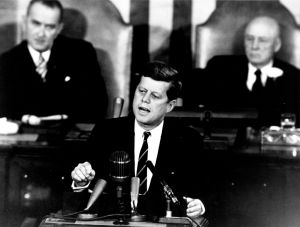
president-john-f-kennedy-address-to-congress-announcing-the-apollo-program

Bottom Image: Wikimedia Commons

Support Semi-Partisan Politics with a one-time or recurring donation:

Agree with this article? Violently disagree? Scroll down to leave a comment.

Follow Semi-Partisan Politics on TwitterFacebook and Medium.

Brexit Catastrophisation Watch, Part 3 – The Cultural Elite’s Ongoing Anti-Brexit Tantrum Is Pointless And Childish

girl-tantrum-eu-brexit-catastrophisation

Hell hath no fury like a self-involved, virtue-signalling, pig ignorant artist forcibly separated from his beloved European identity

Anyone who has ever had the misfortune to be in close proximity to a young child having a screaming meltdown in a supermarket, church or (worst of all) on a long aeroplane journey will immediately recognise the tenor and tone of the Guardian’s latest offering in their ongoing “But The Evil Tor-ees Took My European Identity From Me” series.

And this week’s whinnying public tantrum comes courtesy of writer Tom McCarthy, who can’t wait to tell us how he spurned the opportunity to attend a festival of British arts because daring to celebrate British artistic creativity post-Brexit is clearly akin to having attended the Nuremberg Rallies in 1930s Germany.

McCarthy pompously declares:

In our society, the artist may have no executive power whatsoever, but their ace-card lies in the fact that they command a means – perhaps the primal one – of putting value in the world: a means of making meaning. They can use this status to subvert, or to shore up, power – sometimes both at the same time – and they can do this well, badly or indifferently; but one thing they can never do is be politically neutral.

A few weeks ago I received an invitation to a special reception to be held at the Royal Academy for “British artists” to celebrate “British creativity”. In normal times such a gesture might have seemed a little jingoistic, but essentially innocuous. But these are not normal times. Given the extraordinary far-right takeover the country seems to be undergoing, current talk of “British” X or Y or Z (“values” or “decency” or “culture”) usually marks one end of a chain, at the other end of which someone is being shunned in a playground, spat at in a supermarket, or worse. The invitation mentioned designers and businesses who “shape our culture”, and outlined the security procedures that would surround the event. It wasn’t hard to read between the lines: while Martin Roth at the V&A had made it clear his institution would have no truck with such nonsense, the RA was helping to assemble a roll-call of figures from the arts to pose arm-in-arm with ministers, royalty and innovators of the James Dyson variety, for a soft-power, post-Brexit rebrand of “British” culture.

How terribly brave of McCarthy to make such a principled stand, which will have cost him absolutely nothing and cemented his status as a hero among other pig-ignorant europhiles in the cultural scene. No, really. How terribly subversive, taking a public action which panders to the existing groupthink and prejudices of the political and cultural elite, nearly all of whom remain horrified by Brexit. The idea that Tom McCarthy is in any way being countercultural or subversive is as hilarious as it is pitiful.

McCarthy continues:

The fact is, I’m not an example of “British creativity”. Like all English-language writers, I’m thoroughly European. To read Shakespeare is to read a rich remix of Ovid, Petrarch and Lucretius; to read Joyce (a British passport-holder) is to read Mallarmé, Laforgue, Goethe. The wellspring of our shared archive is Greek – and since the Hellenic world was in fact spread all around the Mediterranean basin, this means that to be European is already to be African and Asian.

Millennia of trade and empire, of diaspora and endlessly crisscrossing migration, have produced a culture that is and always will be cross-pollinated. If London and other British cities have become cultural hubs, this is because they stand at intersections within larger, international flows and networks. To credit an intersection with creating (“innovating”) the currents from which it merely feeds, though, is like calling a lightbulb a generator.

The number of idiotic sentences about Brexit and democracy uttered by self-proclaimed artists probably now registers in the tens of millions, but still McCarthy’s claim that all English-speaking writers are “thoroughly European” is particularly fatuous.

If “all English-language writers” are European, why do we not hail F. Scott Fitzgerald as a great European author? And even if we did consider Fitzgerald to be European, using McCarthy’s tortured logic, isn’t this yet more damning evidence that one does not need to be part of a supranational political union to derive a sense of regional or continental identity? Fitzgerald’s European-ness is innate and inalienable, according to McCarthy, and utterly uncontingent on belonging to a power-hungry, relentlessly integrating Cold War-era club like the EU. So what exactly in the problem with Brexit?

Is Switzerland, outside the European Union, not “European”? Is Norway somehow severed from the continent, its artists unable to “cross-pollinate” ideas with their French or Spanish peers? And if the likes of John Steinbeck and F. Scott Fitzgerald are great European writers despite both of whom having perished before the sainted European Union came into being, isn’t this proof that sharing an undemocratic set of supranational institutions is entirely unnecessary in forging a common heritage and identity?

Weepy British artists still in floods of tears at the thought of Britain leaving the EU should in fact take heart from Tom McCarthy’s rant. Since “all English-language writers” are “thoroughly European”, even those who lived their entire lives on a different continent decades before the institutions of the European Union even came into existence, why get so upset simply because Britain will shortly cease to send MEPs to Brussels and Strasbourg?

The culmination of McCarthy’s virtue-signalling extravaganza:

About the same time, I received another invitation, this time to read from my work at an anti-Brexit art festival in Hackney’s gallery-filled Vyner Street. Beneath bunting designed by Fiona Banner, Bob and Roberta Smith and Jessica Voorsanger played a gig, Katrin Plavcak and Ulrika Segerberg did an electronic sewing machine-enhanced performance, Lucy Reynolds conducted a “choir” who chanted in 20 languages at once, and a large crowd who could trace their heritage to every corner of the Earth ate, drank and generally had fun celebrating internationalism and renouncing tribalist bigotry, while children darted round their legs.

It’s quite possible that several of the Vyner Street participants, being high-profile culture-shaping innovators, were invited to the RA too. I doubt they’ll go, though, any more than I will.

And there it is. That’s what this is really all about. Tom McCarthy hasn’t had his European identity ripped away from him, as by his own admission his sense of European-ness transcends any one political institution and seemingly includes African and Asian culture, too (perhaps someone needs to have a quiet word with him about his imperialist, oppressive cultural appropriation).

No, this is members of the British artistic and cultural scene, left-wing almost to the last man, doing what they do best: spurning patriotism at every turn (embracing “all centuries but this and every country but their own”, as W.S. Gilbert might have put it), revealing their exquisite discomfort with anything British and promoting a rootless form of virtue-signalling internationalism instead. It is self-evident that Tom McCarthy would have no qualms about attending a celebration of French or Italian culture, were he invited to one. No, it is only his own culture which he detests and sees fit to associate with the “far right”.

“Look at me, look at me! I’m a citizen of the world! I’m not beholden to your base, quasi-fascistic preoccupations with national identity and community”, screams Tom McCarthy’s insufferable hissy fit in the Guardian. Well, good for him. Thankfully, a majority of Britons (even those cowed by Project Fear into voting Remain) disagree with this toxic notion.

Castigating the inventor James Dyson for having “[thrown] his lot in with Nigel Farage” in supporting Brexit, McCarthy declares “I don’t even dry my hands in public toilets” any more following the EU referendum, a riveting declaration that this brave, Super Virtuous Man will have absolutely nothing to do with those who dared to defy the pro-EU orthodoxy.

If Tom McCarthy chooses to forego washing his hands after using the lavatory as part of some pinch-faced middle class anti-Brexit rebellion, that is his own business. This blog would be quite content if he simply took pity on the rest of us and ceased to sculpt prissy, virtue-signalling little articles in the Guardian out of his own faeces.


Thousands Of People Take Part In The March For Europe

Top Image: Pixabay

Support Semi-Partisan Politics with a one-time or recurring donation:

Agree with this article? Violently disagree? Scroll down to leave a comment.

Follow Semi-Partisan Politics on TwitterFacebook and Medium.