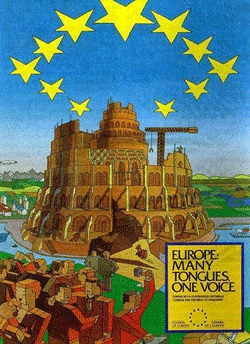
The Spirituality of the European Union

EU church religion


St George’s Day brings yet another wildly misguided and inappropriate intervention from a Church of England bishop, this time the Rt Rev Michael Langrish, Bishop of Exeter.

While back-handedly praising Prime Minister David Cameron for the zeal of some of his reforming efforts, he goes on to expound at length on the question of whether Cameron might be – wittingly or unwittingly – undermining the “deep spiritual roots” of the European Union.

From The Telegraph:

The Rt Rev Michael Langrish, who sits in the House of Lords, told Peers that he was concerned that Mr Cameron’s policies could contribute to the “loss of the European soul”.

He told how the European project has “deep spiritual roots” and said the Church of England “engages with the EU itself through its own representation and structures”.

The Bishop of Exeter is, of course, a Lord Spiritual, one of those Church of England bishops given the right and authority – unique among leaders of all other religions and denominations in this country – to sit in the upper house of the British parliament and meddle in our lawmaking. The Telegraph continues:

Speaking in the House of Lords this week the Rt Rev Langrish insisted that the Church of England has a “European perspective”.

“It may be thought that the Church of England does not have a particularly European perspective, but that is far from being the case,” he said. “Through its diocese in Europe it is present in all the member states of the EU. It has effective links with other churches throughout Europe and is active in the Conference of European Churches. Together with our partner churches, we are also deeply aware of some of the roots of the EU and the vision of its founders in Catholic social teaching.”

First of all – deep spiritual roots? Really? I am not wholly ignorant of Catholic social teaching, and I am probably better informed than most about the history and development of the European project from its humble beginnings as the European Coal & Steel Community. In my misguided undergraduate days I curated a half-hearted, rightly neglected website called the Pro-European Alliance which aimed to explain some of this history and spin it in a way that case favourable light on the modern-day European Union.

Bishop Langrish’s attempt to describe the institutions, mechanisms and workings of the EU as having any spiritual dimension to them whatsoever seem to be a rhetorical step too far. That is not to say that there was or is nothing noble in the idea and reality of the EU. Binding the fractious nations of Europe together through increased trade, some common institutions and a mechanism to resolve local disputes was undoubtedly a good thing. So potentially a tenuous argument could be made that the existence of an organisation such as the EU served or serves some spiritual goal.

But the European Parliament? The Council of Ministers? The Commission, which hasn’t produced an audit-worthy budget and financial statements for years beyond counting? The European Courts? How do any of these inefficient, undemocratic, self-serving institutions, created by bureaucrats to serve the interests of bureaucrats, nourish the roots of spirituality? In any way?

The only way that one can see any spiritual element to any of this is if one subscribes to the view that the nation state and international institutions are the most suitable – or only acceptable – forums for key aspects of the modern welfare state such as regulation, income redistribution and the like to be administered. That people are inherently selfish, thoroughly unaltruistic, and that only through government coercion (either at a national or European level) can we make ourselves administer fair justice and look after the weak and vulnerable in our societies.

And of course this is exactly what large swathes (though not all) of the Church of England does believe today – see “Christ would not privatise our NHS” as just another recent, damning example. Build and maintain a big state sector to do all of the things that humans are too selfish or wicked to do of their own volition for the good of their fellow men, and criticise anyone who holds opposing views from the pulpit every Sunday.

The Bishop concludes:

“I hope that the failure of successive British Governments to articulate a coherent and constructive policy towards our European partners and to manage to take public opinion along with this will not contribute to that loss of the European soul.”

When the Bishop of Exeter defends the spiritual roots of the European Union and attacks David Cameron for seeking to repatriate powers from the EU and return them to the nation state or to the individual, not only is he wrong, but in so doing he is no less than abdicating his own Church’s spiritual roots and its responsibility to empower and enlighten the individual.

Death Of A Prime Minister

“After the storm, of a life lived in the heat of political controversy, there is a great calm”.

The excellent sermon given at the funeral yesterday of Baroness Thatcher, given by the Bishop of London at St. Paul’s Cathedral:


I was particularly pleased to hear the misinterpretation of Thatcher’s famous “there’s no such thing as society” quotation being so publicly corrected and presented in its fuller, Christian context by such a respected authority.

But indeed the whole sermon stands out as one of the best in recent memory, struck exactly the right note and was the high point of an exceptionally well-choreographed and well-executed ceremonial funeral.

The Compassion Monopoly


Today saw the installation of Justin Welby as 105th Archbishop of Canterbury.

The service was moving, with many elements incorporated to reflect the international diversity of the worldwide Anglican communion. Although myself a Roman Catholic, I wish the new Archbishop of Canterbury the best and pray for him as he seeks to tackle the many challenges facing his church.

I was, however, momentarily distracted from the beauty of the service by this image of a protester in Canterbury, shown on the BBC News website here.

We’ll let the misspelling of the word “privatise” go.

But both Pope Francis and Archbishop Welby can hang up their hats and go home, because this lady clearly has such a direct line to the Lord that she is able to tell us God’s political stance on any issue of the day. With such an ability we should probably make her a Lord Spiritual so she can sit in the House of Lords and meddle in British lawmaking with the others.

Christ would “NOT” privatise the NHS? Really? What does He think about Clinical Commissioning Groups? Is it okay with Him if private firms perform non-clinical work for NHS hospitals (such as cleaning or catering), or must this be owned and managed by the state too? And I have a feeling I know her answer, but does our Lord support the renationalisation of the railways in Britain?

Why does the left have such a monopoly, a stranglehold on the idea of compassion in our country?

Why is it that to speak out against the state taking such a large, meddling role in all of our lives marks one out as a mean-spirited and cruel person, indifferent to the needs of others?

And why do we all buy in to the idea that in order to be charitable and compassionate, we must funnel our efforts to help our neighbours, the less fortunate and the downtrodden through an inefficient state bureaucracy?

If the counterargument is that people would be selfish and insufficiently generous without the heavy hand of government coercion and taxation to take wealth and redistribute to those in need, what does this say about the leftist’s view of human nature?

Did it ever occur to this protester that perhaps it is directly because the state plays such a large part in everything that we do, from cradle to grave, that the church to which she belongs is withering and shrinking by the year?

To a great extent, aside from the divine aspect, has the British welfare state not done away with the purpose of church, of knowing your neighbour, of being part of a community, altogether?

I ask these questions because the answers to these issues of how best to act charitably, to help your neighbour and provide for those in need seem to be self-evident to so many on the left. Of course, they say, we must give more to the government so that they can give back to us according to our need. Certainly the newly-installed Archbishop of Canterbury, Justin Welby, seems to subscribe to this mindset, from what we know of his recent remarks.

I could not disagree more vehemently.

How Not To Pick Your Successor

Great news for all those who tweet. The Daily Telegraph reports today that Twitter users are to be invited to help choose the next Archbishop of Canterbury:

http://www.telegraph.co.uk/news/religion/9164900/Twitter-users-invited-to-help-choose-the-new-Archbishop-of-Canterbury.html

Well, to clarify, it will not just be Twitter users. As the article states:

A spokesman for the Church of England said the invitation would be made through the church press but also through other media including the social networking site Twitter, where the CofE already posts news in nuggets of 140 characters or less. Tweeters and others will be asked to offer names and “views on the needs of the diocese of Canterbury and the wider community”.

I wonder if this is entirely wise.

Britain is known for not taking publicity stunts or requests for audience participation very seriously, as anyone from Vodafone (http://beta.techradar.com/news/world-of-tech/10-tech-pr-stunts-that-spectacularly-failed-641612) to David Blaine (http://news.bbc.co.uk/1/hi/entertainment/3206044.stm) can attest. In fact, such requests often degenerate into one-liner competitions, with users trying to out-humour one another in their facetious responses.

So if too much weight is assigned to the views of those who respond on Twitter, it is entirely possible that we will end up with Archbishop Billy Connolly or Pete Doherty. And maybe inadvertently canonise St. Amy Winehouse while we are at it.

On a more serious note though, I read this article and my first thought was how silly, for such a major world religion to effectively take nominations for the top job via Twitter. But then I read and recalled how the process works at the moment:

Having wrestled with the best way to choose a new leader, the Church of England has decided to use the social networking site Twitter. It will also seek the views of people of all faiths and none, from the Chief Rabbi to Professor Richard Dawkins.

For the first time in history, the long and usually private process will begin with a widespread public consultation, to be finished by the end of May.

The Crown Nominations Commission, which must present the Prime Minister with two possible successors to Dr Rowan Williams, will also ask for contributions from “senior figures in other faiths, the secular world and the life of the nation”.
[my emphasis in bold]

So yes. On reflection, compared to having the Prime Minister tossing a coin and choosing the next leader of the worldwide Anglican communion, asking for the opinions of a load of drunk Twitter users fresh back from the pub, people from rival faiths, an avowed atheist and Susan Boyle doesn’t sound like such a bad idea after all.

A democratic church, what a genuinely interesting concept. One that probably deserves a blog post all of its own.

To vote for Dr. John Sentamu, text “YORK” to 800555 or press the green button on your remote control. Text messages will be charged at your cellphone provider’s normal rate + 50p. Please ensure that you have the bill payer’s permission before texting.

On Freedom Of Religion

I have only one further comment to make on the topic of gay marriage and religious freedom for now, this time prompted by another article in the Daily Telegraph:

http://www.telegraph.co.uk/news/politics/9145759/Church-powerless-to-stop-same-sex-marriage-even-if-hundreds-of-thousands-object.html

The article discusses the publication of the British government’s “national consultation document” (no, I don’t know what one is and have never heard of one either, but I’m sure that its publication kept an army of civil servants and several retired, titled former judges well-occupied and remunerated for some considerable period of time, as all lengthy British enquiries seem to do).

The gist of the article that even if hundreds of thousands of people object to the legalisation of gay marriage, it may still go ahead (and it is implied, of course that this would be a terrible thing, because apparently we like the tyranny of the majority – or enthused minority, in this case – in this country, as long as it is working in our favour).

However, one sentence in the article struck me as particularly important and much overlooked:

“The document repeatedly underlines that the change would only affect civil marriage and that there would be an outright ban on same-sex marriages [in] religious premises even if some denominations wanted them.”

Do you understand this, stalwart defenders of “traditional values” and “religious freedom”? Even in the government’s new proposed law, it would be illegal for your church, synagogue or mosque to perform a same-sex marriage even if it wanted to some day. The government is dictating what you can and cannot do within the confines of your own church.

In this case, your view and that of the government are broadly in alignment, believe it or not – neither of you want same-sex marriages to take place in religious spaces. The only argument concerns whether you should be allowed to continue to impose your definition of marriage on the general, non-religious population through the institution of civil marriage. But some day in the future your interests may diverge, and the government may choose to legislate something directly impacting what goes on in your holy place that you profoundly disagree with.

They have the power to do it now, and as this “national consultation document” shows, they are doing it now, but you say nothing because your interests are aligned. But I don’t want to hear a word of complaint if ever a government law is proposed that actually makes your church do something that it doesn’t want to do.

That would be a violation of freedom of religion. Not the legalisation of civil same-sex marriages.