The UKIP Insurgency

Nigel Farage UKIP voting


Well, those local council elections across England this past week were quite interesting.

The United Kingdom Independence Party has firmly established itself as Britain’s fourth (or maybe even third) party with a strong showing in which they received over 25% of the vote across those wards where they were able to field candidates.

And this despite a volley of negative and dismissive statements ahead of the elections, in which UKIP’s leadership, membership, policy positions and candidate screening processes were all mocked and derided.

Cue lots of hand-wringing about what the Tories can do to win back their disaffected supporters, etc. etc. As The Guardian reports:

A contrite David Cameron has promised to show a surging UK Independence party respect after it gained more than 130 seats in the English county elections and polled 25% of the national vote. The result led the party’s leader, Nigel Farage, to claim the birth of a new and irreversible era of four-party politics.

Cameron, who once described Ukip as fruitcakes and closet racists, admitted his mistake, saying it was no good insulting a political party that people had chosen to vote for: “We need to show respect for people who have taken the choice to support this party. And we’re going to work really hard to win them back.”

Cue also some quite entertaining journalism about the quirky, eccentric nature of British local politics. As Iain Martin writes in The Telegraph:

What is even funnier is the confusion it is causing the leaders of the established political class. They are already emerging for a round of local election bingo, with the key phrases drawn from the standard issue manual used by all the major parties. “We hear what people are saying… people want to make a protest… they want us to get on with the job… people have very real concerns… it’s mid-term… we’ll be reflecting.” But this time, when they mouth the words, they look as though they know their platitudes have been rumbled.

The distress the voter rebellion causes the bigger parties does seem to be an important part of the appeal of Ukip. Voting for Farage is an entertaining way of giving the Tories, Labour and the Lib Dems two fingers. Of course the longer-term implications are not necessarily funny. This is a country, not a comedy club. But large numbers of voters are so disenchanted that they see no possibility of an answer in the old parties. They are having a lot of fun trying to blow up the system.

Of course, this runs contrary to the counterargument that these were only local elections, that off-cycle elections always see the governing party (or parties in this case) punished at the ballot box, and that people will return to one or other of the Big Three come the general election in 2015.

But a 25% share of the vote, and a national second place position, can start to shift perceptions, a fact that Nigel Farage, UKIP’s leader, is no doubt counting on. If people absorb the consequence of these election results and no longer see UKIP as a party of “fruitcakes and closet racists”, as David Cameron once uncharitably called them, their support may not peel away as it has previously done, and we could see a number of newly minted UKIP MPs entering parliament.

But what is contained within the UKIP manifesto? Well, quirky though some of their individual members and candidates may be, the manifesto on which they are running is actually quite appealing to those who favour smaller government. The BBC offers a fair overview, which includes the following:

EUROPE: Nigel Farage says he wants an “amicable divorce” from the European Union. Britain would retain trading links with its European neighbours but would withdraw from treaties and end subscription payments, adopting a similar relationship with the EU to Norway or Switzerland.

TAX: UKIP favours a flat tax – a single combined rate of income tax and national insurance paid by all workers. It claims this would end the complexity of the current system and allow people to keep more of the money they have earned. It would also lead to a major shrinking of the size of the state, which would revert to a “safety net” for the poorest. The party has yet to decide the rate at which the flat tax would be levied. Its policy at the 2010 election was 31% but a recent policy paper suggested 25%. It is having an internal debate about whether there should be two rates.

EDUCATION: UKIP backs selection by ability and would encourage the creation of new grammar schools. It would give parents vouchers to spend in the state or private education sector. It also advocates the return of the student grant system to replace loans.

DEMOCRACY: The party wants binding local and national referendums on major issues.

Freedom from EU meddling and over-regulation. A fair, flat tax. Freeing the education system from those who want uniform mediocrity at the expense of individual excellence. A strong national defence. All of these are causes dear to the hearts of the small-government conservative, and make the party worthy of support.

Of course, with the good also comes the less-good:

ENERGY AND CLIMATE CHANGE: UKIP is sceptical about the existence of man-made climate change and would scrap all subsidies for renewable energy. It would also cancel all wind farm developments. Instead, it backs the expansion of shale gas extraction, or fracking, and a mass programme of nuclear power stations.

GAY MARRIAGE: UKIP supports the concept of civil partnerships, but opposes the move to legislate for same-sex marriage, which it says risks “the grave harm of undermining the rights of Churches and Faiths to decide for themselves whom they will and will not marry”.

LAW AND ORDER: UKIP would double prison places and protect “frontline” policing to enforce “zero tolerance” of crime.

THE ECONOMY: UKIP is proposing “tens of billions” of tax cuts and had set out £77bn of cuts to public expenditure to deal with the deficit.

Anti-science climate change denial is tempered with a pragmatic approach to ensuring energy security through next generation nuclear power. The unfortunate opposition to gay marriage is at least balanced with support for civil partnerships. The spirit of cutting taxes and controlling spending is absolutely right, but the wisdom to wait until a stronger recovery exists is lacking. And the draconian, counter-productive policies on law and order are just bad.

So there is good and bad in the UKIP manifesto, just as there is in the manifestos of the other main political parties. As always, the ultimate question must be who delivers the best package of policies to improve the country?

Until now, I have been fairly dismissive of UKIP’s offering to the electorate, but no more. Here is a broadly libertarian-leaning party, offering a no-nonsense, very pro-British package of policies. And while there is a little too much authoritarianism and social conservatism still in the mix, the failings of the present Conservative-led government to revitalise the economy and enact any of the urgently-needed supply side reforms in Britain make UKIP a potentially viable alternative for my vote.

The UKIP manifesto is worth a read. Are there unsavoury fringe elements within UKIP, and endorsements from without? Certainly. Are there some rather eccentric characters representing the party at the moment, yes. Are all of the policies fully costed and backed with feasibility studies? Of course not – UKIP has never seen power, and remains a less mature political party. But then so were the Liberal Democrats until the 2010 general election gave them the chance to wield real power and become as dour and unappealing to the electorate as Labour and the Conservatives.

We currently suffer under a Conservative-led government that has done barely anything to shrink the scope and size of the state, and the meddling influence of all levels of government in our lives. UKIP promises to do differently.

And, based on their manifesto if not their fringe supporters, would that not potentially be a very good thing for the cause of smaller government and individual liberty?

The Fallacy Of Stimulus vs Austerity

We are now six years into our global economic crisis which began in 2008, and from which most western countries still suffer acutely to varying degrees. And yet our political leaders are still having the same argument that they were having when the crisis began. The argument has not matured, developed or sprung new offshoots; it remains exactly the same.

Austerity versus Stimulus. With deficits exploding as government revenues collapsed during the great recession, should we spend more taxpayer money to create new demand in the economy, or tighten our belts and trust that an immediate return to fiscal rectitude would be the answer? Should we be Keynesians or not? And, whatever ones personal point of view, we have pretty much stuck to them since that time; and by and large we have trodden a middle ground that has delivered at best anaemic growth rates and jobless recoveries, or at worst has failed to stem the tide altogether.

Those on the left, such as Guardian columnist Polly Toynbee, castigate the British conservative-led government’s efforts to do anything to reduce the deficit – not to eliminate it so as to begin paying down the national debt, but just to reduce the deficit – as heartless and cruel. Not a day goes by without some new stricture on the harm that government spending cuts (read: reductions in the rate of increased government spending) will cause to the weakest and most vulnerable in our society.

Conservative politicians on the right, such as German Chancellor Angela Merkel, bristle at being labelled dispassionate and unsympathetic to those in need, and claim that their harsh medicine is the only way of saving the ailing economic patient.

Semi-partisan people such as myself tread an unpopular middle ground, arguing that this time of weak to negative growth is the worst possible time to be cutting spending (though radical rethinking of spending priorities is certainly needed), but worrying that moderate left-wingers and fair weather conservatives will not fulfill their end of the bargain and actually begin rolling back government spending and the boundaries of the state when healthy economic growth is eventually restored.

And so we all sit in our respective ideological trenches, lobbing the occasional rhetorical grenade into no-man’s land, and nothing changes.

Enter Shinzo Abe, prime minister of Japan.

Japan has been wrestling with stagnation and it’s terrible consequences for much longer than most western countries, and after 20 or so lost years, have come up with a new solution which might just actually work.

The Guardian reports:

Japan’s central bank has been ordered to print money at twice the rate that even the US is doing, to go on more spending by government and private firms. It must get inflation up by two percentage points at once. Firms must increase wages. Taxes will come down before rising to ease the deficit. Structural change will impede inflation and short-term debt may rise, but the risk must be taken. The economy must grow, at all costs.

Wow, growth at all costs rather than half-hearted measures and finger-pointing when it doesn’t work.  What a novel idea. The report continues:

As David Graeber put it in the Guardian this week, austerity is no longer an economic policy but a moral one in which someone must be found to pay for past profligacy. It is “a politics of crime and punishment, sin and atonement”. It seems almost to appeal to Protestant countries. They regard Greeks and Cypriots as singular sinners, but are all guilty.

Britain has less excuse. It could print money, inflate like Japan and let the exchange rate take the pressure. The government has already printed about £375bn, but has given the money exclusively to banks. The money has vanished on boosting bank reserves, inflating the stock market and buying more government debt. None of it has “pumped”, or even leaked, into the productive economy, whatever Bank of England handouts say.

If every pound George Osborne had printed had gone on consumer spending, it defies belief that the British economy would be still be in acute recession. As in Japan, sales would be rising, order books filling, jobs returning, tax revenues expanding and the deficit shrinking. Banks are not stupid. They lend against profits, not against Vince Cable speeches. Their retail customers need real rising demand to restock, instead of relying for turnover on benefit recipients. Austerity in recession is the nadir of economic illiteracy.

The wisest words on economic policy that I have heard in a long time, and I have to hear them from a left-leaning newspaper. Conservative outlets, talking heads and think tanks should be ashamed.

The reason that “stimulus” has failed (or at least has not resulted in a return to robust growth) is because we have been attempting to stimulate the wrong thing. If we are going to print money and run the risk of inflation, is it not far better to put that money into the hands of actual citizens, taxpayers, who need it and who will immediately go out and spend it, rather than using it to shore up the balance sheet of a bank that was probably involved in all manner of dodgy activities leading up to the financial crisis, and which has no intention of lending that money to individuals and businesses who want it?

But the killer lines from the article are these:

Japan is taking a gamble. The gamble is not with inflation but whether state spending and bank lending will actually get money into rapid circulation. The country’s past experience with big infrastructure projects (as favoured by Osborne) is that they yield little short-term stimulus. More roads and railways are a glacier when what is needed is a torrent. The torrent comes from consumer wallets, filled by lower taxes and higher wages. It comes from the fastest possible cash infusion. Any resulting inflation is a problem for the day after tomorrow.

The joy of a country with its own currency is that it can handle it as it wishes, not as eurozone leaders wish. It need not increase government debt but just print money to distribute for as long as it thinks necessary. This could be through higher benefits, higher wages, higher tax thresholds or lower VAT. For that matter, the Treasury could add £10,000 to every adult’s bank balance – a giant version of the pensioners’ Christmas fuel allowance – and still have spent less than it has handed to the banks in the past four years.

Think on that for a minute. If the government had given all the money it gave to the banks over the last four years to private individuals instead, it would be the equivalent to putting £10,000 into the bank account of every adult in the UK. Even if you argue that the financial sector required a cash injection in order to prevent a calamitous collapse of the system, if the government had lavished just half as much on the banks, we could all be receiving a £5,000 cheque in the mail.

Yes, there are arguments to be had about how we put the newly printed money into the hands and bank accounts of the citizenry. Should it be equally per person (no), equally per taxpayer (no), based somehow on one’s past tax contributions (yes, probably), or some other means of allocation? We can have those arguments once we accept the reality that the current course of action is not working, and as we move to follow Japan’s lead and implement their real stimulus policy. We need to face facts and acknowledge that printing money and giving it to the banks has not worked; perhaps giving the money directly to the consumer will.

The economic news emanating from the US and the UK continues to be bleak, and our leaders keep offering the same solutions and hammering out the same compromises between themselves.

In the final, desperate hope of avoiding another lost decade, let us at long last now try something new.

The Spirituality of the European Union

EU church religion


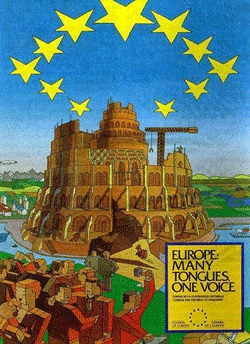
St George’s Day brings yet another wildly misguided and inappropriate intervention from a Church of England bishop, this time the Rt Rev Michael Langrish, Bishop of Exeter.

While back-handedly praising Prime Minister David Cameron for the zeal of some of his reforming efforts, he goes on to expound at length on the question of whether Cameron might be – wittingly or unwittingly – undermining the “deep spiritual roots” of the European Union.

From The Telegraph:

The Rt Rev Michael Langrish, who sits in the House of Lords, told Peers that he was concerned that Mr Cameron’s policies could contribute to the “loss of the European soul”.

He told how the European project has “deep spiritual roots” and said the Church of England “engages with the EU itself through its own representation and structures”.

The Bishop of Exeter is, of course, a Lord Spiritual, one of those Church of England bishops given the right and authority – unique among leaders of all other religions and denominations in this country – to sit in the upper house of the British parliament and meddle in our lawmaking. The Telegraph continues:

Speaking in the House of Lords this week the Rt Rev Langrish insisted that the Church of England has a “European perspective”.

“It may be thought that the Church of England does not have a particularly European perspective, but that is far from being the case,” he said. “Through its diocese in Europe it is present in all the member states of the EU. It has effective links with other churches throughout Europe and is active in the Conference of European Churches. Together with our partner churches, we are also deeply aware of some of the roots of the EU and the vision of its founders in Catholic social teaching.”

First of all – deep spiritual roots? Really? I am not wholly ignorant of Catholic social teaching, and I am probably better informed than most about the history and development of the European project from its humble beginnings as the European Coal & Steel Community. In my misguided undergraduate days I curated a half-hearted, rightly neglected website called the Pro-European Alliance which aimed to explain some of this history and spin it in a way that case favourable light on the modern-day European Union.

Bishop Langrish’s attempt to describe the institutions, mechanisms and workings of the EU as having any spiritual dimension to them whatsoever seem to be a rhetorical step too far. That is not to say that there was or is nothing noble in the idea and reality of the EU. Binding the fractious nations of Europe together through increased trade, some common institutions and a mechanism to resolve local disputes was undoubtedly a good thing. So potentially a tenuous argument could be made that the existence of an organisation such as the EU served or serves some spiritual goal.

But the European Parliament? The Council of Ministers? The Commission, which hasn’t produced an audit-worthy budget and financial statements for years beyond counting? The European Courts? How do any of these inefficient, undemocratic, self-serving institutions, created by bureaucrats to serve the interests of bureaucrats, nourish the roots of spirituality? In any way?

The only way that one can see any spiritual element to any of this is if one subscribes to the view that the nation state and international institutions are the most suitable – or only acceptable – forums for key aspects of the modern welfare state such as regulation, income redistribution and the like to be administered. That people are inherently selfish, thoroughly unaltruistic, and that only through government coercion (either at a national or European level) can we make ourselves administer fair justice and look after the weak and vulnerable in our societies.

And of course this is exactly what large swathes (though not all) of the Church of England does believe today – see “Christ would not privatise our NHS” as just another recent, damning example. Build and maintain a big state sector to do all of the things that humans are too selfish or wicked to do of their own volition for the good of their fellow men, and criticise anyone who holds opposing views from the pulpit every Sunday.

The Bishop concludes:

“I hope that the failure of successive British Governments to articulate a coherent and constructive policy towards our European partners and to manage to take public opinion along with this will not contribute to that loss of the European soul.”

When the Bishop of Exeter defends the spiritual roots of the European Union and attacks David Cameron for seeking to repatriate powers from the EU and return them to the nation state or to the individual, not only is he wrong, but in so doing he is no less than abdicating his own Church’s spiritual roots and its responsibility to empower and enlighten the individual.

Neil Kinnock Falling Into The Sea

Someone made a tone poem about former Labour Party leader Neil Kinnock’s close encounter with the sea, back in 1984.


And now I share it with you all, for some light relief today.

Death Of A Prime Minister

“After the storm, of a life lived in the heat of political controversy, there is a great calm”.

The excellent sermon given at the funeral yesterday of Baroness Thatcher, given by the Bishop of London at St. Paul’s Cathedral:


I was particularly pleased to hear the misinterpretation of Thatcher’s famous “there’s no such thing as society” quotation being so publicly corrected and presented in its fuller, Christian context by such a respected authority.

But indeed the whole sermon stands out as one of the best in recent memory, struck exactly the right note and was the high point of an exceptionally well-choreographed and well-executed ceremonial funeral.