Labour Leadership Candidates United By Arrogance On Europe


Anyone hoping that Labour Party’s haemorrhaging of northern votes to UKIP or the EU’s sacrifice of Greece to preserve the Euro might lead to a reconsideration of Labour’s reflexive, metropolitan pro-Europeanism must be sorely disappointed with the four candidates jostling for the honour of leading the party to defeat in 2020.

Although there is a groundswell of euroscepticism building across the country – and even though many prominent left-wingers are now calling for “Lexit”, including the ubiquitous Owen Jones – those who aspire to lead the Labour Party remain wedded to their desperate belief that the EU is somehow good for Britain.

Even as the contrary evidence mounts and public pressure for a left-wing eurosceptic political outlet grows, the Labour Leadership candidates prefer to stick to their increasingly hollow-sounding scripts, proclaiming the dubious virtues of political union and the supposed horrors that would befall Britain if we were to regain our independence.

This much became clear during the LBC radio Labour Leadership hustings, when a certain “Nigel from Kent” (yes, that one) phoned in with a question, asking the candidates whether there were any scenarios in which they could envisage campaigning for Britain to leave the EU and voting “no” in the Brexit referendum.

The responses were predictably depressing.

Continue reading

2015: A Good Time To Be Eurosceptic

Europe - EU Flag - Brexit - Eurosceptic - Fading Flag


First published at Conservatives for Liberty

It’s hard to remember the last time it felt this good to be a Eurosceptic, to love Europe but abhor the mid-century anachronism that is the European Union.

Since the dying days of the Major government we eurosceptics have been on the back foot, forced to watch Britain sign the agreements and ratify the treaties which lashed us ever more tightly to the post-war dream of ever-closer union, totally incapable of mounting an effective defence. And when we did speak up, we have consistently been portrayed as cranks, obsessives (and far worse) by left-wing politicians, Conservative sympathisers and the media.

Aside from the recent morale boost courtesy of Nigel Farage and UKIP, it has often felt as though we eurosceptics were waging a lonely and futile battle against progress itself – that the inevitable world of 2115 would be organised into huge, supranational, protectionist trading blocs, with nation states stripped of power and relevance, and representative democracy having long since slipped down the crack between the two.

But not now, not in 2015. Not after Greece.

It should not have taken the immolation of a small, southern European country – sacrificed for the “greater good” of monetary union – for so many people to finally wake up and realise that the European Union does not mean them well, that the Eurogroup’s treatment of one recalcitrant member is the rule, not the exception.

Continue reading

The Curiously Brittle Bonds Of Left Wing Patriotism In Britain

EU - European Union - Flag - Cross - Eurosceptic - 2


People of all political stripes sometimes say things they don’t mean, or come to regret, in the heat of passionate argument, either out of anger or just for dramatic effect.

The Sun newspaper once famously warned the last person fleeing Britain in the event of a Labour election victory to “turn out the lights”. Every Labour Party campaign in living memory has warned voters that they had only “24 hours to save the NHS”, though somehow it never seems to disappear in the Tory years. Paddy Ashdown said he would eat his hat if the Liberal Democrats did as badly in the 2015 general election as the exit poll predicted (they did worse).

Meanwhile, across the Atlantic, angry liberals threatened to move to Canada when George W. Bush was re-elected, while social conservatives – high on passion but lacking in international awareness – responded to the Supreme Court’s ruling legalising gay marriage by themselves threatening to move to Canada, that well-known bastion of homophobia and social conservatism.

So rhetorical hyperbole is not restricted to any one political party or any one type of outlook or worldview. But there is a certain type of political argument to which those on the political Left seem to resort far more often than their opponents on the Right.

When faced with electoral defeat and years in political opposition, those of a conservative mindset tend to lick their wounds for awhile and then set about the business of trying to re-acquire power and influence, however angrily or unsuccessfully. However, when those of a left-wing mindset are faced with rule by the other side, they are far more likely to view the situation as intolerable to the extent that even remaining part of the same country or political structure becomes undesirable.

Continue reading

The British Left Rediscovers Euroscepticism, With Help From Greece


You know there must be a serious disturbance in the Force when left-wing commentators like Owen Jones begin openly flirting with euroscepticism. But this is exactly what we are now witnessing, with formerly staunch eurofanatics up and down the land executing sharp 180-degree U-turns in their general attitude toward Brussels, sometimes with quasi-admissions of former error (see Owen Jones) but usually done quietly in the hope that nobody will notice.

Never mind the fact that just a couple of short months ago, many of these same left-wing talking heads were taking to the airwaves during the general election campaign to argue that the European Union represents enlightened internationalism at its best, and that only the most unlettered and unsavoury characters (read: Ukippers) could possibly believe otherwise.

Never mind the cognitive dissonance required to accuse Nigel Farage of paranoid xenophobia one month and then find fervent common cause with him the next; wherever there is a David vs Goliath struggle raging in the world, the virtue-signalling Left are never slow to exploit it, even if it means resorting to twisted pretzel logic or making themselves look extremely silly in the process. Thus the British Left have decided that plucky little Greece is “good”, while the European Union – for so long a beacon of social democracy in Britain’s ‘capitalist darkness’ – has suddenly become the evil enforcer of a punitive “neo-liberal” agenda.

Of course, this is done with the level of sanctimonious obnoxiousness that you would expect. Those filthy Ukippers hated Europe for all the ‘wrong’ reasons, one can imagine them thinking as they penned their first tentative polemics against once-loved EU institutions. But we changed our opinion of the EU for ‘good’ reasons, reluctantly, after watching Greece being bullied. So you should sit up and take notice when we criticise the EU, because we’re not like the fruitcakes and closet racists who bang on about Europe the rest of the time.

Continue reading

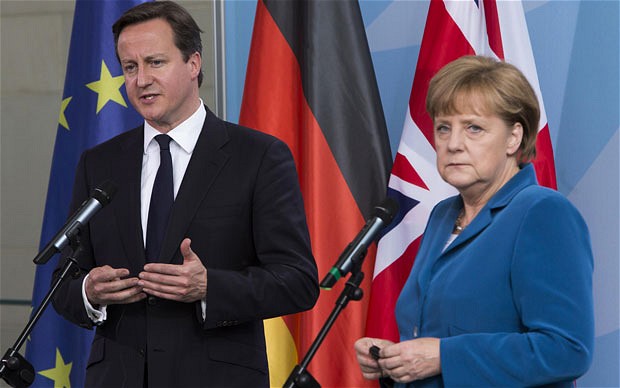
Why Should Britain Help Germany Reform The EU?

David Cameron - Angela Merkel - EU - 2


You have to hand it to Michael Fuchs, deputy chairman of Angela Merkel’s CDU party in Germany. If you genuinely want Britain to remain part of the European Union – for intentions noble or otherwise – the best way for other countries to achieve that outcome is by convincing the British people that they too are frustrated by Brussels bureaucracy, that they yearn for real reform, and envisage our humble selves at the heart of this great effort.

And this is exactly what Fuchs has done, presenting the face of German concern about Britain’s place in the EU while his ally Angela Merkel is preoccupied with the far more pressing matter of the Greek crisis.

From the Telegraph:

“I want the UK to stay in the EU, and I cannot even imagine an EU without the UK. I don’t want to imagine it,” [Fuchs] said.

“In particular, for us it’s not good because the UK is a partner promoting a free-market economy, much more than the southern hemisphere in Europe. [Some of these countries] want to have a more state-regulated economy, and the UK is more like us, for instance, like Holland and the northern hemisphere, so we would not be very happy to see it go.”

Mr Fuchs described Brussels as a “huge” bureaucracy that needed to be scaled back. “I fully agree with certain statements of [Prime Minister] David Cameron saying that Brussels need not be such a huge bureaucracy, with so much red tape.

“That’s quite important, I think, and we need Cameron’s help to change it.”

Unfortunately, when someone you normally expect to be an antagonist starts acting very friendly, there is usually an ulterior motive at play. Feigning concern for and agreement with a difficult negotiating partner is straight out of Hostage Negotiation Strategy 101, and just as the man in the FBI jacket doesn’t really care that your wife left you and isn’t really going to arrange that escape airplane filled with cash, so Germany isn’t really about to let awkward old Britain stop the wheels of an EU juggernaut which has been rolling and gaining momentum since the 1950s.

Continue reading