Biased Or Not, The BBC’s Political Coverage Is Shockingly Bad

BBC Daily Politics Political Journalism SPS


The BBC – our national treasure or money and creativity-sapping black hole (depending on your viewpoint) has been given due notice by Sajid Javid, the new Culture Secretary, that every aspect of its future funding and existence is under review.

The Huffington Post reports:

All aspects of how the BBC is run and paid for will be reviewed when its charter comes up for renewal, the Culture Secretary has said. Sajid Javid said “everything” would be looked at, including licence fees and governance structures, when negotiations get under way … Tory Party chairman Grant Shapps warned the corporation last year it could lose its exclusive right to the £3.6 billion raised by the licence fee if it failed to tackle what he believes is a culture of secrecy, waste and unbalanced reporting in the organisation.

For those who believe that on balance the BBC is currently doing more harm than good, this is welcome news. Indeed, this kind of root-and-branch re-evaluation of public services is precisely what many people who voted Conservative in 2010 expected but have not seen thus far under the coalition government.

Re-evaluation and reform is sorely needed. The BBC has recently struggled to defend itself against allegations of incompetence and institutional corruption following the Jimmy Savile sexual abuse scandal, excessive remuneration of top talent and high level executives, and catastrophically poor editing of it’s flagship nightly news programme. And only last week the corporation defiantly kept the editor of the BBC News Channel in her post despite the fact that she posted highly partisan and derogatory comments about a political party on her Twitter account, in flagrant violation of BBC rules.

This blog is not alone in noting the gradual fall in the quality of the BBC’s political output in particular. The Telegraph’s Dan Hodges rightly lambasted the corporation’s recent election results coverage for being both lightweight and unresponsive to complex, dynamic situations. Hodges notes that despite token efforts by the legacy broadcasters to acknowledge the existence of social media, the BBC’s election results programme (for the recent local council and European elections) was way off the mark in its analysis, seizing upon the first narrative that emerged and stubbornly sticking with it throughout the evening even as Twitter started to better reflect the more nuanced results which later emerged.

It is worth quoting Hodges at length, because he makes a vital point:

I’m usually quite sceptical about the whole “social media is taking over the world” meme. But on Sunday night it became very obvious. Twitter and the other social media outlets are making the big election night programs utterly redundant.

It wasn’t apparent when they were the only outlet for results and analysis. But last week both main broadcasters were horribly exposed. What was amazing was the way it was clear neither Sky nor the BBC were taking the slightest bit of notice of their own output. They were engaged in a logistical exercise – “Let’s make sure we don’t miss the returning officer from Torquay” – rather than an analytical one.

What I also couldn’t understand was who they thought their audience was. The same headline mantra was chanted – “Ukip earthquake, Ukip earthquake” – over and over again, but no serious effort was made to deconstruct it. Surely the only people watching local election results at one in the morning are political geeks like me. And what we’re looking for is serious analysis.

Watching the difference between the discussion in the election studios and the discussion on Twitter was like the difference between watching Gary Lineker and Alan Shearer on Match of the Day and Gary Neville and Jamie Carragher on Monday Night Football. The former talk blandly about great attacking or terrible defending. The latter explain in granular detail precisely why it’s great attacking or terrible defending.

Sadly, that just about sums up the BBC’s approach to political programming today. There is a heavy focus on the personality-based politics (epitomised by the need to muckrake, sensationalise and have a “gotcha” moment in every interview) and the logistics of electioneering, but a rapidly fading focus on the comparative assessment and scrutiny of opposing policies. These days, the BBC’s political coverage is all about The Game – who’s up and who’s down at any given moment. Who’s wrong and who’s right barely gets a look-in any more.

What’s worse, the increasingly lightweight personalities – journalists and contributors – deployed by the BBC to cover the political beats are often incapable of the latter, more serious type of reporting, able only to offer superficial ‘analysis’ of the ups and downs of parties and personalities as measured by the twenty-four hour news cycle. Over time, the BBC divested itself of much of the expensive, skilled talent needed for good quality political coverage, either reshuffling them, demoting them or letting them go – and with them, their vital knowledge.

Before the BBC apologists leap to their feat in protest, no it does not have to be this way. High quality, penetrating analysis is not thwarted by the need to remain impartial (an imperative that the BBC fails to achieve anyway), but the BBC is in danger of succumbing to the worst current instincts of political coverage on American network television – giving each ‘side’ of an argument equal weight and validity out of desperation to appear non-partisan, even when the truth is quite clear-cut and largely occupied by one particular party.

The liberal comic Bill Maher perfectly skewers this unnecessary impulse, increasingly seen in BBC political broadcasting, as it pertains to the non-existent flat-Earth debate:


In other respects, though, Americans enjoy far better political coverage than their British cousins. America benefits from the existence of C-SPAN, a private but nonprofit cable network set up by the US cable television industry, who pooled their resources to establish a one-stop shop that they could all draw on for in-depth political coverage.

The BBC’s own effort, BBC Parliament, does not compare favourably with C-SPAN. BBC Parliament occupies one channel, while C-SPAN has three. C-SPAN provides much more extensive and flexible coverage of both houses of Congress, while BBC Parliament is bound by the ludicrous and archaic rules governing the televising of Parliament. C-SPAN offers a much wider range of other programming such as book talks, public debates and call-in shows, while BBC Parliament has to fit its own meagre offerings of this type in the periods when Parliament is not sitting. C-SPAN’s online presence vastly outstrips that of BBC Parliament in terms of depth of analysis and availability of archive footage.

But most importantly of all, C-SPAN has a reputation for balanced programming and is well-regarded by both liberals and conservatives. British conservatives, by contrast, have long since given up trying to get a fair shake from the BBC – though this article makes a persuasive case for the BBC’s innate small-C conservatism.

It is impossible to properly compare the entire outputs of two news networks in this short space, but a lot can be learned by watching the following excerpts of political output from the BBC and C-SPAN respectively.

First the C-SPAN show, a typical and broadly representative example of their output; in this case a call-in show featuring the national security journalist Glenn Greenwald as special guest:


And here is a C-SPAN StudentCam short film, also on the topic of national security. Such segments form a regular part of C-SPAN programming, filling the time slots between regular programming and encouraging young people to take an active interest in civic issues:


Contrast these with the BBC’s recent efforts, this exerpt taken from the flagship Daily Politics show:


The difference in focus, tone and overall quality could not be more striking. Even the student effort on C-SPAN outmatched the quality and seriousness of the BBC’s political output – and again, these examples are fairly representative of each network’s normal output, not chosen to unduly embarrass the BBC.

The obvious question that must be asked is this: Why the grave disparity in service, given the deep pockets and institutional clout of the BBC compared to its upstart American counterpart?

(In the interest of fairness, it must be mentioned that much of the BBC’s radio coverage is of significantly higher quality, particularly Radio 4’s Today in Parliament).

It’s not that there are necessarily more smart people with a burning interest in politics and public policy in America than there are in Britain. But because the BBC’s omnipresent dumbed-down approach crowds out all other offerings in the marketplace, politically interested citizens are much better catered to in the United States than they are in Britain, where the Daily Politics-style cartoonification of politics insults those with real knowledge and interest.

The truth is that the quality gap between C-SPAN and BBC Parliament has not always existed – it was brought about fairly recently by people who should be ashamed of their decisions, and whose CVs should carry indelible black marks as a consequence.

Before the Daily Politics came along and ruined everything, the BBC’s flagship political programming consisted of shows such as On The Record, Despatch Box and Westminster Live. Much like C-SPAN’s offerings in the United States, the budgets were small and the production values cheap; but this had the beneficial effect of making it all about the programming – the quality expertise and the analysis shared with the viewer.

This all changed when former BBC Director General Greg Dyke commissioned a review of the BBC’s political output, leading to a wholesale relaunch and rebranding. By 2003, out had gone the old shows with their dull but informative content, and in came the quirky, zany future where everything is a joke, everything is accompanied by a jaunty animation and theme tune, and everything is lightly mocked from the couch by host Andrew Neil and his unglamorous assistants.

Viewers can discern everything they need to know about the Daily Politics from the opening title sequence, without sticking around to suffer the show itself:


Portraying the British political system as some kind of sputtering, wheezing steam engine perpetually on the verge of breakdown may sometimes be uncomfortably close to the truth, but the BBC’s flagship daily political programme should not lead with this suggestion. Disillusionment with politics is high enough as it is without making jocular reference to all the reasons why in the opening credits.

To be clear, this is not to say that the politician themselves should be necessarily be treated with respect, reverence or deference, particularly when their actions have merited the opposite – but there should be a baseline of respect for the political process itself that now seems entirely absent from the BBC’s output. And all for what? What grand prize is the BBC seeking that is worth so much debasement?

The BBC is chasing a pipe dream if they believe their new dumbed down approach will result in more people tuning in and engaging with politics. Tacky, irreverent output better suited to satirical comedy shows will not draw in viewers who currently favour watching repeat episodes of Top Gear on Dave – it only serves to patronise and alienate those viewers who are interested in political coverage anyway, without the added allure of bright colours and jaunty theme tunes.
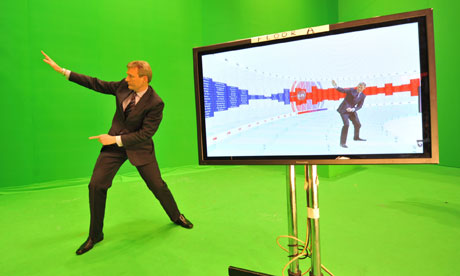
This isn't helping
This isn’t helping.


The point is not that the BBC should be disbanded entirely, or that the license fee should necessarily be scrapped (although it certainly should), or any one other prescription. The point of shaming the BBC with the woeful quality gap in its political programming is to point out that there are other delivery models out there in the world that work and which could produce good results back here in Britain, if only we would allow ourselves to consider them without feeling that we are somehow “cheating” on Auntie.

Those who become overly sentimental about the BBC in its current form suffer from the same forgiving and idealistic delusion as people who create Twitter hashtags or found political parties to “save the NHS”. Just as some NHS activists prize the survival and continuity of that organisation over the outcomes it was created to deliver (the best possible healthcare for British citizens), so BBC defenders cling to nostalgia rather than acknowledge the fact that the beeb can learn a lot from other broadcasters, at home and abroad.

There are many ways in which the BBC must prove its continued legitimacy other than in the field of news and political reporting. Why, for example, does a state-owned broadcaster need to operate eight national television channels, sixteen national radio stations and forty local stations when there is a thriving commercial sector?  But the BBC also gets many things right when it comes to news coverage – no one else in the world can match its depth and breadth, while British audiences tend to trust it above commercial rivals at times of crisis or when major incidents are unfolding.

The BBC’s political coverage, however, goes from bad to worse; and if left unaddressed for much longer it not only runs the risk of negatively colouring Sajid Javid’s upcoming review, but it will start to undermine British democracy itself.

As a first step in the right direction, the BBC News Channel’s editor, Jasmine Lawrence, needs to be reassigned to another role where her toxic anti-UKIP beliefs are in no danger of bringing the corporation’s impartiality into further question. But above all, the BBC needs to stop dumbing down in the one key area where dumbing down offers no benefits at all in terms of audience engagement or viewing figures.

The BBC’s Royal Charter – a delightfully worded document whose preamble would not be out of place in a Shakespeare play – defines the corporation’s public services (in part) as follows:

(a) sustaining citizenship and civil society;
(b) promoting education and learning;

Unless our national broadcaster is happy to continue fostering a state of cultural apartheid, where radio listeners receive tolerably decent political news output while television viewers are talked down to and belittled at every turn, the BBC must acknowledge that it is currently failing to meet these public service requirements.

And as it goes for anyone finding themselves on the wrong path in life, the first step toward the BBC’s redemption will be admitting that they have a problem.

At Long Last, Will The BBC Take Editorial Bias Seriously?

Jasmine Lawrence BBC UKIP bias tweet

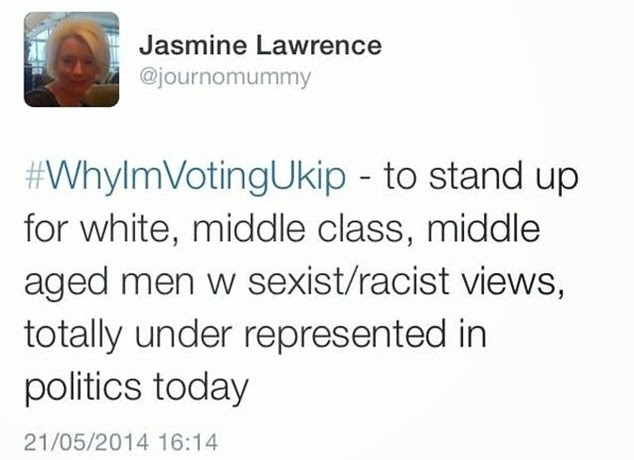
It is a sign of the times that things which used to cause outrage are becoming commonplace and shrugged off as unimportant, a fuss about nothing. And so it was that barely anyone spoke up when Jasmine Lawrence, the editor of the BBC News Channel – Britain’s most watched news channel – caused a stir by posting a virulently anti-UKIP screed on Twitter (supposedly in a personal capacity) before quietly deleting it when it began to attract negative attention.

The Guardian summarises the incident:

Lawrence, who has now shut her Twitter account, posted a tweet on Wednesday that said: “#WhyImVotingUkip – to stand up for white, middle class, middle aged men w sexist/racist views, totally under represented in politics today.”

The tweet was posted the day before the local and European elections.

Of course, the story was seized upon by the likes of blogger Guido Fawkes, but outrage and indignation at such a flagrant breach of impartiality should not be the exclusive preserve of those on the right. It does no one any good if the national broadcaster, whose one supposed redeeming feature lies in its non commercial and impartial nature, permits its employees to go rogue without consequences.

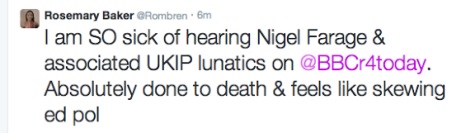
And this was far from the only example of BBC journalists publicly showing contempt for political parties outside the “big three” – a BBC Radio 4 producer had this to say:

Rosemary Baker BBC election bias tweet

The BBC’s mail-merged response to Semi-Partisan Sam’s complaint (yes, a complaint was justified) came today via email, and read as follows:

Jasmine Lawrence was tweeting from a personal account. She has been reminded of her responsibility to uphold BBC guidelines. She has deactivated her twitter account and will now be playing no part in the BBC’s election coverage in coming days.

Nevertheless, we acknowledge the strength of your complaint and we can assure you that we’ve registered your comments on our audience log. 

Wow, the audience log. That will definitely stop anything like this from happening again.

What the BBC fail to address in their response is the fact that the remainder of the BBC’s election coverage is not the problem. The problem is the fact that Jasmine Lawrence will remain the editor of the BBC News Channel, presumably resuming full duties as soon as the election coverage is completed on Sunday.

Yes, it is certainly likely that she caused editorial harm and biased coverage in the weeks leading up to the election before her ill-advised tweet saw her stripped of her duties, but how much more damage can she now do in the coming year leading up to the general election?

We all have political preferences, and that’s fine. But the Jasmine Lawrence tweet doesn’t just reveal a tendency to lean one way or the other along the political spectrum. The editor of the BBC News Channel clearly has a deeply ingrained, long held antipathy toward UKIP and the people who support that party or agree with its policies.

Are we really supposed to believe that when she walks into the BBC offices in the morning, Jasmine Lawrence takes off her scornful, UKIP-denigrating hat and puts on her cap of unblemished impartiality, and that the decisions she makes regarding story selection, focusing of time and resources, determining which guests to interview, lines of questioning and other matters will not be influenced by the same sentiments that prompted her to call UKIP supporters white, middle aged sexists and racists?

From the muted BBC response so far, it appears that the corporation remains wholly ignorant or disdainful of the outrage that continued examples of personal bias create among its audience and the British population at large.

Rod Liddle captures and distils this outrage in the Spectator today:

‘I’ve fucking had it with these people. They are so smug; they think they know everything and they know nothing. They want a good kick in the face.’

So said a close friend of mine, more usually a Labour voter, before she went out to vote for Ukip earlier today. I think it was the Jasmine Lawrence thing which tipped her over the edge. Jasmine is, improbably enough, the boss of the BBC’s News Channel. She had ‘tweeted’ that Ukip was a sexist and racist party – yesterday.

Of course, she should be sacked. Right now. The BBC’s News Channel is supposedly impartial – that’s what we pay for, an impartial service. Either that or the BBC should accept that all of its employees possess political views and there is no problem in having them aired. But it will not sign up to that more enlightened position because it knows that 90 per cent of them are as smug, and stupid, and bien pensant as Jasmine.

The latest update from Guido Fawkes reports that a memo has been sent to BBC journalists drawing their attention to pre-existing policies on impartiality. The memo reads, in part:

But the guidance is clear when it comes to personal activity: “As a BBC member of staff – and especially as someone who works in News – there are particular considerations to bear in mind. They can all be summarised as: ‘Don’t do anything stupid’.”

I’d also specifically draw your attention to the following section: “You shouldn’t state your political preferences or say anything that compromises your impartiality. Don’t sound off about things in an openly partisan way. Don’t be seduced by the informality of social media into bringing the BBC into disrepute.”

Don’t do anything stupid – a warning issued rather too late, given the fact that the polls have now closed. But the real damage could lie ahead of Lawrence resumes her duties at the BBC News Channel after the election. If she is reinstated, everything you watch and everything you hear on the BBC’s 24-hour news channel will be filtered through the perspective of someone who thinks that the ~30% of voters sympathetic to UKIP are nothing more than Oswald Mosley blackshirt-style fascists in disguise.

If you believe that actions should have consequences, and that the BBC should have as editor of its news channel someone who is at least able to maintain the illusion of impartiality, you can quickly and easily submit an online complaint here.

Local Elections: Mid-Earthquake Progress Update

Nigel Farage UKIP voting


Over half of the local election results are in, and so far we see UKIP picking up an impressiv number of council seats (139 and counting), running a strong second in many areas (which is impressive but of course delivers no councils or councillors when it happens) and causing mayhem with the fortunes of the other main parties.

Many of the establishment politicians and journalists, who had clearly vested their hopes in the all-out assault on UKIP in the press, have been caught flat-footed and are struggling to agree a line and respond before being overtaken by events when the European election results are announced on Sunday.

Some politicians, who are capable only of showing condescension toward UKIP voters and sympathisers, tried to portray them as victims with neither intelligence or agency, who are primarily economic ‘losers’ with an axe to grind. Labour’s Douglas Alexander epitomised this view on BBC Radio 4 this morning:

I think there is not just a whole group of people who feel left behind by the economy but locked out of politics. ‘There is a deep anger and alienation there and the votes that we have seen for Ukip overnight are in part a reflection of that reality.

But others showed more nuance and tact:

When the left pipes up about Ukip voters’ worries being reducible to either the “cost of living crisis” or a tangle of concerns around job markets and public services, they get nowhere near the whole story … When you meet a Labour-Ukip switcher who expresses worries about immigration, you can’t simply reduce what they say to falling wages and the lack of social housing.

A plurality – including those who know how the main parties behave – clung to the naive belief that the only thing needed is a change of tone and marketing from the main political parties:

The success of Ukip is a direct and inescapable consequence of the abject failure of the mainstream parties to connect with deeply disillusioned voters. It doesn’t need Dave and Ed to light up a fag and be photographed from now on only with a pint of beer in their hands – perish the thought – it just needs them to start talking a language that vaguely resembles the language the rest of us speak.

Of course, this unlikely formula for success relies on the supposition that the establishment politicians can still remember how to speak the same language as the people they supposedly represent, and that the likes of David Cameron and Ed Miliband might suddenly startspeaking frankly and honestly about Britain’s difficulties and opportunities without having their statements parsed and filtered through party-approved talking points.

Some newspapers have at least had the self-awareness and humility to examine their roles in the anti-UKIP onslaught ahead of the polls, acknowledging that the wholesale, scornful vilification of UKIP supporters not only backfired but was actually wrong:

Over the past week or so … something interesting began to emerge … A collective outbreak of sneering, which started to transcend the party itself and blur into a generalised mockery of anyone minded to support it. You could see it most clearly in the rash of satirical(ish) #WhyImVotingUkip tweets that are piling up even now (e.g. “Because I’m uneducated,uncultured, white and old”) and it’s not pretty: an apparent belief that to vote UKIP is to be an idiot of some description, either bigoted or duped, and worthy of little more than contempt.

… if people are supporting Ukip in such large numbers – even after the media’s massed guns have been rattling at it for weeks – it is probably time to drop all the sneering and think about why.

Rod Liddle at The Spectator came out hard against the “London elite” and their attempt to halt UKIP’s progress at all costs:

But it wasn’t just [the BBC], it was a whole bunch of other stuff too. The splenetic fury which the London elite sprays, mindlessly, upon those who do not agree with its views. I’ve fucking had it with these people too, to tell you the truth.

And a commenter at the Spectator expressed his frustration with those national newspapers who are naturally sympathetic to UKIP’s policies but chose to join in the chorus of misinformation and one-sided anti-UKIP coverage:

Nah, what [did] it for me was to see The Sun, The Mail and The Telegraph sticking the boot into Nigel Farage for expressing concerns those papers usually share.

I mean any other day of the week these newspapers are full of immigration stories, Romanian crime gangs etc, but come election time the papers decided to reinvent themselves as metropolitan luvvies backing the establishment parties and pretending Nigel is a dangerous extremist.

The results are still coming in, so it is natural that the party responses (and attempts to lay the blame) are all over the place. But the local council elections clearly have the main political parties (the “legacy parties” to use Nigel Farage’s terminology) spooked, and a convincing first place for UKIP when the European election results are announced on Sunday will really give them reason to pause and look at themselves.

For those of us watching, the fact that the election results are spread out over three days may be a good thing. By the time the European election results come in, the stock answers and meaningless mea culpas of the politicians and the talking heads will have been used up – and they might be forced to start saying what they really think.

The N-Word

N word


One special word has been trending heavily in the British media over the past week, but you are unlikely to have seen it spelled out in print or on screen. Like the character Lord Voldemort from the Harry Potter series, prevailing opinion and political correctness (albeit of the most well-intentioned kind) decree that it shall not be uttered, but only alluded to or heavily disguised for fear of the harm that it may do in its raw form.

Lord Voldemort burst back into the British news this time when popular television host, columnist and author Jeremy Clarkson (of Top Gear fame) had to plead for his job after being caught uttering the word while reciting a rhyme. Such was the frenzied speculation over whether Clarkson had indeed said the word that the Daily Mirror, in possession of the video clip, hired forensic audio experts to analyse the soundtrack in an attempt to decipher the contentious mumbled phrase. In the event, Clarkson apologised as he has never apologised before (rightly so), and lives to offend another day.

But as usually happens when making policy based on political correctness and overwhelming fear of public opprobrium rather than sound reason, the application tends to be panicked, sporadic and contradictory. So it was that after the A-list Jeremy Clarkson was let off the hook with a ‘final warning’ from the BBC and allowed to keep his position despite actually saying the word out loud with his own mouth, the decidedly C-list David Lowe, a provincial radio DJ, was peremptorily asked by the Corporation to resign for unwittingly playing a song containing the same word.

(BBC policy apparently decrees that as you move up the fame hierarchy you can earn the right to skate closer to explicitly saying the word in public without being fired. If the BBC’s top ten stars banded together and offered up their annual vacation allowance and overtime, presumably they could sing the word in the style of a four-part Bach fugue at the start of the Nine O’Clock News.)

What is more concerning than a BBC television star’s casual utterance of the word or the network’s inconsistent treatment of those who fall foul of the complex web of unwritten rules that govern its use, though, is the craven way that the media, almost without exception, voluntarily choose to censor themselves when reporting these stories. Somewhere along the way it was decided that not only is it wrong to say the word in anger (quite rightly – no decent person should), neither is it okay to write or speak the word in the course of a dispassionate news broadcast. And so news consumers are patronised with that childish and awkward compromise, the N-word.

Make no mistake: the word-that-shall-not-be-named is a hateful thing. It brings forth horrible echoes of enslavement, beatings, lynchings and repression, the worst that humanity can do to its own kind. And within some people’s living memory it evokes painful recollections of segregation, discrimination, bullying, voter disenfranchisement and domestic terrorism. But driving the word out of the public discourse completely cannot undo any of these wrongs – the main effect is only to spare us from having to face up to the brutal connotations that come along with it. We may claim to disguise the word for fear of causing offence, but it is just as much an evasion to spare ourselves from feeling discomfort.

The comedian and great observer of human nature, Louis CK, captures this evasion-disguised-as-concern perfectly in his stand-up HBO special comedy routine, “Chewed Up”:

Everybody has different words that offend them, different things that they hear that they get offended by… To me, the thing that offends me the most, is every time that I hear “the N-word.” Not “nigger” by the way. I mean “the N-word.” Literally, whenever a white lady on CNN with nice hair says, “The N-word,” that’s just white people getting away with saying “nigger,” that’s all that is. They found a way to say “nigger.” “N-word!” It’s bullshit ’cause when you say “the N-word” you put the word “nigger” in the listener’s head. That’s what saying a word is. You say “the N-word” and I go “Oh, she means ‘nigger’.” You’re making me say it in my head! Why don’t you fuckin’ say it instead and take responsibility, with the shitty words you wanna say.

CK is right inasmuch as that journalists are not really letting themselves off the hook by referring to the ‘N-word’ rather than its expanded form. Since journalists are effectively planting the word in peoples heads when they refer to the ‘N Word’ in a story, all that refusing to spell or speak the word out in full does is imbue that specific arrangement of letters with some nonexistent, mythical power that must be feared and respected.

The media’s unwritten policy would be slightly more understandable if it applied equally to other racially derogatory terms, but this is not the case. When three football supporters were charged with racial aggravation for chanting the word “yid” at two football matches, the BBC reported on the story and included the word “yid” in the headline. And several years ago BBC Four broadcast a documentary entitled “Kike Like Me”, in which the film maker “goes on a personal journey to find out what it means to be Jewish in the modern world”. But no matter how clinical or non-aggressive the context may be, the word occupies an exalted place among the racial slurs requiring it alone to be diluted before publication.

Yes, the word ‘nigger’ is about as deeply unpleasant a word as can be said. Used as a derogatory term, it has an abiding power to hurt – your blogger speaks from occasional painful experience on the receiving end. But because the word is so hateful, let those in the business of reporting the news show the word’s use in anger to be the outrageous and insensitive thing that it is – by repeating it, straight-faced and in all of it’s ugliness, not by sugar-coating it in the form of a child’s euphemism.

If, in the year 2014, someone in a position of prominence still decides to use the word ‘nigger’ in a derogatory or throwaway manner, we shouldn’t report it euphemistically as though we were embarrassed children tattling about a schoolyard transgression or other act of naughtiness to a teacher – “he said the F-word, she said the C-word!” – we should report it with the honest and brutal simplicity that the facts dictate.

This isn’t school. We are all grown-ups here. So let’s reflect that in our journalism, and put the N-word to bed.

The Establishment Rounds On UKIP

nigelfarage_nickrobinson

It is neither astonishing nor controversial to observe that the British political establishment – politicians and their client political journalists alike – have only animosity and contempt towards the UK Independence Party and the 30 per cent or more of the British electorate who are likely to vote for them at the European Parliament elections later in May.

From their attempt to pre-ordain the outcome of the recent Nick Clegg vs Nigel Farage debates on Britain’s place in the EU to their laser focus on UKIP’s lunatic fringe, the British media has not been shy to express its negative opinion of euroscepticism or those who in any way seek to change the status quo of Britain’s place sulking at the periphery of EU decision-making.

But there are few examples of this bias – borne out of desperation to discredit the insurgent party and a refusal to engage on any issues of real substance – more telling than the BBC’s latest ‘interview’ with Nigel Farage. Nick Robinson asks the questions, and the thrust of his interrogation is this: because Farage employs his wife, a German citizen, as his personal secretary, UKIP’s arguments about unrestricted European immigration causing downward pressure on wages and reduced employment of indigenous workers are hypocritical, and that Nigel Farage is therefore totally discredited and borderline corrupt himself.

http://www.youtube.com/watch?v=yTXYlJNZ7tU

A couple of observations to start. Firstly, this blog is in agreement with the need to curb the persistent practice of politicians (be it MPs or MEPs) hiring family members purportedly to serve as ‘staff’. Sometimes it seems as though absolutely nothing was learned as a result of the parliamentary expenses scandal, when various relatives of politicians were found to be on official payrolls with nominal job titles but no demonstrable evidence of working to earn their money. Though the ideal of competitive and non-discriminatory hiring practices for political staffing jobs may never be reached, we could at least stop politicians from overlooking genuine talent in order to hire gormless relatives. That being said, there is no indication or suggestion that Nigel Farage’s wife is anything other than competent and qualified.

Secondly, this blog supports a liberal, open immigration policy. That is not to refute the various arguments on immigration made by UKIP, or to endorse them; whatever the net effect of unrestricted European immigration on wages and unemployment of British-born workers, it is best debated on other pages. But this blog sees only benefits to making it as easy as possible for skilled and talented people from all over the world to come and to contribute to Britain.

Back to the interview.

Not content with asking his simplistic question – “how can you claim to defend British jobs when you employ a German secretary?” – one time, Nick Robinson indulges himself with a lengthy Jeremy Paxman-style grilling, repeating the insinuation of hypocrisy and scandal (in his trademark bemused and facetious manner) in various different permutations:

You’ve warned about Europeans taking British jobs. Your wife is German! She is your secretary. She’s paid for by the British taxpayer … Was your wife taking someone else’s job then?

Farage’s response – that in his particular case, the hours and demands of the work (late nights at his house) made the secretary role particularly well suited to a spouse, making her the logical choice – did not satisfy Robinson, who continued:

You try to turn everything into a joke. You have a campaign that says that Europeans are taking British jobs. You employ a German woman to work in your office. She happens to be your wife. She happens to spend many hundreds of thousands of British taxpayers’ money. How do you justify it?

Nick Robinson knows full well that Farage’s (and UKIP’s) argument about British jobs being under threat – whether it is a legitimate concern or not – refers to the lower end of the job market, the low-skilled positions, and not to more highly skilled or specialised political staffers. But acknowledging this basic fact would undermine the attack on Farage’s credibility, and so Robinson declines to recognise the distinction.

Farage also points out that Robinson is singling him out for hiring a relative, something that is regrettably common and largely unremarkable in Westminster:

One in four MPs at Westminster employs a close family relative, but actually what’s happening the past two weeks, of 73 British MEPs, I’m the one who is being singled out, and [the press is] saying “goodness me Mr. Farage, you’re costing the British taxpayer an awful lot of money.”

At least one disaffected member of the public spoke wisdom, shouting “What about economic policies?” in the background. Quite right too – what about economic policy? What of the genuine economic costs and benefits of continued British EU membership vs a negotiated secession? The BBC was clearly not interested in following these important lines of enquiry. or asking about specific policy prescriptions.

Gazing on the scene from his adopted home in America, Andrew Sullivan (whose British political acuity has diminished with his years of absence) actually saw Nick Robinson’s glib attempt to concoct a scandal as an example to praise and emulate:

The idea that they [Washington press correspondents] would wreck their access by asking a politician questions that he really doesn’t want to answer – “Isn’t your wife German?” (see above), “Can you give us evidence for your crazy pregnancy stories?” – is preposterous.

So I give you the above video, by the intrepid BBC political reporter, Nick Robinson. Watch him go for the jugular, and watch him not release his grip until the prey is whimpering, near-lifeless on the ground. 

Nick Robinson, intrepid?

This really speaks more about the parlous state of political journalism in Washington D.C. than it does about anything else. So deferential are the Washington press corps to those in power – and Sullivan rightly refers to the recent annual White House Correspondents’ Dinner – that any hounding or questioning of a party leader must in itself seem dedicated and fearless. A closer attention to the specific question being asked, however, would have shown that Robinson’s approach was far from being brave or principled. Sullivan is right about the non-deferential tone of British political interviews being a positive thing, but dead wrong in singling out this particular establishment hatchet-job as  the pinnacle of good journalism.

The BBC had a golden opportunity to ask some real questions of Nigel Farage, to delve into policy differences with the other parties or at least to engage in a bit of speculation and expectations-setting with regard to the upcoming European elections. But they weren’t interested in the policy discussion (the noble option) or in analysing the polls (the political infotainment option). They went instead for the classic hatchet job, the interview ambush that neither educates the informed viewer or grabs the attention of the casual viewer, serving instead only to give David Cameron, Ed Miliband and Nick Clegg some weak ammunition for their negative anti-UKIP political ads.

This was the cheap and tawdry approach taken by a news organisation (if this interview and other recent form is anything to go by) that is becoming increasingly lazy and only comfortable discussing the European Union debate through the existing lens of Labour vs Conservative, more Europe vs a little bit less Europe. The alternative – an end to British membership of the EU – is seen as so radical and threatening to the establishment that it must simply be ignored, or (when feigning ignorance is no longer possible) loudly ridiculed and discredited.

Polling day is on Thursday 22nd May. Soon we will know whether the Nick Robinson strategy has been enough to save the British political establishment from electoral humiliation.