What Kind Of Politician Has To Enshrine Their Own Promises In Law?

David Cameron - Conservative Party - NI VAT Income Tax Lock - General Election 2015


“No other chancellor in the long history of the office has felt the need to pass a law in order to convince people he has the political will to implement his own Budget”George Osborne, 2009

“We will legislate in the first hundred days to make sure these taxes can’t go up” – David Cameron, 2015


What kind of politician has to promise to enshrine their campaign pledges in law?

The answer, of course, is one who cannot be trusted – one who knows that their promises are quite unachievable, but desperately wants to portray a strong belief in their viability. And this is exactly the cheap trick now played by David Cameron and George Osborne, only five years after they mocked Labour Chancellor Alastair Darling for doing the same thing.

The Spectator drily summarised the Tories’ announcement in their Election 2015 Espresso bulletin:

The Conservatives would bring in a law to block rises in VAT, income tax and national insurance for the duration of the next Parliament, David Cameron said today. ‘Why can I make this pledge? Because I’ve seen the books, I know what needs to be done,’ the Prime Minister said. And evidently what needs to be done is to have a pointless law brought in by a leader who once promised to cut red tape. ‘If you trust me, vote for me,’ Cameron says – but his promise of legislation shows that he thinks the public don’t trust him to keep to his word. 

Of course, the Conservative promise to place a legal restriction on government preventing it from raising the “big three” taxes will do no such thing. There is already a legal requirement in place committing the government to eliminating the deficit by the year 2015, and yet here we are, about to go back into the polling booths, and the deficit was not even cut in half – with the national debt continuing to soar upwards.

Will George Osborne find himself on the wrong side of a prison door for having failed to eliminate the deficit? Will the coalition cabinet all receive criminal records? Or will they or the government face civil penalties (raising the hilarious prospect of the government having to pay itself a fine for breaking its own law)? Of course not. These “laws” aren’t worth the paper that the party press releases are printed on, or the air that emanates from the Prime Minister’s mouth as he patronises the British people.

Continue reading

General Election 2015: There Will Be No Passion Until We Rediscover Our National Ambition

David Cameron - Nick Clegg - Passion - General Election 2015


As the 2015 general election campaign grinds past the halfway point with none of the main party leaders doing or saying anything remotely interesting or inspiring – choosing only to shriek about the chaos and carnage that their opponents would do in government – people are starting to ask: where is the passion?

The Spectator’s Fraser Nelson and James Forsyth pick up on this supposed lack of “passion” in politics in their recent interview with David Cameron, conducted as the Prime Minister hurtles around Britain failing to electrify voters with talk of his Long Term Economic Plan and doomsday scenarios about a Labour-SNP government.

Interestingly, Cameron appears totally bemused that his coalition government’s technocratic, risk-averse management of the country from 2010-2015 has failed to win him legions of adoring fans:

The Prime Minister is aware of the criticism and finds it ‘frustrating’. ‘I feel I have worked my socks off for the last ten years to get to this point,’ he says. ‘I feel we are on the brink of something amazing in our country. If I don’t succeed on 7 May I will be furious more for my country — but furious for myself.’ He says this quietly, not crossly, as if he has been confronting his own political mortality. ‘We have done so much to get so far — I do not want to pull back now.’ And then, a promise to do better: ‘If I need to do more to communicate that I will.’

What he is trying to communicate in the final fortnight of the campaign is that Britain’s recovery has been extraordinary, but that it didn’t happen by accident. And that if people want the recovery to continue, they’ll have to vote Conservative. He is writing the speech he’ll give that day, with ‘jobs’ scribbled as the first bullet point. He has created them at a faster rate than any prime minister in history, which he puts down to tax cuts and welfare reform. So he is travelling to Yorkshire to sell ‘an extremely positive plan to transform the education of young people in our country, to keep going with this welfare revolution’.

He accepts that the revolutionary character of his government is not widely appreciated. ‘I think it is very undersold in many ways,’ he says. He doesn’t say by whom. He later refers to the government’s ‘quiet revolution: pro-work, pro-saving, pro-enterprise’.

Revolutionary character? The coalition government came into power promising an economic recovery and the elimination of Britain’s vast budget deficit. It achieved the former but failed spectacularly to eliminate the deficit, reducing it only by a third (now changed to a “half”, thanks to the disingenuous use of different metrics). The Labour Party would have likely done far worse, but this is beside the point – a stable economy should be a hygiene factor, the absolute base in terms of expectations of a “revolutionary” government.

Continue reading

Resisting The Evil Tory Austerity Agenda Through The Power Of Poetry

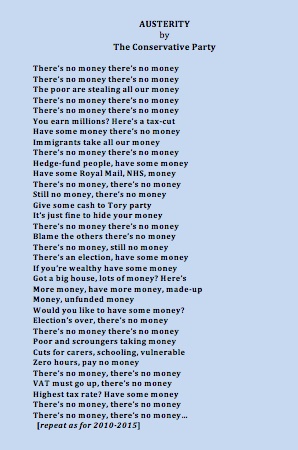
Austerity poem - David Schneider - Conservative Party


Meet Dave Schneider.

Dave is an actor (as well as being a writer, director, coach, voiceover artist and social media guru).

But despite the demands of his multifaceted career, Dave still managed to have a good, long think about the injustices of “austerity”, and produce this gem of a poem.

Here’s the best bit:

There’s no money there’s no money

Hedge-fund people, have some money

Have some Royal Mail, NHS money,

There’s no money, there’s no money

You get the drift.

Naturally, all money belongs to the state, and exists to be parcelled out equally among all British citizens (as well as anyone else who wanders across the English channel, apparently). So Dave Schneider is able to talk about “NHS money” and “Royal Mail money” with a straight face, because as far as he is concerned, money doesn’t belong to the entrepreneurs, risk-takers or investors who create it – it all belongs to the government.

Thus tax cuts are phrased as “have some money” from the state, because in the world according to Dave Schneider, the money never belonged to the people who created it in the first place.

So let’s all join in a rousing chorus of “There’s No Money”. And when we have memorised and recited the Austerity Poem, perhaps there will be time left over to perform some pro-NHS propaganda street theatre.

After all, there’s no such thing as bad art among the anti-austerity crowd.


h/t Vickster51Corner.

Tim Montgomerie, The Good Right And The Battle For British Conservatism

David Cameron - Conservative Party - Tory Compassion - General Election 2015


With the opinion polls still neck-and-neck, David Cameron and the Conservative Party have good grounds to worry that they are not pulling ahead of Labour in the final month of the 2015 general election campaign.

The BBC’s poll of polls puts Labour and the Conservatives on 33% each, which, when constituency boundaries which favour the Labour Party are factored in, means that Ed Miliband’s party are potentially on course to win more seats than the Conservatives, throwing several highly unwelcome left-wing coalition scenarios into play.

Naturally, this is causing much hand-wringing both within the Conservative Party and the Tory-friendly press. But interestingly, much of the free advice being bandied about is encouraging the Conservatives to try to fight the election on Labour’s natural turf (such as emphasising the importance of public services), or to tack even further to the centre, in spite of UKIP’s challenge from the right.

The chief proponent of this strategy is Tim Montgomerie, who uses his most recent Times column (+) to argue that “a show of compassion” (whatever that means) from the Conservative Party could help to “swing the vote” in their favour. Montgomerie is absolutely correct in his diagnosis of the situation – an increasingly coddled, government-dependent British population representing unfertile electoral ground for the politics of individualism and self sufficiency – but hazy on his proposed remedy.

First, the good analysis:

The centre right has to worry that while Tony Blair was wooing Middle England it was really Gordon Brown who was running Britain. Blair was at the front of the shop but Brown was in the control room, overseeing the huge expansion in the number of people who received part or all of their income from the state. Even now, with austerity under way, 52 per cent of Britons receive more from the state than they pay in taxes. There are, to echo Mitt Romney’s infamous and ham-fisted description, more takers than makers. People who are dependent upon the state have every incentive to vote for bigger and bigger government and to get someone else to pay for it — especially, of course, “the rich”.

A redistributive, bash-the-rich message was exactly what helped Barack Obama defeat Governor Romney. If America, land of the free and home of the brave, was willing to choose big state interventionism over small state individualism then it’s hardly impossible that Britain might do the same in a few weeks’ time.

If ever there was a statistic to shock and shame British conservatives, it should be the fact that 52 percent of Britons are net financial beneficiaries from the state. In the conservative model society, there should be generous welfare support available for those suffering true hardship or disadvantage, but a level playing field and light-touch government regulations freeing everyone else to succeed to their potential.

Continue reading

Labour’s Arrogance Could Cost Ed Miliband The Election

Ed Miliband - Austerity - TUC March For The Alternative - Arrogance


With less than a month to go until the 2015 general election, the London Evening Standard (print edition) is currently running a Constituency Focus series, exploring the different dynamics and personalities at play in London’s diverse boroughs and constituencies.

Yesterday saw the focus on the constituency of Hampstead and Kilburn, this blogger’s home turf, with Labour candidate Tulip Siddiq featuring prominently. My own interview with Tulip Siddiq is here, and this blog’s overview of the electoral battle for Hampstead and Kilburn can be found here.

Today the focus moved to the west London constituency of Brentford and Isleworth, an area covering Chiswick, Isleworth, Brentford, Osterley and Hounslow, close to Heathrow Airport. Unsurprisingly, all of the main local candidates are proudly displaying their NIMBY credentials by opposing a third runway at Heathrow.

From the Standard:

In the Tory stronghold of Chiswick, the issue of school places dominates; while in the traditionally Labour-supporting parts to the west, NHS waiting times are the hot topic.

But the one issue that is a major talking point across the whole of the Brentford and Isleworth constituency is the proposed Heathrow expansion, which both the main candidates oppose.

Conservative candidate Mary Macleod won by just 1,958 votes in 2010, making this the 65th most marginal seat in the country. The constituency … is also one of the Tories’ 40/40 seats – 40 to win, 40 to keep.

But it is on the subject of austerity that a real difference is revealed between Labour and Conservative philosophies.

Ruth Cadbury, a long-serving Labour councillor and part of the Cadbury chocolate dynasty, is standing as the Labour Party candidate in the general election. And when she spoke about the level of Conservative support in the wealthier parts of her constituency, she had this to say:

Continue reading