In The Presence Of RBG

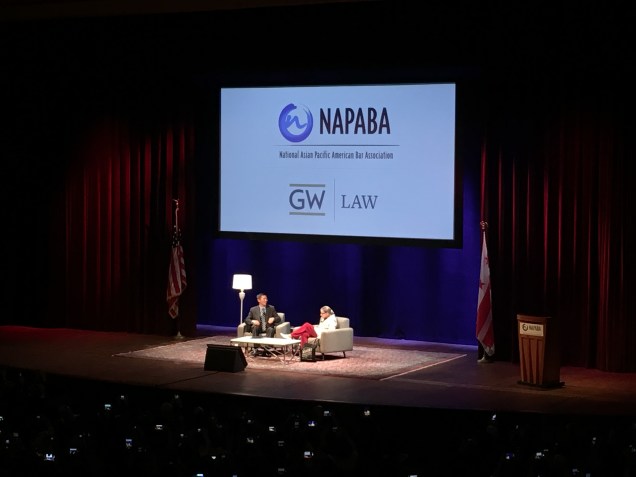
IMG_6301


Justice Ruth Bader Ginsburg deserves to be celebrated for her trailblazing career and for her jurisprudence, not simply reduced to a pop culture meme and uncritically worshipped for supporting the progressive political agenda

Today, the famed Justice Ruth Bader Ginsburg, Associate Justice of the Supreme Court – now better known as the Notorious RBG – came to speak at my law school. As well she should, perhaps, since she only lives about six blocks away…

It was good to hear the justice and see her firsthand, though if you have watched any of her other recent appearances or speeches (as I have) you would not have learned anything new today, besides a few interesting factoids about the various films and documentaries being made about her life and career.

I have become rather wary of the “cult of personality” which builds up around some jurists, most notably in recent years Antonin Scalia and Ruth Bader Ginsburg – not because either are at all undeserving of the praise and respect they receive(d), but because treating a justice of the Supreme Court first and foremost as a warrior fighting for one’s own pet political issues contributes significantly to the politicization of the court. Especially now, when many American institutions – from the presidency to Congress to the media – face a corrosive crisis of legitimacy, doing anything which makes the Supreme Court even more of the extended political battlefield that it already is seems reckless.

Already we have a president who has vowed to only nominate candidates with preset positions on hot-button issues like abortion, and leftists who call for adding seats to the court to dilute the “conservative” voting bloc – we don’t need to go any further in those unseemly directions.


Also from a political perspective, it does not go unnoticed that the first woman to serve on the United States Supreme Court conspicuously fails to enjoy the same acclaim and cult of personality reserved for Justice Ginsburg, the second. Sandra Day O’Connor, nominated by Ronald Reagan and who served on the court from 1981 to 2006, was every bit the trailblazer as Ginsburg. O’Connor, too, had to contend with endemic sexism in her career and achieved a level of success which sets a shining example for aspiring male and female lawyers everywhere. But of course O’Connor, nominated by a Republican president and with a voting record to the court’s ideological right, does not make such compelling Hollywood fodder in a culture which often only celebrates women to the extent they espouse mandatory progressive values. This is a real shame, because O’Connor’s story is very inspiring in its own right. Overlooking O’Connor in order to bestow all of our adulation upon “The Notorious RBG” is akin to ignoring Neil Armstrong and venerating Buzz Aldrin as the only hero of Apollo 11.

As it happens, both Scalia and Ginsburg have written opinions and dissents which I admire (with my still largely-unformed legal brain). I am generally of the opinion that it should be for the state and federal legislatures to explicitly expand enumerated rights by statute or Constitutional amendment rather than continue the charade of having the Supreme Court “discover” new rights which were apparently lurking all along undetected in the words of the founding document. The latter seems like a disingenuous approach, albeit one pursued by both Left and Right on different occasions.

And as Ginsburg pointed out in her remarks this evening, explaining her own equivocation on Roe v. Wade, it can actually be counterproductive for an overly activist court to overstep its bounds and create sweeping new rights at the vanguard of social change. Why? Because this can lead to a political backlash and give opponents a single case law target on which to focus their fire, rather than having to “fight in the trenches” to oppose change in the fifty individual states. How much more secure would Roe supporters now feel in the Age of Trump if the rights they seek to preserve rested upon something more than one solitary Supreme Court decision?

Regardless, there is nothing like looking at Justice Ginsburg’s biography and accomplishments to make one feel inadequate. Here is someone who attended both Harvard and Columbia law schools, served on law review, came up through the ranks of the legal profession when there was real overt hostility to women lawyers, and served a quarter century and counting on the United States Supreme Court. Meanwhile, I plod through my Civil Procedure casebook and try in vain for the third time to understand what the blazes I am supposed to take away from Pennoyer v. Neff.

But I certainly return to my casebooks this evening with an injection of fresh motivation and inspiration. I do not agree with every last one of Justice Ginsburg’s opinions or share her overall judicial philosophy, but I still come away full of admiration, having briefly been in the presence of a real giant of the law. If, at the end of my own legal career I can look back and claim to have made one hundredth of the contribution to law and American life accomplished by Justice Ginsburg then I shall consider my decision to pursue this new calling vindicated one hundred times over.
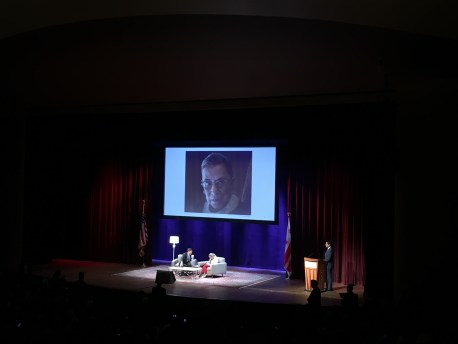
 

IMG_6310

Support Semi-Partisan Politics with a one-time or recurring donation:

Agree with this article? Violently disagree? Scroll down to leave a comment.

Follow Semi-Partisan Politics on TwitterFacebook and Medium.

MSNBC Goes To Flint, Learns Nothing

Flint Michigan - Chris Hayes - Michael Moore


The Establishment Left’s strangely non-diminishing sense of entitlement was on full display in Flint, Michigan

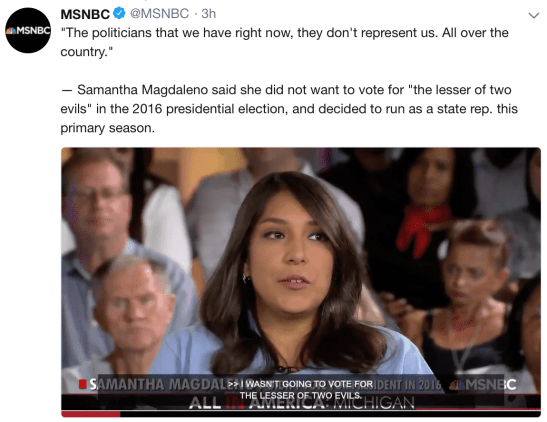
Today, Chris Hayes of MSNBC broadcast a special live town hall from Flint, Michigan, the place made famous by the poisoning of its water supply and the near-criminal incompetence of some of the people responsible for the public’s safety. Left-wing filmmaker Michael Moore has also made the Flint story a personal cause of his, and today both he and Chris Hayes were together, live before a local audience, to talk about national politics viewed through the prism of this beleaguered town.

At one point in the panel discussion, Hayes introduced a number of local people who were non-voters; people who either did not vote at all in the 2016 general election or who voted for down-ballot candidates but refused to cast a vote for either Donald Trump or Hillary Clinton for president.

Almost to a person, these non-voters talked about the fact that despite having been Obama voters in 2008 and 2012, they could not bring themselves to vote in 2016 when the Democrats offered no “inspiring” candidate. One got the sense that many of them may have gladly voted for Bernie Sanders, had the Clinton and Democratic Party machines not unfairly muscled the Vermont senator out of the race, though this was not explicitly stated by anyone during the segment.

For the life of him, Chris Hayes simply could not understand this position. It did not compute. At one point, he told one of the non-voting interviewees that MSNBC viewers were likely “throwing things at their televisions” in reaction to what he was saying. Hayes interrogated each guest as to how they could possibly have abstained from voting for Hillary Clinton when a Republican governor had presided over the poisoning of their town’s water supply. He implied that their desire for an “inspirational” presidential candidate was childish and irrational, and that the obvious choice would have been to swallow any misgivings and vote for the Democratic Party presidential nominee.

This exchange highlighted as clearly as anything else the divide within the American Left – the establishment, coastal Left and the once solid-Democrat heartland left-behinds, if you will. The likes of Chris Hayes (and that mainstream brand of left-wing thinking for which he is a mouthpiece) simply cannot understand why a rational voter would spurn the boring, uninspiring technocrat put forward by the Democrats when the consequence of not voting was the election of Donald Trump. Despite having heard testimony from many people about the long-standing issues and decline facing the town – issues which ate away at the community throughout President Obama’s two terms – Hayes was seemingly unable to understand that another continuity technocrat offering more of the same was the last thing that this community wanted or needed.

Michael Moore cut to the heart of the issue:

Why did people stay home knowing that the result was going to be possibly Donald J. Trump? That’s some serious anger at what the system has done to fail this city.


Like most people, I have my issues with Michael Moore. But credit where it is due – Moore was warning about the dangerous complacency of the Democrats and the visceral anger against the status quo in many communities at a time when establishment leftists were rolling out the grand coronation of Hillary Clinton, oblivious of (or unconcerned by) her utter lack of popularity among people who were sufficiently left-wing and non-racist to cast their prior votes for Barack Obama.

Nobody of any significance on the mainstream Left heeded Michael Moore’s warning to take the Donald Trump threat seriously before the election, and the past two years have been their reward. And even now, in the middle of a pilgrimage to a part of middle America which shrugged its shoulders and abandoned the Democratic Party in 2016, still the chief attitude is one of incredulity that people could have been so stupid / naive / selfish / childish / utopian (delete as applicable) as to demand a Democratic candidate in possession of a clear set of guiding principles and an understanding that globalization has been eating away at towns like Flint as surely as is their contaminated water.

Technocracy is not always a bad thing – at a time when regulations and systems of government are infinitely more complex through necessity, experts are needed to administer the system and keep the machinery of state running effectively. However, technocracy is not well-suited to navigating through periods of disruptive change or crisis. What works well when the economy is in steady-state and there are no significant changes afoot in society or industry does not work well when the economy is in difficulty or when huge realignments are taking place on the national and international level.

Conservative scaremongering about her supposed extreme socialism aside, Hillary Clinton was the quintessential technocratic candidate at a time when the people of Michigan and elsewhere needed a candidate who recognized that for them, the status quo was not something to celebrate and build upon; that the structural changes which had delivered nothing but good things for the likes of Chris Hayes and many of us “coastal elites” were not necessarily anything to celebrate in places like Flint.

More than one of the people interviewed on MSNBC who did not vote in the 2016 presidential election have themselves run for public office in the months since. There is no crisis of political engagement or motivation here. There was only a crisis of ignorance and arrogance among a party hierarchy which believed it could impose their preferred candidate and have people like the inhabitants of Flint, Michigan swallow their distaste and offer up their vote.

And after spending a day in Flint in the company of Michael Moore, I am not sure that Chris Hayes, his core audience or anyone within the Democratic Party leadership are any closer to grasping this essential fact.


Michael Moore - Chris Hayes - Flint

Support Semi-Partisan Politics with a one-time or recurring donation:

Agree with this article? Violently disagree? Scroll down to leave a comment.

Follow Semi-Partisan Politics on TwitterFacebook and Medium.

Sandi Toksvig, Gender Martyr

Sandi Toksvig - Womens Equality Party - Gender Pay Gap - QI - Stephen Fry


It is a far, far better thing that she does…

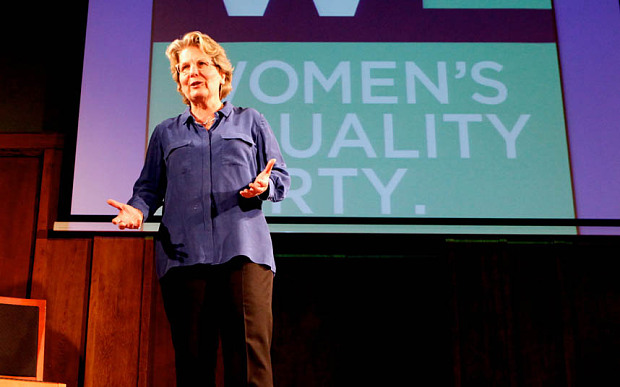
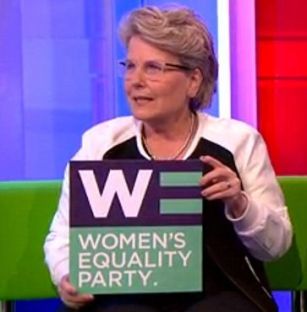
High drama in Britain, as vaguely-known personality Sandi Toksvig reveals – at a meeting of the Women’s Equality Party – that she is not being paid the same as her predecessor, the much more widely known Stephen Fry, to host a television quiz show.

From ITV News:

QI host Sandi Toksvig has revealed she is paid 40% of what the programme’s former host Stephen Fry used to earn for his work on the comedy panel show.

The 60-year-old took over from Fry in October 2016 and her third series as host is set to begin on Monday.

Toksvig was asked a question about her QI salary by an audience member at the Women’s Equality Party conference, where she gave a speech on feminist economics.

She said: “I have recently discovered I get 40% of what Stephen used to get. And I get the same pay as Alan Davies, who is not the host.

“I temper this with the fact that I love the show and I’m the first woman to host such a show.”

What a long-suffering, patient martyr Toksvig is, bravely accepting her lower salary and taking stoic comfort in the fact that at least the evil patriarchal conspiracy allowed her to host the show in the first place.

Naturally, cue lots of outrage from the usual voices on social media:


No, there was a “huge gasp” in the room as hundreds of assembled idiots tried to grapple with the fiendishly complex idea that Sandi Toksvig’s market value is not the same as Stephen Fry’s.

Like him or not, Stephen Fry has led a long and varied career as an author, actor, television presenter, and radio host. He played a character in one of the recent Hobbit movies, because presumably the film’s producers thought that his unique characteristics and talents would make their project more successful.

Sandi Toksvig is a supposed comedian and writer too, but her public profile is nowhere near as large. While Stephen Fry’s reach transcends the narrow London-centric intelligentsia, Toksvig largely leans into this niche, her gig on QI notwithstanding. Unlike Fry, Sandi Toksvig was not invited to be in the Hobbit movie because nobody outside Britain would know who she is.

And this latest confected outrage is the entire problem with artificial, upper-middle class moralistic projects like the Women’s Equality Party. In the age of identity politics, when being able to portray oneself as the victim of historic and present injustices confers an enormous degree of power on those with the education and articulateness to wield it, moaning that one is not being paid as much as one’s far more famous predecessor and suggesting that the reason is rooted in gender rather than talent is very lucrative. But it is also intellectually lazy and shamefully exploitative of those contemporary struggles for justice and equality which are actually worthy of attention and support.

Those who gasped when Sandi Toksvig announced a fact as banal and unsurprising as me announcing that I do not command the same fee as Martha Argerich for a Kennedy Center piano recital are engaged in campaign which has less to do with equality and justice and more to do with assuaging middle-class boredom. It feels good to imagine that despite being a well-off person living in a rich country during the age of universal suffrage (and a minimal gender pay gap, once the appropriate variables are factored in rather than disingenuously ignored), one still happens to be one of life’s great victims; that despite being the kind of person who can easily spend the money and time traipsing from the leafy Home Counties into London to spend a weekend commiserating their shared misfortunes with other wealthy white fourth-wave feminists, you are actually engaged in a life-or-death struggle for dignity and freedom.

It might feel good, but that doesn’t make it true.

Remember, too, that these are the brand of feminists who are apparently willing to die on a hill defending Sandi Toksvig’s right to be paid as much as Stephen Fry, but who also furiously protest, hashtag and campaign to eliminate the jobs of less economically privileged women whose line of work does not meet with their fastidious approval. Ask the Formula 1 grid girls or the walk-on women in darts whether Sandi Toksvig’s overbearing, maternalistic brand of feminism has worked well for them.

But then of course this movement was never intended to work for the benefit of all women – just to cement the power and influence of those well-versed in its highly specific nomenclature and its cynical, myopically-focused agenda.


Sandi Toksvig WEP

Support Semi-Partisan Politics with a one-time or recurring donation:

Agree with this article? Violently disagree? Scroll down to leave a comment.

Follow Semi-Partisan Politics on TwitterFacebook and Medium.

Architects Push Back Against Cultural Appropriation Concept Creep

Safe Space architecture diversity


While some professions seem to be capitulating to the mores of millennial fragility and safe space culture without a shot being firedincluding some of the industries once thought least likely to go soft – it is good to see at least one group pushing back.

Sensing a looming threat from a Guardian Op-Ed which seemed to suggest that every irritating aspect of modern buildings is due to a lack of diversity in the profession, editorial director Paul Finch responded in Architects’ Journal:

If, therefore, it is ‘inappropriate’ for a non-Latino person, let alone a non-Puerto Rican, to take a singing role in West Side Story, how long will it be before we are told that only architects with a particular nationality, or better still ethnicity, should design buildings in certain places? A foretaste of possible debate to come appeared in The Guardian recently, where Christine Murray speculated as to whether cities would be better if they were designed by mothers. Not just women, but women with children.

Finch rightly distinguishes between the need to criticism and improve obviously bad and inconsiderate design, which is still prevalent in many new buildings, with the idea that the only people qualified to do so are those who personally possess the specific physical characteristic which needs to be accommodated:

There are all too may example of this, where architecture is commissioned to satisfy one particular group, possibly or sometimes inevitably at the expense of others. Thus, shopping centre design is skewed towards retailers not shoppers; hospitals are designed for doctors, not patients and visitors; and office design focuses on corporate tenants, not office workers.

This happens where clients are mentally lazy and/or their architects are not up to the job. It is about quality of thought and little else. That is why it is a meaningless question to ask whether cities would be better if mothers designed them: it would depend not on their being mothers, but on being good designers.

Finch’s conclusion:

A plague on the houses of the cultural appropriation brigade, with their increasingly shrill and unpleasant zealotry. In the world of architecture, borrowing, stealing, inspiration and design miscegenation have been an essential part of its evolution for millennia. Long may this continue.

A hearty amen to that, but one wonders if it is wise for someone of any prominence within the creative industries to push back against progressive dogma so publicly. Brave, certainly, but also risky. Watch this space for the likely groveling apology and hasty retraction to come…

Safe Space Concept Creep Reaches The Military-Industrial Complex

screen-shot-2018-09-06-at-22-54-08.png


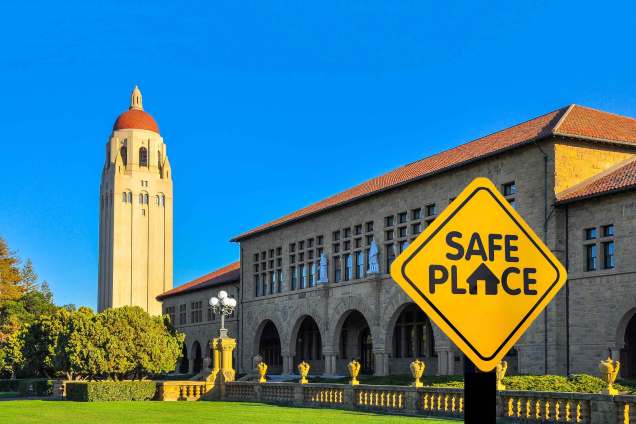
When you think of safe spaces, the image which now most often comes to mind is that of infantilized, artificially fragile undergraduates huddled in a room with soft toys, Play-Doh and puppy dog videos, weeping because someone slightly to the right of Bernie Sanders set foot on their college campus.

You are less likely to conjure this image, painted for us in DefenseNews:

A Trump administration official wants to create a “safe space” for international defense-industrial base cooperation.

As China’s military modernization strategy bridges its civil-military divide and the U.S. National Defense Strategy emphasizes the American industrial base, the Pentagon must protect and encourage America’s international partnerships, according to Eric Chewning, the Pentagon’s deputy assistant secretary of defense for industrial policy.

“As China articulates a civil-military fusion doctrine where they are intentionally blurring the lines between their developments on the military side and the commercial side, we need to work with our allies to create a safe space where we can work collaboratively to do that,” Chewning said Wednesday at the Defense News Conference.

My emphasis in bold.

I’m not quite sure what this looks like – four star generals, Boeing executives and NATO military attachés using crayons to excitedly draw their conception of mind control ray guns bolted onto the next generation of 787 airliners?

In reality I am sure the idea is a serious and worthy one, rooted in long-term strategic thinking. But it is interesting – and slightly  concerning – to note that even the people whose solemn task it is to come up with deadly new ways of waging war are anxious to carve out safe spaces for themselves to operate free from harassment.

And interesting too, that the metastasizing of this concept out of the college campus and into grown-up world is taking place under an administration whose supporters love nothing more than to rail against liberal “snowflakes”.