Labour’s Cynical, Disingenuous National Debt Hysteria

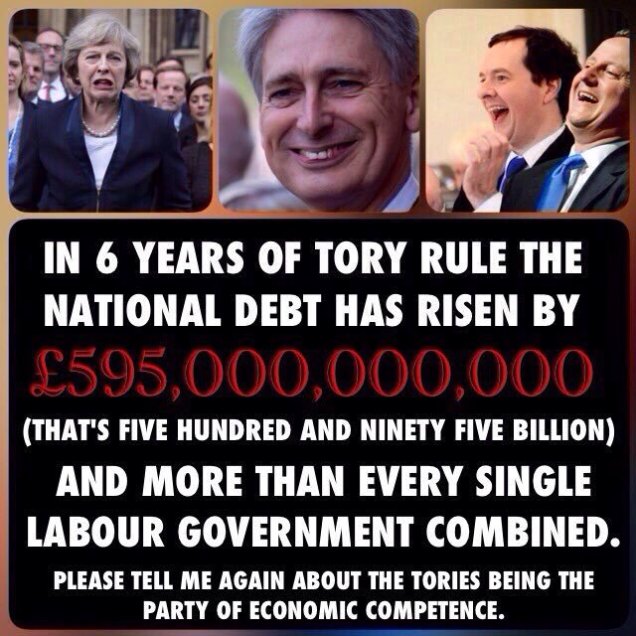
Labour Party attack ad Tories national debt

Pot, meet kettle

You’ve probably already seen them countless times over the course of this general election campaign – the smug, sanctimonious internet memes bandied about by Labour supporters and other left-wing activists excoriating the Conservatives for having presided over a massive increase in the national debt since taking office in coalition back in 2010.

And of course this is factually correct. The only thing missing from these outraged little infographics is an admission of what would have happened to the budget deficit and national debt under fiscally incontinent left-wing economic policies – and the answer, of course, is that the situation would be even worse.

Yet even “serious” publications have been pushing the same disingenuous message, with Alison McGovern recently writing a piece for the New Statesman, demanding “The Tories used the budget deficit to attack Labour – so why haven’t they fixed it yet?”:

Spot the pattern? Tory Chancellors who loudly proclaim the virtues of having a budget surplus, have, in the end, presided only ever over deficits.

But it gets worse. The deficit, as the gap between money coming into the Treasury and money spent, has to be paid for by borrowing. And quite rightly, the Tories’ deficit target was matched by a debt goal. Borrowing to invest in structural improvements to our economy is clearly the right thing to do. But that is very different from permanent borrowing to prop up day-to-day spending.

Yet the Tories have delayed their target on debt three times since 2010

Their original target was to have debt falling by 2015-16. Then in 2014 that was delayed until 2016-17. Then in 2015 the target was to keep it falling every year until 2020-1. Then in 2016 that was changed to be “falling by 2020-1”.

This “goal” looks like one that will always be swerved as the Tory mismanagement rolls on.

Author’s emphasis in bold. McGovern concludes:

The budget deficit was used repeatedly by Osborne as an attack on Labour’s record in office.

This has now been demonstrated to be ludicrous chutzpah. Laughable, if it were not so serious. Ironic, if it were not to have such lasting consequences for all of us.

It’s time we moved on from a debate about the Labour past, and looked at what the Tories are doing today. We should show the leadership the country badly needs, and take this fight on.

Yes, how rude of the homeowner not to instantly repair all of the damage caused by the arsonist.

The bare-faced gall of these people is astonishing. Heading into the Great Recession, the Labour Party under Tony Blair and Gordon Brown consistently ran budget deficits, despite the fact that the economy was growing and boom and bust had apparently been “abolished”. And so when the downturn hit, there was almost zero room for fiscal manoeuvre by the government. Sure, we printed lots of money and nationalised failing banks – didn’t the Left used to angrily call that “privatising the profits and nationalising the losses?” – but we were in no position to undertake the kind of stimulus spending that America unleashed and which Keynesian economics dictates is the correct way to deal with a recession.

The budget deficit naturally exploded and reached a peak just as the Conservative / Liberal Democrat coalition government came into office, reaching a peak of around £160 billion when Labour left office. This means that the national debt was being added to every year at the fastest rate in modern history. To their partial credit, the Conservatives have succeeded in at least reducing the budget deficit every year (thereby slowing the rate of increase in the national debt) though they have consistently relaxed and missed their own targets for doing so, with the budget deficit now not due to be eliminated until the year 2026. And so we now have the spectacle of  smarmy left-wing internet meme-sharers lambasting the Tories for having failed to eliminate the deficit and significantly lower the national debt.

Well, what would they have had the Evil Tories do? The Left squealed like self-entitled pigs when George Osborne made even modest efforts to trim the deficit, repeatedly relaxing the timetable by which he planned to return Britain to a budget surplus. Are the Left now saying that they would rather have had deeper budget cuts? Abolishing the Army, perhaps? Surely not reducing funding for Our Blessed NHS (genuflect)? Or perhaps they secretly intended to eliminate the budget deficit by dramatically hiking income tax and national insurance on all tax bands, in angry defiance of the Laffer Curve? But what when this only suppressed economic activity even further?

Let’s be clear – the Conservative Party, under chancellors George Osborne and Philip Hammond, has been depressingly unambitious when it comes to eliminating the budget deficit. The party of David Cameron and Theresa May has not been the party of fiscal responsibility, and their constant lying about “fixing the roof while the sun is shining” and “paying down Britain’s debts” when in fact they have done no such thing only makes matters worse.

But the only thing more ludicrous than a Conservative Party which struts around pretending to be the guardians of fiscal responsibility is a Labour Party which ran budget deficits in the good years, leaving Britain particularly vulnerable to the loss of tax revenue accompanying a recession, attacking the Tories for having failed to enact measures which they would never have enacted themselves, and which in fact they repeatedly criticised the Tories for even attempting to do. It is simply mind-boggling that the Labour Party dares to attack the Tories on the question of deficit reduction and the national debt when their “anti-austerity” policies would have increased the deficit even further and made the national debt even larger.

Blogger Paul Goldsmith has had enough:

I actually can’t take it anymore. It is economically illiterate and it is self-defeating and it has to stop. It is like someone lighting a fire, which is an inferno when the fire brigade arrives, and then the person who starts it runs around replacing the brigade’s water with oil, and fanning the flames, whilst screaming at the fire bridgade that they can’t believe the fire isn’t out. Yes, Labour’s repeated taunts about the national debt really are that preposterous. Self-defeating too, as it brings attention back onto how the fire got started in the first place.

And then launches into this glorious tirade:

So, having left a deficit of £160bn, and a national debt (cumulative deficits added together), of just under a trillion, Labour have noted that the debt is bigger. Well, duh! Were the Tories supposed to have eliminated the deficit in their first year in Government? Impossible. In fact, what the Tories chose to do is to cut spending, added to a few tax rises, and slowly eliminated that deficit. Very slowly, slower than they originally hoped. But at every turn, every cut, Labour opposed them. Every single one. So yes, every year a lot of deficit (decreasing every time) got added to the national debt, but that is because Labour left such a massive deficit.

Now, yes, they left that deficit mostly because of the action they took to save the banking system and to try and stimulate the economy to stave off depression during the financial crisis. A financial crisis that wasn’t caused by Labour.

But look at the seven years between 2001 and the start of the crisis in 2008. Those were times of economic growth. During times of economic growth that deficit should have been a surplus (tax revenue greater than government spending). But it wasn’t, as Tony Blair and Gordon Brown chose to spend and maintained a deficit of around £40 billion a year. This means there was no financial room to manoeuvre when the inevitable recession came. Of course, Brown had boasted that he might have abolished boom and bust, so may not have been ready for that recession. But when it came, a huge amount of public money was thrown at it, which meant the Conservatives inherited a massive deficit.

Here’s my point, every time Labour mention the addition to the debt under the Conservatives, the Conservatives can just point to what they were left with. Best summed up by the note left by the last Labour Chief Secretary to the Treasury, Liam Byrne, to the first Coalition replacement, David Laws: “I’m afraid there is no money.”

It’s funny. Transport these same leftists to the United States, where beloved Barack Obama ruled from 2009 to 2017 in the aftermath of the same global recession, and they would doubtless shriek with outrage at similarly cynical efforts recently made by the Republican Party to pin the blame for American budget deficits and increasing national debt squarely on the Democrats. They would rightly point out that President Obama inherited a mess, an economy in freefall and public spending jacked up artificially high by his fiscally incontinent predecessor George W. Bush. They would correctly point out that nobody can work economic miracles like making a large structural budget deficit and cumulative national debt disappear in an instant.

But the sanctimonious meme-sharers do not live in America where an admired left-wing president ruled for the past eight years. They live in Britain, where the callous, heartless Evil Tor-ees (they’re lower than vermin, don’t you know!) have been in charge since 2010, and so all of the leeway and understanding that they would demand for themselves is stubbornly withheld from the other side under identical conditions.

As is so often the case, Labour Party propaganda relies on voter ignorance and lack of medium or even short-term memory in order to make an impact. With these lowbrow memes and the highbrow articles which underpin them, Labour Party activists and sympathetic commentators are counting on the British people being too stupid to ask what Labour would have done differently to have achieved a budget surplus and reduced national debt given the same circumstances faced by the Tories.

That’s certainly one way to go about trying to win an election, but there is nothing to be proud of in this tawdry, disingenuous approach.
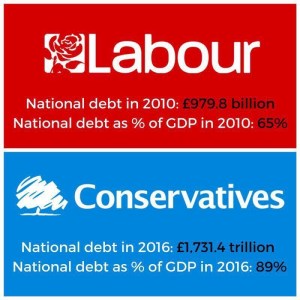
 

Labour Conservatives National Debt - General Election 2017

Support Semi-Partisan Politics with a one-time or recurring donation:

Agree with this article? Violently disagree? Scroll down to leave a comment.

Follow Semi-Partisan Politics on TwitterFacebook and Medium.

The O.J. Simpson Effect And Donald Trump’s Die-Hard Supporters

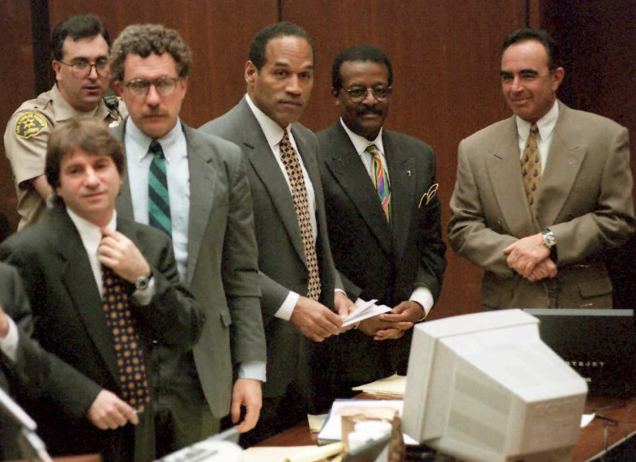
O.J. Simpson (C) and members of his defense team s

Examining the phenomenon of voters who will never reconsider their support for President Trump no matter what he does in office, Andrew Sullivan raises a valid comparison but misses the broader point

I broadly agree with Andrew Sullivan’s assessment of Donald Trump’s presidency thus far (i.e. that it has been a disaster characterised by one self-inflicted crisis after another), while Sullivan’s account of the last week also paints an accurate portrait of a man completely out of his depth:

The White House is barely functioning; legislation is completely stalled; next week’s trip abroad will have everyone watching from behind a couch; the FBI and CIA are reeling; there’s almost no one in the State Department; no presidential due diligence is applied to military actions; the president only reads memos when his name is mentioned in them; a not-too-smart and apparently mute 35-year-old son-in-law is supposed to solve every problem in the country and world; and the press secretary is hiding in the bushes. No one has any confidence that the president couldn’t throw us into a war or a constitutional crisis at a moment’s notice. Nothing this scary has happened in my lifetime.

Sullivan then goes on to ponder why it is that Trump’s devoted base shows no real sign of re-evaluating or revoking their support for the president, and comes up with an interesting analogy:

In some ways, I think the best analogy for Trump is O.J. Simpson. Even if we all know he’s guilty as sin, even if his own supporters see the flimflam behind the claptrap, even if the evidence is staring us in the face, he’ll never lose his core support. For 35 percent of the country, he’ll never be guiltier than the system he’s challenging. The best we can hope for is a Democratic House in 2018 and a grinding, grueling attempt to minimize the already enormous harm Trump has done in the meantime. We can pursue that outcome while hoping our cold civil war doesn’t get hot — because this is beginning to feel like the 1850s.

I was too young (and living in the wrong country) to really understand what was happening or the critical context during the trial of O.J. Simpson in 1995, but I have just finished re-watching the excellent FX television dramatisation “The People vs O.J. Simpson” and the longform ESPN documentary “O.J.: Made in America” – and it seems clear to me that Andrew Sullivan is missing the key lesson from the OJ trial as it pertains to public policy.

Sullivan picks up on the obvious point – that O.J. Simpson was clearly guilty, and that even many of those who proclaimed his innocence actually knew, in their heart of hearts, that the man committed the murders of Nicole Brown and Ron Goldman. So yes, if one wants to keep things superficial then we can join Sullivan in marvelling at the ability of foolish Trump supporters to similarly cast facts and reason aside, motivated by base emotion.

But the real lesson to be learned from the O.J. Simpson case is that no justice system (and by extension, no democracy) can function as it should when there is so much unresolved injustice – real or perceived – within the same system. The OJ murder case took place in the wake of the Rodney King beating and subsequent riots, which themselves took place after years of institutionalised racism within the Los Angeles Police Department. The decision to acquit O.J. Simpson was far more payback for countless previous cases of denied justice than a fair verdict based on the evidence presented at trial. Now, one can rail endlessly against the jury and their decision-making process, but it will do nothing to prevent similar unjust verdicts potentially being reached again in future.

This should be particularly worrying for all of us at the present time, with the Cult of Social Justice and Identity Politics in such ascendancy. With many on the political Left actively seeking to fracture society into competing special interest groups arranged into an intersectional hierarchy of victimhood – a phenomenon which has now escaped the university campus and is beginning to infect the corporate world and other institutions – there has perhaps never been a time when so many have had things so good yet felt so persecuted and oppressed despite their good fortune (just look at any college campus protest).

How will the justice system continue to function in the world of Social Justice, when advancing the interest of one’s own narrowly-defined identity group may increasingly trump the universal need for justice? When even science is forced to bend the knee to progressive gender theory (see Bill Nye the Science Guy’s promotion of Otherkin and forced orgies) what hope can there be for rationality in anything?

Andrew Sullivan is a conservative – or at least he still nominally “identifies” as a conservative. And one characteristic of conservatives is that we generally seek to engage with human beings and the world as they are, rather than as we would like them to be. Unlike the Utopian Left (who have repeatedly flirted with communism, furiously ignoring the fact that such a system inevitably results in tyrannical dictatorship), the Right tend to understand that government and economic policy must work with human nature, not against it. That’s why the Right embraces capitalism – because capitalism harnesses our natural desire for success and monetary reward (the profit motive), and feeds that desire into a system which – to the extent that it is allowed to do its job unimpeded – creates far more prosperity and material abundance for far more people than any other economic system known to man.

With a conservative’s acceptance of human nature, Sullivan should therefore understand that when any given group of people find themselves on the receiving end of perceived injustice for long enough, reason tends to go out the window to a certain degree and people become susceptible to more emotional rather than rational arguments. That’s largely why the O.J. Simpson jury voted to acquit, despite the overwhelming evidence indicating that he was guilty. That’s partly (but not exclusively) why African Americans vote Democrat in such overwhelming numbers, despite the fact that successive Democratic administrations and Congresses have delivered mixed results for them at best. And just to acknowledge that “my own side” are equally vulnerable to this aspect of human nature, it is also partly why a majority of Britons – those with less formal education and those lacking the skills required to prosper in today’s globalised economy – voted against the political elite in favour of Brexit.

You can rail against this human nature all you want – and Andrew Sullivan, having identified that the “O.J. Simpson Factor” is in play appears willing simply to do that – but if you actually want to achieve a different outcome then it is necessary to acknowledge this aspect of human nature and work with it, rather than against it. And in the case of Donald Trump, this will necessarily involve America’s elites actually having to to atone for their manifold failures, which are responsible for giving us President Trump in the first place.

Editor of The American Conservative, Robert Merry, sums it up perfectly:

When a man as uncouth and reckless as Trump becomes president by running against the nation’s elites, it’s a strong signal that the elites are the problem. We’re talking here about the elites of both parties. Think of those who gave the country Hillary Clinton as the Democratic presidential nominee—a woman who sought to avoid accountability as secretary of state by employing a private email server, contrary to propriety and good sense; who attached herself to a vast nonprofit “good works” institution that actually was a corrupt political machine designed to get the Clintons back into the White House while making them rich; who ran for president, and almost won, without addressing the fundamental problems of the nation and while denigrating large numbers of frustrated and beleaguered Americans as “deplorables.” The unseemliness in all this was out in plain sight for everyone to see, and yet Democratic elites blithely went about the task of awarding her the nomination, even to the point of employing underhanded techniques to thwart an upstart challenger who was connecting more effectively with Democratic voters.

At least Republican elites resisted the emergence of Trump for as long as they could. Some even attacked him vociferously. But, unlike in the Democratic Party, the Republican candidate who most effectively captured the underlying sentiment of GOP voters ended up with the nomination. The Republican elites had to give way. Why? Because Republican voters fundamentally favor vulgar, ill-mannered, tawdry politicians? No, because the elite-generated society of America had become so bad in their view that they turned to the man who most clamorously rebelled against it.

These two paragraphs alone do not really do Merry’s piece justice, and I encourage people to read the whole thing, together with Rod Dreher’s follow-up piece.

There seems to exist within the American political and media elite a belief that it will be possible to force Donald Trump from office, either through impeachment, 25th Amendment remedies or coerced resignation, and then simply resume governing in the style to which they are accustomed. This is ludicrous. Donald Trump’s supporters will not take the thwarting of their democratic choice lying down. Trump may be all but guaranteed to fail these people, even if he serves a full two terms as president, but for the Washington elite to effectively engineer a coup against Trump for mere incompetence (smoking gun evidence of direct Russian collusion is another matter, of course) would be to set the social fabric of America, already smouldering, on fire.

In order to put an end to civil unrest and prevent more miscarriages of justice like the O.J. Simpson verdict, the LAPD had to admit to some of their past failings and go through a fairly tortured process to ensure that bad practices and individuals were weeded out of the force. The Christopher Commission (formed in 1991 after the Rodney King beating, but whose effects had not fully taken hold by the time of the OJ murders) was a significant part of this process.

But right now, much of the American elite and political establishment believe that no similar process of atonement and change is necessary. They believe that because Trump is so bad, so unprecedented, that they can agitate for his removal and pick up running the country right where they left off without undergoing any kind of positive reform. And frankly, that notion is absurd.

If one wishes to ensure that the American people never again elect as president somebody with the character, temperament and personal history as Donald Trump, then one must tackle some of the root causes of Trump’s victory. And no, I don’t mean Russian hacking, though Russian influence may have played some as-yet unspecified part.

Rather, the political elite must finally show a degree of empathy for those people whose boats have been submerged rather than lifted by the rising tide of globalisation, and those who hold political, social and religious views which differ from progressive orthodoxy and suddenly find themselves ostracised and labelled “deplorable” as a result. But more than merely paying lip service to these issues, the Washington elite must devise tangible and realistic policies to help these struggling voter constituencies, and demonstrate a plausible commitment to following through with those policies. Only then – if the political elite are willing to take this harsh medicine – can some of the poison finally be drained from American politics.

But Andrew Sullivan doesn’t quite seem to have gotten to this point, still stuck in the phase of scratching his head wondering how Trump’s voter base can possibly be so stupid. This phase is unhelpful, and becomes actively damaging the longer it persists. Nobody behaves entirely rationally all the time, and the phenomenon is by no means restricted to Trump supporters – after all, there is no rationality to be found in that stubborn clique who persist in believing that Hillary Clinton was a wonderful presidential candidate, or those who feel that the European Union is an unquestionably beneficient organisation. We all have our blind spots.

But expecting the country to spurn Trump and accept a return to leadership by the same elites who have presided over such American carnage (yes) in forgotten and unloved parts of the country is to demand that those who have the least make all the accommodations and do all the sacrificing while those who tend to have more are asked to do nothing, give nothing and change nothing.

Donald Trump’s presidency is lurching toward failure, but thus far the dethroned American political elite have done nothing to rehabilitate their standing in the public’s eye; nor have most of them even acknowledged the need to do so.

OJ Simpson had a rock-solid core of support inside the jury room and outside the courtroom for a very clear, identifiable reason which had to be acknowledged and grudgingly tackled by the police and criminal justice system before the racial divide in Los Angeles could even begin to heal. The American political elite are deluding themselves if they believe that they can return to power, normality and stability without going through a similar reckoning of their own.


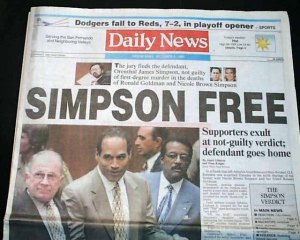
OJ Simpson verdict acquittal - Daily News headline

Support Semi-Partisan Politics with a one-time or recurring donation:

Agree with this article? Violently disagree? Scroll down to leave a comment.

Follow Semi-Partisan Politics on TwitterFacebook and Medium.

Left Wing Self-Awareness Award, Part 2

Samuel Hooper - Left Wing Self-Awareness Award - British Politics - Socialists

Jon Ashworth sees the light

More credit where credit is due to Jonathan Ashworth, Labour’s Shadow Health Secretary, who took a break from leading public worship of Our Blessed NHS (genuflect) to encourage Labour activists to see Conservative voters as potential hearts and minds to be changed rather than unconsionable, amoral degenerates.

From the Guardian:

The shadow health secretary has urged Labour to see Conservative voters as the party’s “friends and neighbours and relatives” rather than portraying those who are attracted to Theresa May’s offer as the enemy.

[..] He claimed that while there was no intention by Labour figures to portray Conservative voters in a negative light, the “febrile world of Twitter and social media can sometimes inadvertently convey that”.

Ashworth said his message was to stress: “Those who vote Conservative aren’t our enemies. They are our friends and neighbours and relatives. We need to be convincing them to switch to Labour where we can.

“They are people who live in our communities – we need to be persuading them as well as ensuring that those who voted Labour in past elections are sticking with us again.”

It’s a little bit cheeky of Jon Ashworth to suggest that there has never been any intention by Labour figures to portray Conservative voters in a negative light. The mere fact that prominent Labour politicians and activists choose to argue in such stridently moral terms about left-wing policies being altruistic and right-wing policies being motivated by base self-interest makes a clear implication that Tory voters are morally deficient – there simply is no other inference to be drawn from the rhetoric.

One might also consider the official Labour party leaflets distributed in the recent Copeland by-election, warning that a Conservative victory would literally “cost mums their children”.

The Guardian reported at the time:

A graphic Labour pamphlet warns voters in Copeland that a Tory victory in the by-election will “cost mums their children” in an open letter aimed at highlighting the risks of NHS cuts in the constituency.

The handwritten letter in support of Labour candidate Gillian Troughton, a St John ambulance driver and former hospital doctor, is from local mother Paula Townsley. The leaflet is the second posted through letterboxes by Labour activists to contain dire warnings about the closures of maternity services at West Cumberland hospital.

Accusing conservative voters of aiding and abetting in the death of babies doesn’t seem particularly inadvertent. On the contrary, it sounds like a deliberate attempt to make conservative policies seem not simply misguided and erroneous (as conservatives believe left-wing policies to be) but deeply, profoundly wicked. And presumably this election pamphlet was signed off by somebody with at least some authority within the Labour Party.

That being said, Jon Ashworth’s clear and explicit exhortation to Labour activists encouraging them to see the humanity in conservative voters (rather than Evil Tory vermin to be avoided or exterminated) can only be a good thing.

Not everybody agrees, though. A below-the-line commenter over at LabourList retorts:

What troubles me is the sacrifices in our values we have to make in order to appeal to Tory voters. What aspects of our manifesto would we have to dump? And how would that go down with our core vote?

None! At this point, you don’t have to make any sacrifices to your values. Just stop treating the other side as though they are pantomime villains, and you will be at least 30 percent of the way there. Dare to imagine that your opponent’s conservatism is borne of a legitimate moral framework and a sincere belief in what is best for society and the country, just as you believe that left-wing policies are the panacea. That’s all you have to do at this stage!

When it comes to toxic left-wing activism, it is the grassroots that do 80 percent the damage – on social media and through their coarse and vulgar protests. Jon Ashworth is correct to say that it is not usually Labour MPs themselves who are most responsible for whipping up anti-conservative hatred – or at least they tend not to do so while the cameras are rolling. Therefore Labour politicians have a responsibility to warn their more hot-blooded activists that treating Theresa May’s really very moderate centrist government as some kind of evil Nazi-like regime to be “resisted” is counterproductive and highly offputting to those who vote Conservative in good conscience.

Jon Ashworth’s conversion to the cause is therefore most welcome.

More, please.


Jonathan Ashworth - Labour Party - shadow health secretary

Support Semi-Partisan Politics with a one-time or recurring donation:

Agree with this article? Violently disagree? Scroll down to leave a comment.

Follow Semi-Partisan Politics on TwitterFacebook and Medium.

Labour Manifesto: Voters Know Left Wing Policies Are Individually Alluring But Collectively Foolish

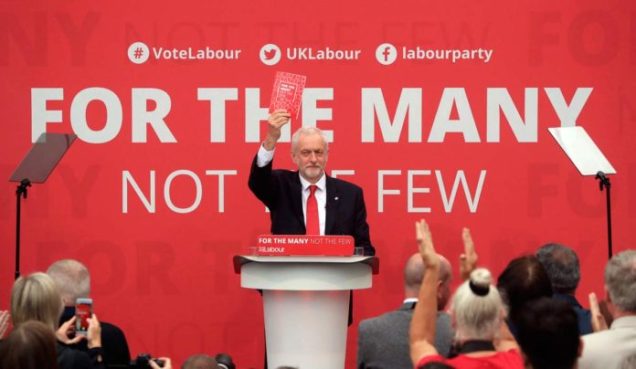
Labour Party General Election 2017 Manifesto - Jeremy Corbyn - For The Many Not The Few

Left-wing party manifestos fail to deliver electoral wins despite the popularity of their individual components because voters are smart enough to realise that promising the moon on a stick is not realistic

One self-deceiving mantra that we hear time and again from the Labour and the British Left is that people supposedly love individual left-wing policies but fail to vote Labour in the same numbers, and that if only they change X, Y or Z then the public will fall in love with the great package deal of free stuff + no responsibility and usher in a perpetual era of socialist government.

Currently, the excuse for failure is Jeremy Corbyn, and a number of leftist activists are busy consoling themselves that the Labour leader’s reputation is the only problem. Swap him out and keep the same policies, the self-deception goes, and everyone will suddenly start clamouring to vote Labour at all times.

How many times have we heard the likes of Polly Toynbee sanctimoniously declaring in a TV news debate that people “overwhelmingly” support left-wing policies like the renationalisation of the railways and the utilities sectors, hiking taxes on “the rich” or funnelling ever-increasing sums of money toward “Our NHS”? Too many to count.

And yes, certain individual policies can be very popular, particularly left-wing ones. If you prance around promising more stuff for less money – better public services, faster healthcare, higher welfare payments, all conveniently paid for by somebody else – you are bound to pick up a number of gullible admirers. But more importantly, when pollsters test the appeal of individual policies, people are likely to be very warm to left-wing, redistributive ideas when they are named individually.

It is only when you look at the systemic effect of implementing a basket of left-wing policies all at once that the appeal begins to wear off, as people engage more deeply with the question and the shine starts to come off the socialist Utopia. You might be able to convince voters that a punitive tax raid on the most productive people in society will cobble together enough money for one shiny new government programme, but when you start spending the revenues from that same tax hike multiple times and promising to do fifteen wonderful things with the same small pot of cash, that’s when voters’ natural scepticism kicks in.

Here’s the Guardian, falling into the same trap:

Renationalising the railways was backed by 52% of voters, with 22% opposed and 26% saying they did not know. Nationalising the energy market was supported by 49% with 24% against and 28% saying they did not know.

Labour’s most popular policy among those surveyed was banning zero-hours contracts, with 71% in favour and 16% against.

Despite the strong support for the party’s policies, only 30% agreed with the sentiment that Corbyn should be given a fair chance at leading the country, while 56% said he would be a “disaster” as prime minister.

And the Mirror, doubling down:

There is also widespread support for increasing income tax on those earning more than £80,000 a year.

This is backed by 65% of voters, with just 24% opposed.

A small majority (51%) of Tories also support the policy as do 80% of Labour voters, 72% of Lib Dems and 69% of UKIP voters.

Labour’s pledge to limit the state pension age to 66 is supported 74% of voters, with 15% against and 11% don’t know.

Again this policy goes down well with Tory voters, with 67% of them supporting it and just 22% against.

Here’s Manuel Cortes banging the drum at LabourList:

Make no mistake, Labour’s programme is transformative in a way not seen since 1945 or, Thatcher’s counter-revolution. We know our policies are overwhelmingly popular. Our challenge between now and June 8, is to turn the debate in our country away from Brexit onto the bread and butter issues which our policies tackle.

The polls tell us this will be a Herculean task but they are also saying that our manifesto commitments, on a raft of issues, have huge majorities in favour.

Meanwhile, Josiah Mortimer at Left Foot Forward at least recognises that voter preference is more complex than approval for a basket of individual policies, but still manages to miss the point:

It begs the question: if voters agree with most of Labour’s headline policies – what’s going wrong?

The latest poll of polls has Labour on around 30% – 16 percentage points behind the Conservatives. It’s a divide that makes sense only if you understand politics as being about much more than policies – but leadership, and above that: presentation of those policies and that leadership.

There are of course the usual misgivings over Jeremy Corbyn’s qualities as a statesman (56% say they think he would be ‘a disaster’ as Prime Minister while 30% think he should be given a ‘fair chance at leading the country’).

But beyond that, there is the issue of presentation. It’s been said time and again that Labour’s current policies aren’t significantly to the left of his predecessor (‘warmed up Millibandism’). From renationalising the railways and ending private involvement in the NHS, to prioritising council housing and clamping down on the energy companies: all this has been done and said before.

But it often feels that the left do ourselves few favours – in presenting policies as more radical than they really are – and voters do perceive Corbyn as much more left-wing than he is: with 0 being effectively a communist, and 10 being the most right-wing, voters put Corbyn at 2.2, and Labour at 3.

But the discrepancy between individual policy popularity and overall opinion poll performance is due to more than the “Corbyn effect”, and it is disingenuous of the Guardian and other left-wing media to pretend otherwise.

We see similar enthusiasm gaps between individual left-wing policies and overall voting intention throughout recent British political history – support for rail renationalisation has been high since the railways were privatised – and also in the United States, where Democrats love to crow that many voters actually support their high-taxing, pro-union, pro-redistribution policies only to be disappointed on election day when conservative Republicans keep being elected to various levels of public office.

But many leftists genuinely seem to struggle with this notion. To their minds, if one promises one wonderful free thing after another, the cumulative effect will be enormous and should result in nothing but a Labour landslide in the general election. They make no allowance for the diminishing returns of left-wing fiscal incontinence, or realise that each further promise makes the complete package less believable rather than more.

Owen Jones actually gets closer to the truth, admitting to Varsity:

However, Jones is quick to point out that popular policies aren’t enough saying “individual policies don’t win elections, you need a clear vision to inspire people in terms of what you’re going to do.”

And developing his point in the Guardian:

As has been noted, Labour’s recent policies are indeed electorally very popular. You don’t win elections, though, with policies that – taken individually – have high levels of support, as Ed Miliband discovered. There has to be a vision to bring them together. If you don’t define what you are for, you will be defined by your opponents, already the critical problem afflicting Labour’s leadership. You need a sunny, optimistic vision, not a miserable shaking of the stick at everything that’s wrong.

Jones is right and wrong here. A vision certainly helps. However, the Tories have just launched their 2017 general election manifesto which contains no discernible vision or philosophy of government at all, beyond a final repudiation of Thatcherism, a spiteful kick at libertarianism and a pledge to make random gestures to the Just About Managing (JAMs) by pinching from the Labour playbook.

This blog certainly wishes that it were otherwise; that Theresa May had decided to fight the 2017 general election on an unapologetically small-government, conservative platform – particularly since electoral victory is all but guaranteed, together with the opportunity to reshape the country if only the political will was there. But the Conservatives’ imminent victory is proof that one does not need a logical set of policies or a coherent philosophy of government in order to win support.

If anything, the problem is that many voters know the left-wing vision only too well, and simply want nothing to do with it. Jeremy Corbyn may be bad at communicating an appealing left-wing worldview, sometimes couching even relatively pedestrian policies in the off-putting language of revolutionary struggle, but his predecessor Ed Miliband was as bland as bland can be, and still nobody took the bait. Likewise, since leaving office the heavy fisted Gordon Brown has developed a talent for giving angry TED-style intervention speeches at crucial political junctures, but he too was unable to sell an attractive, convincing left-wing vision to voters tired of centre-left New Labour rule.

The problem is not that the left-wing vision does not exist, or lacks decent salespeople to pitch it. The problem is that people who know it tend to dislike it. Envy of the rich, a desire to tear the successful down rather than build the underprivileged up, a seething antipathy to business and entrepreneurship, the stubborn insistence on inviting the government deep into the private lives of every citizen, treating half the country as perpetually helpless and “vulnerable” people in need of constant nurturing by the state, endless moralising about being the sole keepers of compassion, and now the embrace of toxic and divisive identity politics – there is no confusion about what Labour stands for, only dislike ranging from mild indifference to complete revulsion.

Unfortunately, though, these beliefs and attitudes run deep through the political Left. Even when voters like a particular individual Labour policy they are too often unconvinced to give Labour their vote because they rightly perceive that the policy is borne from the wrong motives.

Labour could promise to cut income tax to zero for everybody earning below £50,000 and throw in a £10k rebate on top, funded by punitive taxes on millionaires and confiscatory wealth taxes on assets, which would be a hugely popular policy, but they will not persuade an election-winning coalition of voters to back them based on it because in the back of their minds, voters know that even if they are to personally benefit from one of Labour’s pie-in-the-sky ideas, everybody will suffer – themselves included – when they quickly succeed in driving the country into the ground.

Hard as it is for some on the Left to believe, voters sometimes actually appreciate it when political parties level with them rather than endlessly trying to flatter and bribe them with “free” stuff. It was a Democratic president, John F. Kennedy, who exhorted his fellow citizens to ask what they could do for their country rather than what their country could do for them. Somewhere along the way, on both sides of the Atlantic, the Left seems to have lost this spirit, and replaced it with the gnawing certainty that voters want a shopping list of bribes, a promise to be perpetually looked after by the state and alleviated of all responsibility for their lives.

Fortunately this is not the view of most voters, which is why the Labour Party and the British people look set to continue talking past one another, on June 8 and into the future.


Labour Party Manifesto 2017 - For the many not the few

Support Semi-Partisan Politics with a one-time or recurring donation:

Agree with this article? Violently disagree? Scroll down to leave a comment.

Follow Semi-Partisan Politics on TwitterFacebook and Medium.

Is It Time For Conservatives To Get Over Thatcher?

Theresa May - Conservative Party Tories General Election 2017 Manifesto Launch - Halifax

Theresa May is proving to be more Ed Miliband than Margaret Thatcher

Conservative Home’s Paul Goodman thinks that we should all flop around on the ground and praise Theresa May for tearing up tried-and-tested small-government conservative ideology in favour of an interventionist, paternalistic, stubbornly large state. Apparently at this challenging point in our history, when decisive leadership and a clear direction of travel is needed more than ever, we should swallow our reservations and lustily cheer on a pragmatist, paternalistic prime minister who still has not even properly articulated her vision for Britain.

On the day of the Conservative Party’s 2017 general election manifesto launch, Paul Goodman tells us that it is time for us to “get over Thatcher” and “get on with May”, because apparently a New Labour government with a blueish tint is the best that conservatives can now hope for.

Softening the ground in advance of what will surely prove to be a frustratingly unambitious general election manifesto launch – particularly given the paucity of opposition faced by the Tories and the near certainty that they will be returned to government with an increased majority – Goodman simpers:

Theresa May does not support a big state: in her very first major policy speech outside her ministerial responsibilities, she said that it should be “small, strong [and] strategic”.

Oh, well that’s fine then. She said it, so it must be true.

Nor, for that matter, is her so-called Red Toryism as crimson as is sometimes claimed.  Many of the headlines generated during the last few weeks will look less alarming to liberals if they peer at the small print.  May wants more council houses, but it isn’t clear where the land to build them on will be found.  She supports more rights for workers, but it isn’t evident whether taking leave to care for a family member, for example, will be paid – and nor is she planning to scrap the employment tribunal fees that David Cameron introduced.  She has resuscitated a requirement to put employees on boards, but it looks as though companies will choose them.  The red spray is mixed with blue paint.

So now we are to celebrate that Theresa May apparently wants to build more council houses? What about houses for upwardly mobile young people to buy – people who now find it exponentially harder to get on the property ladder than Theresa May’s generation? Where does Theresa May think that the next generation of conservative voters will come from when it is so difficult for so many to take the stake in society that comes from property ownership? And are we to rejoice that an unfunded pledge to allow workers to take family care leave could hurt small businesses and make companies quicker to fire in a downturn and slower to hire in an economic recovery?

She doesn’t want to state to get bigger, but she does want it to intervene more.  The industrial strategy won’t seek to pick winning companies, but it will search for winning sectors.  There will be an energy price cap – not the relative one floated by John Penrose and others, but an absolute one.

I’m sorry, but what is the functional difference between a bigger state and one which simply “intervene[s] more”? Most people judge the size and bearing of the state on the number and nature of interactions they must have with it over the course of their daily lives – everything from speeding tickets to planning permission to small business red tape to the amount of tax taken from their pay cheque every week or month. Even if Theresa May was technically shrinking the percentage of Britain’s GDP accounted for by government spending – and there is no indication that this key indicator is even on her main dashboard of concerns – her record as Home Secretary and subsequently as prime minister suggests that her “intervening” state will only seek to take on an even larger role in our lives.

More:

But while we agitate about the detail, the Prime Minister sees the big picture – and has assimilated its scale and size more clearly than her Thatcherite critics.  The Conservative Party travels through the landscape of its times.  These are not the same as they were in the era of Thatcher’s first landslide, over a quarter of a century ago, any more than they were a quarter of a century or so before that, when Harold Macmillan won his own overwhelming victory in 1959.  The world has globalised.  Family structure has been transformed.  The western world has low birthrates and high immigration.   Britain is a multi-racial country.  The Soviet Union has collapsed and Islamist terror has risen.  The crash happened and recession followed.

Free market absolutists will claim that the former took place because there is too much crony capitalism, and too little of the real thing.  They have a good point.  But the argument only draws one deeper into probing whether the system works as well for the working man and woman as it did in Thatcher’s day.  There are three big reasons why it does not.  First, relations between capitalism and nationalism are strained now in a way that they weren’t then.  Many of those who do well out of it feel they have more in common with their counterparts abroad than their fellow citizens at home.  If you doubt it, ponder the politics of immigration – and look, to pluck just one example out of the air, at how George Osborne at the Evening Standard now beats a pro-migration drum.

Second, the changes in the way we live now have created winners and losers.  The latter are simply out-wrestled by Iain Duncan Smith’s five giants – failing schools, crime, sub-standard healthcare, problem debt, and drug and alcohol dependency.  For those who can’t read or are mired in debt or trapped in substance abuse, the traditional free market nostrums of lower taxes, a smaller state and less red tape are not so much wrong as irrelevant: if a man isn’t working because he can’t count, cutting taxes won’t help him.  Finally, capitalism in the western world is simply not creating well-paid white and blue collar jobs on the same scale as it was in the immediate post-war period.  Welcome to the gig economy.

Nobody seriously disputes any of this, but Theresa May’s prescriptions are all wrong. Globalisation does present real social challenges in terms of ensuring that people are no longer left behind as they have been by many callous elites who otherwise consider themselves enlightened and compassionate. And of course Britain’s industrial makeup and labour market are very different today than in the 1980s, but this doesn’t mean that a heavily interventionist state is the answer.

This blog has often noted that the challenge falls hardest upon conservatives to come up with answers to the problems of globalisation – to find ways to retool and retrain a population so that they can participate in the industries of tomorrow rather than clinging to the dying industries of the past. This was clearly one test that the Thatcher government failed, and the legacy of broken communities left behind as side effects of the Thatcherite medicine is why there are still many people who would shoot themselves before voting Tory, and why the Labour Party’s electoral floor remains so stubbornly high.

But the answer to this challenge is not to steal wholesale from the left-wing playbook and seek to make the government the energetic auxiliary parent to millions of grown adults, people who should be expected to find their own way in life. The answer is to find the least invasive way possible of incentivising people to retrain and gain skills that make them competitive in the labour market – perhaps the kind of vocational adult education common in America’s community colleges, but either tied to the welfare system (so benefits become contingent on learning), made tax-deductible or a requirement for larger companies seeking to make redundancies. As this blog has previously noted, Jeremy Corbyn’s vision for a National Education Service connecting adults with further education is not actually a bad one – it is just the left-wing execution (funnelling everybody off to university, free of charge) which is wrong.

More:

We will have seen more of the Conservative Manifesto by the end of the day.  But what we know already is that May, if she can win her own landslide, wants to correct the liberal excesses of the Thatcher era by making peace with the state – of seeing it, as this site puts it, not as Big Brother, but Little Brother.  This ground has the merit of being where most voters stand: very, very few speak the Westminster Village language of making it bigger or smaller.  And the Prime Minister seems set to use her mandate to do much of what this site has been pressing it to do – such as dropping the tax pledge and ending the pensions triple lock, thereby setting the scene for more flexibility in deficit reduction and more fairness between the generations.

It doesn’t matter whether people speak the Westminster Village language or not. When Margaret Thatcher came to power in 1979, most people had not read the “Stepping Stones” report – that influential document which diagnosed all of Britain’s economic and social ails, and prescribed a comprehensive cure. But the man in the street didn’t need to have read the report, or necessarily have a firm sense of the ideology behind it. What was important was the fact that Margaret Thatcher came to office with a pre-formed ideology already in her mind, while her government’s policies generally flowed from that same consistent approach.

Theresa May is the precise oppose of this – the anti-Thatcher, if you will. Theresa May ascended to 10 Downing Street as the ultimate pragmatist – somebody who kept her head firmly under the parapet while Home Secretary, almost never stirring the waters or causing controversy by ramming through serious reforms in her department and being notable only for her willingness to take advantage of terror attacks in Western countries to vest ever more powers in the security services and clamp down on civil liberties.

There is no Theresa May governing philosophy. While Margaret Thatcher somewhat vaguely quoted St Francis of Assisi as she entered 10 Downing Street for the first time as prime minister, Theresa May spoke quite specifically about helping the JAMs (people who are Just About Managing). But Thatcher’s vagueness concealed a deadly seriousness of intent, while May’s specificity seems only to hint that she will steal shamelessly from the Labour playbook in order to steal their voters.

More:

Thatcherism was right for its times, and has lessons for today.  But the world has moved on, and the Conservatives must move with it.  This is a Party, not a mausoleum.  None the less, the Prime Minister’s plan contains a stinging irony.  May, the former Remainer – as Thatcher also was – has not only embraced Brexit but grasped, perhaps more fully than any other British politician, what it means, what the British people wanted in backing it, and where it is leading.

It is Brexit that is empowering May within her own Party, because the free marketeers are so often Brexiteers too.  Since she has won their trust over the EU, they will forgive her views on the market – for the moment, anyway.

That’s not how it works! Even if one agreed with Theresa May’s ill-considered Brexit approach, merely agreeing to carry out Brexit in accordance with the referendum result does not and should not automatically build up reserves of goodwill ready for the moment that the prime minister chooses to chuck conservative economic policy overboard.

Brexit is incredibly important, but so is the day-to-day government of the country. And rejecting the lighter touch, non-interventionist policies which have benefited this country so much should not be done lightly, as Allister Heath warns in the Telegraph:

This jobs explosion [from 1975 onwards] is an extraordinary achievement, and one which, tragically, the Tories now take for granted. Their policies are no longer geared towards job creation – yesterday’s issue, they clearly think – but towards “improving” the labour market and making it “work” for more people.

[..] The answers from Mayonomics are much more simplistic. There is a demand for lower energy prices, so she will simply deliver them by fiat. The jobs market will be fine regardless of how much more red tape is thrown at it, the new doctrine asserts – after all, the minimum wage keeps going up and the roof hasn’t fallen in. The existence of invisible side-effects, or the fact that we may well be nearing a tipping point, doesn’t enter the calculation. Mayonomics advocates blaming business for “not doing enough for their workers”, but hitting them with yet more non-wage costs will merely put further downwards pressure on wages, in a dangerous vicious circle.

Heath concludes:

To make the most of Brexit, the UK needs to embrace free markets, not retreat to the quiet economic certainties of the Sixties. The Tories will eventually come to realise this, of course, but not before they squander an immense opportunity to retool this country into a 21st century trading superpower.

As I write, Theresa May is on her feet in Halifax, Yorkshire, launching the Conservative Party manifesto. People are standing and cheering. It is an election manifesto which will almost certainly receive the endorsement of the electorate on June 8. But contrary to the hysterical shrieks of the British Left, it will not be a Thatcherite manifesto. In some cases, it will barely be recognisable as a small-C conservative manifesto.

And small government conservatives should not take this lying down.


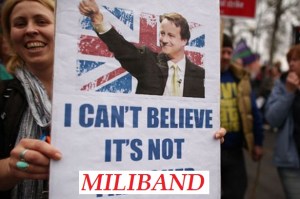
david-cameron-coke-zero-conservative-i-cant-believe-its-not-miliband

Support Semi-Partisan Politics with a one-time or recurring donation:

Agree with this article? Violently disagree? Scroll down to leave a comment.

Follow Semi-Partisan Politics on TwitterFacebook and Medium.