Banker Cat has some bad news, I’m afraid:

Sorry about that.
Banker Cat has some bad news, I’m afraid:
Sorry about that.

–
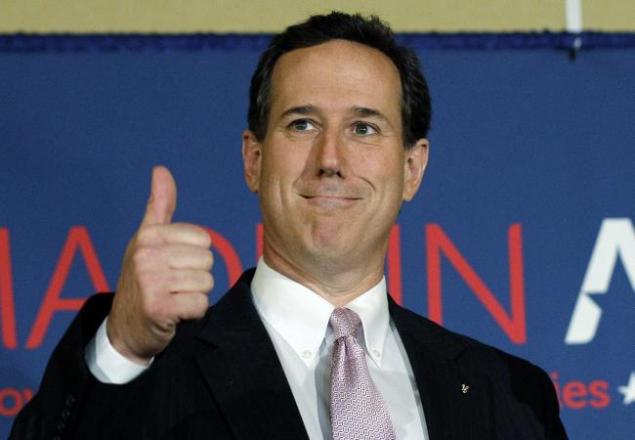
Oh dear. The good people over at The Daily Beast have heeded the call of the Pied Piper of Pennsylvania and endorsed the never-gonna-happen pro-manufacturing-rennaissance mirage offered up by Rick “Blue Collar” Santorum.
Of course, they are at pains to distance themselves from his more extreme social policy positions, and they get that out of the way at the beginning:
“There’s a lot not to like about Rick Santorum on the social-issues front. He’s an anti-abortion absolutist, no fan of gay rights, and possesses politics so influenced by faith that even contraception remains controversial in his mind.”
But after this, and a couple of disclaimers about the effect of such a manufacturing policy on the budget deficit, they are all praise:
“But at least the man is making a bold proposal that attempts to address an issue that has helped destroy the jobs that used to enable families to get on the first rung of the ladder out of poverty. Rather than simply having products designed in the U.S.A. and then produced overseas, an added incentive to make things in America could help tip the scales back in favor of American manufacturing. It might help make a real dent in our half-trillion-dollar trade imbalance with China and other countries.”
Okay, firstly: future manufacturing jobs will be more highly skilled and require a greater level of education or prior training than many of those displaced by the decline in manufacturing currently have. They aren’t going to get these jobs, if employers bother to create them in the US at all, despite a big tax giveaway. Those jobs that don’t require this higher level of skill won’t offer a rung on the ladder out of poverty any more than an entry-level job in the service sector.
Secondly: What if I write and distribute an awesome piece of new software? What business is it of the government to tell me that my work isn’t as worthy as that of someone else who opened a factory or a sawmill? Are we supposed to pick winners now, based on perceived societal good? The Daily Beast seems to lean to the left somewhat so I can understand them espousing this argument, though I vehemently disagree with it.
But my point remains: a Republican – especially one who rails about government handouts to individuals and bailouts to Wall Street and Detroit – has no business espousing policies to favour one segment of the economy over the other. I mean, that’s European/Soviet style planned-economy socialism, right?

I have only one further comment to make on the topic of gay marriage and religious freedom for now, this time prompted by another article in the Daily Telegraph:
The article discusses the publication of the British government’s “national consultation document” (no, I don’t know what one is and have never heard of one either, but I’m sure that its publication kept an army of civil servants and several retired, titled former judges well-occupied and remunerated for some considerable period of time, as all lengthy British enquiries seem to do).
The gist of the article that even if hundreds of thousands of people object to the legalisation of gay marriage, it may still go ahead (and it is implied, of course that this would be a terrible thing, because apparently we like the tyranny of the majority – or enthused minority, in this case – in this country, as long as it is working in our favour).
However, one sentence in the article struck me as particularly important and much overlooked:
“The document repeatedly underlines that the change would only affect civil marriage and that there would be an outright ban on same-sex marriages [in] religious premises even if some denominations wanted them.”
Do you understand this, stalwart defenders of “traditional values” and “religious freedom”? Even in the government’s new proposed law, it would be illegal for your church, synagogue or mosque to perform a same-sex marriage even if it wanted to some day. The government is dictating what you can and cannot do within the confines of your own church.
In this case, your view and that of the government are broadly in alignment, believe it or not – neither of you want same-sex marriages to take place in religious spaces. The only argument concerns whether you should be allowed to continue to impose your definition of marriage on the general, non-religious population through the institution of civil marriage. But some day in the future your interests may diverge, and the government may choose to legislate something directly impacting what goes on in your holy place that you profoundly disagree with.
They have the power to do it now, and as this “national consultation document” shows, they are doing it now, but you say nothing because your interests are aligned. But I don’t want to hear a word of complaint if ever a government law is proposed that actually makes your church do something that it doesn’t want to do.
That would be a violation of freedom of religion. Not the legalisation of civil same-sex marriages.

I didn’t go to Mass last weekend because I knew that all of the Catholic churches in Britain were going to read to their congregations a pastoral letter from the Bishops, exhorting us to fight against the government’s plans to legalise gay marriage in the UK. I don’t have time for that nonsense, and I don’t much care if this puts me at odds with official church teaching, because in 100 years’ time the church will agree with me. People that accept gay marriage and contraception will be looked back upon as latter-day Copernicuses, and those who frown upon it will be looked upon much like the Antebellum South. That’s just how it is, huff and puff about traditional values all you like.
I’m used to seeing cringeworthingly anti-intellectual arguments against gay marriage from my church, but this latest one from the Most Reverend Vincent Nichols, Archbishop of Westminster, really takes the cake:
Gay couples are, apparently, just lifelong friends who somehow got confused or duped into incorporating a romantic element into said friendship. Says the Bishop:
“I would want to say to them that I understand their desires, that I understand their experience of love is vitally important in their lives, but I would want to say to them that they are called in my view, in the Church’s view, to a very profound friendship in life … I would want them to be respected, but I would want them to have a vision in themselves that what they are called to is not marriage but a very profound and lifelong friendship.”
Good, well that’s sorted then! No need to continue this argument about marriage equality because gay and lesbian people are just good pals who got a bit confused after a few drinks.
Sigh.
The Daily Telegraph has a poll on the subject, which, as is so often the case, misses the point entirely:

It is not for Daily Telegraph readers to decide whether gay marriage in churches should be allowed. That is a matter that does, and should always, remain with the various religions and denominations. No one is suggesting that Vincent Nichols be frog-marched to the altar of Westminster Cathedral and made to bestow the Catholic sacrament of marriage on a gay couple. As long as the official church position is that homosexual unions are a sin, clergymen should and must not be required to violate their churches teaching in such a way.
However, neither does any one religion, church or denomination have the right to impose their particular standards for marriage – or dietary customs or anything else – on the population as a whole. The Catholic church can object to gay marriage and ensure that no such unions are sanctioned within the church, but beyond that it has no authority, spiritual, moral or otherwise, to lecture other people. And any claims to the moral high ground are roundly rebuffed by their tolerance of civil heterosexual unions, and their deafening silence on the topic of extra-marital affairs and the astonishingly high divorce rate.
I’ll leave it to Nick Herbert, the UK government Home Office minister to have the last word in this case:
“I don’t seek to dictate to the Archbishop what happens inside his Church, what standards he sets and what he seeks to do. It would be quite wrong for me or the state to do so. But equally I wonder why he should seek to dictate the institution of civil marriage outside of his Church which is not a matter for the Church.”
Amen.


Good news, everyone. Ed Miliband has solved the youth unemployment crisis in Britain. I guess he was lying in bed last night and the ghost of Michael Foot visited him and told him what had to be done to make everything better again.
Once he and his merry band of super-competent cabinet colleagues are sworn in as the next government in 2015, everything will be fine. Rainbows will appear in the sky and bunny rabbits will hop across the land. We know this because, at the one-day Labour Party conference in Coventry today, Mr. Miliband unveiled his “real jobs guarantee”.
The nasty Conservative Party, of course, likes young people to be unemployed. It gives us right-wingers a kick to pay taxes so that people can receive Jobseekers Allowance indefinitely.
His plan – to give every young person who has been unemployed for 12 months or more a guaranteed internship with a company, paid at the minimum wage – would be paid for by another £600m arbitrary raid on bankers bonuses.
Miliband says:
“To business we say, we’ll pay the wages, if you provide the training … To young people: if you’re out of work for a year we’ll guarantee you the opportunity to work.”
The BBC article goes on to mention:
“Those taking part will be expected to turn up for work, as well as looking for a full-time job and complete training, or face “tough consequences” – including possible benefit sanctions.”
What other tough consequence could there possibly be for failing to turn up for work or complete the other requirements for receiving government benefits, other than to lose those benefits? Being scolded by someone at the Job Centre? Being sent a letter of disapproval? Anyway.
I almost don’t feel as though it is worth delving into the flaws in this dystopian policy, especially given the fact that Labour’s deputy leader, Harriet Harman, was apparently clueless when it came to how much the scheme would cost, and whether this cost would be fully met by their proposed one-time (but seemingly all-the-time) tax on bankers’ bonuses.
Nonetheless, a couple of points of rebuttal, just to go through the motions:
1.Guess what, not all “bankers” had a hand in bringing about the global economic downturn. In fact, a lot of people in quite a lot of industries, and government positions also had a hand in it. So when will the Labour Party get over trying to use banks as a piggy bank to raid at will to fund their latest scheme? Gordon Brown was either Chancellor of the Exchequer or Prime Minister for the decade leading up to the collapse, so how about we also arbitrarily add a 10% tax surcharge on all of his future income to help him atone for the consequences of his calamitous incompetence?
The time to extract penance from the banks was at the time of the bailouts, but it didn’t happen. The Labour government missed the opportunity. Businesses cannot plan for the future and grow and prosper if they don’t know if they will be hit by a new punitive tax at any moment to fund the latest socialist pipe dream. Should the country have extracted more of a toll from the financial sector at the time? Almost certainly. But we didn’t, and now it is too late, and we have Gordon Brown and his heirs and successors in today’s Labour Party to thank for it.
2. This policy is so vague as to be worthless. Mr. Miliband says that “saying ‘no’ is not an option”, but doesn’t outline the consequences of saying no. After never once having gotten tough before in their history, does anyone really expect that this Labour policy, if implemented, would actually have any real teeth?
3. Youth unemployment currently stands at around 22.5%, or 1.042 million people. How, exactly, is a future Labour government going to coerce enough firms to take people on in order to reduce this to 0%? The answer is, of course, that they won’t. And if they even come close, it will only be because they bully firms into taking on people to do non-jobs that are of no training value, just to help the government meet its target.
4. Go away, and come back when you have a real jobs policy or any kind of plan that will actually solve the problem of youth unemployment. And in the meantime, perhaps stop demonising the current government’s “Welfare to Work” plans, which are much more cost-neutral and much more likely to succeed.

 Semi-Partisan Politics