The Christian Persecution Complex Stands In The Way Of Revival

Public fretting about the supposed War on Christmas may be behind us for another year, but that does not mean that the sound of wailing and gnashing of teeth emanating from certain grumpy Christian quarters has ceased entirely.

There is always some new perceived slight or attack to form the next rallying point for indignant protest at the assault on religious freedom (which can be translated as the end of state-sponsored primacy for one religion over all others, or none). And if nothing is currently happening to cause new outrage – no matter, they can quite happily argue their case to anyone who will read or listen without a clear jumping-off point.

Step forward Cristina Odone. The redoutable Odone has taken to her Telegraph column to bewail the “disappearance of the Bible from our children’s lives”:

Almost a third of children do not know their Adam from their Noah or that David slew Goliah. The Good Samaritan is a stranger and the Nativity just a Christmas play.

The latest Bible Society findings prove that the West has erased its Christian heritage from public life. I’m not surprised – only saddened that No God Zone, my e-book on the subject, has been vindicated. After decades of concerted efforts by secularist zealots, the Bible is a truly alien subject. Future generations will look on “the greatest story ever told” and think it is a 1965 movie starring Charlton Heston and Max von Sydow.

At fault, of course, is the ever-present, ever-menacing atheist brigade, who want nothing more than to tear down her church, prohibit her from celebrating her religious holidays and re-educate her to worship at the altar of multiculturalism:

A few faith schools still teach “the Good Book”; but they are under fire from the atheist brigade, and many feel that they will only survive if they promote a multicultural syllabus that stars Gandhi and Mandela rather than Abraham and Jesus.

The extraordinary, subversive book, with its lessons on charity, compassion and respect for others inspired generations to rebel against tyrannies of all kinds – dictators, addictions, vices. Men and women dedicated their lives to its teachings – and were ready to die for it. But today it seems that a host of martyrs lost their lives in vain: the Bible is just another book that sold more than the Hunger Games trilogy at some point.

How very melodramatic.

No longer the exclusive preserve of Bill O'Reilly and the Fox News Channel.
No longer the exclusive preserve of Bill O’Reilly and the Fox News Channel.


Odone worries about the children, but really it is the adults and parents who should be the focus of her concern – two thirds of British adults have no connection with the Christian church at present, half of whom having left at some point and the other half never having had any involvement at all.

As a practicing Catholic this saddens me, but unlike Cristina Odone it is not my first instinct to go lurching off to the government for redress, to make them make people behave the way that I want them to. Indeed, it speaks very poorly indeed of Odone’s supposed conservative credentials that she thinks that such a thing would be at all appropriate. A religion that requires government promotion makes itself immediately vulnerable to government influence, interference and control – something that no supporter of religious liberty should wish upon themselves.

If there is to be a Christian, or any type of religious revival in this country, it will not come about by going back to what Cristina Odone clearly sees as the “good old days” of having the Church of England shoehorned into every conceivable tradition or aspect of British life. Singing Christian hymns at public school assemblies, cramming public squares with nativity scenes or erecting stone carvings of the Ten Commandments outside courthouses are not going to make a blind bit of difference to church attendance or the practicing of Christian teachings.

Maybe Odone would rather tie the awarding of jobseeker’s allowance to church attendance rather than the claimant’s willingness to take remedial literacy and numeracy training where required – I would love to watch her make that argument, just for the fireworks that it would create. But short of extremely heavy-handed government coercion such as this, I am at a loss as to exactly what external actions she thinks should be taken.

Rather than looking outside for help that will never arrive, people of faith would be far better off engaging with their local churches, parishes or faith groups and helping them in their work to serve their communities and make themselves more relevant to the people whom they serve. For it is only through this bottom-up approach that any meaningful progress will be made.

My own track record in this area is far from impressive – very occasional bouts of deep involvement in parish life followed by months or years of either lazily sitting back in the pews or not attending church at all. But this is exactly the point – if I can only halfheartedly and sporadically muster the will to do something, why should I expect the government to enforce it on people who may have different beliefs and have no desire to follow along at all?

A parallel argument – perhaps better suited to the boardroom than the church hall, but perhaps not – would be that is it not far better to have a smaller, leaner church that is filled with more committed members and does more to show God’s love and do His work in the community than a bloated, lazy, state-supported church, topped up with unwilling attendees and with no clear direction other than to keep pleasing the government on which it depends for survival?

I believe that a strong argument can be made for just such an adaptation, one that is in any case well underway – for just as businesses must retrench and refocus during economic recessions, so too, perhaps, must religious organisations during times of spiritual recession.

Yes, the church and the values that it professes (love, understanding, charity – I’m less worried about society’s rejection of archaic cultural rules about gay people, wearing garments made from multiple types of cloth or the eating of shellfish) have experienced an unbidden and unwelcome decline, and this is a legitimate cause for concern. But if it also provides space for a sober reassessment and recalibration of our understanding as to the role of faith in our society, is there not also a great opportunity to be exploited as well? Sometimes, after all, it is necessary to go backwards first in order to move forward.

There are parts of the world where Christians really are being persecuted, quite terribly. Cristina Odone’s leafy corner of west London is not one of them, and she would do well to acknowledge this and to give thanks that she lives in a place where she is free to openly practice and profess her faith.

Then we can talk about Christian revival.

Music For The Day

“My Song Is Love Unknown”, hymn by Samuel Crossman (1664), tune by John Ireland (1879-1962).


Performed here to great effect by the Choir of King’s College, Cambridge.

Where Are The Women In British Politics?

Blair Babes women British politics


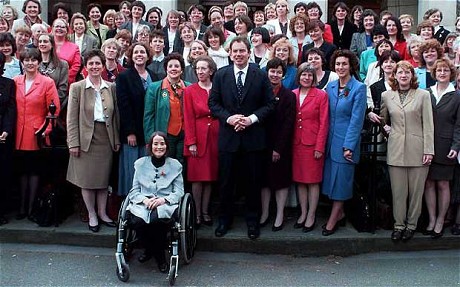
The conventional wisdom holds that Ed Miliband managed to land a serious blow on David Cameron at this week’s Prime Minister’s Questions, exposing the Tory leader and his party for their chronic shortage of women in leadership positions and the key offices of state. Miliband makes a good point – an abysmal 4 out of 22 cabinet ministers in the coalition government are women, and only one of those, Theresa May at the Home Office, occupies a position that really matters (Culture, Northern Ireland and International Development, the other ministries headed by women, are either irrelevant or decidedly junior-league). That simply is not good enough, and David Cameron has just cause to feel ashamed.

The Guardian makes the case:

[David Cameron] was taunted about the Conservatives’ “women problem” by Ed Miliband in the same week it emerged several prominent women have recently been sacked from government jobs and Anne McIntosh, a high-profile female Tory MP, was deselected by her local association.

The Labour leader also claimed a prominent businesswoman, who is the wife of a Tory donor, had been greeted by Cameron with the remark: “Where’s your husband?”

He then accused the coalition of failing women across the UK by allowing the pay gap between men and women to widen for the first time in five years.

“You promised to modernise your party, but you are going backwards. You run your government like the old boys’ network – that’s why you are failing women across your party and across the country,” Miliband said.

And the initial exchange between the two leaders at Prime Minister’s Question Time can be seen here:


Less reported is the fact that the Labour Party has a record on promoting women every bit as appalling as do the Conservatives, as Dan Hodges correctly observes in his Telegraph column:

Women still aren’t allowed to hold senior positions in the Labour party. The three major political briefs are Prime Minister/Leader, Chancellor and Foreign Secretary. Apart from a short period during the fag end of Tony Blair’s administration when Margaret Beckett was placed in charge of the Foreign Office, and 14 weeks when Yvette Cooper oversaw the shadow post under Ed Miliband, none of those offices have been held by women. The Labour party has been in existence for 114 years. And during that time – under Labour – a woman has held or shadowed one of three major offices of state for a period of 14 months.

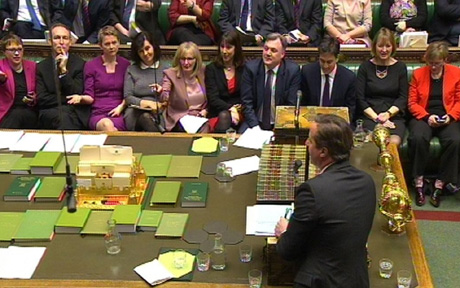
Fourteen months. And yet you would not think that Labour was sitting on such a poor record when Ed Miliband stood preening at the dispatch box in the Commons on Wednesday. One could have been forgiven for thinking that women made up a statistically and politically perfect 51% of Labour seats in Parliament and in the shadow cabinet, particularly given the rather unusual concentration of the Labour Party’s female talent on the front bench alongside their leader:

When PMQs started, several people commented on the fact that a number of Labour’s women shadow cabinet members were artificially concertinaed together close to Miliband. The reason they did that was because if they hadn’t done that they wouldn’t have been in camera shot. And that’s because there’s a convention that people sit alongside their leader based on seniority.

If something about the picture below strikes you as odd – don’t worry. There is indeed something different about the Labour front bench at PMQs this week – namely, a lot more women clustered on either side of Eds Miliband and Balls than is usually the case. It is hard to determine which is worse – Ed Miliband’s disingenuous photo opportunity, or the willingness of a number of female Labour MPs to go along with it by essentially allowing themselves to be used as props by their leadership.

Not your standard distribution.


A less-reported fact amid the furore is that all four women cabinet ministers in the coalition government are Conservative MPs, which rather begs the question of how the Liberal Democrats have managed to fly under the radar and avoid being called out for their own shameful inability to recognise and promote female talent within their own ranks. But somehow the party of Lord Rennard seems to be scoring a free pass on their own institutional sexism for the time being – at least as far as Ed Miliband’s focus is concerned.

The lack of women in senior positions in all political parties is a real problem, one which Miliband does little to debate or address by trading barbs with the Prime Minister. Some advocate all-woman shortlists as a solution to the problem, and of course the Labour Party has adopted this particular approach. This blog disagrees with it – firstly on the grounds that it robs local constituencies of the opportunity to select from the widest possible pool of talent when choosing who they want to represent them in Parliament, and secondly because if we must tolerate reverse discrimination as a necessary evil to help put right historic wrongs (and I’m far from convinced that we should), it should be done at the earliest stage possible and certainly not at the point of parliamentary candidate selection.

But while we may condemn Miliband’s posturing on the subject and question his methods, we must also acknowledge that at least the Labour Party under Ed Miliband is engaged in a bona fide effort to increase the number of women in their parliamentary party. There is a lot of rueful head-shaking from the Conservatives at the conspicuous lack of women in theirs, but not much action of any kind at all.

Four women out of twenty-two cabinet members in the British government, in the year 2014. This is a national scandal, far more serious than localised spats about the deselection or resignation of individual constituency MPs, or accusations of politicising quango appointments. This is about the integrity of our democracy and our desire to be a more practically and visibly meritocratic country.

The Conservatives, the party of Margaret Thatcher, should be leading the charge on anything to do with meritocracy. The fact that they are not currently doing so is alarming.

The Winter Olympics Begin

As the countdown to the opening ceremony for the 2014 Winter Olympics in Sochi nears its conclusion, Google marks the commencement of the Games:

googleolympics

A timely reminder of the Olympic values, at a time when the host country conspicuously fails to practice them when it comes to respecting and upholding the rights of its own citizens.

I was never in favour of the Olympics being awarded to Russia, especially at a time when that country’s tentative moves toward real democracy were being so rapidly undone and an authoritarian one-party government consolidated its power. Indeed, today’s Russia exhibits almost all of the characteristics that you would not want to see in a country hosting a major international event – corruption on a massive scale, dangerous levels of internal unrest, displacement of local people, oppression of minorities, lack of a free press, suppression of political dissent and the strangulation of democracy in every way.

But in mitigation, it should be remembered that in some very pertinent aspects, we are not so much more “advanced” or enlightened than the Russian state. Andrew Sullivan makes the excellent point that many people from the United Kingdom and United States who are so aghast at Russia’s controversial laws prohibiting “homosexual propaganda” overlook the fact that until quite recently, things were not so different back home:

At the same time, it seems to me we need to be careful not to misread the specific cultural context here. There’s a worrying tendency for some gay activists to assume that because a foreign country is not identical to the US on the question of gay rights, it’s an outrage that must be immediately confronted and changed. But America, only a decade ago, was not identical to the US today. Many states still have in their very constitutions the relegation of gay people to second class status. The last president of the US, George W Bush, wanted to enshrine the inferiority of gay couples in the federal constitution. It’s been only a few years since gays were able to serve openly in the US military. To turn around and then be shocked and appalled that homophobia is still very much alive and well in the Russian rural heartland is more than a little obtuse.

A fair point well made. Indeed, there are a number of British and American pundits and politicians, strident in their opposition to equal rights for gay people, who openly admire and praise the actions of the Russian government. And so I should reiterate that my antipathy is toward the authoritarian, corrupt President Putin and the culture that he has helped to create, and not toward the Russian people themselves.

I will watch the Sochi Olympics with interest, as I always do, and I hope that they are a wonderful sporting success, free from any of the feared violence or disruption. But you must excuse me for not joining in the celebration of the despot Vladimir Putin’s moment of triumph – the man does not deserve a victory lap on the world stage.