A Move Toward Transparency On Tax

Image from ConservativeHome.com


It may be a small, mostly cosmetic change, but for once it is a change that small government and libertarian-leaning conservatives can really get behind.

Ben Gummer MP, who has made tax transparency a major focus of his parliamentary career, is today proposing that National Insurance be renamed the “earnings tax”.

The Telegraph reports:

National Insurance, a 100-year old charge on employers and employees, will be renamed “earnings tax”, the Chancellor has signalled.

The change, which will be proposed in legislation to be published on Tuesday, is the first step towards merging income tax with National Insurance.

Ben Gummer MP, a rising star Tory backbencher who has been campaigning on tax transparency, will propose the change in a Commons Bill on Tuesday.

On the face of it, perhaps nothing to get too excited about. After all, nothing is being done here to address the punishingly high rates or the legacy of fiscal drag that has seen people on relatively standard incomes being taxed at the top rate.

But Gummer’s proposal is significant because it is the first step toward the government finally and explicitly admitting the obvious – that National Insurance is a second income tax in all but name. The money collected is vast, all goes into the same pot, and is in no way strictly reserved for specific purposes as the “insurance” moniker suggests.

At the present time, Ed Miliband and Ed Balls are able to rail against the Conservative/Liberal Democrat government and accuse them of enacting “massive tax cuts” for the rich – by which they mean reversing half of Gordon Brown’s gargantuan tax increase – and keep a straight face while doing so.

Using the innocuous term “50p” tax which evokes the small sum of fifty pence rather than the cold reality – half of each additional pound earned, for top band taxpayers – is bad enough. But high tax advocates such as those in the Labour Party are also aided by the fact that discussion of income tax alone does not come close to recognising the full tax burden.

The Telegraph shows the full extent of this second income tax:

National Insurance rakes in billions every year for the Treasury. Anyone who is employed and earns between £149 and £797 a week pays 12 per cent of their income in National Insurance. A further 2 per cent is paid on all earnings over that level.

It is doubtful whether, if asked, most people would correctly identify the top rate of tax as being 59% – a staggeringly high level that immediately makes Britain’s anaemic economic growth statistics much more understandable.

Therefore, from a fiscally responsible and small government-advocating stance, anything that helps the public consciousness to start to recognise income tax and national insurance as nothing but two sides of the same coin can only be a good thing.

ConservativeHome also recognises the importance of this seemingly small proposal:

There’s a fundamental, sound principle here – which has been championed by the TaxPayers’ Alliance among others.

It is clearly unfair and immoral for taxpayers to be misled about the level and function of taxation. National Insurance is income tax in disguise, but many people still think it actually pays into a pot for their own social security.

Hopefully the Chancellor will listen to Gummer, and it will be a step on the road to merging NI with Income Tax altogether.

Indeed, merging NI (or whatever name it ultimately goes by) and Income Tax should be the end goal. Just as Ben Gummer successfully campaigned for taxpayers to receive a yearly statement showing exactly how their tax contributions were split up to fund the operations of government

The proposal will doubtless meet with strong resistance, primarily from those on the left who continue to support high taxation and high spending with such fervour that they almost seem to be an end in themselves. It is not in the interests of such people for the public to have full visibility of the amount of tax they pay – the more confusing it is, the more easily their distortions and rhetorical sleights of hand about the tax burden are believed and accepted.

ConservativeHome also notes this fact:

There’s a test for Labour here, too. They will instinctively dislike the idea, given that it will make it harder for future governments to raise taxes by stealth. But Ed Miliband rails against opaque, complex and misleading charging by companies as a rip-off which harms consumers – surely they should hold the taxman to the same principles?

Surely they should hold the taxman to the principle of transparency, perhaps, but inevitably in practice they do not – a century of experience tells us so.

While transgressions by the private sector are immediately jumped on, the failures and mistakes of the public sector are excused or overlooked time and time again, and are then counter-intuitively used as justification for increasing spending and expanding the public sector even more. Private sector failure and opacity, in other words, is punished while public sector opacity is encouraged and rewarded.

Transparency is the ultimate antidote to the big tax/big spending status quo, and to the policies of those who continue to view fiscal policy as a tool for punishing success. Britain needs Ben Gummer’s medicine, and the government should now give tax transparency its full-throated support.

Stop Building Palaces While The People Suffer

newarkarchdiocese

At a time when the Catholic and Anglican churches on either side of the Atlantic have been parading their advocacy on behalf of the poor and the powerless, they might have bothered to put their own houses in order first. But, once again, through acts of bad timing and breathtaking bad taste, they have shot themselves in the foot.

In the UK, a Conservative MP hit back at the twenty-seven Church of England bishops who signed an open letter condemning the British government’s welfare reforms and labeling them “punitive”. Charlotte Leslie MP rightly pointed out that the church has considerable assets of its own that it could deploy in service of the poor before it becomes necessary to start badgering the government to redistribute more income between private individuals:

They say charity starts at home. Lambeth Palace [the official London residence of the Archbishop of Canterbury] is a rather nice home.

If you are invited to a reception there, you pad up richly carpeted stairs, along corridors of gold-framed paintings, before being treated to quails eggs with a delicate celery salt dip, and freely flowing wine. It’s rather a long way away from the local churches with crumbling roofs, serving damp biscuits and coffee in cracked mugs after the service.

One can’t help but think that this luxurious, and historic Palace might not be put to better use, more in line with the New Testament , if it was rented out to those who would pay dearly for such luxury, and the operation of the Church of England were to decamp to an industrial estate, outside Slough.

Just think of the number of church roofs that could be repaired from the income, and indeed the number of hungry people who could be fed.

The church’s ill-advised foray into campaigning for the Labour Party is encountering much-deserved resistance because the views of twenty-seven relatively coddled bishops with little recent experience of real life are not in tune with the sentiments of the people, and because they displayed a fundamental misunderstanding of the government’s own policy and its application.

Not very impressive from a large faith organisation seeking to influence the public debate.

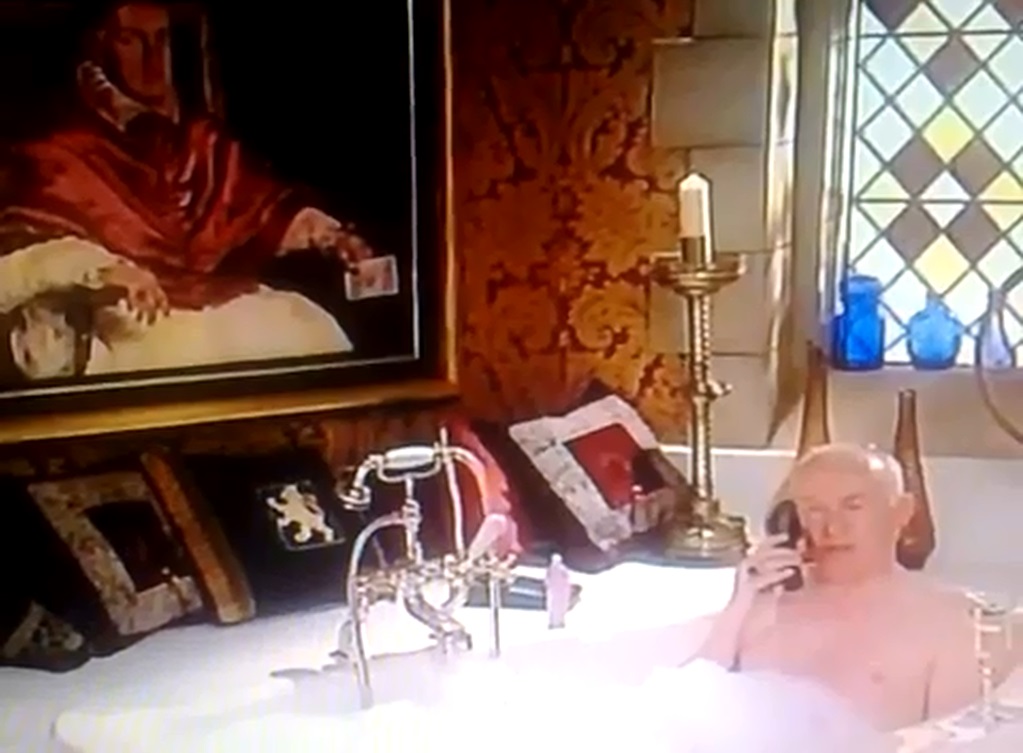
Father Ted's Bishop Brennan - not a role model for the Church leadership
Father Ted’s Bishop Brennan – not a role model for the Church leadership


Meanwhile, the New York Times reports on the attempts by the Archdiocese of Newark to lavish over $500,000 on upgrades to a residence for the bishop – not his primary residence, but his separate vacation home:

John J. Myers, the archbishop of the Newark Archdiocese, comes to this vacation home on many weekends. The 4,500-square-foot home has a handsome amoeba-shaped swimming pool out back. And as he’s 72, and retirement beckons in two years, he has renovations in mind. A small army of workers are framing a 3,000-square-foot addition.

This new wing will have an indoor exercise pool, three fireplaces and an elevator. The Star-Ledger of Newark has noted that the half-million-dollar tab for this wing does not include architects’ fees or furnishings.

The expansion of the bishop’s vacation home will be funded by the sale of other properties owned by the archdiocese, they claim, as though this detail somehow makes the outrage more palatable. It does not. Either the sold buildings served an important purpose for the archdiocese which was suddenly ripped away in order to provide a little more luxury for the bishop, or they were unused and deserved to be sold so that the equity can be released in service of the church’s core mission.

A just reward for a job well done?


Neither is the lucky beneficiary, Archbishop John J. Myers, a particularly lovable figure whose flock would be particularly thrilled to see treated in so generous a way:

So many leaders of the church have served it so badly for so many decades that it’s hard to keep track of their maledictions. Archbishop Myers provides one-stop shopping. He is known to insist on being addressed as “Your Grace.” And his self-regard is matched by his refusal to apologize for more or less anything.

It was revealed last year that a priest seemed to have broken his legally binding agreement with Bergen County prosecutors to never again work unsupervised with children or to minister to them so long as he remained a priest. When next found, he was involved with a youth ministry in the Newark Archdiocese.

Parishioners in Oradell, N.J., also discovered that the archdiocese had allowed a priest accused of sexual abuse to live in their parish’s rectory. A furor arose, and last summer the archbishop sat down and wrote an open letter to his flock. He conceded not a stumble. Those who claim, he wrote, that he and the church had not protected children were “simply evil, wrong, immoral and seemingly focused on their own self-aggrandizement.”

It is hard to see how frittering away scarce diocesan resources in order to build an MTV Crib-style McMansion for a mediocre bishop on the verge of retirement constitutes good stewardship of the church finances. And it is equally regrettable that given opportunity after opportunity to rehabilitate its battered image and start practicing humility and restraint, the hierarchy of the American Catholic church is unable to do so, and – worse still – feels no need to do so.

The church seeks to add its voice to important political debates on both sides of the Atlantic – concerning freedom of religion and abortion in America, and on welfare reform in Britain. In both countries, church leaders seek to portray themselves as spokespeople for the poor, the voiceless and the powerless.

This message would be slightly more credible if church leaders could somehow find it within themselves to stop building swanky palace extensions for their hedonistic bishops.


Image – a palace fit for a mediocre, hypocritical bishop. The new extension being built at the vacation home of Newark Archbishop John J. Myers.