The death throes of free speech in Russia


As the world’s attention remains fixed on Ukraine, less attention is paid to the final nails being hammered into the coffin containing the corpse of Russia’s free and independent press. And while the annexation of Crimea and the west’s shamefully half-hearted response (slapping sanctions on a mere handful of Russian officials and exempting Vladimir Putin and his closest confidantes) certainly deserve their column inches, journalistic independence and free speech finally died in Russia, without a shot being fired. It is only right that we acknowledge this backward step, too.

A couple of excellent columns published over the past weekend aimed to do exactly that – Julia Ioffe writing at the New Republic and David Remick at The New Yorker. Both articles come highly recommended and paint a compelling, sad story.

In his piece, Remnick mourns the backwards steps under Putin which have now erased each and every gain made for freedom of expression under the Gorbachev glasnost era, with particular reference to the Russian government’s recent interference with popular news site Lenta.ru:

In recent years, when Russian liberals have tried to sound optimistic, they have invariably said, Well, at least they haven’t cracked down on the Internet the way the Chinese have. Lenta.ru is one Web site, not the entire Russian-language Web, to be sure, but today’s firing is still an important and ominous step. Lenta.ru was getting more than thirteen million unique visitors a month, and was far more direct and critically minded than anything on state television or in most print publications. Some staff writers and editors have said that they will leave rather than work with [new editor] Goreslavsky. They have no doubt that responsibility for today’s firing lay with Putin and his circle.

Seventy-nine staffers at Lenta.ru issued a statement of angry protest, reading, “Over the past couple of years, the space of free journalism in Russia has dramatically decreased. Some publications are directly controlled by the Kremlin, others through curators, and others by editors who fear losing their jobs. Some media outlets have been closed and others will be closed in the coming months. The problem is not that we have nowhere to run. The problem is that you have nothing more to read.”

Remnick notes that in today’s world and with modern technology, the domestic Russian media can be bought, manipulated and coerced very easily by Putin, with no need for recourse to any of the Soviet-era’s more heavy-handed techniques:

In each individual case, the degree of censorship and pressure is hardly Stalinist in degree. Putin’s media strategy is more sophisticated than that. (The book-publishing industry has remained quite free and unchanged in recent years.) The sophistication of it is that Putin exerts just enough control (blacklisting certain known dissident voices from state television, for example), and punishes just enough of his opponents, to set markers—boundaries of the permissible. Sometimes those boundaries are crossed, but a general tone has been set.

This is precisely the problem, and perhaps the reason why the assault on the Russian free press is getting much less attention than it deserves. In the modern age, the sheer number of cable television channels, newspapers and online news sites can easily give the impression of a vibrant, raucous and effective media, easily reflecting the views of the entire population and holding the leadership to account. However, because of concentration of ownership and endemic corruption, the appearance diversity or independence is merely an illusion – everyone toes the party line.

Julia Ioffe’s New Republic piece sees even more danger, with Russia’s authoritarian attempts to control speech and thought now reaching the internet:

Yesterday, the Kremlin went full-China on the Internet, the holy of holies of the Russian opposition. Using some flimsy legal pretexts, it banned access to various oppositional news sites, to the website of Moscow’s biggest radio station, and to the blog of Alexey Navalny, who is currently under house arrest. Last week, the owner of Dozhd announced that, due to the clampdown, the channel is going to close in a couple months.

Within the span of a couple months, the Kremlin, by hook and by crook, has cleared all the media underbrush. There’s suddenly not much left of the independent media, even of what little of it there was left after Putin’s first two terms at the wheel.

Some of the personal anecdotes recounted by Julia Ioffe are even more disturbing:

Then came the day a Moscow acquaintance announced on Facebook that her daughter, a first-grader, came home from school in a panic because the teacher had told the class that America was about to invade Russia. But then television host and attack dog Dmitry Kiselev went after the “radicals” in Kiev in a special broadcast dedicated to Ukraine, saying that the transfer of Crimea to the Ukrainian Soviet Republic in 1954 was “a historical crime” and blaming the dissolution of Yugoslavia on the West. “What is Yugoslavia now? A pimple on the body of Europe.”

The Russian Writer’s Union then felt the need to write an open letter to the Kremlin throwing their wholehearted support behind Russia’s annexation of Crimea:

… the Russian Writers’ Union, which is as Soviet as it sounds, declared that, “in these worrying times, when the fate not only of Russia and Ukraine, but of all European civilization, is being decided, we want to express our support of your firm and responsible position.” They also blamed “the destructive forces of the West.”

Whatever one might think of the press in the United Kingdom or United States, one cannot imagine them banding together like this to explicitly praise the leader. It is certainly true that President George W. Bush received ridiculous levels of hagiography and unquestioningly supportive coverage from the western press in the run-up to the second Iraq war, the profession as a whole did not feel the need to pledge their fealty with one voice. And though they were largely banished from the main networks, there was strong and vocal opposition. Not so in Russia today.

If there is any glimmer of hope to be had in this sorry situation, it is the fact that a sizeable number of Russians – despite their almost total erasing from the domestic news – have grown heartily sick of their country’s backward slide, and are making their views known as best they can.

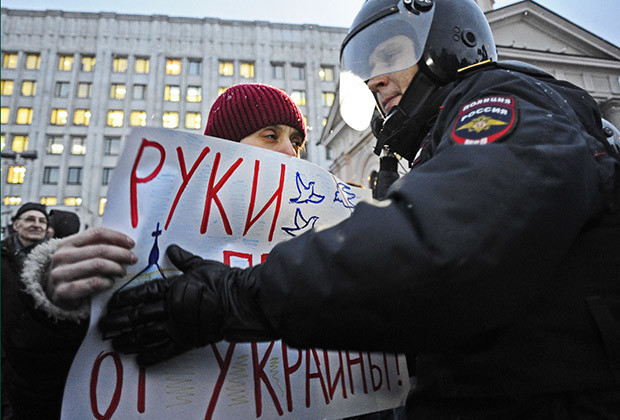
The BBC reports that up to 50,000 people attended a pro-Democracy “Hands Off Ukraine” rally in central Moscow. And apparently caught off guard, Putin’s regime did not thwart the march, and mustered only 15,000 of their own supporters in a counter-demonstration:

Earlier in Moscow, tens of thousands rallied against Russia’s actions in Ukraine, the biggest such protest in two years. As many as 50,000 attended the rally, with protesters shouting: “Hands off Ukraine.”

One man told the BBC he felt Russia was turning back to the days of Soviet dictator Joseph Stalin.

Nearby, some 15,000 supporters of President Vladimir Putin came out to support the Crimean referendum. Many of them wore identical red outfits and carried Russian and Soviet flags.

But displays such as this are likely to become far fewer as the number of truly – or even partially – independent news outlets willing to provide a non-Kremlin perspective on the world dwindles to nothing.

Regrettably, the paranoid propagandists at the Kremlin are now also being encouraged to a degree by some in the west. The usually-admirable Ron Paul, for example, clearly shows the limitations of applying libertarian philosophy to its ultimate limits, and of citing moral equivalency between Russian meddling in Ukraine and unauthorised Western invasions to argue that the West has no legitimate basis to condemn Russia’s actions. Because the United States and Britain did wrong in the past, goes this argument, Russia must be allowed to do wrong now:

Paul said Crimeans should be allowed to break away from Kiev.

“I think everyone should have right to express themselves,” he said. “It is messy, that is for sure, because two big governments are very much involved in trying to tell the Ukranians what to do.”

However he said Russia had a more justifiable basis for being involved in Crimea than the US, and no government should prevent locals on the peninsula from determining their future.

This deference toward Russia maintaining a geopolitical sphere of influence whereby it is allowed to meddle and assert special interests in the politics of its neighbours would be slightly more defensible coming from Ron Paul if he did not castigate the United States for doing the same thing when it comes to influencing America’s Latin American neighbours:

PAUL: Well, I think free trade is the answer. Free trade is an answer to a lot of conflicts around the world, so I’m always promoting free trade. And you might add Cuba, too. I think we would be a lot better off trading with Cuba.

But as far as us having an obligation, a military or a financial obligation to go down and dictate to them what government they should have, I don’t like that idea. I would try to set a standard here where countries would want to emulate us. Unfortunately, sometimes we slip up on our standards and we go around the world and we try to force ourselves on others.

If free trade and an absence of foreign meddling is truly the stance favoured by Ron Paul he should be vigorously denouncing the aggressive actions taken by Russia, not seeking to justify them by finding tenuous comparisons in recent US and western foreign policy. Ukraine had a clear choice – closer engagement with the European Union or re-embracing Russia. Until Vladimir Putin began interfering in Ukraine’s internal politics and encouraging President Yanukovych to abandon the EU deal in exchange for sweeteners from Russia, Ukraine leant towards Europe. The EU may have its imperfections, but it represents a much more liberal option than anything Putin’s Russia represents, and if anyone has subverted the will of the Ukrainian people and deserves Ron Paul’s disapproval today it is Vladimir Putin.

And while Ron Paul has led from the front in the important public debate about the nature and extent of the US surveillance state, and any curtailments on free speech in America, there is no acknowledgement from him of the grave and far more routine impositions on free speech that take place in Russia. That’s not to say that every criticism of America needs to be counterbalanced with a corresponding flaw in the rest of the world, but it is certainly the case that jumping into the debate on Ukraine without acknowledging this elephant in the room significantly detracts from his argument.

When it comes to counterarguments and balance in media coverage, Russia makes America and Britain’s own tribulations look like nothing by comparison. And while it is unfortunate that some people – particular those from the left/libertarian part of the spectrum – have felt the need to use the Ukrainian crisis as an “I told you so” moment or to burnish their own non-interventionist credentials, this is nothing more than posturing for a domestic audience. It does nothing to help the people of Ukraine or Russia.

While it is Ukraine that is currently being deprived of its territory in Crimea, the usurping Russians are also being robbed. Their loss, taking place with far less comment, is that of their independent press and free speech. And without a free domestic press to even go through the motions of scrutinising Vladimir Putin’s leadership, today’s Russia – in full paranoid, expansionist, Soviet-nostalgic mode – is not going to stop at Ukraine.

Music For The Day

The second movement of Ravel’s Piano Concerto in G, performed by Leonard Bernstein and accompanied by the Orchestre National de France:


I have never been a tremendous aficionado of Bernstein’s piano performances – a great (if variable) composer and conductor, he simply spread himself too thin to have made himself one of the greats. But this is a superb performance, very well conducted from the keyboard.

It is also interesting to see Bernstein (partly through necessity) adopt the pre-Liszt piano/orchestra configuration.

GCH Who?

Who?
Who?


Watching the debate on government surveillance and citizen privacy play out differently on opposite sides of the Atlantic is both astonishing and depressing.

While the issue has become a hot political topic and an electoral issue leading into the 2014 midterms – with candidates and incumbents lining up to praise Edward Snowden for whistleblowing and revealing the extensive activities of the NSA, or condemn him as a hypocritical traitor – in Britain, the debate has caused barely a murmur.

Despite the fact that as closest allies, the United States and United Kingdom cooperate intensively on surveillance and national security issues, sharing the front-end technology as well as the intelligence results, those responsible from the United Kingdom side have escaped serious political pressure and questioning almost completely.

The closest to uncomfortable scrutiny that anyone from the British security apparatus came was when former GCHQ chief Sir David Omand was asked a softball question at the Home Affairs committee, and used it as an opportunity to bemoan the fact that all of this pesky, pedantic oversight of the intelligence community is harming their morale and making them feel sad.

John Naughton, writing in The Observer, has a theory about this relative lack of interest in Britain. He proposes that people would sit up and pay more attention to the erosion of their right to privacy and protection from unreasonable search if only the technological aspects of the question were explained in a more accessible way:

As someone who is supposed to know about these things, I’m sometimes asked to give talks about computing to non-technical audiences. The one thing I have learned from doing this is that if you want people to understand technological ideas then you have to speak to them in terms that resonate with their experience of everyday things.

Naughton believes that the problem is a lack of technical understanding in the British population – that if only the man on the Clapham omnibus knew what it meant to tap transatlantic fibreoptic cables to eavesdrop on data, to use computer malware to snoop on untargeted citizens or to maintain logs of telephony metadata, he would suddenly take to the streets in anger. This seems somewhat naïve. After all, American citizens are no more technically sophisticated than the British, and yet they managed to generate and sustain a sense of outrage that their privacy was being routinely violated by a government that would have happily continued doing so in secret were they not caught red-handed.

Naughton continues:

One of the things that baffles me is why more people are not alarmed by what Edward Snowden has been telling us about the scale and intrusiveness of internet surveillance. My hunch is that this is partly because – strangely – people can’t relate the revelations to things they personally understand.

The average Brit may not be conversant in the technical details, but they know the broad strokes – that the government is and has long been collecting and sharing data on us all with our international intelligence partners, that this was done without ever bringing the question up for national or parliamentary debate, and that the government is more interested in bullying people who try to report on the truth than in making their activities more transparent and democractically accountable.

The problem is not that the average Brit simply doesn’t understand what it means when GCHQ or the intelligence services collect reams of data indiscriminately with no targeting and no proof or suspicion of ill intent – they understand all too well. The problem is that far too many British people, when asked, simply shrug their shoulders and say something along the lines of “well, if it keeps us safe we should probably keep doing it,” or “if you have nothing to hide you have nothing to worry about.”

And more worrying still is the fact that some elements of the press also seem willing and eager to promulgate this attitude.

The reason for this apathy among both the people and the press is the fact that the British people have no real terms of reference when it comes to thinking about what government actions are good and which are bad. In the United Kingdom, the law of the land is only as cast iron and certain as the whims of the current government and current parliament. Aside from the European Union and European law (which act as brakes on British government ambition in almost every other sphere than this), the British citizen has no real defence against any action taken against him by the elected dictatorship of the day. And where it comes down to interpretation of existing law by the intelligence agencies, the cases are fought in court in a very opaque way that hardly anyone understands.

Contrast this to the situation in our closest ally, the United States of America, where precisely the same debate is playing out but at a much louder volume. The debate is much more accessible to the average American because the US government is structured in a much more understandable way and the powers and limitations of each branch of government are delineated by the Constitution. Though ambiguities and disagreements naturally always occur, the Constitution at least provides a frame of reference.

When issues such as bulk collection of telephony metadata or the recording of international telephone calls or the intercepting of emails come up, Americans can point to the Fourth Amendment to the United States Constitution, which clearly states:

The right of the people to be secure in their persons, houses, papers, and effects, against unreasonable searches and seizures, shall not be violated, and no Warrants shall issue, but upon probable cause, supported by Oath or affirmation, and particularly describing the place to be searched, and the persons or things to be seized.

There it is, in black and white. And it protects Americans in perpetuity until such time as it may be repealed or replaced with a new amendment (for which the bar for passage is prohibitively high).

That’s not to say that the US Constitution has done anything much to help American citizens defend themselves from unwarranted government intrusion. The Obama administration, and the Bush administration before, are able to come up with all manner of tortured (no pun intended) interpretations of the law to justify both the illegal things that they do and the fact that they try so hard to keep them secret.

But the mere fact that the highest echelon of law concerning search and seizure of property is so comparatively well known in the United States means that shady government activities suspected of falling on the wrong side of the line between legality and unconstitutional overreach are noticed much sooner and debated much more vigorously. By contrast, it would be astounding if any more than one in a thousand Britons of voting age could point to the relevant laws and statutes which define the British government’s legal powers to monitor the communications and data of its citizens.

The sad irony is that the Fourth Amendment protections enjoyed (or at least referred to) by American citizens derive largely from British legal doctrine, and yet it is the former colony which now tenuously keeps alive something which has been slowly and deliberately extinguished in the mother country.

John Naughton is right to be alarmed at public apathy toward the growing British surveillance state – it is perhaps the greatest threat to our democracy and free speech currently in existence. But public opinion will not be inflamed by holding a national technology seminar to explain the small print; there will only ever be opposition to government overreach on spying or anything else when we sit down together as a country and agree exactly what should be the limits on government power.

Holding a constitutional convention for the United Kingdom – as this blog has consistently advocated – to determine once and for all the powers that we are willing to grant the government and those which we would keep for ourselves may not be popular or sexy. But it is needed now more than ever.

Generation Hackney, opening up the world of work to young people

The penultimate week of the Big Issue Online Journalism course had us writing features, a nice progression from having already covered News-In-Briefs, news stories and case studies.
The course really has been quite superb, and very well instructed. Personally speaking, doing some primary journalism and learning those skills has been invaluable and hopefully will be reflected in the increasing quality of my output.
Week 5 saw me interviewing Richard Hearn, the young founder of a new east London social enterprise called Generation Me / Generation Hackney. Here are the fruits of my labour.

bigissueonlinejournalists's avatar

Picture: Ian Aitken - The studio where Generation Hackney is based Picture: Ian Aitken – The studio where Generation Hackney is based

By Samuel Hooper

The thirty-year-old founder of Generation Hackney rises eagerly to greet us as we arrive, picking his way forward through the studio he shares with an eclectic mix of social entrepreneurs earnestly tapping away on laptops, sipping coffee or mending bicycles in the corner.

From his hotdesk in Hackney, armed only with a MacBook, a mobile phone and his unshakeable optimism, Richard Hearn is trying to improve the lives of disaffected school-leavers struggling with the transition from education into work. “I left my job [working as a volunteer mentor coordinator for a large charity] in November and just went for it. And this is where I am now,” he explains.

Launched in November 2013, Generation Hackney aims to improve the prospects of at-risk young people by teaching them employability skills such as time management and communication before…

View original post 699 more words

The BBC, Impregnable Fortress of Conservative Bias?

owenjones


List your top three current threats to British national security and democracy.

What did you write down? Government electronic surveillance and public apathy toward the erosion of privacy? The government bullying a national newspaper into destroying its computers as a vengeful and intimidating act in response to the Edward Snowden leaks?

How about the government detaining relatives of journalists at the airport under risibly inappropriate anti-terrorism laws? Or maybe you cited Russia’s increasing assertiveness and Vladimir Putin’s apparent desire to reassemble the USSR? Islamic extremism and the threat of terrorism? Climate change? The Only Way Is Essex?

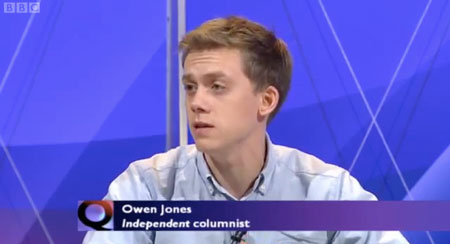
Not if you are Owen Jones, the ubiquitous, telegenic new face of left wing punditry and author of “Chavs: The Demonisation of the Working Class”. According to Jones, British democracy and journalism are most under threat from that evil right-wing juggernaut that extends into all of our homes – the BBC.

Jones has apparently had it with claims from the right of leftwing political bias at the BBC, and has responded with a whinnying, foot-stomping tantrum in The Guardian where he single-handedly attempts to redress the balance. As he sees it, the BBC has become a hotbed of right-wing propaganda, stacked with conservative personalities and pumping out unchallenged conservative viewpoints 24/7:

The truth is the BBC is stacked full of rightwingers. The chairman of the BBC Trust is Chris Patten, a former Conservative cabinet minister. The BBC’s political editor, Nick Robinson, was once chairman of the Young Conservatives. His former senior political producer, Thea Rogers, became George Osborne’s special advisor in 2012. Andrew Neil, the presenter of the BBC’s flagship political programmes Daily Politics and This Week, is chairman of the conservative Spectator magazine. His editor is Robbie Gibb, former chief of staff to the Tory Francis Maude. After the BBC’s economics editor Stephanie Flanders left for a £400,000-a-year job at that notorious leftwing hotbed, JP Morgan, she was replaced by its business editor Robert Peston.

How shocking that successful people (whom the BBC naturally looks to recruit for senior positions) have held strong political views or been allied with political parties in the past. What should happen instead, according to Jones, is that candidates for BBC positions are automatically rejected if they appear on the electoral roll, have voted in a past election or have ever expressed a political opinion on social media.

His outrage at the staffing of the BBC’s business and economics positions is particularly unreasonable. One might think that those who have worked in business and have a functional understanding of the financial industry are well placed to write or broadcast about it – assuming they are professional and operate under the same editorial policy as everyone else – given their expertise and links to the industry. But Jones seems shocked that the BBC didn’t select someone from Occupy Wall Street or Greenpeace to take on these high profile roles.

And it is not just the personalities that Owen takes issue with, but also the resulting coverage. When the global financial system teetered on the brink of disaster in 2008, Jones was apparently livid that the BBC interviewed so many people with knowledge of the industry who could explain to audiences what was happening. These people, despite being involved in the system and deeply impacted by what was happening, were not the right people to speak to, according to Owen Jones. He would have preferred more interviews with sleepy left-wing academics, aging hippies and assorted other people ready and willing to say variations on “I told you so”:

When the financial system went into meltdown, BBC interviews were dominated by City voices like stockbrokers and hedge fund managers, rather than critics of a sector that had plunged the country into disaster.

And at the end of his hit-piece, Jones makes his true intentions fully transparent. He has no interest in correcting this non-existent right wing bias at the BBC and restoring what he would see as some kind of non-partisan parity. No, he wants to transform the BBC into a fully-fledged mouthpiece of the left. It’s about giving conservatives a black eye for perceived past injustices using the BBC as a weapon, and he is willing to indulge in any amount of hyperbole or scaremongering to achieve this end:

For too long, the right has got away with weaving a fairytale of BBC leftwing bias. Until the left starts complaining – and loudly too – the BBC’s agenda will be shaped by supporters of government, big business, the free market and western foreign policy. That does not just subvert honest journalism: it undermines our democracy.

The Owen Jones phenomenon is not unique – whenever someone has a cause to promote (often a losing or flawed one, it seems) there are accusations and recriminations that the media has not jumped on the pro-whatever-the-idea-is bandwagon and given it unwavering support. Any and all instances of giving coverage to the opposing point of view is scrutinised, and any occasional discrepancies – which almost always even out over the long run when it comes to any issue or party – are held up as the “smoking gun” evidence of institutional bias.

Owen Jones' views being airbrushed and ignored on BBC television
Owen Jones’ views being airbrushed and ignored on BBC television


If Owen Jones were to take a step back from his outrage and really consider the BBC’s media coverage, someone as intelligent as he seems to be will surely have to concede that he overstepped the mark with his criticisms. No, the BBC has not shared his stridently left-wing viewpoint on almost every issue – but nor can they. They have a charter to represent and produce content for the entire country, not just left-wing activists. And from the charter come strict editorial guidelines and policies, which are carried out diligently and in good faith by human beings working to a high standard but as prone to error as the rest of us.

All of us – left or right leaning – can point to instances where television and radio and online news output has left us feeling hard done by, or shouting at the screen, convinced that the buffoon they chose to represent our side of the argument is a stooge, deliberately undermining our own, perfectly logical beliefs. But that’s just the nature of having strong political opinions. And as concerned, active citizens we should put our efforts toward actively convincing people of the merits of our arguments, not running off to a non-existent referee for redress whenever we feel the other side came out on top.

Owen Jones has enjoyed considerable airtime across the British political media, and has had ample opportunity to set forth his own strong opinions in a very articulate, persuasive way. It was the BBC, which he now chooses to castigate, that gave him many of these opportunities as part of their news coverage.

To then accuse the BBC, who have done so much to help his own career as a left-wing ‘intellectual’ and pundit, of political and institutional bias, is more than a little rich.