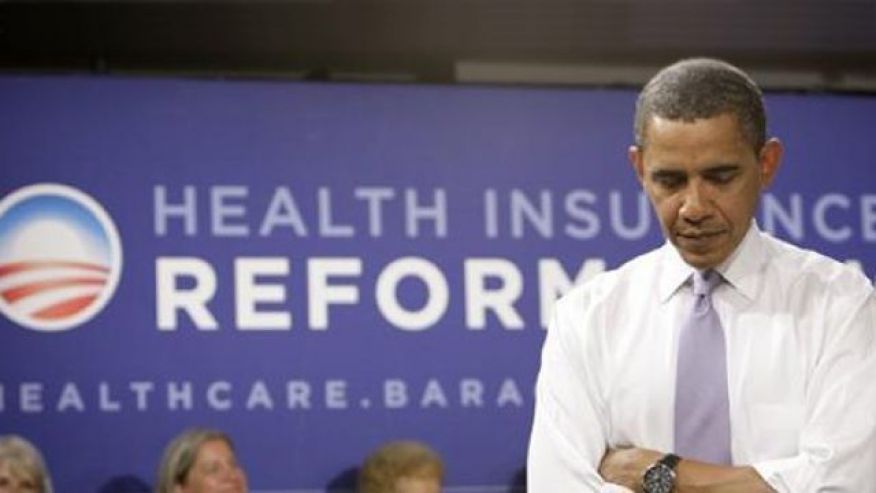
The Patient Protection and Affordable Care Act – otherwise known as the ACA or ObamaCare – was signed into law four years ago this week after tortuous rounds of planning, posturing, arm-twisting and televised negotiating in Washington.
And while many of the features (to say either ‘benefits’ or ‘drawbacks’ immediately displays one’s political bias) of ObamaCare are only now taking effect, this is a good moment to take stock, step back from the thrust and parry of partisan bickering and reflect on what has actually happened since America decided – with the GOP kicking and screaming defiance to the bitter end – that as a country they would no longer tolerate the spectacle of millions of people without health insurance or reliable access to preventive medicine.
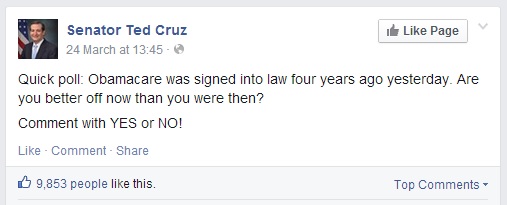
Tea Party darling Ted Cruz, the junior senator from Texas – who fancies himself an intellectual heavyweight and a man of deep principle – took the opportunity to reflect by posing a question to the public on his Facebook page:
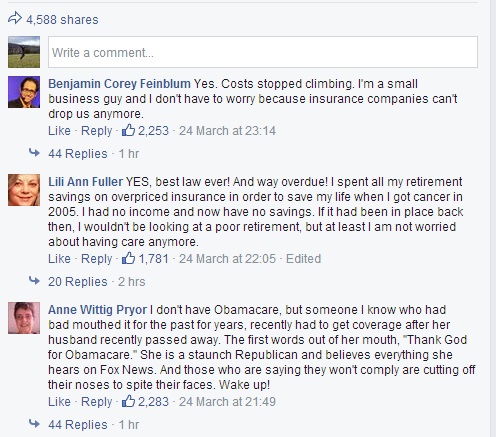
Perhaps surprisingly, given the likely political leanings of a Ted Cruz facebook follower, the majority – the real, undeniable, vast majority – of responses to Cruz’s question are unabashedly, overwhelmingly in favour of ObamaCare.
The following responses are the most recent as of the time of writing, and are entirely representative of the rest:
The warmth of these responses to the effect of ObamaCare – some from staunch Republicans – is quite arresting, and really reveals the gap between the GOP rhetoric on healthcare reform and the way it is perceived by many of those directly impacted.
This is not to say that there are not dissenters among those who answered Ted Cruz’s question on facebook – there are plenty. But the fact that they are in such a minority (and that they often failed to directly answer the question in terms of impact on their finances or lives) again exposes a fundamental weakness in the Republican party’s full-throated opposition to the bill.
While there are certainly – as with any major legislation – those who have lost out as a result of ObamaCare, either through having to change their healthcare plan, pay a higher premium or lose some other benefit – for every one of these cases, there seem to be other people being rescued from catastrophic personal and financial ruin or uninsurability. It is quite telling that when Ted Cruz opened the floor to the public to make their voices heard – without the controlling hand of opinion pollsters or leading questions in focus groups – the message painted was overwhelmingly positive.
The GOP has long tried to paint the passing of ObamaCare as the sudden imposition of socialism on America (conveniently forgetting huge programs such as MediCare for seniors, which are real, tangible socialism in action) against the will of the people and the founding values of the nation. In GOP-world, everyone is a small business owner or unspecified “wealth creator” being taxed to death in order to fund this extravagant giveaway by the “takers”. The real world, as glimpsed through the windows of Ted Cruz’s Facebook page, appears to contradict this worldview.
With ObamaCare, as with most big policies, there is merit in the arguments of both supporters and detractors. President Obama’s signature domestic policy achievement is not without multiple flaws, but those who oppose it undermine themselves by the fact that they made no effort to tackle the glaring problems in America’s healthcare system – sometimes laughably called the “greatest in the world” by ignorant people who have never set foot outside the United States – before Obama took office, and then decided to adopt a position of total, unwavering obstruction once reform efforts got underway – even denying and repudiating policies and ideas once favoured by their own side as conservative reforms.
The Republicans could very well win total control of Congress at the midterms this November, and then go on to win back the presidency in 2016. If they do so, they will have to decide – and admit to the world – how much of their opposition to ObamaCare is real and principled, and how much was political posturing and pandering to the base. And the measure of this will be the provisions that they seek to repeal and those which they keep.
If the Republicans want to be a serious party of government again – and sadly, there is currently very little sign that they do, even though America sorely needs a sane right-wing voice as part of her political discourse again – they will have to confront people like those who shared their positive stories of ObamaCare on Ted Cruz’s Facebook wall, and tell them precisely which of their newfound securities will be ripped away, and why.
Over 7 million Americans have now signed up for health insurance through the various ObamaCare exchanges. If the Republican Party is to regain power, it must face a political day of reckoning with each and every one of them.
If you were wondering exactly how deep goes the rot in the American conservative commentariat in the Age of Obama, you need look no further than the editorial and letters pages of the Wall Street Journal.
When these pages are not screeching warnings of an imagined upcoming Kristalnacht for wealthy Americans to be carried out by the seething, envious masses, they have taken to publishing seemingly highbrow retrospectives on the Obama presidency, paying particular attention to America’s failures and shortcomings under President Obama, whilst brazenly whitewashing the conservative or Republican part in those failures.
Danniel Henninger has the honour of writing the latest of these historically revisionist editorials on the WSJ’s aptly named “Wonder Land” blog – apt because what is written there bears so little resemblance to fact, or reality. In this piece, Henninger asks “The left can win elections. Why can’t it run a government?”
The editorial gets off to a bad start, attempting to link three quite ideologically disparate politicians and use their waning fortunes as evidence of a socialist malaise:
Surveying the fall in support for the governments of Barack Obama, New York City’s progressive Mayor Bill de Blasio and France’s Socialist President François Hollande, a diagnosis of the current crisis begins to emerge: The political left can win elections but it’s unable to govern.
It may have become what now passes for a fact by some on the American right, but in truth – if you look up the dictionary definition or compare his policies to those of previous Democratic presidents – Barack Obama is not a socialist. Therefore, Obama’s troubles have little to do with the travails and setbacks experienced by President Hollande of France, a legitimate socialist whose actual, socialist policies continue to do damage to that country.
Henninger then spends the rest of the article expanding on his cheeky proposition that the political left can win elections, but are unable to govern once in power. He fastidiously examines every possible reason for Obama’s failure to advance his agenda, save the most glaring one – the fact that the Republican opposition have consistently been more interested in token opposition, nihilism, public posturing and pandering to their base than they have bothered to engage in the processes of government while in opposition.
But Henninger is less interested in any kind of introspective analysis of the rights own complicity in America’s current difficulties than in spewing misleading half-truths:
Once in office, the left stumbles from fiasco to fiasco. ObamaCare, enacted without a single vote from the opposition party, is an impossible labyrinth of endless complexity.
The merits and drawbacks of ObamaCare aside, the blanket Republican opposition was more a strategic move to damage the Obama presidency than a principled stance (Republicans having long been content to leave “the best healthcare system in the world” and all it’s flaws untouched and unaddressed), and Henninger conveniently forgets that Anh Joseph Cao of Louisiana provided a solitary GOP vote for the draft version of the health bill.
Henninger’s next exhibit is the world’s response to climate change, an issue which he says has more political support than any other in our time:
No idea in our time has had deeper political support. Al Gore and John Kerry have described disbelievers in global warming as basically idiots—”shoddy scientists” in Mr. Kerry’s words. But somehow, an idea with which “no serious scientist disagrees” has gone nowhere as policy. The collapse of the U.N.’s 2009 Copenhagen climate summit was a meltdown for the ages.
It may or may not be correct to state that global warming is the greatest area of consensus in world politics at the moment, but what is truly laughable is Henninger’s neglect to admit that all of the opposition to taking any action on climate change comes from his own side. In doing so, he really answers his own question, except that it is not so much the left who are terrible at governing, but more that the ideologically inflexible American right are brilliant when it comes to using whatever political power they still wield to throw a spanner in the works and thwart the majority.
Sometimes it may be right to use opposition power in this way, in order to prevent abuse of power by that majority – but using that same tactic over and over in response to every initiative from the governing party is overkill, and the opposite of good governance.
Henninger sums up:
Making the unworkable work by executive decree or court-ordered obedience is one way to rule, and maybe they like it that way. But it isn’t governing.
True – and Henninger can rightly point to numerous cases where the left has taken these shortcuts to governance, especially recently. But he fails to take the next step and ask why President Obama and the Democratic party are behaving as they are, showing a complete unwillingness or inability to examine the GOP’s own role in creating the acrimonious partisan deadlock for which executive orders and court judgements have been the only pressure release valve.
Under the presidency of George W. Bush, the Republican Party had a tight grip on the reigns of power, holding the executive branch and both houses of Congress for a time. And in this time meaningful legislation was passed, sometimes in the face of vociferous opposition from the left and from libertarians. Significant legislation such as the PATRIOT Act, Sarbanes-Oxley and the 2003 Partial-Birth Abortion Ban Act were all shepherded through Congress without Democratic Party histrionics or threat of filibuster.
One can argue that the Republicans’ willingness to remain united as a single block in order to successfully oppose legislation is a sign of strength, and that the Democrats’ tendency to fracture and allow members of their caucus to be picked off in order to garner support for conservative proposals is a sign of weakness. But in that weakness is also the flexibility and willingness to compromise – hell, to acknowledge that some people in America hold a different point of view – that is so utterly lacking in today’s GOP and in much modern conservative thinking.
The American left may sometimes be catastrophically bad at advancing their agenda, framing the debate and winning the now all-important war of words (death panels, death taxes, job-creators) when courting public opinion, but the American right plays a daily role in the left’s emasculation. In many ways, even in opposition the Republicans have seemed like the playground bully who grabs hold of his prey’s wrist and turns his fist against him, all the while asking why the hapless victim likes punching himself so much.
Blanket, unthinking opposition to everything that the governing party tries to do has been effective for the GOP of late. They have successfully stopped President Obama’s legislative agenda in its tracks. The conservative strategy has been proven to work very well, but good responsible governance it is most certainly not.
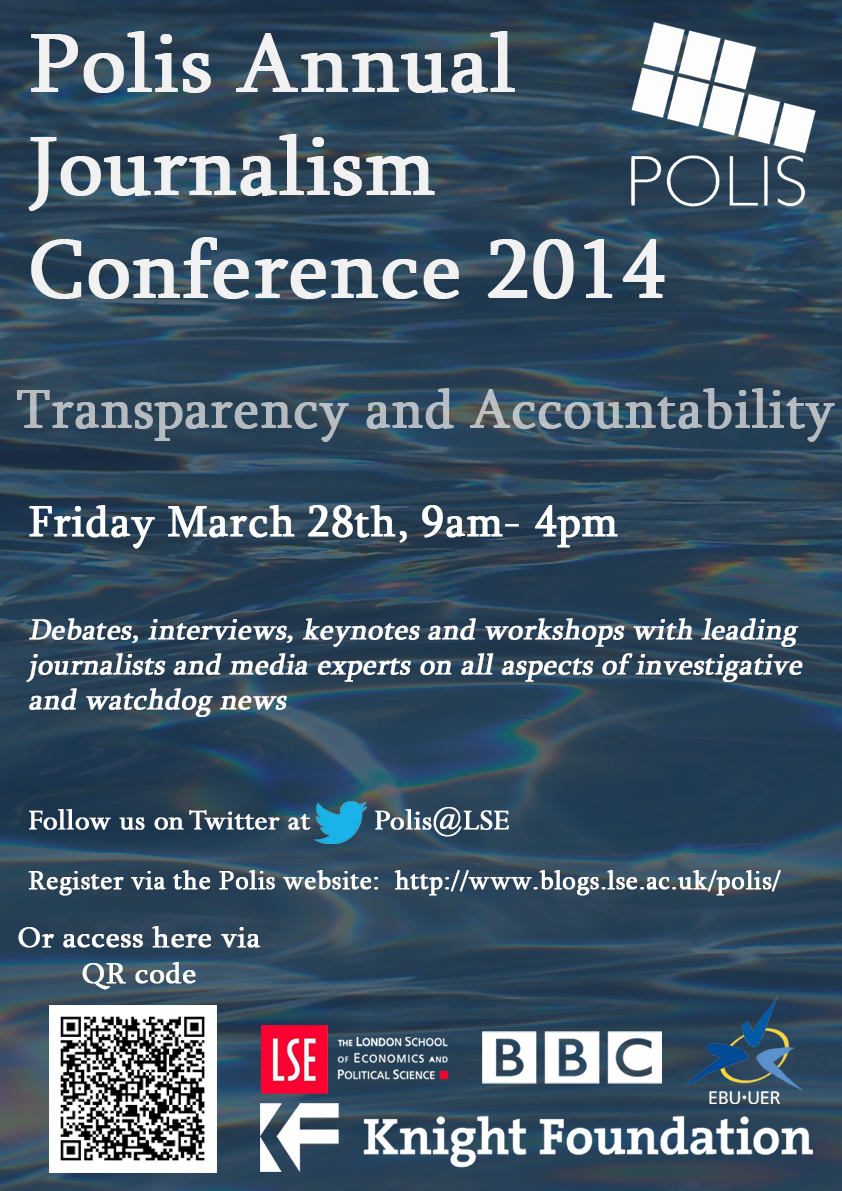
Semi-Partisan Sam will be attending the annual Polis Journalism Conference later today at the London School of Economics for what promises to be a very stimulating day of discussion and debate, featuring – for good or for ill – a Who’s Who of the British media establishment.
Several sessions in particular are especially relevant to the aims and objectives of this blog:
Journalism after Snowden: Watchdog or thug? In the wake of the Snowden story and the Leveson Inquiry into the press, we ask whether British journalism is too supine or too aggressive? Was the publication of state secrets justified?
Taking on the world: The Guardian In the last 12 months The Guardian has published one the biggest scoops in its history. The Snowden revelations brought intelligence officials into its offices to smash up hard-drives. At the same time it is re-inventing itself as the radical liberal journalism platform for the world. Steve Hewlett puts its editor under the spotlight.
The future of transparency journalism A new generation of journalists is emerging, finding fresh ways to hold power to account. What skills do they need? How will their work change? We bring together former top news professionals and journalism educators to debate the way forward.
Holding Europe to account As Europe prepares to go to the polls in a month’s time it is facing a political crisis. How can journalists get citizens to engage with European issues and how should they report on the growth of scepticism?
Stay tuned to @SamHooper on Twitter for live-tweets from the event, and to this blog for discussion and analysis of the conference after the fact.
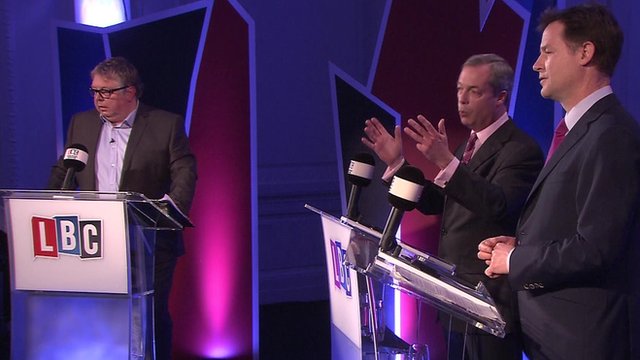
Finally, the British voters got what they had always wanted – a real debate between politicians on the merits and disadvantages of Britain’s continued EU membership. The political elite and main party leaders may have snubbed the debate and thumbed their noses at the concerns and sentiments of the people, but the discussion went ahead nonetheless, thus proving that important and thorny issues will be debated and tackled in Britain, even when it does not dovetail conveniently with the news strategies of the main political parties.
This blog offered a running, real-time commentary on the debate as it took place, on Twitter.
Nick Clegg, having been nominated to begin the debate, started with the risible and misleading suggestion so beloved of Europhiles that Britain’s trade with Europe and membership of the European Union are essentially one and the same thing – that to leave the political organisation that is the EU would be to build a wall and sever all trade ties with our continental European trading partners. Of course, in reality this is simply not the case, and Nigel Farage took the earliest opportunity to swat down this false argument.
Farage continued his strong start by cunningly reversing the question and asking if Britain were currently outside the EU, and given what we all now know about the costs and flaws and drawbacks of EU membership, whether the British electorate would likely vote to join. This simple shifting of the lens on the debate is clever, and moves focus away from distracting side-issues about the mechanics of secession, looking instead specifically at the merits.
The debate then moved on to whether a referendum on British membership of the EU is desirable at all. Here, Farage did a superb job of calling out the main political party leaders for repeatedly promising referenda in the run-up to elections and then back-peddling or stalling when the time came to deliver on the promises.
Here, Nick Clegg was firmly on the defensive, continually resorting to the official line that he might deign to grant the British people a say on future EU membership, but only in the event of some future treaty change. The justification for this particular stance, at one time used by all of the major political party leaders, has never been convincingly made. People in Britain are unhappy with the EU as it is now, not with how it might be after some as-yet unknown treaty modification. So why can the debate and the referendum not take place on Britain’s current status quo relationship with the EU? As this blog observed at the time, if you catch someone stealing from you, you don’t wait until the next theft before alerting the police, you would do so immediately. And so if Britain’s EU membership has been acting against our national interests, why should the British people have to wait until the next harm is caused to the country before seeking redress?
Of course, the topic of immigration was raised, thus exposing the major chink in UKIP’s armour – the perception that the party and its supporters are hostile to immigrants per se. The fact that the question was asked by an audience member of the ‘swivel-eyed lunatic’ type appearance and then heartily embraced by Farage did not help matters. A party that aims to abhor regulation and restrictions on business and the market really needs to ask itself if continued opposition to immigration is a sound policy in 21st century Britain.
Aside from this inevitable rocky point, Farage remained combative and humorous throughout, while Clegg – despite deploying his usual tricks of staring into the camera and repeating the names of audience members as many times as possible – seemed defensive and on the back foot. There was even time for an awkward Marco Rubio-style on-camera gulp of water from the Deputy Prime Minister.
Farage landed yet another blow on Clegg when he reminded viewers of the apocalyptic doomsday scenarios laid out by pro-Europeans in the 1990s, claiming that Britain’s economy would be dealt a mortal blow if we failed to sign up for the single European currency. “Thank God we didn’t listen,” thundered Farage, to loud applause.
This left Nick Clegg scrabbling around for any remaining mud to sling at Nigel Farage and the Eurosceptic movement. In the end, he resorted to a beloved bogeyman of British social discourse, paedophilia. Nick Clegg, in his desperation to score a final point against Nigel Farage, actually appeared to suggest that British secession from the EU would eradicate Britain’s ability to extradite and prosecute paedophiles – a ludicrous argument, and basically a reassertion of the false argument that Britain would leave the EU without drawing up replacement political, trading and justice treaties with the remaining member states.
And on that damp squib of a counter-argument, save only the closing statements, the debate was over. A solid victory for Nigel Farage, one might have thought, until one witnessed the commentary on television and the internet.
Several commentators rightly pointed out that the media showed several worrying signs of institutional bias. In the buildup to the televised debate, ably anchored by Kay Burley on Sky News, at one point a panel member – a visiting university student from America – was asked if she was ‘worried’ or ‘alarmed’ by the fact that Britain was debating the topic as she landed in the country. Never mind the fact that the poor girl clearly knew next to nothing about what the EU is or how it works, the question was so leading as to be risible. Rather than painting the in/out decision in more clinical terms and asking for a comment, it was suggested to the American student that the very idea of Britain leaving the European Union is alarming and scary. Naturally, the student – on live television – agreed with the questioner that it was indeed a scary prospect. So much for objective coverage.
Peter Oborne, writing in The Telegraph, also found significant institutional fault in the way that the mainstream media handled the coverage and the issue of Britain’s EU membership in general. Oborne saw a deliberate attempt to spin the results of the debate as a victory for Nick Clegg and the pro-European side, until the overwhelming results of the post-debate poll forced them to amend their stories:
Last night’s debate between Nigel Farage and Nick Clegg was a very good example of this phenomenon. The lobby wanted a Clegg win and … collectively called victory for Clegg the moment that the debate was over.
It was only when the YouGov poll came through showing that Farage had won the debate hands-down with the public that lobby journalists were forced into an abrupt U-turn.
I am not going to embarrass reporters by naming names. However, it is fair to hold both Sky and the BBC to account.
Oborne concludes that the UKIP and Eurosceptic-leaning side not only have to win their argument in the court of public opinion, but also overcome a second opponent in the British press:
Farage is leading a political insurgency. Last night was a reminder that Ukip’s opponents are not just the other political parties, but also the mainstream British media.
The Spectator also picked up on the media’s U-turn upon realising that their preferred narrative was falling apart in the face of the YouGov poll:
Nick Clegg had been given the night off babysitting; but, after the poll verdict on tonight’s EU debate with Nigel Farage, he may wish he’d stayed at home with the kids. As the dust settled, the Deputy Prime Minister was bundled into a car and fled the field of battle. Meanwhile, Nigel Farage headed for a victory lap at the Reform Club, where his party donors had been watching.
Backstage, Westminster’s hack-pack was necking cheap vino and Pret sandwiches after carrying out a spectacular volte face. Initially ‘the spin room’ had called the duel for Clegg, on both style and substance. But, as news of the Sun/YouGov poll filtered through to the scribblers, headlines were rewritten and awkward tweets deleted. Soon, only the BBC was left flying the Clegg flag, with the help of Danny Alexander and Tim Farron.
And even now, in the cold light of a new day, the general consensus from the headlines appears to be that that it was an honours-even draw, and that there were ‘no knock-out blows’:
The question of the hour, should Britain stay in the European Union? But the question now being asked? Who won, Nick or Nigel?
Well, it might be disappointing but both men certainly remain standing after tonight’s event. Neither was knocked to the ground and both sides will be pleased with how their leaders performed.
Given the testy nature of the debate and the fact that Nick Clegg was on the back foot for nearly the entire duration, one wonders what would have had to happen – short of either man accidentally lighting his podium on fire – for the news media to declare an actual victory for either side.
And this typifies a problem that is becoming endemic in the news media, not only in Britain but also in the United States. All too often, there is such a tremendous pressure to appear nonbiased and objective that news organisations are terrified to report on anything of a partisan nature without giving equal balance to both arguments. The compulsion to treat both sides of an argument as equally valid and legitimate – even when one is clearly correct and the other one wrong – is paralysing the ability of many news outlets to correctly report the news, even when there is no deliberate attempt to give favourable editorial treatment to a particular side.
The only news outlet with a convincing explanation (i.e. one not based on bipartisan spinelessness) for why both UKIP and the Liberal Democrats seem happy with last night’s debate is The Spectator:
Nick Clegg and Nigel Farage may have looks straight into the same camera and appeared to be addressing the same audience, but they were aiming for different listeners. That’s why the Lib Dems were happy with the 36 per cent that they polled last night. It demonstrates to them that there is some kind of constituency that likes to hear a politician being honest that he likes Europe and that he is pessimistic about Britain’s chances outside the EU.
Last night’s result also demonstrates that even if you appear a bit ratty and sweaty at times, as Nigel Farage did to those who are not instinctively his supporters, you can still win the debate, because there is a bigger constituency of voters who do agree with what you are saying, even if you’re not as polished as Nick Clegg. Thus the first of the two debates went very well for both parties: both were shoring up their own bases and motivating them to vote in elections with typically very low turnout. The real mission for these party leaders is to get their voters to go to the polling booths, not bother about people who haven’t made up their minds.
This ‘one debate, two audiences’ explanation makes a good deal of sense.
Of course, there is one further debate to take place, this one hosted by the BBC on Wednesday 2 April. Again, the Prime Minister and Leader of the Opposition have declined to participate. And once again, despite their resistance and the timidity of much of the British press, the public will continue to debate the issues in their absence.
One day, Timmy, all of this will be seized by the government to stop you from gaining an unfair advantage in life
Never mind tinkering around the edges and tweaking the rates for inheritance tax or the level at which it takes effect – those arguments are so 2013. The real movers and shakers of the left are now questioning the right of anyone to pass on anything to their children at all, and their self-appointed spokesman, James Butler, has taken to the Comment Is Free pages of The Guardian to argue his case.
In high dudgeon, Butler points to several universally-acknowledged flaws in society, wildly extrapolates from them and reaches the conclusion that we would all be much better off if parents were actively discouraged from working hard and getting ahead for the benefit of their children. Apparently, goes this argument, the natural human instinct to provide for one’s offspring should be forcibly curtailed by government in order to ensure a strictly level playing field for everyone – and what is more, the government should have the right to enforce this usurpation of property rights:
Why do we permit this? The transfer of wealth between generations is an injustice: it is a reward for no work, and a form of access to privileges that are otherwise beyond reach.
The ‘we’ that are permitting this is never fully identified by Butler, but appears to consist of himself, his friends and others of a similarly cataclysmically communist bent. Butler clearly does not start from the basis that the people determine the powers that government may wield, instead approaching the issue from the basis that government should decide which powers and rights to grant the people. And to Butler’s mind, free agency and the ability to do what you like with your own assets is a liberty too far:
Far from a Keynesian “euthanasia of the rentier”, we are seeing the triumph of a rentier economy: in such conditions, rather than further accumulation by the sons and daughters of the wealthy, we should instead demand an end to inherited wealth entirely.
An end to inherited wealth entirely. Quite how such a policy would ever be implemented remains conveniently unmentioned by Butler, but would clearly happen only over the dead bodies of the thousands and millions of people who believe in the right to pass on to their children that which they have built or preserved during their lifetimes, to do with as they see fit.
None of this is to say that Butler does not hit on some of society’s ills; indeed, he is quite right to point out the fact that too many people in Britain are born with almost impossible odds of achieving success in life, whilst for children of privilege, failure is next to impossible. He detail many of the ways in which this problem perpetuates itself in a way that is impossible to refute:
Despite nominal efforts to curb this kind of [tax] minimisation, there remains a booming market in financial advice tailored to avoidance. The knock-on effects of this minimisation are huge: it permits further concentration of wealth in the hands of those who already possess it, rewarding those cunning enough to avoid taxation, and cushioning their children with an influx of unearned wealth. There are obvious uses to which this can be put: paying off student loans early, thus avoiding interest, investing in buy-to-let property, or high-return financial products. It permits the children of the middle classes to sustain themselves through unpaid internships or unfunded study into secure middle-class careers, while locking these off from those without such resources.
The diagnosis is spot-on, but the prescription that follows is barking mad. And as is all too often the case with solutions from the left, Butler seeks a remedy by tearing down the successful or privileged rather than building up the weak or disadvantaged. He legitimately seems to believe that Britain’s societal ills can be cured if the counter is reset to zero as each generation expires, with all of the winnings confiscated by the government and scooped into a big pot for the communal good.
Neither does it occur to Butler or other death tax proponents that the human brain and spirit – if given an adequate starting point via a good quality education, a safe upbringing and ambitious goals – is capable of outmatching and overtaking others born with far more advantages but much less motivation or natural ability.
So here is a different prescription: what if Butler and others of his persuasion placed more trust in human ability properly nurtured, and less reliance on the government to be the final arbiter of who gets to keep what when the music stops at life’s end?
Not all rich and wealthy people achieved their favourable position in life through the fruits of their own talent and labour – this is abundantly and indisputably clear. But equally, not all poor or less successful people arrived at their less favourable position because of a lack of resources and opportunities.
So why do people like James Butler and his inheritance tax-supporting friends on the left continue to clamour for a one-size-fits-all remedy to a complex problem?