The Age Of Trump: As The Republican Party Goes To Its Armageddon

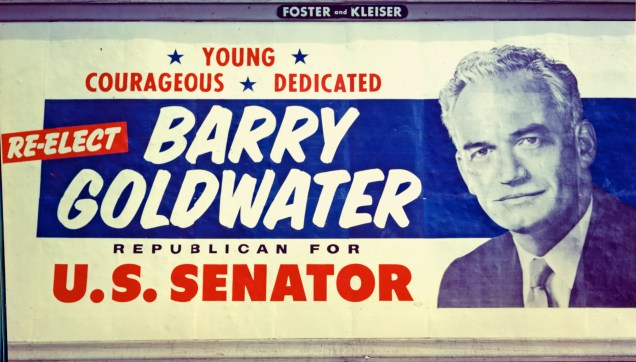
Barry Goldwater - Election Poster

To understand why the Republican Party are on course to lose their third consecutive presidential election, one must look much further back in time than the rise of Donald Trump

It gives no satisfaction to watch any storied political party hurl itself into oblivion – even the US Republican Party, which has frequently infuriated true conservatives with its sanctimonious and hypocritical habit of screeching about the dangers of encroaching socialism under Democratic administrations while themselves consistently cranking up the size and role of the state at every opportunity.

But while it now seems almost certain that the Republicans have thrown away any chance of reclaiming the White House, imploding in a foul-mouthed torrent of bluster and recrimination more worthy of Jerry Springer than a presidential primary campaign, it is worth looking back and asking how the GOP finds itself in this position, and exactly when the seeds of destruction were sown.

I have been reading widely on this, focusing less on the crowing and virtue-signalling Left, and far more on those thoughtful and introspective voices on the Right who are often appalled by the rise of Donald Trump in particular, but often sympathetic to the anti-establishment fervour which fuels his candidacy.

And if I have to pick just one excerpt from one piece to explain the predicament in which the Republican Party currently finds itself, I would encourage my readers to read “I was wrong about Donald Trump” by Daniel McCarthy over at The American Conservative.

In his piece, McCarthy concludes:

Trump succeeds because of more than outsize personality, of course. He attracts some support from everyone who thinks that Conservatism, Inc. and the GOP establishment are self-serving frauds—everyone who feels betrayed by the party and its ideological publicists. Working-class whites know that the Republican Party isn’t their party. Christian conservatives who in the past have supported Mike Huckabee and Ben Carson also know that the GOP won’t deliver for them. Moderates have been steadily alienated from the GOP by movement conservatives, yet hard-right immigration opponents feel marginalized by the party as well. Paleoconservatives and antiwar conservatives have been excommunicated on more than one occasion by the same establishment that’s now losing control to Trump. They can only applaud what Trump’s doing, even if Trump himself is no Pat Buchanan or Ron Paul.

Conservative Republicans™ somehow maneuvered themselves into a position of being too hardline for moderates and non-ideologues, but not hardline or ideological enough for the right. Trump, on the other hand, appeals both to the hard right and to voters whose economic interests would, in decades past, have classed them as moderates of the center-left—lunch-pail voters.

What’s even more remarkable is that movement conservatives, who have been given plenty of warning, ever since 2006, that their formula is exhausted, keep doing the same thing over and over again: they’ll dodge right, in a way that right-wingers find unsatisfactory but that moderates find appalling; then they’ll weave back to the center, in a way that doesn’t fool centrists and only angers the right. Immigration—which was another of George W. Bush’s stumbling blocks, lest we forget—has been the issue that symbolized movement-conservative Republicanism’s futility most poignantly. It’s not even clear that most GOP voters agree with Trump’s rhetorical hard-line on immigration—they just like it better than the two-faced talk of the average Republican politician.

Trump has a plethora of weaknesses, as general election polls amply demonstrate. But just look what he’s up against within the Republican Party: that’s why he’s winning.

I have yet to see the rise of Donald Trump explained as thoughtfully and succinctly as it is in the first three paragraphs quoted above. Sure, McCarthy’s piece does not tackle every aspect of the situation – whole books can and will be written about the causal factors of this huge anti-establishment backlash, which is far bigger than any one political party – but it does explain why the current GOP was so badly positioned to withstand a populist insurgency like Trump’s.

Much like the British Labour Party has become a fractious and increasingly unworkable coalition of idealistic left-wingers, pragmatic centrists and (let’s be frank) soulless political shapeshifters, and much as the historic splits in the Conservative Party are re-emerging following a vacillating 2016 Budget and the party leadership’s betrayal of the activist base on the coming EU referendum, so the Republican Party’s big tent of Reaganites, neo-cons, Evangelicals and social conservatives is collapsing – for those reasons outlined above by McCarthy.

Read the collected output of Rod Dreher too, and this piece by David Brooks, which looks to the future which could yet follow 2016’s rock bottom:

Trump is prompting what Thomas Kuhn, in his theory of scientific revolutions, called a model crisis.

According to Kuhn, intellectual progress is not steady and gradual. It’s marked by sudden paradigm shifts. There’s a period of normal science when everybody embraces a paradigm that seems to be working. Then there’s a period of model drift: As years go by, anomalies accumulate and the model begins to seem creaky and flawed.

Then there’s a model crisis, when the whole thing collapses. Attempts to patch up the model fail. Everybody is in anguish, but nobody knows what to do.

That’s where the Republican Party is right now. Everybody talks about being so depressed about Trump. But Republicans are passive and psychologically defeated. That’s because their conscious and unconscious mental frameworks have just stopped working. Trump has a monopoly on audacity, while everyone else is immobile.

[..] At that point the G.O.P. will enter what Kuhn called the revolution phase. During these moments you get a proliferation of competing approaches, a willingness to try anything. People ask different questions, speak a different language, congregate around a new paradigm that is incommensurate with the last.

That’s where the G.O.P. is heading. So this is a moment of anticipation. The great question is not, Should I vote for Hillary or sit out this campaign? The great question is, How do I prepare now for the post-Trump era?

As Brooks says (perhaps a little naively), this is not necessarily all bad news for conservatives. If we are honest, we have to admit that conservative policies in America and Britain are no longer perfectly calibrated to the challenges of the day as they were in Thatcher and Reagan’s time.

That is not to say that the Left are any better; Lord knows they aren’t. But it does mean we should acknowledge certain facts – like the fact that we still have a stubbornly large permanent underclass, and that for all the irreplaceable benefits of globalisation, there are still those who miss out – and seize the initiative by proposing radical conservative policy solutions to the great challenges of the new century.

In Britain, David Cameron’s Coke Zero Conservative government – or the Ted Heath tribute act, as this blog has taken to calling them – seem to think that One Nation Conservatism means stealing as many of Labour’s left-wing ideas as possible. And in America, Donald Trump’s brand of populist pseudo-conservatism doesn’t believe in One Nation at all, unapologetically carving the country up into winners and losers.

Neither is the correct approach. And as Cameronism and Trumpism run their respective courses, this blog will continue providing commentary and offering suggestions for an alternative conservatism, in Britain and America.


Postscript: This blog has decreased its focus on US politics in the past few years, primarily because I have been London based and fully occupied writing about British political issues. But Semi-Partisan Politics will begin to cover the American presidential election with a little more frequency going forward, partly because I have always remained a close follower of American politics – often more so than the household name journalists dispatched to the States by their newspapers and now portentously reporting back to us as self styled “experts”.

Having lived in America helps – particularly having lived in the American Midwest, not just the coastal enclaves of New York and Washington, D.C. familiar to most British journalists who write about America during election season. And the fact that I am married to a Hillary Clinton-supporting Hispanic Texan helps too. When I write about American politics, I know whereof I speak.

But I am also covering the presidential race because as a conservatarian with one foot firmly planted on either side of the Atlantic (and a heart divided equally between Britain and America), I believe that in my own small way I can bring a perspective to the left/right, authoritarian/libertarian debate that is often missed by those whose thinking and writing is rooted firmly in just one country’s specific conservative tradition.

To borrow an overwrought phrase from the dystopian world of Identity Politics, consider this my contribution to an “intersectional” perspective on conservatism.

They’ll absolutely hate me for that.


Donald Trump Hat - Make America Great Again

Agree with this article? Violently disagree? Scroll down to leave a comment.

Follow Semi-Partisan Politics on TwitterFacebook and Medium.

Happy Easter – He Is Risen

A very happy and blessed Easter to all of my Christian readers

Hallelujah, for the Lord God Omnipotent reigneth, Hallelujah!

The Kingdom of this world is become the Kingdom of our Lord and of his Christ, and he shall reign for ever and ever, Hallelujah!

King of Kings, and Lord of Lords, and he shall reign for ever and ever, Hallelujah! REVELATION 19.6, 11.5, 19.6

Hallelujah Chorus, Messiah by Georg Friedrich Händel, performed by the London Symphony Orchestra and Tenebrae Choir under the baton of Sir Colin Davis.

A brief and entertaining history of Handel’s Messiah is here.


He is Risen - Happy Easter

Follow Semi-Partisan Politics on TwitterFacebook and Medium.

The EU’s Model Of Supranational Harmonisation Does Not Keep Us Safe

EU - European Union - Security Defence Policy

On national security as with trade and social affairs, the case for Brexit hinges on the conflict between intergovernmentalism and supranationalism

In his latest Telegraph column, Christopher Booker joins this blog in refuting the baseless, scaremongering claims by the Remain camp that being in the EU in any way protects Britain from the risk of terrorist attack.

Booker writes:

It was unfortunate timing for our not very convincing Defence Secretary Michael Fallon, when he used the Brussels terrorist attacks to claim that they only confirm how disastrous it would be for Britain to leave the EU. “The fact is,” he said, that “across Europe we do have these mechanisms now” for “sharing intelligence about terrorists’ movements” that enable “all intelligence services across Europe to pool their efforts”.

Do those “mechanisms” for sharing intelligence include the Parliament, Court of Justice, Commission, the supranational elements by which the European Union undermines nation states and seeks to usurp their role on the world stage? Of course not – these are all explicitly political institutions. All of the collaboration which actually helps to combat terrorism in Europe occurs on an intergovernmental, not a supranational basis, mostly outside of European Union structures.

When sovereign governments are free to co-operate on mutually important issues, they can often do so well. But when a busybody supranational regime seeks to take on ever more responsibilities from the nation state, vesting them in inappropriate and unproven institutions, that’s when things can easily fall through the cracks, as this blog explained yesterday.

Booker rightly goes on to argue:

In fact, there is here a much wider point, which highlights one of the most common misunderstandings about the EU, whose supporters try to persuade us that without it, international cooperation could not exist. In fact, over a whole range of issues, countries have long evolved extremely effective systems of inter‑governmental cooperation, such as on air-traffic control, Interpol, the international postal union, the European Space Agency and dozens more (not to mention Nato).

All these, negotiated between national governments, regardless of whether or not they are in the EU, work very well. And not the least absurd feature of the EU’s attempt to make itself a “supranational government of Europe” is how often it has tried to absorb these examples of effective cooperation into its own clumsy bureaucratic empire: as when it launched its “Single European Sky” programme, or set up “Europol”, or issued directives on postal arrangements with which it then expected non-EU states to comply, or tried to take over the European space programme for its crazy Galileo satellite project.

If only more people appreciated the crucial difference between “inter‑governmental”, which works, and “supranational”, which doesn’t, how much more enlightening our debate might become.

Inter-governmental versus supranational. It is very much in the interests of the EU’s apologists and closet federalists for the general public not to realise the difference between these two important terms.

The former describes the healthy co-operation between friendly allied countries, sometimes bilaterally and other times facilitated by an organising body (like Interpol). The latter describes weak nation states outsourcing key responsibilities to a higher third party, a reckless and unproven approach only ever attempted by national politicians seeking to escape accountability to their own electorates.

If the Remain camp succeed in their effort to lay a thick fog of war over the EU referendum debate so that important terminologies and ideas are confused and muddled, they automatically win. If they can persuade people that the EU equals warm, fuzzy co-operation with our friends while Brexit equals snarling isolationism and being an international pariah, the Remain camp need to nothing else. And so far, they are succeeding.

In order to turn this around, the Leave campaign absolutely must succeed in educating the public on the difference between laudable and (ideally) transparent and accountable co-operation between European countries on one hand, and the outsourcing of core government competencies to undemocratic, unwanted and untested unified European institutions on the other.

This applies not only to national security, but economic and social affairs too. When the Leave campaign are able to cut through the fog of confusion and make people realise that leaving the EU would actually represent an affirmation and strengthening of the only kind of co-operation which actually delivers positive results (the inter-governmental kind), they are far more likely to embrace Brexit and realise how the EU actively harms healthy intergovernmentalism in its rabid pursuit of ever-closer union.

Can the Leave campaign this message across in less than three months between now and the referendum? Perhaps. But enlightenment will not spring from the mouths of deliberately ignorant “leaders” like Boris Johnson.

Those who can actually distinguish between the real issues and the cosmetic ones – which sadly excludes much of the British press corps – urgently need to find a way to amplify their message.


Intergovernmental vs Supranational - European Union - EU Referendum

Bottom Image: Cartoon by Wolfgang Ammer, published in Intergovernmentalism & Liberal Intergovernmentalism

Agree with this article? Violently disagree? Scroll down to leave a comment.

Follow Semi-Partisan Politics on TwitterFacebook and Medium.

The EU’s Undermining Of National Identity Creates A Space Where Islamist Extremism Freely Grows

Jean Claude Juncker - Manuel Vals - Brussels Attacks - European Union

Eroding national identities while forging an unwanted and unloved new European identity creates a dangerous gap, which Islamist extremists are now exploiting

There is a welcome glimmer of realisation in today’s New York Times that repeated attempts to artificially force political union on the disparate peoples of Europe (alternately by threat and by stealth) is leading to increasingly suboptimal outcomes.

Jochen Bittner writes:

Official Europe has worked hard to move past nationalism, so that there is no German or French Dream. But there’s no European Dream, either, not yet. So new migrants have no spirit to tap into, as they do in the United States. Instead, some Muslims find it more attractive to give their loyalty to Allah, their fellow believers or the Islamic State.

Intelligence services estimate that up to 6,000 jihadists from Western Europe have traveled to join the Islamic State. This enormous figure does not illustrate merely the failures of integration policy. It also shows the failure of mainstream European Muslims to keep their youth immune from extremism.

A result of this mutual apathy is too many Islamists, and too few police and intelligence officers — particularly in Belgium, but not just there. We may have a common European currency, but we still do not have a common European terrorism database. Islamists in Western Europe seem better coordinated than the European authorities hunting them.

There is a creeping awareness too that the head-in-the-sand insistence by many Western leaders that Islamist terror has “nothing to do with Islam” has been a textbook case of wishful thinking overriding political judgement, even common sense:

For the sake of social peace, after the Sept. 11 attacks, and later after the Madrid and London bombings, we told ourselves that Islam and Islamism had nothing to do with each other. But sadly, they do. The peaceful religion can sometimes serve as a slope into a militant anti-Western ideology, especially when this ideology offers a strong sense of belonging amid the mental discomfort of our postmodern societies.

That’s not to say that the article is right about everything. At one point it lapses back into the lazy, unthinking assertion that the European Union is solely responsible for keeping the peace since the Second World War:

So are Germany’s critics right? Is it reasonable to pull up the drawbridge?

In a way, the very question shows the disproportionality of the thought — unless you think it’s worth sacrificing 60 years of peace and international cooperation to the depredations of terrorists. It’s what they want; European disunity, confusion and extremism put them a step closer to the all-out war between Muslims and non-Muslims they so desperately seek.

The notion that the leaders of Islamic State – or radical jihadists in general – could give a hoot whether the Western European countries they so fervently loathe are grouped together under a single political umbrella or under their own auspices is ludicrous beyond words.

The home-grown radical Islamist terrorists from Belgium, Britain and France do not feel any allegiance to Europe or to their own particular country. Their only allegiance is to their warped strain of Islam, which teaches them to loathe anything and everything which does not conform to a very fundamentalist, conservative and specific worldview.

If anything, the European Union’s insistence on subordinating the national identities of individual member states in a thousand ways large and small, and attempting to shoehorn in an artificial new European identity which consistently fails to take root is primarily responsible for allowing a radical Islamist identity to creep in between the cracks.

If the European Union is the vehicle for international collaboration that its cheerleaders consistently claim, then it would focus on intergovernmental co-operation – for that is what will do the most good thwarting future terror attacks. But the EU doesn’t particularly care about co-operation between security services. Such matters are exquisitely boring to the architects and drivers of European political integration, who care only about creating a single European state.

Consider: if the European Union is a benign and non-threatening group of countries coming together to trade and solve common problems (like the threat of Islamist terrorism), why is such a tiny fraction of its budget – and an even smaller percentage of officials’ time – spent on enhancing intergovernmental co-operation so that agencies and forces work seamlessly together when they most need to?

No, the European Union has a flag, anthem and parliament for a reason – because those are the things that matter to them, the building blocks of political union. Sure, the EU’s leaders are happy to take advantage of the Brussels terror attacks – as they do with every other crisis – to declare that the only solution is “more Europe”. But the more Europe they have in mind won’t do a damn thing to thwart future terror attacks. It will only make them more likely.

Building a politically unified European state involves first dissolving existing national identities, and then replacing them with a new European identity commanding the loyalty and affection of the people. The EU has been moderately successful at the former, but absolutely hopeless at the latter. Staggeringly few people see themselves as European first and foremost – nearly all retain primary loyalty to their country, or in some cases to a region – like Scotland or the Basque region.

And as the nation state is undermined on one side while the vaunted new European identity consistently fails to materialise, this creates an ever widening gap which can be filled by Islamist extremist recruiters and terrorists. When there is no healthy sense of national identity, first and second generation immigrants may struggle to assimilate, and sometimes they will find meaning and belonging in undesirable places.

None of this should be shocking. Much of it was entirely predictable. But the European Union – who are now sickeningly claiming that they were the true victims of the attack, as though a self-important bureaucratic talking shop even registers on the Islamic State’s radar – refused to take the threat seriously, because it was too busy building up the appearance and trappings of a state.

Proper co-operation and coordination between national intelligence services does not require a European Parliament, a European Council, a flag, an anthem or pretensions on the world stage. If the EU really cared about keeping its citizens safe first and foremost, it could immediately deprioritise all further steps toward political integration, roll back its outsized role in supranational governance and focus on facilitating the kind of basic inter-governmental cooperation that might have feasibly prevented the Paris and Belgium attacks.

But of course the European Union will never do this in a million years. Because the EU has some other objective, far more important than trifling concerns over national security, on its agenda.

Now what could those other priorities possibly be?


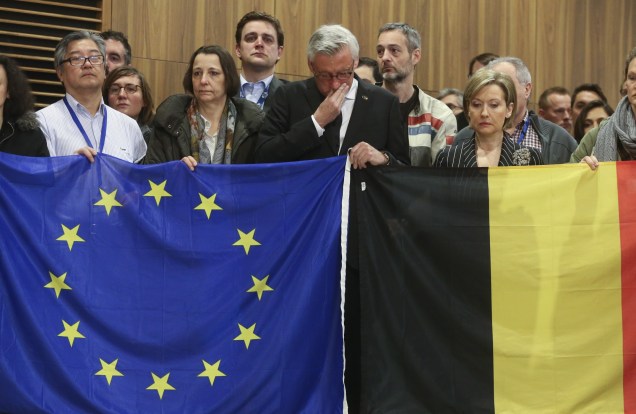
Brussels Attacks - Je Suis Bruxelles

Agree with this article? Violently disagree? Scroll down to leave a comment.

Follow Semi-Partisan Politics on TwitterFacebook and Medium.

When Expecting Politicians To Have Principles Is Considered Unreasonable

trump-announce

Damn those stubborn idealists

Sometimes satirical American news site The Onion strikes a little too close to home.

The latest case in point is an excellent News in Brief story from last week, entitled “Precious Little Voter Needs To Feel Inspired By Candidate“:

CLEVELAND—Noting how important it is for him to find a campaign that stirs genuine optimism and enthusiasm in its supporters, sources confirmed Tuesday that precious little voter Adam Higgins needs to feel inspired by a candidate. “To be perfectly honest, I just can’t bring myself to vote for someone I’m not excited about,” said the delicate little flower, who simply has to experience an authentic and personal connection to a candidate and believe in his wittle-bitty heart that the candidate’s message will legitimately move the country forward in meaningful and significant ways. “Policies and experience are certainly important, but a candidate has to have a vision I truly believe in. I’m only going to cast a ballot for someone who actually provides real hope for the future of this country [because I need to feel all snuggly-wuggly and special].” Sources further confirmed the fragile, dainty buttercup feels he absolutely must vote for someone who is trustworthy and competent.

The Onion’s fictional Adam Higgins sums up this blog’s attitude nicely in a single paragraph. Let Semi-Partisan Politics be a refuge for dainty buttercups everywhere!

But maybe it is time to give up on our dainty buttercup ways and embrace the cold hard reality of politics, where even fundamental positions on issues as consequential as the future of our democracy are nothing more than bargaining chips to be picked up, traded and discarded as politicians seek to advance their careers.

Maybe if people like me – those who think that political ideas and governing ideology actually matter, and that there is nothing mature or laudable about “pragmatically” lurching from crisis to crisis, dealing with each one on an isolated, ad hoc basis in pursuit of favourable newspaper headlines – simply shut up and got out of the way, the whole system would suddenly start functioning much better.

Actually, no, it wouldn’t. It is for the political class to change their ways, not the citizens who many politicians have so conspicuously failed to serve. Give me Jeremy Corbyn over Ed Miliband any day, even though his politics are anathema to this blog. And give me Margaret Thatcher over almost anybody in the Ted Heath tribute act of a government we currently have in Britain.

The most unnerving Onion headlines and stories are generally those which in the the course of recent years have become impossible to distinguish from real life, or those which invert reality so that the offensive and unnatural is considered normal.

This is one of those stories.


And no, this blog does not support Donald Trump.


Political centrism

Agree with this article? Violently disagree? Scroll down to leave a comment.

Follow Semi-Partisan Politics on TwitterFacebook and Medium.