Who Really Wants A Free Press?

MapRSF


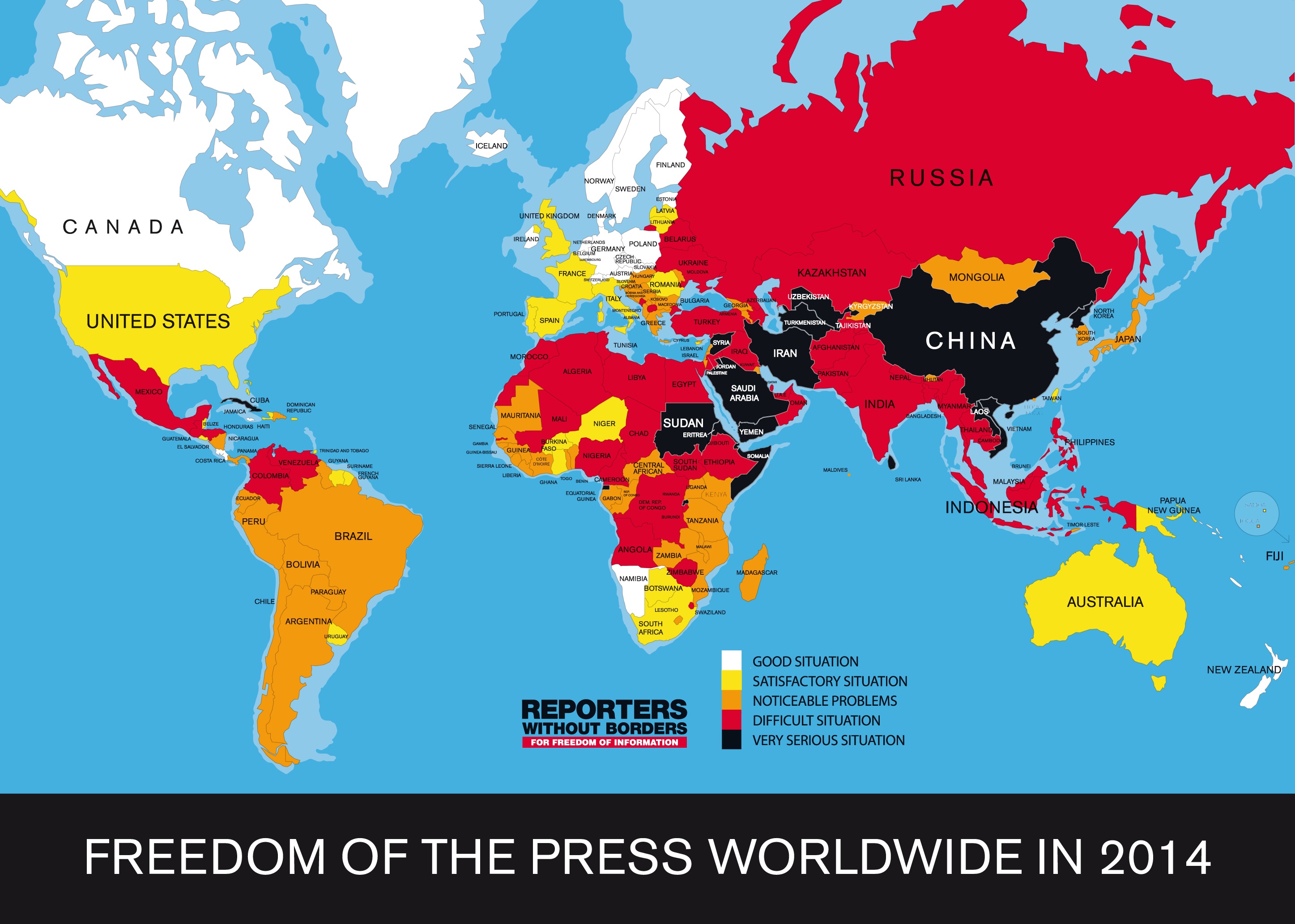
The United Kingdom has fallen from 29th to 33rd in the world in the World Press Freedoms Index 2014.

The report, compiled annually by Reporters Without Borders (RSF) is scrupulous in methodology and incorporates both qualitative and quantitative data. And for a country like Britain, which likes nothing more than to strut around the world proclaiming its comparative virtues, it makes for some dismal reading.

RSF’s summary of Britain is dominated by the British government’s chilling and bullying treatment of the Guardian newspaper as it sought to suppress the publication of information based on the NSA leaks by Edward Snowden, as well as the fallout from the Leveson Enquiry into the press behaviour and the prospect for further stultifying regulation of the industry:

In the United Kingdom, the government sent officials to The Guardian’s basement to supervise destruction of the newspaper’s computer hard disks containing information from whistleblower Edward Snowden about the practices of GCHQ, Britain’s signals intelligence agency. Shortly thereafter, the partner of Glenn Greenwald, the former Guardian star reporter who had worked closely with Snowden, was held at Heathrow Airport for nine hours under the Terrorism Act. By identifying journalism with terrorism with such disturbing ease, the UK authorities are following one of the most widespread practices of authoritarian regimes. Against this backdrop, civil society could only be alarmed by a Royal Charter for regulating the press. Adopted in response to the outcry about the News of the World tabloid’s scandalous phone hacking, its impact on freedom of information in the UK will be assessed in the next index.

Britain isn’t always called out by name, but there can be little doubt which European country was the intended target of this particularly barbed comment:

These developments showed that, while freedom of information has an excellent legal framework and is exercised in a relatively satisfactory manner overall in the European Union, it is put to a severe test in some member countries including those that most pride themselves on respecting civil liberties.

How true this is. Britain has long been (and has long considered itself) a stalwart defender of free speech, but the recent thuggish attempt to use anti-terrorism laws to detain a relative of a journalist and to threaten a national newspaper with closure unless it destroyed information which had the potential to embarrass the government are more worthy of Vladimir Putin’s Russia than the land of Magna Carta.

The New York Times, on the other hand, looks at the same report and seems to take succour from it, which is very surprising given the fact that their journalists have worked so closely with their beleaguered colleagues at The Guardian.

Their editorial board is celebrating the 50th anniversary of the landmark New York Times vs. Sullivan case, which set the bar for winning libel or defamation claims much higher than in Europe and thus created a bulwark protecting press freedom in the United States. This excerpt from the majority opinion in that case should be mandatory reading for all British politicians and those involved in public life, who are often all too keen to clamp down on free speech at the first sign of discord:

The Supreme Court voted unanimously to overturn that verdict. The country’s founders believed, Justice William Brennan Jr. wrote, quoting an earlier decision, “that public discussion is a political duty, and that this should be a fundamental principle of the American government.” Such discussion, he added, must be “uninhibited, robust, and wide-open,” and “may well include vehement, caustic, and sometimes unpleasantly sharp attacks on government and public officials.”

While the New York Times is absolutely right to recall and celebrate this landmark victory – libel laws in many other countries, especially Britain, are far too plaintiff-friendly – they seem all too willing to ignore the negative actions that have chipped away at this victory in the intervening half century, the various acts of craven self-censorship or collusion with imperial government overreach or the undermining of factfinding by the ongoing war on whistleblowers.

This selective amnesia leads to the following self-congratulatory pronouncement by the Times editorial board:

Still, American press freedoms rank among the broadest in the world. Citizens and media organizations in countries from China to India to Britain do not enjoy the same protections. In many parts of the world, journalists are censored, harassed, imprisoned and worse, simply for doing their jobs and challenging or criticizing government officials. In this area of the law, at least, the United States remains a laudable example.

The only problem with this statement? The United States ranks thirteen places behind the United Kingdom, at 46th in the world.

Fortunately for the New York Times and the reputation of the American press, the RSF world press freedom index does not take quality of journalism into account, only the ability of the journalist to practice their trade freely – otherwise they could have found themselves docked another few positions for that howler of an America-must-be-best presumption.

The truth is that neither Britain or America have anything to be proud of faced with this latest report. In an ideal world, David Cameron and Barack Obama would be held to account and hauled over the coals for presiding over such a poor performance. A backbench MP looking to bolster his or her civil liberties credentials could do worse than to ask the prime minister to defend or account for his government’s performance on press freedom at Prime Minister’s Questions this coming Wednesday.

But regrettably, a place in the mid-low 30s ranking is exactly where David Cameron, Barack Obama and many of those in power in Britain and America want their respective countries to sit. It allows for a press that is boisterous and noisy in all of the areas that don’t really matter (and so showing every outward appearance of being free), but that meekly tows the line when it comes to critical issues such as national security, civil liberties and holding those in power to account for their actions.

We in Britain or America may not think of countries such as Finland, Norway, Luxembourg or Liechtenstein as shining role models to emulate, if indeed we ever think about them at all. But in some key aspects, it is they who now carry the torch for freedom of speech and the free press, not the traditional Anglo-American partnership who held it aloft so dutifully for so long.

The Morning After In Arizona

Andrew Sullivan’s reflections on the vetoing of SB1062 by the Arizona Governor, Jan Brewer. We are in agreement, with one significant exception – Andrew sees no issue with discrimination against gays (or any other minority or class of individuals) in the private realm, only the public realm where government is an actor. While I admire his magnanimity in being willing to shrug off the hate and intolerance of certain fundamentalists, I cannot agree that this is the right approach. It is all very well to favour “maximal liberty”, but taken to its (logical, not extreme) conclusion, this would open the door for arbitrary refusal of service to anyone on the grounds of anything masquerading as religious conscience.

Andrew Sullivan's avatarThe Dish

[Re-posted from earlier today]

Here’s the money quote from Jan Brewer’s veto statement last night:

Senate Bill 1062 does not address a specific and present concern related to religious liberty in Arizona. I have not heard of one example in Arizona where a business owner’s religious liberty has been violated … Religious liberty is a core American and Arizona value, so is non-discrimination.

As I’ve mulled this over and over, I have a few straggling thoughts. Against the bill: it had two terrible features. The first was the breadth of the religious liberty invoked. The real innovation in Arizona was the extension of religious liberty claims against other citizens, rather than against the government itself. That’s a big leap, and trivializes religious liberty in some ways. No individual can coerce, even with a lawsuit, the way the government can. The second is the environment in which this bill was…

View original post 369 more words

Triangulating On Gay Rights

gayweddingcake


A surprising piece today from Andrew Sullivan, in which he distances himself from certain aspects of the opposition to the anti-gay discriminatory legislation currently working its way through the usual-suspect state legislatures.

Sullivan, gradually sensing victory in his long struggle and seeking (perhaps overly so) to be magnanimous in the face of it, writes:

The truth is: we’re winning this argument. We’ve made the compelling moral case that gay citizens should be treated no differently by their government than straight citizens. And the world has shifted dramatically in our direction. Inevitably, many fundamentalist Christians and Orthodox Jews and many Muslims feel threatened and bewildered by such change and feel that it inchoately affects their religious convictions. I think they’re mistaken – but we’re not talking logic here. We’re talking religious conviction. My view is that in a free and live-and-let-live society, we should give them space. As long as our government is not discriminating against us, we should be tolerant of prejudice as long as it does not truly hurt us. And finding another florist may be a bother, and even upsetting, as one reader expressed so well. But we can surely handle it. And should.

I have read and re-read this paragraph multiple times, and this argument both surprises and concerns me. Boiled down to its essence, it is frankly disturbing – in essence, Sullivan is saying that discrimination in the private sector should be allowed and that a blind eye should be turned, and that we only have real cause for concern if gays (or presumably other minorities) face discrimination at the hands of the government.

Sullivan is also willing to play along with the fairly innocuous example of the gay couple approaching a florist to cater their wedding. It may well be the case that such a couple, spurned by one business, will be able to find an alternative provider in their town. But equally, it may not. There may be only one business of its kind in the vicinity, or there may not be the time or money to go on a Nativity-style trek through town trying to find a spare room at the inn.

More seriously, the business in question may be more important than providing flowers for a social occasion. What if it is accounting services? Or social care? A funeral home? Or medicine? Would it be permissible to deny services to gay or lesbian couples in one of these fields? If so, which ones? And what would be the logic behind such a consideration?

Sullivan’s desire to reach out to the viscerally anti-gay hold-outs in society (and if your beliefs prompt you to deny service to someone based on them, they are visceral) comes at the expense of the logic of his own argument. Sullivan remains fully cognisant of the danger of using religious freedom arguments to permit discrimination:

But the wording of the bills in question – from Kansas to Arizona – is a veritable, icy piste for widespread religious discrimination. And that’s for an obvious reason. If legislatures were to craft bills specifically allowing discrimination only in the case of services for weddings for gay couples, as Erickson says he wants, it would seem not only bizarre but obviously unconstitutional – clearly targeting a named minority for legal discrimination. So they had to broaden it, and in broadening it, came careening into their own double standards. Allow a religious exemption for interacting with gays, and you beg the question: why not other types of sinners? If the principle is not violating sincere religious belief, then discriminating against the divorced or those who use contraception would naturally follow.

This awareness only makes Sullivan’s desire to reach an accord with those who want to enshrine discrimination in law all the more bizarre. Sullivan seems to want to have it both ways – to point out the impossibility of the “religious freedom” bills, while also holding out an undeserved olive branch to the fundamentalists and proclaiming his unwillingness to force them to stop discriminating.

Sometimes it is appealing to float serenely above the fray and call for moderation and respect. Most of the time, it is probably the right course of action. But sometimes it is not.

The people currently trying to enshrine anti-gay discrimination into law want nothing more than to hoodwink the public into fretting about an imaginary future where beleaguered mom-and-pop businesses are forced at shotgun to commit acts in violation of their religious beliefs, acts that risk sending them straight to the pits of hell.

They want to recast the ignorant, the hateful and the prejudiced in the role of the plucky underdog hero, humbly attempting to live their simple lives according to their God-fearing values, but being thwarted and dictated to by the arrogant metropolitan elites. This image is sensationalist and false.

And the last thing that these cynical people deserve is the sympathy and respect of Andrew Sullivan or anyone else who has fought so hard to end discrimination.

Dick Cheney Has No Regrets

He hasn’t gone anywhere, in case you were wondering. And he remains entirely unrepentant about all of his decisions and actions while in office. The authorisation of and boasting about torture, the clampdown on civil liberties, all of it. Andrew Sullivan has curated some of the latest goings-on in Dick Cheney Land.

Andrew Sullivan's avatarThe Dish

The trailer for R.J. Cutler’s The World According To Dick Cheney, which premiered last March:

What has long struck me about Dick Cheney was not his decision to weigh the moral cost of torture against what he believed was the terrible potential cost of forgoing torture. That kind of horrible moral choice is something one can in many ways respect. If Cheney had ever said that he knows torture is a horrifying and evil thing, that he wrestled with the choice, and decided to torture, I’d respect him, even as I’d disagree with him. But what’s staggering about Cheney is that he denies that any such weighing of moral costs and benefits is necessary. Torture was, in his fateful phrase, a “no-brainer.”

Think about that for a moment. A no-brainer. Abandoning a core precept of George Washington’s view of the American military, trashing laws of warfare that have been taught…

View original post 484 more words

The Fox-ification of MSNBC

billmaher

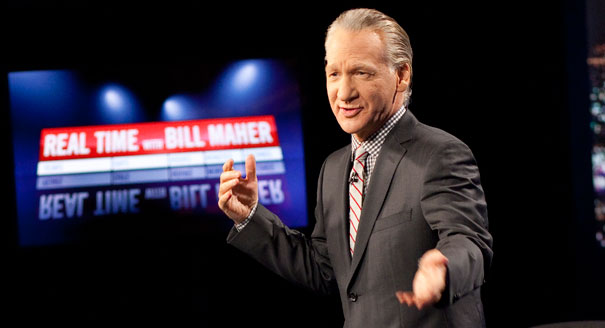
US comedian Bill Maher is publicly ending his romance with the MSNBC news network.

The liberal entertainer and commentator, an unapologetic supporter of President Obama and donator to his Super-PAC, has finally been persuaded to look for love elsewhere because even though they share a similar core ideology, MSNBC has become too strident and partisan in its approach to delivering the news. In short, he claims, MSNBC is becoming Fox News:

Whatever we had is not working any more. You’re obviously interested in another man: Chris Christie. You’re obsessed with him. So I wanted you to hear it from me first. I’m going to start seeing other news organizations. I’ll miss what we had. It was a rocket ship ride. We were both passionate flaming liberals and we didn’t care what the world thought of us. It was a glorious time. We finished each other’s Sarah Palin jokes. But now we never talk about any of the things we used to talk about: global warming, gun control, poverty… All because Chris Christie came along and put you under his spell. 

Look at yourself. You’re turning into Fox News. Bridgegate has become your Benghazi, and this isn’t easy to say, but you and I are no longer on the same news cycle. Sure, you read me the results of a recent Gallup poll, but you never really ask me how I’m feeling. It’s not you, it’s… Chris Christie.

While the reality is not quite so black-and-white, it is certainly true that MSNBC’s programming has suffered lately as editorial focus (particularly in January) seized on New Jersey Governor Chris Christie’s political travails at the expense of almost everything else, abandoning any significant discussion of public policy in favour of personality-based and partisan attacks.

Sure, Chris Christie may yet be proven to be at fault in the Bridgegate scandal, and the network’s intrepid main anchor and personality, Rachel Maddow, was covering the story long before it exploded into the national consciousness. But the degree to which the network then seized on the issue, to a far greater extent than other news networks, shows the Fox mentality starting to manifest itself in a very real way at MSNBC.

Bill Maher has long been able to draw laughs from his audience by pointing out the formulaic approach to journalism that lies behind the success of Fox News, as shown in this typical excerpt:


Here is the key quote:

They [Fox News and other populist right wing media outlets] have discovered that there is a fortune to be made keeping a small portion of America under the illusion that they are always under attack, from Mexicans or ACORN or Planned Parenthood or gays or takers or global warming hoaxers…it doesn’t matter. They don’t want a majority, they want a mailing list. A list of the kind of gullible Honey Boo-Boos out there who think that there’s a war on Christmas, and that the socialist policies of our Kenyan president have been so disastrous that the end of the world is coming.

The fact that Maher now sees parallels in MSNBC’s programming should concern anyone who has an interest in promoting a free and principled media providing a service essential to democracy over an array of narrowly-targeted niche outlets, each making their money by reinforcing the existing fears and prejudices of their respective audiences.

And the extent of MSNBC’s decline does not stop there. Any reader of MSNBC’s facebook account would struggle sometimes to distinguish it from President Obama’s. They trumpet the same initiatives, promote the same causes, celebrate (or invite their readers to celebrate) the same successes.

And, increasingly, they are starting to get touchy when called out on it:

msnbc_christie

Ultimately, the problem extends far beyond Fox News and MSNBC who are only the latest media organisation trying to emulate Fox’s success. The real problem occurs when any news outlet decides that its primary purpose for being is to help “balance the debate” in response to perceived slanting or bias from elsewhere.

The Fox News Channel proclaims itself to be “Fair and Balanced”. But when probed further about specific instances of right-wing bias on-air, Fox’s journalists, editorial staff and managers do not rush to draw public attention to the Fox News editorial guidelines or their policy on political impartiality. Instead, they draw attention to what they see as the liberal bias of the “mainstream media” and describe their role as being to correct the bias by offering an alternative point of view.

But as soon as you start seeing yourself as a counterweight to something else, you can no longer plausibly claim to inhabit the centre. This is what has now happened to MSNBC. That network watched for a long time as Fox News grew, prospered and humiliated them in the ratings by offering their viewers a diet of politically conservative-skewed infotainment, and now appears to have decided to copy and emulate large sections of their business plan, likely out of a twin desire to reap the same success and to give liberal voices an equally brash, punchy voice. Thus, their motto “Lean Forward”, is becoming increasingly descriptive of what they do, and not for the better.

Progressive opinions and ideas can expect to be given more airtime and favourable editorial consideration on MSNBC, while dissenting conservative voices will be fewer and further between. It is true that many of the new generation of Republicans, hailing from conservative gerrymandered districts and used to sympathetic media, are virtually incapable of taking part in real fact and reason-based debate, and shy away from MSNBC anyway. But even more so than has already been the case, when conservatives do feature on MSNBC it will more likely be as the targets of scandal-related investigative journalism along the lines of Bridgegate.

This is not a positive trend. Were it to continue, the only feature of MSNBC preferable to Fox News will be the honesty of their motto. “Lean Forward” at least strongly hints at the network’s political leanings, whereas “Fair and Balanced” is a running joke in the media world, so clearly does it contradict Fox News’ real motives.

There is probably an initial rush of euphoria to be had, discovering and catering to a new, thus far neglected market of strident and angry liberals who are happy to be fed the Obama administration line. And it may be some time until the network misses the favour of Bill Maher and others who are happy to wear their liberalism on their sleeve, but do not wish to be condescended to by being fed a heavily curated and redacted leftward spin on the news.

But, if they do not change course, the time will come when MSNBC regrets taking the low road. Bill Maher was not the first to compare MSNBC to Fox, and he won’t be the last. Perhaps when the two brands become equally synonymous with partisan propaganda, the executives in charge will realise what they have done.