The Enemy

donald-trump-swastika-sign

When will key influencers on the American Left learn that they can criticise Donald Trump all they want, but that continually punching down and demonising everybody who voted for him is hugely counterproductive?

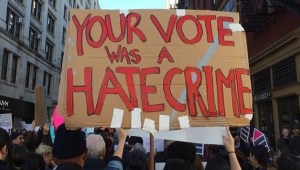
Does Nicholas Kristof’s latest New York Times column reveal an early glimmer of realisation among the elite left-leaning commentariat that demonising the 46% of voters who voted for Donald Trump – and effectively accusing them of complicity with a fascist regime – is no way to win back local, statewide and national power for Democrats?

Perhaps so:

I understand the vehemence. Trump is a demagogue who vilifies and scapegoats refugees, Muslims, undocumented immigrants, racial minorities, who strikes me as a danger to our national security. By all means stand up to him, and point out his lies and incompetence. But let’s be careful about blanket judgments.

My hometown, Yamhill, Ore., a farming community, is Trump country, and I have many friends who voted for Trump. I think they’re profoundly wrong, but please don’t dismiss them as hateful bigots.

The glove factory closed down. The timber business slimmed. Union jobs disappeared. Good folks found themselves struggling and sometimes self-medicated with methamphetamine or heroin. Too many of my schoolmates died early; one, Stacy Lasslett, died of hypothermia while she was homeless.

This is part of a national trend: Mortality rates for white middle-aged Americans have risen, reflecting working-class “deaths of despair.” Liberals purport to champion these people, but don’t always understand them.

In Yamhill, plenty of well-meaning people were frustrated enough that they took a gamble on a silver-tongued provocateur. It wasn’t because they were “bigoted unthinking lizard brains,” but because they didn’t know where to turn and Trump spoke to their fears.

Trump tries to “otherize” Muslims, refugees, unauthorized immigrants and other large groups. It sometimes works when people don’t actually know a Muslim or a refugee, and liberals likewise seem more willing to otherize Trump voters when they don’t know any.

More:

There are three reasons I think it’s shortsighted to direct liberal fury at the entire mass of Trump voters, a complicated (and, yes, diverse) group of 63 million people.

First, stereotyping a huge slice of America as misogynist bigots is unfair and impairs understanding. Hundreds of thousands of those Trump supporters had voted for Barack Obama. Many are themselves black, Latino or Muslim. Are they all bigots?

Second, demonizing Trump voters feeds the dysfunction of our political system. One can be passionate about one’s cause, and fight for it, without contributing to political paralysis that risks making our country ungovernable.

[..] The third reason is tactical: It’s hard to win over voters whom you’re insulting.

Many liberals argue that Hillary Clinton won the popular vote and that the focus should be on rallying the base and fighting voter suppression efforts. Yes, but Democrats flopped in Congress, governor races and state legislatures. Republicans now control 68 percent of partisan legislative chambers in the U.S.

If Democrats want to battle voter suppression, it’s crucial to win local races — including in white working-class districts in Ohio, Wisconsin and elsewhere.

Yes, a majority of Trump voters are probably unattainable for Democrats, but millions may be winnable. So don’t blithely give up on 63 million people; instead, make arguments directed at them. Fight for their votes not with race-baiting but with economic pitches for the working and middle classes.

Clinton’s calling half of Trump voters “deplorables” achieved nothing and probably cost her critical votes. Why would Democrats repeat that mistake?

Kristof is inevitably taking a lot of heat from many of his readers, whose blood is still up following the election and who think that falling back on the 2008-2016 Republican Party model of total opposition and demonisation (with an extra dose of left-wing moral sanctimony) is a winning, beneficial strategy for the country.

One angry reader concluded her comment by saying “I am scared and they are the enemy. Plain and simple.” Is this really helpful language to be using at a time of national division, and is the mindset behind it a healthy one? Surely not. Of course much of the fault lies with Trump, his bellicose rhetoric and his entitled, backward attitude towards women. But Nicholas Kristof and other commentators on the Left also bear some responsibility for having created such fear among their own readerships, by frequently hyping and exaggerating the troubling aspects of Trump’s administration for political reasons (playing with language to imply with virtually no basis in fact that the president has a deep antipathy to all immigrants or to people with brown skin, for example).

Many Trump supporters and residents of Trumpland are good, caring, conscientious people. Kristof’s reader only came to the conclusion that they are all “the enemy” because she has been told so, repeatedly, by people in the media whose partisan cunning and residual bitterness outweighs any sense of professional responsibility they ought to possess. And the concerning aspects of Donald Trump’s presidency are bad enough without the leftist spin machine, working through the imprimatur of prestige titles such as the New York Times, convincing their audience that half the country (apparently including millions of “self-hating women”) is somehow out to get them when this is usually not the case.

Nicholas Kristof warned of the dangers of demonising Trump supporters as a cohesive bloc back in November, when the wounds of the election were still very raw indeed. Unfortunately, he did so in the very same column where he suggested that the pain felt by American liberals in the Age of Trump would be akin to that of an addict in recovery, a grotesquely self-indulgent and self-pitying assertion  which made light of the struggles of those suffering from mental illness. As so often with the Left and their struggle against reality it was one step forward, two steps back.

Hopefully with this new plea to his readers, Nicholas Kristof will at last hold on to some of the moral high ground he has occupied.
 

donald-trump-election-victory-protest-your-vote-was-a-hate-crime-banner

Support Semi-Partisan Politics with a one-time or recurring donation:

Agree with this article? Violently disagree? Scroll down to leave a comment.

Follow Semi-Partisan Politics on TwitterFacebook and Medium.

The Reviled American Media, Part 1

wolf-blitzer-anderson-cooper

Donald Trump versus the media: bad cop, bad cop

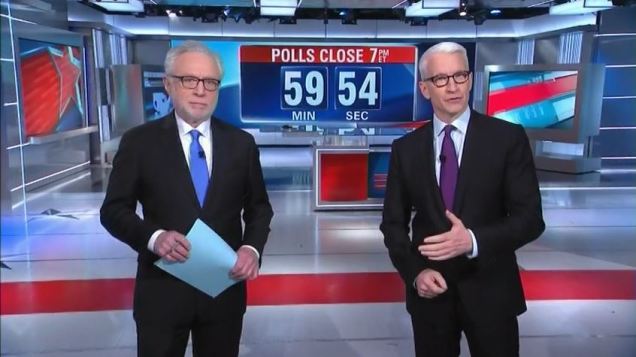
A throwaway line in a Washington Post article goes some way to revealing exactly why the American media is so widely despised and mistrusted.

Musing about why many Trump supporters stubbornly insist on viewing his presidency as a success thus far (rather than the cataclysmic failure portrayed by mainstream narratives), the Post reports:

Several people said they would have liked to see more coverage of a measure that Trump signed Thursday that rolled back a last-minute Obama regulation that would have restricted coal mines from dumping debris in nearby streams. At the signing, Trump was joined by coal miners in hard hats.

“If he hadn’t gotten into office, 70,000 miners would have been put out of work,” Patricia Nana, a 42-year-old naturalized citizen from Cameroon. “I saw the ceremony where he signed that bill, giving them their jobs back, and he had miners with their hard hats and everything — you could see how happy they were.”

The regulation actually would have cost relatively few mining jobs and would have created nearly as many new jobs on the regulatory side, according to a government report — an example of the frequent distance between Trump’s rhetoric, which many of his supporters wholeheartedly believe, and verifiable facts.

My emphasis in bold.

Now, this is not about the merits and disadvantages of expanding coal mining. This is about the blasé arrogance of the Washington Post, suggesting to its readers that the creation of government regulatory jobs in any way makes up for the loss of manual jobs in coal mining.

How many ex-coal miners with high school-level educations will be eligible for these new regulatory jobs? Probably very few. But these jobs will enormously benefit the college-educated, Washington D.C.-dwelling professional class who are eligible for attractive jobs in the Department of Energy or the Environmental Protection Agency.

It is difficult to know whether the Post’s dismissal of concerns about coal mining job losses because they will be “offset” by new regulatory jobs is merely ignorant or deliberately callous towards the working classes. But either way, it reveals a huge gulf between the perspective of the Washington Post and its readership on the one hand, and Trump-supporting people from coal country on the other.

Maybe those coal mining jobs should be killed anyway. Ultimately, of course, they certainly should be phased out as part of a move away from fossil fuel dependence. But for the Post to speak haughtily about Trump supporters’ aversion to “verifiable facts” while misleading its own readership by pretending that the Obama-era environmental regulations (whatever their core merits) were anything other than a transfer of wealth and opportunity away from coal country manual workers towards the DC professional class is morally dubious and a dereliction of their professional duty as a supposedly objective national news outlet.

Essentially, the Post is suggesting that Trump supporters are somehow being irrational to cheer the overturning of anti-coal regulations that will restore some coal mining jobs, because they should instead be rejoicing at the creation of other, office-based jobs for which they are almost certainly ineligible. How terribly unenlightened of them to not cheer as their small-town jobs are sacrificed to create other jobs for city-dwelling public sector bureaucrats.

Assuming the best of intentions rather than the worst, this represents a vast gulf of understanding between the Washington media class and a large segment of the country on which they report. The frequent complaint of Trump supporters is that their interests have long been ignored by a political and economic elite who have time and compassion for everyone and everything save the rural and suburban squeezed white lower middle and working classes, with politicians and the media colluding to keep their struggles, concerns and aspirations off the political agenda. And now the media, which seems to be relishing its oppositional role to President Trump, seems determined to live up to that stereotype.

Accusations that the mainstream media is “fake news” go too far – the Washington Post or New York Times will never publish a breathless story about Michelle Obama being arrested for treason or Hillary Clinton participating in witchcraft rituals, the kind of ludicrous and obviously false clickbait which pollutes the internet and is sadly shared by too many a credulous conservative. The mainstream media’s form of bias is subtler and much more insidious. There are few outright falsehoods in the prestige media, but one can often achieve just as much through deliberately one-sided story selection and a deliberately skewed angle of coverage, made all the more effective because unlike fake news sites, respected outlets like the Washington Post and the New York Times actually influence the worldviews and opinions of key decision makers in Washington D.C. and beyond.

In other words, too many respectable, prestige mainstream media outlets have squandered any trust and goodwill they one held with the public by subtly but repeatedly pushing a political agenda (the largely bipartisan agenda of the DC political elite). This climate of distrust is a problem of the media’s own making. And it all begins with having newsrooms full of reporters and editors with so few (if any) roots in the kind of community which came out strongly for Donald Trump in the 2016 election that they are utterly incapable of reporting on them with any real understanding, subtlety or empathy.

If the goal is to avoid events like the election of Donald Trump as President of the United States, surely our first step must be one of introspection – not furiously shouting insults at people who often voted for Trump through despair or resignation, not misrepresenting their political views to the point of slander, but rather understanding how the political mainstream managed to consistently fail these people so badly that they felt they were left with little alternative. The Washington Post, for all the good reporting they often do, is light years away from recognising this fact, let alone showing such introspection in their coverage.

Indeed, if anything, the American media is moving in the opposite direction. Spurred by President Trump’s reprehensible attacks on the media as a whole, the Washington press corps is doing what they love to do best – talking about themselves and wallowing in a sense of victimhood and persecution, laughably painting themselves as noble and selfless heroes and seekers of truth in this new authoritarian age.

I’m sorry, but that is nonsense. Many of these reporters are the same ones who in the 2000s used to leap smartly to their feet, offering obsequious respect and nary a searching question whenever president George W Bush strolled into the White House press briefing room to announce the erosion of core civil liberties, exaggerate the threat posed by Iraq and then downplay his administration’s calamitous handling of the war. This is the same press corps that often treated every utterance from President Obama as sacred, unquestionable unicorn song, hyping his candidacy and forgiving his administration’s missteps.

This is the same press corps which gathers every year for the White House Correspondents Dinner, in which journalists and politicians slap each other on the back and toady up to power in one of the most sickening modern day political rituals known to man. Oh yes, and they are the ratings whores who gave blanket, uncritical rolling news coverage of Donald Trump’s every garbled word back when he was still just a laughable Republican Party presidential primary candidate, acting as oxygen to the the flames of the Trump campaign in the first place.

A healthy democracy needs a free press. But it sure as hell doesn’t need the craven, self-satisfied press we are stuck with at the moment. You can probably count the number of Washington or New York-based political journalists with a record of consistently principled, inquisitive and objective work on two hands. None of them work in television news. The rest are every bit as much a part of the fetid, corrupt political class as the politicians on whom they report. And now they take the angry anti-media rantings of President Trump and use them as an excuse to prance around playing the noble, heroic victim. We should not fall for their tawdry act.

Increasingly, the presidency of Donald Trump will require us to hold two competing thoughts in our head simultaneously: that yes, the Trump administration is troubling in a whole host of ways, but also that many of the people opposing Trump (from the sanctimonious, rootless, unreformed Democrats to the lazy and morally compromised Washington media) are also grievously at fault. And the sins of Donald Trump do not excuse the failings of those forces ranged against him, just as the spineless, uncurious, self-aggrandising behaviour of the Washington media does not excuse the authoritarian, impulsive excesses of the new president.

It is sheer lunacy to believe that the forces which gave us President Trump will be placated and put back in their box by a coordinated campaign of opposition from a Democratic Party and Washington political media class who have spent precisely zero hours pondering their own role in this period of “American carnage”, and who have shown zero willingness to change their own behaviour and policy preferences. Indeed, as newspaper subscriptions and cable news show ratings rise in step with the turmoil emanating from the White House, many in the Washington media are probably deluding themselves into thinking that they are actually doing a good job.

This could not be further from the truth.

As things stand, both sides will continue to antagonise one another; an out-of-touch Washington media class will continue to report on the residents of Trumpland as though they are some kind of fascinating but dangerous medical specimen best kept behind the safety glass in a lab, and Trump supporters, feeling patronised and wilfully misunderstood, will continue to distrust everything that the mainstream media says (including the 90% which is reasonably accurate, if sometimes politically skewed).

One side will have to blink first. You would hope that it might be the DC chattering class – through some instinctive self-preservation reflex, if nothing else.


donald-trump-press-conference-white-house

Support Semi-Partisan Politics with a one-time or recurring donation:

Agree with this article? Violently disagree? Scroll down to leave a comment.

Follow Semi-Partisan Politics on TwitterFacebook and Medium.

Irony Overload At The Grammys

This article was written on February 13th 2017, back when it was still vaguely relevant


Capping off another celebrity awards ceremony in which cossetted stars withdrew to their bubble to rend their designer garments at the state of the world – with the likes of Katy Perry, Busta Rhymes and James Corden running to their safe spaces this year – Recording Academy President Neil Portnow had this to say in his speech at the 2017 Grammy Awards:

We are constantly reminded about the things that divide us. Race, region and religion. Gender, sexual orientation, political party. But what we need so desperately are more reminders of all that binds us together — our shared history, our common values and our dedication to build for ourselves a more perfect union.

I’m sorry, but who has been constantly reminding us of the things that divide us? Who has been incessantly emphasising differences rather than commonalities at every turn? Who has been the loudest megaphone and amplifier for vicious, self-serving and corrosive identity politics throughout the culture over the past decades? Ah yes – it was that branch of the American Left which includes so much of the entertainment industry.

Often in ignorance more than malice, I’ll concede, but the nerve of a man like Portnow to stand before the kind of people who recorded Hillary Clinton’s “Fight Song” and complain that Americans are being deliberately divided by race, region, religion, gender, sexual orientation and political beliefs is almost beyond belief.

One does not have to be a MAGA-shouting Trump supporter to be drearily, expectantly depressed at the glib self-satisfaction, unawareness and utter banality that took place at the Grammy Awards – as well as at last night’s BAFTAs. This blog certainly abhors Donald Trump and all other ignorant, amoral, authoritarian would-be strongmen like him.

But the answer to a democratic outcome one opposes is not to bemoan democracy itself and ignore one’s own part in bringing about defeat. Hugging identity politics ever-tighter and going back before the American electorate with a leadership team comprising Nancy Pelosi, Harry Reid, Hillary Clinton 3.0 and the same vacuous, corporatist policy book will not put a Democrat back in the White House in 2020.

Introspection is not to be expected from the big egos of Hollywood, I think we have all learned that by now. But a large dose of it must appear from somewhere, and soon, or the opposition to Donald Trump will fall as flat as James Corden at his entrance to the 2017 Grammy Awards ceremony.


hillary-clinton-fight-song

Support Semi-Partisan Politics with a one-time or recurring donation:

Agree with this article? Violently disagree? Scroll down to leave a comment.

Follow Semi-Partisan Politics on TwitterFacebook and Medium.

When American Liberals Lose The Faith

Doesn’t this testimonial from a disaffected California liberal really speak volumes about just how far the American Left is going to lose friends and alienate people?

Rod Dreher shares an email from a reader:

So I was raised a secular liberal. My college professors were secular liberals. During my journalism phase, my newspaper colleagues were secular liberals. My law school professors and peers were – in the vast majority – secular liberals. Almost everyone at my corporate law firm was a secular liberal. My California neighbors and friends are secular liberals, as are my colleagues. My mother, siblings, and their spouses are all secular liberals.

By all rights, I should be a member in good standing of their tribe, “liking” their Facebook posts and joining their candlelight vigils against the evil Trump Administration. But November 8 and its aftermath revealed to me that I am just so tired of these people. I can’t be like them, and I don’t want my kids turning into them.

I am tired of their undisguised contempt for tens of millions of Americans, with no effort to temper their response to the election with humility or empathy.

I am tired of their unexamined snobbery and condescension.

I am tired of their name-calling and virtue-signaling as signs of supposedly high intelligence.

I am tired of their trendiness, jumping on every left-liberal bandwagon that comes along (transgender activism, anyone?) and then acting like anyone not on board is an idiot/hater.

I am tired of their shallowness. It’s hard to have a deep conversation with people who are obsessed with moving their kids’ pawns across the board (grades, sports, college, grad school, career) and, in their spare time, entertaining themselves and taking great vacations.

I am tired of their acceptance of vulgarity and sarcastic irreverence as the cultural ocean in which their kids swim. I like pop culture as much as the next person, but people who would never raise their kids on junk food seem to think nothing of letting then wallow in cultural junk, exposed to nothing ennobling, aspirational, or even earnest.

I am tired of watching them raise clueless kids (see above) who go off to college and within months are convinced they live in a rapey, racist patriarchy; “Make America Great Again” is hate speech; and Black Lives Matter agitators are their brothers-in-arms against White Privilege. If my kids are like that at nineteen, I’ll feel I’ve seriously failed them as a parent. Yet the general sentiment seems to be these are good, liberal kids who may have gotten a bit carried away.

I am tired of their lack of interest in any form of serious morality or self-betterment. These are decent, responsible people, many compassionate by temperament. Yet they seem two-dimensional, as if they believe that being a nice, well-socialized person who holds the correct political views is all there is, and there is nothing else to talk about. Isn’t there, though?

I am tired of being bored and exasperated by everybody. I feel like I have read this book a thousand times, and there are no surprises in it. Down with Trump! Trans Lives Matter! Climate deniers are destroying the planet! No cake, we’re gluten-free!

These are good people in a lot of ways. But there has got to be a better tribe.

It must be disturbing to “wake up” like this and realise that you are no longer fully in communion with your tribe, so kudos to Rod Dreher’s reader for putting into words something that cannot be easy to admit. With the wounds of the 2016 presidential election still raw, many on the American Left have little time for doubters, and admitting a heresy such as this would likely be met not with understanding (let alone introspection) but rather with intolerance and fury.

The scene that comes to my mind is from the film American History X, where protagonist Derek Vinyard, serving a jail sentence for the racist-motivated murder of a black car thief, realises the flaws of his white supremacist worldview while in prison and is then utterly unable to engage with that community – his only source of friendship and support – after his release. Eventually, Vinyard confronts the group’s leader and explicitly rejects their racist ideology, at which point they chase him out of their camp.

Increasingly, one has to either buy the whole regressive leftist agenda or none of it at all. Because it is couched in such explicitly moral terms, with any departure from orthodoxy seen as a moral failure, to question just one aspect of the worldview – the identity politics, the environmentalism, the statist paternalism – is to make oneself persona non grata within that community. Imagine the pain of realising that you no longer believe every article in the leftist gospel, and then being faced either with the prospect of admitting your heresy and being actively shunned by family, friends and colleagues, or else keeping your opposition quiet and living a lie.

The American Left has, with too few exceptions, given up on trying to win by persuasion, seeking instead to achieve victory by shaming and bullying dissenters into a sullen, resentful silence. That approach is no longer working and delivering benefits, to the extent that it ever did. When people like Rod Dreher’s reader are leaving the tribe in disgust at the sanctimonious echo chamber of questionable values then clearly something has gone wrong.

None of this is to say that American conservatism is in fine fettle – clearly not, as this blog has repeatedly warned. The fact that Republicans have closed ranks behind a profoundly authoritarian and un-conservative President-elect Donald Trump is evidence of the challenge faced by small-C conservatives in trying to maintain their influence and steer the Trump presidency away from endless pitfalls.

But it is the slow-burning revolution on the Left (particularly the growing elitism and the lethal embrace of identity politics) which fed the populist Right to the extent that Donald Trump won the White House. And until the American Left learns to moderate its many excesses and accept ideological diversity together with all the other kinds of diversity they champion, they will continue to alienate crucial allies and accelerate their march into irrelevance.


liberalism

Support Semi-Partisan Politics with a one-time or recurring donation:

Agree with this article? Violently disagree? Scroll down to leave a comment.

Follow Semi-Partisan Politics on TwitterFacebook and Medium.

Defenders Of The Nation State Are Not The Authoritarians Here – That Would Be The Unrepentant Globalists

One does not need to be a snarling authoritarian to reject the anti nation state, globalist worldview – and if being wary about the survival of our rights and liberties in a post-patriotic world makes one a populist then so be it

During his recent Intelligence Squared debate/discussion with Nick Clegg on the causes of the populist backlash currently roiling British, European and American politics, Jonathan Haidt makes an interesting observation:

Once you have these incredibly prosperous, peaceful, progressive societies, they people there begin to do a few things. First off, not everybody has those values. Everybody in the capital city and the university towns, they have these values. So if you look at our countries, in America we’re pretty retrograde in some ways, but if you look at our bubble places they’re just like Sweden. And that means that these people now think that, you know, nation states, they’re so arbitrary. And just imagine if there were no countries, it isn’t hard to do. Imagine if there was nothing to kill or die for, and no religion too! So this is the way the values shift, and this is what I and others are calling – the new left/right is the globalists versus the nationalists.

And so the globalist ethos is “tear down the walls, tear down the borders, nation states are arbitrary, why should my government privilege the people who happen to be born here rather than people who are much poorer elsewhere?” And so you get this globalist idea, you begin to get even a denial of patriotism, the claim – there are some pictures going around right wing media now in the United States of anti-Trump protesters holding signs that say “patriotism is racism”. So you get people acting in this globalist way, inviting immigration, spitting on the nation state, spitting on the country and people who are patriotic, and very opposed to assimilation when there is integration because that, as people on the Left in America would say that’s cultural genocide.

So you get wealthy, wonderful, successful societies that are so attractive to poor people around the world you get a flood of immigration, and they are met by the globalists who say “welcome welcome welcome, don’t assimilate because we don’t want to deny you your culture”. And this triggers an incredible emotional reaction in people who have the psychological type known as authoritarianism.

Now it’s a very negative term, but there’s a lot of psychological diversity in this world; there are some people who are attracted to the Lennonist vision, the John Lennon vision and there are other people who are more parochial – I don’t mean that in a bad way, I mean there are people who really care about hearth and home and God and country, and they are actually friends of order and stability, and they are friends of many good things about civic life.

But when they perceive that everybody is coming apart, that the moral world is coming apart, that’s when they get really racist, homophobic, they want to clamp down, they want to restore moral order, and if anybody here saw Donald Trump’s acceptance speech at the Republican National Committee that’s exactly what he said, he modelled himself after Richard Nixon’s 1968 speech, a time when cities are burning, there are riots, and Nixon came in – law and order will be restored, and that’s basically what Trump’s whole speech was.

So what I’m saying is successful democratic capitalist societies create – they change values, they generate wealth, they invite people in and then they make some of the people act in ways that trigger the other people to be furious, and those other people actually have a point because you have to have trust and social capital to have a redistributive welfare state. My point is that yes the economy matters and economic changes matter, but they matter in ways which always run through psychology.

I follow Haidt’s argument, but I do not see myself or many others of my acquaintance in the binary model he describes. For a start, I see nothing particularly liberal about the starry-eyed EU-supporting globalists, particularly when one examines the full palette of their typical political opinions. And there is certainly nothing inherently authoritarian about being a small-c conservative and fearing the jettisoning of the nation state in favour of an ill-defined globalism built upon the foundation of supranational institutions which are flawed, remote from the people and totally lacking in democratic legitimacy.

I and this blog are about as far from authoritarianism as it is possible to get, despite being staunchly pro-Brexit and anti-elite. I alternately use the labels conservatarian and libertarian to describe this blog’s desire for a much smaller state and greatly enhanced personal liberty – give me classical liberalism or give me death! The difference is that I see a strong and healthy nation state as being essential to the defence of these personal liberties, while the globalists (as described by Haidt) seem to lazily imagine that these liberties will automatically continue to endure beyond the era of the nation state.

Our experience with supranational governance – whether the United Nations or, more viscerally, the European Union, has not been a pleasant one in terms of democracy, accountability or the amount of control that ordinary people feel they have over their lives. Perhaps there are ways to reform those institutions in theory, but in practice they are loath to change and almost allergic to close scrutiny. Recall, even the prospect of losing its second largest economy and most powerful military member could not persuade the EU to consider the smallest of meaningful reforms.

Thus the European Union plods blindly onward towards a federal destination set decades ago by grey old men who presumed to decide for us how we ought to govern ourselves in the years following the Second World War, but who never thought to ask our permission. And the result is a remote and unloved supranational government whose “founding fathers” are unheralded and whose true leaders lack all accountability.

More worryingly, the ability of organic popular movements to influence the direction of supranational juggernauts like the EU is almost non-existent. Whether it is anti-austerity movements in Greece or the need for domestic industries to influence vital global trading rules in forums at which the EU speaks for all of us while really representing none of us, it is almost impossible to get the attention of EU leaders or encourage them to change direction. Just ask Greece’s Alexis Tsipras, or anybody who used to work in Britain’s beleaguered fishing industry.

I am patriotic because I love my country and consider it special and exceptional, yes. But I am also patriotic because I believe that the basic unit of the nation state remains a crucial building block in the world order, essential to the defence of our rights and liberties, and will remain so until humanity finds a way to make the various supranational institutions now undermining nation states more democratically legitimate and more responsive to popular opinion.

And so when confronted with a movement full of people who talk eagerly about being post-patriotic, who revel in being “more European than British” and who want to dissolve our democracy into a remote and dysfunctional supranational government of Europe without a second thought for our own distinct history and culture, I oppose them. Because however well-intentioned they may be, they are actively undermining the one institution (imperfect though it may be) which has thus far kept us relatively free and prosperous for centuries – our own nation state, the United Kingdom.

Does this make me an “authoritarian”? I hardly see how. While Britain has its share of authoritarian tendencies (which I despise and frequently campaign against), these tend to be even stronger on the continent. If hate speech laws seem draconian here, they would only become stricter if we were to harmonise our laws with those of much of mainland Europe. Want the police to regularly use water cannon to break up public protests? Again, look to Europe, not Britain. Much of Europe is ambivalent about property rights, to the extent that no watertight right to property is truly enshrined in the European Convention on Human Rights.

And putting all that aside, the vast majority of people in this and other European countries, when asked, do not want their countries to become dissolved into a federal European government and assume the subordinate rank of American states. Maybe rejecting this Utopian vision is backward and foolish, but a fully federal Europe is not what people want (which is why the EU has been forced to move in this direction by unapologetic stealth and deception for over half a century). So since the majority of people in the countries of Europe are not yet post-patriotic, how does opposing an institution which seeks to covertly undermine their wishes make me an authoritarian? And how does it make the people who know the truth but still support this vision enlightened “liberals”?

So much as I admire Jonathan Haidt, hail his work in exposing the Cult of Social Justice and Identity Politics and agree with most of his diagnosis of the reasons behind the current populist backlash, I cannot support his conclusion because it totally fails to take into account people like me and other liberal Leavers and Brexiteers.

Indeed, Haidt’s usual perceptiveness appears to desert him when he suggests that something simply snaps and makes people “get really racist, homophobic” when confronted with pro-globalism policies and sentiments. That is simply not how it works. All racists may be anti-globalist almost by definition, but that does not mean that everybody with reservations about globalism (as it currently exists) is remotely prone to racism.

Clearly there are other reasons for opposing globalist projects (or the current state of globalism, at least) that have nothing to do with authoritarianism, including those I have outlined here, which Haidt fails to take into consideration.

The full picture behind 2016’s populist backlash has yet to be fully understood.


globalism-versus-culture

Support Semi-Partisan Politics with a one-time or recurring donation:

Agree with this article? Violently disagree? Scroll down to leave a comment.

Follow Semi-Partisan Politics on TwitterFacebook and Medium.