Living In The Shadow Of The Bomb

Slate Magazine has a thought-provoking article exploring the condition of disused above-ground nuclear test sites in the former Soviet Union, and the nascent tourism industry which is springing up to give intrepid explorers an experience of this slice of recent military and geopolitical history:
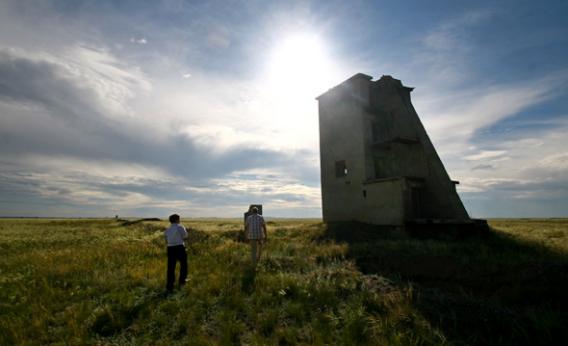
Nuclear test site in Kazakhstan. Photo by Jacob Baynham.

Focusing on a particular test site in Semipalatinsk, Kazakhstan, the article looks at the impact that 116 above-ground nuclear tests can have on the wildlife and topography of an area:

Looking out from the epicenter of these blasts, you can still see remnants of structures the Soviets built to test the power of these explosions. To the right are the crumpled remains of a bridge. To the left are fortified bunkers and barracks that had been filled with dogs, pigs, and goats to approximate the effects a blast would have on soldiers. In a line in both directions, 10 four-story concrete buildings rise from the Earth like the moai of Easter Island. These structures were filled with sensors to measure the explosions. Strilchuk calls them “geese,” because from a distance that’s what they look like: giant goose necks craning up from the grass, facing the place where man played God.

As well as the human impact on those in the nearby towns, fifty miles away:

Anastacia Kyseleva is an 86-year-old resident of the Institution for the Elderly and Disabled in the nearby town of Semey. She was newly married and living in a village near the test site when the explosions began. “We didn’t know what it was,” she recalls 60 years later, wringing a scarf in her hands. It wasn’t until a test in 1956 that soldiers told the villagers to leave their houses and stand beside the river. “We could see the mushroom cloud from the field,” she says. “It looked like a sunset. Since that year, a lot of people started dying.”

But amidst this ongoing legacy of sickness, birth defects and infant mortality, there is also cause for optimism:

The government’s optimism for the Semipalatinsk test site reflects Kazakhstan’s emergence from a Soviet nuclear wasteland into a prosperous capitalist economy. Kazakhstan has come to terms with its history quicker than most former Soviet republics. A wealthy, resource-rich country, Kazakhstan is broadening its profile as a leader of the nonproliferation movement by hosting negotiations on Iran’s nuclear program. They’ve volunteered to establish an international nuclear fuel bank, a measure of nuclear security that the International Atomic Energy Agency is seriously considering. The government even talks of building a nuclear energy reactor of its own, a peaceful application of the fierce atomic power that the Soviet Union once wrought upon the Kazakh steppe.

The full article is well worth a read.

Where’s Gordon?

As Guido Fawkes rightly notes, almost all British Members of Parliament managed to haul their asses back from vacation as the House of Commons was recalled to debate and vote on the government motion relating to the recent chemical weapons attack in Syria. For or against potential future military action by the UK, they gave principled speeches and made their opinions known.

WHERE THE HELL WAS OUR FORMER PRIME MINISTER, THE WALKING DISASTER, GORDON BROWN? If he has such contempt for Parliament and his constituents that he cannot be bothered to attend a debate like this, he should immediately resign his seat so that someone hardworking and capable can take his place. Sickening.

Middle East Crisis Explained

As is sometimes the case, Guido Fawkes says it best. Courtesy of Guido, a cut-out-and-keep guide to who supports, hates or tolerates who in the Middle East. It was posted a couple of hours ago, so is probably already out of date.

A Positive Story From Syria

A brief but welcome glimmer of light in the darkness that is today’s Syria – a grieving father is reunited with the son that he believed had been killed in an attack by pro-regime forces.


Max Fisher, writing at The Washington Post, breaks the story for a western audience, and gives this context:

The man who first appears when the video opens isn’t the father – he’s someone else, perhaps another relative. It’s not until a minute in that the boy’s father appears, his face twisted in joy, running out of the house to see his son.

Even if you don’t speak a word of Arabic, the family’s body language says everything. There is a lot of crying and hugging and grateful recitations of the Takbir (“Allahu akbar!” or “God is great!”).

I am still collecting my thoughts on the latest developments in Syria – the irrefutable use of chemical weapons by regime forces or others loyal to Assad, and the seemingly inevitable military response from the west.

Barring the unveiling of some hitherto-unseen wise and strategic foreign policy or diplomatic initiatives from Barack Obama and David Cameron (neither of whom have stellar track records in this area), I am convinced that nothing good can come of any of this. I genuinely don’t see how any of the likely military scenarios that may play out in the coming days will benefit the innocent civilians of Syria, the national security goals of the west or (somewhat materialistically) the economic and financial wellbeing of anyone at all.

But at least, among the many stories of loss and mourning, there is at least one human story from Syria today with a happy ending.

The short piece concludes:

If you can hold it together through all seven minutes, you’re stronger than I am. But this video provides a welcome, if all too rare, moment of solace and joy in a war that has had precious little of either.

I’m with Max Fisher on this one.

How Best To Challenge Putin? Ctd

A good ongoing series from Sullivan, focusing on the need to stand up to the ever-increasingly authoritarian, intolerant regime of President (Dictator) Vladimir Putin, particularly as his Kremlin policies relate to freedom of the press and civil rights (especially for gay Russians).

Patrick Appel's avatarThe Dish

by Patrick Appel

Jamie Kirchick’s tactic:

Michael Scherer claps:

American reporter and pundit Jamie Kirchick did the cable news medium proud by ambushing a conversation about Bradley Manning on RT, the cable channel funded by the Russian government, to attack Russian President Vladamir Putin over his government’s anti-gay policies. Truly. Great. Cable. Television.

Zack Ford points out that, contra Kirchick, RT has covered Russia’s anti-gay laws – but “much of the coverage has been used to justify it.” Recent Dish on protesting Russia’s anti-gay policies here.

View original post