The Remain campaign are going to tell lots of apocalyptic, scaremongering and false tales about how leaving the European Union would destroy the NHS. But that does not mean that Brexit campaigners should stoop to their level
This is – to use the nicest words possible – completely amateurish and stupid.
Conservatives – especially real ones who aren’t all that keen on the state being a monopolistic provider of healthcare – don’t make very plausible knights in shining armour when it comes to defending the NHS, especially in the minds of voters conditioned by years of hand-wringing left-wing rhetoric that the Evil Tories are perpetually one step away from turning poor people away from hospital.
Besides, the high figure of £350 million fails the common sense test even for the lowest of low information voters. The risible suggestion will do nothing to persuade those who already mindlessly worship the NHS like some kind of secular new age religion and fear that Brexit will hurt their idol, while it offends the more intelligent voter by treating them as though they are stupid.
What is unlikely to impress, to any one who has the first idea of the issues, is the sort of slogan shown above – the £350 million claim. Vote Leave know it isn’t true. That makes it a lie. Why they go ahead with a deliberate lie, I don’t know. They must think there is some advantage to it.
I find the lie offensive. But then the other side is lying as well. I also find that offensive, but it doesn’t worry me. In fact, I welcome it – it shows weakness, reduces their credibility and gives us leverage. It does worry me when our own side lies – for exactly the same reasons: it shows weakness, reduces our credibility and it gives the other side leverage.
Throughout my campaigning career, I’ve made a point of seeking accuracy – as best I can. For the very opposite reasons that the lie is a bad idea. It shows strength, it increases our credibility and it denies the other side leverage.
In other words, accuracy is the embodiment of good campaigning. The lie is the opposite. That matters. We don’t. We need people to grow up and realise that. There is far too much at stake for us to be playing these silly games.
For libertarians and conservatarians, one of the most depressing aspects of nearly all the Leave campaigns is the idea that any money saved through Brexit (and the sums we are talking are likely to be so small in either direction as to be insignificant) should not be handed back to the taxpayer in the form of tax cuts, but merely re-allocated to some other area of the state which is crying out for more funding.
Apparently there is precisely zero demand in this country for a campaign, or politicians, who dare to suggest that we should aim to reduce government expenditure in one area not to free up cash for another, but rather to return the money to the people who earned it and who create value in the first place. Therefore it is unsurprising that the NHS proved too shiny and appealing a target for the dilettantes at Vote Leave to resist. They know we worship the NHS uncritically, and so they think that we will be highly susceptible to any messages which link Brexit with the idea of helping the NHS.
Unfortunately, they also lack the intelligence to realise that making this campaign about our socialised healthcare system means fighting the EU referendum campaign on ground which is uniquely favourable to the mostly Remain-supporting Left. And there is simply no way that a Brexit campaign supported mostly by those on the Right wins a “Who Loves The NHS Most?” contest against the arrayed forces of the Labour Party and every virtue-signalling keyboard warrior in the country.
Whether we vote to leave the European Union or remain in the burning building, the NHS will continue to exist. We can’t seem to shake it. And it will continue to churn out moderately priced but increasingly substandard levels of care while nearly the entire population gathers round to uncritically praise the holy creation of St. Aneurin Bevan of Tredegar from dawn to dusk. Nothing, absolutely nothing, will change.
Do you really believe Britain Stronger in Europe when they suggest that “medical innovation” will cease or be harmed if Britain leaves the political construct known as the European Union? Exactly what is it about forsaking a foreign flag, anthem and parliament which will slow down the cure for Alzheimer’s?
Or do you seriously buy this idea that Brexit means that we can throw up a brand new hospital in every major British city within a year, and keep on doing that until the NHS is not only our largest employer but our only employer?
Don’t be taken in by this execrable, manipulative, transparently idiotic nonsense from the major Leave and Remain campaigns, all of which seem to be managed by B-student politicos and all of which are operating on the hopeful assumption that you are a frightened, credulous simpleton.
In order to have a shot at winning the referendum on 23 June, Brexit supporters must stop getting sidetracked by glitzy distractions like promising to funnel non-existent money towards the NHS, and focus instead on neutralising many voters’ fear of the potential economic impact of Brexit.
As Dr. North correctly points out:
The least important people in the referendum campaign are those of us who have already made up their minds which way they are going to vote, and will not change their minds under any circumstances.
[..] Those who matter are the people who are undecided or who think they have a position but are genuinely open to persuasion. Those are the people who will decide the referendum.
The EU is by no means beloved. If the Brexit campaign could only negate all of the mostly baseless economic fears surrounding Brexit, they would win the referendum by a landslide. But to do so means communicating a Brexit plan which clearly de-risks the process and shows people that it is quite possible to leave the political construct known as the European Union while still participating fully in regional and global trade.
Every day that those with the biggest platforms and media profiles waste their time making implausible and unconvincing promises about the NHS – hostile ground where the fighting is hugely favourable to the pro-EU Left – is a day which is not spent promoting a clear Brexit plan and neutralising the one issue (economic concerns) which is preventing this decision from being a landslide 65-35 in favour of leaving the EU.
It is rather like sending your opening batsmen to the crease only for them to find, the moment the first balls are bowled, that their bats have been broken before the game by the team captain.
With a captain like Boris Johnson and the hotshots at Vote Leave, all bizarrely exhorting us to leave the European Union in order to Save Our NHS, who needs a Remain campaign anyway?
More on the attempts by both sides to weaponise the NHS for the coming EU referendum here and here.
–
Agree with this article? Violently disagree? Scroll down to leave a comment.
Voting to stay in the EU in the hope that a left-wing movement might make the organisation simultaneously more socialist and democratic is like moving to North Korea in the expectation that a friendly word with Kim Jong Un will see the country immediately become a capitalist land of plenty
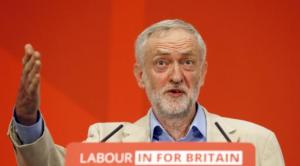
Yesterday, Jeremy Corbyn gave his much-heralded intervention in the EU referendum debate, which is worth analysing as perhaps the single biggest disappointment of Corbyn’s tenure as Labour Leader thus far.
The Labour Party is overwhelmingly for staying in because we believe the European Union has brought: investment, jobs and protection for workers, consumers and the environment, and offers the best chance of meeting the challenges we face in the 21st century.
In fact, Britain’s bounce back from (Labour-inflicted) 1970s decline was due to the free-market policies of the Thatcher Conservative government. The limited extent to which our membership of the European Union helped bring jobs and investment to Britain are the very same reasons why Corbyn now dislikes the current EU – because it is “neoliberal”, market oriented and has awkward rules about state aid and nationalisation of industry.
By voluntarily placing Britain in the EU’s regulatory straightjacket at a time when we were most decidedly mad (with price and wage controls and vast nationalisation of industry) we were indeed prevented from inflicting more harm on ourselves. But Corbyn pines for all the edifices of state socialism which were worn down by Thatcherism and constrained by the EU.
Corbyn basically wants 1970s declining Britain, repeated at a European level. He may admire the social, employment and environmental regulation, but he will not be happy until member states are free to pursue strongly left-wing policies without interference or blocking from Brussels. And of course this is a hopeless fantasy, because the EU is travelling in a direction where member states are able to do fewer and fewer things autonomously in their own national interest, while the euro crisis demands more, not less, convergence.
Corbyn continues:
In the coming century, we face huge challenges, as a people, as a continent and as a global community. How to deal with climate change. How to address the overweening power of global corporations and ensure they pay fair taxes. How to tackle cyber-crime and terrorism. How to ensure we trade fairly and protect jobs and pay in an era of globalisation. How to address the causes of the huge refugee movements across the world, and how we adapt to a world where people everywhere move more frequently to live, work and retire.
All these issues are serious and pressing, and self-evidently require international co-operation. Collective international action through the European Union is clearly going to be vital to meeting these challenges. Britain will be stronger if we co-operate with our neighbours in facing them together.
Not one of these issues is something which cannot be tackled by determined, well-executed inter-governmental co-operation between sovereign member states. There is nothing mysterious about climate change or terrorism or free trade which can only be solved if the countries of Europe dissolve themselves into a single supranational political entity which sits above them, its unelected leaders making decisions on their behalf.
So what is the answer to the European Union’s problems if not recognising that it is a terminally flawed, anachronistic holdover from the early twentieth century, and pulling the eject lever before we impact with the ground?
Corbyn’s solution:
So Europe needs to change. But that change can only come from working with our allies in the EU. It’s perfectly possible to be critical and still be convinced we need to remain a member.
[..] I have listened closely to the views of trade unions, environmental groups, human rights organisations and of course to Labour Party members and supporters, and fellow MPs. They are overwhelmingly convinced that we can best make a positive difference by remaining in Europe.
Then they are all part of the same collective delusion. The European Union is not shy about its ultimate goal of ever-closer, not simply more perfect union. And the juggernaut has continued to trundle inexorably in the same integrationist direction for decades. What, exactly, gives them hope that a twinkly-eyed, bearded British socialist and his starry eyed chums like Greece’s Alexis Tsipras (who was pretty much castrated by the eurogroup on live television during last year’s euro crisis) are going to change the direction of travel?
Don’t expect an answer. Every EU apologist from the dawn of time has been ready with mealy-mouthed protestations that “of course the EU is flawed” and “of course we need to push for reform in Europe”, but there are two problems. One is that the European Union is not interested in their kind of reform, and the second is that the EU apologists lose all interest in actually agitating for reform after awhile. Running into a brick wall at full speeds begins to lose its appeal, after awhile.
Then we get to the meat of Corbyn’s speech:
When the last referendum was held in 1975, Europe was divided by the Cold War, and what later became the EU was a much smaller, purely market-driven arrangement. Over the years I have been critical of many decisions taken by the EU, and I remain critical of its shortcomings; from its lack of democratic accountability to the institutional pressure to deregulate or privatise public services.
Except that what the EU does is not so much lavish spending on cash-strapped institutions being starved to death by the mean Tory government in Westminster. What it actually does is bribe citizens with their own money. In the case of a huge net contributor to the EU budget like Britain, that means sending our taxpayer money to Brussels where it goes through the bureaucratic machine, before a portion of those funds are redistributed to organisations and councils within Britain, to be spent in the way agreed with the EU.
That so many academic, artistic and cultural leaders are so desperate for Britain to remain in the EU should indeed tell us something. It should tell us that they are either stupid for not realising that they are being bribed with their own money, or that they are very smart and cynically think that the EU’s anti-democratic nature is a great way to get taxpayer funding for things which are either so pointless or so much more at home in the private sector that the British public would never countenance spending the money.
So what exactly are these never-gonna-happen reforms supposed to look like? Corbyn sets out his vision:
But we also need to make the case for reform in Europe – the reform David Cameron’s Government has no interest in, but plenty of others across Europe do.
That means democratic reform to make the EU more accountable to its people. Economic reform to end to self-defeating austerity and put jobs and sustainable growth at the centre of European policy, labour market reform to strengthen and extend workers’ rights in a real social Europe. And new rights for governments and elected authorities to support public enterprise and halt the pressure to privatise services.
So the case I’m making is for ‘Remain – and Reform’ in Europe.
Today is the Global Day of Action for Fast Food Rights. In the US workers are demanding $15 an hour, in the UK £10 now. Labour is an internationalist party and socialists have understood from the earliest days of the labour movement that workers need to make common cause across national borders.
Working together in Europe has led to significant gains for workers here in Britain and Labour is determined to deliver further progressive reform in 2020 the democratic Europe of social justice and workers’ rights that people throughout our continent want to see.
But real reform will mean making progressive alliances across the EU – something that the Conservatives will never do.
Ah, so “reform” actually just means lashings more socialism in Europe.
Anyone proposing a change to the workings of the EU based on a single political ideology is immediately doomed to fail, because they are by their own admission less interested in democracy, governance and international co-operation, and more interested in inflicting their own worldview and values on others. And so it is with Jeremy Corbyn’s vision of a left-wing Hands Across Europe movement.
Corbyn has no interest in working with conservative or centrist voices in Europe to create a better-functioning set of institutions and rules, because for him (and many on the left), policies and structure are inseparable. Corbyn doesn’t really care that the EU is antidemocratic – after all, right now he is grateful that the EU is undemocratically imposing on Britain various employment and social directives with which he agrees. Therefore his only interest is seeking out other like-minded people on the continent to grab as much power as possible, only then considering changes to the structure of the organisation to make it harder for conservatives to mount a counter-attack.
And when it comes to partisan point-scoring against conservatives, Jeremy Corbyn’s extended diatribe against tax avoidance incidentally reveals the single biggest hypocrisy in his entire position on Europe.
Corbyn begins this section:
The most telling revelation about our Prime Minister has not been about his own tax affair, but that in 2013 he personally intervened with the European Commission President to undermine an EU drive to reveal the beneficiaries of offshore trusts, and even now, in the wake of the Panama Papers, he still won’t act.
And on six different occasions since the beginning of last year Conservative MEPs have voted down attempts to take action against tax dodging.
But then he dramatically overreaches:
Left to themselves, it is clear what the main Vote Leave vision is for Britain to be the safe haven of choice for the ill-gotten gains of every dodgy oligarch, dictator or rogue corporation.
They believe this tiny global elite is what matters, not the rest of us, who they dismiss as “low achievers”.
For any apologist or supporter of the EU to stand up in front of a room full of people and declare that it is those fighting for Brexit who are the elitists takes real cojones, and an inscrutable poker face. Because back in the real world, nothing epitomises the desire of a small political and financial elite to escape national democratic accountability for their actions more than the existence of the EU.
The EU is not, as its cheerleaders claim, a coming-together of European peoples. Rather, it represents the outsourcing of key parts of national political life to the unaccountable, unreachable realm of the European Commission and other Brussels-based bodies. It directly waters down our democratic clout through granting ever-greater authority to institutions like the EC and the European Court of Justice, whose edicts and rulings can be imposed on nations regardless of what national governments, far less national plebiscites, think of them. That is anti-democratic. End of. And it should be viewed as intolerable by anyone who considers himself progressive, and who recognises that every radical, inspiring leap forward in modern times – from the Levellers to the Chartists to the Suffragettes – has been about people wrestling from the authorities the right to choose who governs them; the right to political say-so.
The EU is a union not of peoples, but of elites. It has in recent decades become the sphere in which national elites, feeling ever more estranged from their national electorates, have effectively taken refuge. In pooling their national sovereignties into the EU, our national rulers absolve themselves of the responsibility to have tough, testy debates with us about various political and social matters, in favour of seeing such issues discussed and resolved by the commissioners and self-styled experts of this rarefied zone.
The EU is not any kind of internationalist or cosmopolitan project, as its supporters claim. Nor is it a conspiracy of French and German blaggards to do over decent Blighty, as its detractors insist. Rather, it is the institution that has grown from and been constantly fed by national elites’ own growing feeling of exhaustion with democracy – and with democracy’s engine: the demos – be it politicians who would rather an aloof court decided something they haven’t got the stomach to debate or advocacy campaigners who agitate for an EC regulation because nothing repulses them more than the idea of trying to win over the plebs of their own nations.
And O’Neill’s conclusion in the same piece could be aimed directly at those left-wing EU supporters who, like Corbyn, insist that we must stay locked in unwanted political union to protect our “rights”:
All those things that the Remain lobby claims will be better if we stay in the EU – workers’ rights, freedom of movement, anti-terror security measures – are things that should be discussed and decided by us. To say the EU does ‘good things’, even though it does them without any real democratic oversight, is to support a benevolent tyranny. A tyranny enacted not to crush us but to save us – the worst kind.
But of course Jeremy Corbyn (and much of the Left) do not trust us to make the “correct” decisions on these or any other issues, so they are more than happy for democratic control of these things to be outsourced to a supranational European level of government which is more amenable to their demands.
So to summarise – Jeremy Corbyn supports Britain remaining in the European Union on the basis that the EU may one day magically reject capitalism and seek to become a socialist paradise. And yet no serious watcher of the EU or its member states believes that this is remote possibility, whatever Yanis Varoufakis and his Democracy in Europe Movement may say.
Therefore Jeremy Corbyn is willing to subject Britain to the ongoing uncertainty of remaining part of a relentlessly integrating supranational political union (not to mention the probability of a violent, uncontrolled Brexit further down the line when the EU either disintegrates or takes another major step toward federalisation) because he is holding out the flimsy hope that a ragtag assortment of socialist and communist groups across Europe will get together and take over the EU’s institutions, recasting Brussels in their own image.
Of all the grandiose claims from both official sides in this referendum campaign, how likely does this proposition seem to you?
Exactly. There is not a snowball’s chance in hell that any of the things that Jeremy Corbyn freely admits to finding most objectionable about the European Union will change any time soon. Deep down, Jeremy Corbyn knows this, and yet here he is, telling us about the wonderful, socialist-friendly EU which could soon be ours.
When Jeremy Corbyn won the Labour leadership contest and almost immediately recanted his long-held euroscepticism, this blog remarked:
There are lots of words you can use to describe the Labour Party’s fawning and uncritical “IN at all costs” attitude toward the European Union, but it is certainly not the “new politics” promised by Jeremy Corbyn.
And as Corbyn’s leadership of the Labour Party continues, it will be very interesting to observe where he chooses to make a stand in defence of his left-wing principles, and where else he is willing – or forced – to make concessions to the majority centrists of the parliamentary party.
On nearly every other issue – armed intervention in Syria, Trident nuclear weapons, you name it – Jeremy Corbyn has been more than willing to provoke rage and hysteria within his own party by treading a different path and rejecting a number of sacred New Labour shibboleths. But when it came to the European Union, Corbyn didn’t simply send out Hilary Benn to give the doe-eyed, europhile position. He swallowed his pride and did it himself.
One might call it a rather bold act of leadership by Corbyn, were it not also such a grotesque betrayal of his own beliefs on the subject of Europe.
Ultimately, Jeremy Corbyn wanting to stay in the European Union to bring about democratic socialist reform is like me wanting to go to North Korea to single-handedly convince Kim Jong Un to surrender power and help his country transition away from totalitarian dictatorship. The aim is certainly ambitious, maybe even noble, but the audience’s receptiveness to the message is decidedly limited. And both are equally doomed to failure.
The only difference is that as a private citizen, I am free to indulge in as many far-fetched daydreams as I like without consequence, whereas Jeremy Corbyn is leader of the Labour Party and the official Opposition.
When I waste my time and energies advocating for a futile cause, it harms nobody. When Jeremy Corbyn does the same, as he did at Senate House yesterday, he betrays not only his conscience but also the people who voted for Corbyn trusting him to speak his true mind and defend their interests.
If you are deciding how to vote in the EU referendum based on what the rival campaigns are telling you is best for the NHS, you’re doing it wrong
The stupidity and incompetence of the Vote Leave campaign reached such desperate lows today that at this point, I can no longer really blame anyone who has not been paying much attention to the EU debate thus far if they end up voting Remain. Heck, if I hadn’t been writing about politics every day and following the debate for years, I might well do the same.
After all, why put your trust in the Leave campaign, the people proposing a departure from the status quo, when the leaders of Vote Leave are conducting their campaign with all the political aptitude of the slow sibling from a well-connected family whose parents were grasping around trying to find something productive for them to do with their lives, and gave them the fate of our country to play with.
And so today we get this much-trumpeted open letter from “more than fifty” healthcare workers, telling us that only by voting Leave can we Save Our NHS.
The NHS is a great British institution that families rely on in times of need. But as it slips into financial crisis the NHS itself needs some urgent attention.
The NHS is being asked to make huge cuts at a time of rising demand. Patients are having to wait longer for treatment, hospital deficits are increasing and doctors are on strike after being told they must take a pay cut. The Government must accept responsibility for this – they have starved the NHS of necessary funding for too long.
If we Vote Leave on 23 June we will be able to spend more on our priorities like the NHS. If we put the billions that currently go to EU bureaucrats into the NHS instead it would hugely improve patient care. For example, the £350 million a week we hand to Brussels is similar to the entire yearly Cancer Drugs Fund budget.
As healthcare professionals who have worked for the NHS for years we believe that the best choice in the EU referendum is to Vote Leave on June 23rd and save the NHS.
But still, what a bunch of utter nonsense this letter (and the decision to campaign off the back of it) is. Not only does this fail the “common sense” test, it fails the “does anyone at Vote Leave have any measurable brain activity at all” test.
The NHS is one of the largest organisations in the entire world, and the fifth largest employer with over 1.7 million people on the payroll. Rounding up fifty NHS workers to put their names to a letter supporting either Brexit or the Remain campaign means absolutely nothing – one could just as easily circulate a letter and get fifty signatures from NHS employees who believe they have been abducted by aliens, demanding a massive budget appropriation to build space lasers to keep us safe.
Furthermore, it would be utterly naive to base a geopolitical and constitutional decision like Brexit on the gut feeling of a bunch of people who not only work in an entirely unrelated field, but who toil for an organisation so large and all-powerful that it positively screams “vested interest” and “deeply ingrained bias in favour of the status quo”.
Besides, a bunch of predominantly conservative politicians and activists not known for their doe-eyed devotion to the NHS suddenly going prancing around the country acting like the health service’s greatest defenders is not going to fool anyone. By a huge majority, the most committed devotees of the NHS are the same people who will unthinkingly vote to stay “in Europe” come hell or high water. Worshipping at the altar of Nye Bevan doesn’t do great things for one’s critical reasoning skills, after all.
All of this time spent repeating the risible notion that only by voting Leave can we Save Our Blessed NHS is time that could be spent – oh, I don’t know, maybe promoting a comprehensive plan for a safe Brexit with the minimum of disruption. A plan which would instantly negate 90% of David Cameron’s fear-based Remain campaign and really bring this campaign to life.
But why do that, when Matthew Elliot and Dominic Cummings are more than happy presiding over their children’s finger-painting exercise of a campaign, preaching to the already converted and singularly failing to tackle any of the counterarguments quite rightly thrown in their faces by David Cameron and Britain Stronger in Europe?
I am never more excited and hopeful for the future of this country than I am when I read their work. Please follow The Leave Alliance, share their articles and (if you are able) donate to their all-important fundraising efforts. Every pound raised helps to spread the message further.
Semi-Partisan Politics will be diverting any kind contributions made to this site to The Leave Alliance from now until the conclusion of the campaign.
It is becoming fashionable among the undecideds in the EU referendum campaign to complain about the supposed lack of available facts in the debate. But they don’t want facts – they want to be spoon-fed opinions and simultaneously reassured that these answers are unbiased
There is a rather nauseating new trend among those people who have somehow not yet come to an informed opinion on whether or not Britain should vote to leave the EU, whereby they blame their inability to reach a decision on the supposed lack of available facts handed down to them from on high.
We even see this cropping up in Question Time, as the Independent reports:
With 113 days until the EU referendum – that’s more than 15 weeks away – levels of stamina among the public for the flow of information being directed at them seem to be waning.
And when the opening question of BBC’s Question Time was on how much the referedum’s outcome would depend on “which side could scare us more”, one audience member put the problem laid before the country in very clear terms.
A young man said the decision to continue or terminate the 40-year relationship all rested on wondering who could be trusted to give impartial, accurate information.
“With all this scaremongering that’s going on in the media about this, I don’t see how us as the general public can make an informed decision,” he said, prompting nods from those around him.
[..] In the light of such risks, the audience member seemed to be concerned that he was given little information with which to make a safe and long-term decision.
“It’s just all sides saying different things and you just don’t know who to believe,” he said.
Boo hoo. It’s so difficult for undecided voters today, bombarded with passionate (but often fact-free) arguments from both sides. How can they possibly be expected to vote when the government and the meejah don’t give them a clear and unambiguous signal?
The amusing thing is that the young Question Time audience member asking the question would probably have absolutely no difficulty using the internet to research a complex and technical query relating to his malfunctioning Playstation or home cinema system. He is likely adept at finding YouTube tutorials which show how to disassemble and repair household appliances, and if he has a favourite sports team, band or celebrity he can quite likely find all manner of information about them online with no difficulty at all.
But when it comes to the workings and operation of his own country and the European Union which influences so many aspects of his life, it apparently does not occur to the questioner that he can use exactly the same skills he honed researching his fantasy football team to turn up some relevant, unbiased facts about the EU. The thought simply does not compute. When it is something glitzy and fun, he is more than willing to spend five minutes consulting Google and a few hours reading through the results that his search throws up. But on “boring” matters like the governance of the EU, what the European Union might look like in the future or how Brexit might actually be accomplished, he loses focus before he can finish typing a query into the Google search bar.
Of course he is not getting unbiased information from the media. Playing the role of high-minded, neutral arbiter has not proven to be very successful for most media outlets, nearly all of which instead churn out content which plays to the gallery of their readerships. That’s life. But it does not mean that the primary information needed to reach an informed and independent opinion is unavailable. It just means forsaking Monday Night Football or the Great British Bakeoff for one night and using the internet or local library to make oneself a more informed and engaged citizen.
EU referendum blogger Pete North has by far the best response to these aggrieved undecided voters who flaunt their ignorance of the debate as though it is an injury inflicted upon them by evil external authority figures withholding “the facts”:
I watched Question Time last night. I heard that whining bovine complaint once more “I just want to be given the facts”, expecting that it’s the government’s job to spoonfeed them with information, under the assumption government can and will. Could they be any more bovine?
As it happens, the facts are available insofar as anything is ever truly a fact. On something as comprehensive as the EU there is all the information you could possibly want. And while you can say a lot of bad things about the EU, one thing we can say is that it is transparent. It publishes most of what it does, the schedules, the regulations, the meeting minutes, the agendas and the agreements. It’s all there if you can be bothered to look for it. I didn’t learn what I know by reading John f*cking Redwood.
And when it comes down to it people say they want the facts but they don’t. You can give them the facts but it’s always “tl;dr”. So they want a digest version of the facts. So you provide them with that and it tells them things they don’t want to hear – and so they stick with their ridiculous notions that either we can pull out overnight and comes the dawn of a new utopia – or on the other side the europhiles pretend the European Union IS that new utopia.
What people mostly want is to be told what to think. To have someone else make the decisions. To not let the complexity of life disturb their comforting ignorance. It’s the “I pay politicians to do the politics” attitude. THAT is how we get in these messes to begin with. Politics is too important to be delegated to these bozos and if this referendum has revealed anything it is that most of our elected representatives are intellectually subnormal and know f*ck all about nine tenths of anything.
In the end, to have a proper democracy participation requires more than just turning up to vote. It requires that you educate yourself, keep yourself informed, keep yourself up to date and find the facts for yourself – and especially that you do not rely on the media – after all our media are very much part of that political class with even less clue than the morons we elect. If you can’t be bothered to engage on that level you really do deserve everything you get from your “leaders”.
It is a lazy, naive idea that we can outsource the running of our country to elected politicians and only perk up and pay attention once every five years or so when there is a general election. As Pete North rightly says, that is how we got into this mess in the first place – people failing to hold their leaders to any kind of account, while the politicians did as they pleased.
But at least if you do so, you are in plentiful (I won’t say good) company. Neither the official Remain or Leave campaigns are exactly brimming over with deep expertise on the workings of the European Union, in which direction the EU will travel or the logistics of achieving Brexit.
Fortunately, there are those who stopped watching television for long enough to educate themselves on this important subject. A number of them have become experts in the subject, certainly far more so than the Westminster media with its superficial grasp of the facts, all while holding down day jobs. They are the the bloggers of The Leave Alliance, and the plan they promote for leaving the European Union in a safe, orderly and non-disruptive way is called Flexcit, or the market solution.
Start with that. Or start with the European Union’s own websites – as Pete North says, much of this information is “hidden” in plain sight. Begin your search for facts in any number of places, just don’t repeat the whiny, false complaint that there is no factual information available.
Postscript: The irony is that facts and figures supporting either side are not the most important thing in this referendum, while economic projections are particularly unreliable to the point of being pure fiction. This blog contends that the EU referendum comes down to more qualitative factors like democracy, sovereignty, governance and constitutional reform, which simply cannot be calculated in an Excel spreadsheet.
–
Agree with this article? Violently disagree? Scroll down to leave a comment.
The European Union is an obsolete and rusting vessel – a dreadnought in an age of guided missile destroyers – holed beneath the waterline by the forces of globalisation
If you have not already done so, be sure to read Roland Smith’s excellent new article for the Adam Smith Institute, “The Liberal Case for Leave“.
Smith, a newly-minted Fellow of the ASI, begins with an excellent summary of the context in which Britain joined the EU in the first place – which also has the effect of showing what a vastly different country we are now than we were at the nadir of our post-war, pre-Thatcher decline:
Let’s bypass the line that says the UK electorate were sold the then EEC on a false premise. Instead let’s look at the circumstances in Britain around the time we joined the EEC and then agreed to stay as a result of the 1975 referendum.
Back then Britain was a country beset by nagging economic problems that were coming to a head: The constant stop/go policies of the post-war period that seemed to only inch us forward while the likes of Germany and Japan seemed to leap ahead; strikes; power cuts; rations even; union power; consensus politics; corporatism; and the 3-day week. Opinion favouring free markets was out on the political fringes.
On a longer view, Britain was a country in decline. Since World War II and particularly since the Suez crisis of 1956, Britain’s empire and its confidence had declined as it grappled with a new post-imperial future. The USA and the Soviet Union were the two blocs that now mattered in the world, each having their own large economic trading zone (the USA itself and Comecon).
Indeed, large and protected blocs seemed to be the future and the EEC was apparently forging a third bloc and third way between these two giants, albeit aligned to the USA.
Then there were the walls.
The most visible walls were the Berlin Wall and the Iron Curtain separating the Soviet Union from the West but there were also significant tariff “walls” between blocs, countries and trading areas. These walls not only demarcated different geographic areas, they reinforced the separateness of those areas, limited trade, and ultimately put a limit on economic progress. The tariff walls in particular defined economic blocs but also made the case for them, creating an impulse for relatively like-minded countries to club together to at least forge a level of economic freedom among themselves.
Smith rightly summarises the prevailing attitude of the time:
Being “for Europe” symbolically represented a future, outward-looking, cosmopolitan and internationalist mindset. It confirmed that you were part of the new jetset or had aspirations in that direction. It was about “getting on”.
Smith goes on to note that Britain joined the EEC just at the time when all of the old certainties which underpinned it began to show the first signs of corrosion – the decline and fall of the Soviet Union bringing an end to the necessity of regional super-blocs, and the decade of negotiations which led to the creation of the World Trade Organisation in 1995.
With the beginning of significant reductions in global tariffs and even the emergence of many new nations, the European Union – a protectionist customs union with explicit and long held aspirations for statehood – was already falling behind the times, as Smith describes:
Unseen and barely discussed in the 1990s, globalisation was beginning to eat into the logic of a political European Union at the very point it was striding towards statehood with a single euro currency.
Looking back, the EU was (and is) an old ideology in a hurry.
The event that was somewhat more attuned to freer globalised trading was the fanfare around the launch of the single market in 1992, except for the fact that it was and is tied to the EU’s political integrationist ambitions. But now, even the European single market is being rapidly eclipsed by the march of globalisation. A large and growing body of single market law is now made at global level and handed down to the EU which in turn hands it down to the member states.
The automotive industry’s standards are defined by the World Forum for the Harmonisation of Vehicle Regulations (known as WP.29) under ‘UNECE’ – a United Nations body. Food standards are defined by the ‘Codex Alimentarius’ established by the UN and the World Health Organisation. Modern labour regulations are defined by the ILO – the International Labour Organisation. Maritime regulations are defined by the International Maritime Organisation. Many energy-related regulations can be traced back to the global Kyoto accord on climate change and other international agreements.
Read the whole article. Roland Smith covers an extraordinary amount of ground in his essay, including more sense on immigration policy than you will ever hear from the official Leave and Remain campaigns.
While the EU’s furtive aspirations for statehood are misguided and abhorrent, many of the ways in which the European Union has developed were born not out of particular malice toward the sovereignty of its member states but merely as the result of being perpetually stuck in an increasingly irrelevant post-war mindset. Unlike many rent-a-copy diatribes against the EU, Smith captures this nuance well.
If we are to succeed against the odds in securing Brexit in this EU referendum, it will not be the alarmist cries about impending dictatorship or the abolition of the NHS which secure victory.
Reasonable, moderately engaged people – those with vague eurosceptic thoughts but who are minded to vote Remain because of the Fear, Uncertainty and Doubt kicked up by the government that those with vested interests in keeping things as they are – are most likely to be persuaded to Vote Leave if they are told that the EU is not necessarily the Great Satan, but rather a hopelessly outdated mid-century anachronism thrashing around and drowning in the sea of globalisation.
Given the choice, people will quickly vote with their feet when it comes to safely evacuating a foundering ship. Which is why the Remain camp are doing their utmost to portray the EU as a faithful and seaworthy vessel, albeit one in need of a lick of paint here and there.
This important article by Roland Smith – as well as outlining a bright and positive liberal vision for Brexit – also sounds a timely warning that RMS European Union has essentially been holed below the waterline by the iceberg of globalisation and is already steadily taking on water, regardless of the course it now chooses to steer.
And the fact that the lights still burn and the band plays cheerily on as the water laps ever higher around the deck is no reason for Britain to foresake the waiting lifeboat on offer.
–
Agree with this article? Violently disagree? Scroll down to leave a comment.







 Semi-Partisan Politics