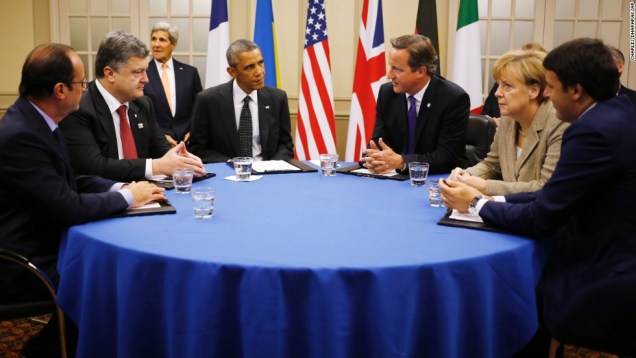
The importance of the UK as a key figure inside the EU club will be symbolically underscored when Obama again meets David Cameron, Angela Merkel, Mario Renzi and François Hollande in Hanover, Germany, on Monday to discuss Syria, Libya and the consequent migration crisis. The implicit message is that the UK outside the EU would not have been invited to such a high-level transatlantic conclave.
Oh gosh! How kind of Italy and France to allow Britain to take part in their Super Important Meeting with Germany and the United States. Of course, puny little Britain – the fifth largest world economy and pre-eminent European military power – would never normally be allowed to sit around the table with François Hollande and “Mario” Renzi, but for the fact that we are part of the same supra-national political union.
Is the Guardian serious? Sometimes it is hard to tell whether this dismal, miserablist attitude toward Britain is entirely genuine, or an attitude which is affected purely for the purposes of keeping our self-esteem just low enough that we don’t get ideas of national independence above our station.
The trouble, though, is that the Guardian is very much a thought leader in this area. Where the Guardian sighs, tuts and shakes its head at the hopeless prospects of puny, pathetic Britain, so many of its readers have been conditioned to automatically do the same. I’m frequently amazed by the number of conversations I have with otherwise intelligent, knowledgeable people who genuinely believe that Britain is a small and inconsequential nation.
It is almost as though someone distilled Britain’s despairing psyche when we were at our 1970s nadir into its purest, bleakest form, and then injected that dismal serum into half of today’s population. Once the infection takes hold, the feeble country that these National Inferiority Virus sufferers hallucinate bears absolutely no relation to the objective reality of modern Britain.
And these are the people who will be voting in the referendum on 23 June. These are the the pessimistic, resigned views which millions of people sympathetic to the Guardian’s position will carry with them into the polling booth. Citizens of a nuclear power, a P5 UN Security Council member, the world’s fifth largest economy and home to the financial and cultural capital city of the world, who nonetheless believe that it is only our membership of the EU which gives Britain’s prime minister the undeserved privilege of being in the same room as the leaders of Germany, France and Italy.
An open letter to Barack Obama, responding to the American president’s heartfelt intervention in our EU referendum debate
Welcome back to Britain, Mr. President. It’s always a pleasure to have you here.
Thank you also for sharing the fruits of your wisdom on how we should vote in our coming referendum to leave or remain in the European Union. Your deep respect and affection for the United Kingdom (and the countless small ways in which you have honoured the special relationship since taking office in 2008) is well known here, and we are sure you would not have made this intervention at David Cameron’s personal request unless you sincerely believed it was the right course of action, and had our country’s best interests at heart.
But before you jet back to Washington DC on Air Force One, Mr. Obama, please allow us to reciprocate by sharing some words of advice for your own country and fellow citizens. We offer this advice in exactly the same spirit with which you blessed us with yours.
Mr. President, it is time for the United States of America to admit that the age of the nation state is over, to let go of excessive pride and patriotism, and form a political Union of the Americas. Don’t waste another moment. Assemble the heads of state from North, Central and South America and immediately sign and ratify a Treaty of Tijuana creating a political and customs union between your respective countries. For this is the only way that the great prosperity which Americans have known in the twentieth century can possibly be preserved in the twenty-first.
Now, we know what you’re going to say. The United States is still the world’s pre-eminent military and economic power. That’s true. But the same was said of the United Kingdom a mere century earlier, and look what a beating Britain took in the first eighty years of the 20th century – a huge expenditure of blood and treasure defending freedom in Europe, a global empire lost and an economy which went from being the world’s largest to smaller than that of Italy.
It was only by the election of Margaret Thatcher joining the European Community that a battered and declining Britain managed to staunch the bleeding and halt the decline. America should seize the initiative, recognise that – like Britain – her best days are firmly in the past, and hedge against the scary and uncertain future by dissolving the political ties which separate her from Canada, Mexico, Belize, Guatemala, El Salvador, Honduras, Nicaragua, Costa Rica, Panama, Suriname, Colombia, Argentina, Venezuela, Peru, Paraguay, Uruguay, Bolivia, Chile, Ecuador, Guyana, French Guyana and Brazil.
Consider: America’s economy will soon be overtaken by China in terms of raw nominal GDP, as will that of our own blessed European Union. And the population of the United States is dwarfed by both India and China, two developing countries with nuclear arsenals and strong regional interests which are often at odds with America’s. If you wait too long to band together into a regional political union based on your shared continental values it may be too late – China will divide and conquer the continent.
No one country from the Americas can hope to stand up to China or wield the leverage to sign the amazing trade deals that one of your potential successors is promising. Only by binding your fate inexorably to that of Venezuela and Ecuador can the United States hope to secure a fair deal. Remember: united you stand, but divided you fall.
And speaking of being united, isn’t it about time that any citizen of North or South America was able to live, work or retire anywhere they please? The new American single market for goods, services and capital is incomplete if there is not also a single labor market, and so the very first act of this new Union of the Americas should be to abolish national borders and establish passport and visa-free travel across the entire continent.
Now, some may object to this with shrill warnings about national security, but consider – as part of this new Union, the United States will have access to the world-class intelligence services of Peru and Costa Rica. As we all know, national security cooperation is only possible through full political union, and so by joining this Union of the Americas the CIA and FBI will for the first time ever be able to share information with Mexico and Canada for the prevention of crime and terrorism.
We anticipate that your labor unions will also kick up a fuss at the thought of millions of economic migrants from South and Central America moving to the United States in search of work and higher living standards. But if you give Tony Blair a quick call, he will tell you that it is possible to overcome these objections by furiously ignoring them and labelling anybody who gets angry about the suppression of wages and conditions as a racist or xenophobe.
So how should this Union of the Americas work? Well, we humbly suggest that you model it on our own European Union, whose institutions are so beloved by all European citizens and whose founding fathers are no less well-known and revered than Thomas Jefferson, James Madison and Benjamin Franklin.
Of course you will need a government for this union. We have found that a Commission of 28 mostly failed politicians from our respective countries serves this purpose very well indeed. This body will be the only one which can propose new laws for your union, so finding the right calibre of candidates is important. It’s the strangest thing, but former prime minister and presidents who left office under a cloud of scandal and popular dissatisfaction often turn out to make amazing commissioners. We don’t know why it works, it just does.
You will need a Parliament for your union, too, in order to act as a rubber stamp for new directives and legislation. But it is no good having each country voting along national lines – remember, the goal is to gradually weaken and erode national identity so as to gain public acceptance for our new Union of the Americas. So each member state should be divided up into regions, with each region represented by a number of MAPS (Members of the American Parliament). You might think that the United States is already ideally divided into fifty such constituencies in the States, but this is entirely the wrong way of thinking. The regions should be arbitrary places to which nobody feels any sense of connection or belonging. Geographic descriptions like “North East” and “South West” are always a good choice, because they help to break down peoples’ backward and antiquated feelings of patriotism and pride in their home, and finally begin to see themselves as the pan-American citizens that they are.
And we can’t forget the judicial branch. Your new Union of the Americas must uphold the rule of law and ensure that national governments, corporations and individuals are in compliance with foundational treaties and Union laws and directives. The American Court of Justice (ACJ) will fit nicely above your own Supreme Court – and of course, any decisions which the US Supreme Court makes are subject to review by the ACJ because lovely though your own Constitution may be, Union Law must have primacy if this new arrangement is to work.
The goal, as you can probably tell, is the gradual accretion of power and responsibility at the supranational level, so that key decisions are taken in Tijuana rather than the capitals of each member state. National identity is so anachronistic, and stubbornly clinging to outdated concepts of nationhood will doom the American peoples to a lost century of relative decline. Now, naturally you may encounter some resistance to all of this from the voters, which is why it is actually best to talk about the whole enterprise exclusively in terms of trade and co-operation. If anybody accuses you of harbouring grander plans for political union, just dismiss them as cranks and conspiracy theorists. It works really well.
And don’t worry – you can keep all of your institutions. Congress, the Supreme Court, the office of the presidency, all of it will still exist under the new Union. It’s just that various powers and responsibilities will need to be outsourced to the supranational level to ensure the smooth running of the new Union. We think you will quickly come to like the arrangement – having dedicated civil servants in Tijuana administering social policy, negotiating trade deals and hammering out a common foreign policy will free up so much time for partisan grandstanding, political fundraising or a few more sneaky rounds of golf.
We know how tiring you have found the partisan gridlock in Washington. Well, by signing the United States up as a founder member of the Union of the Americas, you don’t have to worry about it any more! Democrats and Republicans can continue to posture, argue and filibuster about a whole range of largely symbolic issues, while increasingly all of the governing that actually matters moves to the supranational level. It’s a win-win situation.
I hope that by now you can sense the excitement we feel for the potential of this new Union of the Americas. And frankly, from a selfish European (I nearly said British – old habits die hard) perspective it would make our lives much simpler, too. It is rather time-consuming and expensive to maintain embassies and consulates in so many countries and cities across North, Central and South America. And at times of crisis, I know that Federica Mogherini, our incredibly well-qualified and able High Representative for Foreign Affairs, would find it so much easier if she only had to dial one number to speak to the Americas.
Nation states are a thing of the past. And good riddance, too – they have brought us nothing but war, misery and shame (as our French and German compatriots keep reminding us). So, Mr. President, let your parting legacy to the United States be setting in motion the process of her abolition.
But we do not need to convince you of any of this. After all, it is you urging us vote to remain in the European Union, because you understand the advantages of post-democratic, supranational governance better than many of our own stubborn, backward citizens.
And of course you would never recommend anything for your closest ally that you do not also consider good enough – and earnestly desire – for the United States.
This joint therapy session between Owen Jones and Yanis Varoufakis fails to dispel the cognitive dissonance created by their respective decisions to argue against Brexit despite being such vocal critics of the European Union
Our longed-for referendum was finally on the way after the UKIP surge and David Cameron’s desperate concession to staunch the bleeding of his own MPs to Nigel Farage’s insurgent party. Meanwhile, the Left finally seemed to be rediscovering their long-misplaced euroscepticism after witnessing Greece’s treatment at the hands of the eurogroup and finally realising that post-democratic, supranational governance is not the shining utopia they had been so sanctimoniously claiming.
Back to the present day, and once again there are many reasons for thinking British eurosceptics to despair, and precious few reasons to hope. The Leave campaign is being conducted by an official group comprised primarily of B-list politicos who actually seem to think that a group of mostly right-wing politicians prancing around the country screeching that Brexit will Save Our NHS will be a) remotely believable, and b) a referendum-winning issue.
But perhaps most depressing of all is the fact that the awakening left-wing eurosceptic movement seems to have rolled over in bed and gone back to sleep.
And now, in a new YouTube video [see top] we have Owen Jones and Yanis Varoufakis together in a joint therapy session, perhaps to work through the immense cognitive dissonance that both must currently be feeling from spending 2015 railing against the EU, and 2016 telling us how it is our humanitarian duty to keep the rotten enterprise afloat.
Varoufakis’s view in a nutshell:
The Left should never lose sight of the history of the 1930s. After 1929, the Left failed to create the coalition with other democrats that was necessary to prevent the descent into the abyss of the 1930s.
Now, I see such an abyss opening up in front of our eyes in the centre of Europe today. And if it does, we are going to unleash very vulgar and brutal ultra right wing forces throughout Europe, and various xenophobic tendencies that will be turbocharged by the disintegration of the European Union.
Brexit would speed up the disintegration of the European Union and in the end the only beneficiaries will be those ultra-nationalists, xenophobes, racists everywhere, including in Britain.
In other words, Britain should sacrifice her own freedom and democracy because the rest of Europe is a perpetually backward powder-keg of barely suppressed “ultra right-wing” populism and resentments which will lead us back to war faster than you can say “Treaty of Versailles”, unless we dissolve our individual national identities into a common European body.
Note how Varoufakis says that Brexit would “speed up” the collapse of the EU, not that it would precipitate the collapse. That suggests that he strongly believes that the EU is doomed regardless, but still wants Britain to remain inside the burning building along with Greece to the bitter end. Quite why Britain should sacrifice our own democracy and future economic and even political stability in this way is never explained by Varoufakis or Owen Jones.
Note too how Varoufakis is keen to say that the only ones looking forward to Brexit are the foaming-at-the-mouth racist mobs which are apparently just waiting for their signal to wreak havoc on the streets of Britain. This is a variant on the claim that we should remain in the European Union because Vladimir Putin would apparently like nothing better than for us to leave. That’s certainly an interesting way to run a country – doing the precise opposite of what Vladimir Putin might want at every single decision point – but as a general rule one would have thought it was best to focus more on what is best for Britain rather than what is worst from the imagined perspective of some other world leader.
Our criterion should be a broad, pan-European, democratic movement for preventing the post-modern 1930s from hitting us and future generations.
[..] I feel it in my bones that to all of us we have a duty to band together across borders throughout Europe to prevent this decline, this degeneration into an ultra right wing cesspool of xenophobia, of deflation, of loss of jobs, and this is something we can only fight at the level of Europe. It cannot be fought at the level of Scotland, of Wales, of northern England.
This is an attempt, maybe Utopian, to say “Okay, forget that we are Greek, Scottish, English, German, Italian, let’s get together as European progressives and ask ourselves a very simple question: ‘how do we stop this decline?'”
So it’s not about democracy at all. It’s about leftists from across the European continent banding together to inflict their particular worldview on a reluctant continent. Varoufakis may want to use the European Union as a megaphone to amplify his neo-Marxist message and leftist policies, but he has no intention of his Brave New Europe being a democracy – at least, not if the majority of voters prefer more right wing, capitalist ideas.
Note that Varoufakis says that these right wing terrors (mostly existing only in his mind) cannot be fought at the home nation or English regional level. But he conspicuously fails to mention that they cannot be addressed at the UK level – because, presumably, he believes that they can. Which once again brings up the question of why Britain should remain part of the European Union when Varoufakis himself tacitly admits that Britain is not in need of Europe’s help.
Varoufakis goes on to make legitimate criticism of the lack of real democratic accountability and responsiveness within the member states themselves:
What is the enemy? The enemy is the contempt for democratic processes in our national capitals and in Brussels, because the contempt that the elite has in London for democracy is only reinforced by the contempt that Brussels has.
We make decisions in pure opacity. You have no idea what George Osborne says in Ecofin on behalf of you.
But while he keeps offering More Europe as a solution, at no point is it explained why each member state should not simply strive to become more democratic in their own way and in accordance with their own traditions, culture and history.
The British parliament’s oversight of the government’s handling of EU matters is abysmal at present, with ministers, diplomats and MEPs rarely being held to anything like proper account for the decisions that they make on our behalf in Brussels. That is something which could be changed with sufficient political will – ideally as part of a far more widely reaching constitutional convention, but as a lone issue if necessary. But this is change which must come from within – the EU is never going to start issuing directives instructing national parliaments to pay much closer scrutiny to their own government’s interaction with Brussels.
Ultimately, the problem with Varoufakis’s argument is that it basically amounts to a vain struggle to bring greater transparency to European institutions which nobody wanted in the first place. Live streaming meetings of European finance ministers (to use one of his examples) is all well and good, but it does not change the fact that the entire foundations of the EU were built without the expressed democratic consent of the people.
If your right to decide unilaterally what new car you want to buy is taken away and vested in a group including of 27 of your neighbours, your family is unlikely to be greatly mollified by being allowed to watch your joint deliberations on the internet as together you hash out a compromise. Because they reject the fundamental premise of the exercise, attempting to add a thin layer of democratic gloss over the top doesn’t make it any better.
But half way through the video, Varoufakis makes an important concession, with great emphasis, saying:
The retreat to the nation state is never going to benefit the Left. Never.
And there you have it – the real reason why even the EU’s strongest critics, like Yanis Varoufakis and Owen Jones, ultimately just can’t abandon their commitment to the European Union. Because the only realistic chance they see of imposing their left-wing policies on broadly centrist or centre-right populations is by doing it through the remote and unaccountable auspices of the EU.
The Left look around and see free markets accepted and delivering prosperity in nearly every country, including those who have sworn eternal opposition to capitalism. And despite the Corbynite takeover of the Labour Party in Britain, there is still no evidence of a groundswell of public longing for 1970s style statist economic policies to be brought out of mothballs. What chance, then, does the Left have to bring more of the economy under state control other than the extreme long shot of seizing control of Europe’s supranational layer of government on the back of the supposed European left-wing popular movement (DiEM25) talked up by Varoufakis and Jones?
As Varoufakis admits, “the retreat to the nation state is never going to benefit the Left”. The Left can only advance their cause by sidestepping nation states altogether, which means taking control of the EU, where national legislatures are bypassed and unpopular and even hated policies can be imposed on the peoples of Europe with very limited opportunity for effective resistance (see Greece). This may seem laughably unrealistic – and it is. But it is the Left’s only remaining hope, and so they cling stubbornly to their delusion even if it means betraying democracy and supporting the EU in its current form (and with its current policies) until the time comes for their popular revolution.
Meanwhile, the young Left have simply grown up with the European Union, do not see it as a threat or even a problem of any kind, and have been repeatedly told that opposition to the European project is synonymous with racism and ignorance – and so they support it unquestioningly. And this puts left-wing figureheads like Owen Jones and Yanis Varoufakis (and even Jeremy Corbyn) in a pickle, because there is only so far they can lead their flocks or step outside their side’s own Overton window before the people take fright at being made to think unthinkable, heretical thoughts.
This was not a problem for the late Tony Benn. Benn was able to trash talk the European Union and talk about democracy, and he was indulged much like a crazy but beloved uncle or grandfather. And that enabled Benn to make a compelling case against the European Union and for Brexit, drawing not on left-wing or right-wing political objectives but purely on his respect for democracy.
When asked his own thoughts about the European Union, Tony Benn did not do what most contemporary Labour Party personalities do, and talk about the virtues of undemocratically imposing more stringent social and employment laws on Britain (an irritatingly less social-democratic country than our continental friends). Because Tony Benn understood that the left-wing case against the European Union was about democracy, democracy and more democracy.
Tony Benn understood that some things are more important than whether Britain might happen to move in a slightly more left or right wing direction as a short and medium term consequence of Brexit. He understood that self-determination and democracy – particularly the ability for the citizenry to remove people from office – is the first and most important consideration in determining the democratic health of a country.
And Benn understood that living in a democracy where his own side would sometimes win and sometimes lose was far preferable to living in a dictatorship where his own preferred policies were implemented through coercion with no public redress.
Unfortunately for Corbyn, Jones and Varoufakis, they do not command the universal love and respect enjoyed by the late Tony Benn. They cannot make a case for Brexit to their followers based on democracy, because in truth their followers generally do not care about democracy – they care about getting their way, and imposing their values and policies on Britain whether the people want them or not. In other words, the Left’s most high-profile EU apologists are being led by their followers – and it shows in the paucity and half-heartedness of their arguments against Brexit.
And it is in this context that we should view this fifteen minute televised therapy session between Owen Jones and Yanis Varoufakis, two intelligent people who know deep down they are on the wrong side of democracy, and are desperate to find as many reasons as possible to soothe their burning consciences.
–
Agree with this article? Violently disagree? Scroll down to leave a comment.
If Brexit is like divorce (and it isn’t), it is only because we were tricked into marriage in the first place
You hear it again and again, the hysterical comparison Remainers make between Brexit and getting divorced.
Throughout this EU referendum campaign we have constantly been told that not only will voting to become an independent country will see us physically severed from the continent of Europe and cut adrift to bob around aimlessly in the Mid-Atlantic, but also that this “acrimonious split” will be akin to walking out on our European allies and leaving them with the house, the car and custody of the kids.
On top of the disruption of a messy divorce, Britain would suffer enduring damage by separating from the huge, wealthy market on its doorstep. Not only would trade with the EU be less free, Britain’s access to other export markets would be worse too.
Article 50 provides that the EU will negotiate a new agreement with the withdrawing country over two years. That can be extended, but only by unanimous agreement. The article also specifies that, when agreeing a new deal, the EU acts without the involvement of the country that is leaving. To get a feel for the negotiating dynamic, imagine a divorce demanded unilaterally by one partner, the terms of which are fixed unilaterally by the other. It is a process that is likely to be neither harmonious nor quick—nor to yield a result that is favourable to Britain.
(This is false narrative is nothing but hyperbolic, biased scaremongering, as brilliantly debunked by The Leave Alliance here).
The Labour party turned out on parade last Thursday, and Jeremy Corbyn pronounced that there was an “overwhelming” case for our remaining in the EU. This is statesmanlike behaviour and judgment. Whatever the deficiencies of the EU, we are not going to remedy them if we leave. And the Lawson/Johnson idea that we can renegotiate our way into the advantages of belonging to an organisation that we have just left is for the birds. Messy divorces do not work like that.
The broader point keeps on cropping up – Brexit means a messy and acrimonious divorce, we are told, and therefore we should avoid this at all costs.
But this is pure nonsense. Britain’s relationship with the European Union is not like a marriage. Our membership is not a flawed collaboration or partnership whose kinks and problems need to be patiently worked through in couple’s therapy.
In truth, Britain’s experience of EU membership has been like being in a platonic friendship with someone who is desperately trying to turn that friendship first into a romantic relationship and then into a marriage, and using every single trick and deceit at their disposal in order to do so.
Britain wants somebody to hang out with sometimes, a bit of companionship and a mate who will be there to help celebrate the triumphs of life and provide support and encouragement when things are difficult.
The EU, on the other hand, keeps agitating for us to get a joint bank account, a veto over what TV shows we should watch, a common “guests remove shoes upon entering” household rule and is insisting that we spend our precious vacation time visiting their parents in the south of France rather than driving Route 66 like we always wanted.
Worse still, the EU is making ominous sounds about going vegan “for the good of the Earth”, the clear implication being that we are expected to forswear steak night and take the plunge as well.
And despite our repeated attempts to push back and hint at our desire for a platonic relationship, at some point soon we know in our heart of hearts that the EU fully intends to do to us what every newlywed wants to do on their wedding night – consummate the marriage.
Poor Britain just wanted someone to go to the movies with once in awhile, and now the EU has moved in, spent three grand on new curtains and turned the home cinema into a mini fitness centre. Throw in the fact that suspicious looking packages from Ann Summers have been arriving all week – not to mention that leather whip and pair of handcuffs resting casually on the bed – and it looks like we are in for a rather excruciating evening.
Of course, this could all have been prevented at any point if only we had been willing to have one slightly awkward but brief conversation making it clear that our view of the relationship and the EU’s view of the relationship are fundamentally different – that we want to be friends, and that if it is to be “friends with benefits”, the only benefits we are interested in relate to pragmatic things like trade and friendly cooperation (where doing so on a regional European basis makes sense).
There is still time to have that conversation – just. There is still time before the removal van comes to bring the EU’s clothes and furniture, and before the wedding invitations go out announcing our forthcoming nuptials to the rest of the world. The conversation will become trickier and more fraught the later we leave it, but if we Vote Leave in this referendum we can still salvage an important friendship while preserving our own national bachelorhood.
Brexit now would not be a divorce – it would be correcting a decades-long misunderstanding about the nature of our relationship with the EU, and what we wanted to get out of it.
Wait much longer, though, and the relentless process of political integration (which David Cameron has utterly failed to win an exemption for Britain) will soon be such that we find ourselves trapped in a common law marriage, and a relationship which is much harder – or even impossible – to escape.
–
Agree with this article? Violently disagree? Scroll down to leave a comment.
Another passionate and articulate voice joins the ranks of The Leave Alliance, recognising that while UKIP may have helped get us the EU referendum, neither they nor the freshly-designated Vote Leave are in a position to do anything more than preach to the converted.
So don’t listen to the formal leave campaigns you see on the TV news or read about in the newspapers. I’m talking about Leave.EU, Grassroots Out, Vote Leave, and of course UK Independence Party (UKIP). I used to be a UKIP member because I wanted a referendum, and now we’ve got one, they are doing more harm than good.
These groups want to take the EU marriage certificate and tear it up in front of the EU, in some sort of dramatic gesture, and then walk away and have a bonfire of regulations, and start from zero, with great bravado, to create a bespoke trade deal with various countries around the world, which would probably take 5-10 years (it has taken Switzerland 16 years and their position is good, but not ideal).
That’s all bollocks, obviously.
This is a referendum, not an election. We are only being asked whether we want to stay in the EU or leave the EU. Nothing more.
If we as a nation decide to leave, nobody gets elected, not Nigel Farage, not Boris Johnson, or anyone else. They won’t even get seconded to some transitional team to work on extricating ourselves from the EU. So don’t even listen to them.
It is the current government who would be tasked with the leave process and the end state. This means Whitehall (civil service) and the FCO (Foreign and Commonwealth Office).
So ask yourself: what process and end state would the current government choose?
I’ll tell you. They would choose to leave by Article 50 of the Lisbon Treaty (sorry to be an anorak), and they would choose to enter the EEA (European Economic Area) as a member of EFTA (European Free Trade Association), of which we were originally a member.
Why? Because that is the solution that most closely resembles the current membership of the EU that we already ‘enjoy’.
What this means is that we would still be a member of the Single Market, we would still pay into the EU budget (about 20% of what we do now, based on Norway), and most importantly, we would still sign up to freedom of movement of people, capital and goods.
It is this last point that is the reason why you have not heard the Norway Option being promoted. UKIP, the progenitor of the leave impetus, is all about immigration, so the Norway Option does not address their issue.
Pick a number, but there are about 30% of people who want to leave, 30% of people who want to stay, and 40% of people who are undecided.
The UKIP immigration concern has a plateau, which has already been reached, and will not win the referendum. The undecided middle listen to all the ridiculous messages from both ends and, when push comes to shove, will probably plump for the devil they know, even though that devil is not a status quo, because the EU is proceeding towards political integration and that’s unstoppable.
So the thing about EFTA / EEA is that it is not a big risk. There is no bonfire of regulations, no loss of access to the Single Market, and no change to freedom of movement. But we do regain our sovereignty and self-determination. That’s the only real change we are after.
It’s a stable, low-risk departure lounge, from which we can consider other matters later.
That’s what the undecided 40% of voters need to know. That’s what will actually happen if the government is charged with leaving the EU.
If you want to know more about my point of view, look for Leave HQ and search for The Leave Alliance.
David Taylor, like me, has been on a political journey to reach this point. Readers may recall that I reluctantly gave my vote to UKIP in the 2015 general election, in protest of a thoroughly un-conservative Conservative Party and the desire to reward what I saw as genuine political courage from Nigel Farage’s party in speaking up for a segment of the British public – and for certain ideals – which for too long had been high-handedly ignored by the entire political establishment.
Such people should be welcomed into The Leave Alliance – despite our growing social media and online reach, it is still not easy for members of the general public to become aware that there is another, better eurosceptic game in town than that offered by the likes of Boris Johnson and Vote Leave.
Our national media holds the independent political blogosphere in something near contempt when they think about us at all, which makes it very difficult to cut through the noise and reach people with our message (it would be altogether impossible without the levelling effect of social media).
The British press will gushingly write up almost anything that BoJo does, but are seemingly incapable of acknowledging the incredible work and research undertaken by The Leave Alliance’s largely unpaid team of citizen bloggers, and so it is up to all of us to amplify the message until it can no longer be ignored.
If you have strong doubts about Britain’s continued place in the European Union but feel alienated by the superficiality of Vote Leave and worried about the potential economic consequences of Brexit, know that there is an alternative campaign with a compelling, comprehensive plan for safely leaving the EU in a controlled manner.




 Semi-Partisan Politics