A Friend Turns Fifty

As I was browsing The Spectator website earlier today, I noticed a link to a piece from their archives, an article written to mark the consecration of the newly built Coventry Cathedral on 25 May 1962, half a century ago:

http://www.spectator.co.uk/coffeehouse/7869058/from-the-archives-coventry-cathedral.thtml

Coventry Cathedral was a temporary spiritual home for me during my time studying at nearby Warwick University, particularly during my second year when the university forced us into off-campus housing in the city. Though I converted to Roman Catholicism at the age of eighteen, I quickly grew to love the Anglican service of Choral Evensong, which I would sometimes attend first at my college in Cambridge and later while studying at Warwick. Though these periods were not anything approaching a high water mark in my ebbing and flowing faith, I do have very fond memories of attending Choral Evensong in these places, and feeling closer to God when I did so.

Coventry Cathedral is a particularly inspiring place. You can walk from the still, quiet, grey remains of the old Cathedral (largely destroyed during the Coventry Blitz on 14th November 1940) to the beautifully designed and lit tranquility of the new building, and the feeling when doing so is quite remarkable.
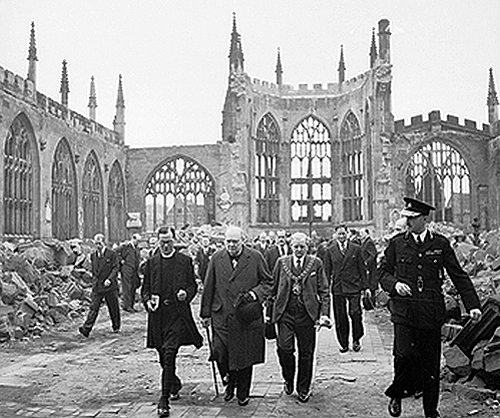
Prime Minister Churchill views the remains of the old Cathedral

The thoughts of the Spectator’s reviewer are worth quoting at some length:

As I stood just inside the glazed ‘west’ wall of Coventry Cathedral, beneath John Hutton’s gaily engraved angels — running, jumping and standing still — I was stunned by the richness of John Piper’s baptistery window, the absolute rightness of the Sutherland tapestry which fills the whole wall behind the altar and the simplicity and serenity of the ‘great barn’ itself — Sir Basil Spence’s own words — in which, from the main entrance, they are the only immediately visible works of art.

It would have been shattering enough simply to see the live version of the building I had admired in models and drawings for several years; it was much more disturbing to hear it. Just by chance, as I approached the cathedral it had been completed — by being filled with music. I cannot remember a more moving experience. With my hand still on one of the tiny bronze door knobs, sculpted as a child’s head by Epstein, I was hit simultaneously by shapes, colours and sounds — the fourteen slender pillars of reinforced concrete which suspend the timber- and-concrete vaulted canopy beneath the roof; the perpetual sunshine that bursts from the centre of deeper colours in the eighty-four-foot-high Piper window, and the familiar hymn tune which reached me — as I reminded myself in an effort to keep emotion in its place — by courtesy of Mr. David Lepine (performing with four manuals and seventy-three speaking stops) aided by acoustic slabs of cork and Weyroc, placed high above the vaulting, and the sound-absorbent surfaces of Sutherland’s Christ in Glory.

I half hoped that by turning my mind towards technical achievements of this kind I would suppress the urge to go away without having the impertinence to write a single word of adverse criticism about the cathedral. So I tore my thoughts away from the simple beauty of the font (a scooped-out boulder from the Holy Land) and Ralph Beyer’s superbly carved lettering on the white stone panels that flank the nave, and tried very hard to see the cathedral as an elegant box of functional tricks. But I had to give in. This is a great and humbling building — a building in which trivial criticisms merely make the critic himself feel trivial. Of course it is a box of functional tricks; but every trick is inspired and designed to help the real user of the building. This is a machine for Worshipping in — a cathedral built round the Communion service.

The ruins of the old Cathedral seamlessly morph into the new building designed by Sir Basil Spence

I like that phrase, “a machine for worshipping in”. I find that it describes very well the utility and efficiency of the building and its contents, as well as the streamlined, modern beauty of the furnishings and commissioned artworks. To my (very) amateur architecture enthusiast mind, Spence’s design epitomises the very best of mid-century architecture. Given the era in which it was commissioned, designed and built, the new cathedral could so easily have been a drab grey brutalist building (not that I object to all of those, but more on that in another blog post), one of many that were being enthusiastically erected up and down the country.

Light streams in through the stained glass of the baptistry window

I will always remember one occasion, one of the first times that I attended evensong at Coventry cathedral. Attendance was particularly light that particular Sunday evening, so one of the Deacons beckoned me from my normal seat in the Nave to sit in the row of seats behind the choir on the raised platform at the front of the church as they sometimes did when there were few attendees. Once I had been guided to my new, front-seat location, however, the Deacon was distracted by some other issue and neglected to tell any of the other arriving congregation members to follow my lead. Soon there was a small gaggle of twenty or so elderly parishioners sitting in their normal places in the Nave, and then me, sitting on the raised section behind the choir, with one of Sir Basil Spence’s soft spotlights gently highlighting my solitude.

And then the organ started to play.

The choir and ministers started to process through to their places from the back of the church, and as they got closer to me, I realised with growing alarm that two of the lead celebrants were walking down the same row that I was sitting on. Was I supposed to move out of their way, or stay there, or acknowledge them or ignore them? I decided to ignore them, and stood there like a lemon while the two men in pointy hats took up position next to me behind the choir. They didn’t seem to be put out at my presence so I figured that maybe I was okay. Not so much.

It wasn’t that anything bad happened; it’s just that in much the same way as you wouldn’t necessarily expect or want to be strapped in next to the pilot for the duration of a commercial flight from London to Paris, neither would you want to be sitting right next to the con-celebrant of a choral evensong service, between him and the congregation, in a large cathedral, when you are not that familiar with the order of service, and haven’t quite mastered the basics of when to stand up and sit down. That’s all I’m saying.

The following week I sat far enough back in the regular seats that the Deacon would not notice me before the service and invite me to “come on down”.

Anyway, enough of rambling anecdotes. I am out of practice at blogging and I’m pretty sure that I need an editor.

But let me close this post by wishing a very happy 50th birthday and a long life ahead to an old friend.

Happy Easter

A very Happy Easter to all of my Christian readers.


My apologies for the lack of recent posts. Normal service will resume shortly.

Thank You

I wanted to write a quick note of thanks to the readers of this blog. Last night, after just over two weeks of daily blogging, I reached my 1000th viewing:

As was to be expected, the majority of these views originate from either the United Kingdom or the United States, with the UK currently holding a very narrow lead. New Zealand, France, Spain and Hong Kong are also quite well represented, as is Colombia (though I believe this to be entirely attributable to the fact that my wonderful sister-in-law is there on holiday at the moment – thanks for reading!!).

My solitary viewer from Iceland, sadly, has not become a regular reader. I hope one day to capture the interest of a second Icelander.

I am, however, personally affronted that nobody from Canada has yet tuned in. Where is the Commonwealth solidarity, I ask you? The great white north comprises a substantial part of the world’s land mass that I have yet to stake a claim on. I will forgive the citizens of China, though, as my blog is probably not visible from behind the great firewall, and would likely be of little interest even if it was.

Anyway.

I would like to thank you all for your clicks and comments. I value the comments, dissents and suggestions in particular; it is affirming to know that I am not speaking into an empty void and I highly prize the opportunity to engage and discuss the issues that I cover here. I hope that my humble blog will continue to be a source of entertainment, information, infuriation or a mixture of all three for a long time to come.

With thanks – Sam.

Truth Or Snobbery?

Steve Silverman today lets rip in The Daily Telegraph on the subject of British classical/crossover singer Katherine Jenkins, in a very amusing and persuasive tirade:

http://blogs.telegraph.co.uk/culture/stevesilverman/100061641/katherine-jenkins-hasnt-got-the-voice-or-the-technique-to-sing-opera-so-why-does-she-pretend-that-she-can/

For those without the time or inclination to click the link, I can assure you that the article’s title – “Katherine Jenkins hasn’t got the voice or the technique to sing opera, so why does she pretend that she can?” is about the kindest line in the whole thing.

Silverman takes objection both to Jenkins’ niche in the market (classical-sounding music rendered with heavy studio effects, and pop ballads sung in Italian to add gravitas) and to what he considers to be her outrageous claims to be be a “classical singer”.

He writes:

“As it happens, I would be surprised if anybody were actually to begrudge Jenkins the fame and wealth she has acquired from her career as a crossover artist. As a performer of middle-of-the-road ballads and pop songs (often translated into Italian for added gravitas) delivered in an innocuous pseudo-classical voice, she is inoffensive and even preferable to many who ply their trade in this section of the market. It is in allowing herself to be promoted as an opera singer that she has earned the scorn of those who care deeply about that particular art form.”

And goes on to say:

“Opera singers are unique among those who have made their careers in the performing arts. They study for many years in pursuit of developing voices that are beautiful, resonant and seamless across a range that can be more than twice that of any other type of singer in Western music. They learn how to use their instruments to convey, in at least four different languages, every possible emotion that a human being can feel. And the miraculous thing is that, without the aid of any electronic amplification, they do all of this over the top of a large orchestra in spaces big enough to hold thousands of people. As if that were not sufficiently remarkable, they also create fully-rounded and widely varying characters during evenings that last for several hours, often while wearing uncomfortable costumes and negotiating their way around awkward sets.”

This latter point is very true. To attend a really good operatic performance is to be amazed at the technical skill of the performers, in their ability to master their voices in such a way that makes people like me (far better suited to belting out semi-in-tune songs during pub karaoke nights) sit and listen in open-mouthed amazement.

Silverman offers an excellent compare-and-contrast of two performances of the same area – “Una voce poca fa”, from The Barber Of Seville – one by Jenkins, and another by Elīna Garanča.

First the Jenkins:


And then the Garanča:


There is no comparison between the two. One (the Jenkins) is a heavily muffled and amplified performance betraying a weak and untrained voice that is totally unequipped for the demands of the piece, and the other (the Garanča) is…well, the polar opposite of that.

Mean as it sounds, Silverman is not wrong when he writes of the Jenkins performance:

“This is a ferociously difficult piece that shows off the technique of a good singer, and shows up that of a bad one. It is immediately obvious which category she falls into, as the demands of the aria elicit from her the response of a deer in the headlights. The rapid runs are beyond her, with notes being either smudged together until they are indistinguishable from one another or omitted entirely; she repeatedly loses her support and vocal placement; and the two terrified screams at the end that pass for high Bs are less at home in the theatre than they would be on a labour ward.”

Ouch.

Which I suppose brings me to the point of this piece: I find myself thoroughly in agreement with the premise of Steve Silverman’s article. And probably like many other classical music fans, I feel a slight sense of shame in admitting it. Why? At least partly because of the “snob” factor that hangs around the neck of the classical music and opera worlds like an albatross. The “you just want to keep classical music the exclusive preserve of you and your Waitrose/Whole Foods-shopping middle class friends and hate the idea that it be dumbed down in any way for the masses to enjoy” argument that is often brought to bear against people who push back at crossover’s claims on legitimacy in the world of classical music.

This argument is wrong. Well, aside from the second part. I shop at Asda, the UK subsidiary of Wal-Mart these days. And I want everyone to be given the opportunity to enjoy classical music (as I wrote in a previous blog post, I became a Patron of the London Symphony Orchestra several years ago to help support this very objective), though of course many people freely choose not to listen to it. But I do hate for classical music to be dumbed down. And while I believe crossover artists such as Jenkins have every right to do their thing, and to become rich and successful in the process, I don’t believe that they deserve to be compared to those musicians who take the time and the effort to truly master their instruments in order to do justice to the music as it was written, and not as it was dumbed-down and cheesily reorchestrated by the writers of such TV reality shows as “Popstar to Operastar”.

I used to receive Classic FM TV as part of my Sky TV subscription. God knows why I ever watched it, but I sometimes would, sitting through endless hours of Jenkins-genre performers belting out well-known arias, often with a synthesised orchestra and a gentle drum rhythm in the background (gotta have a drumbeat these days, what was Verdi thinking forgetting to include a lively drum kit solo in the middle of “Gia nella notte densa”?!) in place of the original orchestration, waiting for the rare occasion when a performance by a “serious, classically trained” musician that I liked would come on. Looking back at it now, I’m glad that someone recently threw a stone at my satellite dish, knocking it out of alignment, so that I can no longer view this channel even if I lost my mind and attempted to do so again.

At this point, a disclaimer is necessary: I am in no way a classical music traditionalist. My favourite classical musician is the late pianist Glenn Gould, who was about as unconventional as they come in terms of many of his interpretations of the major piano repertoire. Glenn Gould was, for a time, the most famous classical pianist in the world, particularly lauded for his recordings of Bach’s keyboard music, which (if you compare them to older recordings) are revolutionary and sound as though someone has flung open the windows to a dark, stuffy room that has been locked shut for years, allowing new light to shine in for the first time in centuries. Many fine Gould performances are easily searchable on YouTube, and I encourage those unfamiliar with him to look. The difference between the Glenn Goulds of the world and the Katherine Jenkinses is that legitimate classical music “superstars” achieve their fame by illuminating the music, combining ‘mere’ technical mastery (which abounds in the graduates of many of the best music conservatoires) with another, hard to define quality, the ability to shed new light on a well-known piece, or to bring a fresh perspective and interpretation to bear on their chosen repertoire. The pretenders cloud the music rather than illuminating it, hiding either the composer’s original intentions, or just the true complexity and beauty of the music.

For this reason, I also happen to believe that to some extent the success of the crossover genre may be actively preventing rather than encouraging people to learn more about classical music, providing the newly curious with a reassuring set of water wings (armbands), enabling them to float comfortably in the shallow children’s pool of pseudo-classical music rather than discovering the riches and intellectual and emotional pleasures that can be found in the olympic-sized pool of the entire classical repertory. I’m not saying shut it down, or that crossover artists are evil – as this blog makes clear, I am a firm believer in the free market. Let’s just call it a significant negative externality.

So my Springer’s Final Thought for this post: Good luck to Katherine Jenkins and those many others in her genre. Jenkins seems to have a huge chip on her shoulder about not being taken seriously, which is a shame. Because she should be taken seriously and afforded all due respect, in the genre in which she operates. It’s just that this genre is not classical music. And when she (and others) try to perpetrate the story that they are in any way equivalent to classically trained musicians, unfairly looked down upon by the elite because of their good looks and material success, they simultaneously misrepresent themselves to the public, and do a great disservice to those countless musicians who are infinitely more talented, many of whom will work in obscurity and poverty for much of their careers, in service to their art.

Married Couple Or Just “Profound Friends”?

I didn’t go to Mass last weekend because I knew that all of the Catholic churches in Britain were going to read to their congregations a pastoral letter from the Bishops, exhorting us to fight against the government’s plans to legalise gay marriage in the UK. I don’t have time for that nonsense, and I don’t much care if this puts me at odds with official church teaching, because in 100 years’ time the church will agree with me. People that accept gay marriage and contraception will be looked back upon as latter-day Copernicuses, and those who frown upon it will be looked upon much like the Antebellum South. That’s just how it is, huff and puff about traditional values all you like.

I’m used to seeing cringeworthingly anti-intellectual arguments against gay marriage from my church, but this latest one from the Most Reverend Vincent Nichols, Archbishop of Westminster, really takes the cake:

http://www.telegraph.co.uk/news/religion/9147559/Gay-couples-are-just-lifelong-friends-says-Catholic-leader.html

Gay couples are, apparently, just lifelong friends who somehow got confused or duped into incorporating a romantic element into said friendship. Says the Bishop:

“I would want to say to them that I understand their desires, that I understand their experience of love is vitally important in their lives, but I would want to say to them that they are called in my view, in the Church’s view, to a very profound friendship in life … I would want them to be respected, but I would want them to have a vision in themselves that what they are called to is not marriage but a very profound and lifelong friendship.”

Good, well that’s sorted then! No need to continue this argument about marriage equality because gay and lesbian people are just good pals who got a bit confused after a few drinks.

Sigh.

The Daily Telegraph has a poll on the subject, which, as is so often the case, misses the point entirely:

It is not for Daily Telegraph readers to decide whether gay marriage in churches should be allowed. That is a matter that does, and should always, remain with the various religions and denominations. No one is suggesting that Vincent Nichols be frog-marched to the altar of Westminster Cathedral and made to bestow the Catholic sacrament of marriage on a gay couple. As long as the official church position is that homosexual unions are a sin, clergymen should and must not be required to violate their churches teaching in such a way.

However, neither does any one religion, church or denomination have the right to impose their particular standards for marriage – or dietary customs or anything else – on the population as a whole. The Catholic church can object to gay marriage and ensure that no such unions are sanctioned within the church, but beyond that it has no authority, spiritual, moral or otherwise, to lecture other people. And any claims to the moral high ground are roundly rebuffed by their tolerance of civil heterosexual unions, and their deafening silence on the topic of extra-marital affairs and the astonishingly high divorce rate.

I’ll leave it to Nick Herbert, the UK government Home Office minister to have the last word in this case:

“I don’t seek to dictate to the Archbishop what happens inside his Church, what standards he sets and what he seeks to do. It would be quite wrong for me or the state to do so. But equally I wonder why he should seek to dictate the institution of civil marriage outside of his Church which is not a matter for the Church.”

Amen.