The EU Referendum, From The Perspective Of A Eurosceptic Christian

Christians for Britain

This EU referendum campaign has been both depressing and insulting for many eurosceptic Christians

Adrian Hilton of the Archbishop Cranmer blog aptly sums up weariness of participating in this EU referendum debate as a eurosceptic Christian:

“I believe in Europe..” is the beginning of every question and the end of every answer when issues relating the European Union are discussed – as if an artificial political construct of 28 states were derivative of or synonymous with ancient notions of Christendom or the contemporary family of European nations of around 50 states. Are the 22 independent European states which are not in the EU any less European for not being so? Are they really all xenophobic, insular and self-regarding?

I have participated in a total of 21 EU Referendum church debates. Some have been a delight, and some quite dire. I’ve spent six hours travelling to speak to an audience of 14 (no expenses offered), and 15 minutes travelling to speak to an audience of several hundred (generous expenses freely given). I drove 200 miles to find myself lauded as a prophet (always dangerous), and 50 miles to be told by the minister that they weren’t expecting me and didn’t need me (I shook the dust off my feet). I saw all the email correspondence relating to that booking, but really couldn’t be bothered to address the incompetence and discourtesy. I wouldn’t expect to be offered expenses in such circumstances, but a glass of water would have been nice. I have formed opinions on the most and least hospitable denominations. The Baptists win hands down. It wouldn’t be very Christian to shame the worst.

Over the past few months, Remain Christians have told me that I’m “peddling myths”; indulging in “crass populism”; “lying” which (I was graciously reminded) “isn’t Christian”; and that my desire for controlled immigration is “really about blacks and Muslims”. In each case, these slurs have come from Christian academics – professors and doctors – one of whom (with his knighthood) was very fond of reminding the audience: “I’m an academic, so I look at the facts” (the inference being… oh, never mind). Most Remain Christians have been kind and attentive to a robust exchange of views, but rather too many talk about Leavers as though we are one step removed from pederasty.

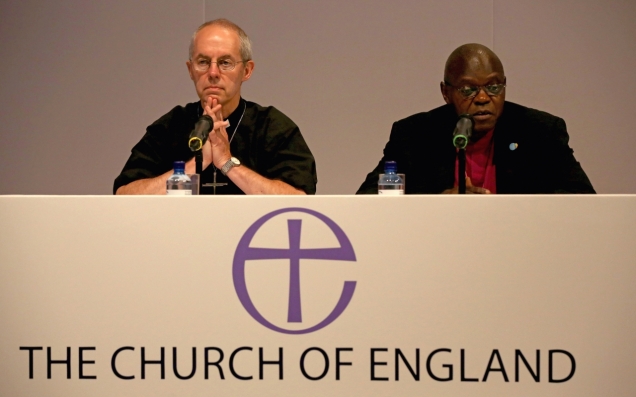
I was fortunate – the priest at my local church exhorted us only to think prayerfully about the question and vote according to our consciences. Eurosceptic Anglicans have had to suffer their first and second in command (Justin Welby and John Sentamu) declaring eagerly for Remain as a “personal decision” while somehow making it crystal clear that you are a Bad, Insular Person of you disagree.

Hilton continues:

The world is changing, and quoting Dicey doesn’t quite cut it. Each incremental piece of legislation or regulation from Brussels does not remotely challenge the sovereignty of the UK parliament because i) that parliament is not sovereign; and ii) those who constitute that parliament have consented to every piece of EU legislation and regulation. What is challenged in some shape or form is the sovereignty of the people. When we cannot vote to change agriculture policy, fishing policy, financial regulation, remove VAT, change welfare (etc., etc.), it doesn’t quite cut it to shout ‘Club rules’. When a British citizen can be arrested here and extradited to languish in a Greek prison for months – no corpus juris; no trial by jury; not even a hearing conducted in his own language – it is the ancient rights and liberties of the freeborn Englishman that are denied. What does that have to do with an economic community?

I have listened to and considered carefully what every Remain Christian has told me over the past few months: principally that we must remain to reform the EU; we must somehow make it better, more responsive and more democratic. But I have not heard any Remain Christian set out how we may achieve that.

You will not hear concrete proposals for reforming the European Union from anybody, Christian or otherwise. “Of course the EU needs reform!” is perhaps the most overused phrase of this entire referendum campaign, impatiently spat out by many a Remainer finding themselves on the ropes while defending the indefensible EU. But there is never a follow-up sentence explaining how the fundamental, deliberate anti-democratic nature and structure of the EU might be feasibly changed, against the wishes of those who like it just as it is.

And as for post-referendum reconciliation:

I have been exasperated by bishops and other clergy who have suggested that my personal motives and political objectives are xenophobic, racist, self-regarding and, in the final analysis, un-Christian. Such judgments wound, but they are not so deep – as they may be in the Conservative Party – that it becomes impossible to conceive of unity being restored. ‘So we, being many, are one body in Christ, and every one members one of another…’ But there are undoubtedly some churches I wouldn’t want to visit again, and doubtless others which would never want to see me again. My, how these Christians love one another…

But love we must, and be reconciled before the sovereignty of the Cross, where partisan posturing pales into utter inconsequence.

Hilton is a better man than I. Personally, I really don’t take kindly to being called uneducated and borderline xenophobic, or labelled as some kind of economically left-behind loser who is afraid of the modern world – all of which the bishops have done. I particularly don’t like it because of all the bishops who have declared for Remain, I can comfortably say that I know more about the European Union than any of them.

And that’s not a boast – if anything, I am aware of how much I have yet to learn, particularly about the global regulatory environment and the emerging global single market which is making the EU obsolete. But at least I have the curiosity and humility to learn more. The pro-Remain bishops, marinating in their smugness and certainty, think that their tired old tropes about “cooperation” and “working together” are the Alpha and the Omega of the debate.

So when we talk about post-referendum reconciliation, I think we need to make clear a distinction between social reconciliation and political reconciliation. Unlike a number of my pro-EU acquaintances, I have never been moved to end a friendship or block/mute people on social media because they hold differing political opinions to me. I have had this done to me, and it is quite wounding when it happens. But at all times I have been happy to courteously debate (or not) with the people I know. It is the duty of those who think otherwise to extend the olive branch, in the unlikely event that they wish to do so.

And as for political reconciliation – no. We have passed a point of no return. The prime minister of this country – a man who calls himself a conservative – as lied, threatened, deceived and bullied the British people in order to coerce a Remain vote. There is no forgiving that, politically. David Cameron must go, and his name should be mud, politically speaking. This blog will not rest until that happens. Likewise with many other conservative politicians who built their careers and reputations on what turned out to be the most superficial and cosmetic forms of euroscepticism. Even now, Michael Fallon is going around telling people that he is a eurosceptic, even as he campaigns for a Remain vote. There can be no tolerating such people in our politics either.

Some new friends and allies have been made along the journey too, particularly those few principled left-wingers who advocate Brexit on democratic grounds rather than fearing “Tory Brexit” because it might lead to a democratically elected British government implementing policies with which they disagree. Others on the Left – particularly Jeremy Corbyn and commentators like Owen Jones – have clearly betrayed their most deeply held principles in order to support Remain, and are deserving only of contempt.

On June 24th, regardless of the referendum outcome, most of us will continue to display common human decency toward one another. It would be a terrible shame if that changed. But there should and will be political consequences for what has transpired over the course of this EU referendum. If, as seems likely, Remain’s project fear wins the day, then they will have committed us to remain in the European Union based on a castle of lies, ignorance and naivety. And there will be a price to pay for that behaviour.


European Union - United Kingdom - Britain - Flags

Agree with this article? Violently disagree? Scroll down to leave a comment.

Follow Semi-Partisan Politics on TwitterFacebook and Medium.

The European Union Does Not Promote The Neighbourliness Preached By Jesus

Bishop Robert Innes - EU Referendum - Remain - Brexit - European Union - Christianity

As yet another bishop declares his support for keeping Britain in the EU, the last gasp strategy of the intellectually and morally defeated Remain campaign starts to become clear

More hand-wringing, wheedling declarations that Britain should sacrifice our own democracy and national interests in order to “save Europe from itself”, over at the Reimagining Europe blog.

Robert Innes, bishop of the Diocese in Europe writes:

At the heart of Jesus’ teaching is an ethic of neighbourliness. ‘Love your neighbour as yourself’, he says. And in the parable of the Good Samaritan he stretches the idea of the neighbour to include even those in close by regions with whom we have traditional rivalries.

Ah, so we are going to be treated to another rendition of that glib assertion that because “friendship” and “co-operation” sound like nice Christian things, it automatically follows that Britain should sacrifice our democracy and dissolve ourselves into the embryonic common European state.

This is based on the blinkered view that co-operation between friendly democracies is only possible when coordinated by a powerful supranational regional government, something which would come as a great surprise to Christians in Africa, Asia and the Americas, whose countries seem to be able to co-operate with one another on environmental, energy, economic, defence and intelligence matters without becoming vassals of a large regional organisation with slobbering aspirations of statehood.

Bishop Innes continues:

Being a good neighbour has costs. We may be expected to come to our neighbour’s aid. Frankly, at the moment Europe needs British help. The whole continent is struggling with migration. Debt and unemployment afflict the southern states. And these are generating populist sentiments which threaten us all. The European Institutions in Brussels have benefited from a good deal of British administrative and political expertise in the past. In order for them to work well and to promote the good of the whole continent, they need that expertise now. We have contributed democratic principles, a sense of humanity, tolerance and practical common sense over many decades. These are loved and valued by our European neighbours.

From where I sit, there is an awful lot riding on the Referendum Vote. It feels, from Brussels, like a vote that could determine not just the future of Britain but the future of the European continent, for decades to come. I have already posted my vote. There’s no secret that it was for ‘Remain’. Not everyone in my diocese will agree with me, and I respect that. But I hope that the remaining days of the campaign will be marked by high quality information and truly informed debate. I hope there will be a massive voting turnout. And, yes, I hope that Britain will stay in the European Union and help our whole continent find its way through difficult times and into a new future.

Having been comprehensively routed in the argument about democracy (though to be fair, the EU apologists, knowing their weak position, barely put up a fight) and seen the polls gradually turn towards Brexit as people tire of the scaremongering and pessimism of the Remain campaign, we seem to be moving into a new phase of the referendum.

It now seems to be the contention of some Remainers that the EU may well do us little or no good whatsoever, but that it is our duty to remain lashed to the mast nonetheless out of blind solidarity with our European allies. We saw Jonathan Freedland advancing just such a case in the Guardian this week, essentially arguing that British democracy is a small and trivial thing, a worthless trinket and a small price to pay to stop the squabbling countries of Europe from going at each others’ throats.

Of course, this is insidious nonsense. The European Union undermines democracy in all of its member states, not just Britain. That’s what it was designed to do – become an increasingly powerful supranational government of Europe by slowly and steadily accumulating more powers and hollowing out the democracy and decision-making competencies of the member states. And we see a growing antipathy toward the EU project across Europe, not just in Britain and not just in the traditionally eurosceptic countries, with France now holding a more unfavourable view of the EU than we do.

In this modern context, stubbornly voting to remain in the European Union in defiance of the damage it is doing to our democracies as well as the social and economic harm being wrought by the EU’s single currency and migration policy is the height of irresponsibility. If you see four friends stumbling drunk out of a bar and walking toward their parked car, you don’t hop in the back seat and go along for the ride, you beg them not to drive and call them a taxi instead. And so it is with the EU – there is no good reason why we should march in lockstep with the rest of the EU in a direction which can only lead to more voter apathy, civil unrest and socio-economic misery – least of all because a very superficial interpretation of Christian teaching suggests that it is the right-on, progressive thing to do.

Interestingly, Robert Innes’ article is currently unavailable at Reimagining Europe – perhaps he encountered hostility to his blinkered europhilia from members of his diocese, or perhaps even he realised the fatuous over-simplicity of his article.

But this is an argument which is coming up again and again, the Hail Mary pass of the Remain campaign – that the EU may well be terrible, but that somehow we owe it to the other member states to stick around until the bitter end. It is a weak argument from a campaign based entirely on weak arguments, and if the Remain camp continue to push this defeatist narrative it suggests that they really are in trouble.


Postscript: More on the Christian case for Brexit herehereherehere and here.


European Union - United Kingdom - Britain - Flags

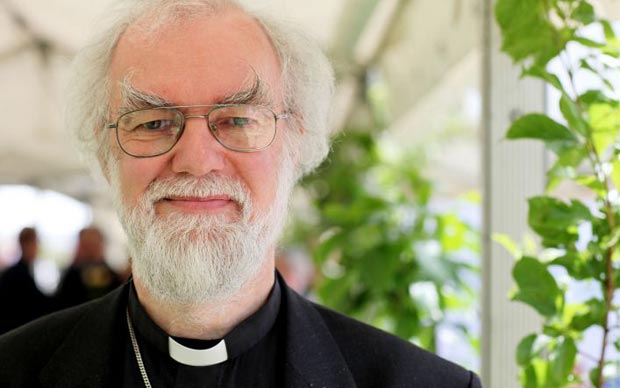
Top Image: Archbishop of Canterbury

Agree with this article? Violently disagree? Scroll down to leave a comment.

Follow Semi-Partisan Politics on TwitterFacebook and Medium.


A Strong, Christian Case For The Nation State (And Against The European Union)

Justin Welby - John Sentamu - Archbishops - Church of England - EU Referendum - European Union - Brexit - Remain

Here is an intellectually robust, theologically rooted argument in support of the nation state and against the European Union. Why are Christian EU apologists unable to produce a similarly heavyweight case of their own, instead of relying on woolly platitudes about ‘togetherness’ and ‘co-operation’?

The Reimagining Europe blog has just published a serious intellectual (and even theological) but highly readable case for the continuance of the nation state, and criticism of those who suggest that the age of supranational government is either logical, inevitable or a goal to which Christians should aspire.

While I do not agree with every single nuance of the argument put forward by Nigel Biggar (Regius Professor of Moral and Pastoral Theology at Christ Church college, Oxford) the overall thrust of his argument is quite unimpeachable. It certainly is rooted in a far deeper reading of scripture and theological analysis than the glib statements of support for the European Union and Remain campaign from Archbishops John Sentamu and Justin Welby.

Biggar begins:

Thirty years ago I was told by a senior Anglican clergyman that the nation-state was passé. I can’t remember why he thought as he did, but I do remember that his conviction was a fashionable one. Quite why it was fashionable isn’t clear to me now. The mid-1980s were too early for globalisation’s transfer of power from national governments to free global markets and transnational corporations to have become evident. Perhaps it was the recent entry of an economically ailing and politically strife-torn Britain into the arms of the European Economic Community that made the nation-state’s days look so numbered. And, of course, the Cold War, which would not thaw until 1989, made international blocs look like a monolithic fact of global political life.

Finally, someone raises the historical context of Britain’s entry into the EEC in their Christian argument about the EU referendum. Good. Nothing can be understood without understanding the history and purpose of the European Union, but also the circumstances which led Britain to join in the first place. For if those circumstances (global obsolescence and lack of a “role”, economic decline, industrial strife, the very real risk of being ejected from what Michael Moore might call the “Premier League” of nations) are no longer present, why on earth would we now wish to stay, given all of the EU’s manifold flaws and failings?

Biggar goes on to discuss differing national attitudes toward being a quasi-autonomous member of a larger supranational grouping:

But there’s another, historically deeper reason. This was graphically impressed upon me during a visit to last year’s exhibition at the British Museum, “Germany: Memories of a Nation”. (I’d strongly recommend the book, by the way.) One of the exhibits was a map of north-western Europe in the mid-18th century, on which were superimposed the coinages current in Germany and Britain at the time. In Britain, there was one coin; in Germany, about sixty. Britain was a unitary state; Germany a territory with a common language, but comprising dozens of different kingdoms and principalities.

And here’s where being both German and Roman Catholic comes into play. For the dozens of mini-states in mid-18th century Germany were the vestiges of the multinational, Catholic, Holy Roman Empire, which the Protestant Reformation had helped to destroy. For Roman Catholics, especially on the European continent, and especially in Germany, the notion of a federation of states, sharing a broadly common culture and subject to a transcendent, quasi-imperial authority seems a perfectly natural condition.

Not so for the English, who have inhabited a nation-state whose basic structures span a thousand years, and whose history has taught them to fear the concentration of continental power. It’s no accident, therefore, that one can find in Anglican thought a marked tendency, from F. D Maurice in the mid-19th century to Oliver O’Donovan now, to affirm the existence of a plurality of independent nations, whose external relations are governed by international law rather than a supranational state.

Quite so. The lived experience of Britons, and our national history, is simply too different to reconcile with that of continental Europe under the umbrella of an overarching set of political institutions. In some areas of Europe, particularly the disputed regions which have changed back forth between countries over centuries (think Alsace-Lorraine), people have a history of maintaining a cohesive identity almost separate to whichever nation happened to claim their territory at the time. There is no similar history in Britain (though one could argue that the experience of the non-England home nations within the UK comes closest).

The upshot is that there is precious little in our folklore, literature, art or indeed politics which well equips us to carry on functioning happily no matter which foreign king makes the key decisions, or from which city they may do so. We are not built for supranational rule – despite ourselves having presided over an empire which did exactly that, we have not been on the receiving end in a thousand years.

Biggar then gets biblical, something which too few of the most prominent Christian apologists for the European Union have been willing to do:

Christians tend to view the nation-state and so the prospect of a European federation differently, according to whether they are Roman Catholic or Protestant, and according to their historical experience. All Christians, however, are accountable to the Bible. What does it have to say about these matters?

On the one hand, the New Testament makes quite clear that a Christian’s affection and loyalty have to go beyond the nation. They have to transcend it. Primarily, they have to attach themselves to God and to His coming Kingdom or rule. This we read in the third chapter of the Epistle to the Philippians, where St Paul, having identified himself strongly with the Jewish nation—“a Hebrew of the Hebrews”—then firmly subordinates his Jewish identity to his loyalty to God in Christ:

“But whatever were gains to me I now consider loss for the sake of Christ. What is more, I consider everything a loss because of the surpassing worth of knowing Christ Jesus my Lord, for whose sake I have lost all things. I consider them rubbish, that I may gain Christ…. [O]ur citizenship”, he tells the Christians at Philippi, “is in heaven” (vv. 7-9, 20).

Taken at face value, it would seem that Paul is saying that Christian identity must obliterate and completely replace national identity. But Paul, I think, is speaking hyperbolically here; he’s exaggerating. In fact, he never entirely repudiated his Jewish identity, but rather sought to understand how his new-found loyalty to God in Christ could actually fulfil his original national loyalty.

Biggar is right to suggest that St Paul’s injunction to completely erase national identity is a rhetorical exaggeration. And it is certainly the case that if British Christians were indeed called to renounce their Britishness, there is absolutely no reason why they should then take up a European identity – if any passing allegiance to country is wrong, then allegiance to a supranational body which is actively trying to become a country in its own right is just as wrong.

As Jesus Himself said, “My kingdom is not of this world” (John 18:36). While we are indeed all brothers and sisters in Christ, it is made very clear to us that our common citizenship is at an embryonic stage in this temporal world, represented by the global Church, and that the nation to which we shall all one day belong is not one of Earth.

Biggar goes on to concede the transitory nature of nation states:

Against such idolatrous nationalism, Christians must refuse the claim that nations have an eternal destiny, and that their survival is an absolute imperative. Nations are in fact contingent, evolving, and transitory phenomena. They come and they go. The United Kingdom did not exist before 1707 (and could have ceased to exist this year, had the Yes campaign won the Scottish independence referendum.) The United States could have ceased to exist in the early 1860s. Czechoslovakia did cease to exist in 1993.

So a Christian cannot be a Romantic nationalist, idolatrously attributing an absolute value to any nation. That’s one part of the truth.

With this important counterpoint:

But there is another part. This is alluded to by St Paul’s continuing identification with the Jewish people. And it’s made explicit in the Old Testament, where the prophet Jeremiah addresses the Jews, who had been carried off into exile in Babylonia, after the sacking of Jerusalem in the year 586BC. This is what he says:

“This is what the Lord Almighty, the God of Israel, says to all those I carried into exile from Jerusalem to Babylon: “Build houses and settle down; plant gardens and eat what they produce. Marry and have sons and daughters; find wives for your sons and give your daughters in marriage, so that they too may have sons and daughters. Increase in number there; do not decrease. Also, seek the welfare of the city to which I have carried you into exile. Pray to the Lord for it, because if it prospers, you too will prosper (vv. 4-7).”

Though they are citizens of another country, though they are currently exiles in Babylon, the people of God should nevertheless “seek the welfare of the city”.

Why is this? The answer lies in our created nature as human beings. We are finite, not infinite; creatures, not gods. We come into being and grow up in a particular time, and if not in one particular place and community, then in a finite number of them. We are normally inducted into particular forms of social life by our family and by other institutions—schools, churches, clubs, workplaces, political parties, public assemblies, laws. These institutions and their customs mediate and embody a certain grasp of the several universal forms of human prosperity or flourishing—that is to say, the several basic human goods—that are given in and with the created nature of human being. It is natural, therefore, that we should feel special affection for, loyalty toward, and gratitude to those communities, customs, and institutions that have benefited us by inducting us into human goods; and, since beneficiaries ought to be grateful to benefactors, it is right that we should.

This is true – we do indeed feel special affection and loyalty toward communities, customs and institutions which give us utility. But we should be wary of where this particular strand of thought may lead us. For as we know, the European Union is particularly adept at “purchasing loyalty” by using funds raised from nation state taxpayers and sent to Brussels as EU membership fees to then bribe national citizens with their own money in the form of development spending or sponsorship of various arts and community projects.

Pete North warns about this very phenomenon with this brilliant observation:

The founding fathers were savvy in their design of le grande project. They always knew it could never be done all at once because the central vision would never secure a mandate. Integration by deception has always been the modus operandi. It salami slices powers little by little, so gradually that few ever notice. And you’d never see it unless you know what the game plan is. They were long term thinkers. They knew it would take a generation or so to advance their agenda and they had a roadmap to do it.

It has always used funding of local projects to manufacture consent. It’s why you’ll find EU logos emblazoned on any nature reserve or community hall or obscure museum out in the shires, to convince the plebs that their benevolent EU guardians cared more for them than the London government. It is why it funds universities too. Every strata of civil society has an injection of EU cash. Education, NGOs, you name it. And it works.

[..] The founding fathers always knew a day would come where the legitimacy of the EU would be questioned. And now you see how well their pernicious scheme worked, with the entirely of the civic establishment coming out in favour of remain. They have made idle supplicants of our institutions, robbing them of their vitality, curiosity and dynamism.

While Biggar is absolutely correct to make his point, defenders of the nation state must be careful that this is not then used as justification by EU apologists for the behaviour and existence of the EU – a kind of retroactive justification for unwanted supranational political union based on the wheedling claim that people like it when Brussels gives them back their own money.

Biggar’s conclusion is a resounding rejection of pessimism about the nation state and the ignorant embrace of the EU by many in leadership positions in the church, based only on the woolliest of Christian thinking (my emphasis in bold):

Of course, institutions at a national level are not the only ones that enable us to flourish as human beings, but they do remain among them; and they are still the most important. This is true, notwithstanding the easy illusion of global identity that today’s social media create. While international institutions such as the United Nations have developed since the Second World War, they haven’t replaced nation-states and don’t seem likely to do so any time soon. Indeed, the UN only has as much power as nation-states choose to give it. So the nation-state is here to stay for the foreseeable future, and it continues to have great power to shape the lives of individual human beings. Insofar as it has shaped our lives for the better, helping us to prosper, we owe it our gratitude and loyalty; insofar as it has mis-shaped our lives (or other people’s) for the worse, we owe it our commitment to reform. Either way, we owe it our attention and our care.

So, in sum, as I see it, the Bible teaches on the one hand that no nation-state deserves absolute loyalty. Every state is subject to the universal laws of God, of which it may fall foul and deserve criticism. On the other hand, Scripture implies that nation-states can, and should, and often do furnish the structures necessary for human flourishing. They cause us to prosper. Therefore, they deserve our loyal, if sometimes critical, care.

[..] In the age of global capitalism, they are less powerful than they used to be. And they have always been bound, more or less, to each other by need, by treaty, and by law. Nevertheless, nation-states remain the fundamental units in the international order, and the day when they will be superseded by a global state is nowhere in sight.

Nation-states are not in fact passé, and the Bible doesn’t tell us that they should be. What’s more, my German Catholic friend really shouldn’t argue for Britain’s remaining in the European Union on the ground that the age of the nation-state is over. Because, of course, a federal EU would be nothing other than a larger state, serving the newly self-conscious nation of Europeans, and able to hold its own against the United States on the one hand, and Russia and China on the other.

There may well be good reasons for Britain to remain in the E.U. But if that is so, the unchristian nature, or the obsolescence, of the nation-state is not one of them.

An intellectually rousing piece with a resoundingly clear conclusion – that the nation state, for all its flaws, has been the underwriter of our most fundamental freedoms and liberties for too long to carelessly cast it aside in the blinkered rush toward supranationalism.

Those with senior leadership positions within the church – I’m thinking here particularly of Archbishops John Sentamu and Justin Welby of the Church of England – are too intelligent not to know the history, purpose and inevitable future trajectory of the EU. Unlike the average man on the street, we need not extend to them the charitable assumption that they are simply ignorant on the matter – after all, our state church is about as deeply embedded in the British establishment as it is possible to be.

Therefore, when the likes of Justin Welby or John Sentamu argue that Britain should vote to remain in the EU in the coming referendum, they do so from a clear base of knowledge that this would mean our continued participation in a project whose ultimate direction has never wavered – the creation of a common European state. This means that they either want Britain to be part of this reckless European endeavour (though they are too dishonest to admit as much, perhaps believing it is their duty to mislead their congregations, who they consider too stupid to appreciate the necessity of political union), or they think that Britain can somehow flourish as a kind of “associate member” on the margins of an ever-tightening political union of the eurozone countries, in which our existing influence would be greatly diminished.

If it is the former, and the Archbishops are closet euro federalists who dare not declare their ultimate goal in public, then this is a truly reprehensible way for them to behave, advocating as they do a wishy-washy, hand-wringing argument for Remain based on economic fears rather than making their true political intentions clear. And if it is the latter, and they have convinced themselves that remaining on the margins of a steadily integrating European Union can do anything but marginalise us and diminish our presence on the world stage then their political judgement is bordering on the catastrophic – and only reinforces the case that the Church of England should be fully disestablished and severed from its anachronistic, unjustifiable constitutional role in the United Kingdom.

But here we have it – a muscular Christian case in support of the nation state, and implicitly against the European Union. Will we ever hear the equivalent pro-EU Christian case articulated so eloquently, or at such length? We have certainly seen nothing to date. In fact, the further up the church hierarchy the Christian EU apologists are found, the weaker and more insubstantial their arguments generally become.

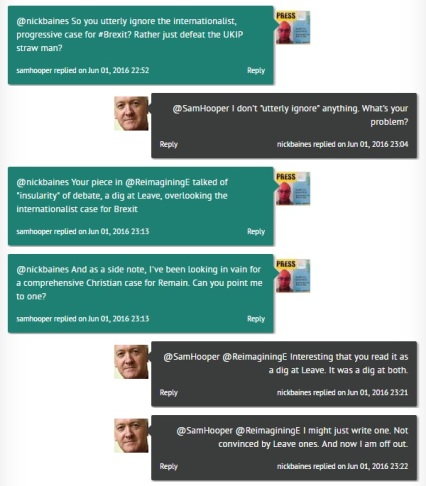
I recently had an exchange on Twitter with Nick Baines, the Anglican Bishop of Leeds, in which I questioned his description of the Leave campaign as “insular” and asked when we might expect a substantive Christian case in favour of the EU:
Bishop Nick Baines - Sam Hooper - EU Referendum - Brexit - Christian case for EU

Bishop Baines promised just such an article, but none has yet been forthcoming. Indeed, a clear, unambiguous and unapologetic Christian case in favour of the European Union and a Remain vote in the EU referendum can scarcely be heard, despite the weight of establishment Christianity coming down on the side of remaining in the EU.

This is untenable. If the bishops are to retain any kind of temporal authority – at least in my eyes – it is not enough to make wishy-washy statements vaguely supportive of the Remain campaign without any intellectual or theological legwork to back them up. This reeks of confirmation bias – of bishops, comfortably ensconced in the establishment, making up their minds that the EU is a good thing in advance, and then cherry picking facts to support their existing viewpoint.

A common Christian complaint is that our religion is being increasingly forced from the public square in this new secular age. And it is partly true – freedom of speech and religious expression are sometimes outrageously curtailed in this country. But participation in the public square comes with a price: if one wants to be heard and taken seriously, one must say sensible things and be prepared to back them up with a solid argument.

At present, too many bishops of the church are willing to sell out the public square and everything else in this country to Brussels, and do so without offering a sound argument for remaining in the European Union based on our knowledge of the nature, purpose and direction of the EU. The bishops believe that a sprinkling of glib words about “togetherness” and “co-operation”, mixed with some hand-wringing concerns about the short term economic impact of Brexit taken straight from the Remain camp’s playbook, amount to a sufficient case. But they do not.

Ideally, the bishops should come down unanimously on the right side of this issue. But since that is not going to happen, they should at least participate in the debate with a shred of honour. And if they arrogantly proceed with their current approach, preaching the Remain argument on the flimsiest of pretexts, then they should not be surprised if they cause the gates to the public square to be permanently locked to Christians.

And what a dismal legacy that will be.


Postscript: More on the Christian case for Brexit hereherehere and here.


European Union - United Kingdom - Britain - Flags

Top Image: New Statesman

Support Semi-Partisan Politics with a one-time or recurring donation:

Agree with this article? Violently disagree? Scroll down to leave a comment.

Follow Semi-Partisan Politics on TwitterFacebook and Medium.

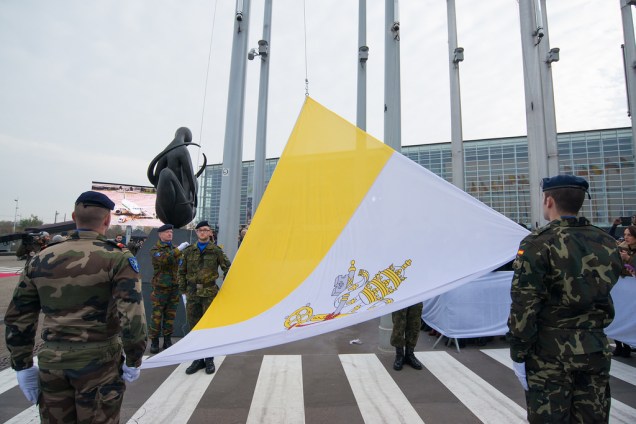
If Supranational Government Is Necessary For Peace And Cooperation, When Will The Vatican State Join The EU?

Vatican Flag - EU European Parliament - Strasbourg - Pope Francis

If you love the EU so much…

Yesterday, this blog took to task the motley crew of Christian bishops and other assorted British faith leaders who signed their names to an insufferably glib and ignorant letter imploring the British people to vote to remain in the European Union in the 23 June referendum.

But the Archbishop Cranmer blog has now gone one better, and published a satirical spoof article reporting that the bishops had actually called for Pope Francis to commit the Vatican State to joining the EU – the joke being that the bishops would never dream of insisting that the Vatican surrender sovereignty to Brussels but are perfectly happy to demand that Britain does the same.

From Archbishop Cranmer:

Religious leaders from the UK’s main faith communities – including former Archbishop of Canterbury Rowan Williams – have joined forces to urge Pope Francis to commit the Vatican State to joining the EU, saying membership is vital to preserving peace, fighting poverty and tackling the migration crisis.

In a letter in the Observer, 37 leading figures from across the faiths say that they hope the Pope will reflect on whether joining the international institutions charged with delivering these goals might contribute to a fairer, cleaner and safer world.

[..]

The letter is obviously not endorsed by any Roman Catholic leaders, but is signed by Anglican archbishops and bishops, Church of Scotland academics, reverend professors, deans, distinguished rabbis and imams, ecumenical coordinators, baronesses and peers, leaders of Sikh and Hindu faith communities, and Global Leader Steve Chalke MBE.

The ‘Stronger In’ campaign have today dispatched comedian Eddie Izzard to tour the Vatican State in an attempt to get the Curia to pray for Pope Francis, that he might incline his ear toward justice, peace and righteousness, and commit the Vatican to immediate EU accession negotiations. “It makes sense,” said Mr Izzard, “to have the Pope of Rome subscribe to the Treaty of Rome.” He added: “We know the overwhelming majority of Roman Catholic leaders and laity support membership of the EU because of the opportunities it presents to work, to study and to travel to Lourdes. I share their positive view of Europe, and I think Pope Francis ought to, too.”

And who can argue with this faultless logic? If we accept the Remainers’ fatuous assertion that Britain must remain in the European Union because only by being subordinate to a supranational government based in Brussels can we work pragmatically with out neighbours to solve problems which transcend national borders, then why should this not apply equally to the Vatican?

In fact, why should it not apply especially to the Vatican, being both an extraordinarily rich state and a hugely influential one, often bypassing other national governments to lay a claim on the hearts, minds and souls of people in countries all over the world? Given the Vatican State’s unique advantages in this regard, surely (according to Remainer logic) it is practically criminal for the Pope to stubbornly hold out, clinging to anachronistic national pride and refusing to be subsumed into the greater European whole.

And yet nobody makes this argument. The Vatican is left to go about its business as a sovereign state unmolested – quite rightly. But the fact that the European Union’s Christian cheerleaders would rather not afford Britain similar freedom is yet more proof of the inconsistency and subjective nature of their case.

As this blog recently remarked:

Britain is and will always remain part of a “bigger whole” whether we remain in the European Union or not. The European Union is a political construct, and a very recent and unproven one at that. It is not interchangeable with the continent of Europe, and it has no democratic legitimacy when it arrogantly claims to speak and act on behalf of the many diverse European peoples. There is a positive case for Brexit based on leaving euro-parochialism behind and engaging more fully in the world, and pro-EU Christians participating in the debate should at least acknowledge this fact rather than arguing against the two-dimensional cartoon Ukipper they hold in their minds.

But this is the very low standard of debate we have sadly come to see from those who claim to represent the Christian perspective. At its core, their argument amounts to little more than “the EU is about friendship and peace and cooperation, and Jesus was in favour of all those things, so what’s not to like?”

[..] Seriously – boil down most of the [Christian pro-EU arguments] and they amount to little more than that. You’ll hear endless variations on the theme that because we are all brothers and sisters in Christ, somehow it naturally follows that we should be united under the same supranational political umbrella – though curiously the Church of England never wastes its time clamouring for Asian countries to merge together, or for Canada, Mexico and the United States to institute a shared parliament.

So, about that rigorous, intellectual, Christian case for the European Union – where is it?

We are still waiting.


European Union - United Kingdom - Britain - Flags

Agree with this article? Violently disagree? Scroll down to leave a comment.

Follow Semi-Partisan Politics on TwitterFacebook and Medium.

Britain’s Religious Leaders Squander Their Moral Authority By Supporting The EU And Forsaking Democracy

Rowan Williams - Brexit - EU Referendum

Another day, another insidious, arrogant attempt by religious leaders to suggest that God is a paid-up member of the Remain campaign

Read this portentous intervention in the EU referendum debate and tell me it isn’t the most fatuous, ignorant, sanctimonious bilge to be uttered by religious community leaders and supposed people of God in recent memory:

Faith is about integration and building bridges, not about isolation and erecting barriers. As leaders and senior figures of faith communities, we urge our co-religionists and others to think about the implications of a Leave vote for the things about which we are most passionate.

The past 70 years have been the longest period of peace in Europe’s history. Institutions that enable us to work together and understand both our differences and what we share in common contribute to our increased security and sense of collective endeavour.

What’s more, so many of the challenges we face today can only be addressed in a European, and indeed a global, context: combating poverty in the developing world, confronting climate change and providing the stability that is essential to tackling the migration crisis.

We hope that when voting on 23 June, people will reflect on whether undermining the international institutions charged with delivering these goals could conceivably contribute to a fairer, cleaner and safer world.

The letter is naturally signed by all of the usual suspects:

Rt Rev Rowan Williams, former archbishop of Canterbury; Rabbi Laura Janner-Klausner, Movement for Reform Judaism; Miqdaad Versi, assistant secretary general, Muslim Council of Britain; Jasvir Singh, chair, City Sikhs Network

Rt Rev Dr Ian Bradley, Church of Scotland & Reader in Church History and Practical Theology, University of St Andrews

Baroness Butler-Sloss, Chair, Commission on Religion and Belief in Public Life

The Rt Rev Professor Lord Harries of Pentregarth, Emeritus Professor of Divinity, Gresham College, Honorary Professor of theology, King’s College London & Former Bishop of Oxford

The Rt Rev Paul Bayes, Bishop of Liverpool

The list goes on. Sadly, from a personal perspective, it includes Bishop Thomas McMahon of the Diocese of Brentwood, who confirmed me into the Catholic church as a young, eighteen year old convert.

But if this ignorant waffle is the best thinking that modern Christianity can bring to bear on the EU referendum debate, then Christianity deserves to be in decline for it has ceased to be any kind of intellectual (let alone moral) force in this country.

If these learned people – many from the higher echelons of the establishment, some of them with theological doctorates to their name  – genuinely can’t discern the difference between leaving one supranational political institution one the one hand and disengaging North Korea-like from the entire world on the other, then they deserve neither our respect nor the media’s airtime. And if they do discern the difference but choose to pretend to their congregations that Brexit means automatic isolationism, then they need to go back and consult their respective holy books to remind themselves what is written about bearing false witness.

Putting political preferences aside for a moment, anybody of faith in this country – Brexiteer or Remainer – should be appalled by this clumsy and ignorant intervention. For if religion is to continue to play a meaningful role in public life (as it should), the representatives of our faith surely have a duty to understand the issues on which they choose to intervene.

One has to earn the right to be listened to and taken seriously in the public square, and the surest way to forfeit that right is to talk loudly from a position of ignorance. And if this letter in the Observer reveals anything, it is a wellspring of ignorance. Ignorance about what the European Union is, why it was created and the direction in which it is plainly, openly heading. Ignorance about the true foundations of peace in Europe – liberal democracy, post-war economic growth and NATO. Ignorance about the future of global trade and regulation. And a profound ignorance (or at least a tendency to conveniently shut out the example) of the rest of the world, which has conspicuously avoided grouping itself into the type of regional supranational political bloc which the bishops bizarrely claim is essential to freedom and prosperity.

Where is the thought here? Where is the serious introspection, the good faith effort to actually listen to the opposing side (the importance of which religious leaders often lecture us) rather than go charging in to battle against a dishonestly constructed straw man? How, in short, is any Brexit-supporting Christian (or follower of any other faith represented in this car crash of an intervention) supposed to respect or feel respected by their spiritual leaders, after no less a figure than a former Archbishop of Canterbury made it quite plain in the pages of the observer that he believes that Brexiteers are literally seeking to undermine peace in Europe for no good reason?

Can the bishops point to a chapter and verse direction in the Bible that nations should seek to merge their political institutions together slowly and by stealth, while claiming that it is somehow necessary in order to underpin free trade? Of course not. Can the bishops highlight a specific injunction from the Lord clarifying that “building bridges” with neighbours means seeking some kind of continent-wide homogeneity? No. Tumbleweeds. The theological case for European political union is nothing more than a wheedling, hand-wringing, simpering assertion that because Jesus commanded us to love one another as He loved us, we should nod our heads and go along with one specific plan for European integration dreamed up by old men scarred from the memory of two world wars.

(In case you protest that a short OpEd in a newspaper is no place to set out complex arguments in full, I refer you to my pieces hereherehere and here, where I extensively discuss the fact that a solid Christian case in favour of the European Union has yet to be made by any religious leader in the course of this sorry EU referendum debate).

Christianity - Europe - EU - Brexit - 3

If the story of religious intervention in the EU referendum thus far teaches us anything, it is that those who claim to lead our faith groups and communities are profoundly ignorant both about the country in which they live, and the world with which they seek to engage.

But worse than that, the bishops are often ignorant about their own flocks and congregations, many of whom have solidly moral and intellectual reasons for wanting Britain to leave the European Union, and who deserve better than to be effectively labelled as harbingers of the apocalypse by virtue-signalling prelates who are either too lazy to learn or too disingenuous to admit that the EU is not the alpha and the omega of democracy, trade and international cooperation.

At some point – maybe not on June 23, but probably in years rather than decades – the European Union will face a true crisis of democracy and legitimacy, as the passions of the narrow-minded European political elites diverge ever further from the interests of the people they lead. Whether this leads to civil unrest, antidemocratic coups d’etat or the breakup of the EU itself remains to be seen. But those bishops and other faith leaders who so airly signed their names to this letter proclaiming that anything other than a vote to Remain in the EU essentially means cheering on climate change, war and pestilence will find themselves dangerously exposed (which is perhaps why they have done so in their own names, but their organisations have held back).

For when the EU’s final crisis of democracy comes, the names of these faith leaders who today encouraged us to remain in the European Union will be mud. And deservedly so, for they have betrayed democracy either through their ignorance or their invidious EUphilia.

And if the bishops think that they and their values are being squeezed out of the public square now, they should wait until they are permanently associated in the public mind with actively working to keep Britain chained inside this failing, antidemocratic, euro-federalist experiment.

When the EU’s day of reckoning finally comes, the signatories to this letter may well yearn for that happy time when the public was merely indifferent about religion.


Christianity - Europe - EU - Brexit

Top Image: Telegraph

Support Semi-Partisan Politics with a one-time or recurring donation:

Agree with this article? Violently disagree? Scroll down to leave a comment.

Follow Semi-Partisan Politics on TwitterFacebook and Medium.