As MPs Debate Making Eid and Diwali Public Holidays, The Wall of Separation Is Under New Threat

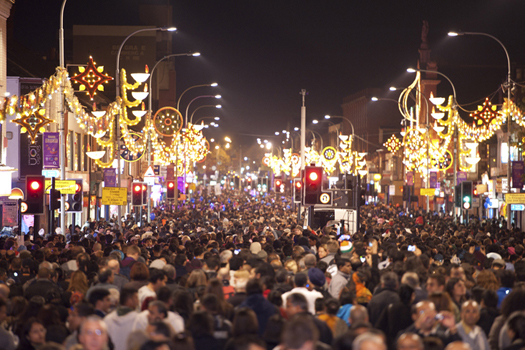
Leicester Diwali celebration


The wall of separation between church and state is under threat once again.

Not officially, of course. We in Britain have no written constitution, no final recourse to turn to in the event of gross government or judicial overreach, or the flagrant violation of our natural rights. But nonetheless, just as progress is being made elsewhere in placing religion in mutually beneficial quarantine from government, the parties of God (a term coined by the late Christopher Hitchens) are launching a counter-attack. And this time the attack comes not from the aggrieved Christian plurality, but the Muslim and Hindu minorities.

The BBC reports:

MPs are set to debate an e-petition aiming to make Eid and Diwali public holidays in the UK.

The e-petition is being championed in Parliament by Conservative MP Bob Blackman, after being signed by more than 120,000 people.

It is only fair that Muslims and Hindus have “the most important days in their faiths recognised in law”, the petition argues.

It should be noted that the government has already rejected the petition. But the fact that a Member of Parliament (and a conservative one at that) is willing to publicly go against the grain and argue for greater, not less government enforced religion in the lives of the people is worrying, and a sign that must be watched carefully.

The reasons for not widening the UK’s current public holidays are many, the first being the fact that shoehorning in another two religious public holidays which are set according to religious timetables rather than the economic rhythm and needs of the nation will only further exacerbate the current skewed system. At present, the UK’s bank holidays are concentrated very unequally in the early part of the year: a brace over the Easter weekend, a volley in May, a last hurrah in August and then the long, slow autumnal death march through the rest of the year until the people are saved by the Christmas holidays. This does little to take into account the needs of businesses (who lose their labour for a day), or for people who might wish the days to be spaced out more evenly.

Secondly, unlike many other countries, none of Britain’s public holidays are used for the beneficial purpose of celebrating our entire nation, our shared culture (as opposed to niche interests – a category under which Christianity increasingly falls) or our collective accomplishments as a British people. Unlike the United States, we have no equivalent to Independence Day, when we can all celebrate being British and indulge in an important exercise in positive patriotism. Unlike France, we have no Bastille Day, celebrating pivotal moments in our national history.

Aside from the fact that recognising pivotal days in our nation’s history helps to nurture the ties that bind us all together, it can be a money-maker too – the American economy may lose a day of labour every year on July 4 and Thanksgiving, but how much is injected into their economy through family gatherings, travel and public celebrations? And how great are the non-monetary benefits of fostering a shared sense of collective identity – one which Britain sometimes sorely lacks?

Thirdly, expanding the public holiday schedule to include more religious days would ignore the simultaneous (and popular) campaign underway to make St. George’s Day a national holiday. The saints days for the home nations are not recognised as UK-wide public holidays, which only fosters internal resentment and fuels the nationalist separatist causes which threaten the balkanisation of Britain.

And finally, written constitution or none, Britain urgently needs to raise a wall of separation between religion and our government, a cause that would be significantly set back by bestowing official government sponsorship on even more faiths. That is not to denigrate the great good that many religious congregations, parishes, charities and organisations do every day. But this social good cannot be used as a bargaining chip to blackmail the rest of the country (an increasingly secular one, for good or ill) into following the same lifestyle practices, moral codes or days of observance as the faithful.

Taken to its logical conclusion, ceteris parabus, this would mean the disestablishment of the Easter and Christmas public holidays. But this would not be a good idea. The Christian holidays, by virtue of having been part of our national fabric for so long, now occupy a place in our culture which transcends their religious origin. Many millions of people celebrate Christmas and Easter who have never set foot in a church, and could not name even the most fundamental tenets of the Christian faith. Furthermore, businesses and organisations around the world – especially in Britain’s main trading partners in North America and Europe – also observe these days as public holidays, making it unwise for Britain to deliberately put itself out of sync. Thus, because the Christian holidays are so embedded in our national life, and are an important reminder to our nation’s history and Christian heritage, there should (and will likely never) be no move to end these holidays.

(This is in no way to suggest that religious festivals and holidays cannot or should not be observed in other ways. The annual Diwali celebration in Leicester, for example, is rightly acclaimed as one of the finest in the world – though such celebrations should at all times be privately funded through sponsorship, and never from public money).

Race, culture and religion often make a volatile, contentious mixture. By granting special rights and favours to some, it can only lead to resentment among the unfavoured, and embolden the beneficiaries to ask for yet further recognition in the future. We already live in an age of religious persecution complexes and exaggerated victimhood – from the mild culture war still fought by the socially conservative Christian rearguard in Britain to the disillusioned British youths jetting off to fight for their so-called faith in Syria – and the very last thing we should be doing is anything that fans the fames of discord at home.

The UK’s Hindus and Muslims (and Christians, and everyone else) are all equally British under the law, and have an equal, important stake in our society, to the extent that they are willing to be British first and foremost. Only recently in the Birmingham schools scandal we have seen the damage that can be done to education and to young minds when religion is placed on a pedestal and sycophantic multiculturalist apologists are too petrified of causing offence to stand up for British values against religious extremism.

Rather than debating the admission of two more exclusionary, religion-oriented public holidays to the British calendar, Parliament should be debating a root and branch review of all our existing holidays as part of a broader effort to make our days off count for something more than a chance for a long weekend and an excuse to jet off out of the country.

What if together we celebrated the Acts of Union which created Great Britain? Or Nelson’s victory at Trafalgar in the Napoleonic wars? Victory in Europe day? Or any one of many other days that could plausibly be used to draw us together as people of a United Kingdom rather than a fractured coalition of different faiths, interests, grudges and resentments?

For the sake of our fraying national unity, admitting more faiths into the elite club of state sponsorship and approval must be rejected as the misconceived idea that it is.

Clarence Darrow vs The Rotten Soul Of Today’s Labour Movement

Kevin Spacey Clarence Darrow 2


What would the famous labour lawyer and anti-death penalty advocate Clarence Darrow say to the late RMT union leader Bob Crow if the two men were to meet in Heaven?

The mental image of their fictional meeting would not leave my mind after I watched Kevin Spacey’s remarkable portrayal of the former unfold in the eponymous one-man play Clarence Darrow at London’s Old Vic Theatre on Friday.

The production – which is well reviewed here, here and here, and in which an elderly Darrow looks back on the many victories and tribulations of his long legal career – gave considerable attention to Darrow’s union activism through his defence of the American Railway Union leader Eugene Debs in the 1894 Pullman Strike, and of the McNamara brothers charged with dynamiting the Los Angeles Times building in 1910, among other famous episodes.

But watching Kevin Spacey portray Clarence Darrow is to see an impassioned and eloquent defence of the rights and dignity of working people that today’s current and recently departed left wing political and union leaders could never hope to equal.

Witnessing the spirit and passion of Clarence Darrow flicker to life on a London stage made it starkly apparent just how close the modern labour movement is to purposelessness and death in the Age of Miliband.

While Darrow in full rhetorical flight could have convinced Ronald Reagan or Margaret Thatcher themselves of the need to concern themselves with the welfare and aspirations of the mother and father working minimum wage jobs on zero hour contracts, today’s left-wing figureheads come across as whiny, self-entitled and spitefully partisan by comparison.

Here are the stirring words of Clarence Darrow in an address to the inmates of Cook County Jail in 1902, the theme of which would be taken up by Ed Miliband and the Labour party in a bold reassertion of conviction politics were today’s labour movement not so politically calculating and intellectually inert:

To take all the coal in the United States and raise the price two dollars or three dollars when there is no need of it, and thus kills thousands of babies and send thousands of people to the poorhouse and tens of thousands to jail, as is done every year in the United States — this is a greater crime than all the people in our jails ever committed, but the law does not punish it. Why? Because the fellows who control the earth make the laws. If you and I had the making of the laws, the first thing we would do would be to punish the fellow who gets control of the earth. Nature put this coal in the ground for me as well as for them and nature made the prairies up here to raise wheat for me as well as for them, and then the great railroad companies came along and fenced it up.

How relevant to today, given the present Labour Party’s focus on the “cost of living crisis” and its apparent determination to freeze consumer energy bills.

But here instead is Ed Miliband warning us of the supposedly mortal threat to the unions posed by David Cameron’s Conservative-led coalition government, in a typically unmemorable speech to the 2013 TUC conference:

We have a Prime Minister who writes you and your members off. Who doesn’t just write you off, but oozes contempt for you from every pore. What does he say about you? He says the trade union movement is a “threat to our economy”. Back to the enemy within.

Six and a half million people in Britain. Who teach our children. Who look after the sick. Who care for the elderly. Who build our homes. Who keep our shops open morning, noon and night. They’re not the enemy within. They’re the people who make Britain what it is.

How dare he? How dare he insult people – members of trade unions – as he does?

Terrible speechwriting aside, Miliband’s suggestion that David Cameron spends his every waking hour plotting against the trade union movement like a modern-day Iago is patently absurd. While the Conservative Party – as one would expect – raises objections to various union policies and rhetoric and their self-interested leadership, you will search in vain to find any evidence of the prime minister “oozing contempt”.

Ed Miliband (in his halting, aggrieved and ineffectual way) and others try hard to continue the life-and-death struggle narrative laid out by Darrow a century earlier, but the fact that their comments are aimed at a modern British audience – even the poorest of whom likely own smartphones, personal computers and enjoy access to universal healthcare via the NHS – renders them ridiculous.

Where Darrow wore his heart on his sleeve and walked the walk of labour advocacy – foregoing a more lucrative career in order to oppose his old railroad bosses who were oppressing their workers – today’s leaders such as Miliband and his union counterparts often hail from the same metropolitan middle and upper-middle classes who form the middle management and ranks of senior civil servants for whom so many working Brits toil. And what’s more, Labour politicians and the management class now talk and sound alike.

Whereas Clarence Darrow stood firmly for worker’s rights without lapsing into sentimental and unworkable socialism, the response of the likes of Ed Miliband, Len McCluskey and Mark Serwotka to our present pale shadow of real austerity has been snarling and misleading hyperbole about the Conservatives “hating” the poor and taking an obscene delight in their suffering.

(It is conveniently forgotten by these anti-Tory crusaders that the suffering was largely created by a gradual bipartisan expansion of the state, and by making so many British people dependent on the government for one thing or another that any retrenchment of spending now has a widespread, painful effect that would not be the case if the government didn’t try to do so much.)

The victories won by organised labour in Clarence Darrow’s day saved lives and liberated millions of people from what William Beveridge would later describe as the five “Giant Evils” in society: want, disease, ignorance, squalor and idleness. And they are immortalised in rights and traditions which endure to this day, such as the annual May Day march and rally in London, and the Labor Day federal holiday in America.

The victories won by the left wing establishment of today (and the debauched, rudderless trades union to whom they are captive) are comparatively petty and trivial, and each passing ‘victory’ incrementally serves either to perpetuate inefficient public sector service delivery or entrench benefits for union members at the expense of the ranks of the budding entrepreneur class, the self employed, the underemployed and the jobless.

The union men of Darrow’s America (and their British counterparts) would be horrified to witness the tanned, bloated, self-satisfied swagger of men like Bob Crow, who delighted in tormenting other ordinary working people with their undemocratic strikes in order to preserve the gold-plated salary and benefits of, say, a tube driver on the London Underground who gets paid well over twice as much as a newly trained Private fighting for his or her country in the British Army.

So how would Clarence Darrow feel upon meeting the likes of Bob Crow?

One can only imagine, but in fairness, it is not unreasonable to think Darrow would first feel immense satisfaction and relief that the causes for which he fought have come to fruition and done so much good, not just in the United States but throughout the Western world.

His heart might swell to know that not only have child labour and the exploitative company towns of his day been cast into history, but that the strength of public sentiment stands firmly against multinational companies who try to take undue advantage of lower standards and regulations in other parts of the world – although there is undeniably still much work to be done.

But a man of such conviction as Clarence Darrow would also likely recoil at the nanny-state socialism, self-entitled smugness and the bitter, envious rhetoric of people like Bob Crow and today’s labour movement leaders, who have casually sauntered in his hard-fought footsteps across what is now much easier political terrain.

And a final bold prediction: A century from now, in the year 2114 – no matter how much the current generation of labour leaders try to portray themselves as intrepid generals locked in an ongoing epic battle for the rights of the downtrodden and the dignity of man – nobody will spend hours queueing for return tickets to a play honouring the life’s work of the likes Ed Miliband, Bob Crow or others of their calibre.

Truly great women and men like Clarence Darrow fought and won ninety percent of the battle before today’s privileged, metropolitan, self-appointed guardians of the common man ever picked up a protest placard or stumbled into their first Labour Students Society meeting.


Clarence Darrow finishes its run at The Old Vic Theatre tonight. Kevin Spacey also portrayed Clarence Darrow in a PBS biopic movie of the same name, the climactic speech of which is shown above.


If you enjoyed reading this article, please take a second to LIKE or SHARE it on social media using the buttons below. Help to spread the word and continue the debate.

How Can We Teach British Values In School If We Are Afraid To Assert Them Ourselves?

British Values Twitter 3

Just what are British Values?

Well, apparently the concept is sufficiently fuzzy in the minds of some people that we all now need to take time to argue amongst ourselves and reach a common consensus while one of the biggest and most worrying educational scandals in recent years plays out unobserved.

In response to the ongoing scandal of Birmingham schools being compromised by activist governors to deliver covert Islamic religious teaching, the Education Secretary, Michael Gove, made the slightly awkward if well-meant assertion that in future, all primary and secondary schools will be required to “promote British values”.

The Guardian reports:

Michael Gove, the education secretary, has seized on a finding byOfsted that a “culture of fear and intimidation” existed in someBirmingham schools by announcing that the government will require all 20,000 primary and secondary schools to “promote British values”.

These values will include the primacy of British civil and criminal law, religious tolerance and opposition to gender segregation. Gove also suggested girls wearing the burqa would struggle to find their voice and must not feel silenced in the classroom.

In what is being described by ministers as a decisive shift away from moral relativism in the classroom, the education secretary took action after a landmark series of reports by the schools inspectorate into 21 Birmingham secular schools found an atmosphere of intimidation, a narrow, faith-based ideology, manipulation of staff appointments and inappropriate use of school funds.

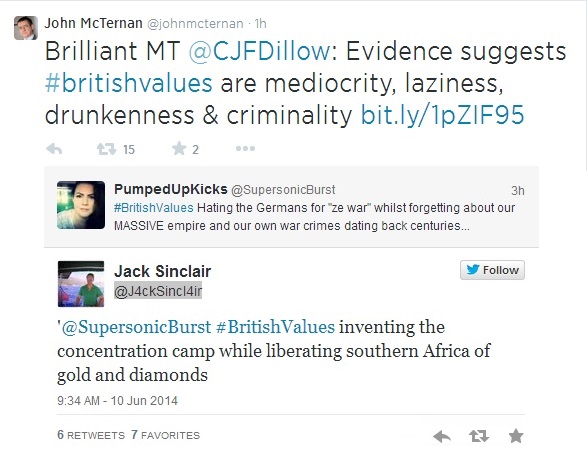
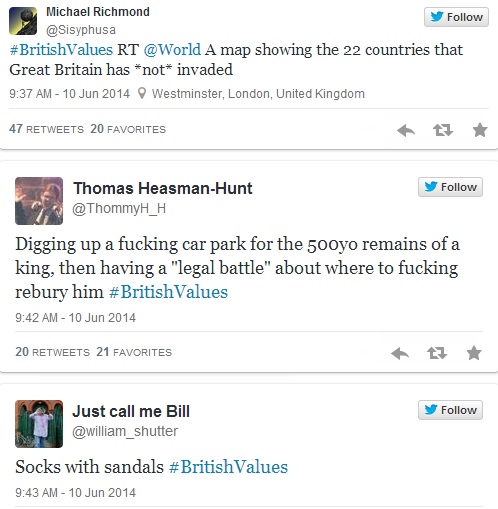
Unfortunately, the predominant response thus far has not been one of outrage that such a thing could happen to compromise children’s education in the UK’s second city; instead, we have seen race to come up with the funniest self-deprecating anti-British putdown as expressed by the #BritishValues hashtag now trending on Twitter.

When presented with the opportunity to express outrage that local school curricula could be so easily hijacked by fundamentalist members of any faith and ‘turned’ to start promoting beliefs very far from the British values of democracy, equality, non-discrimination and obedience to the law, a majority seem more interested in having an introspective discussion about what modern British values really are (at best), or suggesting through Twitter witticisms that any concern is tantamount to xenophobic intolerance  (more common).

The Huffington Post has collated a selection of what it considers to be “the best” responses, which take an almost uniformly dim view of British culture and history:

British Values Twitter 4

(It should be acknowledged that there have also been some very sensible and thoughtful contributions from others, such as the pianist Stephen Hough).

The hashtag activist comedians and earnest scolds of Twitter currently attempting to look cool by running Britain down on social media are actually revealing a few ingrained British traits of their own – excessive self deprecation and an almost craven desire not to offend or appear controversial – which easily become insidious and harmful when taken to extremes.

There is a gnawing anxiety behind some of the mocking #BritishValues tweets. “Isn’t patriotism so old fashioned?”, they scream. “Let’s list all the bad things that Britain has done so that no-one thinks we’re being boastful”. It may come across as cool, trendy liberalism but look closer and you see that some of it is actually rooted in fear.

Somewhere along the way the idea of expressing pride in Britain, and in British exceptionalism, became interchangeable in the minds of many people with that altogether darker and more insidious disease of racism. To express the former is, in the eyes of many, to come uncomfortably close to embracing the latter. And as a result, people instinctively turn away from patriotism, and instinctively oppose suggestions such as teaching British values at school, mistaking it for something else (and, incidentally, leaving a vacuum that the far right is only too happy to exploit).

And yet there is a serious issue at stake here, with the integrity of children’s education in question. Even the Guardian’s John Harris felt the need to weigh in to the ongoing argument about the fundamentalist Muslim influence in Birmingham schools, reminding his readers that state-subsidised religious indoctrination or interference with the curriculum is wrong whatever the source, and that this is no time for those on the left to bury their heads in the sand:

At the risk of reopening old wounds on the liberal left, for all the noise from those on the right of culture and politics, it is no good crying “witch hunt” and averting your eyes from this stuff. It should have no place in any state school, and most of it is an offence to any halfway liberal principles.

But Harris still felt the need to couch his tortured article in the wider context of a state education system which is failing and falling into disarray under the hated Tory government – the harsh unexpectedness of his gentle reminder that it’s not okay to look the other way and pretend to ignore the fundamentalist corrupting of education for fear of seeming racist or intolerant having to be soothed with a good old swipe at the real enemy, those on the political right.

Efforts to stamp out casual and institutional racism in Britain, while incomplete, have come a long way, even since the 1980s and 1990s. A large part of eradicating the scourge of casual racism has been (quite rightly) to mock it, deride racist thoughts and speech as backward and out of place, and doing everything possible to make racism distinctly uncool. The campaign to eradicate racism from football is a prime example of how successful Britain has been, especially when compared with continental and eastern Europe.

But while there is unquestionably still much work to be done, we must also begin to ask ourselves if one of the side effects has been a growing inability for people to express deeply felt but harmless national pride and patriotism in any but the safest, media-approved settings (such as the 2012 London Olympic Games).

If our generation’s instinctive response when they see criticism levelled at a person or group within a religious or ethnic minority is not to check the veracity and demand action if it is found to be true, but either to flinch and avert their eyes out of shock and unwillingness to believe or to become so embarrassed that their only coping mechanism is to resort to self-deprecating humour on social media, perhaps this is the price that our country has to pay in order to purge itself of the ingrained, widespread, casual racism that was common and socially acceptable for so long. Perhaps.

But being this way makes it much harder for us to deal with the problems facing Britain today, where the pernicious influence of fundamentalists (of all religions) on the young and the lack of assimilation of some cultures into wider British society are real issues that are being only half-heartedly tackled because of the paralysing fear of saying the ‘wrong thing’ or giving the wrong impression.

When asked why it was that Americans are so much more openly patriotic than Brits, the late Christopher Hitchens attributed it to the fact that overt displays of patriotism and love of country in the United States are borne out of the fact that as a nation of immigrants, Americans have no real shared history going back more than a couple of centuries. Therefore, simple acts such as reciting the pledge of allegiance every morning in schools and singing the national anthem before sporting events have, over time, helped to forge that unity within diversity.

But what has always been true of America is now increasingly becoming true of Britain. Immigration into Britain may bring profound economic and cultural benefits, but with each successive year of high net immigration and a lack of assimilation in some quarters, that degree of shared common history is diluted a bit more. And that’s absolutely fine, if other measures are in place to balance it out – like reciting a pledge, offering comprehensive British history as a mandatory subject at schools, or, shock horror, teaching children “British values”.

At the moment, though, these countermeasures are lacking. It should come as little surprise then that certain groups within society do not feel as much desire or pressure to integrate as they rightly should, and that when the door is left wide open in places like Birmingham to influence schools to teach children according to certain subcultural norms, some people will seize the opportunity with both hands.

Unfortunately, in the age of hashtag #Britain, not only does it surprise us when this happens, the thought of condemning or intervening in these events embarrasses us so acutely that we are barely able to have a national conversation without descending to xenophobic conspiracy theorising on one side or accusations of scaremongering on the other, topped off with a sprinkling of nervously self-deprecating Twitter jokes.

As John Harris noted in his article, by this point “inflammatory language and alarmism” have now done their work and made it harder to get to the bottom of what has really been going on in Birmingham’s schools. But there is an equally powerful countervailing force working in the other direction, suggesting that any concern is an unwarranted attack on a minority and misrepresenting any calls for the assertion and teaching of British values as xenophobic, Islamophobic and a direct attack on the principle of multiculturalism. It is not.

If we carry on in this way, we will never succeed in building and maintaining the unified, diverse and tolerant Britain that we all say we want.


If you enjoyed reading this article, please take a second to LIKE or SHARE it on social media using the buttons below. Help to spread the word and continue the debate.

The British Immigration Debate: From The Inside Looking Out

SPS UK Immigration Life In The UK Test 4


Most British people will go through life not knowing what it takes for a foreigner to become a citizen of the UK. Why would we? By accident of birth most of us had the immense good fortune to grow up in one of the greatest, most wealthy, powerful and free countries on Earth, never giving our 0.89% against-the-odds luck a second thought. We have no experience of uprooting our lives and moving to these isles from somewhere else, or of the financial and bureaucratic hurdles that must be overcome in order to settle here and acquire a British passport.

Our lack of empathy – together with widespread ignorance of the various types of immigration and the differing rules and laws governing them – makes it very hard to have a rigorous, fact-based discussion of past and present British immigration policy. Throw in the careerist short-term focus of our politicians and a sane debate becomes next to impossible, as we have seen over and over again, most recently in the 2014 European elections.

Witnessing the British immigration system close-up when you are already a UK citizen, safe and secure in your legal status, offers a dispassionate but revealing glimpse of what it is actually like to go through the arduous and often stressful process of settling permanently in Britain. If only our political leaders and opinion-setters in the media would disengage from the battle of the 24 hour news cycle for one day and take the time to see for themselves, they might have a small epiphany and (for those with genuinely open minds) become willing to think and talk about immigration in a different way, giving us the debate we need rather than the one we have.

You don’t have to travel far for this reality check because the heart of Britain’s current immigration problem is best expressed not at passport control at Heathrow airport, the migrant camps in Calais  or the Polish grocery store on the high street, but in the accredited test centres up and down the country that administer the “Life In The UK” test to people seeking permanent residency or citizenship of the UK.

To be clear, the problem is not the “Life In The UK” test itself – though one could certainly quibble with the curious selection of factoids and trivialities that the Home Office proclaims to represent a sound working knowledge of modern Britain, or speculate endlessly about the percentage of immigrants who exercise their right to take the test in Welsh or Scottish Gaelic (at unknown cost to the taxpayer).

The problem is that the “Life In The UK” test takers are in the midst of a long, demanding and expensive process to settle permanently in Britain, one which an equal number of immigrants – by virtue of being EU citizens – are free to bypass altogether. This disparity of treatment, a function of Britain’s membership of the European Union, inadvertently reveals almost everything that is wrong with the current British immigration debate.

Observing the waiting room in of one of these anonymous-looking test centres as an existing, documented British citizen is a revelatory and slightly humbling experience, because here you are surrounded by people who fiercely covet something that you already have. As you enter, you are quite likely to pass by people leaving in tears because they have failed the test and have to take it (and pay the fee) again.

The prevailing mood is one of fear – the candidates sit in tense silence, often with heads bowed over test prep books, going over a few final practice questions before showtime. Did the Roman occupation of Britain last for 150 years or 400 years? Who fought in two wars against Napoleon – Horatio Nelson or Winston Churchill? And is driving your car as much as possible one of the two things you can do to look after the environment?

Softball questions aside, the bar to settle here when you come from outside the EU is set very high. To seek permanent residency or citizenship is to make a significant investment of time, energy and money towards an application which may not even be successful (and for which there is no refund in the event of rejection).

It involves divulging every conceivable detail about your life and proving to immigration officials beyond reasonable doubt that you are capable of sustaining yourself economically without becoming a burden on the state. And to top it off, your biometric information is taken and added to a database for identity verification whenever you enter or leave the country, and for any other purpose that the government may concoct in future.

SPS UK Immigration Life In The UK Test 2
A and B might be more fun.


The process by which someone from the European Union settles in the United Kingdom is rather simpler. The single market ensures that citizens of any EU member state  can move to the UK to work and live indefinitely as they please, bypassing all of the steps and hurdles facing a Sri Lankan, American, Turkish or Chinese immigrant. The minimum logistical requirements consist of packing a bag and turning up.

This is great for those of us who want (and are able) to live an itinerant life or pursue a multinational European career – the benefits of the single market cannot then be overstated. But for every British person who sees only opportunity in the EU’s free movement of people, there is another working for the minimum wage who will never be offered a secondment to the Brussels office by their company, and who must console themselves with the second-order benefits of free movement – such as “delighting in the capital’s kaleidoscopic culture” or being served their “early morning coffee” by someone from Spain.

The single market in its current and unamended form may yet be in Britain’s best interest, and the free movement of people may be a net positive thing – but the British people have not had a say in the matter since the 1975 European Community referendum, and it’s quite clear that they want to have a debate about it now.

Sometimes that desire is expressed forcefully and unpleasantly – any talk from politicians and their supporters about “hordes of Romanians” or slurs about eastern European workers is rude, disrespectful and unbecoming – but it is categorically not racist. Those who disagree need to check their dictionary and contemporary history books to reacquaint themselves with the true meaning of the word.

(It should – but does not – go without saying that just because the immigration sceptics have their fair share of racists within the ranks, this does not imply or prove that all anti-immigrant positions are necessarily racist. All racists are against immigration by definition, but not all people – or even most people – with concerns about immigration are racist).

Our British democracy is neither perfect or universal. That’s how it comes to pass that people have voted in every general and European election since the 1975 referendum but still ended up in 2014 with an immigration policy widely considered unsatisfactory. We have been guided to this bad place by generations of politicians who were too cowardly to start a difficult conversation on the subject during their own tenures, happy to leave the issue on the back-burner until it is now finally starting to boil over in the age of Cameron, Clegg, Miliband and Farage.

A real leader would seize the opportunity to give the British people the debate that they want, and which has been wrongly suppressed for too long by a political consensus that cried “racism!” at the first mention of immigration. A real leader would step up and proclaim the many benefits that immigration confers on Britain, while acknowledging its wildly varying impact on different sections of society, and discussing ways to mitigate the negative aspects. A real leader – and for all he has done to start the debate, Nigel Farage has failed here – would do all of this without resorting to scapegoating or undue exploitation of people’s fears.

In short, none of Britain’s party chiefs can at present be described as a responsible leader on one of the most important political issues of the day for many people. As it stands, our country loses no matter who wins in 2015.

If Labour (who have been almost entirely captured by their metropolitan professional class at the expense of their former party base) win the general election, nothing will change and the increasingly poisonous status quo will continue. A majority within this rootless Labour Party still see any questioning of immigration as morally equivalent to owning a signed first edition of Mein Kampf, and Ed Miliband has apparently decided that refusing to acknowledge UKIP’s victories and the public sentiment behind them will somehow be interpreted as a sign of his strength and resoluteness.

If the Conservatives win, they will likely fail in their attempts to extract meaningful concessions for Britain on inter-union movement of people from the EU or changing the eligibility for immigrant access to public services and the welfare state (getting unanimous support from the other 27 member states being a dim prospect). The only way the Tories will then be able to save face is to increase the already onerous barriers and impediments to those seeking to come to the UK from outside the European Union, many of whose talents and skills we urgently need – and the last thing we should be doing is further discouraging them from coming here.

If the Liberal Democrats avoid complete electoral annihilation in 2015, their best hope is to join another coalition government, in which case their natural instincts could only lead them to solidify Ed Miliband’s “full steam ahead” policy on Europe in the event of a Labour-led government or act as a minor brake on any destructive moves to crack down further on non-EU immigration in the event of another Conservative-led coalition.

And if UKIP were to perform well and capture a significant number of seats at Westminster without toning down their overly strident rhetoric or adding any kind of nuance or acknowledgement of geopolitical reality to their own policies, the other parties would likely be so unwilling to deal with them that their MPs would simply be frozen out of the process altogether.

SPS UK Immigration Visas

For all this ambivalence, Britain is a diverse and mostly tolerant land, and immigrants have played a huge part in our history and heritage. In today’s modern economy we need to be able to compete for the brightest and best of all the world’s talent, making it attractive for people to study at British universities, work for British firms and settle here with their families.

Somewhere between the onerous and expensive application process for non-EU immigrants combined with quotas and limited access to public services on one hand, and the EU single market’s wide open borders on the other, lies the best answer to Britain’s immigration conundrum. Unfortunately, Britain is not able to choose the perfect point along this spectrum because  the EU mandates an all-or-nothing approach. You are either part of the European Union and a full member of the single market, or you are on the outside.

The free-movement aspect of the single market makes perfect sense in the context of the ‘ever-closer union’ that the EU’s founders envisaged would one day become a single political European superstate – indeed, such a goal cannot be realised without total, unimpeded free movement of people. But if the goal is anything less than total political union (and a vanishingly small proportion of Brits  or other Europeans want to be subsumed into such an entity) then there is no real reason for the absolutist status quo, in which any controls on people coming from the EU to live and work in Britain are prohibited.

Unlike the United States of America – a real political, cultural and economic union – in Europe there are naturally occurring impediments to the free movement of people anyway, due to differences in language, culture, currency (not all of the EU is within the Eurozone) and other factors. Imposing modest, light-touch limitations in response to the wishes of the people need not bring the European Union crashing down or mean the imposition of ‘fortress Britain’.

The free movement of people within the EU may or may not remain the correct policy for Britain once all is said and done. But those who trumpet only the benefits and view any discussion of the cost as tantamount to xenophobia are guilty of shutting down an important debate whose time has come.

In this age of austerity, the main political fault line is over how much the rich should contribute versus the poor at a time of cuts to government services. Some of those who speak out most eloquently and forcefully on behalf of the poor are the same relatively wealthy middle class people who also unquestioningly support unlimited immigration.

These left-wing champions of the downtrodden would be aghast at the suggestion that their noble and high-minded political beliefs are in any way hurting the working classes for whom they presume to speak, but in supporting unlimited EU immigration and seeking to shut down any debate on the matter with accusations of racism and ignorance, they are doing just that – preserving benefits for themselves at the expense of the less privileged.

And if you personally benefit from immigration because it keeps your gentrified city neighbourhood more interesting and makes it affordable to get your house cleaned twice a week, but you don’t care about the effect – real or perceived – on those who are never likely to enjoy these benefits, how are you any better than the hated ‘bankers’ who protest higher taxes because (according to the received wisdom) they are good for society but bad for them?

The current immigration debate sees the British metropolitan left doing what it does best – high mindedly pontificating on what’s best for the country and for the less well-off in particular, and then being horrified when those same people actually express ideas and opinions of their own rather than following the script carefully prepared for them.

Immigrants studying for the “Life in the United Kingdom” exam often use the official Home Office approved test preparation book, which contains 408 practice questions to rehearse before subjecting themselves to the real thing. As a result, some newly-arrived immigrants find themselves better versed in fundamental aspects of British life than those of us who have lived here our whole lives.

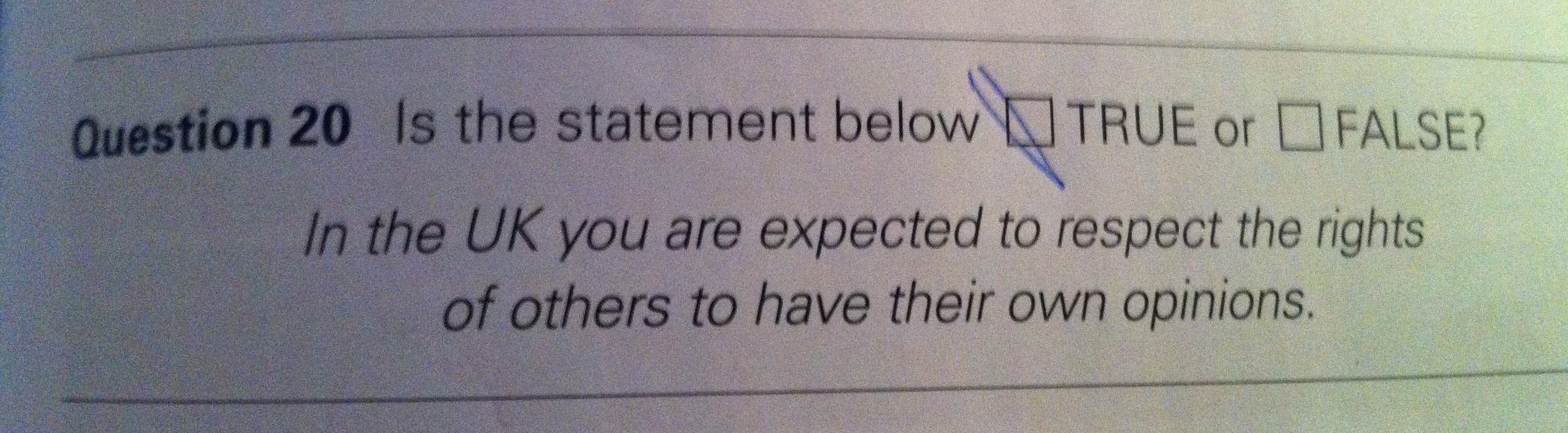
Those politicians, journalists and activists who still seek to police the immigration debate and preordain its outcome could do worse than studying up on this one, known to every new British citizen:

Is the statement below TRUE or FALSE?

In the UK you are expected to respect the rights of others to have their own opinions.

SPS UK Immigration Life In The UK Test 3


If you enjoyed reading this article, please take a second to LIKE or SHARE it on social media using the buttons below. Help to spread the word and continue the debate.

Biased Or Not, The BBC’s Political Coverage Is Shockingly Bad

BBC Daily Politics Political Journalism SPS


The BBC – our national treasure or money and creativity-sapping black hole (depending on your viewpoint) has been given due notice by Sajid Javid, the new Culture Secretary, that every aspect of its future funding and existence is under review.

The Huffington Post reports:

All aspects of how the BBC is run and paid for will be reviewed when its charter comes up for renewal, the Culture Secretary has said. Sajid Javid said “everything” would be looked at, including licence fees and governance structures, when negotiations get under way … Tory Party chairman Grant Shapps warned the corporation last year it could lose its exclusive right to the £3.6 billion raised by the licence fee if it failed to tackle what he believes is a culture of secrecy, waste and unbalanced reporting in the organisation.

For those who believe that on balance the BBC is currently doing more harm than good, this is welcome news. Indeed, this kind of root-and-branch re-evaluation of public services is precisely what many people who voted Conservative in 2010 expected but have not seen thus far under the coalition government.

Re-evaluation and reform is sorely needed. The BBC has recently struggled to defend itself against allegations of incompetence and institutional corruption following the Jimmy Savile sexual abuse scandal, excessive remuneration of top talent and high level executives, and catastrophically poor editing of it’s flagship nightly news programme. And only last week the corporation defiantly kept the editor of the BBC News Channel in her post despite the fact that she posted highly partisan and derogatory comments about a political party on her Twitter account, in flagrant violation of BBC rules.

This blog is not alone in noting the gradual fall in the quality of the BBC’s political output in particular. The Telegraph’s Dan Hodges rightly lambasted the corporation’s recent election results coverage for being both lightweight and unresponsive to complex, dynamic situations. Hodges notes that despite token efforts by the legacy broadcasters to acknowledge the existence of social media, the BBC’s election results programme (for the recent local council and European elections) was way off the mark in its analysis, seizing upon the first narrative that emerged and stubbornly sticking with it throughout the evening even as Twitter started to better reflect the more nuanced results which later emerged.

It is worth quoting Hodges at length, because he makes a vital point:

I’m usually quite sceptical about the whole “social media is taking over the world” meme. But on Sunday night it became very obvious. Twitter and the other social media outlets are making the big election night programs utterly redundant.

It wasn’t apparent when they were the only outlet for results and analysis. But last week both main broadcasters were horribly exposed. What was amazing was the way it was clear neither Sky nor the BBC were taking the slightest bit of notice of their own output. They were engaged in a logistical exercise – “Let’s make sure we don’t miss the returning officer from Torquay” – rather than an analytical one.

What I also couldn’t understand was who they thought their audience was. The same headline mantra was chanted – “Ukip earthquake, Ukip earthquake” – over and over again, but no serious effort was made to deconstruct it. Surely the only people watching local election results at one in the morning are political geeks like me. And what we’re looking for is serious analysis.

Watching the difference between the discussion in the election studios and the discussion on Twitter was like the difference between watching Gary Lineker and Alan Shearer on Match of the Day and Gary Neville and Jamie Carragher on Monday Night Football. The former talk blandly about great attacking or terrible defending. The latter explain in granular detail precisely why it’s great attacking or terrible defending.

Sadly, that just about sums up the BBC’s approach to political programming today. There is a heavy focus on the personality-based politics (epitomised by the need to muckrake, sensationalise and have a “gotcha” moment in every interview) and the logistics of electioneering, but a rapidly fading focus on the comparative assessment and scrutiny of opposing policies. These days, the BBC’s political coverage is all about The Game – who’s up and who’s down at any given moment. Who’s wrong and who’s right barely gets a look-in any more.

What’s worse, the increasingly lightweight personalities – journalists and contributors – deployed by the BBC to cover the political beats are often incapable of the latter, more serious type of reporting, able only to offer superficial ‘analysis’ of the ups and downs of parties and personalities as measured by the twenty-four hour news cycle. Over time, the BBC divested itself of much of the expensive, skilled talent needed for good quality political coverage, either reshuffling them, demoting them or letting them go – and with them, their vital knowledge.

Before the BBC apologists leap to their feat in protest, no it does not have to be this way. High quality, penetrating analysis is not thwarted by the need to remain impartial (an imperative that the BBC fails to achieve anyway), but the BBC is in danger of succumbing to the worst current instincts of political coverage on American network television – giving each ‘side’ of an argument equal weight and validity out of desperation to appear non-partisan, even when the truth is quite clear-cut and largely occupied by one particular party.

The liberal comic Bill Maher perfectly skewers this unnecessary impulse, increasingly seen in BBC political broadcasting, as it pertains to the non-existent flat-Earth debate:


In other respects, though, Americans enjoy far better political coverage than their British cousins. America benefits from the existence of C-SPAN, a private but nonprofit cable network set up by the US cable television industry, who pooled their resources to establish a one-stop shop that they could all draw on for in-depth political coverage.

The BBC’s own effort, BBC Parliament, does not compare favourably with C-SPAN. BBC Parliament occupies one channel, while C-SPAN has three. C-SPAN provides much more extensive and flexible coverage of both houses of Congress, while BBC Parliament is bound by the ludicrous and archaic rules governing the televising of Parliament. C-SPAN offers a much wider range of other programming such as book talks, public debates and call-in shows, while BBC Parliament has to fit its own meagre offerings of this type in the periods when Parliament is not sitting. C-SPAN’s online presence vastly outstrips that of BBC Parliament in terms of depth of analysis and availability of archive footage.

But most importantly of all, C-SPAN has a reputation for balanced programming and is well-regarded by both liberals and conservatives. British conservatives, by contrast, have long since given up trying to get a fair shake from the BBC – though this article makes a persuasive case for the BBC’s innate small-C conservatism.

It is impossible to properly compare the entire outputs of two news networks in this short space, but a lot can be learned by watching the following excerpts of political output from the BBC and C-SPAN respectively.

First the C-SPAN show, a typical and broadly representative example of their output; in this case a call-in show featuring the national security journalist Glenn Greenwald as special guest:


And here is a C-SPAN StudentCam short film, also on the topic of national security. Such segments form a regular part of C-SPAN programming, filling the time slots between regular programming and encouraging young people to take an active interest in civic issues:


Contrast these with the BBC’s recent efforts, this exerpt taken from the flagship Daily Politics show:


The difference in focus, tone and overall quality could not be more striking. Even the student effort on C-SPAN outmatched the quality and seriousness of the BBC’s political output – and again, these examples are fairly representative of each network’s normal output, not chosen to unduly embarrass the BBC.

The obvious question that must be asked is this: Why the grave disparity in service, given the deep pockets and institutional clout of the BBC compared to its upstart American counterpart?

(In the interest of fairness, it must be mentioned that much of the BBC’s radio coverage is of significantly higher quality, particularly Radio 4’s Today in Parliament).

It’s not that there are necessarily more smart people with a burning interest in politics and public policy in America than there are in Britain. But because the BBC’s omnipresent dumbed-down approach crowds out all other offerings in the marketplace, politically interested citizens are much better catered to in the United States than they are in Britain, where the Daily Politics-style cartoonification of politics insults those with real knowledge and interest.

The truth is that the quality gap between C-SPAN and BBC Parliament has not always existed – it was brought about fairly recently by people who should be ashamed of their decisions, and whose CVs should carry indelible black marks as a consequence.

Before the Daily Politics came along and ruined everything, the BBC’s flagship political programming consisted of shows such as On The Record, Despatch Box and Westminster Live. Much like C-SPAN’s offerings in the United States, the budgets were small and the production values cheap; but this had the beneficial effect of making it all about the programming – the quality expertise and the analysis shared with the viewer.

This all changed when former BBC Director General Greg Dyke commissioned a review of the BBC’s political output, leading to a wholesale relaunch and rebranding. By 2003, out had gone the old shows with their dull but informative content, and in came the quirky, zany future where everything is a joke, everything is accompanied by a jaunty animation and theme tune, and everything is lightly mocked from the couch by host Andrew Neil and his unglamorous assistants.

Viewers can discern everything they need to know about the Daily Politics from the opening title sequence, without sticking around to suffer the show itself:


Portraying the British political system as some kind of sputtering, wheezing steam engine perpetually on the verge of breakdown may sometimes be uncomfortably close to the truth, but the BBC’s flagship daily political programme should not lead with this suggestion. Disillusionment with politics is high enough as it is without making jocular reference to all the reasons why in the opening credits.

To be clear, this is not to say that the politician themselves should be necessarily be treated with respect, reverence or deference, particularly when their actions have merited the opposite – but there should be a baseline of respect for the political process itself that now seems entirely absent from the BBC’s output. And all for what? What grand prize is the BBC seeking that is worth so much debasement?

The BBC is chasing a pipe dream if they believe their new dumbed down approach will result in more people tuning in and engaging with politics. Tacky, irreverent output better suited to satirical comedy shows will not draw in viewers who currently favour watching repeat episodes of Top Gear on Dave – it only serves to patronise and alienate those viewers who are interested in political coverage anyway, without the added allure of bright colours and jaunty theme tunes.

This isn't helping
This isn’t helping.


The point is not that the BBC should be disbanded entirely, or that the license fee should necessarily be scrapped (although it certainly should), or any one other prescription. The point of shaming the BBC with the woeful quality gap in its political programming is to point out that there are other delivery models out there in the world that work and which could produce good results back here in Britain, if only we would allow ourselves to consider them without feeling that we are somehow “cheating” on Auntie.

Those who become overly sentimental about the BBC in its current form suffer from the same forgiving and idealistic delusion as people who create Twitter hashtags or found political parties to “save the NHS”. Just as some NHS activists prize the survival and continuity of that organisation over the outcomes it was created to deliver (the best possible healthcare for British citizens), so BBC defenders cling to nostalgia rather than acknowledge the fact that the beeb can learn a lot from other broadcasters, at home and abroad.

There are many ways in which the BBC must prove its continued legitimacy other than in the field of news and political reporting. Why, for example, does a state-owned broadcaster need to operate eight national television channels, sixteen national radio stations and forty local stations when there is a thriving commercial sector?  But the BBC also gets many things right when it comes to news coverage – no one else in the world can match its depth and breadth, while British audiences tend to trust it above commercial rivals at times of crisis or when major incidents are unfolding.

The BBC’s political coverage, however, goes from bad to worse; and if left unaddressed for much longer it not only runs the risk of negatively colouring Sajid Javid’s upcoming review, but it will start to undermine British democracy itself.

As a first step in the right direction, the BBC News Channel’s editor, Jasmine Lawrence, needs to be reassigned to another role where her toxic anti-UKIP beliefs are in no danger of bringing the corporation’s impartiality into further question. But above all, the BBC needs to stop dumbing down in the one key area where dumbing down offers no benefits at all in terms of audience engagement or viewing figures.

The BBC’s Royal Charter – a delightfully worded document whose preamble would not be out of place in a Shakespeare play – defines the corporation’s public services (in part) as follows:

(a) sustaining citizenship and civil society;
(b) promoting education and learning;

Unless our national broadcaster is happy to continue fostering a state of cultural apartheid, where radio listeners receive tolerably decent political news output while television viewers are talked down to and belittled at every turn, the BBC must acknowledge that it is currently failing to meet these public service requirements.

And as it goes for anyone finding themselves on the wrong path in life, the first step toward the BBC’s redemption will be admitting that they have a problem.