Update From The Road

Angkor Wat - Cambodia - Sam Hooper

And now for something completely different

Those who watch my Twitter timeline particularly closely or otherwise follow me outside of this blog may know that I am heading to graduate school in the United States to study law this September.

Just as my initial career in management consultancy was wonderful and taught me much but ultimately was not where I wanted to make my life’s contribution, so producing this blog for the past six years has (hopefully) stretched me as a writer and thinker but ultimately proved frustrating due to the rather incestuous UK political media’s absolute refusal to acknowledge or promote the blogosphere, or nurture the kind of positive symbiotic relationship between old and new media which still characterises American political discussion at its best (even now, this blog is cited far more in US outlets like the National Review than most UK publications).

Fear not, this blog and the political writing will continue. But having read and written so much about policy and political values in recent years, I’ve reached the point where I actually want to see some of my ideas implemented – or at least to advocate for those ideas from a position where there is a fighting chance of making a tangible difference. Deeds, not words.

As I recently wrote in the personal essay component of my various law school applications:

I am proud of my part-time work as political writer and campaigner, particularly my advocacy for Britain’s secession from the European Union during the 2016 referendum, but writing and commentating from the sidelines is often frustrating. I now realise that without a legal education of my own, there will always be a constraint on my ability to fully participate and influence many of the technocratic and constitutional debates about which I care deeply.

Through my writing activities, I see that the future is being shaped by intersecting developments in trade and international law, intellectual property, privacy, civil liberties, national security and constitutional law. I know from my current activism that my future work will require a rigorous knowledge of several of these fields, and that the law, if not quite the battleground on which these issues will be fought, is certainly the language in which they will be contested. I want to have a voice in those conversations, and it is for this reason that I now seek a legal education.

My wife and I have now left London as our permanent home, and having shipped off all of our personal belongings are currently en route to the United States by way of an 11-week trip through southeast Asia. We began in Hong Kong, moved on to Chiang Mai and Bangkok, Thailand, spent an enlightening few days in Siem Reap, Cambodia and are now back in Thailand doing various beachy things before travelling to Singapore, Bali, Australia and New Zealand, arriving in Los Angeles some time in June and then road-tripping back to my wife’s native Texas.

I am currently in the process of hearing back from various law schools and while I am blessed to have already received some very appealing offers of admission we still find ourselves in the strange and rather stressful position of not yet knowing where we will be living and working come September – it could yet be on either coast of this vast country, or somewhere in between. I am also having to frantically switch my brain from work mode to study mode after a decade-long hiatus, and hoping that Study Brain successfully reboots after its extended hibernation.

All this by way of saying sorry for the lack of recent new blog pieces. We front-loaded the trip with most of our time-intensive activities (as of yesterday, for instance, I am now a PADI certified open water scuba diver) so writing time has been largely nonexistent for the past three weeks, but we are now moving into a more relaxed phase of the trip which should afford me some time to blog from various coffee shops and beaches. It’s a tough life.

The benefit of half unplugging from the daily news cycle and not feeling the need to react to every twist and turn of the Brexit negotiation, the establishment backlash against democracy or the metastasization of corrosive identity politics through our culture is the opportunity to gain clarity and perspective which is easy to miss when one is in the fray of daily political debate.

I am currently re-reading Charles Murray’s excellent 2012 book “Coming Apart: The State of White America” in the context of our present reality, which itself is perfectly captured in Amy Chua’s new book “Political Tribes: Group Instinct and the Fate of Nations”. Murray’s warning about the growing societal schism (in terms of both geography and values) goes a long way to explaining how the ruling classes – the “new upper class” in Murray’s language, the “coastal elites” in Chua’s, but both equally applicable to Britain as America – have come to hold very different values and priorities to the broad centre of the countries they lead, to the extent that there has been a near-total breakdown of mutual trust and empathy.

It has long been a theme of my writing that the fault for this schism lies first and foremost with the ruling elite – the well-educated, well-connected and well-employed – for having been content to run society exclusively in their own favour for so long, and for the stunning lack of consultation or restraint with which they pushed ahead with their policy goals. One can potentially agree with every single one of the coastal elite or pro-EU centre-left’s values and still deplore the way in which those who make policy and influence the culture have become so ignorant of the lives of their fellow citizens, and the open disdain shown by many elites for those who hold different values and aspirations. For democracy to long survive, those with power, wealth and influence have a particular responsibility to be magnanimous and empathetic to their political opponents, but instead we are currently witnessing an establishment backlash which ranges from the hysterical to the furious, by way of the conspiratorial.

I have more detailed thoughts on all of this which properly belong in a future blog post, which will hopefully also include some ideas for how these bewildered and furious elites might actually begin to regain the pulse of their own countries – if they are willing to do so. For now, however, I wanted to give this quick status update and apologise for the recent lack of blog posts. More updates (and new material) to follow soon.


Law school - books and gavel

Support Semi-Partisan Politics with a one-time or recurring donation:

Agree with this article? Violently disagree? Scroll down to leave a comment.

Follow Semi-Partisan Politics on TwitterFacebook and Medium.

Political Tribalism, Brexit And The Liberalist Insurgency

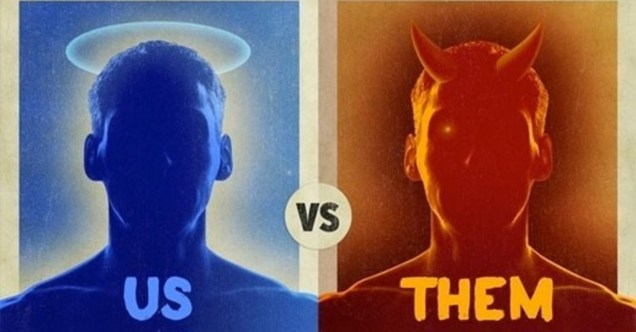
Us vs Them - Political Tribalism

Many so-called liberals are great at diagnosing destructive political tribalism when it manifests in other people, but are often blind to the same pathologies within their own ranks

I wrote a long piece earlier this month about deepening political tribalism as it relates to Brexit. After the piece was serialised in Country Squire Magazine, much of the pushback I received from the usual suspects within the Remain camp (university professors and the like) only served to prove my point – that Brexit merely exposed, rather than caused, the increasing depths of partisan tribalism afflicting Britain.

This tribalism is not the exclusive preserve of the under-educated, supposedly simple-minded working classes whose emotions and voting habits are apparently so easily manipulated by Rupert Murdoch, Cambridge Analytica or the dozens of other shadowy figures who now stand accused of ushering in Brexit for their own nefarious ends. Indeed, through their growing obsession with these new scapegoats, many of those opposed to Brexit reveal themselves to be capable of behaving in an equally aggressively tribal manner without even realising that they are doing so.

It never occurs to many of those people who occupy the groups most statistically prone to supporting Britain’s EU membership – students, university professors, artists and arts workers, young urban professionals – that they might be doing something so base, so primal as to be influenced by tribal behaviour. Why? Because many are used to seeing tribalism as a pathology affecting only the poor, the uneducated or others traditionally seen as either victims (like welfare recipients) or potential threats to be mitigated (juvenile criminals or nascent Islamist extremists). To many journalists, academics and politicians, tribalism is seen as something afflicting only society’s losers and outcasts,  not something which might also pull the strings inside AC Grayling’s neocortex.

The idea that political tribalism might just as easily drive the behaviour of an Oxbridge professor, a PR director on a six-figure salary or a young university student often simply fails to compute, but it is a real and frequent occurrence nonetheless. Being educated and even nominally aware of the existence of tribal impulses does not automatically make one immune from being driven by tribalism oneself, particularly when one possesses the intellectual capacity and vocabulary to rationalise one’s behaviour as more noble and high-minded than it necessarily is.

And so time and again we see those who would normally be first to decry tribal behaviour engaging in its most vicious forms, whether it be the American college students or graduates who refuse to visit their Trump-voting parents or public figures who believe they have license to say the most horrible things about Leave voters and Brexiteers from atop their perch on the “right” side of history. More concerning, since these new converts to overtly tribal behaviour supposedly make up much of the cognitive elite, they seem unable to acknowledge the drawbacks of their behaviour or the many ways in which it actively harms their end goal, be it overturning the result of Britain’s EU referendum or prematurely turfing President Donald Trump out of office.

Smart people should be capable of noticing when an existing strategy is not delivering results and adjusting course to deliver better outcomes, but many within the anti-Brexit academic, cultural, commercial and political elite instead seem intent to double down on losing strategies which may feel cathartic but fail to achieve their political ends. Only political tribalism can drive nominally smart people to behave in so counterproductive a way.

Political tribalism causes anti-Brexit members of the elite to act out in a couple of negative ways – firstly by failing to understand or acknowledge the true motivations and drivers for the Leave vote, and secondly by engaging in public statements and actions which actively alienate many of the people whose good opinion they need to court and convince in order to change their minds. In my recent long article about political tribalism and Brexit I covered a number of the ways in which anti-Brexit elites harm their own cause through misbehaviour and bad messaging, but it is also worth focusing on the way in which political tribalism causes Brexit opponents to consistently ignore the full range of valid reasons which drove thinking adults of good character to vote to leave the European Union.

The first is a binary worldview which sees the EU as representing (if not always achieving) the highest ideals of mankind, and euroscepticism as the antithesis of all that is good in the world. This widely held opinion reveals itself in every tweet decrying Brexit as the result of unchecked xenophobia and racism (or a neo-imperial quest for lost glory) while simultaneously ignoring the EU’s manifest flaws. The best one can often get in debate with a pro-EU activist is an exasperated admission that “of COURSE the EU needs reform!” uttered through clenched teeth, though specific proposals for such reform or estimates of their probable implementation are always curiously lacking. Meanwhile, despite post-referendum polling which showed sovereignty and not immigration as the key driver of the Leave vote, heinous racist or xenophobic statements are taken to represent the broad church of pro-Brexit opinion.

The second reason is the exclusionary nature of many of the strongest bastions of pro-EU sentiment. There are people of good conscience in the academic and arts industries who support Brexit, but they rarely make themselves heard for fear of social or professional reprisal. If the prevailing opinion within one’s social or professional circle holds that Brexit is a national calamity with grievous implications for human rights, few people will have the courage (or luxury of courage) to take an openly contrarian view. Unfortunately this only worsens the situation, with those who do most to oppress pro-Brexit sentiment within their respective circles then failing to see that Brexiteers can sometimes be respected colleagues and friends.

Just as increased meaningful exposure to immigrants tends to reduce xenophobia or opposition to immigration, so structured and controlled exposure to Brexiteers might make many of the loudest anti-Brexit advocates realise that their opponents are not the evil masterminds or stupid pawns they have been portrayed as. But ironically, while many anti-Brexit campaigners are eager champions of multiculturalism, they also either encourage or tacitly tolerate a sometimes aggressively ideologically homogeneous pro-EU school of thought to dominate their field – ideological diversity is the one kind which is not celebrated and put on a pedestal.

But the greatest driver (or manifestation) of political tribalism among anti-Brexit activists now is not the deeply ingrained sense of moral superiority or self-imposed isolation from contrarian viewpoints – rather, it is the degree to which many of the afflicted now seem willing to latch onto anything from issues of concern to downright conspiracy theories, promoting them as valid reasons for nullifying or re-running the EU referendum in order to seek the “correct” response from the electorate.

The latest cause du jour is Cambridge Analytica, which seems to have transformed itself in the minds of Remain supporters from the tawdry and morally questionable data huckster outfit into a shadowy, all-powerful corporate behemoth which single-handedly tipped the balance and inflicted Trump and Brexit on a naive and defenceless world. The re-emergence of Cambridge Analytica in the headlines following news of its connection to a Facebook data “breach” and the Trump presidential campaign has only encouraged those already looking for reasons to invalidate (rather than argue against) Brexit to seize upon the scandal and make a lot of tenuous and irresponsible insinuations.

Pro-EU advocacy website InFacts can now be found – contrary to their name – raising “questions” whose entire purpose is to put the murkiest deeds of Cambridge Analytica as close as possible to Brexit on paper or a smartphone screen in the hope that insinuations about the former question the legitimacy of the latter.

Prior to Cambridge Analytica, the figure of Russia loomed largest in the Remainer imagination as the driver of Brexit. While any foreign interference in British electoral processes represents an abhorrent and unacceptable attack on our national security and civic institutions, one which we should probably be taking far more seriously both in terms of reprisals and future safeguarding, the idea that even a large scale attempt at Facebook manipulation had a material impact on the referendum result is both unproven and far from meeting the common sense test.

Are Remainers seriously proposing that the full weight of UK government advocacy, the massed ranks of the artistic and cultural world, a plurality of big business and heavyweight external interventions from the likes of the IMF and even President Barack Obama, all encouraging a Remain vote, were overshadowed by £1 worth of Facebook ads and the addled efforts of a Twitter troll farm in Russia? Apparently so – and yet many of the high profile personalities and Serious Thinkers who make and amplify these assertions are unable to step back and escape the prison of their political tribalism for long enough to appreciate how unhinged their conspiracies are beginning to sound.

In short, a significant strand of anti-Brexit opinion remains obstinately unwilling to consider any failure on the part of the Remain campaign or the European Union itself, instead attributing their every setback and woe to crude dismissals of the electorate or fantastical conspiracy theories of the type embraced by leading Remainer intellectual Professor AC Grayling.

It takes a lot to make intelligent and accomplished people behave in a way which is both counterproductive to their interests (they will never stop Brexit by repeatedly shrieking that Leave voters are stupid automatons who were hoodwinked either by Vladimir Putin or sinister corporate interests) and damaging to their long-term reputations. In fact, one of the only things which can induce such a mania in so-called “respectable” people is the phenomenon of political tribalism, whereby it becomes more important to be seen as strongly aligned with and supporting ones own people than it is to be either pragmatic or empathetic.

And when it comes to Brexit, so strong is the force of political tribalism among certain demographics that even those whose job it is to understand political and constitutional matters find themselves unable to acknowledge, let alone meaningfully engage with, the real issues which prompted millions of decent people to vote for Brexit, instead blaming “fake news”, the Russians or Cambridge Analytica.

Tom Peck makes a reasonable observation in the Independent:

People have almost entirely forgotten that, say, in 2015, when the BBC hosted its first hustings in the Labour leadership contest in a church in Nuneaton, some hitherto unknown man called Jeremy Corbyn was the only one who had anything of any interest to say. Andy Burnham, Yvette Cooper and Liz Kendall were beyond abysmal, and they remained so throughout the contest.

Is it acceptable to wonder if the fire is only being turned on technology because it hasn’t delivered the results the bulk of the media class wanted? If the Democrats had delivered a candidate better equipped to deal with the shallowness of the media age, and if the Remain campaign had been run as well as the Leave one, this apparently existential crisis would not be occurring.

The comparison with the 2015 Labour Party leadership contest is an instructive one. Then, as now, a cadre of people accustomed to calling the shots and having their worldview acknowledged, respected and advanced at all times – the Labour centrists – suddenly found themselves out of power and influence within the party for the first time since John Smith and Tony Blair ushered in their long period of domination. But rather than engage in any kind of introspection as to why they were so unloved by the Labour base, centrist Labour MPs instead engaged in an unseemly year-long insurrection against new leader Jeremy Corbyn, culminating in the rather disgraceful and ultimately unsuccessful decision to use the shock EU referendum result as a convenient “fog of war” in which to take down their new leader.

Why did the Labour centrists behave in this way? Because they were motivated more by tribal affiliation and beliefs than political principle or even civic decency. They (rightly) sensed that their tribe was under attack from the hard-left Corbynites within the party, and worried that their status would be permanently eroded were Jeremy Corbyn able to cement his grip on power. And thus rather than spending the following years attempting to hold the Conservative government to account, as an Opposition party is supposed to do, we instead saw the biggest names from Labour’s centrist wing engage in a long period of unseemly infighting – because political tribalism trumped their commitment to either party unity or the national interest.

The funny thing about political tribalism is that its most ardent practitioners tend to see themselves as being immune from the phenomenon while ruefully detecting its presence among nearly everyone with whom they disagree. Thus it simply never occurred to many of the Labour MPs who made it their primary mission to destabilise Jeremy Corbyn that they were primarily motivated by tribal interest, just as many of those who howl the loudest about Brexit cannot bring themselves to contemplate the possibility that their behaviour is driven by anything other a rational, fact-based analysis of the common good.


The Liberalist Insurgency

The vote for Brexit and the election of Donald Trump as US president have been widely painted by many establishment opinion-setters as an assault on liberal democracy and liberalism itself, as progressive or enlightenment values fell prey to reactionary populism spouted by right-wing demagogues. Indeed, it pleases many of those who oppose both Donald Trump and Brexit (for the record, this blog strongly opposes the former and supports the latter) to paint themselves as brave guardians of liberal democracy and sole keepers of the frame of liberalism in these uniquely benighted times.

And yet when many of the great and the good in the anti-Brexit or anti-Trump camps are not fulminating against their respective bêtes noires, they can often be found undermining and attacking the same liberal values which they claim to champion. How often are those who decry Brexit as the first step toward fascism also found supporting draconian hate speech laws, advocating censorship and No Platforming on university campuses, attempting to excommunicate those who merely profess (without seeking to enforce) traditional social values from polite society and aggressively ushering in radical new gender theory and the divisive intersectional identity politics movement which seeks to stigmatise and oppress any questioning of these goals? None of these behaviours are remotely liberal in the true sense of the word, yet all are being enthusiastically adopted by many of those who also seek to paint themselves as guardians of liberalism in their fight against Brexit.

It is therefore important that we deny the anti-Brexit campaigners automatic and exclusive use of the “liberal” label, particularly when their actions and words – wheher expressed through contempt for a democratic referendum result and those who voted for it or other stances taken against science, liberty and free speech – are the antithesis of true liberal behaviour. When prestige journalists, academics and politicians who are complicit in these illiberal behaviours also inveigh against Brexit in a way which denigrates Leave voters and fails to even acknowledge the existence of their legitimate arguments we should not allow them to pretend that they are safeguarding either liberalism or democracy when they do so.

And that’s where the word “liberalist” could be very useful. Just as Islamism refers to a fundamentalist, politicised and perverted strain of Islam and the word Christianist has been memorably coined (by Andrew Sullivan among others) to refer to those Christians who profess a harshly authoritarian, theocratic political worldview, so the word “liberalist” (as distinct from “liberal”) should perhaps be taken to mean a hypocritical self-serving authoritarianism masquerading as genuine concern for democratic stability and outcomes, a cynical perversion of true liberalism.

Post-Brexit (and to some degree since the election of Donald Trump in the United States, though the analogy is imperfect), liberalists have effectively become the “faith militant” of progressive liberals, a combative sect who use their typically high-status positions in electoral politics, journalism, culture and academia to inveigh against any political initiative which threatens to disrupt a stale status quo under which they have largely prospered while other groups have largely stagnated.

In order to shroud their blatant self-interest in the more noble garments of high-minded civic duty, liberalists portray their objection to current political developments as flowing from an overriding commitment to individual rights, the protection of vulnerable minorities and the preservation of democracy. This is quite impressive, since many of them have built entire careers on the back of attacking individual freedoms (particularly core civil liberties like free speech) and signing away our right to democratic self-determination by blindly and naively entrusting sovereignty to a supranational political union which represents a non-existent demos, which has never sought public input and which even now shows no real willingness to change for the better.

Taking on this faux-superhero role serves a dual purpose for the liberalists – firstly it allows them to avoid any real introspection as to why the values, norms and institutions they champion are increasingly rejected by a plurality of voters, and secondly it helps to soothe the cognitive dissonance which inevitably arises when people whose identities are so closely tied to projecting the appearance of social conscience and civic virtue act so shamelessly in their own short-term self-interest.

But whatever their protestations to the contrary, the liberalists are engaged in a performative act, if not a downright fraud. That is not to say that there are no legitimate reasons to oppose or even deplore Brexit – of course such a case can be made. But the liberalists will not engage in reasoned debate because they refuse point-blank to even acknowledge the Brexiteer frame of reference, insisting instead that everything is debated through the lens of short-term economic impact. And on top of this obstinacy they treat us to an increasingly tedious and condescending tale about civilisation teetering on the brink and the only safe option being a return to the EU’s cold embrace, with not so much as a nod to Brexiteer concerns.

Political tribalism is not the exclusive preserve of any one demographic group or end of the political spectrum, but the media focus is nearly always on those deemed to have fallen under the corrupting influence of “populist” rabble-rousers – understandably so, because such people are so poorly represented in the politico-media and cultural elite that they can raise no significant objection when one weepy Guardian article after another frets about rising nativist tendencies among the provincial rabble while ignoring rising insularity and decreasing social solidarity within the London-centric elite.

Therefore, it is time that we turn the focus back on the people who ostentatiously fret about the tribalism and populism they so readily detect in others. It is high time that we stop naively accepting the liberalist narrative that their objections to Brexit are exclusively rooted in high-minded concern for the national interest – at least so far as the word “national” incorporates any regard at all for the importance of democratic self-determination. They are not.

Brexiteers may be equally susceptible to political tribalism, but how much more dangerous is it when members of the political, cultural and media elite, with all their power and influence, throw themselves into the opposing side of the anti-Brexit culture war with such verve and venom?

We are about to find out.
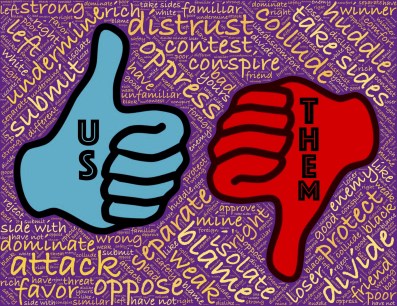
 

Us vs them - thumbs up thumbs down - politics

Support Semi-Partisan Politics with a one-time or recurring donation:

Agree with this article? Violently disagree? Scroll down to leave a comment.

Follow Semi-Partisan Politics on TwitterFacebook and Medium.

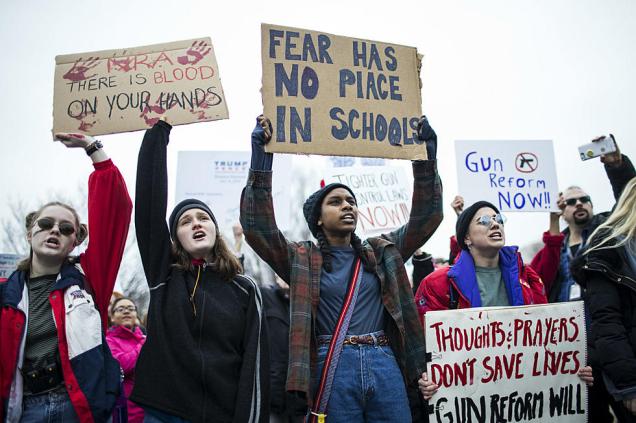
The Left Will Not Achieve Gun Reform By Using Divisive Culture War Tactics

Gun violence protests - NRA blood on your hands

Going on a moralistic crusade against the NRA and gun rights supporters may be cathartic for the Left, but folding the gun control debate into the ongoing toxic culture war only guarantees bitter polarisation and more deadly inaction

A worrying (but perhaps predictable) new development following the horrific Parkland school shooting has been a concerted effort by many on the anti-gun Left to fold the issue of gun rights and restrictions into the broader, toxic ongoing culture war, in which Americans hunker down within their respective ideological bunkers and instinctively assume the worst of those who disagree.

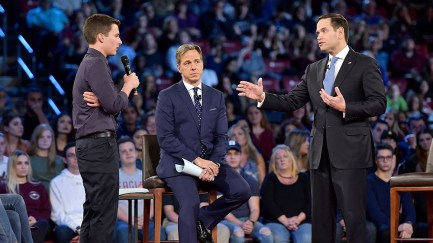
This trend reached depressing new heights last night during CNN’s town hall on gun control, held in Broward County, Florida, where the shooting took place. This was less a serious debate conducted in the spirit of seeking compromise than it was an inquisition, designed not to foster understanding or brainstorm solutions but rather to provide a cathartic opportunity for gun-control advocates to scream at gun rights supporters and accuse them of complicity in the mass murder of innocent schoolchildren.

Even if there were a shred of truth in these monstrous accusations – and there isn’t – it would remain absolutely terrible politics. Constantly fuming that the other side is selfish and evil only encourages alienation and division, a fact which was true when some Republicans implied that President Obama didn’t “love America” and which applies equally now when some Democrats imply that conservatives don’t care about murdered kids. And it really should be a cause of deep shame for CNN that President Trump of all people was able to moderate a calmer, more respectful and productive listening session on gun control at the White House than Jake Tapper, with all his experience, managed on live television.

(Of course, the US media being the uncritically self-regarding entity that it is, Tapper is receiving praise from all corners for permitting what was effectively open season on Republican senator Marco Rubio and NRA representative Dana Loesch while letting the political activist local sheriff whose department failed to take action against the killer before he struck completely off the hook).

The irony to all of this is that there have actually been some genuinely hopeful signs of movement from gun rights proponents after this latest shooting. Whether it is increased fatigue from even hardened gun-rights activists at witnessing the funerals of more young children or (perhaps more likely) the loud and insistent activism of the Marjory Stoneman Douglas High School students themselves, concessions are now being mooted and offered on areas from bump stocks (though no such device was used in this particular shooting) to increased criminal background and mental health checks.

This much, however, was foreseeable. What seems to be new this time is that efforts are now underway to make gun rights supporters pariahs in the wider American culture and society. We see this most notably with swarms of activists on social media browbeating corporations into disassociating themselves with the National Rifle Association – and gunowners in general, by extension:


This, of course, is precisely the same tactic used by the illiberal leftist British organisation Stop Funding Hate, which channels the efforts of a few thousand shrill voices on Twitter to intimidate companies into pulling their advertisements from certain publications or certain publications from their places of business.

Stop Funding Hate has had great success in surgically removing the spines of various corporations in Britain and then bending them to conform to whatever happens to be their moral outrage of the week, nearly always involving the Daily Mail. One does not have to approve of the Daily Mail’s editorial positions or reporting standards to be concerned that leftist efforts to make the personal political are creating dozens of new wedge issues to divide British people from one another rather than uniting us around common values, and co-opting big business in their efforts to do so.

In America, it seems to corporate capitulations are going to be every bit as swift as they have been here in the United Kingdom, with car hire giant Enterprise Rent-A-Car swiftly terminating a deal with the NRA in which offered rental discounts to their members:


Note the specific language used here, too. The business relationship was between Enterprise and the NRA, so the spineless amoebas who run the company’s social media accounts could simply have said that they terminated their relationship with the NRA. But they went one step further and specifically pointed out that they were withdrawing their discount for “NRA members”, as though innocent NRA members (none of whom have ever committed one of these mass shootings) are themselves deserving of opprobrium and social sanction.

An intersectional social justice warrior might say that this has the effect of “othering” the large minority of Americans who own guns, but of course such terms are only conferred on designated victim groups, a label which conservative gun-owners will never attract. Those of us who do not wallow 24/7 in victimhood culture might simply point out that appearing to repudiate law-abiding NRA members

Are firms like Enterprise free to advertise or offer affinity partnerships with whatever organisations they please? Of course. Is it necessarily good business to allow a handful of Twitter activists to effectively dictate corporate strategy? It’s arguable, but I have very strong doubts. But is it good for the country for corporations to so clearly take sides on divisive social issues, coming perilously close to suggesting that those who hold more conservative views are effectively personae non gratae? I think it is unambiguously bad and counterproductive to do so.

We have already been through this dismal dance with the media. The mainstream, prestige media’s often soft but near-universal leftward bias on all issues did not have the desired effect of “reprogramming” conservatives into adopting progressive positions; rather, it simply forced conservative news consumers into the arms of right wing talk radio, Fox News and a slew of independent right-wing websites whose journalistic standards and commitment to objectivity are often questionable at best. And freed from the need to cater to that side of the market, the remaining prestige media has had every social and commercial incentive to pander to progressive dogma and groupthink to the extent that many journalists genuinely believe themselves to be objective while displaying degrees of selection bias and epistemic closure which beggar belief.

Has this division been good for American society? Who can argue that it has been anything other than a monumental failure? More than anything, this is what gave the country President Trump. When the legacy news outlets which generally still come closest to reporting objective truth make it plainly clearly that conservative ideas are unwelcome and will be treated with more scepticism than progressive ideas, the very idea of objectivity is poisoned.

Do we really want to replicate this polarisation across all aspects of American life? Do we want to live in a society where the car rental company you use, the airline you fly, the grocery store you shop at or the high-tech goods you buy become an expression of your stance on every hot-button social issue, a flag planted to declare your allegiance in the culture wars?

Nothing good can come of this. Nothing. Have conservatives historically shown far too little sense of urgency in proposing and implementing policy changes in an attempt to reduce the frequency and deadliness of mass shootings, or at least been content to see efforts stall so long as their rights were not threatened? Absolutely. But now they are actually coming to the table, the Left’s response cannot be to paint every gun-owning American as a pariah and refuse to frequent the same places of business.

The Left have a history of achieving social changes – often welcome, sometimes less so – and responding to these victories not with magnanimity toward the conservatives they routed but rather with an unbecoming, snarling vengefulness. It would be a real catastrophe if they now repeat this destructive behaviour as they fight for greater gun control.

APTOPIX School Shooting Florida

Support Semi-Partisan Politics with a one-time or recurring donation:

Agree with this article? Violently disagree? Scroll down to leave a comment.

Follow Semi-Partisan Politics on TwitterFacebook and Medium.

After The Parkland School Shooting We Need To Rethink The Trade-off Between Liberty And Public Safety

Mass Shooting - Marjory Stoneman Douglas High - Parkland Florida - Gun Control

Conservatives and gun rights activists don’t like to talk about it, but at the heart of their opposition to increased gun control is an unspoken trade-off between defending against possible future tyranny and trying to reduce or prevent otherwise inevitable future deadly mass shootings. In the wake of the Parkland school shooting, we need to drag this debate out into the open and re-examine the trade-offs which we are willing to tolerate

At what point is the promise of the Second Amendment and the assurance it offers Americans as the final firewall against government tyranny outweighed by the monthly carnage in American schools? Or is it wrong to even conceptualise such a tipping point, gut-wrenchingly tragic and outrageous though these endless mass shootings may be?

Are we right to focus on high profile mass shootings when so many more murders take place, in no way less tragic, during shootings involving only one victim? Is it appropriate to even contemplate reviewing something so fundamental to the American culture and precepts of government as the Second Amendment based purely on high profile massacres, when they form such a small percentage of the total yearly gun homicides?

Even if it were possible to outlaw the kind of weapons often used in high profile mass shootings, would it ever be politically or logistically possible to enforce a ban and/or seek to recall these weapons from lawful owners while providing appropriate monetary compensation, or would this simply leave the citizenry more at the mercy of criminals, or even provoke armed insurrection by those unwilling to comply?

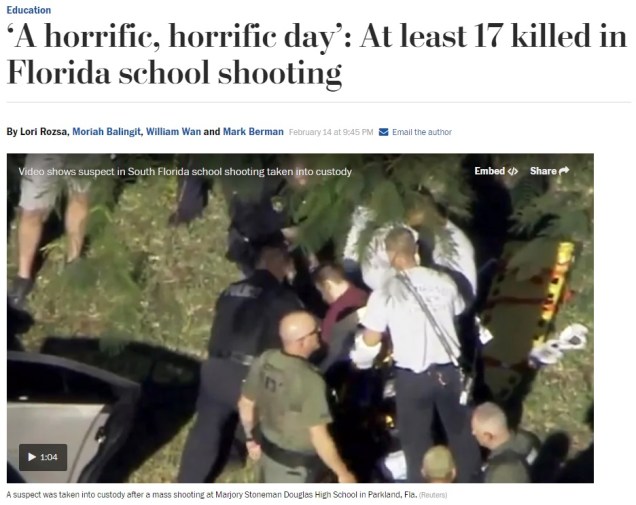
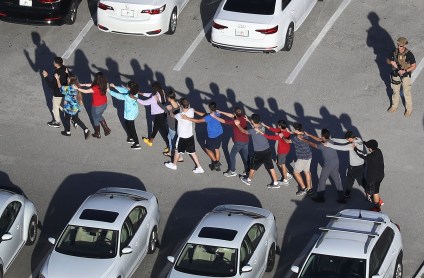
All of these thoughts and more have been going through my mind as I learned of the latest deadly school shooting, this time at Marjory Stoneman Douglas High School in Parkland, Florida, where seventeen young people are known to have been killed.

I have long supported gun ownership rights, albeit with some caveats. Part of this is a function of growing up in the United Kingdom, where not only are most of the police unarmed, but where the law often ends up penalising those who try to engage in legitimate self-defence. If the government will not quickly and reliably come to one’s aid in a life-threatening situation, particularly given the rising Islamist terror threat, then what right has the government to demand that citizens forego even non-lethal methods of personal self-defence such as tasers or pepper spray?

I am not yet constitutional scholar enough to be able to adequately dissect the Second Amendment and the myriad existing gun control laws, but clearly there are existing limits on the right to bear arms, set both by the definition of the word “arms” and by state and federal law. One cannot construct a homemade nuclear weapon or dirty bomb in one’s garage or laboratory as an insurance policy against government tyranny, for example, and even the most conservative Republicans and the NRA don’t seem to register any objection to that.

As with free speech and the First Amendment, a line has been drawn. In the case of free speech, the line has rightly been set at the point of incitement or “fighting words”, the credible threat of harm to another individual. In the case of gun ownership and the Second Amendment, the line is both blurrier and more jagged, with various carve-outs and inconsistent application among the various states. But over the passage of time it was decided that certain semi-automatic weapons should be legal while others designated “assault weapons” are not, and yet nowhere is this spelled out in the Constitution.

Since there is then precedent for wide-ranging interpretation, it does not seem unreasonable to demand one of two things – either that the Second Amendment is revisited and its language tightened up to elucidate precisely what constitutes “arms” and precisely what infringements upon the right to bear such arms are now tolerable, or that the line in the sand (whose presence we all tacitly tolerate anyway) is redrawn in a way that restricts the type of weapon repeatedly used in these mass shooting incidents.

I believe that principles are important. In the Brexit debate here in Britain, I maintain that the principles of democracy and self-determination are sacrosanct and in themselves worth voting to leave the European Union, which is a deeply antidemocratic supranational government in gestation. I hold this view despite the fact that Remainers can point to many potential short and medium-term costs (albeit some of them invented or far-fetched) because democracy, though not quantifiable, is priceless.

And so it is with liberty and the right to fend off a tyrannical government, I suppose. America’s history is rooted in having to fend off a colonial power and fight to remain independent. American government is further predicated on the noble idea that the government and institutions of the day exist at the sufferance of the people, from whom they are temporarily given certain powers of governance, unlike most other countries where rights flow from the government to the individual. Given that the arc of history does not inevitably bend towards progress, and that tyranny can re-emerge unexpectedly at any time, a plausible and coherent (if distasteful) argument can be made that no matter how grim the death tolls and murder rates, the fundamental, universal liberty which the Second Amendment protects is yet more precious even than the lives taken every day by the bullet.

And yet. And yet we do not live in a world of pure political theory. We live in the real world, a fallen world where at some point the body count, the sheer mass of lost human potential will eventually outweigh (if it hasn’t done so already) any benefit that the Second Amendment offers in its current form.

For the past decade I have been a project and program manager by trade, and one of the key things we do in my job is assess and mitigate risk. In order to do so, one needs to determine both the likelihood of an adverse event happening and the severity of the consequences if it does so. Assigning a numeric value to each, one can then multiply the two variables to arrive at a unique risk rating for any eventuality, and use that rating to determine whether the risk can be mitigated and whether it is worth the cost of doing so based on the probability and severity of any potential fallout.

The Second Amendment is essentially a risk mitigation strategy against the re-emergence of tyrannical government. The result of true tyranny (though such things always exist on a sliding scale) can inevitably be measured in countless human lives, as borne out by every dictatorship which has ever existed. The probability of tyranny re-emerging, however, fluctuates all the time according to societal trends and political developments – at this time, some might say that the probability has spiked somewhat, while others would say that such an assessment is overblown.

We then need to compare the price of our current risk mitigation strategy against government tyranny – the Second Amendment in its current form – against the price of such a tyranny re-emerging in the event that we either cease to mitigate the risk (by abolishing the Second Amendment and attempting a recall or seizure of guns in legal circulation) or reduce our mitigation efforts (by imposing additional limits and restrictions on Second Amendment rights).

I’m sure that some person far cleverer (and more clinically, dispassionately calculating) than I could input thousands of societal and political variables into a huge Excel spreadsheet, work some pivot table magic and come up with a theoretical crossover point in terms of lives currently being lost versus lives potentially saved by fending off government tyranny (to the extent that current levels of gun ownership are any true defence against such tyranny). However, I am not that person. All I can do is go by my gut feeling and confess that much as I believe in gun ownership and support the Second Amendment in principle, it seems evident to me that we are way past the tipping point and that something needs to change.

A reasonable trade-off at this point, I believe, would be the banning of the sale of semi-automatic, gas-operated weapons and potentially compulsory buy-backs and amnesties to remove as many as possible currently in private ownership, given the capacity of such weapons to rapidly inflict mass casualties and their current popularity with mentally disturbed or evil people for whom such firearms are their weapon of choice.

I arrive at this position based on an honest and realistic assessment of both the risk of government tyranny (the ultimate reason that supporters of such weapons invoke in their defence) and the ability of such weapons in the public domain to deter against tyranny. I would not go further and propose the banning of non auto-loading firearms because there is a legitimate self-defence and recreational interest in keeping them, while they also provide a continued (if reduced) protection against the emergence of government tyranny, with the reduction in deterrence more equal to the potential lives saved through a successfully-enforced ban of semi-automatic weapons.

As Salon (hardly an unbiased source, but instructive in this instance) wrote in the aftermath of last year’s Las Vegas shootings:

The problem with gas operated weapons is that they are very, very dangerous. They are inherently dangerous, of course, because they are capable of killing people. But they are also dangerous because of the design of their rapid fire mechanisms and because of the nature of the humans who use them. In order for one of these weapons to be safe when it is loaded with a magazine full of bullets, two things must happen: the safety must be on, and it must not have a live cartridge in the chamber. But even if these safety precautions are taken, it’s still dangerous because dropping the weapon might chamber a round and knock the safety off, causing it to fire. The United States Military considers the gas operated weapons it issues to soldiers to be so dangerous that loaded firearms are not permitted on military bases here in this country, or even on bases in combat zones abroad. When I was in Iraq and Afghanistan, every time we entered an Army basecamp, our convoys had to pull over to the side of the road short of the camp entrance, soldiers had to dismount and walk over to barrels full of sand, and pointing the barrels of their M-16’s or M-4’s into the barrels, they had to remove loaded magazines from their rifles and clear the chamber of live rounds. Only when their weapons were completely unloaded and the bullets were put away were they safe.

[..] That’s all the Congress needs to know in order to write legislation that will make it far more difficult for mass killings to be carried out in the future. Ban the sale of gas operated weapons. Ban the importation and manufacture in the United States of new gas operated weapons except those for military or police use, and ban the sale or resale of currently existing gas operated weapons. The Las Vegas shooter apparently bought all of his weapons in contemplation of using them to shoot up the concert on Sunday night. If he had been unable to legally purchase his arsenal of gas-operated rifles, he would have been unable to kill 59 and wound over 500. Nor would the shooters in Orlando, or Newtown, or Virginia Tech, or Aurora Colorado have been able to so easily carry out their mass murders. If each of those shooters had to cock his weapon every time he fired it, far fewer people would have died.

Could such a ban be enforced by a mere Act of Congress? Again, I am not yet lawyer enough to proffer a deeply informed opinion. It may well be that such a ban could only be achieved through a Constitutional amendment – and given the current lack of clarity in the Second Amendment, the latter course of action would probably be preferable. Far better to have a clear and unambiguous limit on the power of the government to infringe on the private right to bear arms than the current situation where we have a very maximalist clause in the Constitution which is interpreted and curtailed in all manner of ways and thus made a mockery of in real life. And since so many decent and law-abiding citizens view their right to own such weapons as rooted in the Constitution, only a Constitutional amendment would give any future ban real weight and legitimacy.

But would such a measure do anything to significantly reduce the carnage which has long been a part of daily life in America? Much would depend on the method and timescale of any recall effort after an applicable law or Constitutional amendment was passed, and one can look to the Australian gun amnesties and buy-back schemes for guidance, but it should be acknowledged that any effect would be marginal at best in the short term.

Many weapons would inevitably not be handed in and would continue to be stored insecurely or accessible to those who should not have them, while psychopaths could continue to inflict mass casualties using smaller weapons. And while in time there would almost certainly be a decrease in the deadliness of mass shooting incidents (if not in the number of incidents themselves) as more guns were handed in and the inevitable smuggling routes disrupted, opponents of the ban could always disingenuously point to any mass shooting involving a semi-automatic weapon which slipped through the net as “proof” that the whole exercise was a futile exchange of liberty for no additional safety. The benefits would be marginal, and one cannot disprove a counterfactual.

And yet clearly something must be done. America stands alone among prosperous, developed countries in terms of gun violence and mass shootings in particular, and freedom enjoyed is not so vastly greater in the United States than it is in other peer countries such as Britain to justify the carnage (though again, America’s “insurance policy” against tyranny is somewhat greater than other countries).

If not this moderate additional restriction on gas-operated semi-automatic weapons, what is the alternative? Many Second Amendment defenders rightly point to a litany of other factors which contribute toward mass shootings, from the degenerate culture and lack of accessible mental healthcare services to the ubiquity of antidepressants and other prescription medications, and more. And they are right to highlight these issues – after all, guns don’t kill people, people kill people.

But we are now faced with a choice between trying to change society and human nature, which is incredibly difficult, time consuming and unpredictable in its results, or taking steps which accept the world and human nature as they are (surely the correct conservative approach) and enact physical constraints on the ability to purchase or acquire semi-automatic or gas operated weapons, or doing both.

At this point, we need to embrace an “all of the above” solution. We should absolutely do what we can to identify instances where the lack of mental healthcare or the prescription or illegal acquisition of certain pharmaceutical drugs can impact someone’s mental equanimity to the point where they become a potential mass murderer, and thenmake sensible reforms in this sphere. We should examine our culture of violence and any role that this plays in mass shootings, and also continue to take steps to change the way that the media reports such incidents (such as by focusing less on the killer, depriving them of the posthumous fame they crave and so acting as a deterrent to potential future killersthough others disagree that this makes any difference).

But this alone is not enough. We need to take practical measures too, steps rooted in the physical world to make it harder to acquire particularly lethal weapons. And for Second Amendment advocates (of whom I still consider myself one, albeit a reformist) it might be suggested that a small tactical retreat on this issue, if exchanged for cast-iron guarantees that no further infringement will take place, is infinitely preferable to inaction and the slow build-up of public outrage which might one day boil over and result in far more draconian gun control laws.

It may sound heartless so soon after another unspeakable tragedy to consider the issue of gun control in the clinical terms of risk mitigation. But at its heart, this is the purpose of the Second Amendment – to provide an insurance policy against encroaching government tyranny. And it does no good arguing the issue from a purely emotional angle or even from the self-defence angle, when both of these approaches skirt the real Constitutional issue at stake.

At its heart, the Constitutionally-rooted argument for the right to bear arms is not about hunting, recreation or self-defence; it is about the preservation of liberty and the right of the people to protect themselves from a government which no longer serves their interests. One can argue that this is an anachronism made hopelessly out of date by advancing weapons and surveillance technology, but American founding history vindicates the right to bear arms, and the wider arc of history warns us repeatedly against allowing ourselves to believe that Western democracies have entered some permanently benign state where the interests of the people and those in power will never again be irreconcilably opposed.

This is the battleground on which the issue must be fought if we are to have any resolution to the gun control debate, because this is the only line of argument seen as valid by gun ownership advocates, and because the Constitution demands that it be so. What, in 2018, would be a more acceptable, legal and politically/logistically feasible balance between safeguarding against the low probability of encroaching government tyranny versusprotecting the presently-imperilled public interest?

That is the question we must answer.


Note: I am no constitutional scholar or expert in how existing gun control measures have been reconciled with the Second Amendment. If anybody has any corrections, additions or counter-arguments to what I have written, I would be grateful to hear them in the Comments.


Shooting At High School In Parkland, Florida Injures Multiple People

Support Semi-Partisan Politics with a one-time or recurring donation:

Agree with this article? Violently disagree? Scroll down to leave a comment.

Follow Semi-Partisan Politics on TwitterFacebook and Medium.


NHS Defenders Value Ideology Over Healthcare Outcomes, But Voters Increasingly Disagree

Reform think tank - NHS private non profit provision

A startling new poll from the Reform think tank suggests that the public’s devotion to government-provided healthcare may be a mile wide but only an inch deep, threatening to burst the leftist bubble of blind, uncritical NHS worship

Today being Valentine’s Day, a predictably saccharine hashtag is trending on Twitter as British people exhort one another to #LoveYourNHS.

And so begins another round of unthinking, unending hymns of praise to the National Health Service, egged on by ideological zealots who wake up in a cold sweat at the mere thought of anyone but the government directly providing all healthcare services in the land, and amplified by thousands of well-meaning but uncritical Britons who have been indoctrinated to believe that because the NHS once delivered their baby / set their broken leg / dug out their inflamed appendix / scooped them off the road after they walked in front of a bus they now owe their eternal thanks not to the medical professionals who helped them, but rather to the bureaucratic system which (dis)organised their care.

These odes of praise generally fall into one of a few well-defined groups. First, there are those predicated on the simple-minded assumption that no other advanced country in the world has figured out how to provide universal healthcare to its citizens:


Then there are those who displace their relief and gratitude at having been successfully treated or sympathetically cared for away from the medical professionals who deserve the praise toward a faceless government bureaucracy and the fifth largest employer on the face of the Earth (right after McDonalds):


Then there are those who just like to take any excuse to bash the Evil Tories and paint themselves as virtuous defenders of institutionalised compassion, struggling against heartless conservatives who want poor people to die in the street when they get sick:

https://twitter.com/JamesSorah/status/963762294890139650


Bringing up the rear are the Part-Time British Exceptionalists, leftists who normally scoff at any expression of patriotism or national pride, but who on hearing or reading the letters “NHS” immediately transform into the worst kind of stereotypical Ukipper, ranting and raving about how our healthcare system is the “envy of the world” and our country the birthplace of all that is good and compassionate, all the while furiously failing to notice the rather glaring fact that no other country in the world has copied our unique and outdated post-war system of socialised healthcare delivery:

https://twitter.com/RoseTintMyWorId/status/963748528588812288


And last but not least are the childishly simple gestures of reverence and affection – poems, songs and the like – which reveal the truly infantilised and subservient attitude held by many of the NHS’s loudest defenders toward the service:

https://twitter.com/RMitchell_NHS/status/961285576816242691


Because these various types of people – NHS High Priest, NHS Congregant, NHS Faith Militant and so on – are so loudly vociferous in the press and on social media, I and many others had rather simplistically assumed that their angry squawking spoke for the country as a whole. But a new poll taken this year shows that in fact the British people have a far more nuanced view of the NHS and the need for serious healthcare reform than the leftist NHS hagiographers would have us believe.

The Reform think tank has published a fascinating poll, taken in January, which revealed some rather striking findings, including:

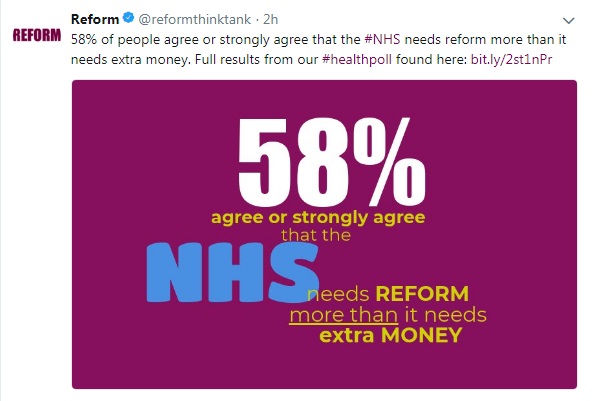
58 per cent of British voters believe that the NHS needs reform more than it needs extra money, according to a new poll commissioned by the independent think tank Reform.

64 per cent of voters believe that it should not matter whether hospitals or surgeries are run by the government, not-for-profit organisations or the private sector provided that everyone has access to care. This is 2 per cent higher than in 2014, despite the Populus poll of 2,106 people being conducted on the day Carillion went into liquidation.

The think tank finds that 59 per cent of voters would nonetheless be willing to pay higher income tax to fund the NHS. This is up from 33 per cent in 2014. On average, British voters would be willing to pay £5.25 extra a month, which is 0.4 pence in the pound of income tax.

The statistic that most of us are already familiar with is the final one – that a healthy majority (in this poll 59 percent) of Brits would be willing to pay higher income tax in order to support the NHS. We cannot escape stats and narratives like this because the media (and on this subject even the supposedly conservative-leaning newspapers are doggedly left-wing) trumpet the news from dawn to dusk.

But looking at this number alone is highly misleading, because all it tells us is that a majority of people would be willing to pay more money for the NHS, not whether they want to do so or even believe that it is necessary. And that is where the other two statistics come in, rather awkwardly for NHS defenders who loudly insist that everything would be perfect if only we firehose more taxpayer money at the same, unreformed system.

We learn in the first bullet point that a full 58 percent of voters believe that the NHS needs reform more than it needs more money, which suggests that contrary to the prevailing narrative, voters are not automatically opposed to significant reform and in some cases might even welcome it if the reforms were woven into a coherent, comprehensive plan to improve healthcare outcomes for patients. And who can seriously argue that the NHS could not do more to find even top-line efficiency savings when we see non-jobs and full-time union rep roles draining local trust budgets?

https://twitter.com/johnmknox1/status/959819605651984389


But it is the second bullet point which is truly surprising – the fact that a full 64 percent of voters don’t give two hoots whether the hospital or medical facility where they receive treatment is government-owned and operated or run by non-profit or even private service providers.

This flies in the face of everything that we are told about public opinion towards the National Health Service. We may as a country (wrongly) favour the re-nationalisation of the railways, but when it comes to healthcare it appears that we are far more pragmatic, preferring what works to leftist ideology or sentimentality for a system which has operated since 1948.

From the Reform blog:

This is an important message for politicians who have questioned the premise of the outsourcing model following Carillion’s liquidation. The reality is that public services would grind to a halt without private and third-sector involvement. Almost one-third of government spend (£242 billion) is spend on external providers for goods and services from paperclips to the trident nuclear deterrent. The NHS spent £54 billion on external suppliers in 2014-15. This model has delivered value for money through increased competition. While the execution of some contracts can be improved, it seems voters are more concerned with access to services than ideological arguments on either side.

Why this growing openness to non-government provision? It could potentially be a case of “the grass is greener on the other side” – the rail operators are already privatised, and so dissatisfaction is more likely to be expressed in terms of a desire to roll the system back to a previous state, whereas NHS delivery (particularly hospital care) is almost always government-provided, making fresh alternatives seem more appealing. This is very likely a factor.

But such is the strength of public feeling on the issue – with 64 percent supporting radical change – that I don’t think “grass is greener syndrome” can account for the entirety. On the contrary, it seems as though the Left have massively overplayed their hand, thinking that they stood on a rock-solid foundation of obstinate support for preserving the NHS in aspic when in fact they are on a bed of quicksand.

Interestingly, the Left have likely done this to themselves, to a large extent. Having bleated for decades that we have only X or Y number of days to “Save Our NHS” only for the NHS to persist through Tory and Labour governments alike, and with left-wing commentatorsmembers of the NHS Industrial Complex and alarmist agitators like Owen Jones penning articles suggesting that the “NHS as we know it” has in fact already been abolished, perhaps the general public has finally tired of their endless hysteria and started to take it for what it is – cynical emotional manipulation.

And if there really is a new openness to healthcare reform, then all it would now take to finally break free from British healthcare exceptionalism – the blind devotion to a tattered post-war consensus dogma which suffocated all previous impetus for healthcare reform – is a purposeful, visionary government with a clear mandate to lead and a Cabinet brimming with talent and political courage.

Oh well.

NHS Logo - Cross - National Religion - Worship - Idolatry

Support Semi-Partisan Politics with a one-time or recurring donation:

Agree with this article? Violently disagree? Scroll down to leave a comment.

Follow Semi-Partisan Politics on TwitterFacebook and Medium.