Bartlet For America

Your daily dose of nostalgia:

TV’s favorite White House Press Secretary was back at the White House podium Friday when Allison Janney made a surprise appearance.

Janney, who starred as C.J. Cregg for seven seasons on The West Wing, shocked the press core when she walked into the Press Briefing Room instead of current Press Secretary Josh Earnest. Janney said that Earnest was having a root canal, a callback to an episode in the first season of The West Wing, in which C.J. had a root canal that led to a disastrous press conference conducted by Josh (Bradley Whitford).

Earnest did show up to reveal that the Mom star was there to discuss the opioid epidemic and to support those who help people dealing with substance abuse. Janney, whose character on Mom is a recovering addict, honored the White House Champions of Change, a group of individuals who are recognized for their work with substance abuse issues.

Janney did take one question when a reporter asked who President Bartlett (Martin Sheen) was supporting for the Democratic nomination. In typical C.J. fashion she replied, “I think you know the answer to that question.”

I’m actually not sure that we do know the answer to that question.

In fact, I think that Jed Bartlet’s take on the current field (on both the Democratic and Republican sides) would be more like his future chief of staff Leo McGarry’s attitude was when trying to persuade a reluctant Bartlet to run:

Leo McGarry: Because I’m tired of it – year after year after year after year having to choose between the lesser of who cares. Of trying to get myself excited about a candidate who can speak in complete sentences. Of setting the bar so low, I can hardly bear to look at it. They say a good man can’t get elected President. I don’t believe that. Do you?

Jed Bartlet: And you think I’m that man?

Leo: Yes!

Bartlet: Doesn’t it matter that I’m not as sure?

Leo McGarry: Nah. “Act as if ye have faith and faith shall be given to you.” Put another way: Fake it ’til you make it!


“Every time we think we have measured our capacity to meet a challenge, we look up and we’re reminded that that capacity may well be limitless”

Bartlet for America - The West Wing - 2

Agree with this article? Violently disagree? Scroll down to leave a comment.

Follow Semi-Partisan Politics on TwitterFacebook and Medium.

Tales From The Safe Space, Part 34 – Harvard University No Longer Prepares Students For The Real World

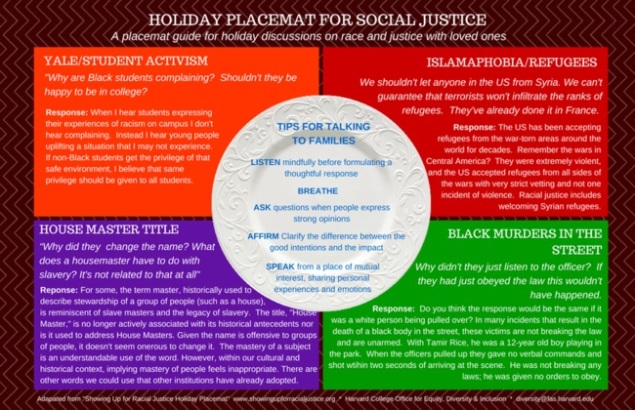
Harvard University - Holiday Placemat for Social Justice

Harvard University now makes it a point of pride to turn out fragile, unresilient graduates with little hope of functioning well in society

There was a time not long ago when universities used to take pride in turning out well-rounded graduates, young adults who were not only skilled in their chosen discipline but who could also hold their own in debate and ably relate to those from other walks of life or bearing different opinions.

But in 2016 it is increasingly evident that with their overwhelming focus on social justice – no longer a side issue but a common thread running through a contemporary student’s entire experience on campus and in the classroom – American universities in particular are actively harming the life prospects of their students by fostering such a therapeutic climate of social justice groupthink that the slightest intrusion of the rough real world is in some cases enough to provoke a real mental and emotional crisis.

Take this incredibly overwrought essay in the Harvard Political Review, which has apparently fallen so low that it now readily publishes weepy accounts from shellshocked students who happen to encounter hurtful words while on campus.

Student Aidan Connaughton writes:

I have heard hate speech in many situations in my life – so much so that I have become accustomed to it, even grown to expect it in some instances. Throughout middle and high school, I heard it so often that I knew the patterns, knew the lead-ins, and knew when I had to brace myself for the sting. Today, however, I did not brace myself.

“Faggot.” “Stop being a faggot.” “What is he? Some kind of faggot?” These all-too-familiar words continue to echo in my head. These are the words I have shielded myself against for years, the words I have learned to block out, coming from the people I have learned to avoid. These are the words that people use when committing hate crimes, and the words that were used for decades to oppress people just because they loved differently.

I never expected these words at lunch in Annenberg from a group of Harvard freshmen.

My guard was down, because I had forgotten what it felt like to hear these words. I know better now. I will not repeat that mistake.

Okay, so from this we can deduce that Aidan Connaughton is gay, and that he heard other students use the word “faggot” in what he felt was a derogatory way. Fair enough. As Connaughton makes clear, he has had this word directed at him from tormentors many times in his childhood, and quite understandably finds it upsetting.

But what follows is a damning indictment of how Harvard University, in a presumably well-intentioned effort to shelter people like Aidan Connaughton from ever encountering the rough and unpleasant views of the outside word so long as they are on campus, is actually retarding the ability of its students to withstand the unfair bumps and scrapes of real life. No gay person deserves to be called a faggot. But neither do young gay students deserve to be stripped of the ability to function and thrive in an imperfect world where hate and prejudice still exist.

Connaughton continues (my emphasis in bold):

Fair Harvard, the bastion of liberal values, a progressive environment where activists stand up against hate and students fight for progress in the belief that they can change the world. It is the place where workers and students unite to fight for health care, where students write plays about Black Lives Matter, where they organize rallies and marches to support survivors of sexual assault. It is the place where mental health is important and QSA is an established organization and where social justice is an integral pillar of student life. The students at Harvard have taught me how to embrace progressive movements and how to fight against administrative oppression. They have supported me, so much so that sometimes I can forget that the world outside of Johnston Gate does not care about social justice in the same homogeneous way as Harvard students. We fight against the Harvard administration to eradicate the structural oppression that continues at our school, and students may clash with each other over whether or not a classroom should be a safe space, but these disagreements seem to be more intellectual than hostile.

In other words, Harvard University is creating a very artificial environment in which their young adult students are expected to mature and grow into robust, well rounded people. By Connaughton’s own admission, the political climate on campus is so sterile and homogeneous that he is able to go for long stretches of time without encountering a contrary opinion, let alone an actively hostile one. This is a young man who has been consciously made fragile by the application of an ideology which preaches that words can cause real harm, and whose “immune system” to hearing non-affirming things has steadily atrophied in an environment where it has scarcely been needed.

And this is the result:

My little group of like-minded friends and I have frequent discussions on activism, politics, and campus issues, yet we usually come to a consensus on whatever issue we debate. I had grown so used to being understood and having my friends agree with me. I was no longer afraid to believe in social justice, the way I had been in my conservative hometown during high school. I had grown accustomed to a student body that was well informed and shared my beliefs. I thought that, at the very least, Harvard students are respectful and above making purposefully insensitive comments.

This is a young man whose idea of a debate is talking with his existing friendship circle, all of whom hold the same beliefs as him, and then (astonishingly) reaching a consensus. The only wonder is that they only “usually” come to a consensus, considering the homogenised intellectual atmosphere.

Worse still – for our democracy, at least – is Connaughton’s notion that this uniformity of thought exists because all of his fellow students are “well informed and shared [his] beliefs”. The obvious corollary to this is that anybody who does not share the worldview of Connaughton and his friends must be ignorant and wrong. There is no room in this worldview for the possibility that those who do not concur with each and every article of the Social Justice Catechism might do so from a position of honest, principled disagreement, and as the honest result of holding a different value system.

The article then builds up to the incident itself, in dramatic fashion:

But today, at table A11, as I sat down with my plate of red spiced chicken breast and broccoli, I overheard that word for the first time since leaving Colorado Springs to come to Cambridge. Two tables away, Dean Khurana was sharing a meal in Annenberg with a group of excited, overeager freshmen. But here were three Harvard students using this hate speech, laughing in their matching Harvard Men’s Lacrosse jackets, unaware that just three seats away, I was listening.

I said nothing to them. I was too shocked to think of anything to say. I held it in, reverted back to middle school, because I didn’t want to believe that I was hearing this word from one of my peers yet again – that I hadn’t left that behind.

So the word “fag” was not even addressed to Connaughton directly. While it was still undoubtedly unpleasant to hear, the suspense which builds throughout the piece makes it seem as though he was the victim of a direct homophobic diatribe, directed at him while he tried to enjoy his red spiced chicken breast (which hopefully, despite its name, was not a culturally appropriative dish). But this is not the case. Connaughton’s trauma – and this entire article – were prompted merely by overhearing the word being used in a conversation between other people.

If alarm bells are not already sounding at the evident mental fragility of this student, what follows is most concerning of all:

I thought that, at least at Harvard, we had won that battle. The culture of Harvard makes us believe that the world shares our views, and that what we believe in is right. Puncturing the bubble of liberalism at Harvard is painful, but it is as easy as hearing a single derogatory word from across the table.

This is almost childlike in its plaintive naivety. But one thing is crystal clear: the culture of Harvard University, now so fawningly tailored to the loud demands of the social justice warriors, is actively harming those who study there. For not only does pandering to the Cult of Identity Politics create a stultifying groupthink atmosphere on campus, it also encourages the utterly unrealistic belief that the rest of the world will be just as careful not to cause offence or tiptoe around any delicate sensibilities.

The most depressing thing in this case is that the student, Aidan Connaughton, is very aware that he is living in a bubble. He calls it a bubble of liberalism, which is obviously incorrect – for there is nothing liberal about maintaining an oppressive atmosphere where controversial or hurtful things can never be said. But the tragedy is that while he is aware that he is living in a bubble, he has no desire to escape and deal with the world as it really is. Living in the bubble has robbed him of the mental armour required to deal with the bumps and scrapes of life, and so rather than puncture the campus bubble and be free he seeks in vain to expand the bubble to encompass his whole world.

I don’t know how it can possibly be made clearer: social justice, identity politics and the idea of the university as a safe space are working together to gravely retard the emotional and intellectual development of today’s students – even Harvard students, who may be among the brightest minds of their generation, but many of whom will graduate incredibly ill prepared to function in the real world.

Harvard has failed Aidan Connaughton. But the failure was not that university administrators allowed a solitary hurtful phrase to be uttered within his earshot; the failure was that in their desperation to appease the demands of the social justice and identity politics movement, the university stripped away any and all of the means by which Connaughton might possibly have developed the intellectual robustness and emotional anti-fragility to deal with what could potentially be an everyday occurrence in the cold, harsh outside world.


Postscript: No wonder Harvard is in such a mess. This is now the declared mission of Harvard College (my emphasis in bold):

The mission of Harvard College is to educate the citizens and citizen-leaders for our society. We do this through our commitment to the transformative power of a liberal arts and sciences education.

Beginning in the classroom with exposure to new ideas, new ways of understanding, and new ways of knowing, students embark on a journey of intellectual transformation.  Through a diverse living environment, where students live with people who are studying different topics, who come from different walks of life and have evolving identities, intellectual transformation is deepened and conditions for social transformation are created.  From this we hope that students will begin to fashion their lives by gaining a sense of what they want to do with their gifts and talents, assessing their values and interests, and learning how they can best serve the world.

Abandon hope all ye who enter here.


Safe Space Notice - 2

Agree with this article? Violently disagree? Scroll down to leave a comment.

Follow Semi-Partisan Politics on TwitterFacebook and Medium.

The Financial Times Makes A Worryingly Stupid Cheerleader For The EU

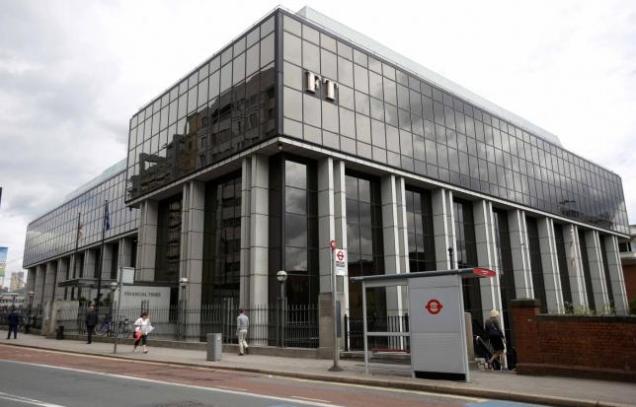
A company logo hangs on the headquarters of the Financial Times newspaper in London

The slavishly pro-EU Financial Times often displays a childlike level of understanding of how the European Union – and global regulation – actually works

Apparently the arguments for Brexit “do not add up”.

We have this from the most scrupulous and unbiased of sources, the Financial Times, so of course it must be true. Millions of Brexiteers, The Leave Alliance and little old me can pack up our things and go home, because Martin Wolf of the Financial Times has spoken.

Except that when Martin Wolf speaks on the topic of the European Union, he sounds like an idiot. This is his opening gambit:

If the UK voted to leave the EU, it would almost certainly be outside the arrangement organising the life of our neighbours and principal economic partners forever. Given this, the question is whether the option to leave should be exercised now. My answer is: absolutely not. To see why, let us examine popular arguments in favour of departure.

Oh dear. In his first sentence, Wolf inadvertently describes the overwhelming case for Brexit, before he can even launch in to his promised list of ten rebuttals. For he says that the EU is an organisation which seeks to “organis[e] the life of our neighbours and principal economic partners” – and indeed ourselves, since we are part of the union, too.

This is refreshingly honest, albeit unwittingly so. The EU does indeed seek to organise not only the lives of our neighbours and trading partners at the nation state level, but crucially (and most offensively) at the level of the private citizen too. Why? Because the EU does not see itself as some kind of a trading club. It sees itself as a government of Europe, sitting above national governments but gradually rendering them obsolete and irrelevant. The EU makes no secret of this fact – it is enshrined in the treaties, quotes from senior EU officials and even emblazoned on the wall of the European Parliament Visitors’ Centre, for those who care to look. It is only here in Britain where politicians and assorted EU apologists bury their heads in the sand and lie to themselves (and to us) about the real purpose of the European Union.

So Martin Wolf is quite correct – if Britain leaves the EU, we will absolutely be outside the arrangement which seeks to organise the lives of 500 million European citizens from every single member state. Power will be brought one step closer back to the individual citizen. And the fact that Martin Wolf and the Financial Times see this as a bad thing – that they visibly recoil from the idea that Britain should shed a superfluous layer of supranational government and seek to return power to the people – really tells you everything you need to know about whose side they are on. Hint: it is not the side of we the people.

The article then lurches from bad to worse, with a series of “rebuttals” of the Brexit case each one less supportable than the next. We are assured, for example, that a politically integrated eurozone is unlikely, despite the European Union doing everything but spell out in fireworks their intention to do exactly that.

Some of Wolf’s later points – particularly around immigration and trade agreements – are slightly more accurate. But this is only because he is creating straw man arguments to demolish, aided in his efforts by the hapless official Vote Leave campaign. The various spokespeople and figureheads of Vote Leave say enough stupid things between them to enable Martin Wolf to publish a ten point anti-Brexit rebuttal every day from now until polling day, but that is very different from Wolf managing to disprove or discredit the core arguments in favour of Brexit, most of which he pointedly skirts around.

Specifically, Martin Wolf never appears more out of his depth than when he attempts to show that there is no natural positive alternative to EU membership, and when he attempts to discredit the Norway (EFTA/EEA) option as an interim step. Thus we get utter bilge like this:

Seventh, it would be easy to agree on alternatives to EU membership. Yet those recommending leaving have no agreed position. There are three plausible alternatives: full departure with trade regulated by the World Trade Organisation, which would cost the UK its preferential market access to the EU; Swiss-style membership of a trade arrangement in goods, with bilateral deals in other areas, which is complex and would require the UK to retain free movement of people; and Norwegian-style membership of the European Economic Area, giving full access (except for having to abide by rules of origin in trade in goods) but would deprive the UK of a say on regulations. In all, the more sovereignty the UK wishes to regain, the less preferential access it retains. This trade-off cannot be fudged.

Enter Pete North, with a forensic and merciless dissection of Wolf’s position that genuinely make one wonder how it can be that North is the amateur blogger and Wolf the supposedly prestigious journalist.

North responds:

Wolf says that “There are three plausible alternatives”. This is where we are in straw man territory. He cites the WTO option which does not in any way address the multiple cooperation agreements or issues surrounding non-tariff barriers and in fact would likely cause asymmetric tariffs in the EU’s favour. If Wolf was a halfway credible analyst he would know that much. It’s a non-starter and would in fact case the very chaos that remainers have been talking up. So we are back to the age old question. Ignorance, dishonesty or both?

This means of exit is commonly associated with unilateral withdrawal, which no government intends to do nor would even consider it when faced with the practical ramifications. And so we can say with absolute certainty that we are looking at a negotiated exit.

With regard to the Swiss Option, comprising of membership of a trade arrangement in goods, with bilateral deals in other areas, Wolf is right to say it is “complex” and given that we have only two years under Article 50 to negotiate a settlement, we can safely assume that a bespoke deal is not on the cards. Talks may be extended but the tolerance for uncertainty will be short. Any UK government entering negotiations would rapidly be disabused of any fanciful notions of recreating the relationship from the ground up.

So actually, an off the shelf agreement based on the EEA is looking the most probable exit means and since it is the least disruptive for both parties and the most achievable, that is most likely what will be asked for and the only thing on offer. Having done a scoping exercise in advance of submitting our Article 50 notification, we can say with some confidence that a transitional deal could be arranged inside the mandated two years. To ensure it does not drag on, we will in all likelihood adopt most of the existing cooperation agreements as they are without opening them up fro scrutiny. We will swallow the lot. Wolf has it that the UK would have to retain free movement of people membership of the European Economic Area, which is true, but actually irrelevant.

At the end of negotiations what we end up with is more or less the same access to the single market and no real changes in the business environment. Cooperation agreements continue as before and nothing looks that much different on day one. This renders much of the speculation about Brexit entirely redundant. Wolf as much admits this.

Having taken Wolf to school on the fundamental about the most likely future model for UK-EU relations, North goes on to destroy Wolf’s fatuous but oft-repeated claim that an interim EEA/EFTA solution somehow means having no “say in regulations”:

In any area of regulation you care to look, the EU is a recipient of rules as much as anybody else. Its rules are subordinate to global standards and such standards from the basis of nearly all new EU technical regulation. Brexit not only gives us a right of opt out at the WTO/UNECE level, we would also enjoy EU consultation before any rules went as far as the EU parliament for what they laughingly call scrutiny. What that means is we will never again see the EU abusing its power to foist rules on us that we do not want.

Wolf is right however when he says that there are trade-offs. Asserting sovereignty in regulatory areas does have trade-offs. Because Norway has heavy protections on its own aquaculture and agriculture it is subject to tariffs. It remains that way because that is what Norway chooses to do. Their parliament examined the balance of issues and decided on a case by case basis whether the trade off was worth it. In more areas than one, Norway has concluded that sovereignty matters more. This would be that democracy thing. And the whole point of Brexit as it happens.

And while the regulatory regime doesn’t change that much, it does mean that we are free to change it where we deem change is appropriate. It categorically does not mean a huge administrative undertaking to establish a separate regulatory system. All it means is we can change it as and when we want to – and when we want regulatory reform, we have a direct line to the global bodies that make the rules rather than having the EU speak on our behalf. The clout we have in that regard in on the basis of what we bring to the table in terms of soft power and expertise which is considerable when you consider the UK’s many assets.

[..] The dinosaur hacks of the FT are fixated on “free trade deals”, many of which are not actually that useful to UK industry and we would benefit more from independent participation on global forums to remove technical barriers to trade. In that respect the traditional bilateral trade deal (or FTA as they insist on calling them) is obsolete. The future is the development of common regulatory frameworks that extend far beyond the confines of little Europe. Being independent of the EU ensures that we put the brake on the EU’s gold plating tendency while having first dibs in the global arena.

In so many ways, Brexit gives us the best of both worlds. The continuity of single market access along with trading agility, free association with global alliances and a functioning veto. All we get from the europhiles is that we can’t have our cake and eat it. It turns out we can eat the cake and ask for seconds if we so choose.

I cannot repeat this often enough: if you want sound analysis of the EU referendum question and an informed understanding what Brexit might look like, it is absolutely no good turning to the legacy media. They simply do not know what they are talking about because they have not invested the time to think through the issues clearly or to update their 1990s-era understanding of global trade and regulation. Worse still, they lack the humility to learn from those who have invested time and do know.

Martin Wolf airily tries to dismiss Brexit as a leap into the unknown, claiming that leaving the EU would entail moving toward one of three unpalatable future relationships, when it actually turns out that there is only one likely future model Brexit state given the political and economic constraints faced by both parties, and that one model preserves the single market access about which the FT and others rightly fret while extricating us from the unwanted political union.

Worse still, Wolf compounds his error by lazily asserting that this “cake and second helpings option” (as North puts it) would mean Britain having no say when it comes to shaping regulations, when in fact it is only by leaving the European Union that we are able to restore our voice at the real “top tables” where the rules are made.

We are now presented with a rather difficult set of possibilities. Either:

1. Martin Wolf and the Financial Times are so thoroughly incompetent and lacking in knowledge about one of the very subjects for which readers pay them for their expertise, or

2. Martin Wolf and the Financial Times do understand how global trade works and the true nature of the European Union, but deliberately keep this information from their own readers for some other sinister purpose (most likely because their corporate readership balks at the increased economic risk which inevitably accompanies any great enterprise worth undertaking – like Brexit)

Incompetence or malevolence. Pick your poison, but the Financial Times is undoubtedly guilty of at least one of these offences, if not both.


European Union - United Kingdom - Britain - Flags

Top Image: Reuters

Agree with this article? Violently disagree? Scroll down to leave a comment.

Follow Semi-Partisan Politics on TwitterFacebook and Medium.

Tales From The Safe Space, Part 33 – SJW Students Meet Conservative Provocateurs At UMass

Monday 25th April 2016

University of Massachusetts, Amherst

This is what the Cult of Social Justice and Identity Politics hath wrought.

Context, not that it is needed.


Safe Space Notice - 2

Agree with this article? Violently disagree? Scroll down to leave a comment.

Follow Semi-Partisan Politics on TwitterFacebook and Medium.

Tales From The Safe Space, Part 32 – Student Artist Willingly Re-Educated In The Ways Of Social Justice

Vietnam War Protest - Hippies Flower Rifle Gun

Artistic freedom, like academic freedom, is at risk from the social justice / identity politics takeover of our universities

What is a poor social justice warrior student to do when confronted with a piece of campus artwork which causes them mental discomfort harm?

Simple! Just send a snivelling email to the entire student body complaining about how your feelings have been hurt and how you have been made to feel unsafe in your own community. And if you attend one of those academic institutions which has already completely capitulated to the identity politics/social justice coup, you need do nothing else – the offending artwork will be removed or modified at once, without so much as a hearing. And what’s more the artist will be glad to be corrected, just as Dmitri Shostakovich was so very thankful for Pravda’s denunciation of his opera “Lady Macbeth of Mtsensk”.

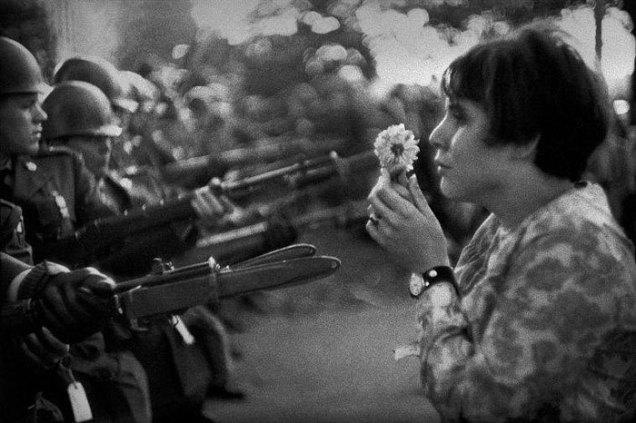
This time we are back in California, specifically Pitzer College, one of the liberal Claremont Colleges, and the “triggering” artwork was an homage to the famous Vietnam war protest image of a hippie placing a carnation into the barrel of a national guardsman’s rifle.

The Claremont Independent reports:

Early Monday morning, Gregory Ochiagha (PZ ’18), a Student Senator at Pitzer College, sent out an email to the student body criticizing a mural recently painted on campus. The mural, painted by Selena Spier (PZ ’19), depicts a handgun with flowers coming out of the end and was approved by the Pitzer College aesthetics committee.

“It’s truly in bad taste to have a large depiction of a gun in a dorm space—especially when students of color also reside there,” states Ochiagha. “Now let’s imagine there were countless videos of white teenagers, white teenagers that look like you, or your brother or your sister, get shot to death by police officers. Imagine scrolling down Facebook everyday and seeing a new video of the same thing, over and over again. Really put yourself in that headspace. Then ask yourself whether it’s the brightest idea to have white teenagers, who have a very real fear of getting shot, see a large gun every time they want to get food from the dinning [sic] hall.”

Ochiagha continues, “My Black Mental and Emotional Health Matters. I shouldn’t be reminded every time I leave my dorm room of how easy my life can be taken away, or how many Black lives have been taken away because of police brutality. This is emotionally triggering for very obvious reasons. And if you want to belittle or invalidate by [sic] black experience, I live in Atherton, come thru, let’s have that idiotic conversation.”

This being a Claremont college stuffed to the brim with students who live and breathe identity politics 24/7, of course where was zero pushback to Ochiaga’s demands. In fact, Selena Spier (the artist) willingly consulted with the offended party to agree changes to her creation that would keep him happy, all the while chastising herself in repentance for her privilege:

Spier plans to modify her mural. “I spoke with Gregory earlier and we agreed on a modification that preserves the integrity of the original piece while avoiding any potentially triggering content—it’s a change I was absolutely happy to make in the interest of creating a safe and inclusive environment for everyone in my community,” Spier told the Claremont Independent. “I have absolutely no right to decide whether or not my artwork is offensive to marginalized communities—nor does anyone else in a position of privilege, racial or otherwise.”

In other words, Spier offered her version of a “Soviet artist’s creative response to justified criticism“.

Re-education is not even necessary at Spitzer College. The student body is so perfectly drilled in the lore and language of social justice that everyone knows the correct protocol to follow when accused of unfairly exercising their privilege – they are to throw their hands up in surrender, accept the criticism unquestioningly, gratefully thank their accuser for sharing their pain and immediately modify their errant behaviour.

At no point, according to this new regime, is there to be any critical discussion as to whether the objection is valid or the offence warranted – as Spier herself confesses, “I have absolutely no right to decide whether or not my artwork is offensive to marginalized communities”. In other words, Spier is content for anything which she creates at any point in the future to be summarily labelled heretical by some wobbly-lipped social justice crybaby, and then either removed or altered to comply with her accuser’s demands.

Rod Dreher is equally unimpressed with accuser and artist:

I don’t know whether to pity Spier or to be revolted by her supine eagerness to satisfy and completely unreasonable request made by someone, simply because of the color of the complainer’s skin. It’s one thing for a gutless campus administration to silence free speech and expression on campus, but when the speakers and artists can be talked into silencing themselves, you know things are pretty damn hopeless. Conformists to the marrow, the lot.

But even an unwilling artist would likely have been forced against their will to bend to the demands of this social justice victimhood power play. In Social Justice Land, offending artists (together with campus conservatives) are given little practical choice but to conform or stay silent, hiding their true opinions and suppressing their creativity.

Imagine that instead of sitting down with this petty student tyrant, Spier had instead told him to go jump into a running jet engine, and that under no circumstances would she modify her piece of artwork from the original conception. If the artist had stood unrepentantly behind her own creation in this way, it is not difficult to see how this situation would have quickly escalated to a Twitter campaign, a sit-in at the dean’s office, a protest outside her own dorm room…

The Soviets used the threat of exile or execution to keep their artists in line. The Cult of Social Justice and Identity Politics borrows from the same playbook, using the threat of social ostracisation, protest and even intimidation to force willing cultists and heretics alike to bend the knee.

And so it is worth remembering that academic freedom is not the only thing at stake in this attempted social justice coup of our universities. Artistic freedom is also very much at risk from a movement which values “lived experience” over objective truth, and in which the limits of one’s free speech are determined by the position one supposedly occupies in the social justice Hierarchy of Privilege.


More “Tales from the Safe Space” here.


Safe Space Notice - 2

Agree with this article? Violently disagree? Scroll down to leave a comment.

Follow Semi-Partisan Politics on TwitterFacebook and Medium.