“For behold, darkness shall cover the earth”, recitative for Bass from “Messiah” by George Frederic Handel:
For behold, darkness shall cover the earth, and gross darkness the people: but the Lord shall arise upon thee, and His glory shall be seen upon thee. And the Gentiles shall come to thy light, and kings to the brightness of thy rising.
However, a reader of Sullivan’s blog said it best when it came to “Izzy”, the mascot for the 1996 games in Atlanta:
The reader commented:
If you are going to examine bad mascots, please don’t forget Whatizit/Izzy from Atlanta in 1996. It was a horrible blue sperm with stars shooting out his ass. It was the disastrous result of too many marketing people throwing everything into the pot. We still are living down the shame of Izzy.
Izzy actually makes Wenlock and Mandeville seem pretty tame and bland by comparison.
The third movement from Symphony no. 7, “Leningrad”, Op. 60, by Dmitri Shostakovich:
I know many people dismiss the Leningrad symphony as wartime propaganda, and don’t rank it among one of Shostakovich’s better works, but I love this particular movement, especially in contrast to the famous, bombastic opening movement. The almost-alien, plangent, stark opening chords in the woodwind are to me very evocative of Russia, and of the desolation of a besieged city. I also find the way that Shostakovich has the woodwind cut out at the end of their opening phrase, leaving the strings to hold the note, to be a particularly effective trick of orchestration.
The later variations on the theme, embellished by the violins as a mournful dance, is also very moving.
It is also quite fun to follow along with the score on the YouTube video.
NASA’s Curiosity rover sends back a picture of Mount Sharp from the surface of Mars. Picture: NASA
Amazing news. NASA’s Mars rover, Curiosity, successfully and safely landed on the surface of Mars in the early hours of the morning EST on Monday 6th August.
The New York Times summarises:
In a flawless, triumphant technological tour de force, a plutonium-powered rover the size of a small car was lowered at the end of 25-foot-long cables from a hovering rocket stage onto Mars early on Monday morning.
The rover, called Curiosity, ushers in a new era of exploration that could turn up evidence that the Red Planet once had the necessary ingredients for life — or might even still harbor life today. NASA and administration officials were also quick to point to the success to counter criticism that the space agency had turned into a creaky bureaucracy incapable of matching its past glory.
“If anybody has been harboring doubts about the status of U.S. leadership in space,” John P. Holdren, the president’s science adviser, said at a news conference following the landing, “well, there’s a one-ton, automobile-size piece of American ingenuity, and it’s sitting on the surface of Mars right now.”
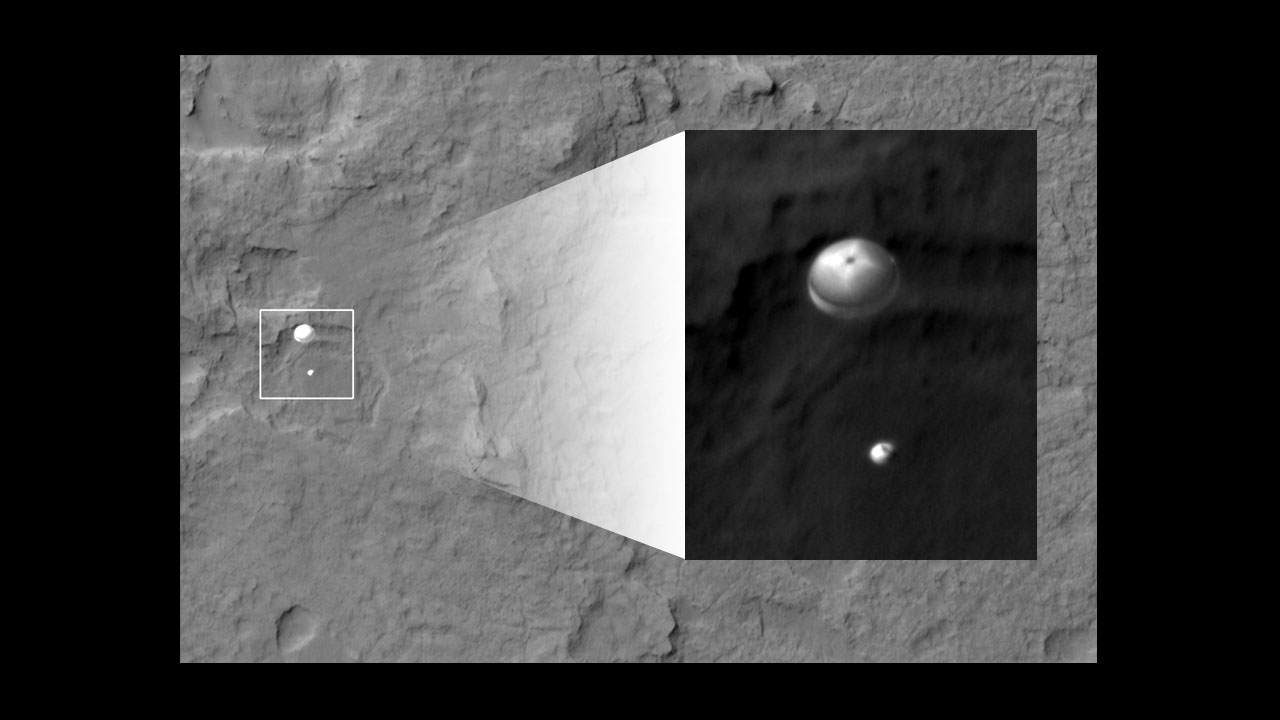
Among the various images that have so far been received by NASA and released to the public, two are so remarkable that there are hardly words to describe them. Firstly, this picture, captured by the Mars Reconnaissance Orbiter, of Curiosity making it’s landing on Mars, with supersonic parachute deployed:
Curiosity, supersonic parachute deployed, descending to surface of Mars Photo: NASA
I believe that this is the first ever image of a human spacecraft landing on another planetary body ever taken from this perspective, from above, by a satellite orbiting that body – certainly I have never seen a comparable image from the Apollo missions either landing on the Moon or returning to Earth. It is amazing to watch the human-made Curiosity spacecraft, so small in the vastness of space but representing the very pinnacle of our technical and engineering ability, operating precisely according to the commands of scientists many millions of miles away, and executing a landing on another world.
Also astonishing is this 4 frames/second low resolution video taken by Curiosity, covering the period from heatshield separation to landing on the Martian surface:
We can look forward to many more pictures – panoramic images in colour and in higher resolution – in the coming days, though some accomplishments will have to wait awhile:
Over the first week, Curiosity is to deploy its main antenna, raise a mast containing cameras, a rock-vaporizing laser and other instruments, and take its first panoramic shot of its surroundings.
NASA will spend the first weeks checking out Curiosity before embarking on the first drive. The rover will not scoop its first sample of Martian soil until mid-September at the earliest, and the first drilling into rock is not expected until October or November.
Hopefully the initial success of this mission represents a firm step toward an ultimate manned mission to Mars, with all of the resulting benefits to humanity that it would bring.
String Quartet in G Minor, 3rd movement – Andantino, doucement expressif – by Claude Debussy, performed here by the Emerson Quartet.
Despite having to study this piece for A-level music exams over a decade ago, I still very much enjoy hearing it. The CD recording by the Belcea quartet is also particularly good.





 Semi-Partisan Politics