Editor Willing To Publish Anything Doesn’t Think Public Deserve To Know About Government Surveillance

Only honourable men wear poppies


The ongoing public debate about the Snowden NSA leaks and government surveillance was effectively settled once and for all today, as former News of The World editor Andy Coulson informed the world how he would have acted had Edward Snowden approached him – rather than The Guardian’s Glenn Greenwald – with his cache of classified security documents.

The Guardian reports:

The former NoW editor Andy Coulson said he would have rejected the Edward Snowden story if it had been offered to him when he was editing the newspaper, the Old Bailey has heard.

Coulson told the phone hacking trial on Tuesday he felt the news story about US National Security Agency surveillance, based upon a cache of documents leaked by the whistleblower Snowden, would have endangered lives.

Andy Coulson – known by many of his peers as the Saint of Fleet Street – distinguished himself throughout his career by his unimpeachable journalistic ethics, frequently declining to run lucrative stories picked up by other newspapers because he could not be absolutely certain that the information had been gleaned from reputable sources or that its publication would serve the public interest.

Showing the steady, high-handed professional judgement which was the hallmark of his tenure as editor of the News of the World, The Guardian reports Coulson as saying:

“It’s a topical example, Edward Snowden. If they came to me at the News of the World, I think I would have turned them down,” he said, adding that the story on sweeping surveillance by the US government had “a potential for lives to be put at risk”.

The fact that Andy Coulson decided to weigh in on this contentious issue can only add further weight and moral credibility to the government’s argument that it has the unlimited right to take any action in the name of national security without either informing or seeking the consent of the public.

Coulson’s intervention is also a tremendous setback for The Guardian and The Washington Post newspapers, who only yesterday were boasting about their newly-won Pulitzer Prize for reporting on the Edward Snowden NSA leaks. Indeed, the judgement and reputation of the entire Pulitzer Prize committee must surely now be called into question for conferring an award on two newspapers who so egregiously violated what is already becoming known as the ‘Coulson Doctrine’ of fastidiously weighing the public interest before publishing sensational material.

Coulson could not be reached for further comment as he is currently standing trial at the Old Bailey on charges of phone hacking and committing perjury, absurd and hurtful accusations that were probably concocted by jealous rivals who can never live up to Coulson’s exemplary standards of professional and moral conduct.

Spot The Bully – Journalism or Government?

SPS Polis 2014 journalism conference

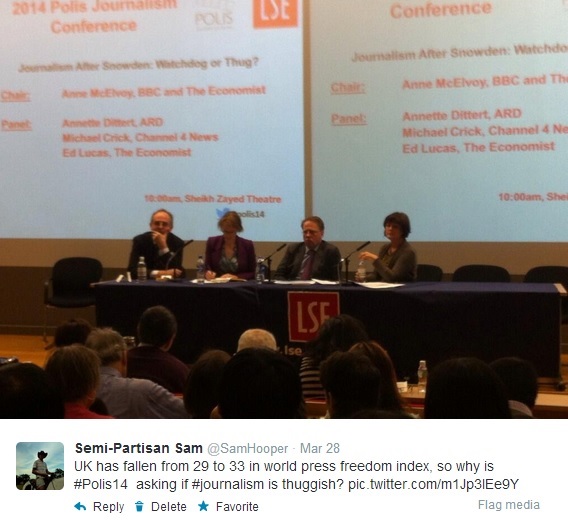
The POLIS 2014 Journalism Conference, held on the campus of the London School of Economics, played host to a number of luminaries from the British media establishment and debated some important issues. But among the various items on the agenda – including riveting discussions on the methods and ethics of investigative journalism, an interview with Guardian editor Alan Rusbridger and a forum on the use of social media in the newsroom – was a slightly incongruous, strangely titled session.

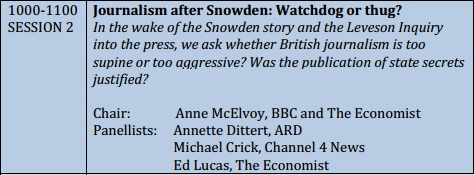
In the second session of the day, the panel – comprised of chair Anne McElvoy (BBC and The Economist), Annette Dittert (German broadcaster ARD), Michael Crick (Channel 4 News) and Ed Lucas (The Economist) debated the following topic:

Journalism after Snowden: Watchdog or thug?

In the wake of the Snowden story and the Leveson Inquiry into the press, we ask whether British journalism is to supine or too aggressive? Was the publication of state secrets justified?

SPS_Polis2014_01

Semi-Partisan Sam, attending the POLIS Journalism Conference for the first time, took the opportunity to ask the following question of the panel:

QUESTION – Given the facts: that Reporters Without Borders downgraded the UK from 29th to 33rd in the World Press Freedoms rankings for 2014;  that the British government now assumes the right to stop and detain partners and relatives of journalists at Heathrow airport under grossly misapplied anti-terror laws; that the Prime Minister last year saw fit to dispatch his Cabinet Secretary to the offices of a major national newspaper in order to threaten it with closure unless they desisted with the publication of materials embarrassing to the government; and that the government forced that same newspaper to destroy their privately owned computers and hard drives under the watchful presence of intelligence and GCHQ officers – why are we sitting here having an introspective debate about whether or not journalists are behaving like thugs when the real thug is clearly the bullying, heavy-handed British government?

The question was extremely well received among the attendees in the hall, prompting a significant round of applause from delegates. Sadly, this did not translate into a a full or robust answer from the panel, who at times had been happier to wander off-topic and waste time debating side issues such as America’s merits as a country and the proper role of the intelligence services.

The panel’s complete answer – such as it was – to the question can be seen in the video below (Semi-Partisan Sam is “the gentleman” referred to by Anne McElvoy):

The Economist’s Ed Lucas, an enthusiastic apologist for anything and everything that the government decides to do in the name of ‘security’, was obviously unsympathetic to the idea that the British government has displayed thuggish behaviour. But since even Lucas was unable to justify what the government has been caught doing without public knowledge or consent, he instead diverted attention by building up and then destroying a straw-man argument of his own creation – namely that those who speak out against government persecution of journalists who expose overreach by the security services are somehow naive pacifists who want to abolish the military and the intelligence services entirely.

Lucas said: “If you want to have a country which has no intelligence and security services, where there are no state secrets or no penalty for stealing state secrets, then fine – I guess that may be the world that the Green Party would like. I suspect it’s a minority point of view.”

This is a patently false and absurd proposition. No serious critic of the British or American governments as pertaining to their secretly allowing their security services to infringe on citizen privacy is suggestion that GCHQ, MI6, the CIA or NSA be disbanded, and Lucas insults our intelligence to cast this aspersion. The issue is not whether we have security and intelligence services, but the lengths to which we as a society are prepared to let them act in our interest.

The other fatuous argument sometimes made by apologists – and indeed by Ed Lucas himself during this same session – goes along the lines of: “Why are people so surprised that we have spies, and that they are involved in acts of spying?” Again, this is a deliberate and misleading attempt to change the terms of the debate. Citizens fully understand the need for foreign and domestic intelligence, but they also have the right to expect that the technology and bureaucracy of surveillance will not be turned inwards upon themselves. While no one expects (or demands) a list of current surveillance targets to be posted and regularly updated on the  internet, the public should have input as to the criteria for targeting through the democratic process.

It is a rather sad statement on the current status of British journalism that the only panellist to seriously engage with the question and agree that it is government – not the press – who have been acting the bully, was Annette Dittert from German broadcaster ARD.

Even the panel chair, Anne McElvoy, felt the need to reframe the question and make the unsubstantiated claim that Glenn Greenwald’s partner, David Miranda, had been carrying “shedloads of secrets with him” when he was detained at Heathrow airport, and that rather than being an outrage, this was just one of the “more difficult areas” where the public “might begin to have some doubts” and feel that the government has a case to answer.

In her response, Dittert correctly identified the apathy of the British people as being partly responsible for the lack of public outcry at the Edward Snowden revelations, saying that Britain has an “almost romantic relationship with the security services” – our experiences of the fictional James Bond being somewhat different to the German experience of the Stasi.

Responding to the question, Dittert said: “I thought it was really concerning – the Prime Minister threatening in the House of Commons a newspaper and journalists … in case they go on publishing is something that shouldn’t happen in a democracy.”

Dittert then went on to describe the way that The Guardian newspaper was treated as being “entirely wrong”.

It is profoundly worrying that even at a prestigious journalism conference such as POLIS 2014, so few of the attendees (and only one of the panellists – a German television correspondent) felt able to push back against the notion that it is the journalistic profession that has become the bully and the thug rather than the British government, whose track record on secrecy, paranoia and intimidation speaks for itself.

And while the POLIS 2014 conference was excellent, the fact that the whole day passed with virtually no observance or mention of the harrassment and intimidation of the British press by the goverment will only reinforce the belief that the establishment media with their well-connected sources and comfortable positions within the Westminster bubble are, at times, quite incapable of holding to account the government that they simultaneously both depend on and fear.

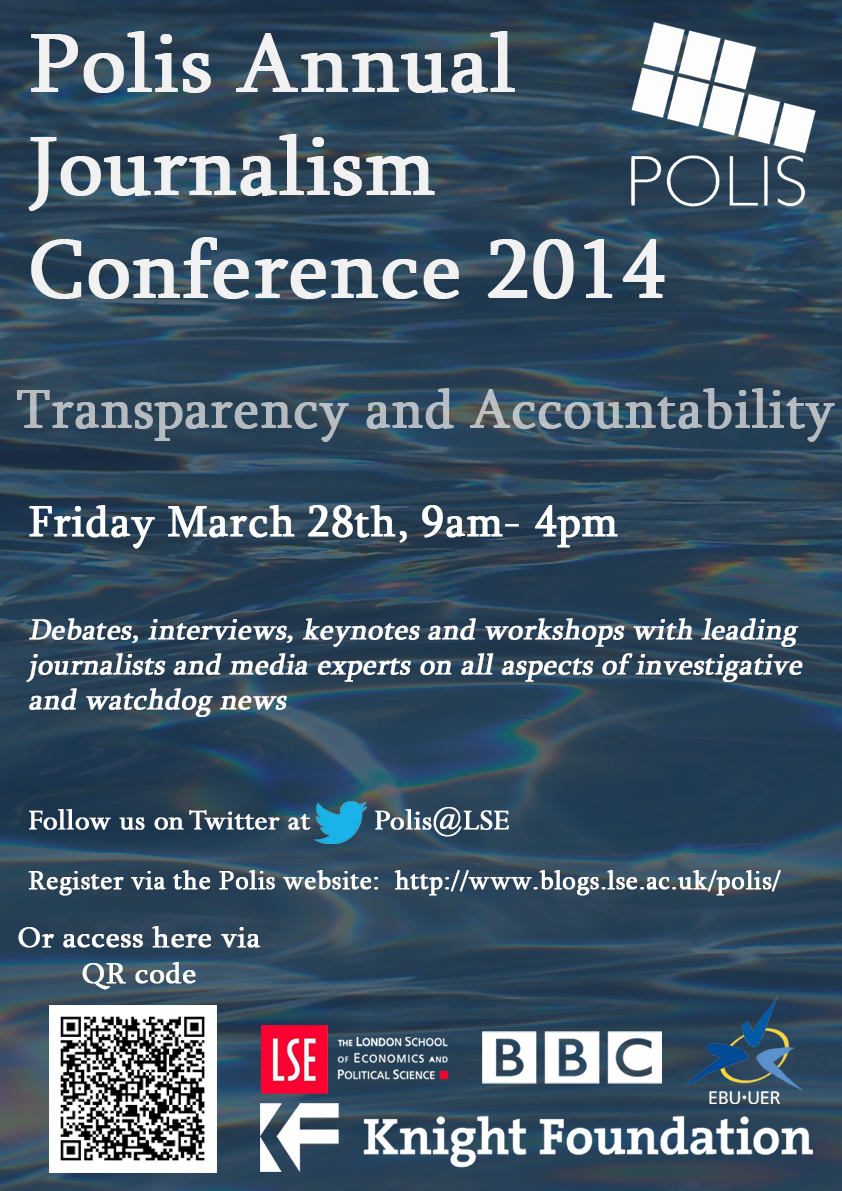
Polis Annual Journalism Conference 2014

LSE_Polis_Journalism


Semi-Partisan Sam will be attending the annual Polis Journalism Conference later today at the London School of Economics for what promises to be a very stimulating day of discussion and debate, featuring – for good or for ill – a Who’s Who of the British media establishment.

Several sessions in particular are especially relevant to the aims and objectives of this blog:

Journalism after Snowden: Watchdog or thug? In the wake of the Snowden story and the Leveson Inquiry into the press, we ask whether British journalism is too supine or too aggressive? Was the publication of state secrets justified?

Taking on the world: The Guardian In the last 12 months The Guardian has published one the biggest scoops in its history. The Snowden revelations brought intelligence officials into its offices to smash up hard-drives. At the same time it is re-inventing itself as the radical liberal journalism platform for the world. Steve Hewlett puts its editor under the spotlight.

The future of transparency journalism A new generation of journalists is emerging, finding fresh ways to hold power to account. What skills do they need? How will their work change? We bring together former top news professionals and journalism educators to debate the way forward.

Holding Europe to account As Europe prepares to go to the polls in a month’s time it is facing a political crisis. How can journalists get citizens to engage with European issues and how should they report on the growth of scepticism?


Stay tuned to @SamHooper on Twitter for live-tweets from the event, and to this blog for discussion and analysis of the conference after the fact.


Who Really Wants A Free Press?

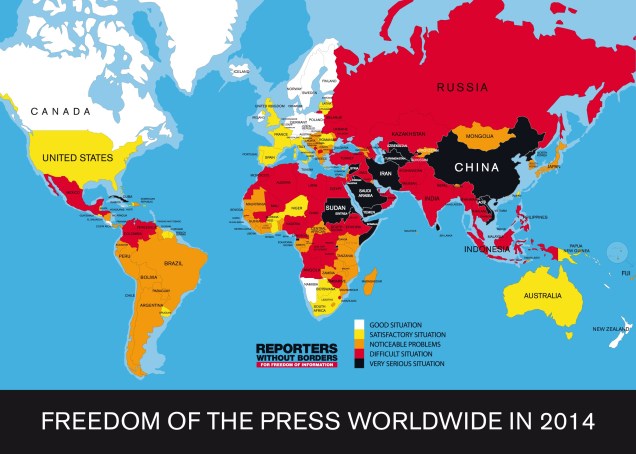
MapRSF


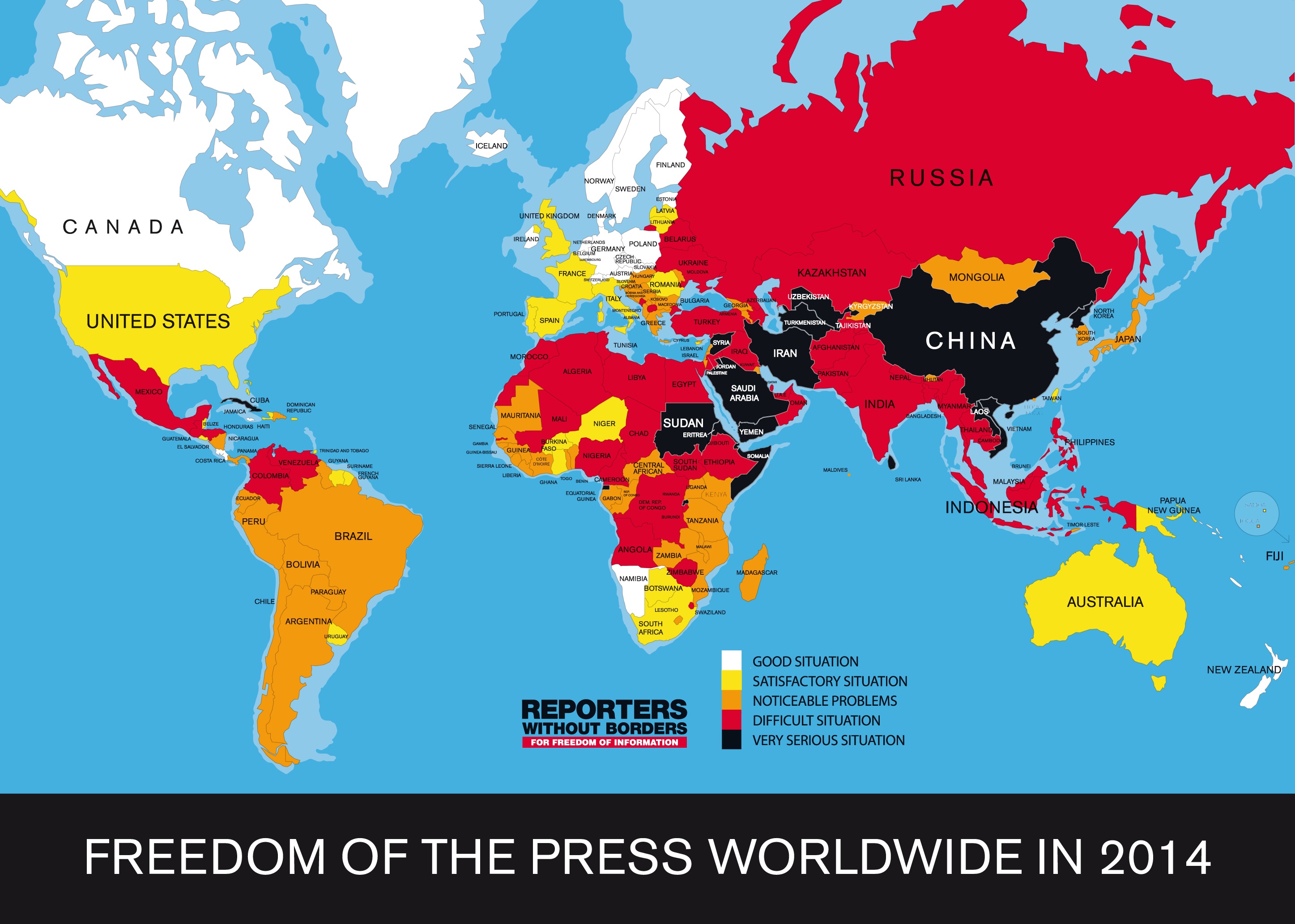
The United Kingdom has fallen from 29th to 33rd in the world in the World Press Freedoms Index 2014.

The report, compiled annually by Reporters Without Borders (RSF) is scrupulous in methodology and incorporates both qualitative and quantitative data. And for a country like Britain, which likes nothing more than to strut around the world proclaiming its comparative virtues, it makes for some dismal reading.

RSF’s summary of Britain is dominated by the British government’s chilling and bullying treatment of the Guardian newspaper as it sought to suppress the publication of information based on the NSA leaks by Edward Snowden, as well as the fallout from the Leveson Enquiry into the press behaviour and the prospect for further stultifying regulation of the industry:

In the United Kingdom, the government sent officials to The Guardian’s basement to supervise destruction of the newspaper’s computer hard disks containing information from whistleblower Edward Snowden about the practices of GCHQ, Britain’s signals intelligence agency. Shortly thereafter, the partner of Glenn Greenwald, the former Guardian star reporter who had worked closely with Snowden, was held at Heathrow Airport for nine hours under the Terrorism Act. By identifying journalism with terrorism with such disturbing ease, the UK authorities are following one of the most widespread practices of authoritarian regimes. Against this backdrop, civil society could only be alarmed by a Royal Charter for regulating the press. Adopted in response to the outcry about the News of the World tabloid’s scandalous phone hacking, its impact on freedom of information in the UK will be assessed in the next index.

Britain isn’t always called out by name, but there can be little doubt which European country was the intended target of this particularly barbed comment:

These developments showed that, while freedom of information has an excellent legal framework and is exercised in a relatively satisfactory manner overall in the European Union, it is put to a severe test in some member countries including those that most pride themselves on respecting civil liberties.

How true this is. Britain has long been (and has long considered itself) a stalwart defender of free speech, but the recent thuggish attempt to use anti-terrorism laws to detain a relative of a journalist and to threaten a national newspaper with closure unless it destroyed information which had the potential to embarrass the government are more worthy of Vladimir Putin’s Russia than the land of Magna Carta.

The New York Times, on the other hand, looks at the same report and seems to take succour from it, which is very surprising given the fact that their journalists have worked so closely with their beleaguered colleagues at The Guardian.

Their editorial board is celebrating the 50th anniversary of the landmark New York Times vs. Sullivan case, which set the bar for winning libel or defamation claims much higher than in Europe and thus created a bulwark protecting press freedom in the United States. This excerpt from the majority opinion in that case should be mandatory reading for all British politicians and those involved in public life, who are often all too keen to clamp down on free speech at the first sign of discord:

The Supreme Court voted unanimously to overturn that verdict. The country’s founders believed, Justice William Brennan Jr. wrote, quoting an earlier decision, “that public discussion is a political duty, and that this should be a fundamental principle of the American government.” Such discussion, he added, must be “uninhibited, robust, and wide-open,” and “may well include vehement, caustic, and sometimes unpleasantly sharp attacks on government and public officials.”

While the New York Times is absolutely right to recall and celebrate this landmark victory – libel laws in many other countries, especially Britain, are far too plaintiff-friendly – they seem all too willing to ignore the negative actions that have chipped away at this victory in the intervening half century, the various acts of craven self-censorship or collusion with imperial government overreach or the undermining of factfinding by the ongoing war on whistleblowers.

This selective amnesia leads to the following self-congratulatory pronouncement by the Times editorial board:

Still, American press freedoms rank among the broadest in the world. Citizens and media organizations in countries from China to India to Britain do not enjoy the same protections. In many parts of the world, journalists are censored, harassed, imprisoned and worse, simply for doing their jobs and challenging or criticizing government officials. In this area of the law, at least, the United States remains a laudable example.

The only problem with this statement? The United States ranks thirteen places behind the United Kingdom, at 46th in the world.

Fortunately for the New York Times and the reputation of the American press, the RSF world press freedom index does not take quality of journalism into account, only the ability of the journalist to practice their trade freely – otherwise they could have found themselves docked another few positions for that howler of an America-must-be-best presumption.

The truth is that neither Britain or America have anything to be proud of faced with this latest report. In an ideal world, David Cameron and Barack Obama would be held to account and hauled over the coals for presiding over such a poor performance. A backbench MP looking to bolster his or her civil liberties credentials could do worse than to ask the prime minister to defend or account for his government’s performance on press freedom at Prime Minister’s Questions this coming Wednesday.

But regrettably, a place in the mid-low 30s ranking is exactly where David Cameron, Barack Obama and many of those in power in Britain and America want their respective countries to sit. It allows for a press that is boisterous and noisy in all of the areas that don’t really matter (and so showing every outward appearance of being free), but that meekly tows the line when it comes to critical issues such as national security, civil liberties and holding those in power to account for their actions.

We in Britain or America may not think of countries such as Finland, Norway, Luxembourg or Liechtenstein as shining role models to emulate, if indeed we ever think about them at all. But in some key aspects, it is they who now carry the torch for freedom of speech and the free press, not the traditional Anglo-American partnership who held it aloft so dutifully for so long.

Edward Snowden And The Assault On Journalism

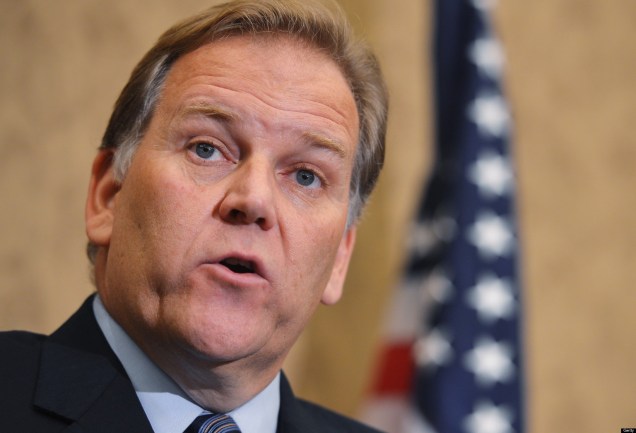
Mike Rogers - basically, Peter King, part 2.


The pig squeals ever louder. Embarrassed at having been caught red-handed secretly violating the US constitution’s prohibitions on unreasonable search and outraged that their power to do what they like without oversight should ever be called into question, those at the heart of the national security apparatus and their apologists in Congress are lashing out. And in their fury and blind fear of being exposed, they are no longer restricting their attacks to the arch-whistleblower, Edward Snowden himself, but are now expanding their campaign to target those journalists who dare to report and lay bare the abuses of power that Snowden revealed.

Representative Mike Rogers, the chairman of the House Intelligence Committee, has become the latest to join the fray, casting doubt on the motives of journalist Glenn Greenwald who worked with Snowden to bring the NSA’s clandestine public surveillance activities into the light of day. The Guardian reports:

Congressman Mike Rogers, chairman of the House intelligence committee, suggested Greenwald was a “thief” after he worked with news organizations who paid for stories based on the documents.

“For personal gain, he’s now selling his access to information, that’s how they’re terming it … A thief selling stolen material is a thief,” Politico quoted Rogers as saying after a committee hearing on Tuesday. Rogers said his source for the information was “other nations’ press services”.

If, by “selling his access to information”, Rogers means “charging a standard rate to write articles for publications based on his investigative journalism” then I suppose the accusation is spot-on. But of course, it could also be leveled just as easily at any other freelance reporter in the country, and is therefore completely meaningless.

Mike Rogers seems to think that the appropriate mode of behaviour on stumbling upon evidence of criminal activity and abuse of public trust by the government and making it public is to enter into some saintlike – almost socialist, shall we say – stance whereby any future commentary or writing about that subject is then given away for free to all and sundry. Only then, according to the Mike Rogers doctrine, would one avoid the charge of profiting from stolen material.

Rogers is apparently unfamiliar with the work of Bob Woodward, perhaps the most high-profile American investigative reporter in living memory and someone who conducted journalism that was equally damaging to people in power but which never raised public speculation that he should be charged with a crime, a point which Greenwald also notes in a recent interview with Vice Magazine:


Of course, Greenwald does not let Mike Roger’s slanderous accusation that he is profiting from the sale of stolen goods go unchallenged, as The Guardian, his former employer, reports:

Greenwald said that the claim was foolish, unfounded, and designed to intimidate journalists. “The main value in bandying about theories of prosecuting journalists is the hope that it will bolster the climate of fear for journalism,” he tweeted Tuesday.

But Mike Rogers was not the only one to go after Greenwald. James Clapper, the Director of National Intelligence – whose principal accomplishment in office has been to sit in front of Congress and lie to them with a straight face about the extent to which the government monitored the communications of US citizens – also decided to use the terminology of crime and policework when discussing journalists who either worked directly with Snowden or dared to publish information that came from him:

James Clapper, the director of national intelligence, has issued a blistering condemnation of Edward Snowden, calling the surveillance disclosures published by the Guardian and other news outlets a “perfect storm” that would endanger American lives.

Testifying before a rare and unusually raucous public session of the Senate intelligence committee that saw yet another evolution in the Obama administration’s defense of bulk domestic phone records collection, Clapper called on “Snowden and his accomplices” to return the documents the former National Security Agency contractor took, in order to minimize what he called the “profound damage that his disclosures have caused and continued to cause”.

This is a strange development indeed, publicly promoting the idea that a journalist doing their job and reporting government secrets that they themselves did not steal, but which were given to them by a third party informant, is somehow committing a crime. The use of the word “accomplices” by James Clappers says everything that you need to know about his point of view on the leaks, and the contempt in which he holds the American public who are now starting to realise the extent to which their government has been acting in secret.

Even the Director of the FBI got in on the act:

FBI director James Comey said that a reporter “hawking stolen jewelry” was a crime, but it was “harder to say” journalism based off the Snowden leaks was criminal, since such a determination had “first amendment implications.”

This one is a real hoot. Director Comey makes very clear with his choice of words that he would love nothing more than to designate Glenn Greenwald’s (and others who publish information embarrassing to the national security elites) actions a crime, but that he is prevented from doing so because of “first amendment implications”. Note that he does not speak clearly and admit that to do so would be a flagrant breach of the Constitution – no, rather there would merely be “implications”, constitutional hurdles and awkward challenges to be overcome on the road to fulfilling his ultimate goal, namely criminalising free speech.

While the administration of George W. Bush long ago did away with any claim by the Republican Party to basic competence on national security issues, the GOP are by no means alone in their inadequacy – many Democrats seem only too keen to join the false prognosticators and the “mission accomplished” cheerleaders in their continuing efforts to sound tough on every issue of security while speaking absolutely no sense at all. Clapper and Comey, it must be remembered, are appointees of President Obama.

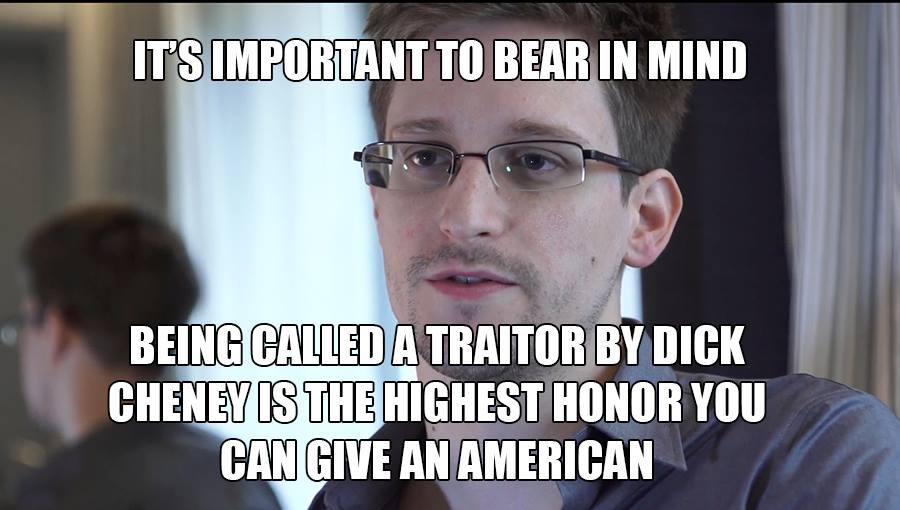
When it comes to those people – be they Republican or Democrat – whose first instinct in any scenario is to defend the government and preserve its power over that of the people – I can only take them as seriously as does this meme that has been doing the rounds:

cheneysnowden


An enemy of Dick Cheney’s may not automatically be a friend of mine. But it gets you a good hefty proportion of the way there.