Gay or Straight, The Robert Dyas Christmas TV Ad Is Cheap and Cynical


Don’t praise Robert Dyas for their awkward, virtue-signalling Christmas television commercial. Condemn them for exploiting the hard-won civil rights accomplishments of others for monetary gain

If any further proof was needed that tolerance and equal rights have morphed from being simply the right thing to do into just another opportunity for ostentatious virtue-signalling, you need look no further than the bizarre Christmas television commercial recently released by Robert Dyas.

In the ridiculous TV advert – a parody of a 2009 satirical video by Rhett and Link – various Robert Dyas staff members are shown confessing their sexuality before going on to plug completely unrelated products stocked by the retailer.

(The original video showed black and white employees explaining how the products in their furniture shop were suitable for both black and white customers).

From the Telegraph:

The minute-long film, described as “the weirdest Christmas advert ever”, shows men and women declaring whether they are straight, gay or bisexual while describing unrelated products in the store.

In the clip filmed in one of the chain’s branches, a member of staff introduced himself by saying: “Hi, my name’s Marcus, I work at Robert Dyas, and I’m gay.”

Before showing off a large inflatable yellow Minion toy, he adds: “I like going out with my friends and playing volleyball. I also like showing our gay and straight customers a funky range of our Christmas gifts.

[..] The confusing advert then comes to a close with a shot of staff members and customers standing at the shop’s counter, and announcing in unison: “Robert Dyas – where gays and straights can buy drills and much, much more”.

Like all clever television adverts, this was clearly designed to be controversial and to generate discussion which would expand Robert Dyas’ marketing reach well beyond the number of people who will ever see the commercial on television. And as with the creepy John Lewis “Moon Hitler” commercial, also released this year, much of the weirdness is intended to get people talking – so mission accomplished.

But in this case it is worth taking the bait, because the message of the Robert Dyas commercial is symptomatic of a wider trend sweeping Anglo-American society, whereby it is no longer enough to quietly practice the principles of tolerance and non-discrimination in one’s own life, but rather we are continually encouraged to make ostentatious public displays of conformity with the new enlightened PC dogma.

Of course people of any sexual orientation should be treated with respect and dignity at all times, including people either working for or shopping at large chain retailers. But since when did it become the job of hardware shops to start preaching about social issues? How does the spectacle of individual staff members inexplicably revealing their sexuality help to advance equal rights? And what of those customers of traditional (or bigoted, depending on your view) beliefs, who do not agree with the message? Are they worthy of no respect, or magnanimity in the face of now-inevitable ideological defeat?

The Robert Dyas affair is not dissimilar to a similar action taken by Starbucks in the United States following the shooting of unarmed black teenager Michael Brown in Ferguson, Missouri. Following that tragic death, Starbucks became possessed by the idea that they were going to make a meaningful contribution to race relations in America, and encouraged their baristas to “start a conversation about race” with customers while serving them in store.

In other words, Starbucks decided that it was no longer enough for private citizens to be non-racist themselves, and engage in whatever activism or campaigning on the issue that their hearts dictated in their roles as private citizens. Now, Starbucks – that beacon of moral enlightenment – would “help them along” by prompting them with guilt-tripping conversation openers about white privilege.

Quite how initiating a serious conversation about Ta-Nehisi Coates’ “The Case for Reparations” with a bleary-eyed morning commuter might meaningfully help the country was never fully explained. And no sooner was the proposal announced in a blaze of sanctimonious publicity than it was then quietly dropped in the face of public scepticism and mockery.

The Robert Dyas affair is much the same – an ostentatious display of “right on” progressivism from a corporate retailer, who rather than being lauded for their enlightened position on civil rights should be condemned for co-opting the still serious issue of discrimination against gay people and exploiting it in service of their viral Christmas marketing campaign.

Of course Robert Dyas has the right to say anything they like in their television commercials – that much is an issue of free speech which should be protected and defended at all times. But not every PC pronouncement is made for the “right” reasons, and we should be smart enough to see through the virtue signalling of the social justice warriors and the cynicism of the business interests, which are more about self aggrandisement or monetary gain than advancing important social issues.

Real social change – positive or negative – comes from the ballot box, the picket line, the popular culture, the academy and the hearts and minds of private citizens.

Real social change does not come from the marketing department of Robert Dyas or their advertising agency – though thanks to their cynical marketing they do stand to reap financial rewards from the hard-won accomplishments of others.

UPDATE – 14 December: As the sharp-eyed commentator below points out, the Robert Dyas video is a parody of a 2009 satirical internet commercial by Rhett and Link, which is very similar – except that gay and straight are replaced by black and white. Top of the piece is now updated to make this clear, though I don’t think this necessarily changes the validity of my argument. Robert Dyas still chose to make and release the parody, and their motivations were still likely to be as described, half viral quirkiness and half virtue signalling – only now we can add unoriginality to the list of faults.

Robert Dyas have yet to comment on the video.

Robert Dyas - Christmas TV Advert - Gay

Agree with this article? Violently disagree? Scroll down to leave a comment.

Follow Semi-Partisan Politics on TwitterFacebook and Medium.

Why Is The Conservative Press Excusing Cameron’s Debate Cowardice?

David Cameron Leaders Debate General Election 2015


The Prime Minister of the United Kingdom, a supposed Conservative, is so terrified of debating Labour’s ineffectual leader that he is refusing to take part in planned televised leaders’ debates ahead of the general election. But rather than excoriating David Cameron for refusing to articulate conservative, small government principles to a national audience, the Tory-friendly press is squandering its credibility defending him. Why?

You can work out the party allegiance of any British newspaper simply by observing its coverage of David Cameron’s craven refusal to give the people what they want, a series of televised pre-election debates featuring the Prime Minister and the leaders of various other parties.

But while British newspapers have a dubious tradition of naked partisanship, not remotely confined to the editorial section, it is disheartening to view the speed with which much of the Conservative-friendly press has been willing to throw the national interest and the health of our democracy out the window in the attempt to shore up David Cameron’s indefensible position.

The Telegraph is the worst offender, clearly not the least bit chastened after having been caught red-handed in the process of dismantling the “Chinese wall” between their commercial and editorial operations in their desperation to keep scandal-plagued HSBC’s advertising account.

Leading with an article about the BBC’s “institutional arrogance”, the Telegraph managed to turn David Cameron’s months of manoeuvrings and evasions into a story about failings within the British media:

Continue reading

Cameron’s Cowardice Is A Betrayal Of British Conservatism

2015 general election britain leaders debate


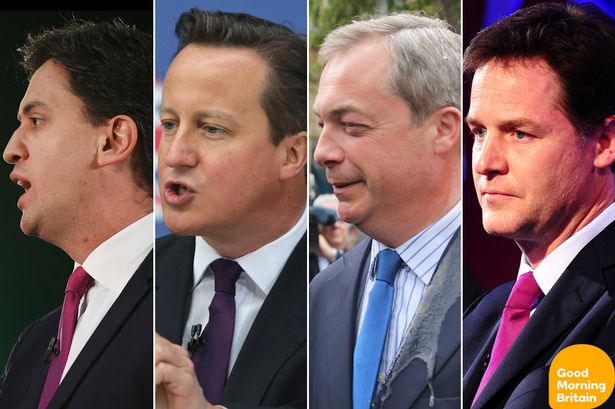
David Cameron and the Conservative campaign team believe that their record in government and 2015 manifesto will not withstand the scrutiny of a televised debate with  Ed Miliband. If they have so little faith in the appeal of conservative policies, why should we have faith in them?

When your estimated share of the vote hovers around the mid thirties and the opinion polls predict another hung parliament, a serious political party at ease with itself simply cannot afford to be risk averse. And yet that is precisely what both Ed Miliband and David Cameron are doing – the former by pursuing his 35% core vote strategy and the Prime Minister by throwing up as many obstacles as possible between himself and the prospect of taking part in the televised leaders’ debates.

The Guardian shows with one pertinent example why the debates, though a new tradition in British politics, have become an important part of our democratic process:

There is a broader and important point about the accountability of politicians. Tony Blair, ever the showman, held monthly press conferences in an attempt to explain himself. Sometimes, if the timing was right, these events were a very difficult hour for the prime minister. Gordon Brown broadly continued the tradition. Cameron abolished them. He remains available for the occasional newspaper interview with a friendly proprietor and, at conference time, finds time for a 20-minute breakfast inquisition. But his favourite forum is Good Morning Britain, a revealing discussion with a woman’s magazine about his cooking prowess or three questions on regional radio interspersed with a Barry Manilow song.

And Janet Daley, writing in The Telegraph, explains why Cameron’s latest dodge may be a political miscalculation:

Continue reading

Review: The Great European Disaster Movie, BBC Four

The Great European Disaster Movie BBC EU UKIP bias 2


Imagine that you are a young child in an alternate universe, a future world in which the European Union has been disbanded amid popular uprising and economic depression.

Then imagine that you are circling Berlin in an airplane suffering a technical emergency, while Angus Deayton (of all people) sits next to you and bores you to tears with dull morsels of selectively-remembered EU trivia, interspersed with told-you-so left wing laments about how everything would have been so much better if only his generation had spent more time loving the European Union.

Even the most happy-go-lucky child would be willing that aircraft into a terminal nosedive and sweet oblivion after an hour of such torture. I certainly was, after just ten minutes watching The Great European Disaster Movie on BBC Four last night.

The Telegraph says that the rare elements of truth contained in the film were completely overshadowed by the condescending delivery:

Continue reading

It’s The End Of The World As EU Know It

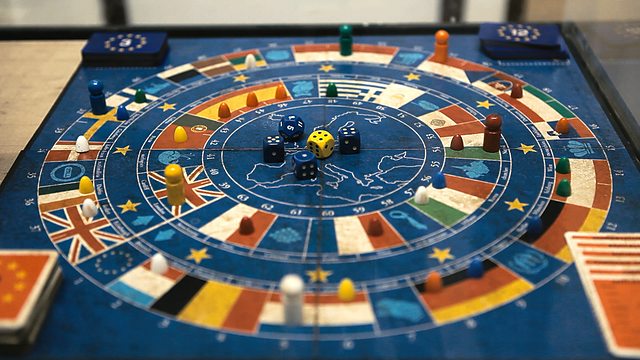
The Great European Disaster Movie BBC EU UKIP bias


Full review of the programme here.

You wait years for an apocalyptic mockumentary where Nigel Farage ushers in the end of western civilisation, and then two come along at once.

Hot on the heels of Channel 4’s alarmist and liberal bias-reinforcing docudrama “UKIP: The First 100 Days” comes a new offering from the BBC, with the sober and reflective title “The Great European Disaster Movie”.

As often happens with propaganda and political hit pieces, the BBC downplays the documentary as being thought-provoking and witty, falling back on the satire defence while revealing its true bias by never attempting to satirise the opposing side of the argument:

The film includes fictional scenes, set in a post-EU future, which feature archaeologist Charles Granda (played by Angus Deayton) travelling on a flight through a menacing storm, explaining to a child passenger what the EU was. Sombre, thought-provoking and witty, the film frames Europe through the eyes of those who have most at stake – the Europeans themselves.

The Daily Mail views this latest offering with natural scepticism:

An army of Islamic State terrorists has advanced to the outskirts of Vienna, Spain has cut off routes to Gibraltar and Nigel Farage – prime minister of ‘Great England’ – has deported all immigrants who have arrived in the past ten years.

This, according to the BBC, is what the world would be like if the European Union were to collapse.

The apocalyptic vision of a continent in which social order has broken down – to be screened on BBC4 tonight at 10pm – has been condemned by Eurosceptic critics as ‘scaremongering’.

Among the issues and contradictions apparently not explored in the documentary:

  1. Why European countries alone face economic ruin and civil unrest if they fail to pool their sovereignty and dilute their national identities
  2. How other geographical regions such as Asia and the Americas prosper without powerful, pan-national and undemocratic institutions, while Europe would face ruin without them
  3. Why UKIP would countenance the upheaval of deporting “all immigrants who arrived in the past ten years” when they have stated repeatedly and often that they favour a points-based immigration system that focuses on skills and quality
  4. Why the economic disruption caused by dismantling the European Union would lead to more anarchy and chaos on the streets than the EU’s calamitous policies, one-size-fits-all monetary policy and lack of democratic accountability are already causing every day

If you sincerely believe that the age of the nation state is over, that Britain is in no way special and cannot compete in the global economy in the same way as, say, Switzerland or South Korea, then fine. But own your position and make your case accordingly from that starting point, not by masquerading as a dispassionate observer with no political bias or financial interest.

More importantly, an organisation like the BBC, in receipt of billions of taxpayer pounds and under a mandate to inform and entertain the whole nation, must recognise that acting as a shill for pro-EU propaganda is incompatible with its founding mission and charter, and renounce all public funding so that it can become a full time political pressure group.

Once the short election campaign is underway everything will become a lot more restricted, and UKIP specifically will benefit from being afforded “major party status” and given the right of rebuttal and increased coverage on broadcast television news programmes.

But until then, expect a lot more hysteria and misinformation of this type, insidious propaganda presented as “just a bit of fun”.

This blog’s full review of “The Great European Disaster Movie” can be read here.