What Comes After Britain?

What comes after Britain broken union flag

Those who are eager to undermine the nation state should explain how they intend to preserve democracy once it is gone

I’m on the losing side of history.

I still believe that the nation state is a force for good, and that it remains the best repository and defender of our most fundamental rights and liberties. But I’m in a dwindling minority, and others have different ideas. Most things to do with the nation state are either being replaced, deconstructed or just becoming passé. I get funny looks if I say wouldn’t it be nice if we brought back the national anthem before sporting and other events, or if I write anything about “British exceptionalism”.

I know that all of these things are fading into the past, and I can make my peace with that. But for those who call themselves “progressive” and heartily embrace conceptions and institutions such as today’s vast European Union or total, unmanaged multiculturalism*, I have a question: do you really know what you are letting yourselves – and all of us – in for?

At the moment almost all of our rights are vested in and guarded by the nation state. But the nation state is under attack on all fronts – unlimited immigration within the EU, free trade, global capital flows, multinational corporations. I broadly agree with some of these trends, I often like them in principle and even personally benefit from most of them; but they are all gradually undermining the nation state.

Continue reading

2014: The Year Of UKIP

Year of UKIP defections mayor Gloucester


“…the core question of our time is how we meet the challenge of globalisation, and how we retool or retire the idea of the nation state in response. You can agree with UKIP’s stance or despise it with every fibre of your being, but right now they are the only British political party to have identified the core problem and gone before the electorate with a proposed solution.”

‘Tis the season for Year In Review blog posts and breathless predictions about what more to expect in 2015. And while these can be good fun to write, and even read, it is safe to say that none of the political predictions, at least, are worth the paper they are printed on, or the real estate they occupy on your smartphone screen.

The truth is, nobody knows what will happen as Britain enters the seismic election year of 2015. The outcome of this general election is almost impossible to predict, and certainly cannot be divined by examining national-level polling that fails to take into account the furious dynamics that will come into play in individual constituencies. Those who confidently predict the total electoral obliteration of the Liberal Democrats forget the huge effort expended by many LibDem MPs to effectively ingratiate themselves with their local electorates, for example, while those predicting that Nigel Farage’s People’s Army will occupy multiple benches in the House of Commons after May 7 overlook just how punishing Britain’s electoral system always is to new and insurgent parties.

But if it is not possible to look forward with much certainty – though a hung parliament and some form of ‘confidence and supply’ minority administration led by either the Tories or Labour seems increasingly likely – we can at least look back at the year that was 2014, in order to see who has been right and who has been calamitously wide of the mark.

Continue reading

Conservatives Should Not Apologise For Wanting To Shrink The State

George Osborne Ed Balls Austerity Big Government debate


“Tories pull into four point lead over Labour” proclaims the headline in today’s Telegraph, citing an Ipsos MORI poll that put the Conservatives on 33 per cent to Labour’s 29. But not so fast: “Labour opens up five point poll lead over Tories” reads a contradictory headline in the Guardian, talking up an ICM poll that put Labour on 33 per cent with the Tories languishing at 28.

Both polls come packaged together with their predictable narratives – Labour have opened a lead because their Road To Wigan Pier attack on the Conservatives is beginning to resonate with voters, according to their supporters, while the Conservatives are gaining ground because of Ed Miliband’s disarray on immigration and the beginning of the inevitable UKIP implosion, according to theirs. But looking past the partisan spin, neither poll makes encouraging reading for Labour or the Tories. In fact, the inability of either of Britain’s two dominant political parties to command the support of more than one third of the electorate is very damning indeed.

The reasons for the Labour Party’s malaise are fairly self evident – residual mistrust and dislike following thirteen recent years in government, a growing alienation between the party elite and their traditional core voters, total incoherence on the topic of immigration and the UKIP threat, and the abysmal personal ratings of their ex-leader in waiting, Ed Miliband. This blog has covered all of these symptoms of Labour decline at one point or another. But far more interesting are the reasons why the Tories are failing to generate any real approval or excitement, even among their supposedly natural voting blocs. These reasons are simple but stark: the Conservative Party has made a hash of delivering against the promises on which it was (kind of) elected, and has spent far too much time apologising for and excusing its policies along the way.

Continue reading

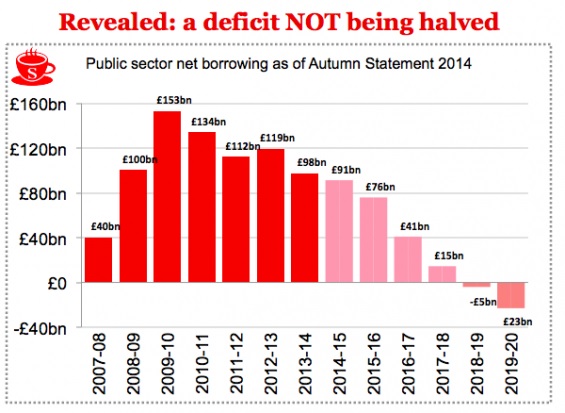
How Will Lying About Immigration And The Deficit Improve Trust In Politics?

Spectator David Cameron Deficit Debt Reduction Lie 2


Somehow, the message still isn’t getting through.

“We just want you to level with us, own up to your past failings and tell us where you really stand on the key issues we care about”, scream Britain’s voters to their increasingly detatched political leaders, in the subtext to every single opinion poll or by-election result of 2014. In response, our political leaders scratch their heads and look confused. “So you want us to pretend as though we understand and respect you?”

Britain’s established political parties have been haemorrhaging support to the new insurgents – UKIP, the Green Party and the fastest growing bloc of all, those who have given up on politics and voting entirely – since the inconclusive 2010 general election and subsequent formation of the coalition government laid bare how vanishingly little difference there really is between the red, blue and yellow team consensus. And as the 2015 general election approaches, each of the establishment parties will come face to face with their own reckoning: David Cameron’s Conservatives face the humiliating prospect of failing to win an outright majority for the second consecutive time, Ed Miliband’s Labour Party behold the implosion of their 35% core vote strategy and Nick Clegg’s LibDems hunker down and wait for the sweet release of electoral oblivion.

In a sane world, the growing revulsion and contempt felt by the British people toward their political class might by now have led to a degree of introspection and a nagging desire among politicians and political parties to cease their endless cycle of cynical, self-destructive behaviour. But we do not live in a sane world. And so the response of Britain’s main parties to the groundswell of public anger at their inability to be honest about their past records and current policies is not to come clean and give honesty a try, but rather to double-down and turn up the brazen deceit to “maximum”.

Continue reading

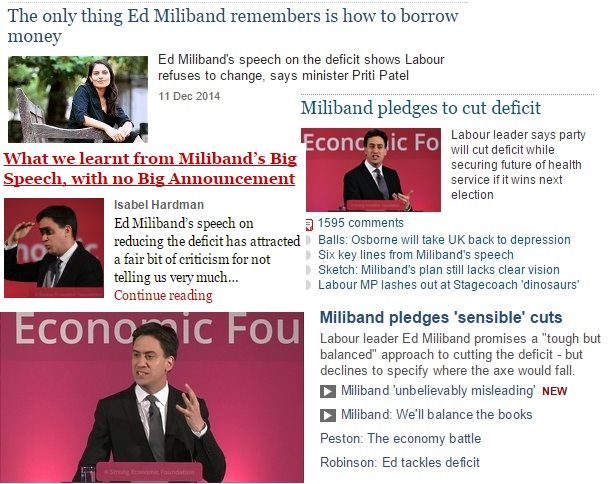
Ed Miliband Talks About The Deficit, Says Absolutely Nothing

Ed Miliband Speech Deficit Austerity Economic Policy Media SPS


How many times have we been told to expect a “big speech” from Labour’s ex-Leader in waiting, Ed Miliband?

Today is the day when Ed Miliband finally gets serious and fires the starting gun for the 2015 general election campaign, we were told. This is the day when the Labour party will stop being scared of its own shadow or apologetic for its past, and tackle the issue of Britain’s persistent budget deficit head-on. In fact, the latest oration by Miliband was so heavily trailed by Labour’s press team that even seasoned and cynical Westminster reporters were teased into expecting some kind of new policy proposal or big announcement. And what did we get? The same lack of specifics and anticlimactic sense of time wasted that Ed Miliband always manages to evoke.

This blog has long pointed out that Ed Miliband wouldn’t know a great political speech if one jumped off the teleprompter and hit him square in the face – a typical Miliband speech is a more or less random assortment of short, standalone platitudes, focus group-tested to ensure their bland inoffensiveness, and none of which exceed ten words so as not to tax the brain of the listener, whose intelligence is so rudely and continually insulted. This being so, it was a pity to see much of the mainstream press, starved of inspiring political oratory for so long, lazily repeating back the assertion that this was indeed a Big Speech by Miliband, just because the Labour press office labelled it so.

Continue reading