Down With Prince Charles

Some wonderful news from Britain today. If you write a letter to government ministers urging a change of course in public policy, or lobbying for a pet cause of yours, the public has no right to know about it, or what you have written. That is, if you are Prince Charles or a member of the Royal Family.

You're there for decoration, not to make policy.
You’re there for decoration, not to make policy.

The “man” who is incapable of squeezing toothpaste onto his own toothbrush without the help of a butler, who travels the globe by taxpayer-funded flights and royal trains while encouraging the rest of us to take short, cold showers to stop global warming has carte blanche to meddle in public affairs. And we, the people, have no right to know what he is saying or lobbying for, because to inform us would be to jeopardise our perception of him as a politically impartial future monarch. Impartial my ass.

The Guardian reports:

Three senior judges have ruled that the public has no right to read documents that would reveal how Prince Charles has sought to alter government policies.

The high court judges have rejected a legal attempt by the Guardian to force the publication of private letters written by the prince to government ministers.

Cabinet ministers have conceded that the prince’s private letters – dubbed “black spider memos” because of their scratchy handwriting – contained the prince’s “most deeply held personal views and beliefs” that could undermine the perception of his political neutrality.

First of all, the mere fact that Prince Charles takes time out of his busy schedule (mostly involving wearing kilts and hiking in Scotland, as far as I can tell) to write to government ministers about anything at all is what undermines the perception of his political neutrality. If he was politically neutral then his royal highness would not have the burning desire to write to British government cabinet members about all and sundry.

The article continues:

[Attorney General Dominic] Grieve had argued that disclosure of the 27 “particularly frank” letters between the prince and ministers over a seven-month period would have seriously damaged his future role as king. The attorney general said there was a risk that the prince would not be seen to be politically neutral by the public if the letters were published.

“This risk will arise if, through these letters, the Prince of Wales was viewed by others as disagreeing with government policy. Any such perception would be seriously damaging to his role as future monarch because if he forfeits his position of political neutrality as heir to the throne, he cannot easily recover it when he is king,” Grieve had said.

Well, I’m glad that the Attorney General of the United Kingdom is worrying about such important matters when we have so many pressing issues about the devolvement of power in our country, the limits on government intrusion into our private lives and the fact that so many people are actually suffering in this country thanks to the many structural problems created by the political elites of years past, the last disastrous Labour government and our current coalition government’s slapstick attempts to correct them.

[The Guardian] won a landmark victory last September when three judges in a FoI tribunal ordered the government to publish the letters as it was “in the public interest for there to be transparency as to how and when Prince Charles seeks to influence government”.

However, a month later, Grieve, with the support of the cabinet, issued the veto which overrode the tribunal’s decision.

Seriously. How messed up is our country when some over-entitled government minister can override the ruling of a court of law? Written constitution and proper separation of powers, anyone? Good idea? No?

On Tuesday, the lord chief justice, accompanied by Lord Justice Davis and Mr Justice Globe, dismissed the challenge, finding that Grieve had acted in the public interest in a “proper and rational way”.

However, Judge said that the power of ministers under the FoI Act to issue a veto and override a decision reached by judges raised “troublesome concerns”, particularly as even a ruling by the supreme court could be overridden.

“The possibility that a minister of the crown may lawfully override the decision of a superior court of record involves what appears to be a constitutional aberration,” he said.

“It is an understatement to describe the situation as unusual,” he wrote, adding that barristers could find no equivalent in any other British law.

You think?! Since our newly created UK Supreme Court is in actual fact not supreme at all, perhaps we should rename it. How about the Court Of Second Last Resort Prior To Ministerial Intervention?

Of course, it is not just Prince Charles who seeks to lobby the government in support of his pet projects or issues of the day. The fact that David Cameron, George Osborne and Ed Balls all attended the recent Bilderberg 2013 meeting in Watford where they hobnobbed with the financial and business elites of the world with no reporting as to what they discussed or agreed to is ample evidence of this.

But why do we let an aging, entitled, sheltered and pampered little man meddle in our politics like this? This is the year 2013. This is no longer acceptable.

The article concludes:

Ministers argue that the letters must be concealed as it enables the prince to air his views privately with ministers so that he can “be instructed in the business of government”.

No. Prince Charles, in his ludicrous and anachronistic role as heir to the throne and future monarch, is entitled to be instructed in the business of government. Instructed. That means that the government elected by the people formulates policy, makes decisions and takes actions, and once it has done all of that, tells Prince Charles about it after the fact. What it most certainly does not mean is that Prince Charles gets to write his black spider letters, weighing in on all matters of public policy. Because that is influencing the business of government, not being informed about it.

Hundreds of years ago, people sincerely believed that these ridiculous people were granted the divine right to rule over us and represent our nation as Heads of State by God himself. That is no longer true, and the price for them keeping their palaces, treasures, land, unearned military uniforms and the servile adoration of the masses is that they shut up and keep their noses out of public policy. That’s it. End of discussion.

Prince Charles’s meddling has to stop. It is embarrassing and inappropriate in the extreme.

Our Superficial Media

The G8 summit in Lough Erne, Northern Ireland, finished some days ago now, but our intrepid journalists in the press are still on the case, poring over and analysing the ramifications and outcomes of this latest summit.

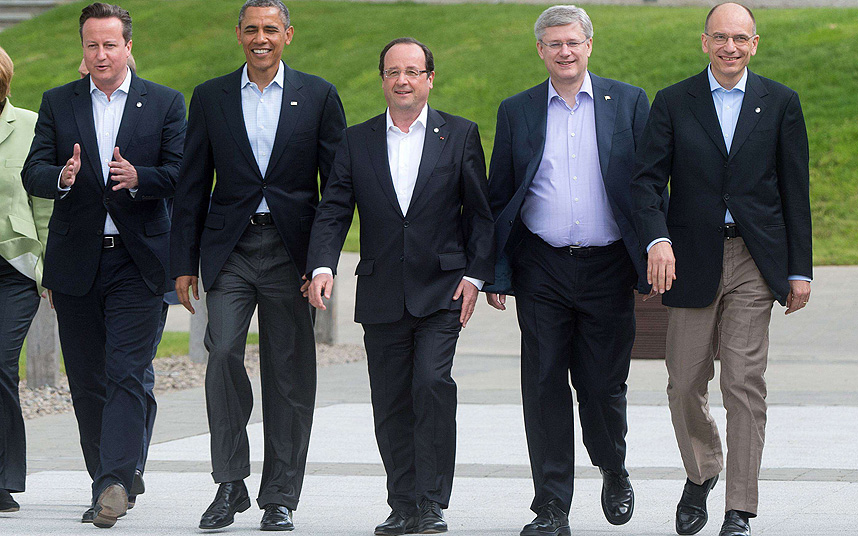
Unfortunately, the minds of our (supposedly) best journalists and bloggers are not concentrated on the policy substance of what was (and was not) agreed at the meeting, distracted as they are by something far more important and consequential – the fact that David Cameron insisted on a smart-casual dress code for the world leaders at this year’s G8, rather than the buttoned-up suit and tie look that is par for the course at these events.

They mean serious business because the ties have come off

Iain Dale, writing at Conservative Home, sniffs:

Whoever chose Lough Erne as the venue for the G8 should get some kind of honour. As a PR exercise it couldn’t be faulted. The countryside backdrops to all the interviews and press conferences were simply stunning. Less stunning, though, was the fact that David Cameron seemed to have a physical aversion to wearing a tie at any point during the event. Orders had clearly gone out from Number Ten that this was a ‘dress down’ G8, although it was rather difficult to tell whether Angela Merkel had got the message, as in all the pictures I saw she seemed to be wearing the same, tired old lime green jacket. I assume she brought a change of underwear.

What penetrating insight. In The Telegraph, Benedict Brogan thunders:

G8 summits are notorious for their sartorial excesses: matching floral shirts, ponchos, stetsons, it has become a commonplace for the host country to rope the visitors into trying on some sort of local dress. Yet what happens when the world’s most powerful men (sic) gather in the UK? We make them dress like bachelors emerging into the bleary dawn after a vigorous stag party. We might as well ask them to wear jeans. What’s wrong with a bit of understated English tailoring, as a way of plugging one of our more successful exports? In fact, it’s London Fashion Week. There’s all kind of natty pastel numbers available, rather than the blue blazers. But for my money, they should tie one on to show they take the taxpayer – and their responsibilities – seriously.

Someone might be so kind to remind Mr. Brogan that he would be taking his responsibilities as a journalist for a prestigious newspaper more seriously if he focused on the policy agenda of the G8 summit, and not the dress code.

Even The Guardian gets in on the act, with a dedicated feature in their Fashion section:

Not for the first time, the dress code has proved to be one of the trickier aspects of the G8 agenda. Style novice George Osborne underlined the dilemma with his sartorial excuse to BBC Breakfast on Tuesday. “I’m doing what I was asked,” he said. “I got out my jacket and blue shirt.” Forget tax and Syria, smart-casual is tough for these guys.

Cameron demonstrated yet again that for him sleeves rolled up and no jacket semaphores getting down to business. He famously did it on the campaign trail all-nighter and he’s done it at Lough Erne. For him a suit jacket and tie is for everyday prime ministerial humdrum but real power dressing – when he’s hosting international leaders – means pale blue cotton and unironed chinos.

But the real gem comes from the sub-headline to that same Guardian article, which reads as follows:

Forget tax and Syria, smart-casual is tough for these guys. Cameron demonstrated yet again that for him sleeves rolled up and no jacket semaphores getting down to business.

Forget tax and Syria. Indeed. Some people certainly have; unfortunately, they are the people whose job it is to hold our elected leaders to account, to scrutinise, analyse and challenge their activities and policy decisions. With a barely growing economy, persistently high unemployment (we recently celebrated the economy adding 5000 new jobs – a paltry 5000 in country of 65,000,000!) and widespread dissatisfaction with his leadership, David Cameron must have been delighted to be taken to task over his sartorial choices rather than his lacklustre/harmful economic policies and desire for more middle-east adventuring in Syria.

The journalists will no doubt counter that there is a “legitimate public interest” in stories like this, that the public are interested and want to know, justifying all of their column inches on rolled-up shirtsleeves and ties, and the dearth of column inches on the outcomes of the G8 summit. This argument is complete claptrap. The journalists themselves generate the public interest in these process-driven non-stories, thus justifying (in their minds) their decision to cover them in ever increasing detail. After all, it’s far easier to sit at your laptop for twenty minutes and bang out a vapid column about the fashion choices of our politicians than it is to do some real journalism, and pore through meeting minutes and policy papers to educate and inform the public as to what is really going on.

Enough of superficial political “journalism”. David Cameron, Barack Obama and the other six can wear matching gimp costumes to the G8 for all I care; what matters is whether they (for once) manage to cook up some policies that actually benefit the non-elites in our respective countries, and (wishfully thinking) take positive steps toward hammering out a comprehensive EU-US free trade treaty.

But I’m not holding out much hope. Our leaders don’t have the best track record when it comes to acting in our interests, and “journalists” such as Iain Dale and Benedict Brogan seem more interested in clucking disapprovingly at their outfits than scrutinising the decisions that they make.

On EU Secession And Straw Man Arguments

Another day, another newspaper column from a political has-been lecturing us on why leaving the European Union or renegotiating our terms of membership would be terrible, just terrible, and consign us to the lowly status of a third world country, adrift in the sea of globalisation with no friends and no influence.

The newspaper columns tend to follow the exact same template, and this time it was the turn of Kenneth Clarke, writing in The Telegraph, to gently explain to us stupid “swivel-eyed” nationalist loons exactly why our views are undermining Britain and putting our future at risk. He writes, with reference to the potential EU-US free trade agreement currently being discussed at the fringes of the G8 meeting in Lough Erne:

For, irony of ironies, it is of course the EU that is making deals with America and Canada possible. It should come as no surprise that President Obama’s officials have commented that they would have “very little appetite” for a deal with the British alone. Quite simply, the political commitment and dedication that the creation of a free market encompassing over 800 million people, 47 per cent of world GDP, and boosting the combined economies of the EU and the US by nearly £180 billion, could only ever be made by the leaders of evenly matched economic blocs.

What nonsense. While this statement may be true for some of the smaller EU member states, until you reach about Spain size, it certainly does not apply to the United Kingdom. Why would any country not wish to negotiate bilaterally with the sixth largest economy in the world, and miss out on the many benefits of tariff-free access to such a large hub of industry, innovation, technology, arts and sciences? Ken Clarke would have us tremble in fear that the mighty President Obama might overlook pathetic, little old Britain if we dared to stand on our own, but he certainly pays attention to the likes of India, Russia, Mexico, Saudi Arabia and countless other countries with much lower nominal GDP than the United Kingdom, so that argument hardly stands up.

But of course, Ken Clarke doesn’t need his arguments to bear scrutiny, because they are straw men. He assumes that a Britain outside of the European Union would automatically be isolated, introverted and inward-looking, seeking to shut itself off from the world, but he is putting words into the mouths of the Eurosceptics. He disingenuously proclaims:

There always has been something of the romantic in the British soul. We can’t fail to be stirred by Charge of the Light Brigade visions of Britain standing alone against the odds. It is the same sentiment behind the idea of exchanging the EU for Nafta.

But, in the end, we are a practical race. We know that the empire on which the sun never set was created by intrepid, relentlessly outward-facing adventurers and administrators, not isolationist John Bulls. That “Brexit” would mean curtains for our ability to have any leadership role in world-defining plays like these free-trade agreements would greatly disturb us. Accepting a diminished situation in which the UK is forced to trade by EU rules which it has had no say in setting is simply not in our nature.

I don’t know of any anti-EU people who want to create a Fortress Britain and isolate ourselves from the world – in fact, quite the opposite is true. We feel that the ever more onerous conditions and regulations that must be observed as part of our EU membership damage our national competitiveness and make it harder for us to do the business that we want to do with the rest of the world. If the EU were simply a free trade area then remaining an EU member to negotiate an agreement with NAFTA or the US would make the utmost sense. But the ever-closer union has become so much more than that, spawning parliaments, commissions, foreign policy chiefs, “human rights” courts, and generally extending its tentacles into every aspect of national life. How does Ken Clarke imagine being beholden to all of these anti-democratic institutions improves our leverage or bargaining position when it comes to discussing matters of free trade?

Of course, Clarke is deeply invested in the success and longevity of the European project. He himself is a current member of the secretive Bilderberg group which in the post-war years was instrumental in formulating many of the policies and initiatives that have helped to bring us to our ever-closer union with our European neighbours and allies. Indeed, at the most recent Bilderberg Group meeting in Watford, England, one of the agenda items specifically focused on “the politics of the EU”, which you can read as “how to make the masses support our floundering European project”. The last thing that he would want is to undo his organisation’s stated objectives of weakening the institution of the nation state in favour of larger, pan-national, anti-democratic organisations. The European Union serves the needs of his political and corporatist friends very well indeed; the average voter, less so.

Personally, I don’t appreciate being talked down to by the likes of Ken Clarke, so in retaliation I am going to post this video of him, taken at a campaign event while he still held fairly high political office, being too fat to get out of a racing car that he was inspecting (skip to the 7 minute mark):


I’ll change my views on Britain’s need to leave the European Union, or at least drastically renegotiate our terms of membership the day that Ken goes on a diet.

Taxes, The Answer To Everything

HMRC taxes


When your default position holds that Government should always be bigger and seek to do more, and play an ever larger role in the life of the citizenry, it generally follows that you will also be obsessed with tax policy, and ingenious ways to come up with new revenues. After all, the all-seeing, all-knowing behemoth has to be funded somehow.

Polly Toynbee, in her latest Guardian column, lambasts the Conservative-led government for “giving up” on trying to find new revenues, and imagines a world where tax avoidance (perfectly legal) and tax evasion (not so much) can be eliminated at the click of her fingers. She writes:

Cutting the 50% top rate suggests no great enthusiasm for rigorous taxing. Last week’s ONS figures revealed gigantic avoidance of the 50% top rate. It could have been collected but George Osborne needed to prove it didn’t work. The Treasury estimated raising the rate to 50% should bring in £6.2bn, but the actual return was a puny £100m.

In year one, before its official start date, high earners gamed the tax by rushing to take dividends and bonuses early. They paid more into pensions, gaining undeserved higher tax relief. Or they used trusts, or took income as capital gains. (That can be stopped, by fixing capital gains, as Nigel Lawson did, at the same rate as income tax, as the Institute for Fiscal Studies advocates.) Once Osborne announced the top rate would fall to 45%, high earners gamed it again. Incomes Data Services reports a massive delay in bonuses until after 6 April, when they leapt up by 107% in the finance sector to catch the new 45% rate. That could have been forestalled.

In Polly Toynbee world, a 50% top rate of tax is absolutely worthy and to be encouraged, and she sees nothing wrong with this, but we already know that. What is more striking, however, is the glib way in which she assumes that the population, outraged by such high taxes, can simply be stopped from taking perfectly legal measures to limit their tax bill. Phrases such as “that can be stopped” or “that could have been forestalled” are boldly laid down, but are not followed up with the how to do it when it comes to implementation.

When she does offer specific prescriptions for raising more tax revenues, she picks and chooses from the worst and most counter-productive tax policies from around the world, including this gem:

Britain can do plenty alone: we could adopt US tax laws that make every UK passport holder, wherever they are in the world, pay UK tax.

Ah yes, double taxation. The United States is the only major western country to enforce this policy of taxing their citizens on money earned overseas, and the policy is universally despised and acts as a significant disincentive for many Americans to work abroad for any length of time. But by all means Polly, let’s adopt that hated policy.

This is not to say that there is not a very real problem of tax avoidance, but it is far more on the business side than the individual side. People are rightly outraged when companies such as Starbucks use crafty mechanisms (“oh, we have to pay all the money we make in our UK stores as a royalty to our European headquarters in Amsterdam, so we don’t have any UK profits to be taxed this year, sorry”) to avoid paying tax on profits earned in Britain. And somehow it seems even worse when those same corporations, under the harsh glare of the media spotlight, deign to cut the government a cheque, to throw the exchequer a small bone to help solve their PR crisis.

Of course, the whole quagmire could be cleaned up very easily if only there was a political party (hi, UKIP) willing to take a scythe to the existing British tax code and rebuild it from the ground up, based on the tenets of real fairness, which of course means a flat tax. A flat rate of tax on income, corporate profits, capital gains and (if we must keep it) on value added, i.e. sales. Wherever possible, double taxation should be avoided – if you have paid tax on income or a purchase already, HMRC should not be allowed to come back for a second bite of that asset later on. And if we have learned nothing else from our friends across the sea in the United States, deductions should be avoided at all costs, as should Gordon Brown’s labyrinthine system of tax credits that you can claim for everything under the sun. Eliminate deductions and tax credits so that you can lower rates for everyone.

Toynbee concludes:

Tax cheating should be Labour’s chance to tell honest political truths: you get what you pay for, you can’t have Swedish services on US tax ideology. Tax is the price we pay for civilisation. At elections, all parties promise the impossible, more with less and cuts in “bureaucracy” to pay for everything. Treating the public like children on tax does nothing for trust in politics. The door has opened for that conversation.

In her mind, big government is synonymous with “civilisation”. The more responsibilities that the government takes on, and the more that citizens are subservient to the government, the more “civilised” that society becomes. Polly Toynbee probably knows more history than me, but I can think of at least a couple of great civilisations from the past that survived and prospered just fine without 50% top rates of income tax, married couples allowances, earned income tax credits or personal allowances.

And if Polly Toynbee really thinks that the door has opened for a conversation about the government going back to talking half of every pound that you earn above a certain threshold, and preventing citizens from making private financial decisions and transactions at a time of their own choosing so as to limit their tax liability, I am reasonably confident that she will find that door slammed very hard in her face by the British people.

On Bilderberg Withdrawal Syndrome

It’s all over.

The last armoured limousines have swept back out of the Watford Grove Hotel’s gates, and the helicopters have departed.

The steel fence is being disassembled, and Alex Jones has flown back to his “central command center” in Austin, Texas.

I’m not ashamed to admit that I have a rather acute case of Bilderberg Withdrawal Syndrome.

For a few precious days, at least a segment of the population who don’t normally pay attention sat up and looked at the protesters, covered on television at length for the first time, and listened to what they had to say. They heard about the concentration of power in the hands of a global elite, about our failed financial system, the lack of accountability in the political and corporate worlds, the pervasive nature of the surveillance state, and the efforts underway to undermine the importance of local power and the nation state.

And so for the first time in a very long time we were able to have something of a national conversation about causes rather than effects. About the disease rather than the symptoms (which are covered in one form another by the newspaper headlines most days – crime, immigration, unemployment, income inequality, education).

And it was amazing how widely and enthusiastically the message was received. I was particularly heartened to learn how many of the police officers guarding the meeting venue and the Bilderberg Fringe protest site had listened to the message from the protesters and taken an active interest, some even undertaking to go home and do their own research:


Ellen Grace Jones, writing at The Huffington Post, agrees with my assessment:

A triumph in securing – for the first time ever – wall-to-wall mainstream media attendance, subjecting the meeting to serious enquiry and inspection. And a triumph in hosting a peaceful, joyful Fringe event within the Grove grounds which united thousands of concerned citizens, activists and inquisitive Watford locals. This year felt like a sea change in dragging the shadowy cabal’s club kicking and screaming into the daylight.

She continues:

On Sunday, with the Fringe winding down and a hundred or so lining the gates as the delegates left, I questioned a police liaison officer if he’d felt awakened by the event he’d witnessed this weekend. “I’ve heard a lot of interesting ideas that I’m going to go away and research. I’ve got a reading list, Agenda 21, Endgame which I’m going to follow up. The one person who really made me sit up and go ‘oh my god’ was one of the audience, a former stockbroker. He was discussing things I’ve thought about like who’s controlling the energy companies, oil company cartels and the Libor bank scandal and he made me think, yeah actually, as someone who’s suffered from the housing crash somebody else should be paying for this but it’s the public sector that’s being screwed to pay for their mistakes – especially the police, we’re being cut.”

Of course, it wasn’t all good. The Bilderberg protests brought out the absolute worst in much of the British mainstream news media, who refused to take the issue seriously at all, treated the protesters as imbeciles and simpletons to a man, and covered the event only as the lighthearted end segment, where you would normally expect to be entertained by a squirrel on water-skis.

The foremost example was the truly dreadful segment from the BBC’s The Sunday Politics show, in which the lead-in to the segment focused only on the lunatic fringe of the protest and wholly ignored the serious concerns of the protesters, and the substance (if it can be called that) of the interview itself, with US journalist Alex Jones, whereupon host Andrew Neil decided to mock his guest from start to finish, fail to ask serious questions and ultimately provoke Jones into one of his famous rages:


There were also reports of Bilderberg-covering journalists being held or turned away at the border, and of harrasment of various kinds.

But on the whole, those wonderful days where we actually got to talk in public and on mainstream media about freedom and liberty without getting bogged down in the minutiae and drudgery of day-to-day political distraction were intellectually refreshing, and invaluable for the movement.

Roll on Bilderberg 2014 – if they dare assemble in public sight again.