Why Britannia Rules

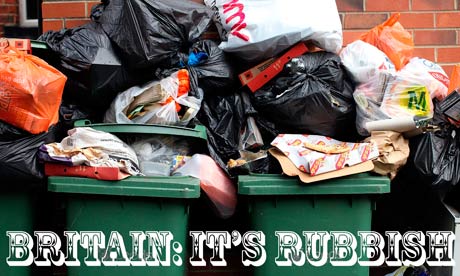
Clearly just a big old pile of rubbish, if today's media naysayers are to be believed.
Clearly just a big old pile of rubbish, if today’s media naysayers are to be believed


We are at that point in the eternal cycle again. Something bad is afoot in the world, the United States of America pricked up its ears and made noises about military intervention, and the world turned to look at Britain to see whether we would leap on board too. And to begin with, everything was proceeding according to the long-established formula. The Prime Minister made the usual belligerent noises, condemned the atrocities taking place (in Syria this time, in case anyone was sitting this round out) and urged the United States to take a strong stance, with the obvious implication that Britain would occupy her usual place in the co-pilot seat.

But then something unusual and unscripted happened – the Prime Minister was manoeuvred into seeking approval from Parliament. MPs, annoyed at being called back from their summer vacations, wary of government intelligence in the wake of Iraq and, as always, looking to protect their own political hides, voted against authorising UK military action. Scandal! Or actually, just democracy working as it should.

And now, all anyone can talk about is how much this foolhardy decision must have diminished us as country, about how we have deteriorated and declined as a nation, and will continue to do so, and how everything is wretched and terrible and how awfully embarrassing it must be for our political leaders to have to represent Britain abroad when Zimbabwe and Somalia are clearly so much better.

Anyone following British television or print media’s coverage of the G20 summit currently taking place in St Petersburg, or the international response to the British parliamentary vote in general, will have been treated to a parade of insecure, snivelling, sometimes self-righteous commentators solemnly telling us that the special relationship between the United States and the United Kingdom has been dealt a death blow, that Britain’s international credibility is in tatters, that we are the laughing stock of the world and that there is little left for our nation to do but limp out to a desolate spot in the north Atlantic and sink ourselves.

What nonsense.

Britain doesn’t sit at the big table because we dutifully follow the United States from one armed conflict to the next. That is not – repeat not – the reason. We sit at the big table because of the hundreds of countries in the world, our economy remains the seventh largest, and one of even fewer lynchpins of the global economy. Many of the world’s greatest inventions and finest companies originated and are based on our shores. Our capital city is the capital city of the world, an indispensable hub for global finance, commerce and culture.

We are a declared nuclear power, and possess one of five permanent, veto-wielding seats on the United Nations Security Council. Our military and intelligence gathering organisations are integrated with their sister organisations in the United States to a degree that no other nation can claim. Our armed forces (despite unwise government cutbacks) are among the most well trained, powerful and deployable in the world, and our country fields one of only three blue water navies to command the oceans.

British popular music, art, literature, film, television and all forms of culture enjoy a popularity and international cultural hegemony second only to the United States. Our people are industrious, friendly, stoic and tolerant. We invented the English language and yes, we speak it better than our transatlantic cousins.

That is why Britain matters, is respected, and is a force to be reckoned with. Not because we go along with Plan X or Plan Y to come floating out of the halls of Washington DC. Sometimes I find myself aghast at the need to remind my compatriots of these simple facts.
 

Did growing up in unionised, socialist, pre-Thatcher, pre-1979 Britain so affect and wound the collective psyche of our political leaders, journalists and commentariat class that they will disregard these manifold blessings and benefits – attributes that any country would be proud to possess – at the mere sight of a negative headline in an American newspaper or an off-the-cuff remark by a junior American administration official? For shame.

If nervous, wet politicians and journalists want to wring their hands and fret because John Kerry called France the oldest ally of the United States (a historical, verifiable fact rather than a poke in the eyes of the British), so be it. But recall that President Obama, speaking from the Rose Garden of the White House, correctly referred to the United Kingdom as America’s closest ally. Because it is demonstrably true, has been for years, and will continue to be so.


The bottom line is this: Britain can afford to sit out a round or two of military intervention now and then, and with so many other countries in the world who profess to care about human rights, we don’t always have to be the ones spilling the blood and treasure in their defence. Britain is a strong, enduring nation, and does not need to prove this fact to the world by getting actively involved in every military conflict, all the while dividing our population and depleting our treasury. America will not stop taking our calls because we sit out this particular action in Syria.

And since when did an expression of British democracy in action – our elected House of Commons voting “no” to a government motion authorising military action – become something to be ashamed of, or to apologise for? Do those people who fret that Britain’s non-participation will be the end of our global prestige really think that bombing sovereign nations at will without consulting the people is more worthy of respect than consulting the people, and holding back when the peoples’ representatives enforce their will?

I do not care to live in their mental version of Britain. Whilst I ache for a written constitution for the United Kingdom and clearly delineated separation of powers, this parliamentary debate, on the whole, was a moment to be proud of.


It concerns me that even our Prime Minister has difficulty articulating the virtues of Britain and making a robust defence when pressed by interviewers who detect political blood in the water and incorrectly perceive our standing in the world as being diminished whenever we are not in lock-step with the United States. It often seems that all David Cameron can do in response to these interview ambushes is stare at his feet and mumble about how many times a day he speaks to Barack Obama, when what he should be doing is reciting a lusty, more eloquently written version of this very article.

We are British. We are a great country. Our economy may still be in the toilet, and we may be governed at present by dilettantish non-entities in the mode of David Cameron, George Osborne and Nick Clegg, but these things shall pass. And when they do, Britain will still be a great country.

Here’s a closing thought: the world might respect Britain a lot more if we showed ourselves more respect for who we are, what we have done and what we can do as a nation.

Where’s Gordon?

As Guido Fawkes rightly notes, almost all British Members of Parliament managed to haul their asses back from vacation as the House of Commons was recalled to debate and vote on the government motion relating to the recent chemical weapons attack in Syria. For or against potential future military action by the UK, they gave principled speeches and made their opinions known.

WHERE THE HELL WAS OUR FORMER PRIME MINISTER, THE WALKING DISASTER, GORDON BROWN? If he has such contempt for Parliament and his constituents that he cannot be bothered to attend a debate like this, he should immediately resign his seat so that someone hardworking and capable can take his place. Sickening.

The Distant Dream of Lords Reform

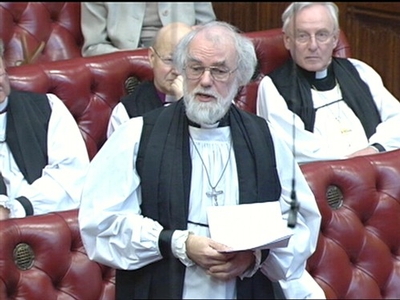
A walking, talking advertisement for the benefits of separation between church and state


In their latest editorial on the subject, The Guardian appears to have given up on the one-step, transformative reform of the House of Lords that was set in motion by the last Labour government and the next steps enshrined in the coalition agreement (before the Tories and LibDems blew the plan to bits in a fit of politically childish pique). Instead, they now advocate a slower (if that were possible), multi-step process of gradual and incremental reforms before we arrive at the cherished goal of having a working bicameral legislature where both houses hold democratic legitimacy.

We begin with the usual wailing and gnashing of teeth at the current state of affairs, and lamentation that the yearly spectacle of undeserving people being honoured with the privilege of sitting in the upper house has taken place yet again:

What an embarrassment to the so-called mother of parliaments. Thirty more cronies and party donors, leavened by a handful of the genuinely worthy and the downright eccentric (what’s an active journalist like Danny Finkelstein doing on the list?), appointed to the democratic world’s largest legislative chamber. It’s hard to imagine where they’ll find room to sit, never mind a job to do, in a chamber where in some debates there’s a 90-second limit on speeches. Yet proposals for reform are discarded. Even a modest suggestion of voluntary retirement founders. And prime ministerial patronage continues more or less unchecked.

The whole exercise is, in the widest sense of the word, corrupt: a system where individuals who make huge party political donations and – however sound their judgment and broad their experience – are awarded a place in the legislature as a gift from the leader of the party is just as much a scandal waiting to happen now as it was when Maundy Gregory was operating the system in the interests of Lloyd George.

But after this strident denunciation of the way things work, The Guardian goes turncoat on us:

Yet despite its Ruritanian appointments process, the Lords is generally acknowledged to be working unexpectedly effectively. Peers do take seriously their duty to scrutinise legislation, they have a good record for improving it, and some have been doughty defenders of individual freedoms. And look closely at who actually sits in the Lords: since the hereditaries were largely ejected in 1999, it’s become a more representative cross-section of the electorate – and the share of the votes cast – than the Commons, and more ethnically diverse. Even the gender balance is at least no worse. The danger is that the more useful it is, the harder it will become to reform.

Well, yes. This is why bicameral legislatures are a good thing. A more ruminative upper house will generally act as a brake (if not a stop) on the more reckless or short-term politically calculating moves of the lower house (and Lord knows that countries like Britain and America need such a check). This fact holds true even when the upper house in question has no real democratic legitimacy. But the fact that the House of Lords is doing okay-ish at the moment (if we choose to ignore the recent lobbying scandal and the fact that 26 lords spiritual continue to exert the not-always-benign influence of the Church of England over our lawmaking) is insufficient reason to reduce the pressure for comprehensive reform.

Most of the hereditary peers are now gone, so Britain is at least spared the indignity of having nascent laws scrutinised by the inbred landed gentry of the realm. We are just left to tackle the political appointees, the favoured party fundraisers and other beneficiaries of prime ministerial patronage who continue to occupy the place. We must also end the ridiculous, anachronistic idea that it is in any way appropriate to reward a person for their deeds (no matter how worthy or altruistic) by giving them a seat in our legislature. The honours system must be divorced from the political system as a matter of great urgency.

The Guardian concludes:

No one supposed, in 1999, that removing the hereditary peers was where reform would end. But since then, the next step has invariably been too much for some and not enough for others. So without abandoning the ambition for an elected upper chamber, perhaps it is time to make progress in smaller steps.

I would rather abandon any expectation of further changes in the next two years in the hope that more comprehensive reform can be achieved following the 2015 general election. This is not an unrealistic goal. True reform was part of the coalition agreement and very much on the cards until the Tories and Liberal Democrats decided to have a mutually destructive bust-up over linking the policy to changing electoral boundaries. Assuming the parties can find it within themselves to grow up slightly, Lords reform can be part of a future coalition agreement (or single party manifesto) too.

Semi Partisan Sam says no to any more slow, incremental reform of the House of Lords. The nation would be better off suffering through another two years with the upper house stuffed full of bewigged, enrobed anachronisms and political patronage beneficiaries before finally kicking the lot of them out after 2015 rather than enduring another decade or more of hand-wringing and glacial progress.

On Information Asymmetry

Well said by Julian Assange in this video clip, on the topic of information asymmetry, the media-ocracy and the media elites who encourage or engage in “lively debate” within such narrow boundaries that the outcome of each political battle is, these days, almost entirely inconsequential:


We need only look at how fiercely the 2010 British general election was fought over tiny differences in the preferred trajectory of increased government spending as proof of this.

Assange has now founded the WikiLeaks party in Australia, where he has several candidates contending for seats in parliament. Some recent polls suggest that 26 percent of Australians are strongly considering voting for a a WikiLeaks party candidate.

“Readers by definition are ignorant. We read to quench our ignorance. Readers, in effect, are easy prey for newspapers and the people that own them. Newspapers have a knowledge advantage, an information asymmetry. They know what readers don’t know yet, but want to know. And so they can distort the news or even invent it.” – Julian Assange

Should MP’s get a pay rise?

Wise words from Bufton Blogs on the issue of whether MPs deserve their proposed 10% pay raise. In short, the answer is a resounding “no”.

buftonblogs's avatarbufton blogs

So last week there was an announcement from the Independent Parliamentary Standards Authority (IPSA) which puzzled many and angered most. IPSA are responsible for setting rates of pay and pensions and things like that for Members of Parliament, and their chairman has recommended MP’s see a pay rise of up to £10,000 – meaning some politicians will be receiving something in the vicinity of £75,000 per year. He cited their ‘unique contribution to society’ as being a reason for why they should see a pay rise at a higher level than others in the public sector; yes their contribution is unique in some terms, but the merit of their actions leaves room for debate. As someone who is studying politics and potentially looking at working in the field in the future, I have given a  fair amount of thought to how pay scales of politicians should be decided – and…

View original post 422 more words