Vince Cable Joins The Anti-Brexit War On The Elderly

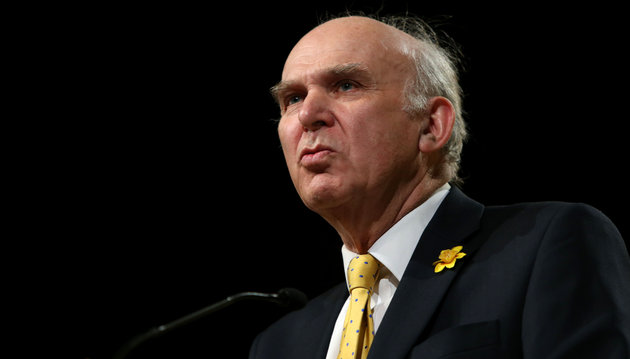
Vince Cable - Brexit

Remainers love to claim that the EU referendum “divided Britain”. But many prominent Remainers are perfectly happy to stoke divisions of their own in order to thwart Brexit

While any measured, rational human being ought to be immediately capable of seeing through YouGov’s recent flawed opinion poll – which was constructed to give the misleading impression of elderly Brexit voters being selfish extremists – new LibDem leader Vince Cable is happy to stoke intergenerational conflict in order to feed his desperate pro-EU confirmation bias.

Writing in the Mail on Sunday (surprising enough in itself, considering most bien-pensant elites view that paper as little more than a fascist propaganda newsletter), Cable moans and wails about how the older generations have supposedly “shafted the young”.

Cable writes:

The Remain argument about economic damage is now largely accepted. Mounting evidence of a slowing economy and rising inflation give substance to earlier warnings. The issue has become one of how to minimise or postpone the damage. And instead of countering the arguments, more and more Brexiteers are embracing economic pain as a price worth paying for ‘taking back control’: almost as a badge of honour.

This attitude has reached worrying proportions. Press stories refer to ‘martyrs for Brexit’ based on a YouGov survey suggesting 61 per cent of the public would accept ‘significant damage to the economy’ from Brexit and 39 per cent ‘don’t mind losing their job’. These figures seem wildly implausible.

I don’t encounter people running around saying ‘please make me poorer’ or ‘please sack me’. These figures are also difficult to reconcile with polling which shows 66 per cent of voters wanting to remain inside the single market.

Of course, as I explained at length in my response to an equally idiotic piece in the New Statesman, there is in fact no contradiction here. It has nothing to do with being a “martyr”, or acting irrationally against one’s economic self interest. Rather, elderly voters simply understand that there are other motivations and considerations besides short term economic gain.

Having grown up in the post-war years and through the Cold War, older voters tend to appreciate the value of democracy and self-determination more than young voters who have never faced existential threat and for whom the EU has been an ever-present reality and an unquestioned positive force. And Vince Cable probably knows this full well, but it suits his purposes to portray those with differing political opinions as somehow unhinged or even malevolent.

Ironically, immediately after impugning the motives and morals of older Brexit voters, Vince Cable then goes on to make a plea for tolerance and mutual respect:

But the last thing the UK needs is further polarisation. There is already more than enough bad-mouthing of opponents and questioning of the patriotism of those who criticise the Government.

The gall of these establishment EU-defenders is absolutely off the charts. Where once a senior politician might have felt a degree of shame that would have prevented him from contradicting himself so completely in an Op-Ed, Cable does so proudly, fully expecting not to be picked up on it. This is how little establishment centrist politicians think of voters and their capacity to understand political or rhetorical arguments. But it is also a sign of the desperation in the Remain camp, as the dream of thwarting Brexit altogether recedes further and further into the distance.

And it gets worse:

To describe such masochism as ‘martyrdom’ is dangerous. We haven’t yet heard about ‘Brexit jihadis’ but there is an undercurrent of violence in the language which is troubling. We have already had the most fervent of Brexiteers, such as Nigel Farage, warning of civil unrest if the ‘will of the people’ is frustrated.

Brexiteers may well be frustrated since the practical difficulties of Brexit, as well as the costs, could result in Brexit never happening.

This is a clever little construction of Cable’s, writing that we haven’t yet heard about “Brexit jihadis” while simultaneously inserting what he clearly hopes will become the Left’s new insult of choice into the public discourse. Let’s be clear – the leader of the Liberal Democrats, that party which considers itself so rational and pragmatic, has just compared Brexiteers who dared to weigh considerations other than economic gain when voting in the EU referendum to jihadis. To murderous Islamist terrorists who maim and kill.

At what point do we stand up to the establishment’s collective hissy fit over Brexit? At what point do decent people refuse to be thus insulted by what Tim Montgomerie called the very “greybeards” who only recently urged further EU integration and the Euro on us even as these failing policies devastated the younger generation, particularly in southern Europe?

That’s not to say that Vince Cable is wrong in many of his warnings about Brexit. In many ways he is right to warn about the implausibility of hammering out a bespoke deal with the EU by 2019, and to urge a slower, managed transition which maintains current access to the EEA. But all of these sensible warnings are completely overshadowed by the overwrought, flowery language suggesting that Britain’s grey-haired voters are supposedly full of hatred and malice towards the children that they raised.

Are the older generations completely innocent? Of course not. Valid arguments can be made that they have been too sheltered from “austerity” and the consequences of the Great Recession thanks to universal benefits and the “triple lock” on pensions. And certainly, as a demographic with a high propensity to vote, the retiree lobby has been very successful in seeing their interests turned into government policy.

But Vince Cable’s over-the-top attack on older voters immediately turns them back into sympathetic characters, and only makes it harder to question the privileges that they have accrued through successive government policy. Comparing decent people who have worked their whole lives and done so much to build the country in which we live today to radical Islamist terrorists is so heinous, so wildly excessive, that sensible discussion becomes impossible.

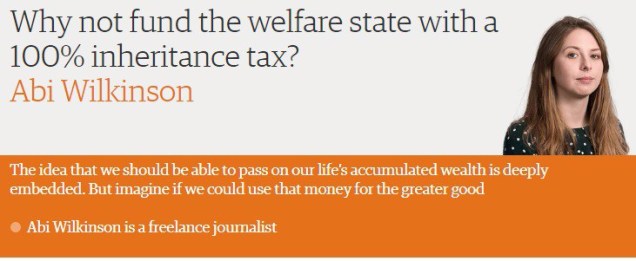
This kind of behaviour might be just about acceptable from someone like me – a relatively unknown political blogger perhaps looking to make a splash by saying something outrageous or provocative (see Abi Wilkinson’s clickbait call for a 100% inheritance tax in the Guardian). But Vince Cable is not an obscure political commentator. He is leader of the Liberal Democrats, a political party which still purports to be taken seriously.

In reality, most people vote both for reasons of self interest and for the perceived good of society. The truth about the elderly Brexit vote probably lies between Brendan O’Neill’s lionisation of these voters and Vince Cable’s haughty dismissal.

O’Neill has been effusive in his praise:

I find it deeply inspiring, moving even, that my fellow Brexiteers are willing to have it rough in the name of democracy, in the name of bringing law-making back to where every progressive of the modern, Enlightened era believed it should be: in the nation, under a people’s oversight.

I straight up got a lump in my throat when I read the bit of the YouGov research that says many Leave voters would even be okay with losing their own jobs, or seeing a family member lose a job, in the name of Brexit. Thirty-nine per cent said such personal hardship would be a price worth paying, against 38 per cent who said it wouldn’t be. Now that’s devotion. That’s idealism. And if it seems alien to us, that only goes to show what a flat, grey political era we live in.

Indeed, the rather elitist alarm that has greeted the revelation that people are willing to suffer for their democratic ideals sums up what a baleful influence technocracy has had on our political imagination. In the technocratic era, when politics has been drained of big ideas and reduced to a box-ticking exercise that is all about managing society, its inhabitants and their aspirations, political passion can seem threatening. Strong feelings, democratic devotion, self-sacrifice – these have become foreign bodies in a time when politics is about making things chug along as uncontroversially as possible. To the technocrat, to the EU suit who drafts laws far from the madding demos, the utterance ‘I am willing to go through hardship for what I believe in’ seems perverse. It’s disruptive. It is because we inhabit such a beige world of spun, small politics that the willingness of us Brexiteers to suffer for our beliefs can look like ‘extremism’.

I get where O’Neill is coming from, even though I think he goes a little too far, reading something that both he and I desperately want to see (a return to conviction politics and commitment to ideology rather than fudged centrist compromise) into a vote whose motivations were more nuanced than either extreme.

In truth, elderly Brexit voters are neither selfless heroes nor foaming-at-the-mouth jihadists. But as far as the media is concerned, the narrative about older voters being selfish is too convenient to ignore. Unfortunately it reveals a gulf of misunderstanding, as Vince Cable makes clear:

The old have comprehensively shafted the young. And the old have had the last word about Brexit, imposing a world view coloured by nostalgia for an imperial past on a younger generation much more comfortable with modern Europe.

If I had a pound for every time some sanctimonious Remainer airily asserted that Brexit was motivated by “nostalgia for an imperial past” then I would never need to work again. In reality, the Lord Ashcroft poll taken in the immediate aftermath of the EU referendum clearly showed that the principle motivating factor for Leave voters was “the principle that decisions about the UK should be taken in the UK”. Perhaps this lacks nuance and an understanding of modern day interdependence in the regulatory environment, but it is also a clear and unambiguous call for the same kind of autonomy enjoyed by countries far smaller than ours in terms of GDP such as Australia, Canada or Korea. This is by no means unreasonable, and cannot be fairly caricatured as some kind of imperial nostalgia.

So why pretend that it is? Either Vince Cable is so full of self-hatred for his own country and its history that he believes that our dissolution as an independent nation state into an increasingly federal EU is somehow appropriate “payback” for our transgressions in the days of empire, or he knows full well that the Brexit vote was not motivated by imperial nostalgia but simply finds this to be a convenient trope with which to whip up his own supporters.

For now I will do Vince Cable the courtesy of assuming the latter rather than the former – that he is in fact not a self-hating Brit, but rather just a cynical old politician like so many others. But the longer this tantrum against anyone and everyone who voted for Brexit goes on, the harder it becomes to assume good faith on the part of the furious Remainers.

At some point the Vince Cables of this world have to either engage with the real substance of Brexiteer arguments, attitudes and motivations, or else just admit that they don’t care – that they simply feel blind, unthinking hatred towards those who disagree with them and have no interest in rational discussion.

It might actually prove quite cathartic; rather than having to make increasingly ludicrous arguments that people voted for Brexit somehow want to bring back the Empire, Vince Cable and his ilk could simply have their Two Minutes Hate every day and be satisfied.
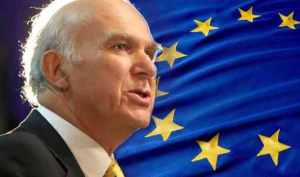
 

Vince Cable - Brexit - EU

Support Semi-Partisan Politics with a one-time or recurring donation:

Agree with this article? Violently disagree? Scroll down to leave a comment.

Follow Semi-Partisan Politics on TwitterFacebook and Medium.

I Watched The Mash Report So You Don’t Have To

The Mash Report - Nish Kumar - BBC - Satire - Comedy - Bias - Leftism

The world of comedy is almost uniformly left-wing and progressive, especially on British television. But will new satirical show The Mash Report be brave enough to confound expectations and take potshots at everyone, not just conservatives?

When a friend first introduced me to British satirical news website The Daily Mash back in 2010, I lost two full days of productive work time, ravenously reading back through their archives and laughing until it hurt. At its best, the Mash is a very funny publication, and a worthy and uniquely British answer to the great American satirical newspaper The Onion.

After the Tories (kind of) won the 2010 general election it was inevitable that the Mash’s unforgiving gaze would fall more heavily on conservatism than it did in the dying days of Gordon Brown’s tragicomic administration, and that we on the Right would be subject to a lot more ribbing than before. That is as it should be – good satire should devote much of its energy to mocking and belittling those in power, and taking them down a peg or two. And Lord knows that the Cameron/Osborne/Clegg trio – and now Theresa May’s clown show of an administration – have given the Mash more than enough prime material.

Sure, if one surveys the overall output of the Mash in recent years one gets the clear sense that their “normal” – the political reference point from which any departure triggers satirical mockery – sits somewhere on the centre-left. But I never really had an issue with their output until the EU referendum, where the Mash firmly planted its flag with the Remain camp on the side of the powerful establishment, subjecting Brexiteers to every lazy insult in the book while making it clear that only Remainers could be deemed “normal” and allowed to be in on the joke.

As I wrote a couple of months ago, in exasperation:

The worn-out old stereotype of Brexiteers as scarlet-faced, tweed-bedecked retired colonels hankering after a bygone age is self-evidently false. It fails the common sense test – over 17 million voters opted for Brexit, and there just aren’t enough retired colonels out there to deliver that kind of result.

But rather than actually take the time to understand Brexiteers and work out what makes them tick so as to better lampoon them (humour, after all, is always better when it is closely observational), publications like The Daily Mash sit back smugly and fall back on the familiar narrative of grumpy old men hankering for empire.

And that, of course, is their right. Nobody has to read The Daily Mash, and despite Britain’s increasingly tenuous commitment to free speech they can mock and lampoon whoever they like, as should be the case.

But how much better would their comedy be – how much wryer and punchier their humour – if the Mash writers actually took the time to really get to know a few more Brexiteers (so as to at least make fun of them for the right reasons), or even (heaven forfend) turn that caustic wit back on their own side once in a while?

A reasonable request, I think, but one which the Mash did not heed. Since I wrote those words in early March, the Mash has doubled down on its Brexit mockery, letting numerous establishment cretins off the hook for their mistakes, evasions and foibles as its wittiest writers spend their time skewering the good-hearted but sometimes inarticulate people who dare to express their support for Brexit.

And now the BBC is launching a new satirical television programme fronted by comedian Nish Kumar, entitled The Mash Report. The idea was partly to transpose the successful Mash format from internet to television, but it is also a very conscious effort to introduce the late-night, US-style satirical show made so popular in America by The Daily Show, The Colbert Report and John Oliver’s Last Week Tonight.

The British Comedy Guide trumpeted before the launch:

Nish Kumar will host the 10-part series, described as “an up to the minute, satirical news show”. Overseen by Princess Productions, it is being produced in conjunction with satirical website The Daily Mash, dubbed “Britain’s most popular original comedy website”.

Kumar has experience at hosting topical comedy, having previously helmed Radio 4 Extra sketch show Newsjack. He now presents Spotlight Tonight With Nish Kumar, a Radio 4 topical comedy which will end its current series next week.

Continuing:

BBC Two boss Patrick Holland says: “I am delighted that we are announcing this new topical comedy entertainment series from Princess. It is whip-smart, hugely timely and driven by some great new talent. I’d like to thank all the teams who contributed to the different pilots. The standard was exceptionally high, but we were drawn to The Mash Report’s blend of great satire allied with the surreal. It feels really innovative.”

It doesn’t take a genius to understand what the BBC’s Patrick Holland means when he says that The Mash Report is “hugely timely”. This is basically code for “Oh my god, what a dystopian age we live in now that Brexit is upon us, the Evil Tories are still in government and Donald Trump is president of the United States! Now more than ever we need a condescending new establishment-approved comedy show to fight back against the populist menace on behalf of the elites and put those Leave-voting troglodytes in their place”.

I hoped against hope that it would not be so. I did not want to be proven right – which is partly why I refrained from writing about the show until a couple of episodes had aired. But I can now officially say, having watched The Mash Report so you don’t have to, that it lives down to the very lowest of expectations.

The first anti-Brexit joke occurred three minutes and forty seconds into the show, after the opening pleasantries by host Nish Kumar (who channels John Oliver rather than Jon Stewart in overall tone). Now, one can’t be too angry about this one, aimed as it was at Boris Johnson, a man who is deserving of endless mockery. But still, this first jab confirmed some early suspicions and set the tone for what was to come.

The first identity politics joke – “I’m the first Asian comedian hosting a prime time comedy show, and now we’re coming for all your jobs! This is PC gone mad” (cue inexplicable delirious screaming from the audience) – occurred four minutes and fifty seconds into the show.

There then came a joke about the opening ceremony of the London 2012 Olympic Games in the context of Brexit, pleading for director Danny Boyle to come and take over the Brexit negotiations. As footage of the ceremony played, Kumar intoned “This is the last time any of you will be happy!”. Yes of course, because watching North Korean-style propagandists prance around in nurses’ uniforms deifying a failed socialised healthcare system is deliriously fantastic, while seeking to reclaim democracy and self-determination, and make political leaders properly accountable to the UK electorate again, is just awful beyond measure.

There was then a short interlude while The Mash Report made fun of David Davis’ name, while Boris Johnson was implausibly described as having the “political outlook of a Victorian man”. Seriously? Have the Mash Report writers ever seen Boris Johnson? Clearly not – but they are in no short supply of lazy, sixth form-style anti-conservative put-downs.

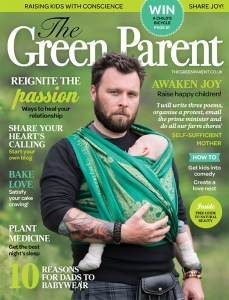
In the same week – particularly given that much of the show is given over to quickfire, Have I Got News For You-style picture caption jokes – the Mash Report could have spent thirty seconds making fun of this hilarious cover of The Green Parent magazine:

The Green Parent cover

God help that baby, particularly because the socially conscious father seems to be preparing to attempt to breastfeed (#SomeMenLactate). But no. The Mash Report – and the BBC in general – know exactly who their core audience are, and which demographics must be coddled and protected from offence at all times (yes, trendy green types very much make the list). The Mash Report already knows exactly who to flatter and who to insult mercilessly without fear of blowback for the naked bias on display.

Later in the show we are introduced to the show’s “religious affairs correspondent”. Already you know exactly where this is going – and indeed, precious minutes were spent laughing at the most unhinged of US evangelical Trump supporters and interviewing a rather loopy-looking Church of England minister who claimed that Jesus would have voted to Make America Great Again.

But perhaps I am being unfair. Even though this first outing was spent skewering Donald Trump and the American religious right, I’m fully confident that in future episodes we can expect all faiths (and none) to come in for equally barbed and scornful criticism. Right? Naturally if Hillary Clinton were currently president, the Mash Report would be mocking the Left’s overenthusiastic zeal for abortion and eagerness to make incursions on religious freedom.

One might have thought that a brand new satirical current affairs show could have something to say about the way that politicians and misguided apologists dither and prevaricate while Islamist extremists mercilessly butcher and wound innocent people going about their daily lives. But no – tumbleweeds. Let’s just bash a few crazy evangelical Christians and call it a job well done. That’s surely the only job of a religious affairs correspondent on a national late night comedy show.

And yet despite these many failings there were a few genuinely funny moments in the Mash Report. The recurring feature parodying the way that 24-hour news networks are desperate to broadcast viewers’ observations sent in via social media was accurate and very well done. The show generally worked best when riffing on non-political stories, like the Love Island reality TV phenomenon. It was also good to see some of the familiar recurring Mash vox-pop names crop up – hi, Tom Booker.

But the format often felt awkward and strained, an uncomfortable hybrid between the whip-smart Daily Show-style interactions between host and correspondent in one moment and much more clipped, Have I Got News For You-style dry witticisms and fake headlines the next. Though the blend was new, ultimately there was nothing original in either style or content – particularly not the near-constant left-wing preachiness.

The closest that The Mash Report came from escaping the gravity of bien-pensant leftist groupthink was a segment entitled “Bursting the Bubble”, featuring rare conservative comedian Geoff Norcott. For a moment my heart filled with hope – titling the segment “bursting the bubble” suggested an acknowledgement that all that had come before was rather one-sided, and that maybe now things would change. But no. The mere fact that the bubble is left-wing while the exterior is right-wing says it all about the show’s deep-rooted bias. The country may be divided nearly 50/50 but the BBC and the Mash Report see fit to ghettoise conservatives into a four-minute slot at the end of the episode, much like Maybelle Stubbs’ monthly Negro Day on the Corny Collins Show in Hairspray.

And even Geoff Norcott proved to be something of a turncoat, choosing to play the role of performing seal for the ogling leftist audience rather than attempting to hit back and mock any progressive, left-wing shibboleths. For example, when discussing Our Blessed NHS, Norcott cited the fact that “people live” (rather than dying before old age) as a problem which vexes Evil Conservatives like him.

“The elderly, Nish – they should be dead by now. Just sitting it out, hanging on in there…” Norcott moaned to the show’s host, while the bovine leftist audience clapped gleefully as every single one of their anti-conservative prejudices were confirmed before their very eyes. How exactly is this “bursting the bubble”? If anything Norcott’s role in the Mash Report was more like Samuel L Jackson’s in Django Unchained, the obedient slave performing for Leonardo DiCaprio and hamming up the servile stereotypes as much as possible. The Guardian approves of his comedy act because he is willing to debase himself and play the Evil Tory stereotype. But any real conservative who watched Norcott’s first cringe-inducing segment on the Mash Report must despise the man. I certainly do.

What didn’t we see in the show? Well, there was nothing substantive about the Labour Party, Jeremy Corbyn, the Liberal Democrats, the SNP or the Green Party for a start. Nothing about how so many of Jeremy Corbyn’s inner court have fallen over themselves to praise Venezuela in recent years, even as socialist policies pushed that country toward its current precipice. And you can be sure that all of these people will be largely protected from satirical scrutiny as the series progresses. If they are ever criticised it will be in the context of their ineptitude in thwarting the conservative agenda (whatever that may be) rather than because of the nature of their own beliefs.

But the show did go out with a bang, with a field report about a traumatised middle class family who – gasp! – had to ride the Megabus coach to London rather than travelling in the style to which they were accustomed. Again, nothing wrong with the individual joke – and to be fair, the Mash makes fun of Waitrose shoppers as much as they do people who buy their lunch at Gregg’s. But place it in the context of the overall show and the Mash Report’s emerging worldview is quite clear.

And so is the message about who this new comedy show is designed to amuse. Basically, if you are conservative, working class, a Brexiteer, a Christian, a social conservative, a traditionalist or (heaven forfend) a Ukipper then don’t bother tuning in unless you want to be the butt of every joke for twenty-six minutes, the only respite being the other four minutes where a two-dimensional cartoon parody of you cavorts in the guest seat, pastiching your sincerely-held views for the amusement of host Nish Kumar and his bovine left-wing audience.

In short The Mash Report is exactly as bad as I feared, and as you probably expected. What a letdown. What a squandering of comedic potential. What a great pity.


The Mash Report - Nish Kumar - BBC - Satire - Comedy

Support Semi-Partisan Politics with a one-time or recurring donation:

Agree with this article? Violently disagree? Scroll down to leave a comment.

Follow Semi-Partisan Politics on TwitterFacebook and Medium.

Does Brexit Mean That Baby Boomers Hate Their Own Children?

New Statesman hysteria - Brexit means baby boomers hate their own children

The idea that parents and grandparents would vote Leave out of hatred for their own children is as absurd as it is vile. But some Remainers will make any accusation in their rage against Brexit

The baby boomers of Britain are in the grip of a virulent, infanticidal mania. The EU referendum apparently caused highly contagious spores to be released into the air,  primarily affecting those aged 65 and over, causing them to forget any maternal, paternal or other protective familial instincts and instead seek to cause maximum financial and emotional suffering to their own children and grandchildren, for the pure pleasure of it.

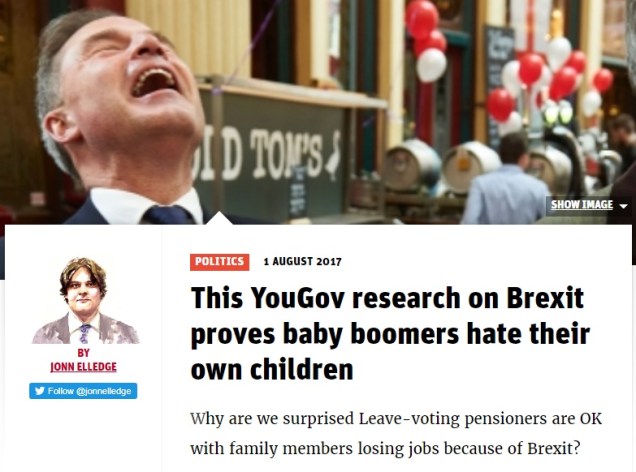
Or at least so says Jonn Elledge, staff writer for the New Statesman, who brings every ounce of confirmation bias in his body to bear on a new YouGov poll in order to pronounce that by voting for Brexit, baby boomers and older people must actively “hate their own children”.

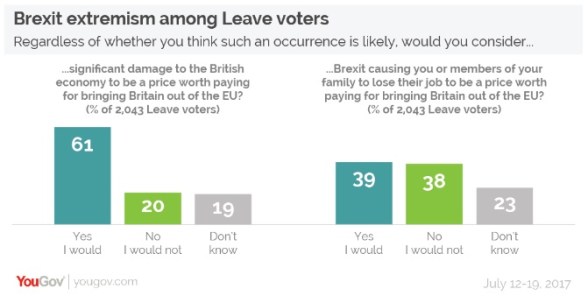
First of all, let’s be clear about what the YouGov poll actually says:

YouGov poll - Brexit extremism

That is, a significant majority of Brexit voters would be willing to tolerate significant damage to the British economy in order to see Brexit fulfilled, a tendency which the poll goes on to reveal becomes stronger among older age groups.

Is this necessarily evidence of “Brexit extremism”? Perhaps, but one can only say for sure if one takes it for granted that economic growth (or avoiding economic harm) is the sole valid consideration of a rational person, a premise which neither the poll nor Jonn Elledge even attempts to make.

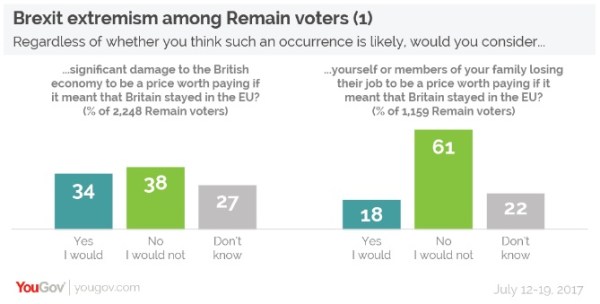
And of course, the corollary to these figures is the fact that the same “extremism” is alive and well among Remain voters, many of whom would dearly love to see Britain heavily punished economically so long as it meant that Brexit was subverted and they could stay in their beloved European Union:

YouGov poll - Brexit extremism 2

Jonn Elledge takes no notice of this latter fact, though, and immediately launches into a hysterical tirade against the evil older generations who clearly could have had no other motive for voting Leave other than to watch as their children and grandchildren suffered and led diminished lives. No, seriously.

Elledge writes:

The older Leave voters are, the more likely they are to think crashing the economy because they don’t like Belgians is a pretty fine kind of idea.

That trend reaches its peak among the Leavers aged over 65, fully half of whom are happy to tell pollsters that they don’t give a shit if Brexit causes a relative to lose their job, they want it and they want it hard.

Ah yes, let’s begin with a glib assertion that Brexit is all about not liking Belgians or other funny foreigners. One might think that one year on after having his worldview so thoroughly and humiliatingly repudiated by the British people in the EU referendum, Jonn Elledge might have had the humility to go back to the drawing board and question some of his glib and not-very-witty assumptions about what motivates people to make political choices. But apparently not.

More:

The thing about the over 65s is that relatively few of them work: to be blunt about it, those most enthusiastic about people losing jobs are those who don’t have jobs to lose. The vast majority of this oldest cohort will be on pensions, whose value is far less likely to come under threat from a recession than almost any other form of income. Most will own their own houses, too. They’re the section of the population most likely to be left entirely unscathed by the Brexit-based recession. They are quite literally alright, Jack – and, it turns out, fully half of them don’t care if their kids aren’t.

Baby boomers, as a cohort, benefited from free education, generous welfare and cheap housing, then voted for parties which denied those things to their kids. Their contribution to intergenerational inequality led my colleague Stephen Bush, in one of his frequent bouts of being infuriatingly good at his job, to note that, “The baby boomer is one of the few mammals that eats its own young.” All this we already knew.

Nonetheless, it’s rare to see this selfishness communicated so baldly, so shamelessly. When asked directly whether they’d swap the wealth and security of their own children for a blue passport and the ability to deport Polish plumbers, they said yes in huge numbers.

“Would you like your children to have a better life than yourselves?” You Gov asked them. And the reply came back: “Fuck ’em.”

This YouGov poll could have touched off a genuinely interesting conversation about the balance between present wealth and future liberty, about other historical examples of populations allowing themselves to be bought off with bread and circuses in exchange for turning a blind eye to the way that their societies were (mis)governed. But that would have required a British political media class who did not think as a herd that the European Union is an unquestionably Good Thing, and that anybody who dissents from this groupthink is an irrational, evil hater.

Does Jonn Elledge seriously believe, in his heart of hearts, that those older people who voted for Brexit did so with the expressed intention of harming their children and grandchildren – or at least not caring that such harm might come to pass? Does he not realise that the counterfactual, unrecorded by YouGov (who did not bother to probe more deeply) is that perhaps these older people – rightly or wrongly – thought that by voting for Brexit they were preserving some other vital social good for their descendants, something potentially even more valuable than a couple of points of GDP growth?

I would posit that the supposedly hateful Daily Mail-reading generation of grey haired fascists scorned by Jonn Elledge actually do not have any particular desire to inflict economic harm on their children and grandchildren, but simply realise – through having lived full lives through periods of considerably less material abundance than those of us born since the 1980s – that other things matter too. Things like freedom and self-determination, precious gifts which were under threat during the Second World War and the Cold War, and which the older generations who remember these difficult times therefore do not casually take for granted.

They correctly perceive that sometimes there is a trade-off between short term economic security and long term freedom and prosperity. Can anyone who knows their history – or at least has watched the recent Dunkirk movie – doubt that the British population would have been immeasurably safer and better off in the short term had we made peace with Nazi Germany rather than fighting on alone after the fall of Europe? And looked at through a purely economic lens, how many years of subjugation beneath the jackboot of a fascist regime would have tipped the scale and suddenly made it worth fighting for freedom after all?

This time, the choice before us is nowhere near as difficult, and the trade-offs nowhere near as severe. Even if this incompetent government mishandles Brexit as badly as sometimes appears likely, bombs will not fall from the sky to level our cities and destroy our cathedrals. This is not to understate the effect that a mishandled Brexit negotiation could have – any uptick in unemployment or decrease in economic activity is highly suboptimal, with real human consequences.

But there are negative consequences associated with failing to safeguard our democratic institutions and fundamental liberties too, though they often seem remote or even irrelevant until suddenly they are both present and irreversible. Those who have been on this good Earth for a few more decades than Jonn Elledge perhaps appreciate this fact more readily.

Our politics has become increasingly consumerist in recent years – the politics of me me me. And unfortunately we now have a young and poorly educated millennial generation – my generation – who see politics only through the lens of what they can get for themselves in terms of perks and opportunities. This makes them particularly vulnerable to any old charlatan who comes along spewing EU propaganda suggesting that the European Union is the only reason that they are able to “live, love and work in other countries” (to use their nauseating phrase du jour).

Ultimately this is yet another total failure of the pro-EU Left to remotely empathise with those on the other side of the Brexit argument. It represents a colossal failure of imagination to sincerely believe – let alone publish in a major national political magazine! – that a generation of parents and grandparents who scrimped, saved and sacrificed to raise their families now want to cause them harm merely to warm themselves in the glow of imperial nostalgia as they enter their twilight years.

And yet this is what Elledge, the New Statesman and countless commentators on the Left would have us believe. Frankly, this haughty and arrogant attitude is more dehumanising of its victims than that of the xenophobe who may believe that foreigners are good people, but simply doesn’t want them in his country – at least there is still the outside possibility that they vaguely respect the other.

I’ll say that again, lest there be any doubt or confusion – by holding this vile opinion, Jonn Elledge, the New Statesman and anyone who concurs is worse than a garden variety xenophobe.

A society which does not respect its elders cannot long endure, and these puffed-up millennial moralisers seem determined to drive us into the ditch as fast as they possibly can.


Thousands Of People Take Part In The March For Europe

Support Semi-Partisan Politics with a one-time or recurring donation:

Agree with this article? Violently disagree? Scroll down to leave a comment.

Follow Semi-Partisan Politics on TwitterFacebook and Medium.

Calls For A 100% Inheritance Tax Reveal The Far Left’s Evil Heart

Abi Wilkinson - 100 percent inheritance tax

Renewed calls by leftists for a 100% inheritance tax force us to have the argument all over again – does the state exist to serve us, or do we exist to serve the state?

I’m sure that many others have already published their own incredulous reactions, but I cannot let my return to blogging commence without comment on Abi Wilkinson’s “brave” idea (filed under the Guardian’s “Utopian Thinking” category) for a 100 percent inheritance tax, levied in order to fund Our Precious Public Services.

In case you haven’t already encountered it, Saint Wilkinson appreciates our public services so much, and cares about the downtrodden in society just so darn much, that she thinks that a 100 percent confiscatory raid on assets upon every person’s death is both meritorious and desirable as a tribute to the all-powerful state, as well as being totally economically feasible.

The article reads like an earnest sixth-form essay, untainted by familiarity with much political theory and penned by somebody who sincerely believes that they are making this proposition for the very first time, and that it is therefore deserving of serious consideration and public debate.

Of course, the complete opposite is true – people have loudly clamoured for the expropriation of wealth from the dead and the living for centuries, with the idea of a 100% inheritance tax proving sufficiently odious that it is not enforced in any successful advanced economy.

Nevertheless, Wilkinson boldly writes:

The idea that we should be able to pass on our life’s accumulated wealth to descendants is deeply embedded. It appeals to the fundamental biological urge to protect your offspring and propagate your genes. Though only a small minority of estates are subject to inheritance tax in Britain as it currently stands, opinion polls consistently find that the majority of people oppose it. Instinct seems to override common sense. VAT falls disproportionately on people with low incomes, but it’s far less hated.

Understandable sensitivity around issues relating to death make it difficult to discuss, but it’s time this conventional wisdom was held up to proper scrutiny. Yes, the desire to pass on property to your descendants may be natural – but why should we be slaves to our biology? Social progress has frequently depended on our ability to transcend individualistic urges and work together for the common good.

A leftist may well ask why we should be slaves to biology (at least now that most of them have stopped promoting eugenics). Half the time prominent voices on the left can be found deliberately trying to negate, undermine or deny basic biology across a whole host of areas, because feelings and virtue-signalling must now trump science (which, after all, is very oppressive).

And as for “instinct overrid[ing] common sense”, it is far more likely that most people, being more perceptive than Abi Wilkinson, can perceive the ruinous implications of implementing a 100 percent inheritance tax policy – not least a vast and unprecedented brain drain of wealth and talent from this country, together with hugely adverse incentives for those who remain behind. Would I vote for a policy which benefited me by stealing from my neighbour, while also knowing that the same policy would lead to the ruin of the country? Unsurprisingly, probably not.

Wilkinson continues:

Some may argue that leaving inheritance is a moral right. It’s not about whether the recipients deserve or need it, nor whether having the ability to do so results in productivity gains. The point is that the deceased earned that money and it should be up to them where it goes.

This is where it gets a little murky. We tend to honour the wishes of the dead – at least to some extent. Those of us who are religious may believe their souls live on and they can witness what’s happening. Even committed atheists recognise the value of respect in this context, even if their primary concern is the emotional impact on those left behind. If someone wanted a certain sort of funeral, for example, it seems right to try and fulfil that. But what if the desires of the dead directly damage the wellbeing of the living? Is there any situation in which the previous instructions of someone no longer actually present in the mortal realm should be prioritised over the needs, interests and opinions of those who are still alive and kicking?

How gracious that we are still to be allowed funerals and other religious rites in Abi Wilkinson’s brave new world. Perhaps we should be grateful for this small dispensation and humbly surrender our accumulated life’s work on our deathbeds without any further complaint.

More:

In the UK, official statistics suggest around £77bn is passed on in inheritance each year (tax avoidance means the real amount could be even higher). That’s money that no living being has a moral claim to, according to standard justifications of wealth inequality and private property. Were that money redistributed by the state, it would cover the cost of adult social care several times over. It could plug gaps in NHS, education and police funding. It could provide the kind of comprehensive welfare state that meant nobody had to worry about their family after they passed away – because there would always be a safety net.

Cultural norms teach us that the inheritance of private property is the default and any expropriation of this wealth must be justified. It should be the other way round. There’s some value in respecting the wishes of the dead, yes, but why is that more important than social housing, healthcare or any number of other possible uses for the money? It’s natural to want to protect and care for your family, but what about people who don’t stand to inherit a penny? Is there any reason their needs should matter less? We have to fund our state somehow – what makes inheritance tax more objectionable than income tax or VAT charged on essential consumer goods?

And what when that £77bn is spent in Year 1 of this nightmare programme, and Britain’s public services come back ravenous for more in Year 2, when the brain drain and disincentives to save or invest reduce next year’s haul by over half? What about Year 3, when the biological urge to defer gratification, save and build for subsequent generations is overridden by benevolent leftist policy, and the tax revenue is even smaller? What about Year 5, when Our Blessed NHS is still in perpetual crisis but inheritance tax revenues now bring in less money than would be required to power a street light?

The perpetual problem with the Left is that they insist on working against, rather than with, human nature. Market capitalism remains by far the best way of allocating scarce resources for the good of the most people because rather than going against the grain of embedded human instinct it works with that instinct, incentivising people to provide value in return for other needed items of value.

But the Left cannot accept this, because inequality. Never mind that this inequality is often less than they contend, and that any inequality takes place in the context of rising living standards for all – no, this is not enough. A functioning system and a great engine of prosperity must be sabotaged and brought down because it does not conform with certain Utopian political theories – theories which Abi Wilkinson might do well to better acquaint herself.

But more than all of this, the great question which not only Abi Wilkinson but the entire Corbynite, Utopian Left must answer is this: does the state exist to serve us, or do we exist to serve the state? Are we entitled to the product of our own labour with the state performing certain acts and services by our permission, or does the state ultimately have a claim to everything that we are, everything that we create and everything that we do, in life and in death?

Of course, we already know the answer to that question. The answer shines through brightly with every weepy new article about how we the people are failing “Our NHS” by not protecting it from the Evil Tories and by failing to firehose sufficient taxpayer money into its gawping, insatiable mouth. The answer shines through with every inane tweet misquoting Aneurin Bevan about how the NHS will continue to exist “as long as there’s folk with faith left to fight for it”, and with every false assertion that cutting taxes is somehow “giving money away” to the wealthy.

In short, it simply could not be more clear that the ideologues within the Corbynite Labour Party – as well as the journalists and commentators who support them – believe that we exist at the pleasure of the state, to serve the state. Sure, they might not put it quite like that. Instead, they waffle on endlessly about society and community, or piously lecture the rest of us on our responsibilities to one another – responsibilities which human beings are perfectly capable of managing through individual charity and civic society, but which the Left insist on funnelling through the state.

And if you are of this mindset, then why indeed not propose a 100% inheritance tax on everybody (save a few “objects of sentimental value” as graciously conceded by Wilkinson)? Abi Wilkinson presumably believes that she too is just a small cog in the machine of the British state; that if it were deemed to be better for society that she stacked shelves in a Tesco distribution centre rather than writing socialist twaddle for a living she would gladly switch occupations in a heartbeat, before giving up her meagre possessions to the taxman upon her deathbed. And she is fully entitled to believe in a totalitarian, dystopian state where the mere words “for the good of society” can be used to compel us to do anything.

But know, when these cherub-faced young socialists get on their soapboxes, eyes aflame with passion and fervour, what they really mean when they talk about “the good of society”. Know the warped moral framework through which these left-wing, self-appointed Defenders of our Public Services see the world – the individual utterly subordinate to the state in every way that counts, save a few highly revocable “rights” given as a distraction.

Because this same black-hearted evil informs nearly every policy that the Corbynite Left proposes, including many which are far more likely to come to pass than Abi Wilkinson’s totally original 100% inheritance tax brainwave.


Inheritance tax

Support Semi-Partisan Politics with a one-time or recurring donation:

Agree with this article? Violently disagree? Scroll down to leave a comment.

Follow Semi-Partisan Politics on TwitterFacebook and Medium.


People Don’t Want Theresa May To Emote, They Just Want Her To Lead

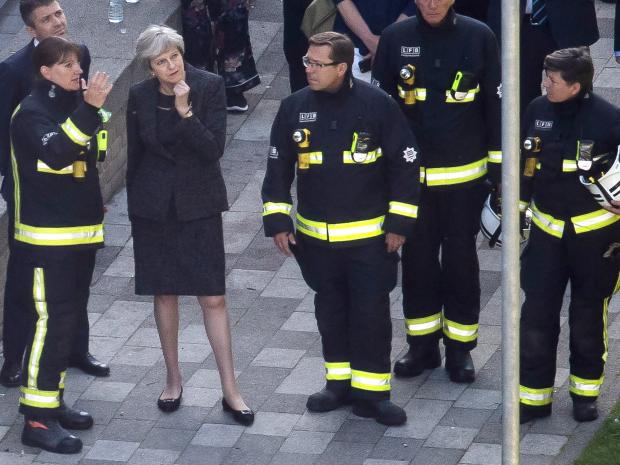
Theresa May - Grenfell Tower fire - London Fire Brigade

Not the “Princess Diana Effect”

Sadly, Brendan O’Neill has jumped on the Theresa May apologist bandwagon, mocking the prime minister’s critics for supposedly demanding that she “perform” for us, wearing her emotions on her sleeve as she weeps with the survivors and bereaved relatives of the Grenfell Tower fire victims.

Apparently by criticising the prime minister’s slow, tone-deaf response to the tragedy and its aftermath we are behaving like a baying mob seeking emotional catharsis rather than concerned citizens with legitimate fears about the quality of leadership that Theresa May is providing. But this is to misunderstand the nature of the public anger directed at the prime minister, and assumes that the hard left socialist agitators who shout the loudest are somehow representative of all of May’s critics. They are not.

O’Neill writes:

Do people want Theresa May to weep in public? Allow herself to be pelted with rotten fruit? Make herself available for cries of “murderer” even though it’s ridiculous for her to be accused of murder? What if it isn’t in her nature to show her feelings to strangers — should she still do it? For the good of the nation? I’m finding this climate of emotional retribution quite ugly, I must say. The public’s urgent questions and anger over Grenfell are being channelled by some into a narrow, cartoonish anti-Toryism designed to hurt May and help Labour. To refight the General Election on the ruins of this building strikes me as a far more callous thing than May’s inability to emote for the cameras.

Ross Clark jumps to the same baseless and rather condescending conclusion (those silly plebs want to see emotion, but we enlightened people are above such base considerations as whether or not the prime minister can act like a real leader in public) over at the Spectator:

If she still hasn’t got the message, it is this:  you are expected, Mrs May, to go and blub before the cameras. You are expected to hug, to hold and say that you share everyone’s pain, that you will not rest until you can make sure that tragedies like this will never, ever be allowed to happen again. That you might have been working behind the scenes since Wednesday on an appropriate regulatory response to follow the disaster counts for nothing at all; it is just tears, please.

The idea that Theresa May is some kind of heartless creature who has not been affected by the Grenfell disaster is absurd. I have never met her, but it is quite clear from the look in her face that she is she is as shocked by the whole thing as we all are, one or two psychopaths aside. It is just that she has a very English facet of character which, until a couple of generations ago, was seen as an asset: she has an aversion to showing emotion in public.  

As a public figure in modern Britain, however, this will no longer do. What used to be called a stiff upper lip is now seen as fault, if not a disability which requires treatment. The new rules of emotional correctness demand not just that you care but that you can cry with the people.

This is asinine. I don’t think that any sane critic of Theresa May wants the prime minister to “weep in public” or “blub before the cameras”. That’s not what this is about. The problem is not Theresa May’s failure to behave like the most unhinged of Princess Diana mourners and rend her garments in front of the television cameras. The problem is her complete and utter failure to lead, at least according to any modern definition of leadership in the age of television and social media.

Would Theresa May have been subjected to angry, painful and politically awkward scenes had she gone to meet the survivors and volunteer disaster relief workers in public, the day following the fire? Of course. But as a leader, you suck it up. Even if the people heckle, you show up and let the victims of Britain’s worst fire since the Second World War know that their plight and their concerns are receiving the direct and personal attention of the head of government.

It isn’t that a prime ministerial visit would make much of a tangible difference to the relief efforts. But the visual would have been very powerful, and that counts for a lot when it comes to public sentiment. I wrote the other day of examples of politicians in America mucking in and helping with disaster recovery efforts as a means of showing solidarity and giving the appearance of engagement. Neglecting to do so, and then only relenting a day later and agreeing to meet the affected people in tightly controlled circumstances, away from the television cameras, is a failure of leadership plain and simple.

That’s why Theresa May has to go. Either she doesn’t realise that her behaviour has consistently fallen short of the standards expected of a 21st century leader, or she does realise but is incapable of improving her performance. And unfortunately, Brendan O’Neill has conflated his justified distaste with the way that left-wing agitators from Jeremy Corbyn on downwards have sought to exploit the tragedy for political gain with the erroneous idea that Theresa May’s lacklustre response to the crisis (and leadership in general) should therefore be immune from criticism. It shouldn’t.

Is there a cartoonish anti-Tory sentiment out there? Absolutely. I have been writing about it and criticising the left’s reduction of conservatives to two-dimensional cartoon villains more or less constantly since I started this blog in 2012. And are many of the hysterical accusations being hurled at Theresa May completely outlandish and hysterical? Yes, of course they are. But Theresa May has also opened herself to vociferous and fully justified criticism thanks entirely to her astonishing failure to lead or carry out the basic entry-level requirements of a modern head of government.

This is not the same as demanding that Theresa May “performs” or emotes for us, or leads us in some kind of cathartic national therapy session. This is about demanding that the prime minister either steps up and acts like a leader, or quits the field so that somebody else can do the job.

As a country we are drifting at the present time, and Theresa May bears the overwhelming share of responsibility for this fact. Acknowledging this fact and holding the prime minister to account for her repeated abdication of leadership does not mean validating the separate, cynical attacks of the hard left.

On the contrary, it is our duty to demand strong and effective leadership, and to refuse to settle for Theresa May’s pitiful approximation of the same.


Theresa May - Downing Street

Support Semi-Partisan Politics with a one-time or recurring donation:

Agree with this article? Violently disagree? Scroll down to leave a comment.

Follow Semi-Partisan Politics on TwitterFacebook and Medium.