Vote Leave: An Unhinged Fifth Column, Leading Brexiteers To Ruin

It’s time to declare open warfare on the malevolent idiots in charge of Vote Leave, if we are to minimise the further harm that they can yet inflict on the Brexit cause

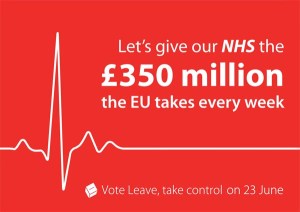
Apparently the super-intelligent, well-connected, savvy people running the Vote Leave campaign think that this political broadcast, which aired today on national television, is a key part of some winning strategy to deliver 50%+1 votes on 23 June.

It certainly has a lot going on. There’s the slavish idolatry of “Our NHS” for a start, which actually might not be a bad tactic in NHS-obsessed Britain but for the fact that the Vote Leave campaign is mostly full of Tory types who didn’t exactly make a name for themselves by protesting their local A&E unit closure or otherwise worshipping at the altar of St. Aneurin Bevan of Tredegar. In other words, it strains credibility to think that Boris Johnson & co are fighting for Brexit because they are desperate to shower the health service with more money.

Ah yes, money. Then we see the flagrant, unapologetic repetition of the false £350 million claim, a number which does not take into account the UK rebate or EU funds disbursed back to Britain. Quite why the more accurate figure of £161 million could not be used is a mystery – perhaps because £350 sounded like a nice round number, and because it conveniently tallied with the cost of building a new hospital. And so the official Leave campaign goes charging into the last month of the referendum waving a headline figure which can be instantly disproved and mocked by any Remain campaigner with a functional brain, tarring the entire Brexit movement with their shameful idiocy.

I cannot stress this firmly enough – at this point, Vote Leave may just as well be part of the Remain campaign. They are essentially operating as a fifth column, actively doing more harm than good. They are wasting precious time and resources simply to ensure that their heavily eurosceptic base vote for Brexit even more emphatically than they already planned on doing, while appearing so shifty and unserious to undecided voters that they destroy our credibility – and with it, our chance of winning.

Therefore, the next month must be spent firing over, around and through Vote Leave. They are not our allies. They may as well be working for David Cameron and George Osborne. In fact, some of them quite possibly are doing just that.

At this late stage, Vote Leave will do nothing other than continue to burble unbelievable nonsense about building a brand new hospital on every street corner in Britain in their fantasy Brexit world; there is nothing we can do about that. But we are not powerless.

We need to go out there and talk about sovereignty and democracy.

We need to talk about the unappealing, authoritarian future of the EU.

We need to talk about the revolution in regulation and the emerging global single market, in which a free Britain can play a leading role.

But most of all, we need to get out there and do something, anything, to distract from the utter FREAK SHOW of an official Leave campaign being orchestrated by BoJo the Clown and his trusty sidekicks.

Glad as I am that they all seem to be having a roaringly fun time on the campaign trail, allowing the children to take the wheel unfortunately means that they are now running over the life’s work and dreams of many a committed eurosceptic and Brexiteer.

And they can not, must not be allowed to continue unchecked.


Postscript: This ad is even more idiotic. The cretin who put it together failed even to draw a link between the subject (possible future Turkish membership of the EU) and the conclusion (vote Leave to Save Our NHS), ensuring that the spot ends with that grating non sequitur. It’s almost as though the entire operation is staffed by not-very-bright nepotism beneficiaries and Westminster hangers-on…


Apparently the only reason now for wanting Brexit is to “Save Our NHS”. When did that happen? And when will the person who signed off on this strategy be made accountable for their utter incompetence?


Vote Leave - NHS 350 Million - Brexit

European Union - United Kingdom - Britain - Flags

Agree with this article? Violently disagree? Scroll down to leave a comment.

Follow Semi-Partisan Politics on TwitterFacebook and Medium.

Nonexistent Shared Christian Values Are No Justification For The EU’s Existence

Francis Campbell - Reimagining Europe

The latest feeble Christian case for remaining in the EU: “Let’s forge a meaningful common European identity based on the fluffiest and least well defined parts of our faith!”

More hand-wringing waffle from the Reimagining Europe blog, this time from regular contributor and former British diplomat Francis Campbell:

Whatever the outcome of the UK referendum in June, there will be equally important questions for EU leaders in the years ahead. The process of Britain’s renegotiation has led many to consider their own national identity and how it fits within the identity of the European Union. With a rising tide of Euroscepticism in countries across the continent, the challenge for Europe’s leaders is to instil a sense of European values which enhance rather than threaten national and regional identities.

Right-o. The challenge apparently is not to question whether the decision to unite the countries of Europe under a single supra-national government was a smart idea in the first place. No, the challenge is simply to do a quick PR job, to “instil a sense of European values” and force the restive people of Europe to come to terms with this government that has been designed for them, without their input or their permission.

Campbell at no point questions the wisdom of the project to establish a supranational government of Europe in the first place, taking its existence and benefits as a given despite the current referendum offering a once-in-a-generation opportunity to question old assumptions and break out of stale ways of thinking.

But Campbell has no interest in doing any of this – he is concerned that the EU try to “build bridges” with its citizens, even though the EU project was largely created behind their backs and without their permission. Saying that the EU needs to build bridges with those it has the nerve to call its citizens is like saying that a robber should be polite and avoid leaving a mess while they ransack your house – when the real issue, of course, is that they have no business walking off with your DVD player in the first place.

We are then treated to more of the same woolly, vague and undefined hand-wringing ecumenism which sadly typifies too much of the church’s response to the EU referendum debate. Campbell writes:

In such a context the EU’s task of building bridges between citizens is a daunting one. But perhaps there is an opportunity in the current crisis for EU member states to identify common interests and shared values in among the obvious cultural differences across Europe.

One powerful shared value that is missing from the negotiation tables in Brussels is religion. Faith plays a huge part in the lives of many millions of EU citizens, yet it has been all but barred from the political arena. Whether they profess to have a faith or not, political leaders should look to religion for inspiration when forging the future identity of the EU.

Christianity is arguably something that is common to all European member states and a potential value or source of identity around which they could unite. But how do we reconcile that sense of shared identity and history with those of other faiths or none?

Catholicism, and indeed all major faiths, teaches us to believe in the intrinsic dignity of every human person. If we can look beyond our differences and guard our national interests less jealously, every EU citizen has shared values and a common identity and a commitment to live within and promote a shared pluralist space.

Okay, but how does that translate into the necessity for a powerful and activist supra-national government to sit above the nation states, claiming exclusive competency in a wide array of areas to speak and act on behalf of a group of people as diverse as Brits, Germans, Poles and Greeks?

The answer, of course, is that it doesn’t. Campbell’s background is in the Foreign Office – including a number of postings to the European Union – so he of all people should understand at least the basic history of how and why the EU came to be and took its present form. Is such a complex and inherently antidemocratic structure in any way necessary to express whatever limited sense of European-ness which may exist in our hearts and minds? Of course not, and Campbell knows it. The only reason you create an organisation with institutions mirroring those of a nation state and staffed with people who constantly agitate for more power and competencies is because you ultimately want the new organisation to be an independent actor on the world stage, replacing the nation states from which it was built.

Of course we all share a common humanity, that much is self-evident. But the sheer disingenuousness required to make the huge leap between all of us believing in the dignity of human life and all of us wanting or needing to be governed by the same common set of institutions in Brussels is simply staggering. And hardly Christian.

Trying to shoehorn Christianity in to fill the spiritual and democratic void at the heart of the European Union also brazenly overlooks the rapid growth of secularism, particularly in Western Europe. If Campbell is seriously suggesting that the EU base its social law on the values of the Roman Catholic Church, as would no doubt be popular in much of Poland, how does he think it will go down in France, Germany and Britain?

And if we attempt to base European values partly on other assertively growing faiths (i.e. Islam), what will then be the consequences for fundamental rights such as freedom of speech? And if this isn’t what Campbell means, then what exactly is his suggestion, than more hand-wringing, morally relativist waffle from the Christian Left?

Pete North hammers this point home in a recent blog post on European disunion:

We are persistently told that Eastern European countries are just chomping at the bit for Western liberalism and that is the justification for root and branch social reforms at the behest of the EU. Anyone who objects is clearly regressive in their eyes. Except the problem with EU foreign policy is that EU elites speak only to other political elites who tell them what they want to hear.

But as with the UK the metropolitan view is somewhat different to the provincial view which is seldom ever heard. It’s all very well demanding sweeping reforms but this rather forgets the lessons we learned in the UK. All economic and social reform has casualties and too much too soon creates resentment that lasts generations. That is why the Tories still can’t win seats in parts of Yorkshire and the North East.

Now apply that same revolutionary industrial reform to Poland and Ukraine while demanding social reforms that do not sit well with the catholic population. Attitudes are nearly thirty years behind in some regions. Try being an unmarried mum in rural Poland. Even today there are still objections in Ireland to reforms to abortion laws. That goes double for Eastern Europe.

So Francis Campbell’s bright idea to base our perpetually missing common European identity on Christianity or religion is clearly a dud. As the Anglican church has discovered, there is such wide and irreconcilable difference between its own traditionalist and progressive wings that some people find themselves unable to remain part of the same congregation or communion. And that’s just one branch of Christianity! How, then, is forming the kind of robust, multi-layered identity required to legitimise a powerful supranational government going to be possible merely by reeling off a few bland pronouncements about Christian “values” and the dignity of human life?

In short, this is exactly the kind of desperately small, unimaginative thinking which is responsible for so much of Britain’s current democratic malaise. When presented with an historic opportunity to look again at European and global systems of governance and regulation, all that Francis Campbell can do is propose minor tweaks to the status quo – tweaks which in his heart of hearts he must realise are empty words which will make no discernible impact in bridging the gap between an increasingly powerful, unloved European Union and the citizens of its member states.

And this is why Brexit must be more than an event – it must be just part of a larger process of democratic renewal and reform of our governance. There is precisely zero point in reclaiming powers and competencies from Brussels through Brexit if we are only to give them back to a government and Foreign Office staffed by rent-a-bureaucrats, who have the “vision” only to ploddingly execute the instructions placed in front of them, and will probably end up giving power away again to someone else in exchange for a few magic beans.

Francis Campbell, like too many other prominent Christian EU apologists, begins from the lazy and unsupported starting point that the European Union is inherently good, virtuous and necessary, without so much as examining its history or asking why similar structures have not developed in other part of the world. The brain then only truly engages when considering how the people might be better made to realise all of the wonderful good being done on their behalf, at which point we get lots of flowery language about shared Christian values but no intellectual meat on the bones. And the analysis is worthless anyway, because the initial assumptions were flawed from the start – the EU is not inherently good, virtuous or necessary.

So still we wait for that most elusive of things – a structured, intellectual Christian case for the European Union, and for Britain remaining in the EU. Many have stepped forward to try, but none (to my knowledge) have yet succeeded. Some have made themselves look quite silly in the process.

And time is running out.


Christianity - Europe - EU - Brexit

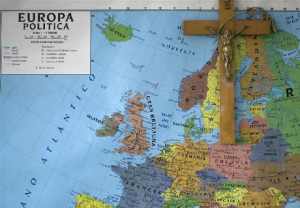
Top Image: Times Higher Education

Agree with this article? Violently disagree? Scroll down to leave a comment.

Follow Semi-Partisan Politics on TwitterFacebook and Medium.

One Month Until EU Referendum Day. Time To Break Out The Rudyard Kipling

The unforgiving minute approaches

At the conclusion of The Leave Alliance’s recent highly successful TED-style talk, in which Dr. Richard North walked through the Flexcit staged plan for leaving the EU, a number of the alliance’s Bloggers Army and other audience members stayed behind afterwards to explain their own reasons for voting Leave on 23 June.

Here are a selection of those reasons – including a contribution from yours truly.

The Leave Alliance is comprised of a diverse group of people from across the political spectrum, some who have been devoted to this cause for decades and others for whom it is a much more recent obsession.

I have the honour of fighting the EU referendum campaign alongside this excellent group of people – a group which comprises Dr. Richard North, surely the foremost authority on the European Union in Britain, Pete North, a writer of very rare ability, the Bloggers’ Army, whose various research and writing talents all far eclipse my own, and our very generous readers and supporters. It is a singular honour to be associated with them all, and to make even a small contribution toward our common goal.

Things are not looking good for the Brexit cause right now. The list of unforced errors, media howlers and general acts of incompetence committed by the oh so politically savvy leaders of the official Vote Leave campaign grows by the day. By clinging stubbornly to disproven statistics and flat-out false arguments, Vote Leave squander credibility faster than we can possibly hope to win it back. Indeed, fighting this EU referendum with the likes of Boris Johnson as a figurehead for the Brexit cause is like trying to swim the English Channel with a ball and chain clamped to one’s ankle – strive though we might, we are inevitably dragged down beneath the waves.

It should be noted that nearly every single one of the official Leave campaign’s missteps and key points of criticism could have been avoided by heeding the advice of The Leave Alliance – not least in terms of the importance of having a robust Brexit plan to lay before serious opinion-formers and influencers.

But we fight on, and we fight to win. Though the path to victory for the Leave side is now very narrow indeed – essentially resting on significant unforced errors from the Remain campaign or major external political shocks, as this blog now argues – we must continue to make the bold, globally-engaged case for Brexit, and stand ready to quickly capitalise on any good fortune which comes our way.

This blog will be working flat out for the next month to achieve the impossible and secure a vote for Brexit in the referendum on 23 June. David Cameron managed to say one true thing during his round of media appearances this weekend – that this referendum campaign is indeed more important than a general election. And so it is. It therefore demands the best of all our abilities.

In his famous poem, “If”, Rudyard Kipling wrote of filling the unforgiving minute with sixty seconds’ worth of distance run. Well, the final month ahead of us between now and Referendum Day will certainly be unforgiving. We are behind in the polls, we have nearly the entire political and cultural establishment ranged against us screaming hysterically that Brexit would somehow usher in the apocalypse, and the man generally recognised as the figurehead of our movement is, for all intents and purposes, a malevolent lunatic.

So – that should make eventual victory having overcome these challenges all the sweeter, no? We at least owe it to ourselves to try, to work tirelessly for victory but also pragmatically so that we are positioned to turn a bad result into the best possible starting point for our next attempt. And when we feel despondent, let’s remember that these are not ordinary political times. One year ago, who would have said that Jeremy Corbyn would be leader of the Labour Party, or that Donald Trump would be the presumptive Republican Party presidential nominee?

So let’s fill the unforgiving minute. Let’s leave it all on the field, as the Americans say – or on the pitch, if we’re being particularly British.

Who’s with me?


While normally it might be considered unbearably trite to quote Kipling, a close reading reveals that in fact there is barely a line which is not highly applicable to those of us struggling to voice a thinking person’s Brexit message in the hurricane of the national referendum debate. And so:


If —

IF you can keep your head when all about you
Are losing theirs and blaming it on you,
If you can trust yourself when all men doubt you,
But make allowance for their doubting too;
If you can wait and not be tired by waiting,
Or being lied about, don’t deal in lies,
Or being hated, don’t give way to hating,
And yet don’t look too good, nor talk too wise:

If you can dream – and not make dreams your master;
If you can think – and not make thoughts your aim;
If you can meet with Triumph and Disaster
And treat those two impostors just the same;
If you can bear to hear the truth you’ve spoken
Twisted by knaves to make a trap for fools,
Or watch the things you gave your life to, broken,
And stoop and build ’em up with worn-out tools:

If you can make one heap of all your winnings
And risk it on one turn of pitch-and-toss,
And lose, and start again at your beginnings
And never breathe a word about your loss;
If you can force your heart and nerve and sinew
To serve your turn long after they are gone,
And so hold on when there is nothing in you
Except the Will which says to them: ‘Hold on!’

If you can talk with crowds and keep your virtue,
Or walk with Kings – nor lose the common touch,
if neither foes nor loving friends can hurt you,
If all men count with you, but none too much;
If you can fill the unforgiving minute
With sixty seconds’ worth of distance run,
Yours is the Earth and everything that’s in it,
And – which is more – you’ll be a Man, my son!


European Union - United Kingdom - Britain - Flags

The Leave Alliance - Flexcit

Support Semi-Partisan Politics with a one-time or recurring donation:

Agree with this article? Violently disagree? Scroll down to leave a comment.

Follow Semi-Partisan Politics on TwitterFacebook and Medium.

Where Is The Serious Christian Case For Remaining In The European Union?

Bishops - Catholic Church - Church of England - Brexit - EU Referendum - European Union

Friendship, cooperation and overblown claims about the EU keeping the peace in Europe do not amount to robust Christian arguments for staying shackled to the European Union

When the Church of England-sponsored Reimagining Europe blog launched last year, I was vaguely hopeful that it might lead to some fruitful discussion about the real Christian case for or against Brexit. Not just the kind of woolly left-wing platitudes which many bishops excel at delivering, but a real granular theological case for why Britain should either remain in the European Union or vote Leave to regain our independence.

Fast forward seven months and the promise of Reimagining Europe remains largely unfulfilled. The only really decent arguments have been those guest posts from Adrian Hilton of the Archbishop Cranmer blog, which have effectively demolished the laziest of the Christian cases for staying in the EU. There have been a few other decent commentaries and a large number of hand-wringing prevarications, but as far as I can tell not one unambiguously argued Christian case for Remain.

This recent blog entry by Guy Brandon is typical of the output in this regard:

At the same time, placing national identity above our identity in Christ should raise a warning flag. Our own legal system might be underpinned by biblical foundations and Christian heritage, but it is not God-given. Sovereignty should not be absolutised, whether the issue is approached from a practical or spiritual direction.

The question mirrors, on the national scale, our view of our own personal autonomy. To what extent do we see ourselves as the architects of our own destiny? We all make personal compromises in the interests of living together. As Freud remarked, ‘civilisation is built on the renunciation of instinct’. For the Christian, there is the added dimension that we have been purchased by Christ’s death (1 Corinthians 6:19-20) and are free – not to do anything we choose, but to ‘serve one another in love’ (Galatians 5:13-15)

So, should we give up a degree of national autonomy in the interests of the common good? As ever, the question is not cut-and-dried. There may be benefits we enjoy, such as guarantees around freedom of religion, which we would no longer have if we withdrew from the EU. Christians might contemplate the risks of withdrawing from such protections, as well as the attractions of being masters of our own destiny.

Immediately there are red flags that this is not a serious analysis, or even reflection.

For a start, the author takes it as a given that the European Union is the “common good”, against which national autonomy is perpetually placed in opposition. But why the European Union (with its dogmatic insistence on representing 28 countries with a single voice of compromise) is in the common good is never explained – and not just in this piece. Over and over again in Christian ruminations on the European Union, the most fundamental europhile assumptions are accepted as Gospel. Of course the European Union represents the common good.

Then we get the old workhorse about the EU guaranteeing freedom of religion, which is problematic in a number of ways. Firstly, it is profoundly antidemocratic in claiming that the British people should have rights imposed on them by others. Of course we should all have freedom of (and from) religion, but we the British people should establish and maintain this right for ourselves – ideally through a written constitution.

The same goes for workers’ rights, which are forever held up by the Remain camp as a scaremongering warning that if we leave the EU, it will be back to seven day working weeks and young children going up the chimneys to earn their keep. Why are so many self-professed Christians so happy for our most fundamental rights to be imposed on us from above, rather than arising organically as the democratic expression of our own hearts and minds?

Christianity - Europe - EU - Brexit - 3


The Catholic Herald’s recent review of church attitudes toward the EU also reveals an excess of woolly thinking at the top:

Cardinal Nichols is also fervently pro-EU, but his support for it has a less Roman flavour. He is, as I remember from his days as general secretary of the Bishops’ Conference, a man who works through committees and relishes bureaucratic procedure.

His politics bear the stamp of his Liverpudlian upbringing. He favours public expenditure over private enterprise; his speeches employ the vocabulary of the state sector. It’s hard to think of a bishop less in sympathy with Eton-educated Catholic Tory Brexiteers such as Charles Moore and Jacob Rees-Mogg.

The Nichols philosophy embraces the dirigism of Brussels; in this he is typical of the moderate British Left, which changed its mind about the Common Market after Jacques Delors persuaded it that Europe was an indispensable ally against “free-market fundamentalism”.

One suspects that Cardinal Nichols would admire the modus operandi of the European Union even if it had no association with the Church. The same could be said of many bishops of England and Wales.

This instinct to remain in the EU is borne out of fear of change and bureaucratic preference, which are understandable human emotions but about as far as one can get from being sound justification for continuing with the current mode of supranational European government.

As this blog recently concluded:

As a Catholic eurosceptic, it is frustrating to witness so many fellow Christians accepting the pro-EU, pro-Remain position almost by default, without actually engaging their brains or making considered reference to their faith. I’m no theologian myself, but I’ve read my Bible and I know that the New Testament offers little by way of clear instruction or even guidance as to how any entities larger than individuals and faith groups should organise or govern themselves, while much of the Old Testament reads as a “how not to do statecraft” manual.

If we restrict ourselves then to the teachings of Jesus, from where do Christian EU apologists draw their inspiration? The EU is not a democratic entity, nor is it likely to become one any time soon. What is so Christian about defending an organisation which insulates a continent’s leaders from the practical and political consequences of their rule? What is so Christian about sticking one’s fingers in one’s ears and loudly repeating the mantra “the EU is about peace and cooperation, the EU is about peace and cooperation”, while ignoring the known history of European political union and disregarding the fact that fruitful inter-governmental cooperation could take place just as well outside the EU’s supra-national structure?

[..]

Regrettably, I have come to the conclusion that much of the Christian case for Remain rests either on a lazy “agree with the Left by default” mindset, or the desire to virtue-signal generally “progressive” values across the board. I will be happy to be proven wrong, and to be presented with a serious Christian case for the EU based on the argument that staying part of a supranational political union unreplicated in any other part of the world is 1) what Jesus would do, or 2) what is best for Christians in Europe. But I’m not holding out much hope.

And if that’s what this is really about – cheering on the EU because it signals that one holds the “correct” progressive opinions in other areas – then they picked a really lousy time to do it. Our politics is suffering a crisis of legitimacy, and yet many in the Church have taken the decision to cheer on the one entity which best represents the interests of a narrow European elite overriding the interests of ordinary people.

In short, I have yet to see a Christian case for Remain that consists of anything other than woolly, tenuous and unsubstantiated assertions that the EU equals being friendly and co-operating with our neighbours (which, unlike the countries of every other continent in the world, can for some reason only be accomplished in Europe through a supra-national government), and that if we vote to Leave we will essentially be voting for war and the stripping away of religious freedom.

Well I’m sorry, but that facile level of argument is not good enough. I’m still waiting for serious theologians or senior figures in the Church hierarchy to put forward one good reason why Jesus would favour Britain’s participation in a remote and antidemocratic-by-design government of Europe.

If staying in the EU is so goshdarn godly, let’s hear why, without recourse to the fluffy, prevaricating jargon about ecumenism and friendship which Christian EU apologists tend to deploy like chaff to distract us from the paucity of their argument. And let them explain too why they are so desperate for continued political union in Europe, yet utterly blasé about the fact that Asia, Australasia and the Americas get by just fine without such a union.

There is a fight for self-determination and democracy underway right now, and far too many voices within the church are coming down on entirely the wrong side. Those who stay silent or openly advocate for Remain will justifiably find themselves on the hook and personally implicated in every future crisis which befalls the EU, and will bear some responsibility for each incremental unit of economic and political suffering experienced by Britain as a continent glued together by unwanted, inflexible political union slowly begins to rip itself apart.

The clock is ticking, and there is little time left for Christian Remainers to defend or amend their position before they go on to face the judgement of history.


Christianity - Europe - EU - Brexit

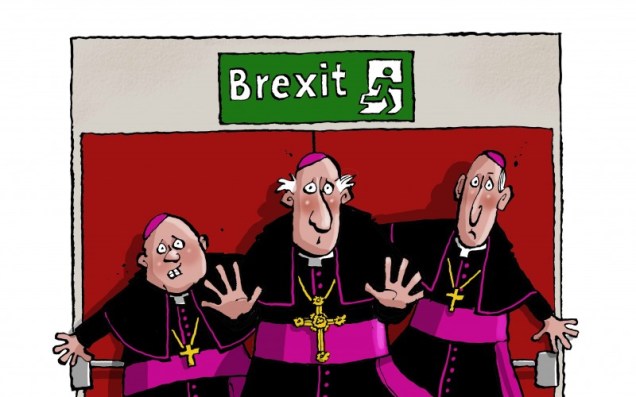
Top Cartoon: Christian Adams, Catholic Herald

Agree with this article? Violently disagree? Scroll down to leave a comment.

Follow Semi-Partisan Politics on TwitterFacebook and Medium.

The Narrowing Path To Victory For Brexit Supporters

George Osborne - Ed Balls - Vince Cable - RyanAir - Brexit - EU Referendum - Establishment - Coke Zero Conservatism

A big external shock or a rising tide of anti-establishment rage are now the only remaining paths to victory for the poorly-led Brexit campaign

Getting a majority of Britons to vote to leave the European Union – particularly in so compressed a time frame, with the entire establishment chorus raised in unison against us – was always going to be very much a long shot. That much is obvious; asking people to vote against the established status quo is always very difficult, and despite having spent years flaunting their euroscepticism in public, it quickly became clear that many of the “big hitters” had given almost no thought as to what Britain’s future outside the EU should look like.

How different things could be if only the official Leave campaign had…oh, I don’t know, some kind of Brexit plan – not just familiar recitations of everything that is wrong with the EU, but an actual positive alternative vision for Britain, rooted in fact and probability rather than idle conjecture. But the shining ones in charge of Vote Leave and Leave.EU saw no need for a stinkin’ plan, preferring to paint with childishly broad brushstrokes their half-baked vision of buccaneering Britain negotiating and signing tens of trade deals a year, while the EU falls over itself to give us all the benefits of single market access at no cost (because the Germans like selling us their cars, don’t you know?)

Or as Pete North puts it:

From the outset you need to stress test your message. It has to be the words of winners. Eurosceptics bleat on about going global but it’s empty when you contrast it with the rest of their message which is outright hostile to global engagement. Again, it fails the credibility test.

I’ve said it time and again, but simply whingeing about the EU doesn’t work. Very few people like the EU, but they need a seriously good reason to take a risk – and that means you have to have a safe and desirable alternative. Oh, and a plan to get there. Vote Leave’s approach is to pretend there are magic wands to instant prosperity. Rather than seeking experts they sought people who will tell them what they like to hear. The Westminster bubble all over. They are going to lose and they will deserve it.

And so, with an uphill battle on their hands, the official Leave campaign has done almost nothing to improve their chances of victory, preferring to fire up the base and exalt in their lack of a Brexit plan rather than make a concerted effort to win over the undecided. And we are now rapidly approaching the point where all straightforward paths to victory are closed to the eurosceptics. Privately, David Cameron’s team expect to win with as much as 58% of the vote, and it increasingly appears that the only thing which might decisively change the Leave campaign’s fortunes is a big external shock – a flareup of the migrant crisis, a badly timed EU power play or a domestic political scandal, for example.

But why, besides the obvious ineptitude of the official Leave campaign, is it proving so hard to win over the undecided? It certainly doesn’t help that the arguments for remaining in the EU tend to be simplistic and fear-based*, while those in favour of Brexit (at least the thinking person’s version of Brexit) are more nuanced and complex. Among those who are not already die-hard eurosceptics, the push factor away from the EU can only take root when one has a basic grasp of the EU’s history and workings, while the pull factor toward an outward-looking, globally engaged Britain requires an understanding of the changing global trade and regulatory environment which the mainstream media utterly fails to provide (because they themselves do not understand it either).

(* Here I discount the genuine euro-federalist argument, which is perfectly legitimate but almost never heard in Britain because it is so distasteful to the majority.)

When Remainers crow that most major organisations from the IMF to large corporations want Britain to remain in the EU it superficially sounds like a slam-dunk case for staying, until one realises that most of the organisations held up by the Remain campaign are duty bound to minimise the risk (however small) of economic disruption, but have absolutely no mandate whatsoever when it comes to protecting and preserving democracy.

The CEO of a large corporation is accountable to the board and shareholders for the financial performance of their firm – often, it should be pointed out, with an unhealthy emphasis on the short term. CEOs have no legal responsibility to make public pronouncements about what is best for Britain’s democracy – the ability of British citizens to exercise meaningful control over the decisions and policies affecting their lives. And they certainly do not forfeit their bonuses when political engagement and voter turnout falls as people increasingly realise that it doesn’t much matter which party holds the majority in Westminster.

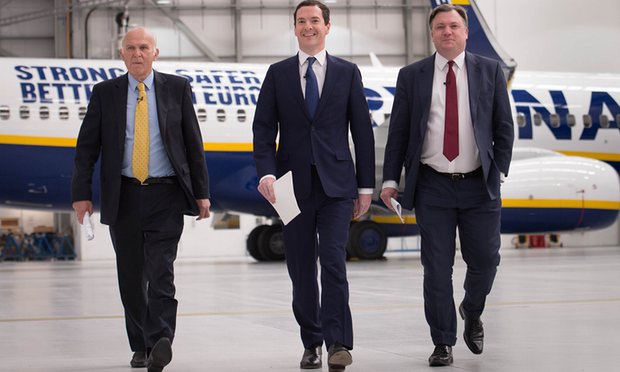
Were it not so depressing, it would be amusing watching Remain campaigners, particularly those on the Left, eagerly lap up every word uttered by the voices of big business – people whom they otherwise utterly distrust and openly despise, but whose statements that Britain should remain in the EU are accepted gratefully and unquestioningly because they confirm all of the existing biases of the EU apologists. Enjoy it while it lasts, because you are never again likely to hear Ryanair and the Labour Party press office singing so lustily from the same hymn sheet.

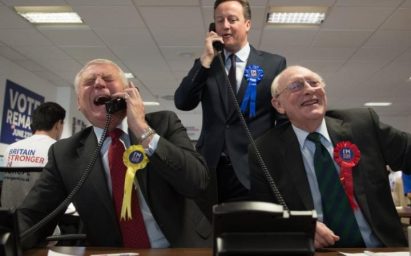
David Cameron - Neil Kinnock - Paddy Ashdown - Stronger In - EU Referendum - Brexit

But if, as expected, we go on to lose the referendum by a sizeable margin, our only remaining hope will be that the victorious David Cameron acts in as smug and condescending a way as he did in the aftermath of the Scottish independence referendum. Counterintuitively, this is when we need the prime minister to be at his arrogant best – to claim that the issue is settled for a lifetime and then swan around taking his gruesome victory lap and talking overexcitedly about how Britain will play a leading role in his mythically reformed European Union.

In other words, we need the prime minister to do everything in his considerable power to mock and belittle us if Remain carry the day, because this will add much needed fuel to the eurosceptic movement, light a fire under the the referendum post-mortem (Pete North is already talking about Nuremberg trials for those Brexit big beasts who did the most to let the side down) and hopefully result in a post-defeat surge in support like the one enjoyed by the SNP last year.

And there is every chance that this will happen – David Cameron has a big ego and a thin skin, and his political radar often deserts him when he gets emotional. Sadly, this may now be our best hope – to keep the margin of defeat as small as possible, and then hope for (or indeed provoke) as many gaffes and missteps as possible from the victorious Remainers.

It bring no joy to report this state of affairs – clearly it would be far better if Leave were consistently ahead by 10 points in all the polls and on course for victory, even if it means winning on the back of a “Brexit plan” drawn in children’s crayon. The only consolation is that this blog increasingly believes that the EU is doomed one way or another, that within ten years or twenty it will disintegrate under the weight of its own paralysing indecision, internal contradictions and interminable one-way ratchet towards closer integration.

We would all like to spend the remainder of 2016 preparing for secession negotiations and pressing the government to adopt sensible stances – and we should continue to fight to win, right up to the end. This is the last negative word this blog will write about the Leave campaign until the referendum is over – at which point you will find me, gavel in hand, on the bench at Brexiteer Nuremberg.

But increasingly it seems that our immediate job on 24 June will be to keep the flame of liberty alive, ready for the next opportunity – if and when it comes. And if we are truly dedicated to the cause, we must now begin preparing for that eventuality, too.


European Union - United Kingdom - Britain - Flags

Top Image: Guardian

Agree with this article? Violently disagree? Scroll down to leave a comment.

Follow Semi-Partisan Politics on TwitterFacebook and Medium.